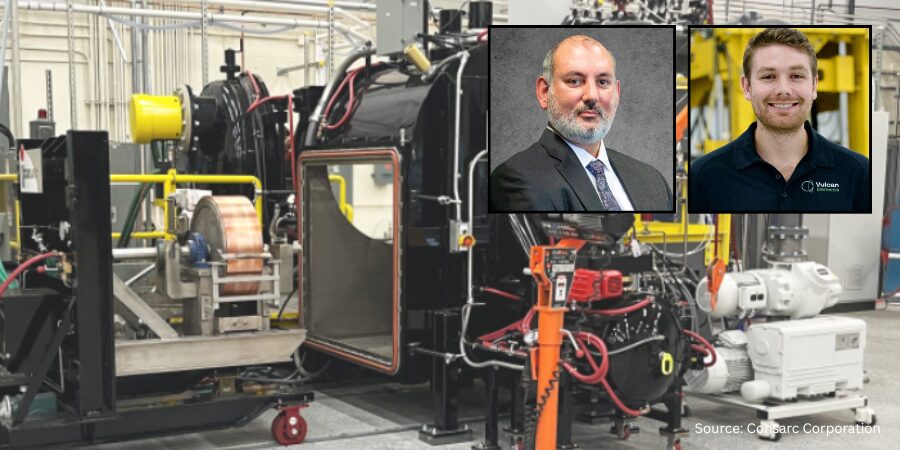
A vacuum induction melting strip casting furnace (VIM-SC) was commissioned for a manufacturer in North Carolina.
Consarc Corporation and Vulcan Elements announced the commissioning and delivery of the furnace at Vulcan Elements’ new facility in North Carolina’s Research Triangle Park. The collaboration marks a significant milestone in the effort to re-shore rare earth magnet production and strengthen supply chain resilience.
Source: Consarc
This furnace enables the rapid solidification of Neodymium Iron Boron (NdFeB) alloys—critical materials for high-performance magnets used in electric vehicles, defense systems, wind turbines, and advanced electronics.
Jai Narayan President Consarc Corporation Source: Linkedin
“Consarc is proud to play a vital role in reestablishing America’s rare-earth magnet manufacturing base,” said Jai Narayan, president of Consarc Corporation.
John Maslin, chief executive officer of Vulcan Elements said, “Vulcan Elements’ mission is to onshore a secure, traceable, and transparent rare earth magnet supply chain…As demonstrated by this newly-commissioned strip casting furnace, Consarc is a core part of that ecosystem, and Vulcan Elements is committed to developing and galvanizing domestic equipment production.”
John Maslin CEO Vulcan Elements Source: Vulcan Elements
Press release is available in its original form here.
The Heat Treat Doctor® has returned to offer expert advice to Heat Treat Today readers and to answer your questions about heat treating, brazing, sintering, and other types of thermal treatments as well as questions on metallurgy, equipment, and process-related issues.
This informative piece was first released in Heat Treat Today’sJune 2025 Buyers Guide print edition.
As we talked about last month, stress relief is a controlled thermal process in which fabricated material (e.g., machined or welded) is reheated to a temperature below its lower critical temperature and then held at that temperature for a specified amount of time before being slowly cooled. Post weld heat treating (PWHT) is a good example. Let’s learn more.
Why PWHT After Welding?
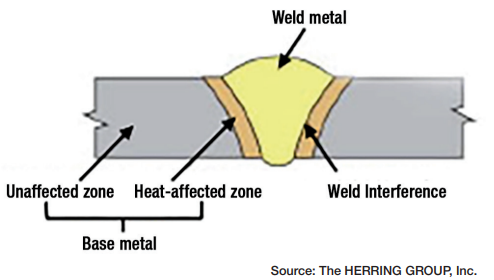
Thermally induced stresses are produced in the weld itself — in the heat-affected zone (HAZ) and in the adjacent base metal (Figure 1) — during welding and need to be relieved to avoid cracking and other modes of failures during final fabrication or service.
Figure 1. Areas of a typical weld
Purpose of PWHT
The primary purpose of PWHT is to help prevent welds in fabrications from cracking (i.e., becoming brittle). It also increases the resistance to stress corrosion cracking (SCC) and lowers the risk of hydrogen-assisted cracking (HAC) (i.e., hydrogen embrittlement) caused by high levels of hydrogen released during the welding process. PWHT can also act as a method of hardness control and enhance material strength.
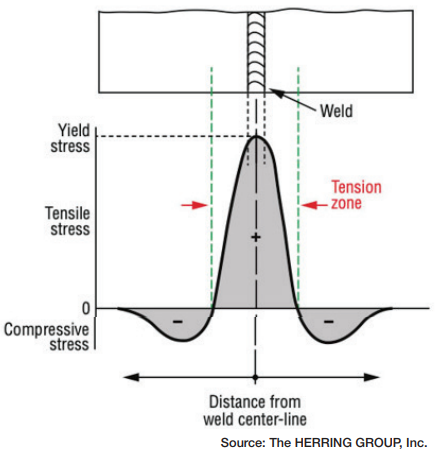
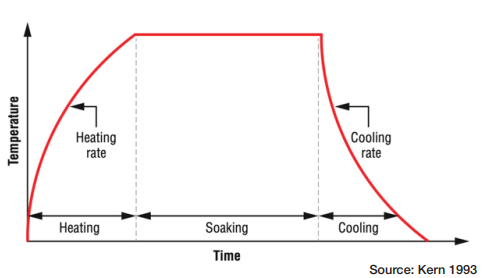
Figure 2. Typical residual stress profile in the weld and heat-affected zoneFigure 3. Typical PWHT thermal cycle
Residual stress present from welding may occur because of the high thermal gradients that develop during heating and cooling of the material. This is especially true during welding due to expansion of the material in some areas and localized contraction in other areas, resulting in the presence of surface tensile and compressive stresses (Figure 2).
These thermal changes produce undesirable residual stresses. PWHT reduces the intensity of these changes by heating the material (uniformly) to a specific temperature, holding at that temperature, and then bringing back to room temperature at a specific cooling rate (Figure 3).
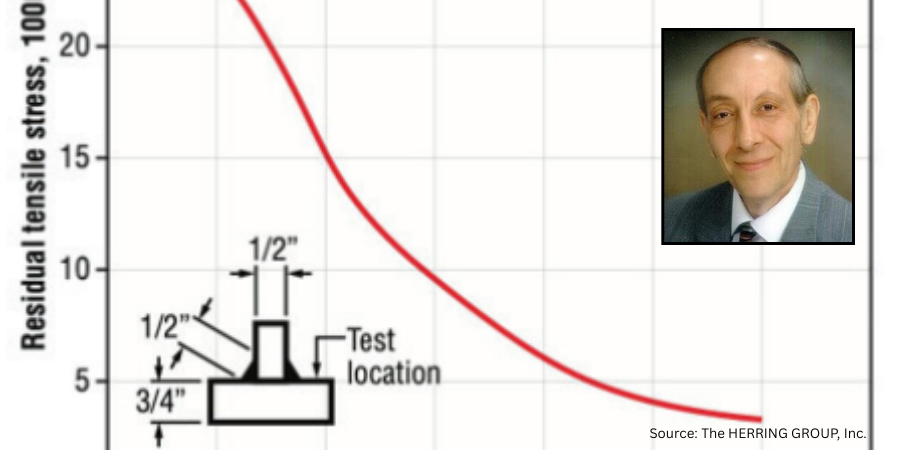
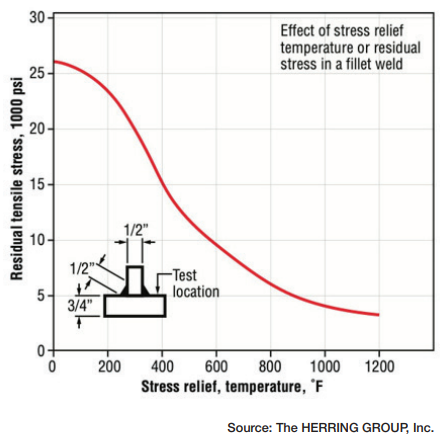
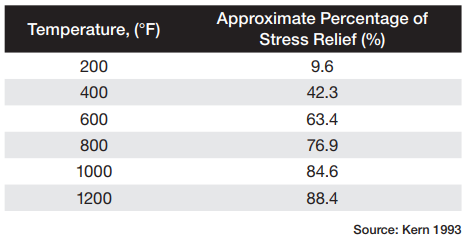
PWHT can be performed over a variety of temperature ranges: low temperatures (300 – 400°F), intermediate temperatures (900 – 1000ºF), or high temperatures (1110 – 1250°F). The temperature, time at temperature, and total cycle time determine the amount of stress that can be removed (Figure 4, Table 1).
Figure 4. Typical residual stress reduction as a function of PWHT temperature – graphical representationTable 1. Residual stress reduction as a function of PWHT temperature – tabular representation
Key PWHT Process Parameters
Key process parameters include adequate part support (remember, steels have lower yield strength at high temperature) and control of:
• Heating rate to avoid uneven thermal expansion
• Soak time to equalize temperature
• Temperature gradients to avoid hot spots from developing
• Cooling rate to avoid formation of brittle structures
What Steps Are Involved in PWHT?
Step 1: Heating
The rate of heating is typically based on the component’s thickness and often specified by the customer or company doing the work (internal standards). If the rate of heating is not performed properly (i.e., if heating is too quick or uneven), temperature gradients can form within the component and introduce undesirable thermal stress. As a result, stress cracks may occur, and residual stresses not previously present can develop when the component is cooled to ambient temperatures.
Step 2: Holding at Temperature (Soak Temperature and Time)
Soak time is governed by material thickness and part thickness. Longer holding times are needed for thicker materials to allow the material to reach a stable condition where the distribution and levels of stresses become more uniform and decrease. The specified holding temperature is one that is high enough to relieve the high residual stress state yet still below the lower critical temperature (Ac1).
Step 3: Cooling
The cooling rate must be controlled to avoid any detrimental temperature gradients that could cause cracking or introduce new residual stresses in the material during cooling. Rapid cooling rates can increase hardness, which may increase the susceptibility of a brittle fracture.
Additional Benefits of PWHT
Contact us with your Reader Feedback!
PWHT can result in other benefits, such as softening (tempering) of the component part. Tempering the part and the weld heat-affected zone provides protection against brittle fracture failures during service.
PWHT can also improve part machinability (for subsequent manufacturing operations). PWHT tends to (slightly) reduce the degree of hardness, so components can easily be machined to required dimensional tolerances. Softening parts allow for easy grinding, machining, and other surface treatments.
PWHT Tips
If necessary, PWHT can be performed multiple times without changing or diminishing the benefits of the process. PWHT may be repeated for power failures, loss of workload thermocouples, burner malfunctions, control instrument glitches, or furnace component failures.
More than one part can be subjected to PWHT at any one time. PWHT can be performed in different types of ovens and furnaces, with box or pit styles and carbottom styles being predominant choices due to the size of many weldments.
Process monitoring can be performed using workload thermocouples attached to the parts undergoing PWHT to check and ensure that heating rates, hold temperatures, and cooling rates meet specification requirements.
Summing Up
PWHT can be applied to both ferrous and non-ferrous alloys and is intended primarily to remove internal residual stresses generated by prior manufacturing processes. Without it, subsequent processing may give rise to unacceptable distortion and/or the parts can suffer from a variety of service-related problems. The treatment is not intended to produce significant dimensional changes (although this can occur) or alter the material’s microstructure or mechanical properties.
References
Ahmed, Khaleel, and J Krishan. “Post-Weld Heat Treatment – Case Studies,” BARC Newsletter, pp. 111-115. 2002.
“An Overview of Stress Relief & Heat Treatment Processes.” DBI, Inc. https://www.dbindt.com.
BorTec GmbH & Co. KG. https://www.bortec.de/en.
Olson, D. L., G. R. Edwards, S. Liu, and T. A. Siewart. ASM Handbook. 10th ed. Vol. 6: Welding, Brazing, and Soldering. ASM International, 1993.
Bryson, William E. Heat Treatment – Master Control Manual. Hanser, 2015.
Croft, D N. Heat Treatment of Welded Steel Structures. Woodhead Publishing Limited eBooks, 1996. https://doi.org/10.1533/9781845698812.
“Heat Treatment of Welded Joints – Parts 1–3.” TWI Global. https://www.twi-global.com.
Herring, Daniel H. Atmosphere Heat Treatment: Atmospheres, Quenching, Testing. Vol. 1. BNP Media, LLC, 2014.
Herring, Daniel H. Atmosphere Heat Treatment: Atmospheres, Quenching, Testing. Vol. 2. BNP Media, LLC, 2015.
Kern Roy., “Ask Roy”, Heat Treating, February 1993
Lyman, Taylor, ed. Metals Handbook. 8th ed. Vol. 6, Welding and Brazing. American Society for Metals, 1971.
Thielsch, Helmut. Defects and Failures in Pressure Vessels and Piping. Malabar, FL: Krieger Publishing Company, 1977.
Oluyemi, O., et al. Process Variables and Post Weld Heat Treatment Effects on Steel Welds. Saarbrücken, Germany: LAP Lambert Academic Publishing, 2012.
“Overview of Post Weld Heat Treatment (PWHT).” Inspectioneering. Accessed June 10, 2025. https://www.inspectioneering.com.
Weld Geometry and Postweld Heat Treatment of a Medium Carbon Steel: Effect on Mechanical Properties. Saarbrücken, Germany: LAP Lambert Academic Publishing, 2013.
Welding Inspection. Miami, FL: American Welding Society, 1980.
WTIA. “Guidance Note 6: Post Weld Heat Treatment of Welded Structures,” 2003.
About the Author
Dan Herring “The Heat Treat Doctor” The HERRING GROUP, Inc.
Dan Herring has been in the industry for over 50 years and has gained vast experience in fields that include materials science, engineering, metallurgy, new product research, and many other areas. He is the author of six books and over 700 technical articles.
In today’s News from Abroadinstallment, we highlight a new €13 million (that’s $14.9 million US) melting furnace which can recycle 7,000 tons of aluminum waste annually, an oxygen enrichment system for a European steelmaker’s billet reheating furnace, and a new bell annealer facility for copper.
Heat TreatTodaypartners with two international publications to deliver the latest news, tech tips, and cutting-edge articles that will serve our audience – manufacturers with in-house heat treat. Furnaces International, a Quartz Business Media publication, primarily serves the English-speaking globe, and heat-processing, a Vulkan-Verlag GmbH publication, serves mostly the European and Asian heat treat markets.
A €13 Million Dollar Recycling Furnace For Aluminum
Aluminium Dunkerque’s €13 million furnace will enable it to recycle 7,000 tonnes of aluminium waste a year. Source: Furnaces International
“Aluminium Dunkerque has inaugurated a melting furnace dedicated to aluminium recycling. It said its furnace 8 will allow it to recycle 7,000 tonnes of aluminium waste each year and to produce an additional 20,000 tonnes of metal with a low carbon footprint. This represents a 10% reduction in CO₂ emissions per tonne of ingots produced, i.e. 25,000 tonnes of CO₂ avoided each year, and 96 GWh of electricity consumption avoided. The furnace also created an additional eight jobs. Furnace 8 is part of a broader approach to reindustrialisation and the reduction of imports of high-carbon aluminium. Guillaume de Goÿs, CEO of Aluminium Dunkerque, said: “Each year, France still exports nearly 500,000 tonnes of aluminium scrap that could be processed domestically. “By enabling on-site processing, Aluminium Dunkerque strengthens national sovereignty in critical metals while reducing greenhouse gas emissions.”
Oxygen Enrichment System For Billet Reheating Furnace
Fives installed an oxygen enrichment system at SN Maia Siderurgia’s furnace in Portugal. Source: Furnaces International
“Fives has completed its first PREMIX oxygen enrichment project on an existing billet reheating furnace at SN Maia Siderurgia Nacional in Maia, Portugal. This marks a milestone in its efforts to optimise furnace performance and improve energy efficiency. SN Maia Siderurgia Nacional, the largest rebar production plant of the MEGASA Group – a European steelmaker, was looking to install a new oxygen system to reduce natural gas consumption, having the possibility to produce oxygen on site at a lower cost. The project was entrusted to Fives Steel Spain, which had previously modified the combustion system of the same furnace. The company developed a new technology called Premix, which injects additional oxygen into the combustion air duct upstream of the burners. Oxygen levels were increased to 25% with around 6% fuel savings, exceeding initial energy efficiency expectations.”
Poongsan Corporation order HICON/H2® bell annealer facility for capacity increase
Source: Ebner
“Poongsan Corporation invests in an additional EBNER HICON/H2® bell annealer facility for bright annealing of copper and copper-alloy strip coils. The new facility comprises 2 heating bells, 4 HICON/H2® workbases and 2 cooling bells including necessary auxiliary equipment and a Visual Furnaces 6® Process Control System. With this facility the capacity will be increased, and it will be available for production in 2026. Poongsan Corporation is a world known quality producer and, among others, supplies their high-end products to the automotive, electronic and coin industry.”
READ MORE: Poongsan Corporation order HICON/H2® bell annealer facility for capacity increase atprozesswaerme.net
Welcome to Heat Treat Today’sThis Week in Heat Treat Social Media. We’re looking at a new metal training hub, Tesla AI robotics, MTI’s Spring meeting highlights, and more!
As you know, there is so much content available on the web that it’s next to impossible to sift through all of the articles and posts that flood our inboxes and notifications on a daily basis. So, Heat Treat Today is here to bring you the latest in compelling, inspiring, and entertaining heat treat news from the different social media venues that you’ve just got to see and read!If you have content that everyone has to see, please send the link to editor@heattreattoday.com.
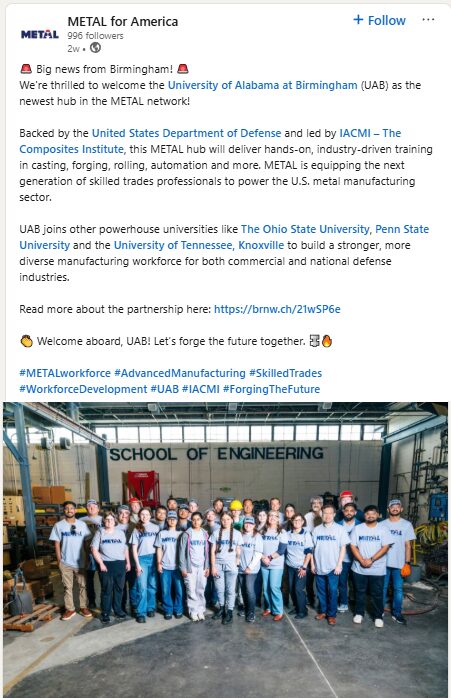
1. New Metal Hub at University of Alabama, Birmingham (UAB)
Check out UAB’s exciting new hub. This partnership with The Metallurgical Engineering Trades Apprenticeship & Learning will provide opportunities for metalworking and manufacturing professional training. Are we looking at the future of Heat Treat Today’s 40 under 40 Class of 2030? Time will tell.
New Metal Hub Launches at the University of Alabama, Birmingham
2. Dance Off With a Robot?
Dancing today, changing a tire tomorrow. Tesla is striving to advance its robotic humanoid AI to be of practical help to its human creators. However, dancing is not only easier, but more entertaining than practical tasks. Check out the moves on their Optimus robot below, and feel free to blast Mr. Roboto by Styx while you do.
Tesla showcasing a dancing Optimus robot.
3. A Visual on Cooling Rates
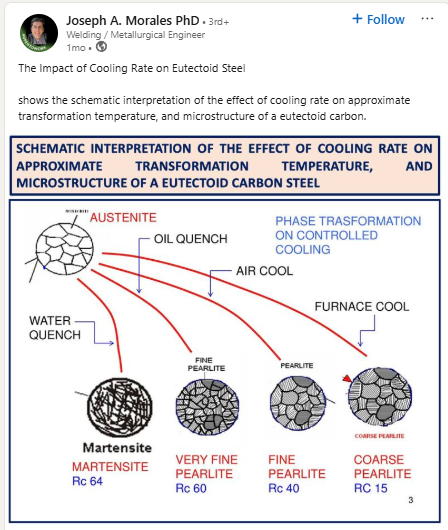
We in heat treatment love quality technical content. Check out this fabulous graph depicting the effect of cooling rate on the microstructure of eutectoid steel.
Graph showing the impact of cooling rate on eutectoid steel
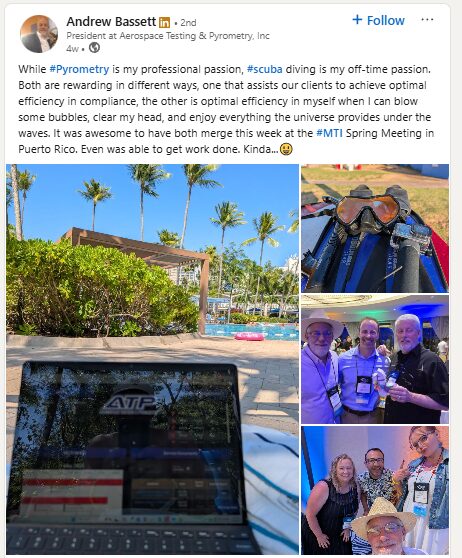
4. Where Do Tan Lines and Pyometry Meet?
Many social media posts poured in about the MTI Spring Meeting in Puerto Rico. Something about those palm trees, salty air, and industry experts puts us in a good place.
Attendees share their about their MTI experience in Puerto Rico
5. Be Inspired With Heat Treat Radio #121
Tune in to Listen to Heat Treat Radio #121: Equipment And Process Insights From A Rising Metallurgical Engineer. This inspiring information shared by Katelyn Kirsch, one of Heat TreatToday’s40 Under 40 Class of 2024, on Heat Treat Radio will keep you well informed! And if you know an up-and-coming leader in the heat treat industry who is 40 years of age or under, head over to the 40 Under 40 nomination page to nominate today!
Katelyn Kirsch discusses responsibilities in integrating new equipment and processes, managing thermal processing, and setting up a metallurgical lab in Heat Treat Radio #121
Two entities located in Meadville, PA will now operate as one organization.
SECO/WARWICKand SECO/VACUUM Technologies have consolidated their U.S. operations. Piotr Zawistowski, the current president of SECO/VACUUM, will remain at the helm of the merged organization.
Growing market needs, changing geopolitical conditions, and the aim to further strengthen the global SECO/WARWICK brand were motivations for the decision.
Sławomir Woźniak CEO SECO/WARWICK Group
Sławomir Woźniak, CEO of the SECO/WARWICK Group shared that “operating under one brand (SECO/WARWICK) is an important step in implementing our product strategy in the North American market. The consolidation will strengthen brand recognition, optimize operational processes, and simplify administrative formalities. I want to emphasize that while the formal structure and name change, the values, mission, and vision of the SECO/WARWICK Group remain unchanged. The goal of the entire undertaking is growth on all fronts.”
“I would also like to emphasize that all existing product lines of both entities will continue,” added Piotr Zawistowski, Managing Director of the American SECO/WARWICK branch.
Piotr Zawistowski Managing Director SECO/VACUUM
One of the short-term goals following the merger will be the transfer of technology and the expansion of the product portfolio in the American market. The remaining branch of the Group in the USA – RETECH in Buffalo, New York – will maintain its existing production, product segment, and separate brand.
Merger Announcement On SECO/VACUUM Website Source: SECO/VACUUM
Press release is available in its original form here.
A new thermal processing company has launched under the oversight of industry leaders.
High Vacuum Technologies (HVT) has announced its inauguration as a new vacuum furnace manufacturer. HVT is committed to serving the industry with energy efficient equipment.
HVT Logo
The executive team for HVT consists of Suresh Jhawar, named chief executive officer, who has 54 years of experience in the industry. He spent the first ten years of his career at IPSEN USA, holding positions of senior project engineer, manager engineering services, manager marketing services, and technical director of Heavy Equipment Division. Later, he assumed the role of vice president general manager at ABAR Corporation. In 1987 he joined G-M ENTERPRISES as a minority partner and became the sole owner in 2005 and oversaw its acquisition by NITREX of Canada. Jhawar earned BSc in physics, BSME in heat transfer & thermodynamics and a MBA in marketing.
Steve Turmala is one of the co-founders and will serve as HVT’s executive vice president of technology. He has thirty-five years of experience in the furnace industry, working with electrical and computer control systems. He actively seeks out and invents furnace control systems, with particular attention to reliability and early warning signs for malfunctions.
Jeffrey Taino is a co-founder and will serve as the executive vice president of engineering & R&D for HVT. He has over 30 years of industry experience, including design and equipment development for heat processing of zirconia tubes for nuclear energy.
Veena Jhawar will fill the role of chief operating officer and co-founder of HVT. She spent 25 years in her career at G-M Enterprises managing supply chain and operations. Veena has a master of science degree in economics. She is aware of the challenges of increasing costs for materials and the impact of tariffs on the industry, but she is ready to meet those challenges.
In this Technical Tuesday installment, Kazunori Hokaku, business director/general manager/sales engineering dept. at Tokai Konetsu Kogyo shares the sustainability benefits of SiC heating elements.
This informative piece was first released inHeat Treat Today’sMay 2025 Sustainable Heat Treat Technologies print edition.
In recent years, Silicon Carbide (SiC) heating elements have been increasingly used in demanding applications involving high temperatures and extreme atmospheres. Battery material manufacturing is one of many such applications. Therefore, improved service life contributes to increased productivity and sustainability as well as reduced industrial waste. This article discusses the long service life for recrystallized SiC heating elements having both excellent oxidation and corrosion resistance.
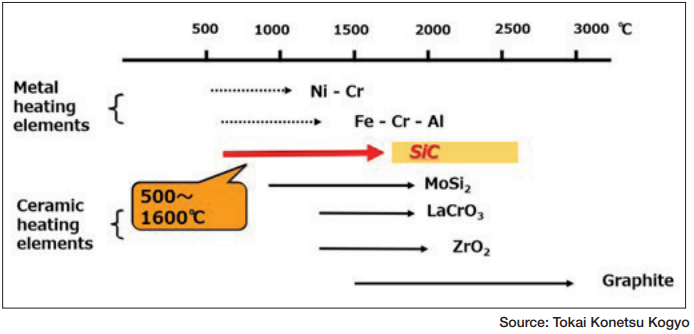
Tokai Konetsu Kogyo in Japan has been manufacturing EREMA® SiC heating elements since 1936. SiC heating elements are categorized as ceramic heating elements, which are widely used in a temperature range between 932°F–2912°F (500°C–1600°C) as shown in Figure 1.
Figure 1. Temperature range for heatingTable 1. Example of applications for SiC
heating elements
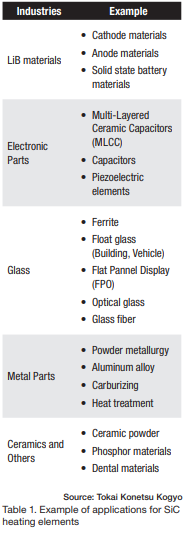
The heat value per unit area (i.e., watt density) of SiC heating elements is quite high, 5 to 10 times that of metallic Nichrome wire heating elements, for example. SiC heating elements are chemically stable and an environmentally friendly source, free of air and noise pollution compared to gas-fired or liquid fuel systems. As such, they are chosen and used for a variety of applications, such as Lithium-ion battery material (i.e., cathode/anode/solid state battery materials), powder metallurgy, aluminum, hardening and case hardening applications (e.g., carburizing), electronic parts (MLCC, ferrite), and dental materials as shown in Table 1.
SiC heating elements come in a variety of shapes, namely straight rod, U-shaped, and W-shaped designs. They are affordable and easy to handle compared to other ceramic heating elements. It is important to remember, however, that their service life is drastically influenced by high temperatures and the atmosphere.
The failure mechanism of a SiC heating element to its service life is shown in Figure 2. SiC reacts with O2 and creates SiO2, by which the resistance of the heating element increases.
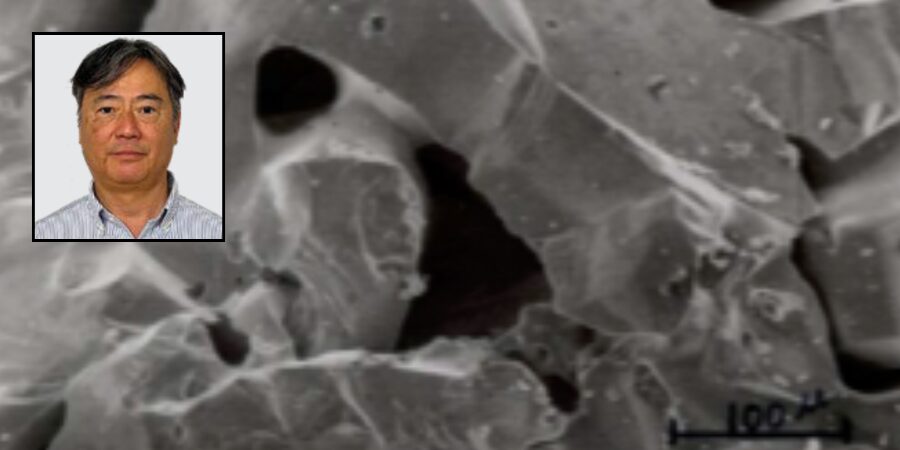
Therefore, increasing bulk density and reducing specific surface area are key to service life longevity. This relationship between bulk density and service life in alkaline atmosphere (Li2CO3) has been explored by Tokai Konetsu Kogyo using scanning electron microscopy (SEM) photos with results as shown in Figure 3.
Figure 2. Mechanism of resistance increase (service life)
Silicon Carbide 101
■ Electric heating elements are a popular choice of many heat treaters. They come in a variety of shapes, sizes, and materials. One of the most common types are silicon carbide (SiC) heating elements, known by several tradenames including Globar™ and StarBar™. They are used extensively throughout the heat treating industry when high temperatures, maximum power, and heavy duty cycles are required.
A SiC heating element is typically, but not always, an extruded tubular rod or cylinder made from high purity grains of silicon carbide that are fused together by either a reaction bonding process or a recrystallization process at temperatures in excess of 3900°F (2150°C). The result is a chemically stable material with a low thermal expansion coefficient and little tendency to deform.
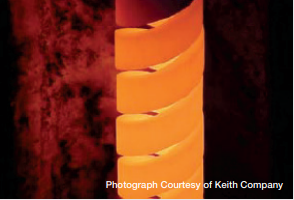
Spiral-cut silicon carbide heating element design provides increased resistance for applications up to 3000°F (1650°C)
Recrystallization forms fine grains of silicon carbide that act as “bridges” or connection points between larger grains thus forming conductive pathways. The number of bridges formed dictates the material’s resistance: the greater the number, the lower the resistance. The secret to the creation of a good heating element is controlling this formation process within the material to develop a consistent electrical resistance
The factors that influence the life of a SiC heating element include the type of furnace atmosphere, watt density, operating temperature, type of service (continuous or intermittent), and maintenance. Furnace type, design, and loading play an important role as well. SiC heating elements are extremely versatile operating, for example, in air up to 3000°F (1650°C).
Finally, the choice of heating element depends on many factors. For example, SiC heating elements are capable of higher operating temperatures and higher watt loadings than say metallic elements; they are self-supporting and can be used in furnaces either too wide or too long to be spanned by other element types and are relatively easy to change while hot. SiC heating elements are used extensively in brazing and sintering furnaces running continuously at or above 2050°F (1120°C) and for other processes where the temperature range lies between 2375°F (1300°C) and 2725°F (1500°C).
With permission from the author, Dan Herring, the information cited has been used in part from, Herring, Daniel H. “Electric Heating Elements Part One: Silicon Carbide.” Industrial Heating, September 2008. ■
SEM photos show the Sustainable Development Goals (SDGs) model observed increased bulk density with low porosity and very thick neck growth of SiC grains. The specific surface area for the SDGs model of 0.03 m2/g by Brunauer–Emmett–Teller (BET) method is smaller than that of the standard high-density grade of 0.05 m2/g.
Figure 3. Life test (resistance increase in alkaline atmosphere)
As a result, the graph in Figure 3 shows that the service life for the EREMA®SDGs model (BD = 2.65) is the longest, which means a reduction not only in downtime of furnace operation but also of industrial waste.
About The Author:
Kazunori Hokaku Business Director/General Manager/Sales Engineering Dept Tokai Konetsu Kogyo
Kazunori Hokaku graduated from Kyoto Institute of Technology in 1985 with a major in ceramics. He has been with Tokai Konetsu Kogyo Co., Ltd., since 1985 and is currently the business director/general manager/sales engineering dept.