These are professional-level spaces where heat treaters from industry sectors can discuss relevant issues and ideas, and Heat TreatTodaywill regularly provide content, keeping members current on the latest technologies, products, processes, and discussions. Be sure to check out Leaders in Automotive Heat Treat, in anticipation of our upcoming Automotive print edition. Join a group today!
A leading full metal shapes solutions provider has announced the opening of its new North American Powder Metallurgy Headquarters and Additive Manufacturing (AM) Customer Center. The 38,260 square foot facility, located in Auburn Hills, Michigan, expands the company’s global 3D printing network and extends its scope of in-house powder metallurgy capabilities.
GKN PM Powder Metal Compaction Press (Source: GKN Powder Metallurgy)
Housing over 80 employees from the three GKN Powder Metallurgy’s businesses, Hoeganaes, GKN Sinter Metals and GKN Additive, the space is designed to inspire teamwork and enhance exceptional customer experiences. The building includes 20,700 square feet of collaborative working areas and 17,700 square feet of shop floor space to complete the cohesive working environment.
“We are excited to start a new journey in Auburn Hills with a space that is dedicated to our team, our community and the advanced technology we create for our customers,” said Reid Southby, President, GKN Sinter Metals Large Segment. “This building reinforces our commitment to the North American market and continued global growth.”
The building includes a 3,200 square foot AM Customer Center, equipped with two EOS M290 Direct
GKN Powder Metallurgy celebrated the opening of its North American PM Headquarter and AM Customer Center with an internal celebration on April 8.
Metal Laser Sinter (DMLS) printers. The DMLS machines incorporate powder bed fusion technology, creating functional prototypes within a two-week lead time and allowing customers to test factors such as usability, ergonomics, manufacturability and materials in the early stages of the development process.
“GKN Powder Metallurgy is at an exhilarating point in its journey of growth and innovation,” Southby added. “We now have the opportunity to provide our customers and strategic partners with local and exceptional support on all fronts of our business.
A large North American supplier of refractory products and services is responding to domestic steelmakers’ increased capacity and solving their refractory challenges through several new initiatives.
Mirroring its steel customers’ investments to boost production capabilities and upgrade facilities, HarbisonWalker International (HWI) is investing to increase capacity by 25 percent in 2019 at key steel refractory facilities. In fact, approximately one-half of HWI’s capital investment dollars will have a direct positive impact on its steel industry customers. Much of the investment will be at its White Cloud, Michigan facility, which manufactures refractory products primarily for steelmakers.
HWI Announces Investments and Digital Refractory Transformation at AISTech 2019
This is the latest in a series of capital investments that HWI has made at White Cloud over the past three years. In 2018, HWI integrated new equipment and technologies to modernize the facility.
The 2019 investment includes expansion to accommodate new warehouse and shipping space, which is being constructed with American-made steel. Additional manufacturing space will house new production technologies, including a new brick press and packaging line, manufacturing technologies that improve production efficiency and worker safety.
“The improvements will further optimize production, product quality, and delivery efficiencies for our steel customers,” said Carol R. Jackson, Chairman and CEO, HarbisonWalker International. “The new press and warehouse increase our capacity to supply our industry-leading products including mag carbon brick for steel ladles, electric arc furnaces (EAF), and basic oxygen furnaces (BOF). The new packaging line allows for increased handling safety and provides quality control benefits associated with our product.”
One year after announcing its plan to significantly invest in monolithic refractories manufacturing, HWI built and opened a new, state-of-the-art facility in South Point, Ohio in 2018. It is North America’s most technologically advanced refractories plant and one of the top globally. Featuring state-of-the-art processes and technology, the South Point plant is now fully operational and supplying steel industry products.
In addition to physical expansion and technology integration in its plants, HWI is evolving the refractory industry for the 21st century by taking a holistic approach to advancing its use of data. HWI is aggressively initiating programs to help customers transition numerous decision-making processes from experienced-based to data-based, through use of various sensor and data acquisition systems, for instance.
Through the expertise of its team and strategic partnerships with industry leaders, HWI is employing sensor technologies, such as infrared cameras, and also utilizing three-dimensional laser measurement to make digital twins of physical assets. These technologies, along with ‘edge’ software that can access datasets from various plant level sources, are helping HWI develop tools to increase product campaign life and improve worker safety. Performance data will also benefit future generations of HWI products.
The outcomes for steelmakers include closer collaboration for customized products and continuous improvement, optimizing throughput and analytical insights to find even more significant cost savings.
“HWI is working to transform data into process improvements and business intelligence that help steel industry customers work safer and smarter, with even better tools for knowledge sharing,” noted Jackson. “Combining our digital transformation with HWI’s proven products and the industry-leading expertise of our field services team, we’re effectively positioned to deliver for our steel customers today and in the future as our industries evolve together.”
HWI has also recently innovated and patented new functional product solutions that are helping steel customers further reduce downtime and increase performance. These solutions allow for faster, easier installation with improved ergonomics.
In addition to its products, HWI also provides around-the-clock support from the most extensive service team in the U.S. and offers dedicated iron and steel application specialists who provide highly customized solutions.
Earlier this spring, a heat treat equipment organization appointed several professionals to new leadership roles.
Established in 1929 to meet the need for effective group action in promoting the interests of industrial furnace manufacturers, The Industrial Heating Equipment Association (IHEA) has expanded and currently includes designers and manufacturers of all types of industrial heat processing equipment used for the melting, refining and heat processing of ferrous and nonferrous metals and certain nonmetallic materials and heat-treatment of products made from them.
IHEA announced its 2019 – 2020 Board of Directors and Executive Officers. IHEA’s President is Michael Stowe of Advanced Energy; Scott Bishop of Alabama Power Company assumes the role of Vice-President; and Jeff Valuck of Surface Combustion was elected Treasurer. Serving as Past President is Daniel Llaguno of Nutec Bickley.
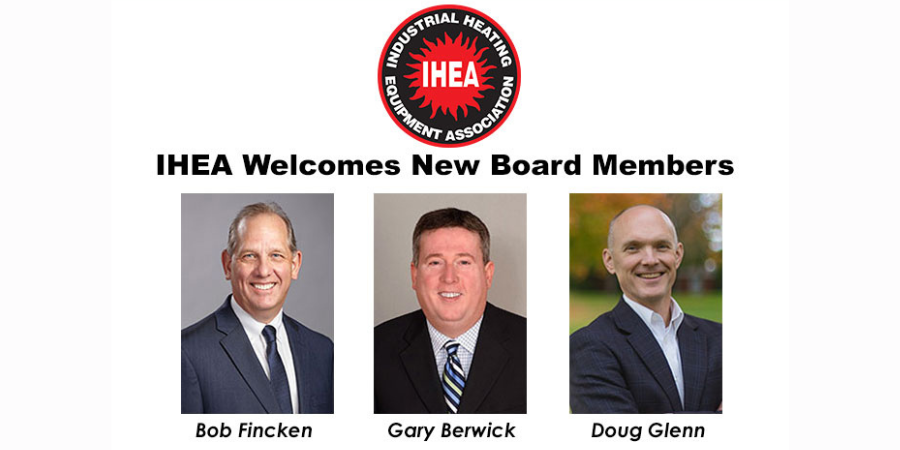
IHEA also welcomed three new board members: Gary Berwick of Dry Coolers, Bob Fincken of Super Systems, Inc., and Doug Glenn of Heat Treat Today. IHEA President Michael Stowe comments, “At our recent annual meeting in Sarasota, FL, we were very excited to officially appoint three new board members. They will each serve a three-year term, with service through the 2022 annual meeting. These folks represent dozens of years of process heating experience across several different markets. IHEA is very fortunate to have them serving on our board.”
Gary Berwick is a veteran in the heat-treating industry with over 30 years’ experience. He has been involved with IHEA since the early 1990s and stays active through his engineered sales role with Dry Coolers. Berwick is also a member of the Metal Treating Institute and the American Society of Manufacturing. IHEA is fortunate to have Gary’s valuable contributions on the Education committee as well.
IHEA gains a respected industry professional in Bob Fincken of Super Systems Inc. Fincken is their national sales manager for all of North America with 30 years of experience in controls and sensors. He is a great asset on IHEA’s Safety Standards and Codes committee and provides input for IHEA’s educational tools to support the association’s knowledge base.
Publisher of Heat Treat Today, Doug Glenn returns to the IHEA Board of Directors. His support of the association spans 25 years and includes everything from promotion, sponsorships, speaking engagements, and serving as a committee chair. Doug has an extensive background in publishing, marketing and association business. IHEA is pleased to have Doug’s dedication and commitment.
To complete the Board of Directors for 2019 – 2020, IHEA is proud to name those continuing their service:
B.J. Bernard, Surface Combustion, Inc.; Brian Kelly, Honeywell Thermal Solutions; Francis Liebens, SOLO Swiss Group, John Podach, Fostoria Process Equipment, a div. of TPI Corp., Jason Safarz, Selas Heat Technology Co. LLC; and John Stanley, Karl Dungs, Inc.
Alessandro Fiorese, R&D Chief Engineer with TAV Vacuum Furnaces SPA
Alessandro Fiorese, R&D Chief Engineer with TAV Vacuum Furnaces SPA, introduces the vacuum brazing process for automotive applications. For more articles, tips, and news related to heat treatment for automotive applications, keep an eye out for Heat Treat Today’s special print/digital issue Automotive Heat Treating, due in June 2019.
Introduction
Brazing is a heat treatment process in which metallic parts are joined together through a metallic filler with a melting temperature lower than the melting point of the joined parts. The filler metal can be used as a wire, a thin plate, or a paste depending upon the final application we are considering.
To obtain a good welding in terms of mechanical properties and corrosion resistance, it’s necessary to minimize contamination and impurities in the joined zone. Vacuum brazing processing provides a way to reach a high cleaning level of atmosphere during the brazing heat treatment.
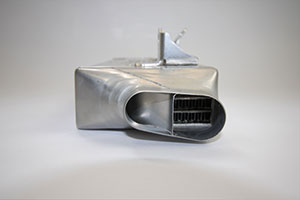
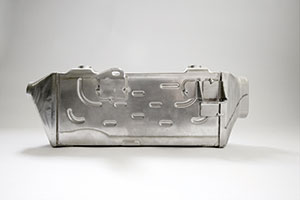
The brazing treatment is particularly useful to produce complex shape parts with a lot of joining points per unit of area. Typical brazing applications are oil or water heat exchangers in the civil and automotive fields such as the ones represented below.
The high-performance aluminum heat exchangers manufacturing is growing particularly in the automotive field. In this context, AA 3xxx and 4xxx are commonly used materials for parts and filler material respectively because these materials have a very low specific weight and a very high thermal conductivity level.
As indicated before, one of the cleanest brazing atmospheres is vacuum. For this reason, in the following discussion, we will analyze in detail the complete characteristics of a semi-automatic TAV vacuum brazing furnace for automotive applications.
Vacuum Brazing Furnace
The entire furnace is composed of three different stations:
the heating furnace;
the loading station;
the cooling station.
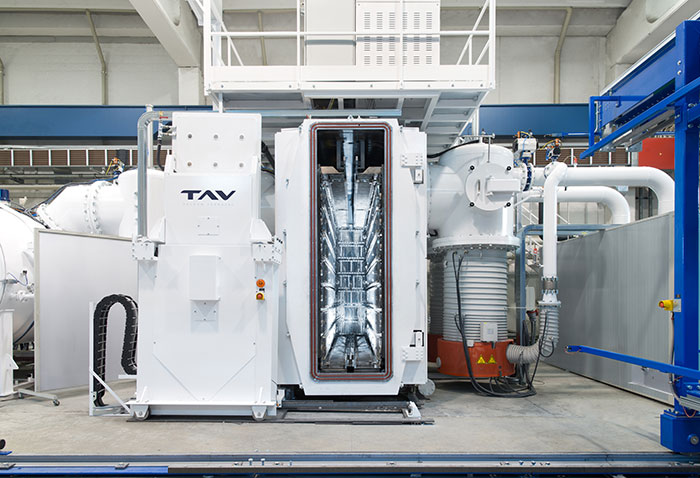
Heating Furnace
heating furnace
Furnace Vessel
The vessel separates the inner part of the furnace where the hot chamber is placed from the outside environment. The vessel develops along a horizontal axis, it has an elliptical design and it is provided with two flat doors (front and rear). Both doors are hinged and can be opened manually. The front door has an automatically sliding entrance for loading-unloading the furnace.
Hot Chamber
The thermal chamber has a rectangular section 71 (H) x 18 (W) x 144 (L) inches (180 x 45x 365 cm), and it is constituted by steel panels with nickel-chrome resistors. There are 23 independent hot zones that make the chamber temperature very well-controlled. The temperature uniformity requested for this vacuum furnace is ± 37°F (± 3°C) from the set temperature. In the following picture, the ± 37°F Temperature Uniformity Survey (TUS) chart is shown.
Figure 1. TUS example at a specific temperature with 12 TLC
Vacuum System
The vacuum system has three pumping groups, two with a rotary piston pump, a roots pump, and an oil diffusion pump. The third pumping group has a mechanical pump, a roots pump, and a cryo-trap in order to condensate humidity and impurities released during the entire process. The ultimate reachable vacuum without the load is 10-6 mbar (range).
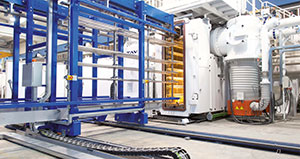
Loading Station
loading station
Loading Baskets
To carry out the brazing heat treatment in a correct way, a specific steel shelved fixtures hold the heat exchangers parts all together with the filler material. For each brazing process, a load from 1984 up to 4850lbs (900 up to 2200kg) can be heat treated at the same time. For gaining a semi-automatic heat treatment process, there is a parking station that can be used as a buffer for the heating furnace.
cooling station
Cooling Station
At the end of the brazing heat treatment, the load is automatically transferred into a separate cooling chamber where the brazed parts are cooled down by forced recirculation of air.
Heat Treatment
Before reaching the brazing temperature, the load is maintained at a lower temperature for a period of time to remove the working oil plate from the heat exchangers. During this maintenance time, a variation between high vacuum and partial pressure of N2 is observed.
Figure 2. Typical brazing cycle. Line yellow is the setpoint, line orange is the temperature TC, line blue is the high vacuum level and purple line is the partial pressure in mbar detected.
After the brazing step, the furnace reaches high nitrogen static partial pressure, starting the cooling phase. This step is considered complete when the furnace injects air up to reach the atmospheric pressure as total pressure. At this time, the front door opens automatically, and the loading track extracts the charge from the furnace.
The parent company of a western Pennsylvania-base heat treat furnace manufacturer recently announced a partnership with a Serbian defense materials manufacturer to supply new heat processing equipment.
Zastava Arms, which manufactures firearms and artillery, based in Kragujevac, Serbia, replaced dated equipment with a new SECO/WARWICK high-temperature box furnace. The new equipment includes tighter temperature uniformity and fully automated temperature controls.
“We chose the SECO/WARWICK technology based on our previous experience and because it fits perfectly with our current Quality Management System by providing real-time controls that ensure a high-quality product and profitable operation,” said Vladan Živković, Manager of Department of Technology with Zastava Arms. “Zastava Arms has been a supplier to the defense industry for many decades and will stay among top defense suppliers thanks to investments in high-quality technology.”
Jarosław Talerzak, Vice President of Thermal Segment at SECO/WARWICK
According to DefenseWeb, the defense industry of Serbia is the largest in the Western Balkans and manufacturers must implement strict standards in order to meet the criteria to get a permit for manufacturing.
“We have enjoyed a long partnership with Zastava Arms and are pleased to continue supplying advanced technology solutions for every heat treatment application,” said Jarosław Talerzak, Vice President of Thermal Segment at SECO/WARWICK. “As a technology partner, we are positioned to support our customer’s growth by offering a wide range of service and equipment options especially for the very demanding industries represented by our partner.”
Main photo credit/caption: MilMag Facebook/Serbian Zastava Arms assault rifle
A Chicago-based manufacturer recently announced the construction of “the world’s largest continuous ERW tube mill,” according to the project’s supplier.
Capable of producing hollow structural sections (HSS) with a size range of 8″ square x 0.750″ wall up to 22″ square x 1″ wall, the new mill, operated by Atlas Tube, a division of Zekelman Industries, will produce square, rectangular, and round structural sections in the mill. The largest rectangular section will be 34″ x 10″ x 1″ wall, and the largest round section will be 28″ OD x 1″ wall. The new mill will produce products to meet or exceed ASTM A500, ASTM A1085, CSA G40 and ASTM A252. This will be the first time ERW sections above 16″ square will be available domestically.
The mill will also be engineered to allow for world-leading full change-over times of less than 60 minutes, as well as special forming and sizing technology for precise dimensional tolerance. Zekelman Industries selected SMS as the supplier for the mill, Kusakabe for the milling cut-off, and Mair for the material handling and packaging line.
Barry Zekelman, CEO of Zekelman Industries
The total project investment is over $150 million — the largest private investment in the U.S. steel industry in the last decade. Frank Lagac, sales manager of welded pipe plants at SMS, noted that it will be the “world’s largest continuous ERW tube mill.”
“At Zekelman, we continue with our long-standing goal of creating, not waiting for, the future, said Barry Zekelman, CEO of Zekelman Industries.
Tom Muth, president of Atlas Tube
“Over the past few years, we have seen the increasing need for larger, domestically produced HSS in the bridge, transportation, and building markets,” said Tom Muth, president of Atlas Tube. “Also, HSS with thicker walls that meet the more stringent width-to-thickness ratio requirements of the AISC Seismic Provisions are in greater demand for lateral bracing systems.”
Brad Fletcher, senior sales engineer for Atlas Tube
“This new mill gives structural engineers new tools to meet the demands of designing and building cost-efficient and safe steel structures,” said Brad Fletcher, senior sales engineer for Atlas Tube.
A Magnitogorsk, Chelyabinsk (Russia) company has placed a new contract for the expansion of their existing HPH® Bell-Type Furnace Plant for Wire Coils with a company based in Essen, Germany. OJSC MMK-METIZ located in Magnitogorsk, Chelyabinsk region, already operates a HPH® Bell-Type Furnace Plant supplied by Tenova LOI Thermprocess in 2014. This plant consists of 2 annealing bases, 1 heating hood and 1 Jet-cooling hood with a maximum net charge weight of 36 tons of wire rod or drawn wire coils. It uses a hydrogen/nitrogen mixture as protective gas atmosphere and features a useable diameter of 3,200 mm and a useable height of 2,700 mm.
In the spring of 2019, a new contract was signed concerning the expansion of the existing plant by further 2 annealing bases, 1 additional heating hood and 1 Jet-cooling hood. The start of production of the new plant is scheduled for the beginning of 2020. Besides the spheroidization annealing of wire rod, this plant also carries out the recrystallization annealing of drawn wire coils with the HPH® (High Performance Hydrogen) annealing technology.
Stephen Kowalski, president of Kowalski Heat Treating, talks about how the family-owned company will streamline operations after adding three buildings next door from Conveyer & Caster to its other six on Detroit Avenue in Ohio City. (Photo Credit: Stan Bullard)
An Ohio City heat treating business recently purchased a neighboring company’s property. The transaction was advantageous to both parties; the owners made a good sale, and the new occupants gained plenty of space without relocating.
After moving to a larger location, Conveyer & Caster sold their three Detroit Ave. buildings to family-owned Kowalski Heat Treating, which now fills nine buildings purchased since their 1975 opening on that street.
“It’s wonderfully exciting,” Kowalski said. “We needed assembly and warehouse space and office space. That’s all there in the Conveyer & Caster buildings. And we don’t have to move.”
Dunkirk Specialty Steel LLC, a leading U.S. manufacturer of semi-finished and finished specialty steel products, unveiled several state-of-the-art upgrades and modernization efforts at its Dunkirk facility. These renovations are the result of a $10 million capital investment from parent company Universal Stainless and Alloy Products, Inc., and collaborative efforts by the County of Chautauqua Industrial Development Agency, City of Dunkirk Department of Development, and NYS Empire State Development.
The 800,000 square-foot facility has installed a new $10 million bar turn and burnish line, as well as a new General Electric phased array nondestructive testing system. The addition of the specialty equipment from Germany and Japan makes the Dunkirk-based unit finishing cell the most advanced in the United States.
“This is more great news for Chautauqua County,” stated Mark Geise, Deputy County Executive for Economic Development/CEO of the County of Chautauqua Industrial Development Agency, “and demonstrates how collaboration at all levels can reap rewards for the County and the region. Dunkirk Specialty Steel LLC continues to up their game, and we’re glad we could be a part of it. I just want to thank Dunkirk Specialty Steel LLC and their parent company Universal Stainless and Alloy Products, Inc.; our economic development partners; and the CCIDA staff for making this project a reality.”














 Source: