OP-ED

DUAL PERSPECTIVES: The Heat Treat Shop of 2050

op-ed

Changes are inevitable, but the world today is changing so rapidly that it’s constantly keeping us on our toes. Do two men from different parts of the world, both with significant experience within the heat treating community, have vastly different perspectives on the happenings in the heat treat industry?

We want to find out, so we asked a question that focuses on the world of heat treating to Thomas Schneidewind, the editor-in-chief of heat processing magazine, and Doug Glenn, the publisher and founder of Heat Treat TodayThe question: What does the heat treat shop of 2050 look like?

Thomas’s expertise lies in the European market while Doug’s resides in the North American market. We will feature their responses in each print magazine. Will their views align? Time will tell. Enjoy this second installment of an ongoing column. This column was first published in the June 2022 Heat Treat Buyers Guide print edition.


What Does the Heat Treat Shop of 2050 Look Like?

Thomas Schneidewind, Editor-in-Chief, heat processing magazine

The Limits of Digitalization

Thomas Schneidewind
Editor-in-Chief
heat processing Magazine

Do you still remember the New Economy? The predictions of some economists at the beginning of the internet economy heralded the end of the classic business cycle when it vanished into thin air in March 2000 – just like the internet bubble on the stock market.

However, a look back at the turn of the millennium shows that many ideas were formulated back then that are only now – more than 20 years later – changing our lives. At this point, I would like to recall The Cluetrain Manifesto, the internet bible of the first hour. This document sets out 95 theses for the new corporate culture in the digital age. Thesis 1 states, “Markets are conversations.” Thesis 19 says, “Companies can now communicate directly with their markets. If they don’t seize this opportunity, it could be their last.”

Today, real-time communication is commonplace. Many companies are designing their workflows to be flexible and able to respond quickly to the needs of their customers and employees. One example: LOI Thermprocess GmbH relies on networked working at its new location in Duisburg, Germany. The central component of the concept is a digital room. From here, employees around the world can take virtual tours with customers. They walk through the plant with a terminal device and employees of the plant manufacturer interact with them remotely.

The SMS group will also implement even closer cooperation along the entire value chain at its new site in Mönchengladbach. The Technology, Service, and Digitalization Campus currently under construction will enable agile working in a 5G infrastructure and offer generous social and communication areas.

In heat treatment, digitization is making an important contribution to implementing the changeover in automated drive technology production. Significantly higher speeds of electrified drives and the resulting change in stress on components require heat treatment that meets these requirements. The high number of variants in drive technology also leads to smaller production sizes – the plants have to be designed more flexibly. In this context, digitization plays an important role.

Another aspect is the work in plant engineering with digital twins. Digital models can be used to increase efficiency in production. It is also about speed in the development of plants and the optimization of processes. The result of any digitization strategy is an increase in competitiveness.

Since almost anything is technically feasible today – at least in theory – the question is rather about the limits of digitization. These are manifold in nature: starting with heterogeneous IT landscapes in companies. These make cross-process integration difficult in regard to data security, (which apparently cannot be guaranteed), to dystopian fears of the replacement of humans by machines, (which stands in the way of the acceptance of digital solutions). In other words, digitization must always remain only a tool, not an end in itself. We recognize this most when the digital space prevents genuine personal communication.

Doug Glenn, Publisher, Heat Treat Today

Doug Glenn
Publisher and Founder
Heat Treat Today

Roughly 30 years ago, I asked this same question to the publishing staff of Industrial Heating magazine. I was their publisher at that time and the answers were intriguing. One person predicted that we would not have phones on our desks and that we would do most of our communication over our computers. Smart phones were not a thing at that time, so that prediction seemed far-fetched, but the “no phones on our desks” prediction has proven to be pretty much true.

What a 2050 heat treat shop/department will look like will be largely dependent on the type of work being processed. For captive shops, we should fully expect that these shops will be nearly 100% automated and self-governing. This includes incoming material analysis, load configuration optimization, multi-furnace utilization schedules, and part-by-part processing analysis – all will be done without human intervention. We will undoubtedly see more artificial intelligence including the resolution of unexpected problem situations that arise during the heat treating process.

More importantly, the idea of a distinct heat treat department will be less and less prevalent. By 2050, the vast majority of captive heat treatments will be done in-line with the manufacturing process with little or no interventions from humans. Washing, fixturing/loading, temperature measuring and control (most of which will be done continuously with full-part, non-contact infrared scanning), and inspection will all be done autonomously.

Most parts will be heat treated individually with single-part traceability/accountability.

The need for heat treat will be minimized with advances in the development of nanomaterials and the ability to designer-build alloys with specific metallurgical/mechanical properties.

Equipment controls and process control will be remote and cloud-based. These are some of the characteristics for captive shops where product variability is low and volumes are high.

For commercial heat treat shops where variability is high and volumes are relatively low, much of the same will be true with less and less human interaction needed. Nonetheless, these job shops will still have a higher need for human interaction than the captive shops. Commercial shops, however, will be much more highly automated than they are today, especially when it comes to part recognition and the recipes associated with those parts.

Finally, I don’t see heat treating as a carbon-free activity in 30 years. In fact, as the need for energy grows, I see the heat treat industry continuing to use carbon-based fuels. The only thing that will change in the next 30 years is the opinion that carbon is the devil. Although much slower moving, I think the world’s opinion about the evils of carbon will change much like the anti-cancer diet du jour in today’s world. In 2050, carbon will no longer be a dirty word.


Find heat treating products and services when you search on Heat Treat Buyers Guide.com


DUAL PERSPECTIVES: The Heat Treat Shop of 2050 Read More »

How To Make $17,792.00 in a Couple of Hours

op-edWe will explore the ever-popular subject of how to make money the easy way. Well, better stated: How to save some money, but at the end of the year the result is the same.

This column is a Combustion Corner feature written by John Clarke, technical director at Helios Electric Corporation, and appeared in June 2022 Heat Treat Buyers Guide print edition.

If you have suggestions for savings opportunities you’d like John to explore for future columns, please email Karen@heattreattoday.com.


John B. Clarke
Technical Director
Helios Electric Corporation
Source: Helios Electric Corporation

For our discussions, we will assume that we are operating a continuous heat treat furnace that processes work at 1600°F. The furnace currently consumes 2,000 SCFH of 1000 BTU/SCF natural gas and operates 8,000 hours per year. With today’s natural gas at 8.00 USD per 1 mmBTU (1 mmBTU = 1,000 SCF of natural gas), our furnace’s annual operating cost is:

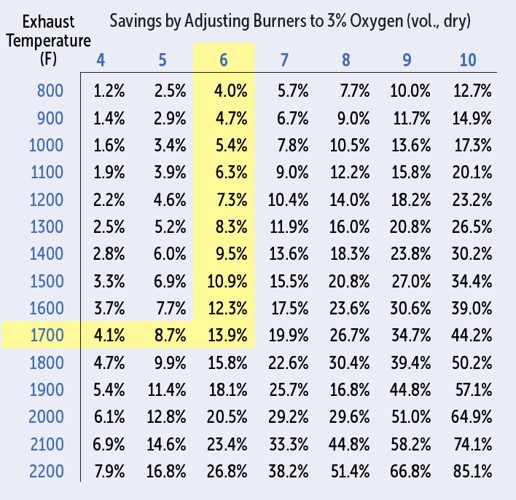
Using our trusty combustion analyzer that provides a readout of the oxygen present in the flue products, we quickly determine the fuel contains 6% O2 (measured by volume, dry basis). The “volume/dry basis” is the most common value measured by handheld combustion analyzers. We measure the temperature of the flue products at 1700°F. Our burner and/or furnace specifications say the system should be operated at 3% O2. How much can we save by adjusting the burner(s) on this furnace?

Table 1 below provides savings numbers that result when non-recuperated burners are returned to 3% O2.

If we read where the exhaust temperature row intersects with our column for our starting O2 volume in the flue products, we see the resultant savings will be 13.9%:


We chose 3% O2 in the flue products (around 15% excess air) because radiant tubes and direct fired systems can commonly operate at this level with little CO or soot generation. A simple combustion analyzer can be purchased for a few thousand dollars and the labor required to make these adjustments is generally under a day. The payback period for this maintenance investment is measured in weeks, even if it requires the purchase of new tools.

There may be an added benefit we receive when adjusting the furnace. We may have an opportunity to increase the throughput, so perhaps production can be increased while fuel costs are reduced.

Table 1 can be used for other specific conditions, so keep it handy. Next month, we will explore the savings resulting from recuperation or pre-heating the air.

Recuperation projects are more complicated and require greater investments, but they are becoming increasingly critical for heat treaters working to stay competitive in our new reality of dramatically higher natural gas prices.

About the Author:

John Clarke, with over 30 years in the heat processing area, is currently the technical director of Helios Corporation. John’s work includes system efficiency analysis, burner design as well as burner management systems. John was a former president of the Industrial Heating Equipment Association and vice president at Maxon Corporation.


Find heat treating products and services when you search on Heat Treat Buyers Guide.com


How To Make $17,792.00 in a Couple of Hours Read More »

Remembering Those Who Served

Heat Treat Today would like to wish everyone a Happy Memorial Day. As you (hopefully) take some time off from work, pause to reflect on the sacrifices men and women gave, and are currently giving, to protect and serve this nation.

Heat Treat Today will be back with you on Tuesday, May 31st, and we hope you too are able to rest and remember this weekend.

Have a blessed and safe holiday!

- The team at Heat Treat Today


.

Search for heat treat solution providers and suppliers on Heat Treat Buyers Guide.com


Remembering Those Who Served Read More »

DUAL PERSPECTIVES: Europe vs. North America

op-ed

Changes are inevitable, but the world today is changing so rapidly that it’s constantly keeping us on our toes. Do two men from different parts of the world and lots of experience within the heat treating community have vastly different perspectives on the happenings in the heat treat industry?

We want to find out, so we asked a question that focuses on the world of heat treating to Thomas Schneidewind, the editor-in-chief of heat processing magazine, and Doug Glenn, the publisher and founder of Heat Treat TodayThe question: Will the war in Ukraine impact the heat treat industry?

Thomas’s expertise lies in the European market while Doug’s resides in the North American market. We will feature their responses in each print magazine. Will their views align? Time will tell. Enjoy this first installment of an ongoing column. This column was first published in Heat Treat Today’s May 2022 Induction Heating print edition.


Will the War in Ukraine Impact the Heat Treat Industry?

Will, or how will, the war between Russia and Ukraine directly or indirectly impact the industry? What immediately comes to mind?

Thomas Schneidewind, Editor-in-Chief, heat processing magazine

Thomas Schneidewind
Editor-in-Chief
heat processing Magazine

First of all, the war in Ukraine is a humanitarian catastrophe. And the first war in Europe since 1945 marks a turning point in history. It has a strong impact on the global economy and hits the thermprocess industry in particular. The exploding energy prices lead to shutdowns of sites in the steel industry. That means that some investments will be frozen.

Europe’s Turning Point

Due to the economic downturn more and more companies are facing another difficult year. Machine and plant builders are affected by the imposed sanctions. Most of the companies are engaged in Russia and in Ukraine as well. One example: Against the background of the war in Ukraine and the human suffering associated with it, SMS group has ceased its main business activities in Russia and Belarus, with the exception of safety-critical maintenance work. New orders will not be accepted. All companies who have strong relationships with clients in Russia and Ukraine are taking care of refugees. SMS will be taking in one hundred families from Ukraine at its German locations in Hilchenbach and Mönchengladbach.

In Europe we see a completely new set up of the political agenda. Specifically, the German so called Energiewende (the country’s planned transition to a low-carbon, nuclear-free economy) will be pushed by the decision makers. The German economy has a long way to go to be independent from Russian gas and oil. The war will affect people and businesses all over the world – we see a historical turning point. For Europe and for the whole world.

Doug Glenn, Publisher, Heat Treat Today

Doug Glenn
Publisher and Founder
Heat Treat Today

The first thing that needs to be clearly communicated is that our thoughts and prayers are with all of those being adversely affected by this war. The loss of human life, personal freedom, and property are the most important impacts of this crisis. Everything else – including what follows in this short column – is somewhat insignificant.

Energy Shortages

Higher energy prices caused by supply shortages are and will continue to happen. More so today than any time in history, markets are global and what happens halfway around the world will have an impact everywhere. The U.S. has imported nearly 20% of its energy from Russia, and with that supply being cut off, we are and will continue to see rising gas, natural gas, and oil prices.

The U.S. could do more to help ourselves and the world through this crisis, however. Mark Mills from the Manhattan Institute asserts that today, with oil prices at $120 per barrel, the U.S. is producing 1.5 million FEWER barrels of oil than we were last year when oil prices were only $60 per barrel. The energy problem in the U.S. is not fundamentally a lack of energy and it is not a market problem. It is a political problem caused by those who have pushed for “green” at all costs.

Supply Chain

Supply chains are and will continue to be disrupted. Being the largest economy in the world and geographically removed from the crisis, I anticipate that U.S. supply chains may not be as badly hurt as those in Europe, but the disruptions will continue. As we all know, if a manufacturer is missing just ONE PART, the entire end-product is on hold. It is completely unpredictable how and when this will impact the North American heat treat industry, but it is safe to say that it is and will continue taking a toll.

Increased National Debt

Probably the most significant long-term impact of the crisis is the continued irresponsible growth in national debt. Now exceeding $30 trillion, our country does not need a war to incur more debt. But as we all know, there is nothing like war to drive national debt through the roof.


Find heat treating products and services when you search on Heat Treat Buyers Guide.com


DUAL PERSPECTIVES: Europe vs. North America Read More »

Natural Gas Revisited

OCNatural gas is the dominant energy source used by heat treaters and its price and availability is critical to all U.S. industry, so let’s look at the data and nail down some simple quantitative facts and maybe answer this pressing question: How will the war in Ukraine impact natural gas production and consumption?

This column is a Combustion Corner feature written by John Clarke, technical director at Helios Electric Corporation, and appeared in Heat Treat Today’s May 2022 Induction Heating print edition.

If you have suggestions for savings opportunities you’d like John to explore for future columns, please email Karen@heattreattoday.com.


John B. Clarke
Technical Director
Helios Electric Corporation
Source: Helios Electrical Corporation

As political pundits seek to explain the cause and impact of the war in Ukraine, I am struck by the lack of quantitative information they use to support their opinions and analyses. Given the complexity of the U.S. energy market, with a myriad of imports and exports between countries (especially Canada and Mexico), it is no wonder that people can support any preconception they have by simply omitting this import or that export. As always, we will focus exclusively on natural gas.

Let’s start with some basic facts. FACT: 40% of our electricity in the U.S. in 2021 was generated using natural gas1 and 20% of electricity generated in Europe is from natural gas2 — so even a vacuum furnace runs on a substantial quantity of this fuel.

One of the challenges when discussing energy markets is the many different units of measure people use to describe production, consumption, and costs. Our preferred unit of measure for natural gas production and consumption will be trillion cubic feet or 1 quadrillion British Thermal Units (BTU)* per year (one cubic foot of natural gas contains 1000 BTU (HHV)). To put this in perspective, if we pay $4.70 per mmBTU** — one trillion cubic feet is valued at 4.7 billion dollars. In 2021, the United States produced 34.1 trillion cubic feet or roughly 161 billion dollars of dry natural gas.


FACT: U.S. production of natural gas was at an all-time high in 2021 and is rising.3, 4 The U.S. is the largest producer of natural gas in the world by a significant margin. U.S. consumption has fallen over the last two years because of our COVID recession — but it is projected to rise in 2022.


Liquified Natural Gas (LNG) Exports

Natural gas can be exported via ship in its liquified state. The following graph shows the U.S. exports of LNG in recent years.5 Our ability to export LNG is limited by facilities that compress and cool the gas to its liquid state and the availability of tankers to move the gas across the ocean. Both ports and ships require significant capital investments and take time to construct — so there is a limit to the rate we can expand exports. Even as we export LNG, we continue to import some natural gas from Canada — but we are obviously a net exporter of natural gas by a considerable margin.

FACT: In 2021, the U.S. exported roughly 10% of the natural gas it produced as LNG. The U.S. is currently the largest exporter of LNG6 while Russia is the largest exporter of gaseous natural gas. Australia and Qatar are also major players in the LNG export market, and we may see these three countries vying for the top spot in the coming decade. The big advantage enjoyed by LNG is once liquified, it is a fungible source of energy — it can be exported to anywhere with a suitable port. Gaseous natural gas must travel through a pipe.

In 2021, the European countries in the Organization for Economic Co-operation and Development (OECD) together imported about 80% of the natural gas they use. Of this number, roughly 6.6 trillion cubic feet per year is imported from Russia, the largest importers of Russian gas include Germany — 1.70, Turkey — 0.95, Italy — 0.92, and France — 0.62 trillion cubic feet per year.

The U.S. has significantly expanded its LNG supplies to Europe in 2019—20217 to an annual rate of 1.86 trillion cubic feet in January of 2022,8 but LNG import capacity is still limited — with additional import facilities coming online in the next few years. Prior to 2019, Europe had little volume of LNG imports, so all the movement of natural gas was by pipeline.

While our price for natural gas in the U.S. has gone up considerably in the last year (approaching a mean of about $5.00 per mmBTU on the spot market), the price in Europe is running about six times as much — $30.00, with recent spikes as high as $60.00 per mmBTU. So, we load a typical LNG tanker with $15 million in natural gas in the U.S., and in 20 days, we lose 4% of the load to vapor, which we burn to power the ship, and offload $86 million at a port in Germany. Of course — this is an oversimplification, but the point is obvious. This price differential will continue to drive the market to invest in new production, LNG ports and ships — and apply upward pressure to our domestic price.

With or without the instability caused by the Russian invasion of Ukraine, we can expect a reliable supply of natural gas to fuel our furnaces and generate our electricity in the United States, but we can also expect higher prices to remain with us for the foreseeable future. Can the U.S. supplant Russia’s natural gas imports? The data indicates the answer is yes — but it will take time and investment. No matter what the outcome of the current war, the West will question the reliability of Russia as an energy supplier and explore all options to lessen their dependency on Russia’s oil and natural gas exports.


*1 BTU is the energy required to heat 1 pound of water, 1 degree Fahrenheit.

**Rough Henry Hub Price per mmBTU of natural gas at time of publication

References

[1] “Electricity explained: Electricity in the United States,” EIA.gov, March 18, 2021, https://www.eia.gov/energyexplained/electricity/electricity-in-the-us.php#:~:text=Natural%20gas%20was%20the%20largest,power%20plants%20use%20steam%20turbines.

[2] Statistical Review of World Energy — 2021. PDF File, 2021, https://www.bp.com/content/dam/bp/business-sites/en/global/corporate/pdfs/energy-economics/statistical-review/bp-stats-review-2021-eu-insights.pdf.

[3] Kirby Lawrence and Troy Cook, “EIA forecasts U.S. natural gas production will establish a new monthly record high in 2022,” EIA.gov, December 16, 2021, https://www.eia.gov/todayinenergy/detail.php?id=50678.

[4] “Natural Gas Summary,” EIA.gov, February 28, 2022, https://www.eia.gov/dnav/ng/ng_sum_lsum_a_EPG0_FPD_mmcf_a.htm.

[5] “Liquefied U.S. Natural Gas Exports,” EIA.gov, February 28, 2022, https://www.eia.gov/dnav/ng/hist/n9133us2A.htm.

[6] Mundahl, Erin. “We’re #1! U.S. Ends 2021 as World’s Largest LNG Exporter,” energyindepth.org, January 5, 2022, https://www.energyindepth.org/were-1-u-s-ends-2021-as-worlds-largest-lng-exporter/.

[7] Victoria Zaretskaya and Warren Wilczewski, “Europe relies primarily on imports to meet its natural gas needs,” EIA.gov, February 11, 2022. https://www.eia.gov/todayinenergy/detail.php?id=51258.

[8] EU-US LNG Trade: US liquefied natural gas (LNG) has the potential to help match EU gas needs, PDF File, March 2022, https://energy.ec.europa.eu/system/fi les/2022-02/EU-US_LNG_2022_2.pdf.

About the Author:

John Clarke, with over 30 years in the heat processing area, is currently the technical director of Helios Corporation. John’s work includes system efficiency analysis, burner design as well as burner management systems. John was a former president of the Industrial Heating Equipment Association and vice president at Maxon Corporation.


Find heat treating products and services when you search on Heat Treat Buyers Guide.com


Natural Gas Revisited Read More »

The “Known – Unknown”: Preparing Your Facility for Unpredictable World Events

op-edThe “Known – Unknown,” the “Undiscovered Country,” the “Movement from cocksure ignorance to thoughtful uncertainty.” It doesn’t matter if you get your catch phrase from Donald Rumsfeld, Star-Trek, or that plaque your mother kept above the kitchen sink, the implication is the same: we really don’t know what the future holds. But, the Unknown of which I speak in this article is natural gas prices.

This column is a Combustion Corner feature written by John Clarke, technical director at Helios Electric Corporation, and appeared in Heat Treat Today’s March 2022 Aerospace print edition.

If you have suggestions for savings opportunities you’d like John to explore for future columns, please email Karen@heattreattoday.com.


John B. Clarke
Technical Director
Helios Electric Corporation
Source: Helios Electrical Corporation

Does “What happens in Eastern Europe stays in Eastern Europe” hold true? Unfortunately — no.

We have learned from recent and ongoing supply chain issues just how interconnected our economy and manufacturing sector is with the rest of the world. The standoff in Ukraine has the potential to impact the world energy markets for years to come, and I suspect this impact will be felt no matter what transpires. I am certainly no expert, but I have a sinking suspicion that our country offered some American methane molecules to Germany to stiffen their resolve to cancel the Nord Stream 2 pipeline. If the EU works to reduce their dependency on Russian natural gas, a significant portion of worldwide exports are removed from the supply side of the equation. From a practical standpoint, these shifts in supply will take some years to achieve, but we have seen a new realization on the part of business and governmental leaders about the importance of robust and reliable supplies of commodities, and manufactured goods and manufacturing capacity. So, less natural gas supply with rising demand equates to higher prices. And as we have discussed previously, liquefied natural gas transportation from the U.S. to the rest of the world is connecting our natural gas market with the world market — and our natural gas price will be affected by consumption and production factors worldwide, just as the price we pay for petroleum oil today is determined in New York, London, and Riyadh — following the consumption patterns in Beijing, Sydney, and Tokyo.

Ok — let’s get back to what we can do in our own facilities to insulate ourselves, to some degree, from unpredictable world events.

Recuperation, or preheating combustion air using the waste heat exiting the furnace or oven is a time proven method to reduce fuel gas consumption. Before we quantify the effect of preheating air, we need to briefly discuss what affects this heated air has on the combustion process. Higher combustion air temperatures are associated with the following:

  1. Peak flame temperatures are increased. As less energy is used to heat the incoming air, the energy in the natural gas can raise the products of combustion (CO2, H2O and N2) to a higher temperature than would be achieved without combustion air preheating. This can be either beneficial or problematic for a specific application. If the work being heated can accept increased radiation from these higher temperatures — heating rates are improved and throughput increased, but these higher temperatures may reduce the life of furnace components, or, in extreme cases, lead to a catastrophic failure.
  2. Flame speeds are increased, so the combustion process concludes in less space. Again, this is a double-edged sword, benefiting some and leading to a loss on temperature uniformity in others.
  3. Total products of combustion required for any quantity of heat input is reduced. Mass flow is especially important in systems where the operating temperature is below approximately 1200°F. If the energy saved leads to a loss in temperature uniformity, it may be a Pyrrhic victory.
  4. NOx formation is increased. Burner technology has come a long way in recent years to allow for systems to use these higher temperatures without greatly increasing NOx emissions, but the rule of thumb is that by increasing the combustion air temperature from 70°F to 800°F, we basically double NOx formation.

Each of these drawbacks, other than NOx formation, may be a plus rather than a minus for any application. Float glass furnaces (plate glass used in windows) and ingot reheat furnaces are examples of applications where recuperation was applied a century or so ago, at a time where fuel costs where not much of a factor. In both cases, the increased flame temperatures accelerated the heat transfer to either the glass or the steel, increasing production. These applications required furnace temperatures where combustion without preheating would have been impractical — as most of the energy would have been lost in the flues, and very little heat would be available to do any useful work.

What questions should I ask? How much can I save? What is my project’s estimated payback? All are critical questions. To start with, can your existing furnace accept these higher flame temperatures, and can you capture the heat and apply a cost-effective heat exchanger? An example would be a radiant tube furnace. Applying recuperation may require an upgrade in the alloy used in the burner and radiant tube. In direct fired applications, will my uniformity suffer? In general, this is a greater concern at temperatures below 1600°F. As the operating temperatures increase, we can generally expect better uniformity. (I can hear the furnace and burner experts reading this cry “foul,” and they are right, it is not wise to rely on my generalizations — always consult an expert about your specific application.)

How much will it cost? With recuperation, it is best to take advantage of an experienced person’s mistakes, rather than making them on your own. Consult a qualified contractor, OEM, or consultant to help with the application and costs.

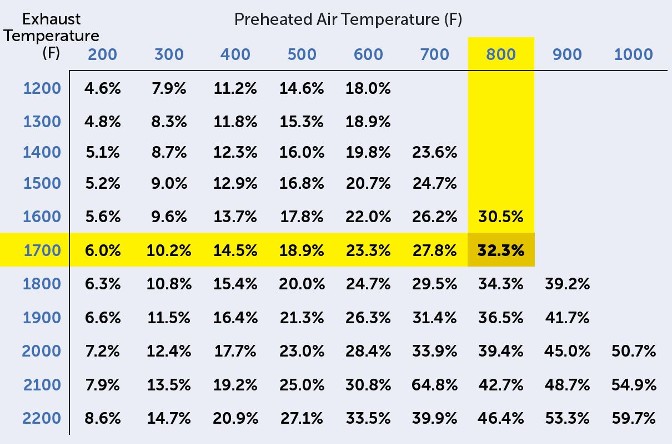
How much can be saved? To answer that question, I provide the above graph. It is not the end all be all but will provide a rough estimate of potential savings. It is for an application with an exhaust temperature of 1600°F operating with 15% excess air.

As we can see, in this application, if we apply recuperation to preheat the air to 800°F, we will save 28% of the natural gas we would otherwise consume.

Before investing your money, an individual analysis of each application is required. This article’s purpose is simply to motivate the reader to invest the time necessary to properly determine, as I mentioned last month, if they have “uncashed checks” lying around their shop.

As always, please let me know if you have any questions.

About the Author:

John Clarke, with over 30 years in the heat processing area, is currently the technical director of Helios Corporation. John’s work includes system efficiency analysis, burner design as well as burner management systems. John was a former president of the Industrial Heating Equipment Association and vice president at Maxon Corporation.


Find heat treating products and services when you search on Heat Treat Buyers Guide.com


The “Known – Unknown”: Preparing Your Facility for Unpredictable World Events Read More »

Are You Holding on to Uncashed Checks?

op-ed

To not invest money in worthwhile projects makes as much sense as not depositing your paycheck. In this column, we will briefly look at energy and gas “checks” you might have received in the mail but have yet to cash.

This column is a Combustion Corner feature written by John Clarke, technical director at Helios Electric Company, and appeared in Heat Treat Today’s February 2022 Air & Atmosphere Furnace Systems print edition.

If you have suggestions for savings opportunities you’d like John to explore for future columns, please email Karen@heattreattoday.com.


John B. Clarke
Technical Director
Helios Electric Corporation
Source: Helios Electrical Corporation

The late Fred Schoeneborn, a long-time energy consultant and friend, described energy savings opportunities that have been identified but not exploited as uncashed checks. To expand on Fred’s metaphor, not to look for opportunities to save natural gas is the equivalent of not collecting and opening your mail.

A furnace or oven is a box that contains the work being processed and the heat used in the process. It is an imperfect box because we are always losing heat. While it is imperfect, there are often opportunities to improve your oven’s performance, saving energy and generally improving quality. (You may notice if you have read a few of my columns, energy savings and quality improvements nearly always coexist.)

At the start of this series, we asked several questions. This time we will consider the following:

  1. Is my furnace or oven at the correct internal pressure?
  2. Is it time to rebuild door jams?
  3. How much fuel is wasted because I am not containing heat within the furnace or letting excessive air reduce my combustion efficiency?

Furnace pressure (in a non-vacuum application) is the simple function of the volume of the material introduced vs. the area of all the openings in our box. The obvious inputs are the products of combustion for direct fired systems, or the atmosphere for indirect systems.

What is the optimum pressure for my system? In general, the best pressure is the lowest pressure at which no tramp or unwanted air can enter the system and contaminate the atmosphere or upset the temperature uniformity. The lower the pressure, the less chance we will have excessive losses around door seals or other furnace penetrations. Most commonly, these pressures are measured in the hundredths or tenths of inches of water column.

In many applications, door sealing surfaces or jams take quite a beating. Their maintenance is expensive in terms of money, labor, and lost production. Expensive, yes, but the cost of NOT maintaining these surfaces may be much more. Losses are a result of radiant and convective losses, but most significantly, product quality because of atmosphere contamination or areas of the furnace not reaching setpoint temperature. When should we maintain these surfaces? In general, the best results I have observed are people who schedule surface maintenance periodically based on wear and available furnace downtime.

Calculating the savings from these fuel savings is more difficult, but in general, maintaining a consistently uniform interior work area saves more than the energy conserved.

About the Author:

John Clarke, with over 30 years in the heat processing area, is currently the technical director of Helios Corporation. John’s work includes system efficiency analysis, burner design as well as burner management systems. John was a former president of the Industrial Heating Equipment Association and vice president at Maxon Corporation.

Are You Holding on to Uncashed Checks? Read More »

Merry Christmas from Heat Treat Today

We will be celebrating the holidays with family, so look for your next Heat Treat Daily on January 3rd.

2021 has been a transformative year! Because we love people and 2021 saw the return of in-person, face-to-face events, seeing you in and around the trade show halls has been our #1 memory from 2021! What a joy to see and talk with so many of you.

In 2022, we’re looking forward to keeping you well informed by sharing relevant and compelling technical content, industry news, and innovative trends in the North American heat treat industry.

We are thankful for you and here’s our year-end prayer for you and yours, “May you experience the peace and hope that only Christ can give. Wishing you the joy of the Lord as we celebrate the birth of the Savior.”

- The Heat Treat Today Team

Merry Christmas from Heat Treat Today Read More »

How to Lower the Cost of Operating Your Burner System

We continue to consider the topic of natural gas pricing and reduction and its impact on heat treaters. Much of the discussion in this month’s article initially appears to deal with process quality or consistency. But understand, process consistency and energy savings are inextricably linked.

This Technical Tuesday column appeared in Heat Treat Today’s December 2021 Medical and Energy print editionJohn Clarke is the technical director at  Helios Electric Corporation and has written about combustion related topics throughout 2021 for Heat Treat Today.

In February 2022, we will continue this series. Please forward any questions or suggestions to our editor Karen@heattreattoday.com.


John B. Clarke
Technical Director
Helios Electric Corporation
Source: Helios Electrical Corporation

No matter what method we pursue to save natural gas, it is safe to assume it will require some investment — time and/or materials. Furthermore, we want a payback from this investment. To calculate the payback, we need to estimate the cost of the project as well as the value of the natural gas saved. We can generally nail down the cost of a project by obtaining quotes for materials and labor, but it is more difficult to know what the future cost of natural gas will be; and without knowing the savings, the payback is at best an educated guess.

As we have discussed in previous articles, demand for North American natural gas is increasing for electrical power generation as well as liquified natural gas (LNG) export to areas in the world with limited supplies. These are steady, predictable demands and less susceptible to seasonal variations in temperature. Less heating demand during warmer winters is generally offset by greater electrical power generating demands during warmer summers.

Let us revisit recent trends in the cost of natural gas. The graph below depicts the spot price for 22 consecutive trading days ending November 2, 2021.

Figure 1. Henry Hub price for natural gas

Beware of the displaced origin on the graph below — it makes the fluctuations in the spot price appear greater than they are, but it is done to indicate a range of prices — generally around $5.50/mmBTU. (Once again, neither the author nor Heat Treat Today presents the opinion of future prices for any purpose other than to further our discussions of energy saving project paybacks.)

Last month, we posed three questions:

  1. How do I know when the material I am heating is at the desired temperature?
  2. Do I have excessive factors of safety built into my process to compensate for not knowing the temperature at the core of the part being heated?
  3. How much fuel can I save with a shorter cycle?

Much of the discussion in this month’s article initially appears to deal with process quality or consistency. But understand, process consistency and energy savings are inextricably linked.

What temperature is my furnace or oven?

You walk up to the controls and read 1650°F. Is that the temperature of your oven? The answer is a definite “maybe” because the temperature displayed on a single loop temperature controller is simply the reflection of the small voltage generated by one thermocouple. This is obvious, or else we wouldn’t need to run temperature surveys. But the question is — do we have to live with this shortcoming? The answer to this question is a definite “no”! Modern control instrumentation makes it easy to use many thermocouples to sense the temperature of the furnace throughout the chamber. Then take the mean of these values to calculate the temperature and use this average value for the input to our temperature control loop. By comparing the readings of temperatures at various points in the furnace chamber, we can sense if all the work being heated is near to the desired setpoint.

No furnace load is perfect — there is always some non-uniformity of mass or surface area. With multiple sensing points, the more massive and slower to heat portion of the load will influence the nearest thermocouple. The furnace control can be designed to hold until the coolest thermocouple in the chamber reaches some minimum temperature. Perhaps this is now the trigger for a soak timer.

In addition to measuring multiple chamber temperatures and inferring the actual temperature of the work, the proportional integral derivative, or PID, temperature control algorithm provides a good deal of insight as to how close the work is to the desired furnace temperature. All PID controllers or programmed functions provide an output value. For our discussions, we will assume the output is between 0-100%. This output is used to control the heating element(s) of burners’ input levels. The advantage of the PID loop is that it calculates the required value more rapidly than a conventional on/off control — providing us the near steady values for our furnace temperatures.

Let’s imagine we adjust the temperature setpoint of our empty furnace to 1650°F. We will allow it to come to temperature and wait an hour until it is soaked out, so that the refractory and internal components are at some steady state temperature. The PID loop will settle to some average value; we will assume this value is 35%, which represents the holding consumption of the furnace. The heat entering the furnace is in equilibrium with the heat being lost through the refractory, up the flue, around the door, etc.

Now we load the furnace with 4000 pounds of thick steel parts, where the mass/surface area ratio is very high. The furnace thermocouple(s) will reach 1650°F in one hour; but, if we look at the PID loop output, it will take time for it to fall to 35%. The time between the indicated 1650°F and the output falling to 35% is a period when the work continues to absorb heat and conduct it to its core. When the output stabilizes at 35%, we know the work is soaked out at temperature — in other words, the surface and core of the parts are at the furnace setpoint temperature.

Do I have excessive factors of safety built into my process to compensate for not knowing the temperature at the core of the part being heated?

With added insight into the actual temperature of the work being heated, excessive soak times can be reduced without risk. It also allows for the running of light and heavy loads with the same program.

How much fuel can I save with a shorter cycle?

Building on the same hypothetical; assume the input to this furnace is 4,000,000 BTU/Hr and 1,000 hours are saved per year — the savings will be roughly 4,000,000 BTU/Hr x 0.35 (holding consumption) x $5.50/mmBTU x 1,000 Hours per year, or $7,700/year. Now, perform this modification on four furnaces. Add to this savings the increased confidence that the work is at temperature before the soak period is initiated, better consistency for varying part loading, and I think we can agree — we have a project. The only question is, will we cash the check?

About the Author:

John Clarke, with over 30 years in the heat processing area, is currently the technical director of Helios Corporation. John’s work includes system efficiency analysis, burner design as well as burner management systems. John was a former president of the Industrial Heating Equipment Association and vice president at Maxon Corporation.

How to Lower the Cost of Operating Your Burner System Read More »

Message from the Editor: Firsts

OCLet's talk about "firsts" and the importance of starting new adventures in the heat treat industry. From her editorial perspective, Karen Gantzer, editor of Heat Treat Today, shares her experience meeting the patient, informative experts in the heat treat industry in today's original content article. Where will your next "first" take you?

This article first appeared in Heat Treat Today's November 2021 Vacuum Furnaces print edition. Feel free to contact Karen Gantzer at karen@heattreattoday.com if you have a question, comment, or any editorial contribution you’d like to submit.


Karen Gantzer
Managing Editor
Heat Treat Today

In January of 2019, our publisher and close family friend, Doug Glenn (Doug, his wife Mary, and I go all the way back to our days at Grove City College), called me, a middle school English teacher, and asked me if I’d consider working for them as an editor. While I was honored that they would think of me, my initial response was something like, “Doug, I don’t know anything about heat treating and besides, I’m a humanities girl, not STEM!” He assured me that I could learn the industry and it would be a fun ride. A first for me to dip my toes into STEM waters!

Well, fast forward to present day, having just passed my second year with the Heat Treat Today team, I can truly attest that it has been an exciting, yet growth-filled adventure in many ways. I don’t teach and grade papers of 7th and 8th graders, but I do have the privilege to work with the most talented and inspiring group of dedicated and committed men and women. What a joy to look forward each day to working not only with the Heat Treat Today team, but also with you, the experts in the industry.

I attended my first trade show in October 2019 — The ASM Heat Treat Show in Detroit. I was such a newbie and it was pretty overwhelming, but an enjoyable experience. Doug, Mary, and the managing editor, Laura Miller, were incredibly kind in not only introducing me to many of you, but I was also thankful for the patient tutorials many of you gave as I began learning the industry. I’ve mentioned this Socrates quote many times, but I truly believe it, “The beginning of wisdom is the definition of terms.” You helped me understand the terms!

While last year was a blur for us all with the cancellation of in-person trade shows, this year was an oasis for those of us extroverts who are energized by the face-to-face time that real, live shows provide. During this year’s Ceramics Expo in Cleveland and the ASM Heat Treat Show in St. Louis, I was able to meet so many of you — for the first time in person — who before this summer, I’d never met but had communicated with often.

Heat Treat Today team at the ASM Heat Treat Show 2021 in St. Louis. Left-Right: Michelle Ritenour, Doug Glenn, Karen Gantzer, Alyssa Bootsma, Ellen Porter, and Bethany Leone.

I truly believe we were created to be in community with one another, and these trade shows offered the opportunity to connect at a deeper level than emails afford. I loved talking with people about what they were working on and how Heat Treat Today could help in sharing their successes.

One of the people I had the pleasure of meeting was Carlos Carrasco of Carrasco Industrial Furnaces, a veteran expert in the industry. As we were chatting about article ideas, he asked if we’d be open to publishing the content in both English and Spanish. We loved the idea and so, with this issue, we are proud to feature our first ever Spanish-translated article entitled, “Guía para la Selección de Equipos para Tratamiento Térmico!” (p.33) which is “A Guide to Selecting Heat Treating Equipment” (p.28). We were honored to work with Carlos.

Taking those first steps can be wobbly, but oh so exhilarating when you experience the satisfaction of deciding to take on the unknown — whether it’s a career change, meeting new people, or accepting a new opportunity. It’s worth the effort. Go for it!

Message from the Editor: Firsts Read More »

Skip to content