


READER FEEDBACK

Reader Feedback: ‘Settled’ Science or an Agenda? Part 2

Our last Reader Feedback edition showcased several comments from readers responding to the letter from the publisher, entitled “What If We’re Wrong About CO2 & Global Warming? In his letter in Heat Treat Today’s January 2025 Technologies To Watch print edition, publisher Doug Glenn challenged the “assumption that global warming, and specifically man-induced global warming, is a real and settled science.”

In this follow-up, we share a reply from a reader who comes to the discussion from a different perspective.

Would you like to weigh in on the topic? Submit your question, comments, thoughts, or queries here or email Bethany Leone at editor@heattreattoday.com.


Here is an excerpt from the publisher’s page:

“I’d like to challenge that assumption. Firstly, legacy media, the federal government, academia, and the scientists who deliver the science we’re called to follow — i.e. “follow the science” — are all strong proponents of man-made global warming and the evil of CO2. This grouping of authorities, in and of itself, causes many to be suspicious, given this group’s historic record of dishonesty and deception. If this group has been so wrong in the past on macro-social economic issues (e.g., Covid) would it not be reasonable to question their claims about climate change?

Secondly, the science doesn’t seem to be as settled as claimed.”


This publisher’s page prompted this feedback from loyal reader Markus Kick, Phoenix Contact GmbH & Co. KG:

Thoughts on “What If We’re Wrong About CO2 & Global Warming?”

“I wanted to share some thoughts on an article from one of my favorite US magazines, Heat Treat Today. If you’re in the thermal processing field, Heat Treat Today is a must-read!

I’ve been working globally in automation and digitalization in industrial thermal process technologies for over 20 years, focusing on furnaces, melting tanks, and boiler systems. So, I know my stuff. It’s really troubling to see human-caused climate change being questioned. But it’s important to discuss every opinion clearly, and that speaks to the quality of Heat Treat Today without losing sight of reality. Our planet and future don’t have a Plan B.

The scientific community overwhelmingly agrees that climate change is real and primarily caused by human activities. Over 97% of climate scientists agree that human activities, especially burning fossil fuels, are the main cause of global warming. This consensus is supported by science academies from 80 countries. Data from the Federal Statistical Office shows that the impacts of climate change are already being felt. Extreme weather events like heatwaves and floods have increased in recent years, causing significant damage.

It’s crucial that we rely on solid scientific evidence to tackle the challenges of climate change. Industrial thermal process technology must always be discussed globally as a team because we all have an impact on this wonderful, millennia-old tradition of heat treatment. The industry shouldn’t work with private opinions but should shape the future for our kids. Especially the thermal industry must ensure that we still have our planet tomorrow. The world is a ‘we,’ not an ‘I.’

Let’s work together to create a sustainable future. By trusting scientific findings and collaborating globally, we can ensure that the tradition of heat treatment continues while protecting our planet.

Sources:

Our World in Data: This source provides a comprehensive breakdown of global greenhouse gas emissions by sector, highlighting the significant contributions of energy, transport, and industry

Intergovernmental Panel on Climate Change (IPCC): The IPCC’s reports offer detailed assessments of the scientific basis of climate change, its impacts, and potential future risks

National Aeronautics and Space Administration (NASA): NASA’s Climate Change and Global Warming portal offers extensive data and research on the causes and effects of climate change

United Nations Framework Convention on Climate Change (UNFCCC): The UNFCCC provides international policy frameworks and agreements aimed at combating climate change.

World Resources Institute (WRI): WRI’s research includes data on global greenhouse gas emissions and strategies for reducing them.”


Heat Treat Today thanks Markus for his input and perspective, and we encourage all respectful inquiries or feedback on Heat Treat Today articles. Submit your questions/comments to editor@heattreattoday.com.

Reader Feedback: ‘Settled’ Science or an Agenda? Part 2 Read More »

Reader Feedback: ‘Settled’ Science or an Agenda?

Readers are checking out Heat Treat Today’s magazine, and the January 2025 Technologies To Watch print edition has a piece that sparked comments from readers. The letter from publisher Doug Glenn entitled “What If We’re Wrong About CO2 & Global Warming? challenges the “assumption that global warming, and specifically man-induced global warming, is a real and settled science.

Would you like to weigh in on the topic? Submit your question, comments, thoughts, or queries here or email Bethany Leone at editor@heattreattoday.com.


Here is an excerpt from the publisher’s page:

“I’d like to challenge that assumption. Firstly, legacy media, the federal government, academia, and the scientists who deliver the science we’re called to follow — i.e. “follow the science” — are all strong proponents of man-made global warming and the evil of CO2. This grouping of authorities, in and of itself, causes many to be suspicious, given this group’s historic record of dishonesty and deception. If this group has been so wrong in the past on macro-social economic issues (e.g., Covid) would it not be reasonable to question their claims about climate change?

Secondly, the science doesn’t seem to be as settled as claimed.”


This publisher’s page prompted this feedback from loyal reader Roger Hird of W.H. Kay Company:

“Thank you for your column in the recent HTT issue.  As a longtime climate skeptic, articles like yours are exactly what’s needed to push back on continued efforts to use climate change as a tool for massive government interference in all phases of life.

Sadly, the EU is much further down the road in their Climate zealotry, and we’re reading how these efforts are even pushing some European landowners to close down their farms to avoid crippling penalties in the decree of decarbonization. 

This past election puts the proverbial ‘finger back in the dike’ of climate-based government intrusion in our economy and daily lives, and thank God for that! 

Keep up the great work Doug.” 

Doug’s reply:

“The well-meaning folks in our government will continually find ways of expanding their scope and power. Let’s assume 90% of them mean well. The fact is, the government should NOT be in 90% of the stuff they’re currently in. It is our responsibility to reign them in, politely if possible.

Keep fighting the good fight when and where you’re able. The publisher’s page is one place I’ve been blessed to use in my little corner of the world.  Not everyone agrees, but that’s the way it ought to be.”

From reader Kevin O’Brien, Birmingham, Michigan:

“Quick note to thank you for your editorial. Yes, agree on the idea that we are re-shaping and re-orienting too many aspects of our economy and society because there is an agenda being pushed by a group. Even more so when you consider that many of the people pushing the agenda stand to gain from massive government spending in this arena. All too often, the environmental ‘movement’ seems to be acting on and reacting to published material that seems more like the flavor of the month rather than solid, steady scientific findings…. The result is that large numbers of people experience a negative outcome (higher prices, more regulations) with no means for redress.”

Doug’s reply:

“Very much agree with your assessment of ‘flavor of the month.’ My content is that we should trust the market and not well-meaning individuals in positions of power to determine the direction of the world’s environmental movement. If everyone in the world were genuinely concerned about global warming, they would demonstrate that sincere concern by spending money in that direction. That in turn would encourage companies to follow the consumer’s lead. We don’t have enough faith in the market … or as Adam Smith would say, the Invisible Hand!”

From reader Steve Maus:

“I have followed this issue with great interest for decades, and so I am familiar with the work and comments of the prominent figures you have referenced. My studies toward a metallurgical engineering degree included significant coursework in organic chemistry and thermodynamics, and in my career, I’ve done extensive hands-on work with CO2 and its many reactions. With that in mind, I tend to agree with the skeptics because the chemistry simply does not support the claims of those who predict catastrophic global effects due to small changes in atmospheric CO2.

It seems to me that our industry ought to encourage frank debate of the issue, and that we should demand that it be based on a critical look at the entire chain of generating process heating, and on the genuine effects of CO2 emissions.  Simply moving the generation of CO2 away from the point of natural gas-based heating and transferring it to the source of generating electricity with fossil fuels or ‘renewable’ sources that have issues of their own or using fuels that require electric power to generate them, is not accurately addressing the situation.  Otherwise, it appears to be a situation of doing something just to do something, for reasons that may not well-considered.  And as we have seen with other attempts like EVs, solar panels and wind turbines, the solutions often come with problems of their own, so we ought to learn the lessons and apply them here.

But I digress. Doug, I applaud you for raising the question, and I look forward to the healthy discussions that will be provoked by it.”

Doug’s reply:

“Thanks for the encouragement, Steve. I hope you’re doing well. By the way, if you haven’t read the article I referenced from The Epoch Times, I highly recommend it. If what they are saying in that article is true (regarding ‘saturation’ of CO2), then the whole issue becomes moot … IMHO! It is worth the read.”

From reader Dean Keal of IGE Fans:

“I think you are spot on.  Aside from all the science debunking this, history has shown the planet has been warmer in the past than it is currently. Heck, in the medieval warming period, the Vikings were grain farmers on Greenland. I think this whole fiasco is about power and control, not science. Unfortunately, there are so many people making money from this issue it has become entrenched. Perhaps President Trump will interject some common sense.”

Doug’s reply:

“Thanks, Dean. Appreciate the encouraging words. Not everyone agrees, but most everyone that has taken the time to respond has been respectful and MOSTLY in agreement. There was one who vehemently disagreed but we’re still on speaking terms!”

We welcome your inquiries to and feedback on Heat Treat Today articles. Submit your questions/comments to editor@heattreattoday.com.

Reader Feedback: ‘Settled’ Science or an Agenda? Read More »

Reader Feedback: Don’t Dis the DOE

Readers are checking out Heat Treat Today’s magazine, and the April/May 2024 Sustainable Heat Treat Technologies print edition has a piece that sparked a comment from a reader. The letter from publisher Doug Glenn, entitled “The DOE IS Coming After YOUR Job“, debates the question of policy-driven market forces over economy-driven indicators.

Would you like to weigh in on the topic? Submit your question, comments, thoughts, or queries here or email Bethany Leone at editor@heattreattoday.com.


Here is an excerpt from the publisher’s page:

“On the fourth slide of a presentation entitled, ‘Cross Sector Technologies Meeting: Day 2, Nex-Generation Enabling Technologies,’ presented by Mr. Chan on May 30, 2023, we find the following: 

  • DOE Commitment to Industrial Decarbonization (slide title)
  • ‘Industrial Heat Shot — Developing technologies to reduce process heating GHG emissions by 85% by 2035′
  • ‘Industrial Decarbonization Roadmap — Net-zero CO2 emissions by 2050′

The same slide goes on to list four international organizations that the U.S. has joined to ‘decarbonize’ energy-intensive industries. Those four organizations are:

  • Net-Zero World Initiative
  • G7 Industrial Decarbonization Agenda
  • Mission Innovation’s Net-Zero Industries Mission
  • UNIDO’s coordinated Industrial Deep Decarbonization Initiative”

This publisher’s page prompted this feedback from loyal reader Jim Conybear:

“I enjoy keeping up with the industry through Heat Treat Today. I read your recent editorial, “The DOE is Coming After Your Job”. Although you make some interesting and provocative comments, I think you did a disservice to the work being done by the DOE. Without their efforts, we would be even further behind in our needed efforts to combat the wasteful use of energy. The headlines you extracted from the presentation by Isaac Chan, fourth slide . . . do not mean that there is an either/or decision on fossil fuels. They are, in fact ,very good goals to pursue if we are to continue to make progress. 

I have known Isaac Chan since his early days with the Gas Research Institute and the DOE. Never did he advocate the elimination of all combustion processes. On the other hand, he has led many industry and government programs that enabled our industry in particular to reduce costs and improve productivity by identifying and supporting more efficient, environmentally compatible processes. 

Isaac Chan is a friend to our industry, not the enemy. I would enjoy seeing an interview with him to present a more realistic assessment of the problems and potential solutions to our carbon excesses.” 

We welcome your inquiries to and feedback on Heat Treat Today articles. Submit your questions/comments to editor@heattreattoday.com.


Reader Feedback: Don’t Dis the DOE Read More »

Reader Feedback: The State of the Quality Movement

Readers are checking out Heat Treat Today’s magazine from March/April 2024. The annual Aerospace print edition has a piece that sparked a comment from a reader. The letter from the publisher Doug Glenn entitled “Is It Time To Rethink the ‘Quality’ Movement?” discusses the current state of the quality movement.

Would you like to weigh in on the topic? Submit your question, comments, thoughts, or queries here or email Bethany Leone at editor@heattreattoday.com.


Here is an excerpt from the publisher’s page:

“One of the first thoughts I remember having about the corporate quality initiative I was involved with was the distinct lack of a definition of what ‘quality’ really meant. For many of the standards, they did not really care what you did (whether or not you did quality work), they just wanted you to prove you had documented your work, that your people knew said documentation existed, and they were following the processes you had described in documentation.”

This publisher’s page prompted this feedback from Jorg Demmel, founder, owner, and president of High Temperature Concept:

“There is one thing I’d like to ask you, because I just read your publisher letter. I like it, although the situation you describe is not ‘quality’ in my mind. It’s a great discussion, which is worth it!

“It’s, in my mind, an oversubscription of quality management and it’s industry. That’s something different than quality. I don’t like these guys called ‘auditors’. Some (or many) never learned what means ‘operational quality’.

“Did you know that e.g. an iso 9001 certified company doesn’t have to follow the iso 9001 10 chapters in their QM handbook. Or, that not all suppliers have to be rated. Or, that internal audits don’t have to be bureaucratic and elaborative. Etc. 

“Conclusion: a QM system is only as good as it is based on the people on the shop floor, their motivation, experience and attitude, and the leadership commitment. I guess I missed something 😉.”

We welcome your inquiries to and feedback on Heat Treat Today articles. Submit your questions/comments to editor@heattreattoday.com.

Reader Feedback: The State of the Quality Movement Read More »

Reader Feedback: AMS2750 The Temperature Debate

Readers are checking out Heat Treat Today's magazine from February 2023. The annual Air & Atmosphere Furnace Systems edition has a piece that sparked a comment from a reader. The letter from the publisher Doug Glenn entitled ± 0.1°F – The Debate discusses revision to AMS2750 regarding compliance temperature.

Would you like to weigh in on the topic? Submit your question, comments, thoughts, or queries here or email Bethany Leone at editor@heattreattoday.com.


Here is an excerpt from the article:

“Both Revision D and E of AMS2750 required compliance temperatures to be ±2°F or ±1.1°C (“or ±0.2%” was added in Revision E). That pesky “.1” in ±1.1°C appears to be the source of this most current “situation.” The folks using °C were recording temperatures down to 1/10th of a degree, while the folks using °F — which was not a small number of people — were not. So, the standards committee needed to make a decision on what to do about this discrepancy. The options were to round up or down or to the nearest integer for both °F and °C people OR require EVERYONE to record their temperatures down to 1/10th of a degree. After surveying end-users, the committee decided that end-users wanted to be required to record the 1/10th of a degree rather than round it up or down to the nearest integer. Thus, the new AMS2750 standard requires accuracy to 1/10th of a degree.”


The article prompted this feedback from reader Aaron Crum:

“I could not agree with you more. This is like measuring a piece of lumber with a tape measure, but being required to record the number in microns.  Making requirements more stringent just for the sake of it costs companies real money with no improvement to the process or the product.  I hope this gets removed in the next revision.

Thanks for the good write-up Doug!”


We welcome your inquiries to and feedback on Heat Treat Today articles. Submit your questions/comments to editor@heattreattoday.com.

Reader Feedback: AMS2750 The Temperature Debate Read More »

Reader Feedback: Measuring Junction Construction in AMS2750 Rev. G

Readers are checking out recent AMS2750 Rev. G changes and want some more information from Heat Treat Today about a specific clarification. Read the correspondence about the implications of AMS2750 Rev. G paragraph 3.1.1.5 about how to measure junction construction.

Douglas Shuler, lead auditor at Pyro Consulting, has written numerous articles with Heat Treat Today about AMS2750 standards. Check them out by searching "Doug Shuler" at www.heattreattoday.com.

Submit your question, comments, thoughts, or queries here or email Bethany Leone at editor@heattreattoday.com.


READER QUESTION: After combing the new AMS2750 Rev. G, I found that paragraph 3.1.1.5 no longer allows thermocouples to be tack welded directly to parts, OR to representative dummy parts. This has been standard practice for decades. So I dug into it further with the folks from PRI and it turns out to be true. They’re now expecting load thermocouples to be either placed inside of a part (ends twisted and inserted), or inside the hole of a dummy block.

I’d done some searching online and there isn’t a single source talking about this major change. This could lead to a lot of failed upcoming Nadcap audits.

Doug Shuler
Lead Auditor
Pyro Consulting

Douglas (Doug) Shuler (Pyro Consulting) for Heat Treat Today: Historically (i.e. prior to Rev. F), AMS2750 was silent on measuring junction construction. In Rev. F, the construction of the measuring junction was as follows:

Measuring junctions shall be made by any combination of twisting and/or welding the thermal elements provided there is no addition of filler metal.

This raised concerns about both the use of quick tips and spot welding to make the measuring junction. The AMEC AMS2750 revision team engaged with Cleveland Electric Laboratories to perform testing on these measuring junctions as compared to the twisting/welding combinations.

The conclusion of the tests were that both quick tips and spot welding to a part/heat sink became unstable at temperatures above 2000°F. The quick tip crimping point and the spot welds showed rapid oxidation and increased errors in a short period of time. Based on the results of these tests the AMEC AMS2750 revision team put forth the following update in Rev. G:

Measuring junctions shall be made by either of the following methods:

        • Any combination of twisting and/or welding the thermoelements provided there is no addition of filler metal (including ungrounded and grounded MIMS).
        • Spot welding the thermoelements directly to a part, simulated part, or heat sink is permitted for temperatures ≤2000°F or 1100°C.

This allows spot welding measuring junctions for process temperatures at or lower than 2000°F. The team and AMEC members decided that quick tips were to unstable to permit their use going forward.

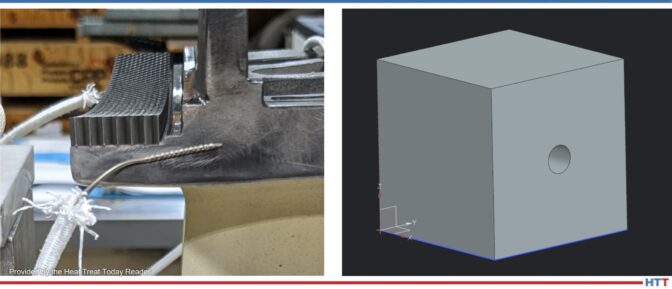
READER FOLLOW-UP: Our current method that we’re using is to twist the thermocouple using a set of Twister Pliers, then tack-weld that twist onto the part (first photo below). We’ve been doing this for parts up through brazing temperatures (~2150°F) without issue. We recently ran a furnace run around 2100°F with parts tack-welded as I’ve described AND had T/Cs that were just twisted with no tack weld. We noticed there was no significant difference in the temperature the TCs were reading. This was also our technique that we used at my previous company.

The way I read AMS2750 Rev. G was: You may twist and weld thermocouples to a part, but only for temperatures less than or equal to 2000°F.

To comply with Rev. G, we have gone ahead and made heatsink blocks to make sure we’re in compliance. Our new method of temperature measurement is twisting the wires and sticking the twisted end down inside of a block of solid metal (like the one I’ve shown below).

Source: Heat Treat Today Reader


We welcome your inquiries to and feedback on Heat Treat Today articles. Submit your questions/comments to editor@heattreattoday.com.

Reader Feedback: Measuring Junction Construction in AMS2750 Rev. G Read More »

Reader Feedback: The Effectiveness of Furnaces

Here is what readers are saying about recent posts on Heat Treat Today. Submit your comments to editor@heattreattoday.com.


Hello Heat Treat Daily,

I was surprised to see this bright red furnace on your daily email this past Friday. This is an old image of a furnace still in production at my company Spectrum Thermal Processing in Cranston, RI.

Now, like most of us, this furnace is showing some age, but is is still in production every day with an upgraded control panel and SSI controls.

I reflected on this particular email and want to add that what I find intriguing about heat treat is the longevity of some of the equipment. This furnace processes work for aerospace, automotive, commercial cutting tools and oil and gas refinery and has for nearly 30 years! Just to the left of this furnace in the photo is an older single chamber vacuum furnace that has process parts for the Apollo space program and has recently processed parts for SpaceX. Somehow this equipment just keeps going.

Thanks for your daily insight into the heat treating industry.

Rick Houghton
VP of Operations/Quality Manager
Spectrum Thermal Processing


We welcome your inquiries to and feedback on Heat Treat Today articles. Submit your questions/comments to editor@heattreattoday.com.

Reader Feedback: The Effectiveness of Furnaces Read More »

Reader Feedback: Thermocouples 101

Here is what readers are saying about recent posts on Heat Treat Today. Submit your comments to editor@heattreattoday.com.


On John Niggle and Ed Valykeo article, "Thermocouples 101" (click here to see original article)

John Niggle, Business Development Manager, Pelican Wire

Edward Valykeo, Thermocouple Specialist, Pelican Wire

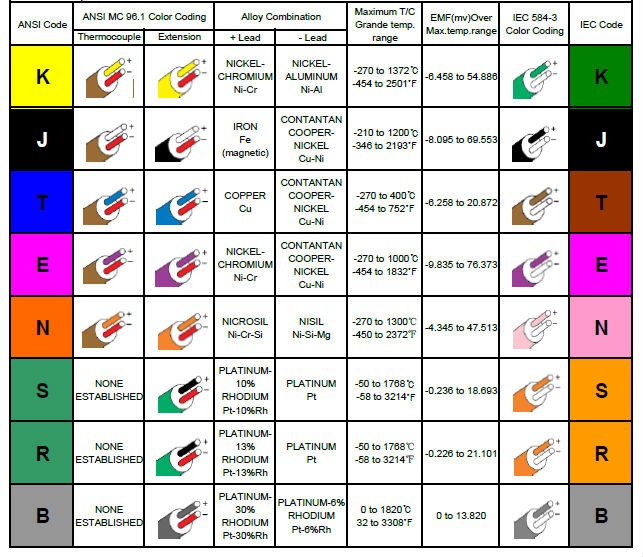
In June 2020, Heat Treat Today published a noteworthy technical article on the basics of thermocouples by John Niggle, Business Development Manager, and Ed Valykeo, Thermocouple Specialist, at Pelican Wire, Naples, FL. The article covers the different types of thermocouples, questions to consider when deciding which type of thermocouple to use, as well as a fascinating discussion on thermocouple wire and wire insulations. One feature of significant recognition is the chart included by Niggle and Valykeo:

Thermocouple Color Code Chart (photo source: "Thermocouples 101")


One of Heat Treat Today's editorial contributors and readers, Martin Reeves of Unitherm Furnace, LLC, saw this article and provided valuable information to the subject:

Martin Reeves, Owner, Fontec-global, LLC

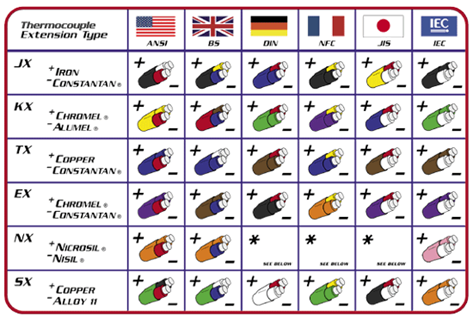
"Excellent article and a great base for understanding T/C's. Only one thing missing and that is the differences between US and international lead colours. These are very different and when equipment is sold overseas or imported this becomes important for T/C's to be wired correctly."

International Thermocouple Lead Colors (photo source: Martin Reeves)


We welcome your inquiries to and feedback on Heat Treat Today articles. Submit your questions/comments to editor@heattreattoday.com.

Reader Feedback: Thermocouples 101 Read More »

Reader Feedback: Reusing Non-expendable Base Metal Thermocouples

Here is what readers are saying about recent posts on Heat Treat Today. Submit your comments to editor@heattreattoday.com.

Jason Schulze has written numerous articles for HTT about AMS2750E. Check them out by searching “Jason Schulze” at www.heattreattoday.com


Jason Schulze, Aerospace Heat Treating
Jason Schulze, Conrad Kacsik

READER QUESTION: As per AMS2750E, what is the number of reuses for nonexpendable base metal thermocouples (N type MIMS TCS) above 980°C? Our application is TUS and SAT from 700°C  to 1250°C. We would like to use N type MIMS thermocouples for both TUS and SAT. Recalibration period is specified as 3 months for N type thermocouples in AMS2750E. But no details are provided for the number of reuses above 650°C.

Jason Schulze (Conrad Kasik) for HTT: The number of permitted uses depends on the intended use of the thermocouple. For example, if the Type N thermocouples are used at 980°C (1796°F) as load thermocouple, the maximum permitted use would be 3 months or 180 uses, whichever comes first. If the thermocouple is used as a resident SAT thermocouple, it would need to be replaced every three months. In this case, the usage limit would be limited to 3 months. This will not be changing when the new version of AMS2750F is released.


We welcome your inquiries to and feedback on Heat Treat Today articles. Submit your questions/comments to editor@heattreattoday.com.

Reader Feedback: Reusing Non-expendable Base Metal Thermocouples Read More »

Reader Feedback: On SATs, Correction Factors, & Possible Findings

Here is what readers are saying about recent posts on Heat Treat Today. Submit your comments to editor@heattreattoday.com.


On Jason Schulze’s article, “Understanding AMS2750E—Standard SAT Description” (click here to see original article):

READER QUESTION: Just read your article in regards to system accuracy test. I just had a question that maybe you can help me understand. When applying the correction factor of the test instrument and test sensor, is the correction factor to be used based on the furnace set point (operating temperature) at the time of the test or the recording instrument reading during the test? Any insight is appreciated!

Jason Schulze (Conrad Kacsik) for HTT:

Jason Schulze
Jason Schulze, Conrad Kacsik

This is a question that comes up often in the pyrometry courses I teach.

The Nadcap Pyrometry Reference Guide, question #6, addresses this question, although from a TUS standpoint. The premise is the same for the SAT process though.

Correction factors applied to any test results (TUS & SAT) should be determined based on the setpoint temperature during testing.

One thing to remember is that you may be testing at a temperature which does not fall directly at a temperature indicated on the test wire/test instrument calibration certificate. In this case, you would have two options;
1) Linear Interpolation
2) Pick the adjacent calibration temperature closest to your setpoint during test.

Either way, you would need to establish if you execute #1 or #2 above and document that in an internal procedure.

READER QUESTION: Thanks for the feedback, I have another concern. I perform an SAT on a refrigeration unit that operates at -20 degrees. My test instrument and test sensor are both calibrated at a low temperature of -20, but sometimes the recording instrument indicates a temp of -21 degrees or so. My operating temperature is -20 (setpoint), but as I stated it might indicate a lower temperature. Is there a possible finding here? Although setpoint is -20, recorder shows -21, which the test instrument/sensor does not cover (calibration point).

Jason Schulze for HTT:

You should be in no danger of a finding. The pyrometry guide states the correction factors are based on setpoint.


We welcome your inquiries to and feedback on Heat Treat Today articles. Submit your questions/comments to editor@heattreattoday.com.

Reader Feedback: On SATs, Correction Factors, & Possible Findings Read More »

Skip to content