A global provider of industrial furnace controls and process automation solutions announced a new collaboration with a leading industrial gas company that combines the core competencies of each company into a comprehensive offering for heat treatment customers. Praxair Inc is based in Danbury, Connecticut, and produces and distributes atmospheric, process, and specialty gases and high-performance surface coatings. Customers will have access to Praxair’s gases, application technologies, and supply systems, along with United Process Control Inc’s portfolio of specialized industrial flow measurement and atmosphere control products. This continues the long-standing relationship between Praxair and Atmosphere Engineering Company, now a member of UPC, based in West Chester, Ohio.
The combined capabilities of the two companies will bring more end-to-end technologies for a broad spectrum of batch and continuous heat-treating processes such as carburizing, carbonitriding, neutral hardening, annealing, gas quenching, and heat-treatment applications under vacuum processing.
“The automotive and aerospace industries continue to expand requirements for heat treating,” said Steve Mueller, Praxair’s Associate Director of Business Development for Metals and Materials Processing. “We have a team approach in place, combining Praxair’s process know-how and expertise in industrial gases with United Process Controls’ specialized products. Together we meet customers’ requirements for high-quality heat treating with reproducible standards in their furnace operations.”
“This strategic agreement with Praxair reflects our commitment to offer the heat-treating industry a complementary and evolving portfolio of innovative technologies that help drive process efficiency and reliability. We look forward to working closely with Praxair in the coming years, as we strive to further increase our presence in North America,” said Paul Oleszkiewicz, President, UPC.
Heat Treat Todayoffers News Chatter, a feature highlighting representative moves, transactions, and kudos from around the industry.
Personnel and Company Chatter
Arathi Krishna has been appointed managing director of Sumdram Fasteners Ltd, based in Chennai, India, as her father and manufacturing veteran Suresh Krishna retires. However, Suresh Krishna will continue to be the director and non-executive chairman of the global auto components maker. Arathi Krishna has been the joint managing director of the company since 2011 and has been on the Board since 2006.
ASM International recently announced that William J. Lenling and Masahiro Fukumotohave been selected to become members of the 2018 Thermal Spray Hall of Fame by the ASM Thermal Spray Society Board of Directors. “Mr. Lenlingis a co-founder (1992) and CTO of TST Engineered Coatings in Sun Prairie, Wisconsin, which engineers and manufactures industrial coatings and coated components. The award citation reads: For sustained achievements in entrepreneurial advances of thermal spray processes and proven leadership in establishing state-of-the-art production processes and high value in-situ quality monitoring manufacturing practices. Dr. Fukumotois a professor of mechanical engineering at Toyohashi University of Technology in Japan. Award citation: For significant contributions to the development of thermal spray technology through innovative research, published papers, and leadership in TSS and Asian thermal spray societies.” (ASM)
UK-based Wallwork Cambridge, which supplies heat treatment, engineering, castings and vacuum equipment to the aerospace sector, has secured Rolls-Royce’s seal of approval for vacuum brazing, plasma nitriding, and heat treatment. With the installation of a vacuum brazing furnace and two new plasma nitriders, the company is more than doubling the nitriding capacity at Cambridge, enabling versatility and quicker processing of aerospace components.
Brandon Sheldon, a project manager based at Plibrico Refractory Construction‘s Salem, Ohio office, recently received his API 936 Refractory Personnel Certification from the American Petroleum Institute (API). The industry certification program certifies knowledge of API STD 936 Refractory Installation Quality Control Guidelines for field testing of monolithic refractory materials, as well as installation and repair of refractory linings. In addition, the certification program helps to align the company’s installation teams with third-party inspection services to facilitate improved quality assurance practices overall.
Solar Atmospheres, Inc., in Souderton, PA, recently installed a 74″ diameter by 72″ deep horizontal internal quench vacuum furnace, designed by Solar Manufacturing, Inc., to quench with argon at 10-bar while utilizing a 600 horsepower motor running at 460 volts from a variable speed drive, and rear head moveable gas baffle doors. The goal of the massive quench system is to be able to quench larger batches of power generation castings by increasing the cooling rate and eliminating the supplemental use of helium and operating in 100% argon.
An electrically heated cyclone pit furnace was recently delivered by Lindberg/MPH to a steel heat treater to be used for a heat treating process on aircraft components. The maximum temperature rating for this electric pit furnace is 1250ºF. The work chamber has a 38″ diameter x 48″ depth and is constructed with an alloy liner backed with 7″ of block insulation.
Spanish supplier of aluminum sheets and coils Aludium has announced that the company will install a multi-chamber furnace to reduce metal costs and improve the sustainability of its operations. The new furnace will be installed in the Amorebieta cast house and will increase Aludium’s ability to melt lacquered scrap and is due to come onstream during 2019. The multi-chamber furnace selected is a Hertwich Ecomelt PS275, a proven technology and one of the largest shaft furnaces in the world.
Solar Atmospheres, Inc., installs internal quench vacuum furnace
Lindberg/MPH delivers cyclone pit furnace
Aludium installs multi-chamber furnace
Kudos Chatter
Proudly presenting the certificates are (l-r) Director Georg Anzer, Managing Partner Renate Keinath and Head of Training Michael Vieth.
PyroGenesis Canada Inc. has announced that it has received certification for the production of metal powders under a quality management system which complies with the requirements of ISO 9001:2008. This certification is an amendment to the company’s existing ISO certification, pertains specifically to metal powder production, and was received under the auspices of a major independent risk and standards company, SAI Global.
Family-owned global manufacturer of plastic processing machines Arburg, based in Loßburg, Germany, has recently been presented three certifications: LQW, ISO, and IHK recognition. The LQW certificate was presented to the machine manufacturer in January after the successful completion of the “Learner-oriented Quality Certification in Continuing Education and Training”. The company received the approval of DIN ISO 29990:2010 “Quality Management Systems for Learning services for Non-formal Education and Training” inspection in February. In late 2017, the manufacturer was recognized with the “1A Excellent Training Company” award presented by the Chamber of Industry and Commerce (IHK) – Northern Black Forest region.
Countyline Tool, a Komet Service Partner based in East Peoria, Illinois, has attained ISO 9001:2015 certification. All Komet partners are currently working to obtain the ISO 9001:2015 certification, and Countyline Tool is the eighth partner to have completed the certification.
Heat Treat Today is pleased to join in the announcements of growth and achievement throughout the industry by highlighting them here on our News Chatter page. Please send any information you feel may be of interest to manufacturers with in-house heat treat departments especially in the aerospace, automotive, medical, and energy sectors to the editor at editor@heattreattoday.com.
The largest U.S. steel producer and “mini-mill” steelmaker recently announced plans to build a rebar micro mill near Frostproof, Florida, in a bid to capitalize on the growing demand for construction steel. The facility will produce steel rebar from scrap metal.
Charlotte-based Nucor Corporation will invest $240 million in the steel plant in Florida. The company began construction on its second rebar micro mill project in Sedalia, Missouri, in November 2017.
“Nucor has always focused on growing our business to better serve our customers. We are building this rebar micro mill in a great and growing market where demand is strong and there is currently an abundant supply of scrap, a good portion of which is handled by our scrap business,” said John Ferriola, chairman, CEO & president of Nucor Corporation. “Consistent with our planned strategy of being a low-cost producer, this micro mill will give us a cost advantage over our competitors who are shipping rebar into the region from long distances.”
The rebar micro mill, which will produce steel rebar from scrap metal, is expected to have an estimated annual capacity of 350,000 tons.
Dave Sumoski, executive vice president of Merchant and Rebar Products
“We would like to thank the many state and local officials, leaders, and partners who have assisted us with the project,” said Dave Sumoski, executive vice president of Merchant and Rebar Products. “Identifying the right location is an essential part of our rebar micro mill strategy, and this part of central Florida met all the criteria we evaluate. We look forward to becoming a member of the community.”
An agreement to bring high-performance differentials and differential technologies from the premium market to the general market of passenger cars, light trucks, crossovers, SUVs was recently finalized between an American driveline and powertrain technologies engineering and manufacturing firm and a German supplier to premium European-based automakers.
Alberto Satine, President AAM Driveline
The expanded relationship between American Axle & Manufacturing, Inc. (AAM), which serves automotive, commercial, and industrial markets, and Drexler Automotive GmbH, which manufactures high-performance limited slip differentials, racing transmissions, drive shafts, and wheel hub systems, immediately integrates electro-mechanical limited slip differentials (eLSDs) into the AAM TracRite family of differential products. These systems greatly improve vehicle handling and traction for all-wheel drive or rear-wheel drive vehicles. The system, used extensively in high-performance vehicles from premium OEMs, provides active torque control of the wheels by translating vehicle torque requests into accurate axle torque response.
“AAM and Drexler are partnering to offer the market mature differential technology that will allow the general driver new levels of excitement by taking handling and traction to new levels of performance,” said Alberto Satine, President AAM Driveline. “Combining AAM and Drexler’s design, engineering and manufacturing expertise will provide our customers with the highest-quality, most-advanced driveline systems.”
The system’s power-dense, four-pinion differential design supports axle modularity with open and eLSD differentials in the smallest packaging space. Additionally, the scalable clutch, actuation, and differential design of the technology drives a wide range of applications and vehicle segments.
Herbert Drexler, Drexler Automotive Founder
“AAM’s global scale and high-volume manufacturing capability make the company the perfect partner for Drexler,” said Herbert Drexler, Drexler Automotive Founder. “We look forward to engineering and developing differentials that meet the needs of our global OEM customers.”
TracRite Electro-Mechanical eLSD will go into production later this year.
This is the fifth in a series of articles by AMS2750 expert, Jason Schulze (Conrad Kacsik). Click here to see a listing of all of Jason’s articles on Heat Treat Today. In this article, Jason advances the discussion of TUSs with a lesson on the definitions of key AMS2750E terms. Please submit your AMS2750 questions for Jason to editor@heattreattoday.com.
Introduction
When executing a technical process, understanding the meaning and intent of certain definitions can clarify the interpretation of certain requirements, thereby, altering a specific course based on that interpretation.
In this article, we will focus on the primary definitions associated with temperature uniformity surveys as they apply to AMS2750E.
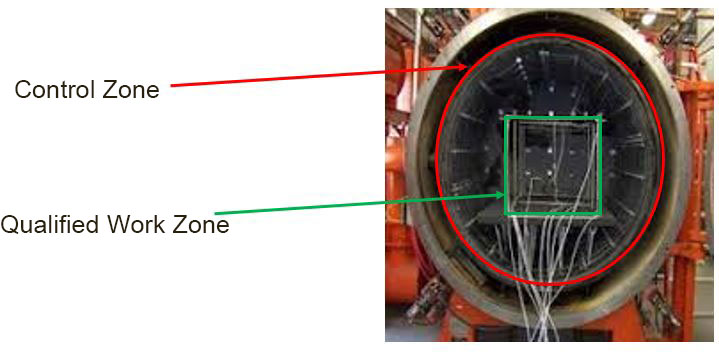
Control Zone vs Qualified Work Zone
Control Zone
AMS2750E, page 44, para 2.2.9: “A portion of the work zone in thermal processing equipment having a separate sensor/instrument/heat input or output mechanism to control its temperature. This portion of a furnace is independently controlled.”
Qualified Work Zone
AMS2750E, page 6, para 2.2.42: “The defined portion of a furnace volume where temperature variation conforms to the required uniformity tolerance.”
It’s important to understand the difference between the two definitions. Below is a figure which outlines the most basic idea behind each.
Figure 1
Failure of a Survey Thermocouple
AMS2750E, page 4, para 2.2.19: “Obviously incorrect or erratic activity of a survey thermocouple indicated by extreme high readings, extreme low readings, and/or erratic changes in readings not reflected by other sensors.”
This situation can be observed by pyrometry technicians in real time as the survey is running. Possible reasons for this may be:
a loss in chrome due to vapor pressure (vacuum furnaces only),
movement of the thermocouple during the test from the documented position,
Polarity reversal during test thermocouple assembly.
Note that AMS2750E allows only a specific number of thermocouples to fail during a TUS (see AMS2750E, page 30, para 3.5.16).
Heat Sink
AMS2750E, page 5, para 2.2.24: “A mass of material equivalent to the heat transfer characteristics of the thinnest section of the part being heat-treated. Heat sinks may be used during TUS (3.5.10.1) and during production (3.3.5).”
The use of heat sinks during a TUS is optional. Operators are permitted to utilize heat sinks on both TUS test thermocouples and the load thermocouple being used. The key is to document the initial TUS load condition, including the use of heat sinks, and utilize this configuration on subsequent tests.
If heat sinks are utilized on either the TUS test thermocouples, or the load thermocouples, the heat sink must comply with AMS2750E, page 26, para 3.5.10. Additional requirements and clarification regarding heat sink requirements can be found in the Nadcap Pyrometry Guide on page 47, question #43 and Heat Treat Auditor Advisory 17-007.
Figure 2
Qualified Operating Temperature Range
AMS2750E, page 6, para 2.2.41: “The temperature range of thermal processing equipment where temperature uniformity has been tested and found to be within required tolerances as specified in 3.3”
This temperature range affects multiple aspects of pyrometry, including the instrument calibration setpoints of both furnace instruments (AMS2750E page 14, para 3.2.5.5.1) as well as field test instruments (AMS2750E, page 14, para 3.2.5.4) used on that particular equipment. It also affects what product can be heat treated in the particular furnace.
Field Test Instrument
AMS2750E, page 4, para 2.2.20: “An instrument that is portable, that meets the requirements of Table 3, has calibration traceable to secondary equipment or better and is used to conduct on-site tests of thermal processing equipment.”
One of the key points in this definition is the term “portable”. This implies that furnace instruments cannot be used as field test instruments. For those new to pyrometry, this may cause confusion as a single instrument make and model could be designated as a field test instrument or a furnace instrument. As an example, consider a Yokogawa DX model electronic recorder. A supplier could buy two of the same model and use one as a furnace recorder and the other as a TUS recorder (making it a field test instrument). The only differences are its designated use, calibration points, and the fact that is independent from the furnace (portable).
Field test instruments must be calibrated using a standard instrument or better at 6 points per AMS2750E, page 14, para 3.2.5 and have an accuracy of ±1°F or 0.1%, whichever is greater.
Temperature Uniformity
AMS2750E, page 7, para 2.2.66: “The temperature variation (usually expressed as ± degrees) within the qualified furnace work zone with respect to set point temperature. For retort furnaces where a sensor in the retort is used to control temperature, the temperature variation is with respect to the sensor in the retort and not to the furnace set temperature.”
This relates directly to the furnace class designation per Figure 2 of AMS2750E. It’s important to keep in mind question #21 of the Hwhen designating furnace class.
Temperature Uniformity Survey
AMS2750E, page 7, para 2.2.68: “A test or series of tests where calibrated field test instrumentation and sensors are used to measure temperature variation within the qualified furnace work zone prior to and after thermal stabilization.”
As any pyrometry technician knows, one of the main issues to watch for is thermal inertia, or overshoot. Any overshoot will be cause for immediate failure and initiation of an internal RCCA per AMS2750E, page 34, para 4.2.
Conclusion
Understanding AMS2750E definitions will be advantageous to readers of the remaining articles in this TUS series.
We will next discuss the differences between periodic surveys, initials surveys and more.
Submit Your Questions
Please feel free to submit your questions and I will answer appropriately in future articles. Send your questions to editor@heattreattoday.com.
A major fastener manufacturer in South America recently received delivery of an endothermic gas generator intended for heat treatment operations at the company’s Brazilian plant.
Jomarca, a Brazilian producer of fasteners for the furniture, tooling, construction, and do-it-yourself markets, purchased the Atmosphere Engineering™ EndoFlex™ generator from United Process Controls (UPC) in reaction to doubled carburizing operations and increased production capacity. Carburizing operations now include ten large continuous rotary retort furnaces that process over 2200 US tons (2,000,000 kg) of fasteners a month.
The high-capacity generator was integrated into the plant’s existing gas distribution system in the first quarter of 2018 and is supplying endothermic gas to all carburizing furnaces. The EndoFlex operates at a lower cost and mixes to more accurate ratios, aimed at maintaining a constant furnace atmosphere and a consistent gas quality at all times. The enhanced control capabilities of the EndoFlex allow for continuous control and monitoring of CH4, dew point, differential pressure, gas temperature, and retort burnout, as well as data logging, which is critical for troubleshooting and meeting regulatory requirements.
Mr. Eric Jossart (Sales Director, UPC USA), Mr. João Marques Castelhano (President, Jomarca), and Marcio Torres Boragini (General Manager, UPC Brazil). In the background is an Atmosphere Engineering™ EndoFlex™ endothermic gas generator installed at Brazilian fastener manufacturer Jomarca
Alice H. Parker’s gas furnace design, as patented in 1919.
Heat Treat Today is pleased to join in the celebration of Women’s History Month by turning the spotlight on Alice H. Parker, an African-American woman from Morristown, New Jersey, who received a patent for a gas furnace heating system that played a key role in the development of the central heating systems most of us have in our homes today.
It was nearly 100 years ago that U.S. Patent No. US132590A was issued to Parker, whose furnace design shows gas being used as a power source when most homeowners were stocking up on wood and coal, and includes the idea of using air ducts to deliver the heat to different parts of a home. Officially granted on December 23, 1919, Parker’s patent was not the first for a gas furnace design, but it was unique in that it incorporated a multiple yet individually controlled burner system (see the text of the patent here). Although this exact design was never implemented due to safety issues with the regulation of heat flow, this structure was an important precursor to the modern heating zone system and thermostats as well.
Following up on the first installment of his series on “perfect vacuum sintering” (linked here), Andrea Alborghetti, technical manager of TAV Vacuum Furnaces and contributor to the company’s blog, provides an overview of the right insulation for a vacuum sintering furnace, an examination of hot zone design, the distribution of gas-flow, and the box for loading and unloading.
An Arizona-based aerospace maintenance, repair and overhaul provider recently announced a significant expansion at three of the company’s U.S. sites during 2018, including the installation of additional heat treatment equipment at one location.
Rick Stine, President of StandardAero Components, Helicopters & Accessories
StandardAero Component Service of Scottsdale, Arizona, reports that the overall investment to fund the expansions exceeds $16 million in construction and capital equipment, involving the facilities in the Cincinnati and Hillsboro, Ohio, and Miami, Florida locations.
The Cincinnati location expansion will include the build-out of an additional 200,000 sq. ft. of work space to accommodate component repair growth on new platforms, military and commercial engine component repair, as well as larger components.
Miami will add 30,000 sq. ft. of working space and capital improvements including the installation of a state-of-the-art clean line, an additional vacuum furnace as well as water jet cleaning capabilities. As a result, the facility will be able to repair large engine cases.
Hillsboro will be completing a 30,000 sq. ft. expansion to support new OEM manufacturing production, bringing the facility’s total manufacturing footprint to 115,000 square feet of space.
“We are making this commitment to grow our capacity to meet the continued demands of our customers – on both legacy platforms and next generation engines — as well as to continue to provide the aerospace industry’s best delivery performance for component repair and manufacturing services,” said Rick Stine, President of StandardAero Components, Helicopters & Accessories. “These expanded capabilities also include dedicated processes for the repair, overhaul and manufacturing of various component types to support our customers’ engine needs.”
A major manufacturer and supplier of oilfield logistics services recently invested in a heat treating line to facilitate processing of oilfield related equipment at its new site in Dubai, UAE.
Premier/BeaverMatic, a heat treatment manufacturer based in Farmington Hills, Michigan, provided an extensive furnace line for heating tools, parts, and components, and for providing repair and inspection services and hard metal applications for oil, gas, energy, and process industries.
The installed atmospheric heat treating system consists of an internal quench furnace including SER heating system, quench oil cooling and centrifugal separation systems, transfer system, and front load table; temper furnace; drying oven; spray and dunk washer; and endothermic gas generator.
The complete system is capable of processing 30″W X 48″L X 26″H workloads which weigh up to 1,500 lbs.