

Here’s a great article by Bob Hadley at AVWeb that explains the differences between aluminum alloys and how heat treating can make a crucial difference in the final properties.
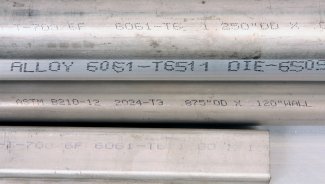
Aluminum is usually marked by the manufacturer to indicate the alloy and temper. The markings may also include the lot number and the born-on date. (PC and caption: AVWeb)
An excerpt:
“Heat treatment can dramatically alter the working characteristics of an alloy. 6061 is a great example. In the non-heat-treated state (6061-TO), it is quite bendable. But it is so soft, if you try to machine it, it will gum up the gullets of your saw and clog the flutes of your drill bits and end mills. It’s like trying to drill taffy. But when heat-treated to T4 or higher (such as 6061-T6 or 6061-T651…T651 being T6 temper plus stress-relived), it responds fine to any machining operation.”
Plus more, including
the range of temper/heat-treat designations denoting the specific process used to treat the material
the higher the number of alloy doesn’t necessarily indicate a stronger and harder alloy
which aluminum stock ought to be considered “mystery” material
Whether the OEM manufactures truck frames, aircraft components, or soda cans, applying the right heat treatment process to the right alloy produces the just the right weldability, machinability, and bendability.
A Swedish high-tech engineering company that supplies to the heat treat industry, offering tooling systems, advanced stainless steels and special alloys, recently announced intentions to broaden its reach in digital manufacturing through the planned acquisition of French software company, Metrologic Group, headquartered in Meylan.
Björn Rosengren, president and CEO of Sandvik Group
Björn Rosengren, president and CEO of Sandvik Group, based in Sandviken, Sweden, noted that this announcement is a “first material step towards an increased offering in digital manufacturing in Sandvik Machining Solutions.”
A market leader in agnostic metrology software, Metrologic Group would form a new business unit within a new product area in Sandvik Machining Solutions and would maintain brand independence, in line with Sandvik’s decentralized business model.
Klas Forsström, president of Sandvik Machining Solutions
Metrologic Group develops 3D inspection software and electronics which run measurement machines used for dimensional control notably in the automotive, aeronautics, transport, and medical sectors.The company’s offering includes agnostic software for metrology, automation and robotics control as well as services for calibration and 3D-measuring. Products are used globally in most industries, including automotive, aerospace, energy, general engineering and consumer goods, all similar to that of Sandvik Machining Solutions.
“By merging Sandvik Machining Solutions’ know-how about materials, customer applications and machining processes with Metrologic’s deep understanding of measurement technology, we would be able to further expand the offering of increased productivity. I am convinced that this step towards increased digital manufacturing will be key for continued success for Sandvik Machining Solutions,” said Klas Forsström, president of Sandvik Machining Solutions.
Original Content by Contributing Writer Ken Stanford
Furnace refractories are an essential consideration in thermal process equipment operations for optimizing efficiency, productivity, and performance as well as cutting operating costs.
To optimize furnace refractory lining, operational factors must be considered, such as furnace type, alloy composition, operating temperatures and melt rate, type of fuel used and charging and drossing practices. Furnace design is also critical, with factors including equipment type, static or tilting, capacity, desired casting temperature and position of freeze plane.
The service life of a furnace refractory lining is typically between four to 15 years, depending on the type of furnace and other variables including alloy type, melt rate, combustion system, scrap charging size and furnace practice. Contributing factors to refractory failure include corundum growth, mechanical damage, metal penetration, thermal shock, erosion and chemical attack.
Since 1974, the Pyrotek TAB Refractory Services team, based in Warrington, UK, has developed lining compositions and materials that can withstand harsh environments. The systems are pre-fired to 932°F (550°C), which eliminates water to allow for faster commissioning. A strong ceramic bond is developed and firing shrinkage is allowed that results in less stress relief cracking. Installation is not affected by ambient temperatures. Big-block systems can also be combined with castable or brick furnace linings, and to maximize service life, the company provides “zoned” refractory linings consisting of both cast-in-place and precast monolithic blocks. Employing the most suitable refractory materials for each different area of the furnace extends the lining’s durability and reduces furnace maintenance and downtime.
Figure 1. Big-block linings improve furnace performance and productivity
Examples of the work illustrate the key issues and routes to effective refractory relines. Here are recent projects where the company has provided refractory technology input:
The company designed and installed refractory components for a South African aluminum operation, then relined those components in 12 smelting furnaces.
Logan Aluminum Inc in Russellville, Kentucky, commissioned refractory lining for a new furnace designed to process flat-rolled aluminum sheet primarily for use in the beverage can market. The 340,000-pound (154-ton) tilting holding furnace, one of the largest in the world, was supplied by UK-based manufacturer Mechatherm International Ltd. Two low nitrogen-oxide burners allow the furnace to have holding and melting capacity. Furnace features include a large 33 foot (10 meter)-wide door, roof-mounted radar molten metal sensor and integration for an under hearth electromagnetic stirrer, Mechatherm says. The furnace is expected to begin operating later this year.
The refractory lining of six new aluminum melting furnaces was contracted by Mechatherm for the Novelis recycling plant in Nachterstedt, Germany. The plant was commissioned in 2014 and processes 881.8K pounds (400,000 tons) of aluminum scrap annually. Mechatherm believes that the melting furnaces are the biggest dual-chamber recycling units in the world. They comprise three 400,000-pound dual-chamber side well furnaces, which each has over 1 million pounds (500 tons) of refractory, and three 286.6K-pound (130-ton) side well furnaces with 661.4K pounds (300 tons) of refractory each. The company was later awarded the casthouse refractory maintenance contract.
A greenfield project in Saudi Arabia jointly owned by Alcoa and the Saudi Arabian Mining Co. (Ma’aden) were supplied turnkey refractory furnace linings by the company’s Saudi Arabian operation, TAB KSA. The integrated aluminum facility, which began pouring metal in 2012, includes an alumina refinery, a smelter, a casthouse and a rolling mill. The smelter has a capacity of 1.63M pounds (740,000 tons) per year. Pyrotek participated in what was reportedly the largest aluminum furnace refractory project in history. The equipment scope comprised: five 220,000-pound (100-ton) ingot furnaces, five 298,000-pound (135-ton) slab furnaces, three 187,000-pound (85-ton) billet furnaces, one 80,000-pound (36-ton) coil melter, one 198,000-pound (90-ton) remelt furnace, and two 265,000-pound (120-ton) used beverage can (UBC) side-well melters,
The company’s global refractory team and engineering centers work with aluminum operations to select the optimal refractory design and materials for their particular applications. In some cases, upgrading from brick to a non-wetting, corundum-resistant lining in smelting furnaces can increase ingot and billet casting capability. After a 5-year period, some customers reported that furnace downtime due to refractory repairs was reduced by up to 65 percent. Total furnace availability increased by up to 12.6 percent, and output increased by up to 26 percent. Refractory costs per pound of aluminum produced were reduced by up to 22.8 percent.
Furnace relines and maintenance for major aluminum companies around the world have been carried out with over 1,100 completed projects in more than 30 countries.
Ken Stanford formerly served as Group Managing Editor and Technical Director at DMG World Media in the UK, responsible for various metal, foundry, steel, and furnaces publications and associated conferences and exhibitions in the UK and overseas, including Aluminium International Today, and the ALUMINIUM series of events, which presents in Germany and the US. Particular industry interests center on new technologies, innovation, and applications, as well as sustainability and environmental issues.
Following several months of nothing but relatively good news, this month’s IHEA Executive Economic Summary Report shows some numbers dipping. As Chris Kuehl, the economist behind the report, states in his monthly in-depth analysis, “This month there is good news in bad data and some bad news in the good data. It is not always about whether an index is climbing this month or not. Sometimes it is the overall trend line and how it compares to what it might have been some months ago.”
Auto and light truck sales continue to be strong.
Every month, Dr. Kuehl, through IHEA, provides not only raw data that is of specific interest to the heat treating industry, but he also provides insightful analysis of what the numbers mean and why readers should care.
Dr. Chris Kuehl, economic analyst for IHEA, prepares the monthly IHEA Economic Trends Index.
The April report showed an increase in roughly half of the index numbers, including a surprisingly strong automobile and light truck sales index which, according to Kuehl, “continues to shock analysts as there is an assumption that the market is already saturated. It seems not to be the case as the consumer still has a desire for new wheels and if the current hike in gas prices accelerates there may soon be a new desire for those fuel sippers.”
Steel consumption continues to be weak.
Along with auto and truck sales, some of the other indices that also continued to climb were industrial capacity utilization, capital expenditures, and durable goods shipments.
Falling indices included the purchasing managers index, new home starts, and steel consumption.
Anne Goyer, Executive Director of IHEA
For a look at the complete report, contact Anne Goyer, Executive Director of the Industrial Heating Equipment Association (IHEA).
Between rounds of heat treating, re-shaped leaves are oil-bathed. Photo credit: ClassicCars.com
Heat treating serves a critical role in the restoration of street rod and classic cars, and a leading manufacturer of leaf and coil springs based in Detroit, Michigan, recently demonstrated the re-temper and re-arch process that brings renewal to first-generation Chevrolet Corvettes, which can be particularly difficult to restore due to the type of steel used in production only up until the mid-1960s.
Eaton Detroit Spring keeps 24,000 original manufacturer spring blueprints to aid in the manufacturing leaf and coil springs for the street rod and restoration industries.
An excerpt from the article at ClassicCars.com:
“Company president Mike Eaton — his grandparents founded the firm, explained, ‘We had a customer in this morning who happens to be the designer of the original Corvette suspension who I have known for years. He brought in a couple of sets of C1 rear springs to be reconditioned. Even though we do a lot of these, there are a lot of ’Vette owners who don’t know we offer it.'”
A German heat treat aftermarket supplier recently reached a cooperation with a European heat treating manufacturer for the production and distribution of heat treat systems for precision fine casting industries.
Linn High Therm GmbH and SAFED Suisse SA, a company of the Aichelin Group, announced the joint project in early 2018, wherein Linn High Therm GmbH will license the production of smaller heat treatment systems for watch, jewelry, and microsystems technology from SAFED’s product range. The agreement states that SAFED will take over the distribution of these products as well as the distribution and service of the products of Linn High Therm GmbH in Switzerland, France, Italy, and partly Germany through the existing sales and service network.
Both companies are experienced in the development and construction of electrically heated heat treatment plants. Linn High Therm GmbH specializes in the production of industrial and lab furnaces/ kilns, microwave furnaces, sample preparation units for spectroscopy, induction heating systems, precision fine casting systems and customer-specific systems. SAFED Suisse SA, based in Delémont, Switzerland, provides installations for the watchmaking and micromechanical industries.
Photo: Antoine Cantenot of SAFED Suisse SA and Horst Linn of Linn High Therm GmbH
This is the third and final special report from the triennial mega-meeting hosted by the Metal Treating Institute (MTI) and the Industrial Heating Equipment Association (IHEA) and the pressing question that needs to be answered is: “Where do manufacturers with in-house heat treat departments find good training and troubleshooting resources?”
This three-day event with over 91 heat treat industry supplier companies represented and approximately 200 attendees addresses the “brain drain” topic we reported on in Monday’s special report (click here to read Monday’s post).
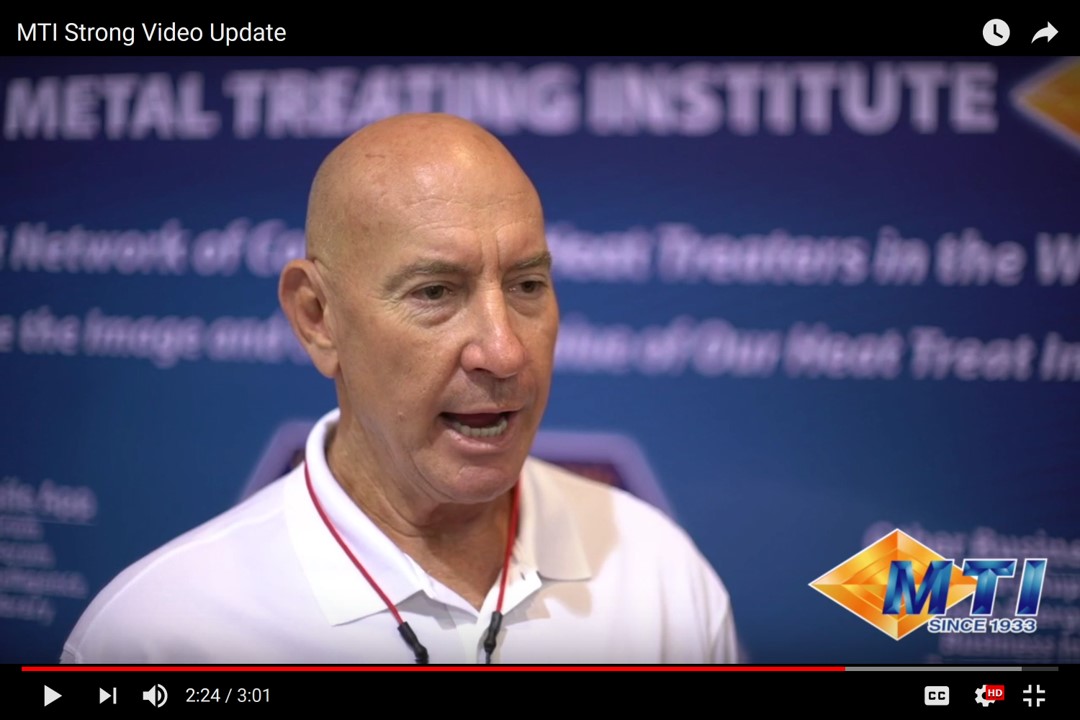
Pete Hushek, 2018 President of MTI, talks about heat treat training for manufacturers with in-house heat treat operations
Both organizations are offering training courses, both live and web-based, for manufacturers with in-house heat treat. Some of the specific courses are mentioned below. In addition to offering training, both organizations also offer memberships to these same companies.
For membership information, click on the appropriate links below:
For the Industrial Heating Equipment Association, click here.
For training, consider the following:
IHEA Training Opportunities
If you’re looking for comprehensive, face-to-face combustion training, consider attending IHEA’s Combustion Seminar. The next combustion seminar is scheduled for early October and a link to register will be up on the website (www.ihea.org) in the near future. You can also purchase a video recording of a recent Combustion Seminar by clicking here. The cost is $960 (less for IHEA members). The course includes the following (plus more):
chemistry and efficiency of combustion
types of industrial burners available and how they are applied for efficient operation
supply and control of the fuel and air for these systems including piping design and valve selection
flame safety requirements of combustion systems
process and ratio controls with exposure to micro-processor equipment
furnace pressure controls for operation and efficiency improvements
preheated combustion air and furnace recuperators
NOX and other emissions: what causes them and how to minimize them
infrared process heating overview and applications
IHEA also offers an Induction Webinar and a Safety Webinar for training your employees how to safely operate and work around heat treating equipment. The next iteration of these face-to-face seminars are scheduled for early October. Check back to IHEA’s website for exact details.
IHEA also offers a very comprehensive online training course which covers many of the fundamentals of heat treating. More information at https://www.ihea.org/events/event_list.asp.
MTI Training Opportunities
The MTI offers equally good training in its Online Academy (click here for more information). The course offering is broad and very professionally presented. The Online Academy comes at a very affordable price of $1,400-$2,800 per year for up to 10 “seats”.
The Academy for Heat Treaters has both technical and managerial content. With over 175 hours of training, there is a wide array of heat treat topics to help management and line personnel understand the technical aspects of heat treating as well as “think” like a heat treater.
Since its inception, the MTI Academy has held over 25,000 classes all across the world. It satisfies minimum training requirements for Nadcap, ISO, and most other certification bodies.
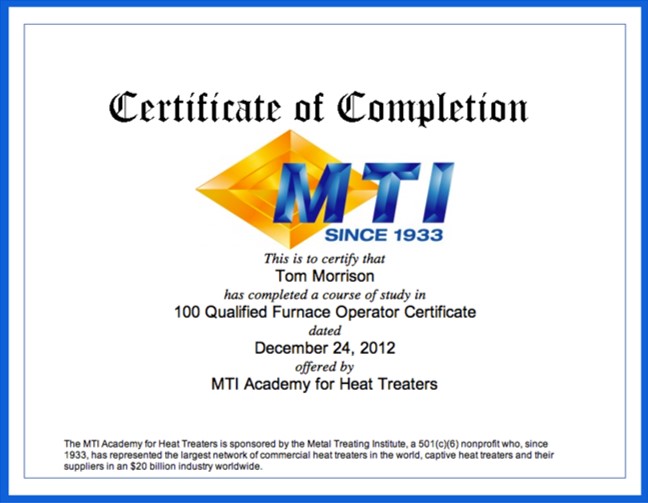
Sample MTI Certificate of Completion available for completing certain MTI Academy training courses.
Within the Academy, students can earn four different certificates:
Courses can be purchased individually or through the Academy Annual Corporate Subscription Program which provides unlimited use of all 175+ hours of training for a heat treat plant.
There’s More
The above listing of courses is not all that can be said about the offering from either organization. More can be found at each organization’s website or by contacting me directly with any questions. Click here to send me an email.
With the need for training being real, both of these organizations have well-developed educational and training programs that are worth pursuing.
See the first two Special Reports by Heat TreatTodaypublisher Doug Glenn here:
Special Report by Doug Glenn, Heat Treat Today Publisher
Doug Glenn, Publisher, Heat Treat Today
As mentioned in yesterday's special report, the Metal Treating Institute (MTI) and the Industrial Heating Equipment Association (IHEA) kicked off their combined triennial meeting yesterday in Scottsdale, Arizona, at the Talking Stick Resort.
For manufacturers with in-house heat treat departments, this event carries significance . . . even though it is not an event many (or any) of you might attend. It's at this event where the suppliers of your equipment, components, technology, and know-how update and hone their skills for helping you accomplish the heat treating you do every day.
Because many of you in the aerospace, automotive, medical, and energy sectors may know and recognize some of the attendees at this event (and because we all like seeing OUR pictures online!), today's Special Report is a selection of photos taken at last night's Opening Reception. Enjoy today's Special Report and let your favorite vendor know you saw them on Heat Treat Today if/when you see them next.
Also, special thanks goes out to these three generous sponsors for helping to underwrite the cost of this event:
Manufacturers with in-house heat treat would benefit from what’s going on this week in Scottsdale, Arizona. As many of you have expressed, experts are leaving your organizations, and they are not easy to replace.
Heat Treat Today recently had a manufacturer in the mid-Atlantic region call to say, “We need help with stress relieving!” They had nowhere to turn so they called us. This same type of thing is happening time and time again across the country as those with in-house heat treat knowledge retire or move on to other companies.
Where does a manufacturer with in-house heat treat turn for heat treating knowledge?
Besides subscribing to one of Heat TreatToday‘s regular newsletters and visiting the website periodically, in-house heat treaters can tap into the resources that have converged on Scottsdale this week. Starting today at the Talking Stick Resort in Scottsdale, North America’s largest gathering of heat treating industry professionals are holding a combined meeting with two of the nation’s most prestigious thermal processing organizations:
MTI — The Metal Treating Institute is a network of over 300 commercial/contract heat treating companies and suppliers.
Both of these organizations have separate semi-annual meetings, but once every 3 years they have a combined mega-meeting that brings in one of the largest gatherings of heat treat intelligence in all of North America. Companies from Canada, Mexico, and the USA are represented. This week’s meeting has drawn over 200 attendees and is full of educational sessions and networking opportunities to keep North America’s heat treat minds fresh and progressive.
Companies with in-house heat treat should consider tapping into one or both of these organizations to help them fill the brain drain that is happening and will continue to happen over the next decade.
Brain drain is a real phenomenon.
Heat TreatToday spoke with one company who estimated that up to 60 percent of the heat treat brains in their organization will retire within the next 10 years. This is not an isolated case. Baby boomers, who make up the vast majority of today’s heat treat industry brain trust, are beginning to retire and there are not enough metallurgists graduating from North American universities to fill the gap. Where are these manufacturers with in-house heat treat going to turn for specific, real-life heat treat help?
MTI CEO, Tom Morrison takes a “selfie” with Heat Treat Today’s Mary and Doug Glenn in Scottsdale, Arizona, as plans are being finalized for this week’s big heat treat brain trust meeting.
Both MTI and IHEA encourage manufacturers with in-house heat treat to join their organizations. This would be a great place to start. Both of these organizations are capable of fielding nearly any heat treat-related questions and if they don’t know the answers, they know people who will know the answers.
Both organizations also provide excellent training programs targeted especially for manufacturers with in-house heat treat.
IHEA’s combustion, safety, and induction seminars are all highly rated and reasonably priced. For more information on these courses, click here.
MTI offers a wide spectrum of heat treating courses in their “Heat Treat Academy”. Some are free, some come at a price. Click here for more information on the Heat Treat Academy.
So, here is a challenge. If you are a manufacturer with in-house heat treat, and your company is located near Scottsdale, Arizona, I suggest you send one or more of your top heat treat personnel over to the Talking Stick hotel/resort/casino sometime on Tuesday or Wednesday to join in on the meetings of top heat treat minds. If you’re brave and compulsive enough to take the challenge, please send me an email and I’ll help make the arrangements.
Otherwise, think about joining one or both of these organizations.
Finally, you can always contact Heat Treat Today with any heat treat related problems or questions.
A Dozen Quick Heat Treat News Items to Keep You Current
Heat Treat Today offers News Chatter, a feature highlighting representative moves, transactions, and kudos from around the industry.
Personnel and Company Chatter
Lars Jonsson has been appointed new employee representative to the Bulten AB board for a term of office of three years. Lars has been employed at Bulten’s plant in Hallstahammar since 1984 where he has worked as a machine operator until two years ago when he switched to tool maker. Bulten is a supplier of fasteners to the international automotive industry.
Paulo’s Cleveland division is expanding to add 50,000 sq ft, allow for the installation of more vacuum heat treatment furnaces, and provide optimized flow of work through the facility. The Cleveland plant primarily serves the aerospace, power generation, and agriculture industries and specializes in precise high-temperature vacuum heat treatment and brazing of nickel-based superalloys.
James R. Darsey, executive vice president of raw materials for Nucor Corporation announced his upcoming retirement after more than 39 years of service with Nucor. Effective June 10, 2018, Craig A. Feldman will be promoted to the role of executive vice president of raw materials. Mr. Feldman began his career with the David J. Joseph Company (DJJ) in 1986 and stayed with the company, becoming president of DJJ in 2013. When DJJ was acquired by Nucor in 2008, Feldman became a vice president and general manager of Nucor Corporation. Upon his promotion to EVP, Mr. Feldman will retain his role as president of DJJ.
Dr. Steve Offley recently joined Phoenix Temperature Measurement as Product Marketing Manager, bringing over 21 years of experience in the industrial process temperature monitoring industry. Besides promoting and marketing PhoenixTM’s temperature monitoring productions, Dr. Offley will focus on development of new and innovative processes temperature-monitoring solutions.
Solar Atmospheres of Western PA recently installed a second machining center to support its newest service for customers – tensile testing. By adding a brand new fully programmable 8100 RPM Haas VF2 milling center, Solar is now able to support the machining of flat tensile specimens. This machining ability fully complements the function of the 10,000 PSI hydraulic jaw that is an integral component of the Tinius Olsen 300SL tensile machine. These massive hydraulic jaws can grip either threaded round or flat specimens.
Paulo\’s expansion in Cleveland
Craig A. Feldman, executive vice president of raw materials, Nucor
tensile testing center, Solar Atmospheres of Western PA
Equipment Chatter
A 750°F (399°C), gas-fired cabinet oven was recently supplied by Grieve Corporation to be used for baking radiator cores at the customer’s facility. The workspace dimensions of this oven, the No. 1046, measure 80″ W x 88″ D x 18″ H, with a 76″ wide x 76″ long, 750 lb. capacity pneumatic operated rollout shelf with an insulated plug to seal doorway opening.
An intermediate-sized front-loading box furnace was recently delivered to the Canadian Government Forestry Division. L&L Special Furnace Co., Inc., equipped the furnace, which meets Canadian electrical standards, with an atmosphere-sealed case for use with inert gas to displace oxygen and minimize surface de-carb. It is purged with inert gas prior to loading and the parts are then heated under a controlled atmosphere. There is a 1″ NPT survey port located on the right side of the furnace employed for calibration and uniformity surveys.
An aerospace and defense company recently purchased a rotary hearth furnace to heat treat state-of-the-art equipment, specifically to process specialized gears for helicopters. Ipsen plans to deliver the rotary hearth furnace early next year.
gas-fired cabinet oven, Grieve Corporation
intermediate-sized front-loading box furnace, L&L Special Furnace
rotary hearth furnace, Ipsen
Kudos Chatter
Advanced Heat Treat Corp. recently reported that its Iowa (MidPort-Corporate Office and Burton Ave, Waterloo) and Michigan locations have successfully transitioned from ISO/TS 16949:2009 to ISO 9001:2015 / IATF 16949:2016.
Stock Drive Products/Sterling Instrument (SDP/SI) has also announced that it meets all certification requirements of the new ISO 9001:2015 + AS9100D standard, maintaining processes that provide superior components and assemblies with detailed quality reporting.
Harbison Walker International (HWI), based in western Pennsylvania, adds its announcement to the mix, reporting that its Thomasville, Georgia, monolithic/precast facility recently became the first of the company’s North American locations to earn ISO 9001:2015 certification, followed by HWI’s South Shore, Kentucky, plant becoming the first refractory brick manufacturing plant in North America to achieve the same status. Both plants achieved this quality system recognition based on the recommendation of SRI Quality System Registrar.
Rio Tinto celebrates the distinction of being the first company in the world to receive certification under the Aluminium Stewardship Initiative (ASI), the highest internationally recognized standard for robust environmental, social and governance practices across the aluminum lifecycle of production, use, and recycling. The certification follows an independent third party audit and covers a range of operations, from bauxite mining to alumina refining, aluminum smelting, the creation of value-added products, transformation and recycling, and associated activities. Rio Tinto’s five aluminum smelters, the Vaudreuil refinery, casting and spent potlining treatment centers, and associated infrastructure such as power, port and railway facilities in Quebec, Canada, have been certified, along with the Gove bauxite mine in Australia.
Heat Treat Today is pleased to join in the announcements of growth and achievement throughout the industry by highlighting them here on our News Chatter page. Please send any information you feel may be of interest to manufacturers with in-house heat treat departments especially in the aerospace, automotive, medical, and energy sectors to the editor at editor@heattreattoday.com.