When steel needs to be softened to alter ductility, toughness, or properties, or to produce a specific microstructure, a heat treater can turn to any one or combination of processes to suit the material or the application.
Metlab Heat Treat’s primer series includes a short explanation of the options available, whether it is
annealing, which “removes the internal stresses, which build up as a result of cold working and other fabrication processes;”
protective atmosphere normalizing, which “refines the grain size and enhances the uniformity of the microstructure;” or
spheroidize annealing, which “is generally done on parts which have been work hardened, to allow them to be further worked, either rolled in the case of coils, or drawn for wire.”
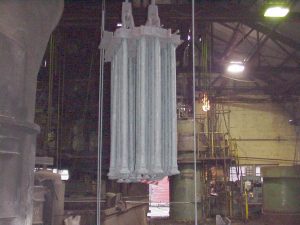
1.) Load of torsion bars, manufactured from 4340 steel, normalized in the vertical position to maintain straightness. Parts measure approximately 3\” in diameter by 6\’ long.
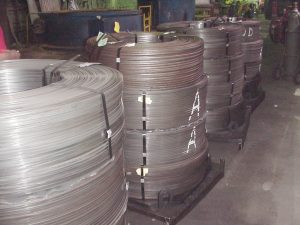
2.) 26,000 pounds of low carbon steel flat wire being prepared for spheroidize annealing. Spheroidize annealing is an intermediate processing step to allow the wire to be further rolled to a smaller gage without cracking.
A California-based, full-service brazing and heat treating company recently installed several pieces of equipment, including an indirect temper furnace as well as a generator that has clocked less downtime than the previous unit.
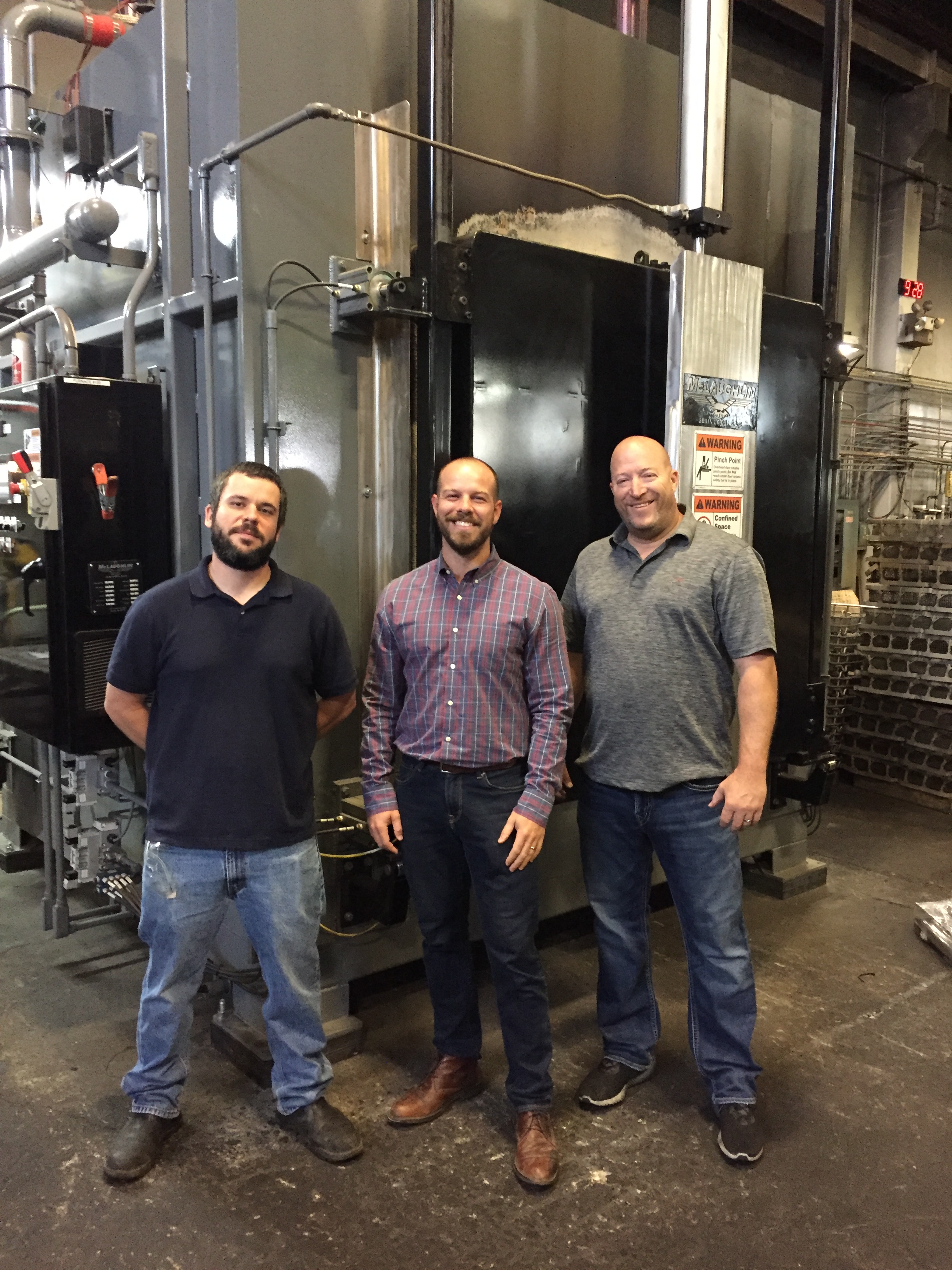
Nick Schreiber, Quality Manager of ThermoFusion; Glen Ottinger, President of ThermoFusion; and Jeff McLaughlin, owner of McLaughlin Furnaces and Equipment
ThermoFusion’s investment of the 2200 Tru-Mix Generator and indirect temper furnace, both McLaughlin Services products, are part of the company’s commitment to support customers in the automotive, aerospace, medical, and energy industries, as well as for multiple other application.
The Tru-Mix 220 is supporting two of ThermoFusion’s internal quench furnaces and a high-temperature tool furnace, almost twice as much equipment as the generator it replaced. According to Glen Ottinger, president of ThermoFusion, the results were better than he had anticipated when researching the 2200 Tru-Mix and other gas generators.
The McLaughlin Indirect Temper Furnace was fully functional and ready for operations only two days after arrival, according to Nick Schreiber, quality manager at ThermoFusion, and has been surveyed at +/- 10F or less, between 300ºF and 1400ºF.
For every three individuals who have had a stent implanted to keep clogged arteries open and prevent a heart attack, at least one will experience restenosis—the renewed narrowing of the artery due to plaque buildup or scarring—which can lead to additional complications.
Now, a team led by UBC electrical and computer engineering professor Kenichi Takahata has developed a type of “smart stent” that monitors even subtle changes in the flow of blood through the artery, detecting the narrowing in its earliest stages and making early diagnosis and treatment possible.
“We modified a stent to function as a miniature antenna and added a special micro-sensor that we developed to continuously track blood flow. The data can then be sent wirelessly to an external reader, providing constantly updated information on the artery’s condition,” said Takahata.
The device uses medical-grade stainless steel and looks similar to most commercial stents. Researchers say it’s the first angioplasty-ready smart stent—it can be implanted using current medical procedures without modifications.
Research collaborator Dr. York Hsiang, a UBC professor of surgery and a vascular surgeon at Vancouver General Hospital, noted that monitoring for restenosis is critical in managing heart disease.
Dr. York Hsiang
“X-rays such as CT or diagnostic angiograms, which are the standard tools for diagnosis, can be impractical or inconvenient for the patient,” said Hsiang. “Putting a smart stent in place of a standard one can enable physicians to monitor their patient’s health more easily and offer treatment, if needed, in a timely manner.”
The device prototype was successfully tested in the lab and in a swine model. Takahata, who holds patents for the technology, says his team is planning to establish industry partnerships to further refine the device, put it through clinical trials and eventually commercialize it.
The research is described in the May issue of Advanced Science and featured on its front cover. Engineering researcher Xing Chen, now a research associate at the Johns Hopkins School of Medicine, and Babak Assadsangabi, a postdoctoral fellow at UBC’s faculty of applied science, also contributed to the study.
Photo credit: University of British Columbia; photo caption: The device uses medical-grade stainless steel and looks similar to most commercial stents.
A new vacuum furnace will be tasked to stress test parts for the LM2500 turbine, which is used by the U.S. Navy to power Spruance and Kidd-class destroyers, Olive Hazard Perry-class frigates, Ticonderoga-class cruisers, and Arleigh Burke-class destroyers.
Ashleigh Burke-class destroyer
Fleet Readiness Center Southwest (FRCSW) commissioned the $1.9 million furnace from SECO/Warwick Group, which manufactured the 2,800°F unit to specification for technicians to test the engine’s components after the heat treat process. It will not be used for the heat treating or plating of LM2500 parts.
“The furnace was custom made for our use and took almost a year to manufacture,” said Martha Hoffman, project manager for FRCSW’s Capital Investment Program (CIP), which invests in new technologies and equipment to improve production efficiencies. “The equipment arrived May 15, and the sign off (acceptance) was July 2.”
The new unit replaces a model that was more than 50 years old with a four-year history of sporadic operation. Difficulty in maintenance and increasingly obsolete replacement parts often resulted in a 60-80 percent down time, causing some LM2500 work to be contracted out.
Sailors check a gas turbine engine. (U.S. Navy photo by Mass Communication Specialist 3rd Class Brian M. Brooks/Released via Wikimedia)
Hoffman said that the new unit will save the command about six months in turn-around time per part vice contracted workload and that 12-15 components will be tested weekly.
FRCSW is scheduled to overhaul about 15 LM2500 engines annually.
Photo caption:
FRCSW teammates who were instrumental in the procurement, installation and acceptance of the Seco/Warwick Group furnace are, from left, materials engineers Michael Schutt and Jessica Porras, CIP project manager Martha Hoffman, metrology calibration Hung Pham, and material engineers David Arenas and Blake Whitmee. (U.S. Navy photo)
It’s no secret to heat treaters that not all methods work well on all parts and specifications. It’s also a hard fact that false readings can result when applying hardness measuring systems, therefore, says Charles D. Schulz of Gear Technology, “critical service parts often require a few ‘sacrificial lambs’ to be processed along with the production parts.”
“I cannot emphasize enough that if you are not cutting up parts or coupons you do not know what is really happening during your thermal processing.” — Charles D. Schulz
Special Message from Heat Treat TodayPublisher, Doug Glenn
Finding and retaining young talent is one of the most difficult challenges for nearly all manufacturers with in-house heat treat operations. It is also a major challenge for commercial heat treat shops and heat treat equipment and component suppliers. Beyond the initial difficulty of finding someone who can pass a drug test (!), there is the more persistent problem of finding and retaining good engineering and business minds.
When you do find that talent, it’s important to recognize it and reward it.
To help you recognize and reward the young talent in your organization — or, if you’re a supplier to the industry, in your customer’s organization — Heat Treat Todayis officially opening nominations for 40 Under 40 the Class of 2018. This inaugural class will be comprised of 40 individuals UNDER THE AGE OF 40 who are significant contributors to the heat treat industry. We’ll give them widespread exposure through our website, our social media platforms, and through a special print edition later this year.
Nominations open today (7/9/18) and close on August 15th.
It is super quick and easy to nominate someone. Simply click on the “Nominate Now!” button to the right. Each nomination should take no more than 5 minutes to complete and it will be sincerely appreciated. If you’d like to read more about 40 Under 40, click on the 40 Under 40 logo above and you’ll be taken to a page with more details.
Don’t miss this great opportunity to recognize the young heat treat talent in your organization. Nominate someone today!
If you have any questions, please contact me directly by email (click here).
15 Quick Heat Treat News Items to Keep You Current
Heat TreatToday offers News Chatter, a feature highlighting representative moves, transactions, and kudos from around the industry.
Personnel & Company Chatter
Professor Chris Sutcliffe, Director of Research and Development (R&D) at Renishaw‘s Additive Manufacturing Products Division (AMPD), was awarded a prestigious Silver Medal from the Royal Academy of Engineering (RAE), recognizing his role in driving the development of metal 3D printed implants for use in human and veterinary surgery and celebrating his successful commercialization of additive manufacturing products as part of his work with Renishaw, the University of Liverpool, Stryker Orthopaedics and Fusion Implants Ltd.
Michael Handscombe joins UK-based Phoenix Temperature Measurement as National and International Sales Manager to support PhoenixTM temperature monitoring solutions used in industrial heat treatment and furnace surveying and other industries.
One of five new vacuum furnaces, with an all-metal hotzone and 15 bar Argon quenching with an 8,000lb capacity, have been delivered to the Cleveland division of Pauloand will be ready for production late July. This represents the first step of a larger expansion that includes a new building.
Two large heat-treating furnaces were recently rebuilt and upgraded at Metlab, a heat treatment and surface enhancement company located in Wyndmoor, Pennsylvania. The furnaces, designated P-1 and P-2, are believed to be the largest atmosphere-controlled pit furnaces in North America and are used to neutral harden, carburize and harden, nitride, anneal, and stress relieve large components or multiple quantities of parts.
A 20-foot long car bottom air furnace capable of handling a workload up to 30,000 lbs will be installed at Solar Atmospheres of Western PA during July 2018 and surveyed in accordance with AMS2750. With a maximum operating temperature of 1400°F, this furnace will accommodate not only the tempering of large tool steel components but also age hardening of 15-5 PH, 17-4 PH, and nickel-based alloys. Although Solar is typically known as a “vacuum only” heat treater, the company notes the need for heat treating non-finished parts and materials in accordance with the same specifications (AMS, MIL, Boeing and Airbus) within different atmospheres where surface oxidation is permissible.
Robrecht Himpe retired from his position as CEO of ArcelorMittal North America and CEO of AM/NS Calvert on July 1, as well as his duties with ArcelorMittal’s executive management team. He has been with the group for 37 years and will be succeeded as ArcelorMittal North America CEO by Brad Davey, who has been serving as chief marketing officer of ArcelorMittal North America and head of global automotive.
Team, Inc., an industrial services company based in Houston, Texas, recently announced that Arthur F. Victorson, President of the Inspection and Heat Treating segment, will retire from the company on September 30, 2018. In connection with his retirement, Mr. Victorson will transition from his current role, effective July 15, 2018, and serve as a special advisor to Amerino Gatti, Team’s Chief Executive Officer, to ensure a seamless transition. Team anticipates naming a successor to Mr. Victorson in the near future.
A partnership has been formed between Plibrico, based in Northbrook, Illinois, and Upstate Refractory Services, headquartered in Newark, New York.
John Hynes has been promoted at Pauloto Director of Information Systems from his previous role as Manager of Information Technology. John has been with Paulo for just over one year, strengthening the company’s IT position.
Chris Sutcliffe, Renishaw
Michael Handscombe, PhoenixTM
One of 5 new furnaces at Paulo
New equipment at Metlab
Solar Atmospheres installs car bottom air furnace.
Robrecht Himpe retires as CEO of ArcelorMittal North America.
New partnership between Plibrico and Upstate Refractory Services
John Hynes promoted at Paulo to Director of Information Systems.
Equipment Chatter
A natural gas-fired, enhanced-duty, walk-in oven was recently shipped to the technology industry by Wisconsin Oven Corporation for use in post-curing refractory material. With a maximum operating temperature of 300°F, the oven was designed with the capacity to heat 8,000 pounds of steel and 4,000 pounds of refractory material from 70° to 150° F within 180 minutes.
A 1400°F electric, inert atmosphere tempering furnace from Grieve Corporation, No. 885, is currently being used for heat treating weldments at a customer’s facility.
An India-based conglomerate recently commissioned an aluminum automotive casting heat treatment system from CAN-ENG Furnaces International Limited for its new greenfield North American expansion in South Carolina.
CAN-ENG Furnaces, aluminum automotive casting heat treatment system
Kudos Chatter
The F-35 Joint Program Office of The Pentagon and Lockheed Martin delivered the 300th production F-35 aircraft, a US Air Force F-35A, to be delivered to Hill Air Force Base, Utah. “The F-35 weapons system is a key enabler of our National Defense Strategy and is providing our warfighters the combat-proven, advanced capabilities they need to meet mission requirements,” said Vice Admiral Mat Winter, program executive officer for the F-35 Joint Program Office. The first 300 F-35s include 197 F-35A conventional takeoff and landing (CTOL) variants, 75 F-35B short takeoff/vertical landing (STOVL) variants, and 28 F-35C carrier variants (CV) and have been delivered to U.S. and international customers. More than 620 pilots and 5,600 maintainers have been trained, and the F-35 fleet has surpassed more than 140,000 cumulative flight hours.
The first Future Aluminum Forum was held on 8th & 9th May 2018 in Milan, Italy, with more than 150 delegates from across the aluminum manufacturing and processing industries gathering to hear from technical experts and uncover the myths behind Industry 4.0 and what this means for the manufacturing value chain. An Advisory Board was established to develop a strategic approach towards integrating Industry 4.0 across the aluminum manufacturing and processing sectors.
A center for aerospace air management systems, Liebherr-Aerospace Toulouse SAS, in Toulouse, France, recently obtained accreditation from the National Aerospace and Defense Contractors Accreditation Program (NADCAP) for its materials testing laboratory. This accreditation follows an audit conducted in early March 2018 by the Performance Review Institute (PRI), which focused on both the overall quality system of the laboratory and the practice of static and dynamic mechanical tests.
Lockheed Martin and Pentagon deliver 300th aircraft.
Future Aluminum Board meets in Milan, Italy.
Liebherr-Toulouse obtains Nadcap Approval.
Heat Treat Today celebrates with our heat treatment industry partners by highlighting their accomplishments and announcements here on our News Chatter page. Please send any information you feel may be of interest to manufacturers with in-house heat treat departments especially in the aerospace, automotive, medical, and energy sectors to the editor at editor@heattreattoday.com.
A manufacturing company based in Loves Park, Illinois, recently purchased a vacuum furnace with 2 bar gas quenching that will be used at its facility in Ho Chi Minh City, Vietnam.
The TITAN® H6 furnace
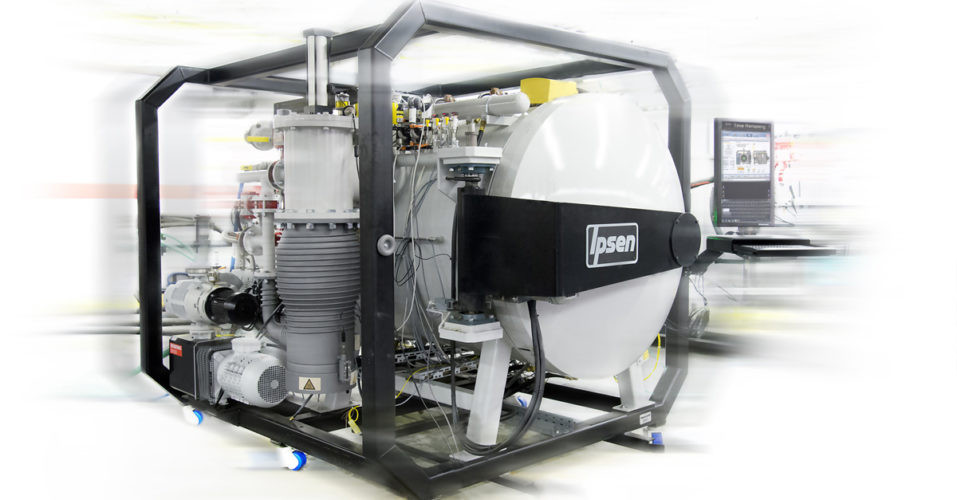
Zenith Cutter, which manufactures industrial knives, cutter blades and related accessories for multiple applications, is transitioning its shop from atmosphere heat treating to using vacuum equipment for production and commissioned a TITAN® H6 furnace from vacuum furnace maker Ipsen for its Metkraft location.
The TITAN® H6 furnace has a graphite work zone measuring a 36″ x 48″ x 36″ (915 mm x 1,220 mm x 915 mm) with a 3,000-pound (1,360 kg) load capacity and is capable of operating at temperatures of 1,000 °F to 2,400 °F (538 °C to 1,315 °C) with ±10 °F (±6 °C) temperature uniformity.
To join the United States in the celebration of Independence Day, Heat TreatToday brings you a story that highlights the role played by colonial-period metallurgists in the fight against the British, specifically the British Navy’s attempts to sail up the Hudson River during the American Revolution.
One of the first steel and iron manufacturers in the American colonies, the Sterling Iron Works, located in Warwick, New York, very near the New Jersey line, forged its place in history by forging the Hudson River Chain as a way to prevent the British from gaining access to West Point, the strongest and most important military post in America at that point in the war.
Interesting FAQs:
Peter Townsend, owner of Sterling Iron Works, probably violated the Iron Act of 1750 by building the steel furnace and kept it hidden from the British.
The chain was forged at Stirling ore mines and hauled to the shoreline of the Hudson where it was floated down the river. It was positioned on logs across the river with a heavy log boom in front of it.
The links of the chains weigh 140 lb (64kg) each; the total length weighed 186 tons.
The placement of the iron chain and boom at West Point
Benedict Arnold plotted to reveal a strategy to breach the chain to the British, but he was discovered by Sally Townsend, Peter Townsend’s cousin, when she intercepted his message and unmasked him as a traitor. He escaped to the British, and no attempt was made to break the chain.
The Great Chain of the Hudson River remained unbroken for the length of the war. Afterward, most of the links were melted down and made into cannons, but a few of the links have been preserved at the Military Academy at West Point.
A heat treating process surfaces as one of the most effective methods to prolong the lifespan of wind turbine components. Turbine shaft bearings, planetary gears, and rotating shafts operate under extreme conditions, and the demand for taller and larger wind turbines limit the options available to manufacturers and operators seeking protection against wind, weather, fatigue, and overall wear and tear.
Plasma nitriding was recently found in tests to exhibit “one-fifth the roundness deviation and seven times better planarity than gas nitriding on a two-meter diameter ring gear,” said Dr. Florian Rovere of Oerlikon Balzers, a supplier of surface technologies for metal processing industries in North America.
“Plasma nitriding has the advantage of making the treatment more precise by minimizing warping and distortion while providing a higher load-bearing capacity,” notes an article published in Windpower Engineering & Development.
“It is . . . an important discovery for the service life of a system where enormous forces are at work,” said Rovere.