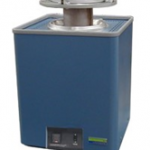
Two all-metal hot zone furnaces were recently shipped to the medical and additive manufacturing industries. Solar Manufacturing created and shipped the Models HFL-3848-EQ and HFL-3836-EQ, both featuring metallic-insulated hot zones, a load weight capacity up to 2,000 lbs., and a maximum operating temperature of 2400° F. Measuring 24” wide x 24” high x 48” deep, and 24” wide x 24” high x 36” deep respectively, each furnace was designed with the SolarVac Polaris® Control System. The furnaces were shipped to a location in Tennessee.
Dan Insogna, Southeast Regional Sales Manager for Solar Manufacturing
“Solar Manufacturing was awarded the order because we offered the best solution for their vacuum furnace needs,” states Dan Insogna, Solar’s Southeast Regional Sales Manager. “Our knowledge and experience of the additive manufacturing market set us apart from the competition. Additionally, the customer found the premium features and benefits offered with our vacuum furnace equipment impressive. We’re pleased to have helped them select furnaces that best suit the unique requirements of the industries they serve.”
A company that manufactures custom magnetic shields, precision sheet metal fabrication, and Hydroforming recently commissioned its first-ever vacuum furnace to accommodate expansions to better serve the magnetic shielding industry by providing material designed to protect sensitive electronics from magnetic fields.
Jason Davidson, Solar Manufacturing’s northeast regional sales manager
MuShield Company of Londonderry, New Hampshire, commissioned Solar Manufacturing to design the furnace, built with a SolarVac® Polaris control system, fully compliant to AMS2750E pyrometric specification, operating at a vacuum level of 10-5 Torr with the capability of maximum temperatures up to 2400°F, and featuring an external quench system designed for pressures up to two bar.
“What this means for us is that we’ll be able to offer quicker turnaround times on heat-treated products, fit larger shields into our furnace, and eliminate outside vendor work,” notes MuShield’s website.
“MuShield was already aware of our excellent reputation in the industry, and they were impressed with our facility when they visited earlier this year,” said Jason Davidson, Solar Manufacturing’s northeast regional sales manager. “They were also impressed with results of testing performed for them by Solar Atmospheres, so we’re pleased they have placed confidence in Solar Manufacturing to provide their first vacuum furnace.”
The new vacuum furnace will also allow MuShield to perform stress relief annealing cycles on hydroformed parts made from non-shielding alloys, which is a manufacturing requirement on most materials that the company hydroforms.
Heat TreatTodayoffers News Chatter, a feature highlighting representative moves, transactions, and kudos from around the industry.
Personnel & Company Chatter
Bharat Forge America Inc. will build an aluminum forging plant to manufacture automobile components in Sanford, North Carolina.
Ipsen USA recently announced the completion of an initiative to expand aftermarket services across the United States and Canada. Five regional sales engineers (RSEs) were hired over the last six months to assist customers with replacement parts, retrofits, upgrades, service, and technical support for any brand of atmosphere or vacuum heat-treating system.
An industrial heating technology company, Kanthal, recently launched an additive manufacturing service that will produce heating elements and components, as well as developing a new iron-chromium-aluminum alloy called Kanthal AM100.
GKN Aerospace has been selected as a key supplier on the new Gulfstream G700 business jet. The company is using its expertise in the design and manufacture of business jet empennages and thermoplastic components on the advanced aircraft. The rudder and elevators that are part of the empennage, as well as the floorboards, feature the latest thermoplastic technology. GKN Aerospace also produces the bonded fuselage panels for the new fuselage.
A ribbon-cutting ceremony recently marked the opening the new corporate headquarters and manufacturing facility of Process Cooling Systems, Inc. in Massachusetts.
Gasbarre Thermal Processing Systems recently partnered with Humberto Bastidas from Thermal Technic Furnace Solutions. Gasbarre will be working with Humberto and his team to launch a Spanish version of Gasbarre.com in the coming weeks and will assist with other marketing efforts in that region.
Equipment Chatter
A manufacturer of products from carbon recently provided large, custom Sigrabond Performance CFC fixtures to a North American aerospace company. By replacing the current alloy fixture with the new CFC fixtures from SGL Carbon, the customer increased part/fixture weight ratio from 62/38 to 87/13.
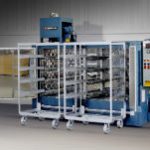
Two electrically heated multi-zone curing ovens were recently shipped to the composites industry by Wisconsin Oven for the purpose of curing carbon fiber threads.
A Model FB1046 floor-standing box furnace has been shipped by L&L Special Furnace Co, Inc., to a worldwide leader of high tech aerospace and associated components located in the Southeastern United States. The furnace will be used for processing aerospace parts and various thermal applications.
Danieli Olivotto Ferrè recently started up a tube roller hearth annealing furnace at Tenaris Tamsa, in Veracruz, part of one of the world’s largest manufacturers of steel pipe for the energy and automotive industries. The furnace is designed to treat steel tubes coming from cold or hot processing with a maximum throughput of 5 tons/h. The flexible furnace is able to perform different heat-treatment cycles, including normalizing, annealing, tempering and stress relieving. In addition, Danieli has been selected to supply the new electric arc furnace (EAF) melt shop and plate-/steckel-mill, as well as an electrical and automation package provided by Danieli Automation, for Nucor Corporation and its new greenfield plate steel mill complex in Brandenburg, Kentucky.
Dana Incorporated announced the expansion of a joint engineering agreement with Fendt, a worldwide brand of AGCO. Over the past three years, the companies have co-developed advanced Spicer® 980 independent suspended axles for the new Fendt 900 Vario series of large tractors.
Allegheny Technologies Incorporated announced it signed another 1-year agreement to extend and expand carbon steel hot-rolling conversion services for NLMK USA at its world-class hot rolling and processing facility, or HRPF, located in Brackenridge, Pennsylvania.
A global leading stainless steel manufacturer with headquarters in Spain, Acerinox, S.A., has reached an agreement for the acquisition from Lindsay Goldberg Vogel GmbH and Falcon Metals BV. of VDM Metals Holding GmbH, with headquarters in Germany and leading producer of specialty alloys.
A vacuum furnace for processing additive manufactured parts has been shipped to a large science and technology laboratory by Solar Manufacturing. The lab requires the furnace to further research and development work.
Through its subsidiary, Tenova Goodfellow Inc., Canada, Tenova installed and commissioned a peak shaver at VINA Kyoei Steel, Vietnam, providing continuous improvement for melt shop operations.
Kudos Chatter
A Ph.D. student at the University of Strathclyde in Glasgow, Scotland, Lewis Print is the inaugural winner of an international student award in industrial heating, the Kanthal® Student Award, presented by industrial heating technology company Kanthal. The award has been made for his work on the development of new technology for the production of silicon carbide (SiC) heating elements used in high-temperature industrial processes operating in the range 2012°F-2912°F (1100°C-1600°C).
At the October fall meeting in Vancouver, Canada, the Metal Treating Institute (MTI) recognized Mary Springer from Thermtech in Waukesha, Wisconsin, with the Heritage Award. The Heritage Award is MTI’s most prestigious award.
The Center for Materials Processing Data (CMPD) recently announced three organizations have committed to the Center’s inaugural Industry Member class: Pratt & Whitney (a founding industry member), MTS Systems Corporation, and Weber Metals. This commitment, operating to solidify its formation, has allowed CMPD to greenlight a pilot project focused on the material flow behavior as a function of temperature, strain rate, composition, and prior microstructure processing.
Pelican Wire was named the winner of the 25th annual Southwest Florida Blue Chip Community BusinessAward at this year’s luncheon and awards ceremony. Chosen by an independent panel of judges, the criteria are centered around overcoming adversity to achieve success.
ASB Industries, Barberton, Ohio, announced that Charles Kay, ASB vice president, was recognized as an ASM Fellow at the annual ASM Awards Banquet in October. The award citation states, “For global technical leadership in innovative thermal spray technologies, mentoring thermal spray practitioners, and sustained dedicated volunteer service to the thermal spray community.”
Heat TreatTodayis pleased to join in the announcements of growth and achievement throughout the industry by highlighting them here on our News Chatter page. Please send any information you feel may be of interest to manufacturers with in-house heat treat departments especially in the aerospace, automotive, medical, and energy sectors to editor@heattreattoday.com
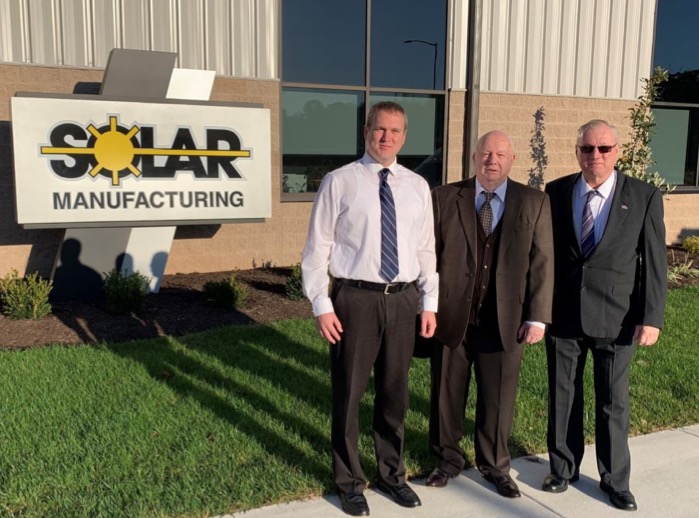
Three generations of the Jones family. This picture taken just moments before the Ribbon Cutting Ceremony shows (l-r) Trevor Jones, CEO of Solar Manufacturing; Trevor’s grandfather, William R. Jones, CEO of the Solar Group of Companies; and Trevor’s father, Roger A. Jones, President of Solar Atmospheres (retired).
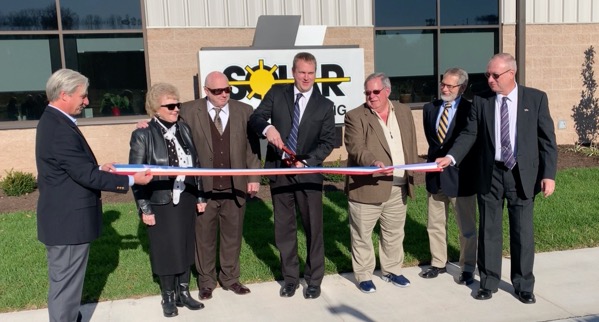
William and Myrtle Jones were recently joined by a group of key Solar Manufacturing employees including Roger Jones and Trevor Jones at a ribbon-cutting ceremony for the company’s new manufacturing site in Sellersville, Bucks County, Pennsylvania.
Speaking at the ceremony in addition to William Jones was Sellersville Borough mayor Thomas C. Hufnagle, Gorski Construction president Jerry Gorski, Bucks County Industrial Development Authority chairwoman Mary Smithson, and Bucks County Board of Commissioners chairman Robert Loughery. Employees moved into the newly constructed 59,000 square foot facility in early October on land vacated by AMETEK in 2008.
Gorski Construction president Jerry Gorski; Myrtle Jones; CEO of Solar Group William Jones, Solar Manufacturing CEO Trevor Jones; Sellersville mayor Thomas C. Hufnagle; Solar Manufacturing president Jim Nagy; and retired president of Solar Atmospheres Roger Jones.
"It is important that we invest in our communities,” explained CEO William Jones. “When AMETEK left, they left more than a couple of vacant lots. It’s our goal to grow and support the local economy.”
Jim Nagy, president of Solar Manufacturing, gave the local dignitaries a tour of the facility including a shop floor filling up with equipment being transferred in from the company’s previous manufacturing locations.
The company plans to hold an open house event in the first or second quarter of 2020 once the dust has settled on the new construction and employees have had a chance to acclimate to their new surroundings.
In the video below, Gorski Construction president Jerry Gorski presents a shovel to William Jones, representing the groundbreaking of the new location.
A thermal processing company donated a $300,000 commercial-grade vacuum heat treating and brazing furnace to Lehigh University’s materials science program to help increase opportunities for its students in the field.
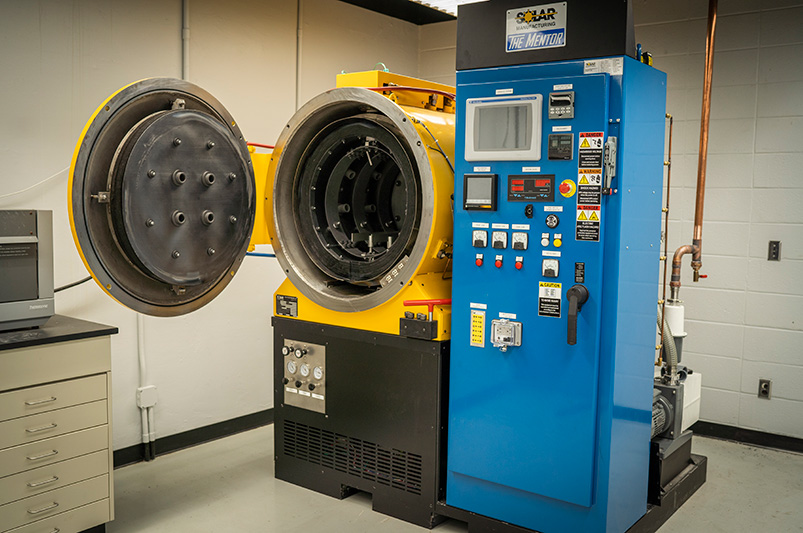
The new addition, known as The Mentor®, was donated to Lehigh University by thermal processing company Solar Atmospheres and its CEO and founder, William R. Jones. Its sister company, Solar Manufacturing, designs and builds vacuum furnaces at its location in Souderton, Pennsylvania, just 23 miles from Lehigh’s campus.
Additionally, Solar Atmospheres built and donated a transformer and water-cooling system that was specifically designed for the application.
Wojciech Misiolek, professor and cha ir of the Department of Materials Science and Engineering at the P.C. Rossin College of Engineering and Applied Science
“This is a very powerful, advanced piece of equipment that will allow us to conduct important experiments in our metallurgy teaching and research, especially around additive manufacturing, which is a hot topic these days,” explains Wojciech Misiolek, professor and chair of the Department of Materials Science and Engineering at the P.C. Rossin College of Engineering and Applied Science. “And we will challenge ourselves to use it up to its full capabilities for heat treatment of metals.”
“With this donation,” adds Misiolek, “suddenly you have the industry-grade equipment. It’s not a miniature version, it’s what you will see out in the field. Our educational system at Lehigh is very hands on, and we have a reputation for that. This furnace will increase opportunities for our undergraduate and graduate students and help them hit the ground running when they go into industry.”
Georgia Southern University (GSU) in Statesboro, Georgia, recently purchased a horizontal front-loading vacuum furnace from a Pennsylvania based heat treat furnace manufacturer.
GSU plans to use Solar Manufacturing’s Mentor® furnace primarily for vacuum thermal processing research and development of various iron-based alloys, including additive manufactured parts.
The Mentor® includes a graphite shielded hot zone and heating elements, with a work zone size of 12″ wide x 12″ high x 18″ deep, and a weight capacity of 250 pounds. Solar Manufacturing reports that this furnace complies with aerospace specification AMS2750E to process in an argon or nitrogen atmosphere or in high vacuum in the 10-6 Torr range with a 6” Varian diffusion pump. The furnace incorporates a control system package with a large graphic touchscreen overview and can be programmed to control gas quench rate up to two bar pressure and achieve temperature uniformity up to 2400° F.
Dan Insogna, Solar Manufacturing
“We are pleased to provide a solution to GSU’s growing research and development efforts, and we know the Mentor® vacuum furnace will benefit the university with this research,” said Dan Insogna, Solar Manufacturing’s Southeast Sales Manager.
Heat Treat 2019 is coming, and one of the great benefits of gathering with a community of heat treaters is the opportunity to challenge old habits and look at new ways of doing things. Heat TreatToday’s101 Heat TreatTips is another opportunity to learn the tips, tricks, and hacks shared by some of the industry’s foremost experts. The inaugural list of 101 Heat Treat Tips was published in the FNA 2018 Special Print Edition. This special edition is available in a digital format here.
Today's Technical Tuesday features 10 Tips -- all from the Vacuum Furnaces category and all supplied by the same equipment manufacturer.
Heat TreatTodayis compiling the 2019 101 Heat TreatTipslist for the fall issue to be distributed at Heat Treat 2019, the biennial show from the ASM Heat Treating Society to be held in Detroit, Michigan, October 14-17, 2019. If you have a heat treat-related tip that would benefit your industry colleagues, you can submit your tip(s) to doug@heattreattoday.com or editor@heattreattoday.com.
Heat TreatTip #24
Dirt In, Dirt Out!
Parts going into the furnace should be as clean as possible. Avoid placing parts in the furnace that contain foreign object debris (FOD). FOD on work surfaces going into the furnace will contaminate the furnace and the parts themselves. Dirty work in, dirty work out. FOD comes in many forms. Most common: oil, grease, sand in castings or grit blasting operations, and metal chips that generally originate from the manufacturing process before the parts are heat treated. It could also be FOD from the shipping process such as wood or plastic containers used to ship the parts.
Heat TreatTip #26
Solenoid valves could be the problem if helium detection fails.
When a Helium Leak Detector Doesn't Help
If an air leak cannot be found with a helium mass spectrometer, take apart the gas backfill or partial pressure solenoid valves to ensure they are clean. A small piece of debris can cause a valve to leak a process gas into the furnace that will not be found with a leak detector. Debris is often found in the valve seats when piping to the valve was disturbed in some way such as new piping or repair that stirs up contaminants in the line.
Heat TreatTip #46
O2 Analyzer Helps Ensure Gas Purity
In addition to monitoring dewpoint at the farthest location from the gas source in your heat treat facility, an oxygen analyzer is also recommended as an additional tool for monitoring gas purity. Generally, the analyzers used to measure dew point drift low over time. One may think they have a very low dew point gas, however, it could be the dew point analyzer is beginning to fail. Quarterly checks of the dew point analyzer's accuracy should be taken; some OEMs recommend replacing the sensors annually. Oxygen analyzers provide a more stable reading over a period of time and build redundancy in confirming gas purity when coupled with the dew point analyzer.
Heat TreatTip #48
Seal Threaded Connections
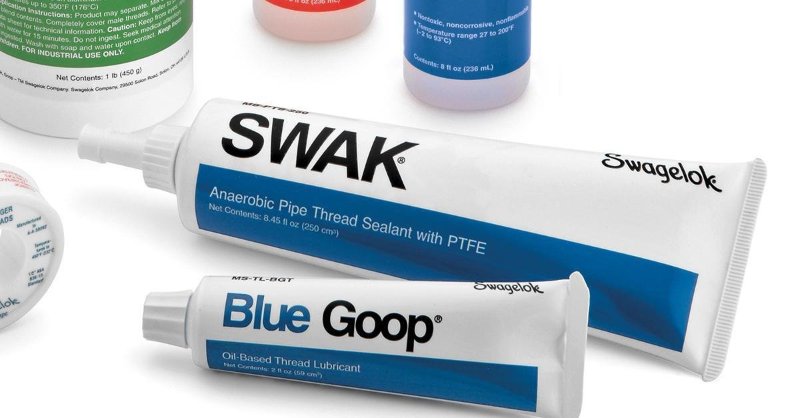
SWAK from Swagelok is a great thread sealing option. (photo source: LinkedIn)
Ensure threaded connections have adequate sealing protection on them to prevent air leaks through the threads where applicable. Wipe off excess sealant once the connection is made.
SWAK from Swagelok is excellent
Apply to the male threads only, not on any other surface as it could contaminate the system the component is being installed on.
Excess SWAK can be removed with a solvent such as acetone
Finger tight first, then tighten with a wrench
After the sealant is dry (recommend 24hrs by manufacturer) do not loosen as this could break the seal once cured.
Heat TreatTip #61
Start With the Obvious
When a problem arises with the furnace, always start the troubleshooting process with the last item that was worked on. Start with the obvious; don't look for a needle in the haystack. For example, if the furnace will not pump into high vacuum and maintenance was just performed on the furnace with the pneumatic pressure valves being shut to perform that maintenance operation, the pneumatic valve to the main poppet valve on the diffusion pump may not have been re-opened, causing the diffusion pump main poppet valve to not open.
Heat TreatTip #74
Make Sure Your Gas Meets Spec
Ensure each delivery of process gas is accompanied by a certification identifying purity, oxygen content, and dew point. For example, nitrogen should be 99.998% pure, 10 ppm oxygen max, and a dewpoint no higher than -89°F. With contaminated gas or gas that does not meet the criteria above, parts processed in the furnace and subjected to the partial pressure of the gas or quenched with the gas may also become contaminated, typically in form of oxidation and/or decarburization. Generally varying purity is not a concern, however, the specific purity of the gas required needs to be conveyed to the gas supplier and a certification supporting the gas type you ordered was delivered. An accompanying certification by the gas supplier goes a long way in audits and other disputes.
Heat TreatTip #76
Specification Checklist for Vacuum Furnace Purchase
If you're planning on purchasing a new vacuum furnace, create a technical specification for the manufacturer(s) that clearly outlines the performance, functions, and accessories required on the furnace. The specifications should be reviewed by multiple departments including but not limited to engineering, quality, production, and management.
List of department sign-offs required (engineering, production, maintenance, quality)
List of parameters to be recorded (temperature, pressure, flow rate, etc.)
List of required alarms
Physical location of furnace and associated components such as control system and surge tank
Units of measurement (°F or °C, torr or Pascals, minutes or hours)
How many process gases and what type
Cooling rate requirements (This will help decide what quench pressure design furnace is required, for example, 2 bar or 10 bar.)
How many work thermocouples are required
What pre-testing verification is required for final acceptance. For example, thermal uniformity survey temperature points and tolerances, vacuum pump downtime and levels, leak up requirements, quench tests, process validation tests.
Wipe both door flanges and O-ring every time.
Heat TreatTip #84
Clean the Door—Every Time!
Wipe down the front door O-ring and both flanges every time before the door is closed to ensure there is no debris on the O-ring or flange. Over time, the debris will damage the O-ring and pit the flange causing sealing issues.
Heat TreatTip #91
Include Maintenance Team in New Vacuum Purchase Process
Include the maintenance manager in any furnace purchase decision. The manager and team are the ones tasked with troubleshooting, repair, and preventative maintenance. The maintenance manager will make sure the furnace has clear access for maintenance and replacement of major components including vacuum pumps, cooling motor, hot zone, and heat exchanger. The longer it takes to repair the furnace, the more downtime and lost revenue because the furnace is not running.
Heat TreatTip #94
A properly greased O-ring will ensure a solid, leak-free seal.
Inspect Replacement O-Rings
When replacing an O-ring, be sure the new O-ring is clean and undamaged (free of cuts, nicks, tears, or gouges) and that the splice joint is solid and true. Use a conservative amount of vacuum grease on the O-ring to ensure a tight sealing furnace. Not too much grease is needed. Rule of thumb: a light gloss or sheen, but no build-up.
If you have a heat treat-related tip that would benefit your industry colleagues, you can submit your tip(s) to doug@heattreattoday.com or editor@heattreattoday.com
A Dozen & a Half Quick Heat TreatNews Items to Keep You Current
Heat TreatToday offers News Chatter, a feature highlighting representative moves, transactions, and kudos from around the industry.
Personnel and Company Chatter
Mike Woolery has recently joined Plibrico Company, LLC, as its purchasing manager. Woolery will report directly to the company’s Chief Financial Officer, Rob Wasieleski.
The recent acquisition of the SME Group by Dana Incorporated, as well as the Drive Systems segment of Oerlikon Group, including the Graziano and Fairfield brands, has resulted in the addition of five facilities throughout China.
Gasbarre Industrial Furnace Systems is pleased to announce the promotion of Mike Harrison to Engineering Manager for Gasbarre (formerly J.L. Becker), in Plymouth, MI.
A global investment firm recently announced that it has closed its purchase of StandardAero.The Carlyle Group completed the purchase from Veritas Capital. StandardAero is a global provider of repair and maintenance services to the aviation industry.
R. Joseph Stratman, Chief Digital Officer and Executive Vice President of Nucor Corporation, recently announced plans to retire on June 8, 2019, after more than 29 years of service with Nucor. Effective May 19, 2019, MaryEmily Slate will be promoted to Executive Vice President and will assume responsibilities for the Tubular Products Group, logistics and certain joint ventures.
Saint-Gobain Coating Solutions, Amherst, N.Y., has recently appointed Tim Vitorino, a member of the ASM Thermal Spray Society, to the position of Product Manager for Thermal Spray Powders. In this role, he will have global responsibility for the current TSP portfolio and for new product development.
Mike Woolery, purchasing manager, Plibrico Industries
Dana Incorporated expands with new sites.
Mike Harrison, Engineering Manager,Gasbarre Industrial Furnace Systems
R. Joseph Stratman, retiring Chief Digital Officer and Executive Vice President of Nucor Corporation
MaryEmily Slate promoted to Executive Vice President, Nucor Corporation
Tim Vitorino, Product Manager for Thermal Spray Powders, Saint-Gobain Coating Solutions
Equipment Chatter
A modified shelf oven, No. 879 from Grieve Corporation, heats to 350°F (177°C) and is currently used for pre-heating bulk friction material in trays at the customer’s facility.
A continuous annealing and chemical pretreatment line for processing strip coils for the aluminum market has been contracted by Henan Tongren Aluminum Co. Ltd, which specializes in aluminum products. Tenova will deliver the new line, which will process automotive and aircraft aluminum alloys, family series 2XXX, 5XXX, 6XXX and 7XXX.
A new 12’ long car-bottom vacuum furnace with advanced pumping system and rapid cooling capability has been ordered for Solar Atmospheres’ Greenville, South Carolina, facility. The horizontal vacuum furnace has been manufactured by sister company Solar Manufacturing; installation is scheduled for early 2020.
Two CaseMaster Evolution® (CMe) vacuum furnaces have recently been delivered to an aerospace components manufacturer, and an additional CMefurnace has gone to a performance automotive manufacturer, from SECO/WARWICK Group.
No. 879 from Grieve Corporation
Continuous annealing and chemical pretreatment line, Tenova
Car-bottom vacuum furnace for Solar Atmospheres, manufactured by Solar Manufacturing
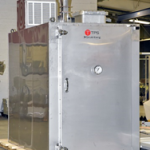
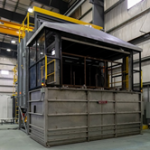
A Gruenberg explosion resistant truck-in oven has been shipped to the defense security industry by Thermal Product Solutions.
An electrically heated horizontal solution treat system with a maximum oven operating temperature of 1,100°F and a chiller system has been shipped to a manufacturer in the aerospace industry by Wisconsin Oven Corporation. Guaranteed temperature uniformity of ±10°F at set points of 870°F, 920°F, & 985°F was documented with a twelve (12) point profile test in an empty oven chamber under static operating conditions and was performed in accordance with BAC 5621F specifications.
A 2012°F (1100°C) crucible furnace has been shipped to a research and development laboratory in the nuclear industry by Lindberg/MPH. This crucible furnace will be used for a wide variety of laboratory melting applications, including annealing, ashing, carbon firing, ceramic firing, hardening, melting, nitriding, normalizing, sintering, solution treating, and stress relieving.
StandardAero recently celebrated the delivery of the company’s 500th CFM International CFM56-7B turbofan engine from its overhaul facility in Winnipeg, MB, Canada. This milestone engine powered a Boeing 737 Next Generation passenger jet operated by a major North American airline supported by StandardAero via offload agreements with its valued partner GE Aviation. StandardAero launched its CFM56-7B program in June 2009,
Precision Micro is now certified to ISO 13485 – the internationally recognized quality management system for medical device manufacturers. The accreditation was awarded following a successful site audit conducted by the British Standards Institution (BSI), the national standards body of the United Kingdom.
Stratolaunch Systems Corporation recently completed the first flight of the world’s largest all-composite aircraft, the Stratolaunch. With a dual fuselage design and wingspan greater than the length of an American football field, the Stratolaunch aircraft took flight at 0658 PDT from the Mojave Air and Space Port. Achieving a maximum speed of 189 miles per hour, the plane flew for 2.5 hours over the Mojave Desert at altitudes up to 17,000 feet. As part of the initial flight, the pilots evaluated aircraft performance and handling qualities before landing successfully back at the Mojave Air and Space Port.
JTEKT North America (JNA), a supplier of steering systems, driveline components and bearing technologies was recognized with an Excellent Award in Technology & Development from Toyota Motor North America, Inc. (TMNA) at its Annual Supplier Business Meeting (ABM) in March.
The leading producer of flat-rolled aluminum products recently hosted a ribbon cutting celebration to commemorate a $4.5 million investment at its facility in Warren, Ohio. Through this investment, Novelis, Inc., will provide greater versatility for pretreatments, improves operational efficiency and reduces costs over time.
StandardAero delivers 500th CM56-7B engine.
Precision Micro is now certified to ISO 13485.
Stratolauncher completes flight.
JTEKT receives award from Toyota. L-R: Arata Ito, Jennifer Cullum, Shannon Johnson, Gregg Malpede, Bob Young, Deb Schroeder
Heat TreatTodayis pleased to join in the announcements of growth and achievement throughout the industry by highlighting them here on our News Chatter page. Please send any information you feel may be of interest to manufacturers with in-house heat treat departments especially in the aerospace, automotive, medical, and energy sectors to the editor at editor@heattreattoday.com.
During the day-to-day operation of heat treat departments, many habits are formed and procedures followed that sometimes are done simply because that’s the way they’ve always been done. One of the great benefits of having a community of heat treaters is to challenge those habits and look at new ways of doing things. Heat TreatToday‘s 101 Heat TreatTips, tips and tricks that come from some of the industry’s foremost experts, were initially published in the FNA 2018 Special Print Edition, as a way to make the benefits of that community available to as many people as possible. This special edition is available in a digital format here.
Today, we offer one of the tips published under the Vacuum Furnace category.
Vacuum Furnace
Heat TreatTips #3
Make and Stick to a Clear Preventative Maintenance Program
Make sure a preventative maintenance schedule is clearly defined and adhered to. Most modern furnace control systems include diagnostics to assist in determining when certain components of the equipment require maintenance. Use these tools to prevent downtime and avoid wasting unnecessary maintenance.
Change pump oil regularly: roughing, pump, boosters, and holding.
Check hot zone for wear, loose, or missing hardware; verify element to ground resistance is greater than 10 ohms, vacuum out loose debris (monthly).
Check water chemistry and adequate flow to and from the furnace (weekly).
Check front door O-ring integrity, make sure there is no damage and that the ring is not flat; light grease as needed.
Bubble check process gas lines for potential leaks.
Controlling process temperature with accuracy and without extensive operator involvement is a crucial task in the heat treat shop and calls for the use of a temperature controller, which compares the actual temperature to the desired control temperature, also known as the setpoint, and provides an output to a control element. This comparative process relies upon an algorithm, the most commonly used and accepted in the furnace industry being the PID, or Proportional-Integral-Derivative, control.
“This popular controller is used because of its robust performance in a wide range of operating conditions and simplicity of function once understood by the processing operator,” writes Real J. Fradette, a Senior Technical Consultant with Solar Atmospheres, Inc, and the author of “Understanding PID Temperature Control as Applied to Vacuum Furnace Performance” (with William R. Jones, CEO, Solar Atmospheres, Inc, contributing).
The PID algorithm consists of three basic components, Proportional, Integral, and Derivative which are varied to get optimal response. If we were to observe the temperature of the furnace during a heating cycle it would be rare to find the temperature reading to be exactly at set point temperature. The temperature would vary above and below the set point most of the time. What we are concerned about is the rate and amount of variation. This is where PID is applied. ~ Fradette
In this week’s Technical Tuesday, we direct our readers to Fradette’s article at Solar Manufacturing’s website where he and Jones cover the following on PID temperature controllers:
Definitions, e.g., Closed Loop System; Proportional (GAIN); Integral (RESET); and Derivative (RATE)
Actual operation of a PID temperature controller, including understanding PID dimensions and values; and general rules for manually adjusting PID