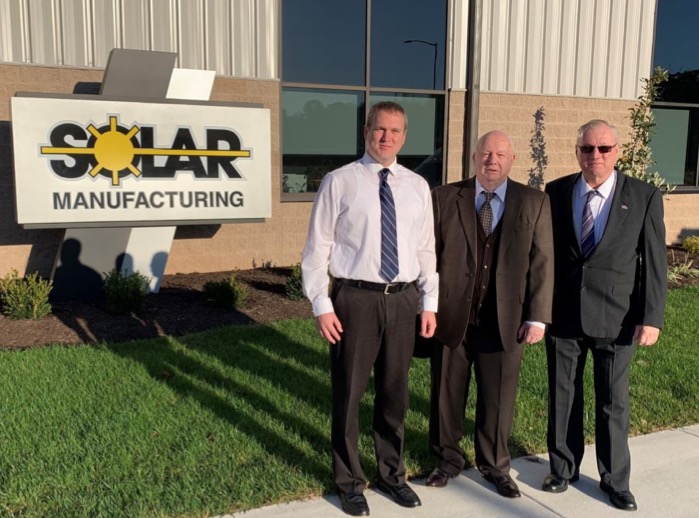
Three generations of the Jones family. This picture taken just moments before the Ribbon Cutting Ceremony shows (l-r) Trevor Jones, CEO of Solar Manufacturing; Trevor’s grandfather, William R. Jones, CEO of the Solar Group of Companies; and Trevor’s father, Roger A. Jones, President of Solar Atmospheres (retired).
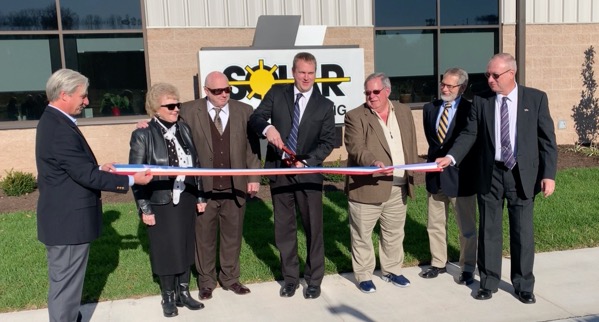
William and Myrtle Jones were recently joined by a group of key Solar Manufacturing employees including Roger Jones and Trevor Jones at a ribbon-cutting ceremony for the company’s new manufacturing site in Sellersville, Bucks County, Pennsylvania.
Speaking at the ceremony in addition to William Jones was Sellersville Borough mayor Thomas C. Hufnagle, Gorski Construction president Jerry Gorski, Bucks County Industrial Development Authority chairwoman Mary Smithson, and Bucks County Board of Commissioners chairman Robert Loughery. Employees moved into the newly constructed 59,000 square foot facility in early October on land vacated by AMETEK in 2008.
Gorski Construction president Jerry Gorski; Myrtle Jones; CEO of Solar Group William Jones, Solar Manufacturing CEO Trevor Jones; Sellersville mayor Thomas C. Hufnagle; Solar Manufacturing president Jim Nagy; and retired president of Solar Atmospheres Roger Jones.
"It is important that we invest in our communities,” explained CEO William Jones. “When AMETEK left, they left more than a couple of vacant lots. It’s our goal to grow and support the local economy.”
Jim Nagy, president of Solar Manufacturing, gave the local dignitaries a tour of the facility including a shop floor filling up with equipment being transferred in from the company’s previous manufacturing locations.
The company plans to hold an open house event in the first or second quarter of 2020 once the dust has settled on the new construction and employees have had a chance to acclimate to their new surroundings.
In the video below, Gorski Construction president Jerry Gorski presents a shovel to William Jones, representing the groundbreaking of the new location.
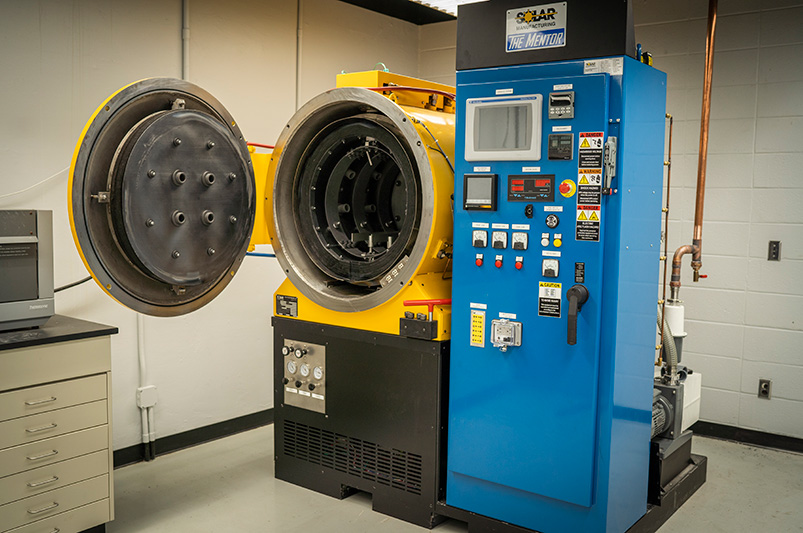
A thermal processing company donated a $300,000 commercial-grade vacuum heat treating and brazing furnace to Lehigh University’s materials science program to help increase opportunities for its students in the field.
The new addition, known as The Mentor®, was donated to Lehigh University by thermal processing company Solar Atmospheres and its CEO and founder, William R. Jones. Its sister company, Solar Manufacturing, designs and builds vacuum furnaces at its location in Souderton, Pennsylvania, just 23 miles from Lehigh’s campus.
Additionally, Solar Atmospheres built and donated a transformer and water-cooling system that was specifically designed for the application.
Wojciech Misiolek, professor and cha ir of the Department of Materials Science and Engineering at the P.C. Rossin College of Engineering and Applied Science
“This is a very powerful, advanced piece of equipment that will allow us to conduct important experiments in our metallurgy teaching and research, especially around additive manufacturing, which is a hot topic these days,” explains Wojciech Misiolek, professor and chair of the Department of Materials Science and Engineering at the P.C. Rossin College of Engineering and Applied Science. “And we will challenge ourselves to use it up to its full capabilities for heat treatment of metals.”
“With this donation,” adds Misiolek, “suddenly you have the industry-grade equipment. It’s not a miniature version, it’s what you will see out in the field. Our educational system at Lehigh is very hands on, and we have a reputation for that. This furnace will increase opportunities for our undergraduate and graduate students and help them hit the ground running when they go into industry.”
A Baker’s Dozen Quick Heat TreatNews Items to Keep You Current
Heat TreatToday offers News Chatter, a feature highlighting representative moves, transactions, and kudos from around the industry.
Personnel and Company Chatter
Tom Spicer recently joined Gasbarre Industrial Furnace Systems (OEM of J.L. Becker brand equipment) as a Field Service Technician. Tom brings over 20 years of industry experience to the Plymouth, Michigan, company, having previously worked with OEMs assembling and servicing equipment and in maintenance at a commercial heat treat facility.
Changes at DANTE: The month of May saw the transition of Dan Londrico and Stefan Habean from intern to staff engineer. Charlie Li moved from Vice President to President of the company, and Lynn Ferguson became Emeritus. Edward Lee, a mechanical engineering student at The Ohio State University, joined the DANTE team as an intern.
Sławomir Woźniak has been appointed by the Supervisory Board at the SECO/WARWICK Group to the role of President of the Management Board. The new President has been appointed for the same period as the joint term of the new Management Board, which spans the next three full financial years.
Ajax TOCCO Magnethermic / Emmedi would like to congratulate Don Gibeaut on his election to Chairman of the North American Management Board of Directors (NAMB) for the International Tube Association (ITA). Don is the product manager for ATM’s Tubular Products Division.
A materials technology engineering group recently completed a partial acquisition of a provider of metal additive manufacturing (AM) services and advanced end-use components. Sandvik acquired a 30% stake in privately owned Beam IT, which supplies metal AM end components to demanding industries, including automotive, energy and aerospace, and holds several relevant quality certifications to serve these industries.
A new hot isostatic press (HIP) has been delivered and installed at Paulo’s Cleveland Division. The furnace was built by Quintus Technologies. The 30,000-sqft expansion to house the HIP vessel is complete and will provide the Cleveland Division room for additional expansion to support customer needs.
GE Additive recently announced that the company has made a significant investment in its electron beam melting (EBM) technology, with the purchase of an additional 17 A2X systems and 10 Spectra H systems. Avio Aero, a GE Aviation company, currently operates a fleet of 35 Arcam machines at its recently expanded site in Cameri, Italy. The additional EBM systems will be installed at GE Aviation and Avio Aero facilities in the US and Europe and will be used primarily for the production of titanium aluminide (TiAl) blades on the low-pressure turbine for the GE9X engine.
Metal Exchange Corporation (MEC), headquartered in St. Louis, MO, is forming a new joint venture with Novellini Industries Srl in Mantova, Italy. Called novALmec, the newly formed company will supply aluminum billet capacity to the European market.
Charlie Li, DANTE
Lynn Ferguson, DANTE
Equipment Chatter
An automotive supplier recently ordered a nitrocarburizing furnace for a new component line for a major carmaker. SECO/WARWICK commissioned the high-volume, horizontal retort furnaces, which will allow the customer to produce parts for North American suppliers. In addition to ferritic nitrocarburizing, the furnaces can provide clean, stress relief processing.
Four atmosphere controlled, aluminum coil annealing furnaces, which will be used to anneal automotive body stock and common alloy sheet coils, have been ordered by a leading U.S. aluminum producer from Consolidated Engineering Company.
A quench tank has been installed by Baker Furnace, a division of Thermal Product Solutions, for a supplier in the heat treatment industry. The customer had two quench tanks and three drop bottom furnaces and needed the third quench tank in order to optimize quench loads per day.
Kudos Chatter
During the 2019 CCAI Annual Meeting in Hilton Head, South Carolina, the Chemical Coaters Association International held their annual awards ceremony to recognize the CCAI Chapter Users and Suppliers of the Year and announce the 2019 James F. & David J. Wright Lifetime Achievement Award recipient. The 2018-19 Chapter Award winners are: Central States Chapter – Frank Laster, A-1 Paint Powder and Sandblasting LLC and Ron Cudzilo, George Koch Sons LLC; Georgia Chapter – Wayne Pettyjohn, Georgia Power Company; Las Vegas Chapter – Tony Sclafani, AR Iron, LLC and Sercy Spears, TIGER Drylac, Inc. USA; Northern Illinois Chapter – Matt Ambrose, Henkel Corporation; Salt Lake City Chapter – Ginny Phommavongsay, Martin Door Mfg.; Southern California Chapter – Shivie Dhillon, Sundial Powder Coating, Tony Sclafani, AR Iron, LLC and Luis Hernandez, Coral Chemical Co.; Twin Cities Chapter – Mark Walsworth, Retired and Jim Henningsen, Troy Chemical; West Michigan Chapter – In memory of Herb Knape, Knape Industries Inc., and Jason Meekof, Industrial Metal Cleaning; and Wisconsin Chapter – Justin Jarmuz, Wacker Neuson Corp. and Matt Roeser, DuBois Chemical Co.
During the July 9th Collier County Board of County Commissioners meeting, Pelican Wire was named the Collier County ‘Business of the Month’ and was recognized by the Board for being a manufacturing leader in Collier County for over forty years.
On July 11th, Solar Atmospheres hosted 28 high school students enrolled in the Summer Engineering Institute (SEI) at Lehigh University. The group also included a few members of Lehigh University undergraduate students and staff. The SEI program, under the guidance of Director Dr. Laura Moyer, is a two-week residential program, running two sessions back to back. Students are nominated by faculty of local high schools, and the program specifically targets under-represented groups including girls, first-generation students, and students who might otherwise have limited opportunities to study in the fields of science, technology, engineering, and math (STEM).
Heat TreatToday is pleased to join in the announcements of growth and achievement throughout the industry by highlighting them here on our News Chatter page. Please send any information you feel may be of interest to manufacturers with in-house heat treat departments especially in the aerospace, automotive, medical, and energy sectors to the editor at editor@heattreattoday.com
A vacuum heat treatment provider recently installed an all-metal hot zone vacuum furnace at their Souderton, Pennsylvania, location.
Solar Atmospheres
Solar Atmospheres added a third all-metal hot zone furnace for its climate-controlled room at its facility in Souderton, Pennsylvania. The additional furnace increases Solar’s capacity for processing sensitive materials such as PH stainless, nickel-chrome based superalloys, titanium, and ferritic and austenitic stainless steels.
Vacuum levels lower than 5 x 10⁻⁶ Torr can produce clean, bright results without contamination. Solar reports that the unique placement of isolation valves, an all-metal moly/stainless steel hot zone, and a stainless steel chamber in its new furnace allow it to attain the level of cleanliness mandated by aerospace and medical markets. The furnace also incorporates Solar Manufacturing’s latest SolarVac Polaris HMI control system for complete process automation.
Jamie Jones, President, Solar Atmospheres in Eastern PA
“The increasing demands for cleanliness levels in critical aerospace and medical applications, and the growth in these markets paved the way for Solar Atmospheres to add capacity through this investment,” said Jamie Jones, President of Solar Atmospheres in Eastern PA.
A Dozen & a Half Quick Heat TreatNews Items to Keep You Current
Heat TreatToday offers News Chatter, a feature highlighting representative moves, transactions, and kudos from around the industry.
Personnel and Company Chatter
Mike Woolery has recently joined Plibrico Company, LLC, as its purchasing manager. Woolery will report directly to the company’s Chief Financial Officer, Rob Wasieleski.
The recent acquisition of the SME Group by Dana Incorporated, as well as the Drive Systems segment of Oerlikon Group, including the Graziano and Fairfield brands, has resulted in the addition of five facilities throughout China.
Gasbarre Industrial Furnace Systems is pleased to announce the promotion of Mike Harrison to Engineering Manager for Gasbarre (formerly J.L. Becker), in Plymouth, MI.
A global investment firm recently announced that it has closed its purchase of StandardAero.The Carlyle Group completed the purchase from Veritas Capital. StandardAero is a global provider of repair and maintenance services to the aviation industry.
R. Joseph Stratman, Chief Digital Officer and Executive Vice President of Nucor Corporation, recently announced plans to retire on June 8, 2019, after more than 29 years of service with Nucor. Effective May 19, 2019, MaryEmily Slate will be promoted to Executive Vice President and will assume responsibilities for the Tubular Products Group, logistics and certain joint ventures.
Saint-Gobain Coating Solutions, Amherst, N.Y., has recently appointed Tim Vitorino, a member of the ASM Thermal Spray Society, to the position of Product Manager for Thermal Spray Powders. In this role, he will have global responsibility for the current TSP portfolio and for new product development.
Mike Woolery, purchasing manager, Plibrico Industries
Dana Incorporated expands with new sites.
Mike Harrison, Engineering Manager,Gasbarre Industrial Furnace Systems
R. Joseph Stratman, retiring Chief Digital Officer and Executive Vice President of Nucor Corporation
MaryEmily Slate promoted to Executive Vice President, Nucor Corporation
Tim Vitorino, Product Manager for Thermal Spray Powders, Saint-Gobain Coating Solutions
Equipment Chatter
A modified shelf oven, No. 879 from Grieve Corporation, heats to 350°F (177°C) and is currently used for pre-heating bulk friction material in trays at the customer’s facility.
A continuous annealing and chemical pretreatment line for processing strip coils for the aluminum market has been contracted by Henan Tongren Aluminum Co. Ltd, which specializes in aluminum products. Tenova will deliver the new line, which will process automotive and aircraft aluminum alloys, family series 2XXX, 5XXX, 6XXX and 7XXX.
A new 12’ long car-bottom vacuum furnace with advanced pumping system and rapid cooling capability has been ordered for Solar Atmospheres’ Greenville, South Carolina, facility. The horizontal vacuum furnace has been manufactured by sister company Solar Manufacturing; installation is scheduled for early 2020.
Two CaseMaster Evolution® (CMe) vacuum furnaces have recently been delivered to an aerospace components manufacturer, and an additional CMefurnace has gone to a performance automotive manufacturer, from SECO/WARWICK Group.
No. 879 from Grieve Corporation
Continuous annealing and chemical pretreatment line, Tenova
Car-bottom vacuum furnace for Solar Atmospheres, manufactured by Solar Manufacturing
A Gruenberg explosion resistant truck-in oven has been shipped to the defense security industry by Thermal Product Solutions.
An electrically heated horizontal solution treat system with a maximum oven operating temperature of 1,100°F and a chiller system has been shipped to a manufacturer in the aerospace industry by Wisconsin Oven Corporation. Guaranteed temperature uniformity of ±10°F at set points of 870°F, 920°F, & 985°F was documented with a twelve (12) point profile test in an empty oven chamber under static operating conditions and was performed in accordance with BAC 5621F specifications.
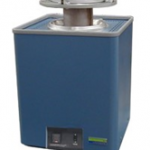
A 2012°F (1100°C) crucible furnace has been shipped to a research and development laboratory in the nuclear industry by Lindberg/MPH. This crucible furnace will be used for a wide variety of laboratory melting applications, including annealing, ashing, carbon firing, ceramic firing, hardening, melting, nitriding, normalizing, sintering, solution treating, and stress relieving.
StandardAero recently celebrated the delivery of the company’s 500th CFM International CFM56-7B turbofan engine from its overhaul facility in Winnipeg, MB, Canada. This milestone engine powered a Boeing 737 Next Generation passenger jet operated by a major North American airline supported by StandardAero via offload agreements with its valued partner GE Aviation. StandardAero launched its CFM56-7B program in June 2009,
Precision Micro is now certified to ISO 13485 – the internationally recognized quality management system for medical device manufacturers. The accreditation was awarded following a successful site audit conducted by the British Standards Institution (BSI), the national standards body of the United Kingdom.
Stratolaunch Systems Corporation recently completed the first flight of the world’s largest all-composite aircraft, the Stratolaunch. With a dual fuselage design and wingspan greater than the length of an American football field, the Stratolaunch aircraft took flight at 0658 PDT from the Mojave Air and Space Port. Achieving a maximum speed of 189 miles per hour, the plane flew for 2.5 hours over the Mojave Desert at altitudes up to 17,000 feet. As part of the initial flight, the pilots evaluated aircraft performance and handling qualities before landing successfully back at the Mojave Air and Space Port.
JTEKT North America (JNA), a supplier of steering systems, driveline components and bearing technologies was recognized with an Excellent Award in Technology & Development from Toyota Motor North America, Inc. (TMNA) at its Annual Supplier Business Meeting (ABM) in March.
The leading producer of flat-rolled aluminum products recently hosted a ribbon cutting celebration to commemorate a $4.5 million investment at its facility in Warren, Ohio. Through this investment, Novelis, Inc., will provide greater versatility for pretreatments, improves operational efficiency and reduces costs over time.
StandardAero delivers 500th CM56-7B engine.
Precision Micro is now certified to ISO 13485.
Stratolauncher completes flight.
JTEKT receives award from Toyota. L-R: Arata Ito, Jennifer Cullum, Shannon Johnson, Gregg Malpede, Bob Young, Deb Schroeder
Heat TreatTodayis pleased to join in the announcements of growth and achievement throughout the industry by highlighting them here on our News Chatter page. Please send any information you feel may be of interest to manufacturers with in-house heat treat departments especially in the aerospace, automotive, medical, and energy sectors to the editor at editor@heattreattoday.com.
Our Reader Feedback feature allows us to facilitate discussion between Heat Treat Today‘s content contributors and hard-working folks in the shop who have questions about an article.
This Reader Feedback exchange followed an inquiry to our publisher Doug Glenn about government regulation of heat treatment of firearms which we threw out to a few of our consultants and individuals who have knowledge and expertise in this field — and we added a few questions of our own. Our experts are Doug Shuler, lead auditor with Pyro Consulting LLC;John Quaglia, president of Bennett Heat Treating and Brazing; and Jamie Jones, president of Solar Atmospheres. If you have any questions about this or other topics you’ve seen covered on any Heat Treat Today platform, please submit them to editor@heattreattoday.com.
Do you know if any type of firearms license is required to heat treat firearm components?
Doug Shuler
Doug Shuler: It depends on which components are being heat treated. Barrels, slides, etc. do not require a license, but if the receiver (the part with the serial number) is heat treated, a license is required and the heat treater is subject to ATF audits. . . . Basically, if serialized parts are heat treated it must be done under an FFL (Federal Firearms License) so the ATF can audit the whereabouts of any firearm at any time.
John Quaglia
John Quaglia: To the best of my knowledge, based upon some pretty extensive experience heat treating firearm components for one of my customers, the only license I am aware of is an FFL which is required toheattreatserializedreceivers. If the components are military or ITAR controlled, you must be registered with the DDTC and have ITAR certification, [as well as] for domestic (commercial firearms) if you are heat treating serialized components of a firearm (the receiver). Barrels, slides, sights, magazines, springs, firing pins, etc., are all easily acquired and interchangeable between firearms and therefore require no special permitting.
Jamie Jones
Jamie Jones: The US Department of Justice authorizes the ATF to regulate those who are manufacturers, dealers, collectors, and importers of firearms and destructive devices. Part of that regulation requires a license (Federal Firearms License [FFL]) be applied for and held by those who are involved with any of the above. For a contract heat treat company, this essentially only pertains to serialized components. Under the “manufacturing” definition, the ATF considers any activity which results in the manufacture of firearms for sale or distribution (including installing parts in or on firearm frames and receivers, and processes that primarily enhance a firearm’s durability), constitutes firearms manufacturing, and requires a manufacturer’s license. The FFL does not include components related to fully automatic firearms or suppressors. In order to possess and process those serialized items, the ATF requires a manufacturer’s FFL plus a special occupational tax stamp (SOT). Prior to issuance of the FFL, the ATF will conduct an on-site audit of the operation and person(s) applying for the license/stamp. The FFL needs to be renewed every three years.
What is the most challenging part of heat treating gun parts?
Spring Loaded Firing Pin thetruthaboutguns.com
JQ: Managing distortion is probably the most challenging as most components are very close to being finished machined. Special racking and methodizing is often required. Marquenching, ausquenching, and vacuum processing are often employed to minimize or eliminate the possibility of distortion. Also, due to the small size and complex geometry present, inspection of the parts is difficult. It is important to clarify the testing location with the manufacturer prior to punching hardness holes into areas of the parts that may be exposed after assembly. After all, manufacturers want their guns to look nice afterward. We have experienced delayed rusting on barrels due to the combination of steel wire and the 4150 barrel reacting to cause anodic corrosion after processing in a salt bath which would only expose itself after a few days. We would ship parts that were perfect, and two days later I would be on the phone with my customer trying to explain a mysterious rust line through the rifling in the barrel. We solved this with some tooling changes.
JJ: Frankly, it is no more challenging or different than heat treating any other parts for any other industry. Some parts are routine and some are challenging. Some materials are more challenging than others and some designs are more challenging than others.
Which parts are the most difficult and why?
BCM PNT™ Trigger Assembly Bravo Company USA
JQ: They all present challenges. Slides and barrels present challenges due to the non-symmetrical nature which require special setup procedures. These also tend to have lots of crevices and blind or small holes which trap quenchants, salts, cleaning materials which tend to lead to unhappy customers unless the parts are thoroughly cleaned. Magazines present challenges because they are thin steel stampings which tend to distort due to the quench and induced stressed relieving themselves during heating. I could write a book on the challenges we have faced with the processing of gun parts.
JJ: Parts that require carburizing which have been machined to a finished or near-finished state, with intricate designs, cut-outs, and varying cross sections are the most challenging; a perfect example of this is an AR bolt carrier. This kind of challenge is why we developed our version of low-pressure vacuum carburizing, as we now don’t need to worry about severe quench distortion or carbon potential control. With traditional carburizing, the austenitizing temperature of the steel can change if too much carbon diffuses into the corners and edges. This can lead to retained austenite and carbide formation. Our process negates that phenomenon by using precisely controlled boost-diffuse controls instead of carbon potential. Our process also leaves the parts bright, with no post carburizing blasting or cleaning operations required.
Is it the materials that make it difficult or is it the configuration of the part?
JQ: The materials tend to be common that most heat treaters have worked with before so from a metallurgical standpoint I would say that the materials are not the problem. The configuration of the parts is definitely worse. Non-symmetrical parts tend to distort more than symmetrical parts. It also makes it difficult to inspect the parts. Test in the wrong area and you have spring-back or rocking. As I mentioned earlier, if you test in the wrong area the customer cannot sell the part. Some gun manufacturers have test methods that are unconventional, testing a shallow case depth using an HRC scale, so that the hardness reading is a combination of the case hardness, case depth, and core hardness.
JJ: It seems like you are assuming it is difficult all of the time! Please see my answer to question 2 above.
Are there any other special processes or regulations that need to be followed when heat treating gun parts? If so, what are they?
JJ: This answer is not to be taken as legal advice. If you want to apply for an FFL, or you get an FFL, you need to know the regulation. It is serious business: if you don’t follow regulation, you could end up in prison. You need to keep detailed records of EVERY serialized component that you receive, process, and ship. You don’t want to be on the tail end of a missing part or parts, especially if you don’t know about it. If something goes missing you need to report it immediately. Of course, reporting it could mean losing your license. So my advice to anyone considering this is: BE GOOD AT TRACEABILITY and RECORD KEEPING!
We welcome your inquiries to and feedback on Heat Treat Today articles. Submit your questions/comments to editor@heattreattoday.com.
A Dozen Quick Heat TreatNews Items to Keep You Current
Heat TreatTodayoffers News Chatter, a feature highlighting representative moves, transactions, and kudos from around the industry.
Personnel and Company Chatter
John Finch has joined Plibrico Company LLC as the Southeastern Territory Manager. Mr. Finch, an accomplished refractory professional and is an active member of several different industry and refractory associations.
Timothy C. Fish has joined the sales team at Solar Atmospheres of Western PA as Regional Sales Manager, focusing on the Midwest region.
Triumph Fabrications is being acquired by Arlington Capital Partners. Triumph consists of four companies that manufacture, coat, and assemble complex sheet metal components for fixed wing and rotorcraft platforms. Heat treating and annealing are included in the operations.
A new state-of-the-art aluminum billet manufacturing facility will be constructed in the Rapids East Commerce Center in the City of Wisconsin Rapids, Wisconsin. Matalco Inc., a member of the Giampaolo Group, will house the new facility in a 110,000 sq ft manufacturing plant, which at full production capacity, will produce in excess of 230 million pounds of high-quality aluminum billet. This is part of a larger investment plan to construct several greenfield aluminum remelt facilities for billet and rolling slab production in North America.
Equipment Chatter
A series of gas nitriding and tempering furnaces have been installed at a commercial heat treatment company specializing in mold & die steel heat treatment for its newly formed division. The horizontal gas nitriding furnaces supplied by JGEF Furnaces can produce a hard clean substrate onto which is deposited a duplex layer with high hardness values. The JGEF tempering furnace series will help the manufacturer achieve a pre-vacuum protective atmosphere for tempering, and the atmosphere in the furnace chamber will reduce the oxidative decarburization reaction of the heat-treated workpiece. The furnace has a load capacity of 11023 pounds and an operating temperature range of 302-1202°F
Grupo TTT, one of the leaders in heat and surface treatments, recently added a SECO/WARWICK vacuum heat treatment and brazing system equipped with high-pressure gas quench to their Bergara, Spain, facility to run a variety of processes. This is the fourth system purchased by Grupo TTT with an earlier installation in Europe, and two systems currently in operation in Mexico.
Three box furnaces have been shipped for installation by Lindberg/MPH. An unnamed customer purchased one Temperite™ Box Furnace and one Treet-All™ Box Furnace to work in tandem. The Temperite™ Box Furnace is configured for aging, annealing, austempering, baking, solution treating, and tempering applications, while the Treet-All™ Box Furnace is configured for annealing, ashing, austempering, brazing, preheating, and solution treating applications. In addition, Lindberg/MPH announced the shipment of one Treet-All™ Box Furnace to the technology industry. The maximum temperature rating of this light industrial box furnace is 2050°F.
A state-of-the-art continuous mesh belt heat treat system has been commissioned for the production of high-quality automotive fasteners. CAN-ENG Furnaces International Ltd was selected for a project in the Piedmont Region of Italy, one of four installation locations for this globally recognized producer of specialty automotive fasteners.
A Blue M Friction-Aire® Safety Oven, which provides a controlled heat source without heating elements, was recently shipped to a manufacturer of consumer products by Thermal Product Solutions.
Kudos Chatter
StandardAero’s Maryville, Tennessee facility recently completed and shipped its 10,000th auxiliary power unit (APU) repair since the nearly 25 years it has been providing APU MRO services to the industry. The specific 10,000th repair was on a Honeywell model 36-150RJ APU for a regional aircraft operator.
Allied Mineral Products has launched a new Chinese-language website. The website, alliedchina.com, targets the local business market in China while actively engaging existing customers. In Northern China, Allied’s manufacturing facility in Tianjin celebrated its 20th anniversary last year.
The ASM Materials Education Foundation is pleased to announce the winners of the 2018 ASM Materials Genome Toolkit competition. As determined by an independent review committee, the undergraduate engineering departments at Georgia Institute of Technology, Louisiana Technological University, Montana Technological University, and Worcester Polytechnic Institute will receive a three-year site license for a suite of Thermo-Calc software tools intended to aid in the instruction of computational materials design, an emerging engineering practice deemed essential to the success of the U.S. Materials Genome Initiative (MGI) and global leadership in manufacturing.
Heat TreatTodayis pleased to join in the announcements of growth and achievement throughout the industry by highlighting them here on our News Chatter page. Please send any information you feel may be of interest to manufacturers with in-house heat treat departments especially in the aerospace, automotive, medical, and energy sectors to the editor at editor@heattreattoday.com.
A Dozen Quick Heat TreatNews Items to Keep You Current
Heat TreatTodayoffers News Chatter, a feature highlighting representative moves, transactions, and kudos from around the industry.
Personnel and Company Chatter
Todd McDonald was recently hired as president and chief executive officer of Thermal Process Holdings, Inc., which was formed by Calvert Street Capital Partners and John Hubbard, former CEO of Bodycote, PLC, to pursue a buy-and-build strategy in the thermal processing industry.
Gasbarre Products, Inc. launched its new website, www.gasbarre.com. As part of the rebranding initiative, Gasbarre has categorized its diverse product offering into three business units: Powder Compaction Solutions, Thermal Processing Systems, and Manufacturing Technologies.
Bentraum D. Huffman has been named president and chief executive officer of the Ellwood Group, Inc. Huffman previously had served as chief operating officer since 2015.
Chemcoaters, a coil coater and manufacturer of proprietary coating chemistries, has acquired Eco Green Coatings, making it a wholly owned subsidiary. Both companies are located in Gary, Indiana.
Connie Mackey, Advanced Heat Treat Corp. (AHT) Corporate Quality Systems Manager, was recently selected to be a voting member of the Nadcap Heat Treating Task Group. Nadcap is a global accreditation program designed to ensure standardized and cost-effective approaches and to provide continual improvement among the aerospace and defense industry.
Equipment Chatter
A large retort box furnace used for de-bindering ceramic composite pre-peg materials along with powder metals processing and hot isostatic processing was recently purchased from L&L Special Furnace Co., Inc.
A cabinet oven from Grieve, No. 934, is currently being used by the customer for heat treating. Workspace dimensions of this 850°F oven measure 38” W x 20” D x 26” H.
A LP gas-fired heavy duty car bottom oven with fume incinerator was recently delivered to a leader in the oil and gas industry by Wisconsin Oven Corporation. This car bottom oven will be used for prebaking drill pipe joints. The thermal clean oven has a maximum operating temperature of 800° F and work chamber dimensions of 8’6″ wide x 50’0″ long x 8’6″ high.
Kudos Chatter
Solar Atmospheres, Inc. has filed a Patent Application with the US Patent Office, application number 15/999,873 for a high-pressure, rapid gas quenching vacuum furnace utilizing an isolation transformer in the blower motor power system. The gas quench with a 600 HP motor operates at 460 volts in Argon gas, utilizing a double wound, Magnetic Specialties, Inc. electrical isolation transformer, primary winding 1:1 to the secondary winding, with a Variable Speed Drive and solid state electrical spike protection for motor arc suppression.
Thermal-Vac Technology, Inc., located in Orange, CA has received merit status for NADCAP AC7102 Heat Treating accreditation. Thermal-Vac Technology Inc. City Steel Heat Treating, located in Santa Fe Springs, CA has been awarded NADCAP accreditation in AC7102 Heat Treating. This is the initial accreditation award after our 2016 acquisition of this location.
Cornwell Quality Tools, which produces fine quality tools with high-grade alloy steel, combined with modern heat-treating methods, celebrates 100 years in business this year.
Tekscan’s Gait Analysis System Wins R&D 100 Award. Tekscan is thrilled to announce that StridewayTM has won an R&D 100 Award. The R&D 100 Awards honor the latest and best innovations, identifying the top technology products of the past year. Since 1963, the R&D 100 Awards have identified revolutionary technologies introduced to the market.
Heat TreatTodayis pleased to join in the announcements of growth and achievement throughout the industry by highlighting them here on our News Chatter page. Please send any information you feel may be of interest to manufacturers with in-house heat treat departments especially in the aerospace, automotive, medical, and energy sectors to the editor at editor@heattreattoday.com.
Heat TreatToday offers News Chatter, a feature highlighting representative moves, transactions, and kudos from around the industry.
Personnel and Company Chatter
Julien Noel has been named Vice President / General Manager of the Buehler worldwide division. ITW Test and Measurement Group President, Yahya Gharagozlou, made the announcement. Buehler is an ITW Company which manufactures scientific equipment and consumables for materials analysis.
A fourth vacuum aluminum brazing (VAB) furnace has been purchased by California Brazing, a Newark, California, heat treating company in order to expand the capability to service the aerospace sector.
Solar Atmospheres recently awarded the title of CEO Emeritus to Roger A. Jones, FASM. The honorary title was conferred by the company and announces his semi-retirement as Solar Atmospheres’ CEO, the culmination of 45 years of leadership and service to the vacuum heat treating industry.
A refractories supplier’s recently established partnership will result in the full-service distribution of the company’s products and services throughout several European countries. The Plibrico Company and Pli Group Europe GmbH, a highly experienced refractory distributor contractor based in Vienna, Austria, have entered into a new value-added distribution partnership will cover Austria, France, Germany, Switzerland, Italy, Hungary, Czech Republic, Slovakia, Slovenia, Croatia, Serbia, and Bulgaria.
The world’s largest aerospace company, the Boeing Company recently acquired Embraer SA, the commercial aircraft arm of a Brazilian aircraft manufacturer, in a new $4.75 billion joint venture.
Equipment Chatter
Seven Gruenberg Glassware drying ovens were recently shipped to a university in the U.S. Midwest by Thermal Product Solutions, a manufacturer of thermal-processing equipment based in New Columbia, Pennsylvania.
A furnace equipment company based in Erie, Pennsylvania, recently designed and manufactured a front-loading forge furnace for a leading North American forging company. The furnace built by Onex, Inc., is one of the largest of its kind in North America with workspace dimensions measuring 26ft (W) x 20ft (D) x 14ft (H).
A heat treating services provider in the U.S. Northwest recently purchased a Meg-HIP hot isostatic press for heat treating and metal processing. Västerås, Sweden-based, Quintus Technologies installed the system at Stack Metallurgical Group in Albany, Oregon.
Kudos Chatter
Thermal-Vac Technology, Inc. has been awarded a 2018 Top Workplaces honor by The Orange County Register. The list is based solely on employee feedback gathered through a third-party survey administered by research partner. The anonymous survey measures several aspects of workplace culture, including alignment, execution, and connection, just to name a few.
AK Steel recently announced that it has accepted an award of up to $1.2 million from U.S. Department of Energy (DOE) under the Office of Energy Efficiency and Renewable Energy’s (EERE) Advanced Manufacturing Office program to investigate novel low-density steels in the laboratory, which could ultimately be used in automotive structural applications. The three-year project will be conducted in collaboration with DOE, Oak Ridge National Laboratory Materials Science and Technology Division, and the Advanced Steel Processing and Products Research Center in the Department of Metallurgical & Materials Engineering at the Colorado School of Mines. The objective of the project is to conduct alloy design, laboratory validation, and testing of low-density steels that are alternatives to currently available advanced high strength steels and other lightweight metals.
Heat Treat Today is pleased to join in the announcements of growth and achievement throughout the industry by highlighting them here on our News Chatter page. Please send any information you feel may be of interest to manufacturers with in-house heat treat departments especially in the aerospace, automotive, medical, and energy sectors to the editor at editor@heattreattoday.com.
Controlling process temperature with accuracy and without extensive operator involvement is a crucial task in the heat treat shop and calls for the use of a temperature controller, which compares the actual temperature to the desired control temperature, also known as the setpoint, and provides an output to a control element. This comparative process relies upon an algorithm, the most commonly used and accepted in the furnace industry being the PID, or Proportional-Integral-Derivative, control.
“This popular controller is used because of its robust performance in a wide range of operating conditions and simplicity of function once understood by the processing operator,” writes Real J. Fradette, a Senior Technical Consultant with Solar Atmospheres, Inc, and the author of “Understanding PID Temperature Control as Applied to Vacuum Furnace Performance” (with William R. Jones, CEO, Solar Atmospheres, Inc, contributing).
The PID algorithm consists of three basic components, Proportional, Integral, and Derivative which are varied to get optimal response. If we were to observe the temperature of the furnace during a heating cycle it would be rare to find the temperature reading to be exactly at set point temperature. The temperature would vary above and below the set point most of the time. What we are concerned about is the rate and amount of variation. This is where PID is applied. ~ Fradette
In this week’s Technical Tuesday, we direct our readers to Fradette’s article at Solar Manufacturing’s website where he and Jones cover the following on PID temperature controllers:
Definitions, e.g., Closed Loop System; Proportional (GAIN); Integral (RESET); and Derivative (RATE)
Actual operation of a PID temperature controller, including understanding PID dimensions and values; and general rules for manually adjusting PID