


Retort furnace

EV Chassis Production Expands With Retort Furnace

ev chassis production expands with retort furnace

An international manufacturer of electric vehicles (EVs) is adding an advanced retort pit furnace for the production of EV chassis. The equipment’s larger working space will allow for the nitriding of very large die elements needed to produce this automotive equipment.

Maciej Korecki
Vice President of Vacuum Business Segment
SECO/WARWICK
Source: SECO/WARWICK.com

“This is the fourth SECO/WARWICK furnace for this global manufacturer of electric vehicles. Our product solves the challenge of nitriding dies for the production of large-sized chassis, using a working space with a diameter of 1,600 mm and a height of 2,800 mm. We delivered a similar solution to this partner last year,” said Maciej Korecki, vice-president of the SECO/WARWICK Vacuum Segment. 

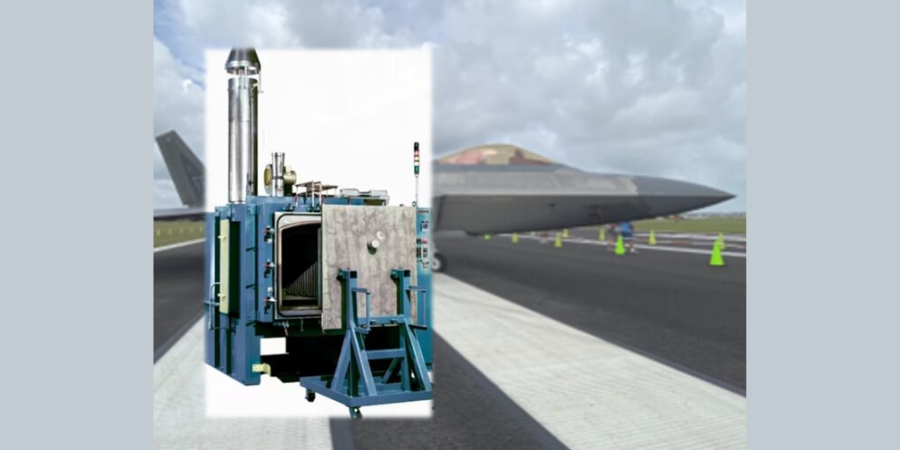
The equipment provided to the company has a compact design with vacuum purging, electric heating supported by an internal circulation fan, and an external cooling system. The retort and heating system’s special design as well as the gas installation ensures long and reliable operation in industrial conditions. The solution is based on a standard vertical VR retort furnace with an enlarged working space (Ø 1600 mm/63 in and 2800 mm/110.2 in effective height), which will allow the manufacturer to nitride the huge dies used for electric car chassis. 

The press release is available in its original form here.


Find Heat Treating Products And Services When You Search On Heat Treat Buyers Guide.Com


EV Chassis Production Expands With Retort Furnace Read More »
Motor Lamination Manufacturer Adds New Retort Furnace

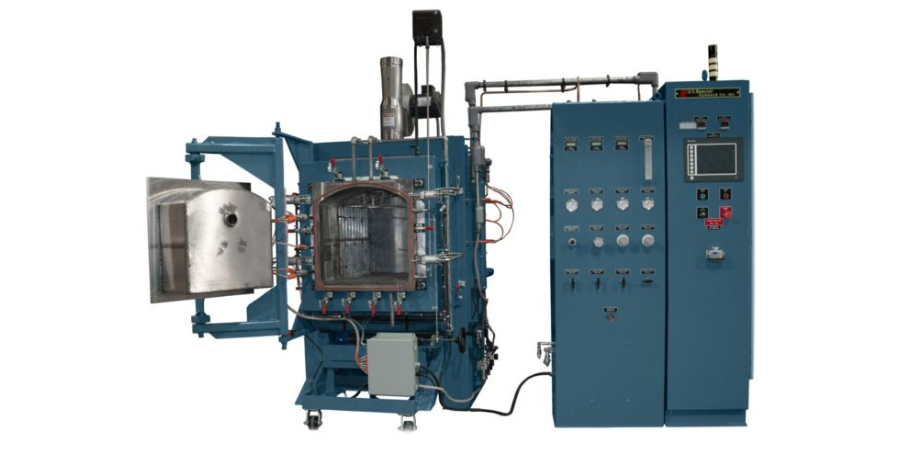
HTD Size-PR LogoA retort furnace with an Inconel 602CA alloy retort has been shipped from Pennsylvania to a leading manufacturer of motor laminations, located in Midwestern U.S. The laminations are deployed for motors in various aerospace, military, automotive, medical and industrial fields.

L&L Special Furnace shipped the model XLC3348 XLC3348 which has an effective work zone of 23” x 23” x 36” and uniformity of ±15°F above 1,200°F. The control system includes one control loop along with six zones of heating volume that can be adjusted to achieve the required temperature gradients. The model XLC3348 satisfies all requirements for AMS2750F class 3 uniformity and type B instrumentation. The process gas lines are required copper refrigeration lines along with stainless steel to ensure a very low dew point in the process gasses.


Find heat treating products and services when you search on Heat Treat Buyers Guide.com


Motor Lamination Manufacturer Adds New Retort Furnace Read More »

Heads or Tails, Philadelphia Mint Wins by Upgrading Heat Treat Furnaces

HTD Size-PR LogoThe Philadelphia Mint recently began a round of upgrades for its heat treat furnaces. Their function in the minting process is to anneal, clean, and dry the coin blanks to soften the metal prior to striking into coins, extending the service life of the striking dies.

SECO/WARWICK Group’s American subsidiary, located in Meadville, PA, recently began upgrades, a refurbishment of all five of the Philadelphia Mint’s heat-treating furnaces, one furnace per year. The heat-treating furnaces were originally installed there by SECO/WARWICK USA from 1994 through 2000.

All five furnaces are 4000 pound per hour rotary retort furnaces outfitted with a quench system, as well as a hopper feeder, a batch burnish barrel, and a batch/continuous drum drier. The furnaces are showing their age after a quarter century, so rather than nickel and dime the maintenance, the mint opted for a comprehensive refurbishment.

“Our Partner has plenty of coin to heat-treat, but they don’t have any to burn," commented Marcus Lord, managing director at SECO/WARWICK USA. "These waste-heat recovery and combustion efficiency upgrades are going to save them a mint while cutting carbon and NOx emissions nearly in half."

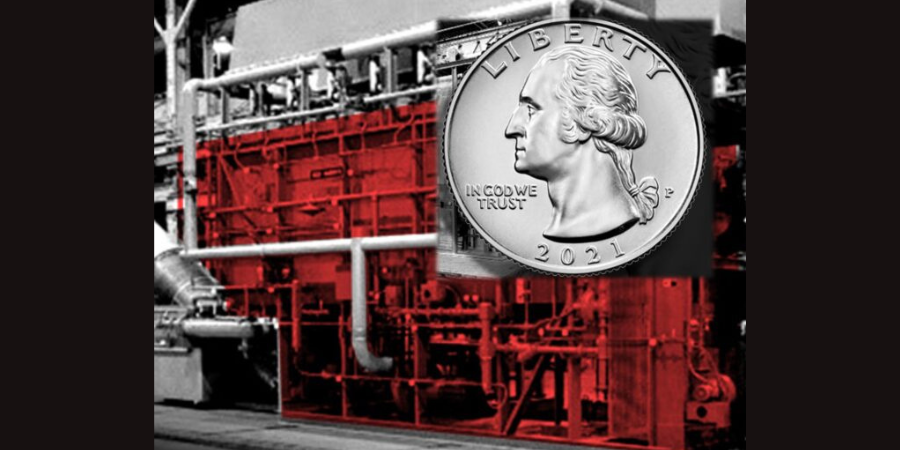
The small letter at the nape of Washington’s neck in the coin image above is a mint mark.  The “P” indicates that the coin was struck at the Philadelphia Mint.
Source: SECO/WARWICK Group

To reduce energy consumption, the Mint is replacing insulation, roof panels, and radiant tubes as well as upgrading the loading systems. More energy efficient burners are being installed, along with recuperators to preheat the combustion air, to improve energy efficiency and use less natural gas. Mechanical improvements include replacing drive motors and two-speed gear boxes. The retort can over-heat and warp if the rotary retort unexpectedly stops before the cool-down cycle. As a failsafe, SECO/WARWICK added a pneumatic backup motor that can run the gear box off the Mint’s compressed air reservoir during a power outage.

The mint was established by the Coinage Act of 1792, when Philadelphia was the nation’s capital. It was the first public building constructed under the direction of the recently formed United States government. The machinery was powered by a horse walking circles in the basement.


Find heat treating products and services when you search on Heat Treat Buyers Guide.com


Heads or Tails, Philadelphia Mint Wins by Upgrading Heat Treat Furnaces Read More »

Atmosphere-Controlled Retort Burn-Off Furnace Delivered to Midwest Manufacturer

HTD Size-PR LogoA heat treat furnace has been delivered to a Midwest manufacturer of ceramic matrix parts. This system will be used for aerospace and military purposes.

Atmosphere-Controlled Retort-Burn Off Furnace
Source: L&L Special Furnace Company, Inc.

Ceramic matrix parts materialize when nanofibers of silicon carbide or other ceramic nano threads are wound together, forming various sheets and 3D-printed shapes. The nano threads in the process are coated with proprietary resins that must be completely removed from the substructure using heat. The resulting finished product is lighter and stronger than titanium.

L&L Special Furnace Company, Inc.'s Model XLC3672 has a work zone of 32” wide by 32” high by 66” deep. It has a single zone of control with a temperature gradient of ±20°F at 1,100°F using four zones of temperature control with biasing to balance any temperature gradients. The Model XLC3672 is controlled by a Eurotherm Nanodac Mini 8 program mechanism with overtemperature protection.


Find heat treating products and services when you search on Heat Treat Buyers Guide.com


Atmosphere-Controlled Retort Burn-Off Furnace Delivered to Midwest Manufacturer Read More »

Skip to content