

Nutec Bickley

This Week in Heat Treat Social Media


Welcome to Heat Treat Today's This Week in Heat Treat Social MediaAs you know, there is so much content available on the web that it’s next to impossible to sift through all of the articles and posts that flood our inboxes and notifications on a daily basis. So, Heat Treat Today is here to bring you the latest in compelling, inspiring, and entertaining heat treat news from the different social media venues that you’ve just got to see and read!

If you have content that everyone has to see, please send the link to editor@heattreattoday.com.


1. Sailing Through AM

In this short video, an innovative team of project engineers designed a new part for a sailboat, increasing the performance of the boat in its application. The part was created through additive manufacturing (AM) techniques in order to optimize structural properties and decrease costs. Check it out!


2. Show Me: Charts, Figures, Videos

Hey. Let's cut to the chase. You want quick, visual info? See what we found for you.

The Nitriding Process

Shout out to Rosanne Brunello at Mountain Rep for sharing this video on LinkedIn. Follow #WomenInHeatTreat for more!

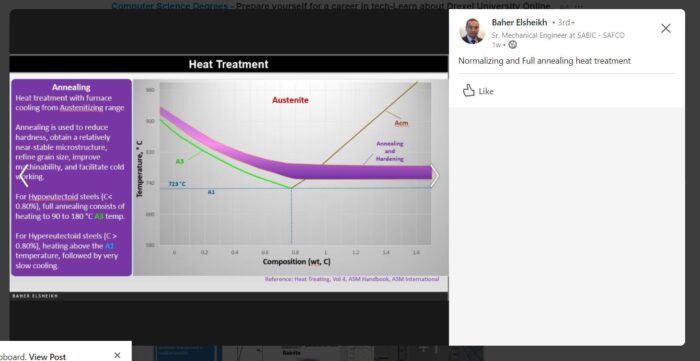
Normalizing and Full Annealing Heat Treatment

Click the image to see the other charts and graphs in the series posted by Baher Elsheikh on LinkedIn.

(photo source: Baher Elsheikh on LinkedIn)

Eight Reasons - Vacuum Brazing

What do you think of Alessia Paraviso's 8 reasons? Are there other reasons you would add?


Steel vs. CFC -- The 10 Advantages of CFC

Click the image to see the full LinkedIn post. There are a lot of colors going on, but share what you think about these differences. Do you agree? 


3. Social Celebrations

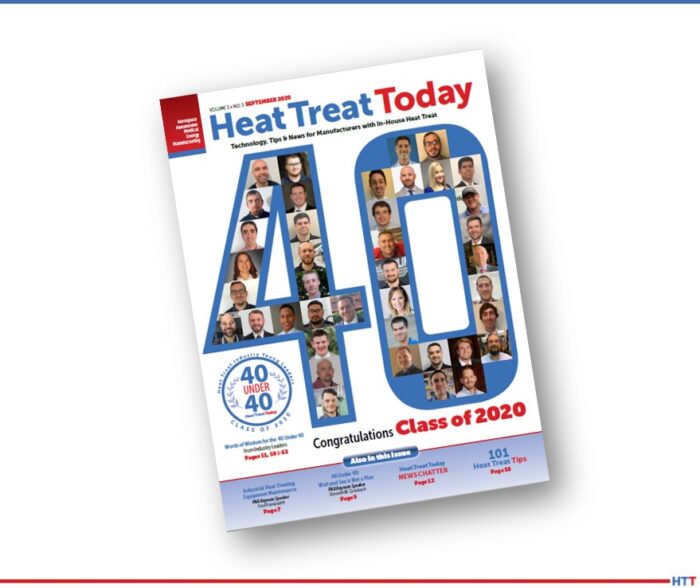
There are three heat treating-related celebrations from on social media that you may have missed: Nutec Bickley celebrating Mexico's Independence Day, SECO/WARWICK celebrates their e-Seminar event, and companies and individuals celebrate the Heat Treat Today 40 Under 40 Class of 2020.

Nutec Bickley Celebrates Mexico's Independence Day


SECO/WARWICK Celebrates Completion of their e-Seminar

40 Under 40 Winners are Recognized

In addition to the posts from Bodycote and CeraMaterials, other messages to honor the 40 Under 40 Class of 2020 have been trending on LinkedIn, such as the ones below.


4. Podcast Corner

Harb Nayar, the Sintering Expert

Harb Nayar is both an inquisitive learner and dynamic entrepreneur who will share his current interests in the powder metal industry, and what he anticipates for the future of the industry, especially where it bisects with heat treating.

Joe Powell of Integrated Heat Treating Solutions 

According to Joe Powell, heat treaters' focus should be on the quenching portion of the process where distortion often happens. In many instances, distortion is able to be eliminated.

Andrew Bassett, president of Aerospace Testing & Pyrometry, on AMS2750F

Andrew Bassett discusses the significant changes of AMS2750F in the specification areas of thermocouples and calibrations.


5. Metal Gear

Ah yes. "Safety first," but what about aesthetic? These metal t-shirts should do the trick.

See where you can order this t-shirt here.


Have a great weekend!

This Week in Heat Treat Social Media Read More »

Heat Treat Case Study: The Installation of 17 Ovens and Kilns

Time for a solid case study. In this Heat Treat Today Technical Tuesday feature, José P. Sanchez, part of Ceramics Business Unit in Nutec Bickley, describes the installation of several high-temperature and low-temperature ovens and kilns at one of the largest plants of a worldwide refractory product manufacturer.

Read this Original Content piece to get the details about how this project was executed and what measures were implemented for successful follow-up service.


About the Client

The client is recognized worldwide for the manufacture of refractory products used in the steel industry and on this project we worked with one of its largest plants.

This project comprised the design, manufacture and installation of 13 ovens and two kilns with temperatures ranging from 390°F to 3,000°F (200°C to 1,650°C) and retrofits to two existing kilns, as part of a major redesign at the client’s plant.


The Challenge

Nutec Bickley had to design, manufacture/modify and install 17 ovens / kilns in the space of 12 months, so we had to be especially careful organizing ourselves in the following aspects:

  • Ensuring we had the required space in our plant for the pre-assembly of all these units
  • Coordinating the execution of the project in which more than 80 people participated directly
  • Coordinating the parallel installation of multiple pieces of equipment in the customer’s plant, where at times there were more than 30 of our personnel on site at the same time


Our Solution

One of the decisive factors in winning this contract was the fact that other suppliers only had the capacity to manufacture either low temperature ovens or high temperature kilns, with Nutec Bickley being the only one with the capacity to manufacture both.

Additionally, we demonstrated our experience and ability to design ovens/kilns in temperature ranges from 210°F  right up to 3,270°F (100°C to 1,800°C).

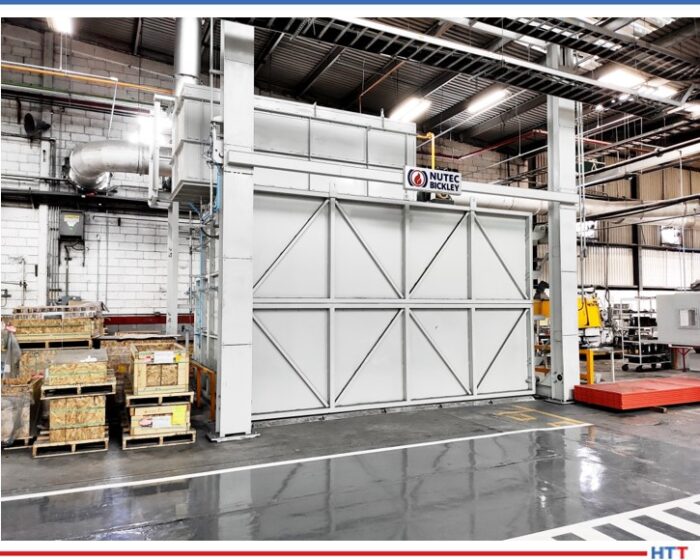
(photo source: Nutec Bickley)

We offered an ideal option, enabling the client to take on a single supplier to supply all of this equipment and to have it delivered it as a turnkey project.


Equipment Supplied

The turnkey solution comprised the following equipment and technologies:

A high temperature convection oven (1,110°F/600°C) with nitrogen injection

  • Equipped with stainless steel baffles to direct gases into the chamber and achieve the required temperature uniformity
  • Equipped with a thermal incinerator to reduce VOCs


Two Carbell Kilns

  • Operating temperature: 1,600°C (2,910°F)
  • Maximum operating temperature of 1,700°C (3,090°F)
  • Nine temperature control zones
  • High alumina bubble brick insulation
  • High velocity burners
  • Ceramic fiber lined exhaust vent
  • Incinerators in the exhaust for volatile gases


Two Retrofits of Existing Equipment

A) Modification of a Carbell kiln from another plant

  • We renewed the MCC and control panels.
  • We updated the PLC and display.
  • The combustion system was modified to comply with the NFPA-86 standard.

B) Transfer of a kiln from another plant

  • Insulation was supplied using our Jointless system.
  • Updated to meet NFPA-86 standard


12 Low-Temperature Convection Ovens (390°F to 660°F/200°C to 350°C)

(photo source: Nutec Bickley)

  • Two of them with forced cooling using extractors
  • Two of them with an incinerator to burn the volatile gases being vented to the atmosphere, greatly reducing pollution emissions
  • The other equipment was adapted to install more incinerators in the future.
  • Steel paneled ovens and mineral wool insulation
  • Design of baffles to direct gases into the chamber and achieve the required temperature uniformity


Project Benefits

  • Provided a comprehensive solution in the agreed timescale
  • Optimization of the use of floor space and improvements in operational logistics
  • SCADA system to monitor the uniformity of temperature in each cycle
  • Alarms in the event of sub-optimal temperature or where there is some discrepancy in the heating zones
  • Higher process quality and traceability in the case of rejects
  • Using some equipment from other plants reduced investment costs
  • Quickly service the 17 new, as well as the other, equipment
  • HSE supervisors in the field to monitor the operations of our mechanics and electricians
  • Knowledge to follow any type of safety standard in the design of combustion equipment. In this case it was NFPA 86-2019 (Class A oven and furnace design).
  • Opened our facilities at Nutec Bickley for visits to review progress of the oven manufacture


About the Author: José P. Sanchez is part of the Ceramics Business Unit in Nutec Bickley, in charge of sales in LATAM for kilns and major retrofits in the ceramic industry. He has been an active participant of multiple projects involving kilns and ovens in numerous industrial sectors, mostly refractories for the steel & aluminum industry.

Heat Treat Case Study: The Installation of 17 Ovens and Kilns Read More »

Furnace Temperature Control Options

Ernesto Perez,
Director of Engineering,
Nutec Bickley

In today’s Heat Treat Today Technical Tuesday feature, Ernesto Pérez, Director of Engineering, at Nutec Bickley, introduces readers to different options when it comes to furnace temperature control.


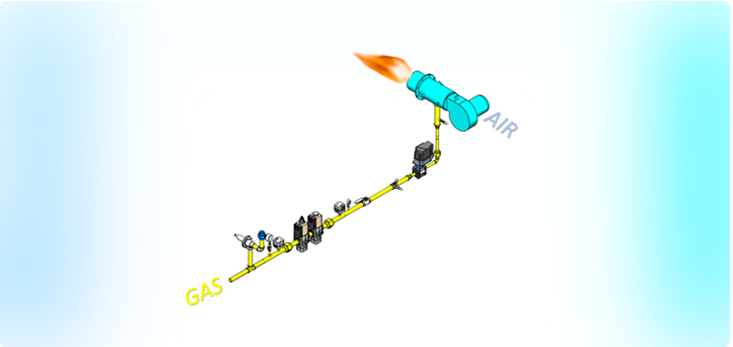
The main aim of the temperature control function is to keep a furnace operating within certain predefined values and it is composed of two main parts:

  • Electronic control element, usually a PID (proportional–integral–derivative) controller
  • Mechanical components

In this article we will look at the various control modes used in industrial furnaces, and their applications for various heat treatment processes.

Back to the Beginning: “Zero Control” Mode

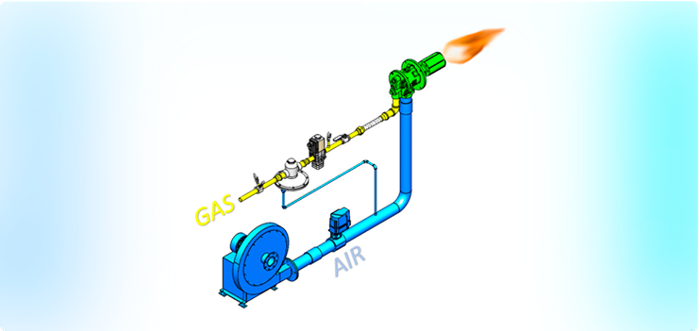
Figure 1

Before considering the modes currently used, we should briefly mention the “zero control” mode found in earlier furnace models, employed some time back, also known as “atmospheric mode.”

This mode operates by taking air from the environment by means of the venturi effect to perform combustion without controlling the air flow, resulting in an inefficient use of energy. (Figure 1)

Fuel-Only Control System

Figure 2

This operates in a similar way to zero mode, where only the gas is controlled. However, instead of the air being introduced by the venturi effect, there is a turbo fan that provides a constant flow to the process, while the gas is regulated during the different stages of combustion. (Figure 2)

  • Economic system having a single line of control.
  • It provides good temperature uniformity in applications where all items being fired in the furnace need to be at the same temperature.
  • Ideal for low temperature furnaces, kilns for ceramics and applications that require high-level heating homogeneity.

Possible Disadvantages
This technique leads to high gas consumption due to the heating of all the air present, irrespective of the size of the load in the furnace.

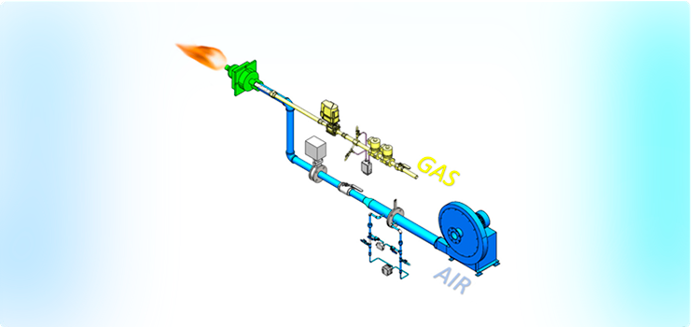
Proportional Control System

Figure 3

With this control mode, the air and the gas are controlled proportionally. (Figure 3)

The operation starts with a small flame, and as the temperature rises, it grows as the air and gas levels increase.

  • This system allows you to adjust the amount of gas based on the air present in order to achieve perfect combustion and optimal fuel consumption.
  • Ideal for any type of furnace, for example for heat treatments such as aging, tempering, forging and normalizing.

Possible Disadvantages
At the beginning of the heating process, it can be the case that temperature uniformity across the entire furnace is not so good due to the small flame, so it is not a system recommended for the treatment of very fragile pieces that can break.

Mass Flow Control System

Figure 4

This system controls air/gas in the same as the previously described method, but it also gives allowance to vary the air/gas ratio during combustion process in order to optimize the fuel. (Figure 4)

  • It enables for the achievement of optimal combustion conditions with less energy input.
  • If more air is needed in a particular heat treatment stage (usually at the beginning), it can be temporarily increased.
  • Ideal for any type of furnace, like heat treatments such as aging, tempering, forging, normalizing and applications involving fragile products.

Possible Disadvantages
Because of the technology behind the system, it is more expensive.

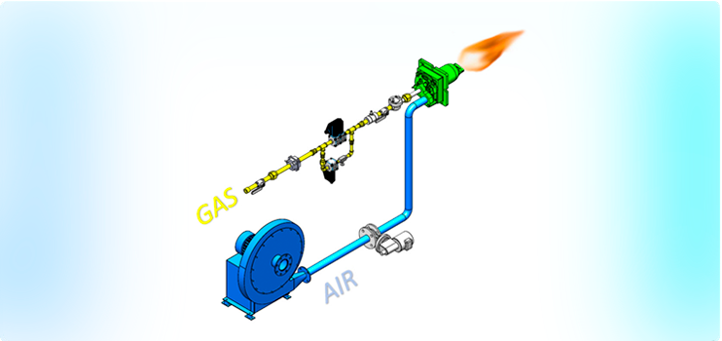
Pulse Control System

Figure 5

This is one of the most recently introduced methods that provides a fixed air/gas ratio, but unlike the previous mentioned systems, flame velocity for product heating is always high, which generates ideal temperature uniformity right from the beginning of the cycle. (Figure 5)

The burners pulse from high-fire to low-fire, repeating this cycle every 15 to 60 seconds.

  • It is cheaper to operate than the mass flow system, allowing users to handle the entire range of products with a smaller investment.
  • It provides greater fuel efficiency by heating the product evenly from the beginning.
  • Ideal for any furnace, for example for heat treatments such as aging, tempering, forging, normalizing and applications involving fragile ceramic products.

Possible Disadvantages
The radiation of the flame can affect certain products; however, by installing an additional instrument it is possible to control this effect and to reduce flame radiation.

Experts in Temperature Control

Nutec Bickley can offer all current systems, advise on the most appropriate choice with the best cost benefits, update old systems with current technology, and provide repair and spare parts services for existing temperature control systems.


About the author: Ernesto has been sharing his expertise at Nutec for 18 years. As an electronic system engineer with a master’s degree in artificial intelligence, the 25-year industry veteran has been focused on the control aspect of software and hardware.


(All images: Nutec Bickley)

Furnace Temperature Control Options Read More »

New Additions to the 2020-2021 IHEA Board of Directors and Officers

Scott Bishop, incoming president of IHEA (source: IHEA)

Jeff Valuck, incoming VP of IHEA (source: IHEA)

The Industrial Heating Equipment Association (IHEA) recently announced its 2020 – 2021 Board of Directors and Executive Officers. The new executive officers are Scott Bishop of Alabama Power Company as president, Jeff Valuck of Surface Combustion as vice president, and Brian Kelly of Honeywell Thermal Solutions as treasurer. Outgoing president Michael Stowe of Advanced Energy assumes the role of president emeritus.

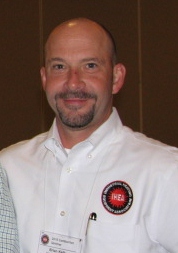
Brian Kelly, incoming treasurer for IHEA (source: IHEA)

IHEA also welcomes new board member Alberto Cantu of Nutec Bickley. Alberto has been involved with IHEA since 2011 and participates on the Safety Standards and Codes Committee.

Alberto Cantu, incoming board member of IHEA (source: IHEA)

IHEA President Scott Bishop, who is highly involved in IHEA’s Infrared Division, says, “It is an honor to serve as IHEA’s president for the 2020-2021 term.  I look forward to continuing the great work IHEA has done for more than 90 years.  Also, during this unprecedented time I would like to encourage our members to be proactive in finding ways to better serve our industry and make an impact.” Bishop has served as IRED chairman, presented at numerous workshops and seminars, and provided key support in the recent revision of the Infrared Process Heating Handbook for Industrial Applications. 

Michael Stowe, outgoing president of IHEA (source: IHEA)

“I am very excited about this new role,” Cantu states. “I think it will be a great opportunity to connect with colleagues in the industry and help move it forward,”


New Additions to the 2020-2021 IHEA Board of Directors and Officers Read More »

Policy and Programs That Impact Manufacturers – What You Should Know

The ITPS and IFCS will bring together an impressive and diverse group of business leaders to help executives stay on top of the latest trends and innovations affecting their manufacturing operations. This two-day summit will feature two joint general sessions with a total of ten presentations addressing topics that appeal to all manufacturing executives, including:

TRUMP’s Washington: The New Normal?

Omar Nashashibi

Omar Nashashibi, Founder Partner, The Franklin Partnership

President Trump has kept his campaign promise to shake up Washington and it is anything but business as usual in the nation’s capital. Omar S. Nashashibi lobbies Congress, the White House, and federal agencies on behalf of manufacturing companies and other groups. This is your chance to hear directly from a Washington insider about the latest on trade, workforce training, regulations, and implementation of the new tax law, among other timely issues.

Manufacturing USA Initiatives: What They Are and How You Can Benefit

Thomas Kurfess, Ph.D., P.E.

Thomas Kurfess, Ph.D., P.E., HUSCO/Ramirez Distinguished Chair in Fluid & Motion Control and Professor in the Woodruff School of Mechanical Engineering, Georgia Institute of Technology

Manufacturing USA is an initiative focused on coordinating public and private investments in emerging advanced manufacturing technologies that bring together industry, academia, and government partners to leverage existing resources, collaborate, and co-invest in advanced manufacturing innovation. Dr. Kurfess will provide an overview of these initiatives and how manufacturers can benefit from these efforts.


Why I’m Attending:

“ITPS gives me the opportunity to gather general high-level knowledge about the health and trends of my industry, combined with networking opportunities, in a nice atmosphere. I was satisfied with ITPS two years ago, and I’m looking forward to the event this year.”

Daniel Llaguno, President, Nutec Bickley

[button link=”www.itps-ifcs.com” size=”default” icon=”Select a Icon” side=”right” target=”blank” color=”b70900″ textcolor=”ffffff”]Register Now[/button] Save 25% with discount code ED25C.

Registration discounts are available for IHEA, CCAI, MTI, CECOF, JIFMA, VDMA, Electrocoat Association, and WiM members.

For complete Summit information, including hotel reservations and to register, visit ITPS/IFCS. Call 941-373-1830 with questions.

Heat Treat Today is proud to be a co-sponsor of this event.

Policy and Programs That Impact Manufacturers – What You Should Know Read More »

Mexico-Based Furnace Manufacturer Acquires PA Heat Treat Equipment Supplier

An international manufacturer of industrial furnaces, ovens, ceramic kilns, and combustion systems, based in Monterrey, Mexico, recently announced the key asset acquisition of a Pennsylvania-based supplier of industrial furnace and process-heat treating equipment, broadening its offerings to the steel, aluminum, and alloy industries, and ultimately user industries such as steel, heat treatment, aerospace, automotive, and oil and gas.

Nutec Bickley expands its operations by bringing on board Olson Industries’ line of equipment to secure access to larger projects for the Metals Business Unit and consolidating its position in the North American market. As part of the transaction, Bryan Kraus (President and Owner of Olson Industries), will be engaged in Nutec Bickley’s Metals BU, providing guidance and assistance in related activities such as technical sales and engineering.

“We are very excited about Olson Industries and Bryan Kraus joining the Nutec Bickley family,” said Nutec Bickley President, Daniel Llaguno. “Applications such as large rotary-hearth furnaces, and peripheral equipment such as quenching systems, manipulators, robots, and conveyors will now be a standard offering from us,” confirmed Daniel Llaguno. “If you couple that with Nutec Bickley’s state-of-the-art facilities, highly experienced staff, and constant focus on customer satisfaction, you can see that there is indeed a very powerful value proposition on offer to both existing and new customers.”

Mexico-Based Furnace Manufacturer Acquires PA Heat Treat Equipment Supplier Read More »