The heat treating industry is under pressure to reduce its greenhouse gas emissions (GHGE), and the response has been a noble effort to attain sustainability. In 2024, Heat Treat Today published a series of articles by guest columnist Michael Mouilleseaux, general manager at Erie Steel, Ltd., regarding the U.S. Department of Energy’s initiative related to the decarbonization of industry and its potential impact on the heat treating industry.
This update was first published in Heat Treat Today’s February 2025 Air & Atmosphere Heat Treating Aerospace print edition in response to recent changes in the U.S. administration.To catch up on previous columns by Mike, check these out: “US DOE Strategy Affects Heat Treaters“ appeared in the March 2024 Aerospace print edition; “U.S. DOE Strategy: Ramifications for Heat Treaters” appeared in the May 2024 Sustainability print edition; and “US DOE Strategy: Why the Heat Treating Industry?” appeared in the June 2024 Buyer’s Guide print edition.
As described in previous articles, President Joe Biden issued an executive order in 2021 that committed the federal government through the Department of Energy (DOE) and the Environmental Protection Agency (EPA) to reduce GHGE attributable to “process heating” by 85% by 2035 and attain net zero CO2 emissions by 2050.
These goals were to be achieved by implementing four largely unproven technologies:
Energy efficiency
Industrial electrification (using green electricity)
Adoption of low-carbon fuels (e.g., hydrogen), feedstocks, and energy sources (LCFFES)
Carbon capture, utilization and storage at the generated source (CCUS)
On www.heattreattoday.com/factsheetDOE, you can utilize the one-page resource to let governmental officials know what our industry is, who we are, who we employ, and the effect this effort has in regulating us out of business.
We further described the negative effect the implementation of these efforts would have on the heat treating industry — specifically, an increase in energy costs from 4x to 15x, with a companion reduction in energy reliability. This is not the combination that portends success in business.
In November of 2024, the people of the United States made a statement. They decided the direction of the country for the past four years was not what they wanted and chose another path, a path they chose based on what they had experienced from 2017 through 2020. As it pertains to industrial policy, they knew that reduced regulation and policies favorable to business growth were the guiding principles.
What may we reasonably expect from a Trump administration relative to this Industrial Decarbonization Effort?
At a minimum, we should expect a sober understanding of the issues and agreement that any low-carbon replacement energy technologies will come with the assurance they are cost competitive with current sources, and that they will be reliable and secure.
Is this to say that all efforts toward the achievement of a reduction in greenhouse gas emissions (GHGE) should be abandoned? Absolutely not, however, they should not be implemented with a religious zeal that places implementation above practicality. We need to recognize that if our way of life is to be maintained, these changes will be evolutionary — not revolutionary.
Should we anticipate this effort to revise the “timing” of GHGE reductions will be easy to achieve? It will not; the Biden administration has made every effort to obligate a maximum amount of the funding from the IRA earmarked for “clean energy,” understanding any funds not so obligated can be rescinded. Additionally, a concerted effort to place these funds in Republican states was made to make any recission as politically painful as possible for the incoming administration.
The incoming administration has made it clear they will scrutinize all existing funding sources that support those clean energy initiatives that distort and undermine energy independence and reliability. They have stated they intend on immediately pausing all regulatory activities until they have the opportunity to review them. They intend on rescinding all executive orders that further the clean energy agenda.
Do we have a part in this? Yes, our industry, although crucial to the manufacturing community and national security, has very little visibility. Now is the time to act and to let our representatives and senators know how important it is to pause, if not reconfigure, this Industrial Decarbonization Initiative to assure our businesses remain vibrant and vigorous.
Attend the 2025 SUMMIT to find out more about the DOE’s actions for the heat treat industry.
About the Author:
Michael Mouilleseaux General Manager Erie Steel, Ltd
Michael Mouilleseaux is general manager at Erie Steel, Ltd. He has been at Erie Steel in Toledo, OH since 2006 with previous metallurgical experience at New Process Gear in Syracuse, NY, and as the director of Technology in Marketing at FPM Heat Treating LLC in Elk Grove, IL. Michael attended the stakeholder meetings at the May 2023 symposium hosted by the U.S. DOE’s Office of Energy Efficiency & Renewable Energy.
In this Heat TreatRadioepisode, Mark Rhoa, Jr. from Chiz Bros, a company specializing in ceramic fiber products, discusses insulation with host Doug Glenn. Mark focuses on the benefits of ceramic fiber in industrial applications. The conversation covers decarbonization, the importance of insulation and thermal shock resistance, the shift to electrically heated modules, and practical maintenance tips for ceramic fiber-insulated furnaces.
Below, you can watch the video, listen to the podcast by clicking on the audio play button, or read an edited transcript.
Doug Glenn:I want to welcome our guest today: Mark Rhoa Jr. from Elizabeth, Pennsylvania, near Pittsburgh. Mark’s been involved with the industry for quite a while with Chiz Bros, our sponsor for today. Mark is also aHeat TreatToday40 Under 40honoree from the Class of 2021. And, Mark, could you tell me who started your company — your dad or your dad and his brother? I don’t know the history that well.
Mark Rhoa: My dad actually joined the company in ‘97, but when he joined, Chiz Bros. had been around for a good 30 years or so. It was started by the Chiz brothers originally: Al, Ray, and John Chiz. As they got older and some of them moved on from the company to retire, my dad took over the company in 2014, and that’s when I came on board.
I’ve been here about ten years. And Ray Chiz Jr. just recently retired; he is one of the original owners’ sons who was working here running our warehouse. He’s the last with the Chiz name to work here. We say that the Chiz haircut is kind of what I’ve got going on. You can know by the haircut there’s a lot of Chiz’s still working here, and you might even be an honorary.
Doug Glenn: I can be an honorary, for sure. I don’t have enough on the side.
Chiz has been around for 50 some years doing specialty solutions for refractory applications in the metals, power, glass, and ceramics industries. And you guys deal with multinational companies as well as the small Ma and Pa shop furnace manufacturers or heat treaters/thermal processors, a pretty good mix. You’ve got great customer service, reasonable pricing, and quick delivery. And I know you and I have talked about how you guys pride yourselves on having a lot of stuff in stock. And finally, you guys have your Pittsburgh location and are also in Detroit, which is a relatively new addition, right?
Mark Rhoa: Yeah, about two years ago we opened up a Detroit warehouse. We’ve always had some good clients up that way. You’ve got to have some boots on the ground to be super effective. I say to get the easy orders you’ve got to have the stuff on the ground to get the hard orders, which are the phone calls at 5 o’clock on a Friday saying, “Hey, we need to pick this up because the furnace is down.” And we didn’t have that opportunity to improve our customer service up there before opening that location.
We try to punch above our weight to compete with the big guys on pricing. We make sure we’re always still answering the phone.
Doug Glenn: It makes a huge difference when you’ve actually got people answering the phone.
My understanding is that you provide castables, fibers, brick, etc. But today we want to hone in a little bit on ceramic fiber.
Mark Rhoa: Ceramic fiber is the big portion of our business. We’re one of the biggest Unifrax (Alkegen) ceramic fiber distributors in the country. So, a lot of what we do is being driven by ceramic fiber products we supply. We still can supply castables, bricks, and everything in between. But ceramic fiber drives the ship for us.
What Is Ceramic Fiber? (04:58)
Doug Glenn: Let’s talk about that. Most of our listeners are folks with their own in-house heat treat. But let’s assume we’ve got some people watching that don’t know some basics.
Tell us about ceramic fiber: What is it? How is it made? What are we using it for?
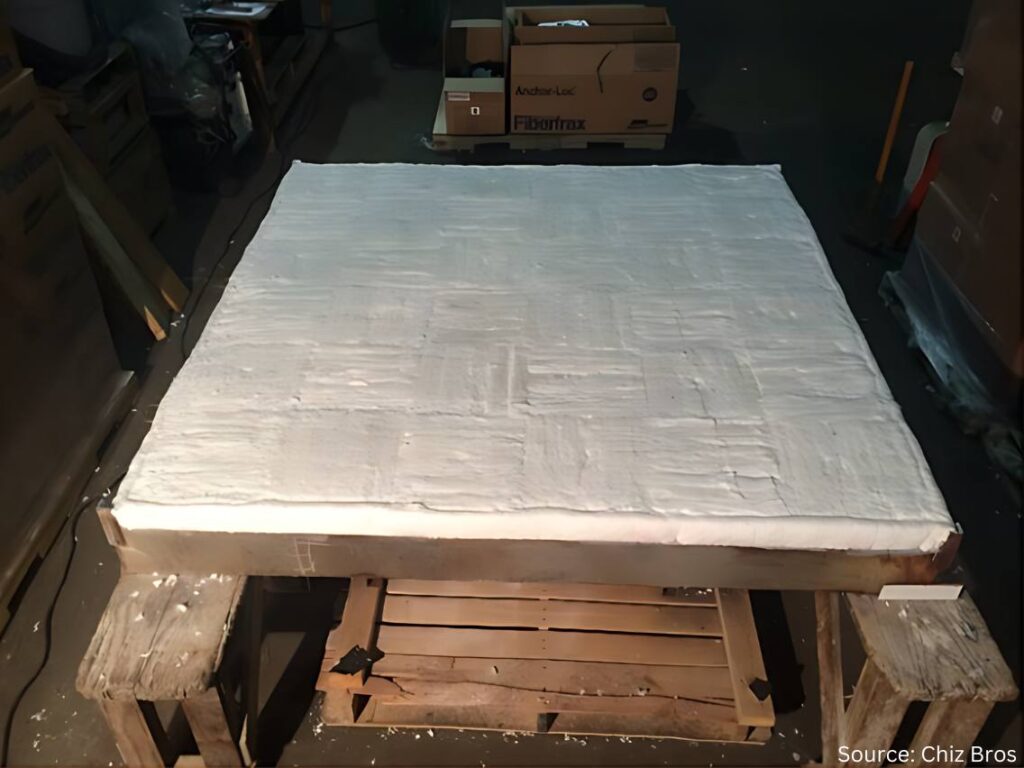
Mark Rhoa: I describe it to people who may not know much about it by comparing it to the Pink Panther insulation that people may recognize up in their roof or in their walls. Ceramic fiber is white, but picture that insulation for 2300°F. That’s what ceramic fiber is, and it’s a form that we sell the most of right now.
Ceramic fiber
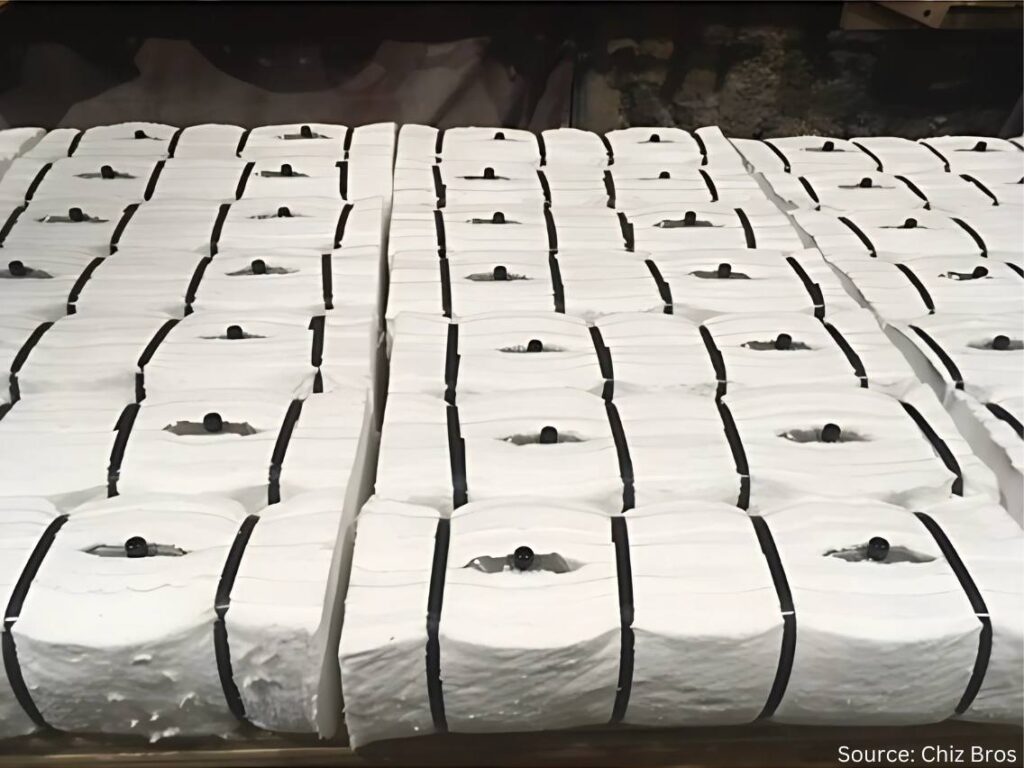
You can take that and cut gaskets out of it. You can form it into hard boards through a vacuum forming process. You can take it folded into what we call ceramic fiber modules; your furnace probably has modules in it if it’s a traditional gas-fired or electric furnace. Ceramic fiber products typically aren’t used on the vacuum side of things. People with all vacuum furnaces are probably not going to be using ceramic fiber. There are cloths that are ceramic fiber based as well. There’s a bunch of other ways it’s used.
Ceramic fiber is made of a blown, spun glass. Essentially what you’re doing is dropping the liquid aluminum silica mixture, and it gets blown or blown and spun at super high temperatures. I’m not going to get into the details of the differences there, but whether the stream is blown or is spun on wheels will determine the tensile strength of blanket.
In the grand scheme of things, what you’re doing is collecting all that fiber and getting it onto a mechanism that’s moving along a conveyor belt. Then it’s getting needled from each side to interlock the fibers to make a 26” wide blanket. It’s going to be trimmed off an inch when it goes through, and at the end you have a 24” wide x 1” thick, 8-pound density roll coming out.
Those densities can vary based on how much fiber is going into it. It’s pounds per cubic foot. But when you’re using a 1” thick piece, it’s divided by twelve from a weight standpoint. The fiber you’re needling in there determines the density.
And there are slightly different chemistries for 2300°F, 2600°F, and the most expensive would be 3000°F polycrystalline. The process to make that is a little bit different, too.
But most people are probably more interested in what we’re doing with it. What’s the Chris Farley line in Tommy Boy? We’ll keep it PG, but “take a butcher’s word for it” — take our word for it; it’s made the right way.
Now we can get into how it’s actually used.
Doug Glenn: It’s basically like insulation in your house, like you said. That’s probably the best description of it for people that need to know. But it can obviously go to a much higher temperature.
In an industrial setting, why would you use fiber versus a castable or brick?
Why Fiber? (08:28)
Mark Rhoa: Ceramic fiber is a great insulator. We’ll probably get into why a better insulator is important for decarbonization efforts and things like that.
It’s certainly a better insulator than castables, easy to install, and easy to use. The main reason it’s preferred is for its insulating value and ability to have varying temperature ranges, which you can certainly do with castables and brick.
But to put brick in a wall 12” thick, for argument’s sake, you will need four layers of 3” brick on there. With ceramic fiber, you can take one 12” x 12” module, shoot it onto the shell, attach it, and be good to go from there.
The main thing would be longevity and stuff like thermal shock value. One of the things you have to worry about with castables and brick — maybe not as much with IFB but standard brick — is the heat cycling. Heat treat furnaces are a great example of that.
That door is opening up a lot, so the air is coming in there. People probably see it in their furnaces. The castable is going to want to crack because it’s not designed for thermal shock like ceramic fiber is.
There are certainly applications that you wouldn’t want to use ceramic fiber for. If you’re looking at a traditional heat treat furnace, it depends on how the load is supported: If the floor is the refractory, it is actually supporting the load, and you’re going to want some sort of brick, some sort of castable. Fiber is going to be soft, compressed, and get beat up. You can’t necessarily put it everywhere, but there are areas where it may be up for debate on.
You can use a brick or you can use fiber in the wall. Traditionally, you’re going to use fiber for the insulated value, thermal shock value, installation, and weight; it’s a lot lighter.
A lot of heat treating furnaces are small compared to the massive furnaces in steel melting. They’re going to ship heat treating furnaces. With ceramic fiber, a 12” x 12” fiber module, 12” thick, weighing roughly 12–14 lbs. is 5–10x lighter than brick or castable.
Repairability (10:51)
Doug Glenn: How about addressing the repairability issues between castable and brick and fiber?
Mark Rhoa: Fiber, especially if you’re getting into higher temperatures, can have some shrinkage to it. But you’re able to repair fiber a lot easier. If you wreck a little bit of fiber, you can get in there and get it repaired quickly. With a brick or castable everything’s tied together as either a monolithic piece or a bunch of bricks that are connected, it can start to become a house of cards scenario where you pull and one goes down then everything goes down.
Doug Glenn: It’s like a Jenga game. You pull that brick out on the bottom and what happens?
Figure 2. “You don’t want to pull out the wrong brick.”
Mark Rhoa: Yeah, you don’t want to pull the wrong brick.
Doug Glenn: You already mentioned the temperature ranges we’re talking about. The standard bottom temperature is 2300°F; the fibers are good up to 2300°F. Then you’ve got 2600°F and then 3000°F. Is that roughly the breakdown when you’re looking at fibers?
Mark Rhoa: I don’t know why they ended up doing this, but for 2300°F ceramic fiber, realistically you only want to use it to 2150°F. That goes along with the shrinkage curve of it. I forget the exact number, but I think it’s like in 24 hours, you get less than 3% shrinkage. Typically, the rule of thumb is that you don’t want to use that full temperature range; you want to give yourself 150°F of cushion to be safe. It will still have shrinkage after that up to that temperature.
I don’t know who ever thought of that; it was probably some genius marketing guy to get a little extra.
Fiber Shrinkage (12:57)
Doug Glenn: You’ve mentioned shrinkage a couple different times. Why does that happen with ceramic fiber? And how does that impact installation?
Mark Rhoa: When ceramic fiber hits its operating temperatures, it shrinks up. On the chemistry side, I don’t have an answer there. But we factor in compression to help alleviate when something shrinks. It’s already pushing out against something. It still keeps its resiliency (it wants to pop back out), and that’s factored into every design.
If you’re doing 12” modules, you’ll have a batten strip between them. That makes up for some of the shrinkage that may come where there’s not compression. Any sort of design we would do, or probably anyone would do, is going to factor in shrinkage. You don’t want to just put something in there, and when it shrinks, it leaves a gap. You want to make sure you have something in there that’s going to fill that gap; and that’s typically for modules.
Now if you’re getting to a low temperature, we’re talking about a furnace at 1200°F, you’re not going to have to worry about shrinkage. Even in some of those furnaces, you’ll see designs we call wallpaper — a pin’s exposed and you’re layering on top of it. You’re just kind of overlapping gaps, but you’re not going to have any shrinkage there, so you don’t really have to worry.
Figure 3. Avoiding gaps when shrinkage occurs
Doug Glenn: There is one question I did want to ask you when we were talking about the different temperature ranges of 2300°F, 2600°F, and 3000°F. Are the chemistries between those different?
Mark Rhoa: They’re all alumina silica based. 2300°F is like 50% alumina and 40% silica. They’ll typically inject some zirconia in it, maybe around 15% zirconia. That gives it the extra boost. Alumina is what drops down.
We don’t want to get into every example, but it does have a lower aluminum content. Sometimes in aluminum melting you can get some flexing because there’s zirconia in there, so you need to know the exact application.
And then the polycrystalline, what people call the 3000°F, would be 72% alumina. And that’s made in a calcined process. The 72% alumina is the key factor.
You can also have super high aluminum blankets. Saffil® is the typical brand name. And that’s a 95% plus alumina. That’s for high hydrogen atmospheres, stuff where there’s bad attacking, bad off gassing. The alumina is usually more resilient to that. Some aerospace applications have that stuff spected in for effectiveness and also because they probably have government money. Why not pay for the highest quality, most expensive thing, right?
Electric Element Modules (18:32)
Doug Glenn: You mentioned modules before, but I want to take a little bit of a different angle. The modules you were talking about have no type of heating element in them. They’re just simply the insulating modules that you put on the side of the wall, side by side, maybe alternating the orientation. But what I want to talk about are electric element modules. Can you describe what those are and why you are using them? And maybe hit on the decarbonization or electrification element of those?
Mark Rhoa: Traditional fiber modules are used in a gas furnace, even an electric furnace that may be heated by glow bars or radiant tubes or something like that. That’s going to have a similar penetration there.
One of the systems we call our ELE system. I’d say in the last two years we’ve probably had as many inquiries or conversations about going to these electrically heated modules than we have in the past 5–10 years combined. A lot of that has to do with companies wanting to get away from gas, or they’ve got pressures for different environmental or cost saving reasons.
What we’re doing with that is hanging the elements on the ceramic fiber module. And when they show the pictures of this one, there’ll be one in there. But that allows us to do a modular system where they can get a lot of power on those walls, and it lets us keep a lot of the same insulating value from using modules without having to use brick or a super heavy element in the sidewalls for support.
Electric Element Modules
When someone says we’re putting this many BTUs of gas; here’s the load, size, weight. We do the electric calculations to see how many kilowatts of power we need to pump into this furnace and elements in order to heat something up just like you would do with gas.
And rest assured, someone a lot smarter than me does those calculations. I’m just a pretty face that gets to sell them. But this is something that we’re seeing a lot of. There’s a big push coming from the government and boards of directors.
Doug Glenn: It’s going to help companies reduce their carbon footprint if that is their desire.
I have a question for you about those and specifically about installation. If every module needs a power source, do you have to punch a hole in the furnace wall for every module, or can you interlink them and only have one power source at the end of the chain?
Mark Rhoa: Good question. I didn’t do a good job describing that, but the modules will still go in just like a regular module. They actually have an extra set of ceramic tubes in them. When we do our design, we know where the elements are going to be hung.
If you have a 10-foot wall, you’re not going to have ten 1-foot pieces of element. You’re going to have an eight foot string of elements along that wall, and they will be hooked into the loops. One end of the hook will go on a loop, the other end will go on the ceramic tube that’s inside the module.
If you have a 12’ x 12’ high wall, and you may have a 10’ element in there, you’re probably only going to have four penetrations, maybe more. It’s not going to look like Swiss cheese. They’re going to be linked together.
These are all based on the number of zones in a furnace, too. Some super high aerospace applications are going to have everything super fine tuned just like it is with burners. If you think about how certain applications require way more precision and control over burners, the same thing can be true for these elements, too. The more precision and control you need, the more complicated it’s going to be just like it is with burners.
Before you hang the elements, you could look in that furnace and it would look just the same as a regular gas-fired furnace without the burners. Then you start hooking the elements on the walls. And the pictures of it are helpful.
If anyone has seen Home Alone, he goes into his basement and his furnace is shooting out all the flames. If you walk into a plant and can see that, getting that to seal will prevent heat from leaving.
Mark Rhoa
Furnace Doors (23:52)
Doug Glenn: When I think about ceramic fiber (which you don’t often see it inside a furnace if the door is closed), but a lot of times you’ll see it jammed in around the doors. To me it doesn’t look like that’s the way it’s supposed to be. So, doors are an issue, right? Can ceramics help with that?
Mark Rhoa: In heat treating furnaces, the temperatures aren’t totally crazy like forging furnaces where there’s a lot of shrinkage so they’re replacing it all the time. In heat treat, the temperature is lower. The main wear and tear items we see when we’re working on a repair with a client are around the doors because they’re getting the mechanical abuse of constantly changing. In some of the decarbonization talks I’ve attended and given at trade shows, we’re really looking at ways to save heat. Just making sure your door is sealed properly can do wonders.
If anyone has seen Home Alone, he goes into his basement and his furnace is shooting out all the flames. If you walk into a plant and can see that, getting that to seal will prevent heat from leaving.
You hear all these decarbonization talks, you see all these millions of dollars being thrown around, and, really, you can make a huge difference on a shoestring budget by simply making sure your door is sealing the way it’s supposed to seal.
If you can see the heat coming out, it’s like dollars flying out of your furnace on a game show. You’d have people lined up for that every day of the week.
So you hit the nail right on the head there. A really small, easy way to make a calculated decarbonization effort is making sure you have a door plan or you’re changing it.
It’s the same thing with tuning burners. Little tunes to a burner can save tons of gas and tons of CO2.
Figure 5. Heat leakage from doors needing maintenance
Doug Glenn: Making sure you’re maintaining good flame curtains on a continuous furnace, all that stuff just keeps the heat from coming out.
Did I see correctly that you guys do door repairs?
Mark Rhoa: We’ll do door repairs in our own shop. If someone ships a door to us, we’ll do the realigns there. About 20 years ago, we stopped having our outside contracting arm. Now we’re not doing any of the fieldwork. But we do realign doors in our shop.
Fiber is pretty easy to work with. Door perimeters are something that can easily be done by someone’s own maintenance crew. Maybe they’ll need one of our sales guys there making sure they do it right the first couple times. But it’s not a hard thing to do. If you have a 12 inch module perimeter, switch those 40 modules out once a year and you’ve got fresh gas savings.
Ceramic Maintenance (27:07)
Doug Glenn: Let’s shift gears a bit and talk about typical maintenance of ceramic-insulated furnace. What do we need to be careful about? Any tips you can offer?
Mark Rhoa: There’s another really affordable thing you can do. You can probably sometimes see this if you have a hot spot where paint’s chipping off or melting or if you have a temperature gun you can find those hot spots. If you see heat on the outside, then you’re typically going to see some sort of crack or gap on the inside. Make sure you have scheduled maintenance downtime with your furnace and stuff in any of those cracks.
If you’ve got a really big furnace or a continuous furnace, roller hearth, furnace type thing, the roll seals are some of the areas where you’re going to end up losing a lot of heat because there’s more wear and tear there. There’s just more opportunity for expansion and contraction.
We do have ceramic pumpable products. We call it liquid ceramic fiber for when there’s a hot spot on a furnace, it’s a big one, and you can’t get in there, you can drill a little hole on it, pump it in from the backside, and fill that up. You don’t want to start making your furnace Swiss cheese and poking holes.
It can be a quick stopgap. If you can’t get inside the furnace, fill it in from the backside, too. Because you don’t want those hot spots to grow and cause problems. You don’t want them to get to the hardware.
Then you may have a module where the hardware gets too hot in the backside and the module ends up falling in. That’s one scenario. You can get out ahead of it by filling some of those gaps.
For a refractory on the hearth, too, if you don’t want to replace a hearth you can find a refractory contractor to come in and (if you have a big furnace) spray gunite over the hearth to fix any gaps or cracks.
Doug Glenn: That’s more for castable, though?
Mark Rhoa: Yeah. On the fiber side of things, you’re looking for hot spots.
Doug Glenn: The takeaway is to make sure you’re taking regular thermal imaging of your shell of the furnace. If you’re noticing some hot spots, it’s time to investigate.
Mark Rhoa: If you have a lot of furnaces, you can get a thermal imaging gun for a couple hundred bucks and really [keep an eye out].
An even bigger deal are the doors. It will blow your mind if you look at the temperatures on a fresh door seal versus an old one. Have a temperature gun to justify to your bosses. “Hey, we realigned this, and it is 150°F. This time last year it was 250°F–350°F degrees.” Common sense can tell you we’re losing more heat when it’s like that.
Concerns with Free Floating Fiber (30:20)
Doug Glenn: Can you address the concern that some furnace users have regarding free floating fiber, especially in furnaces where there’s high velocity airflow?
Mark Rhoa: Talking about the benefits of fiber versus brick and castable, one of the benefits of the hard refractory is it does better with high velocities. Patriot furnaces may have a fan in there. Typically, they’re not getting high enough where we need to worry. You can put coatings on the fiber or rigid dyes or things like that to harden them.
But from a health and safety perspective, anytime you’re working with fiber you want to make sure you’re wearing a mask. They have warning labels on them. It’s not like it was back in the day. I’m not allowed to say the “a” word [asbestos]. So there are not worries like that anymore, either. But refractory ceramic fiber still does have a warning label on it.
We do have body size soluble fiber. Alkaline earth silica (AES), non RCF fiber, a bunch of fancy names, are more prevalent in Europe because of their rules. California’s got a lot of rules, too….
But we do supply that as well. It doesn’t have any sort of warning labels on it.
Obviously, when you’re working with it, you want to wear a mask because dust in general isn’t good. But it’s naturally soluble for your body.
It’s not quite as strong. It can have more shrinkage at lower temperatures. But it’s best to talk with somebody and understand what the right product is to use. Things can be a little worse, but there is a slight move in the direction of body soluble fiber because there are no warning labels on it. But it’s not drastic.
Some of the similar concerns foundries have is with sand and airborne silica now. Technically, I guess going to the beach we’d have airborne silica, too. There’s justification to taking those precautions, but it’s certainly not all doom and gloom.
The ceramic fiber is essentially little glass beads, like a tadpole head and then there’s a fiber tail that interlocks.
Mark Rhoa
Doug Glenn: What I heard wasn’t so much a human safety issue. It was the use of ceramic blankets inside of an aluminum annealing furnace: If the fibers got airborne, they would come to rest on the coils and mess up the strip going through. And then you have contaminated coil or it’s marked.
Mark Rhoa: The issue with that is the shot on the fibers. The ceramic fiber is essentially little glass beads, like a tadpole head and then there’s a fiber tail that interlocks.
Fiber has come a long way. The shot content is way lower than it used to be. But it’s certainly a concern if that gets on a coil and then it goes through the rolling mill and you make a small dent in all the glass … yeah.
A lot of different things can be done for that. People put up cladding; people rigidize it to lock the fiber in.
There are definitely concerns for all the applications. Big aluminum homogenizing furnaces may have that. Traditional, smaller batch annealing furnaces may not.
It would be the same thing if a little piece of brick chipped off onto [indiscernible]. The worry with some of the fiber stuff is it’s obviously a lot smaller so you don’t get to see it.
Doug Glenn: It’s a lot more conducive. You can imagine the difference between a brick being hit with high velocity air and a fiber, you would just see the degradation of the fiber. A fiber ceramic blanket would go down quicker.
Induction at Chiz (35:20)
I have one other question for you about Chiz. Your company was one of our sponsors at our recent Heat TreatBoot Camp, and I was surprised when you had an induction coil on your table. If you don’t mind, address what it is Chiz is doing in the induction area?
Mark Rhoa: We were using the company down the road from us, Advanced Materials Science (AMS), to machine some of our fiber boards and bricks that were a little too complicated for what we had in-house at the time. They have some really good CNC equipment up there. The guy who owned AMS was looking to sell off that branch of his business. We had been one of his bigger clients, and we came to an agreement to it; it’s still out of the same building, same equipment, same guys that are doing all the good work.
We started getting in there and saw a lot of the induction heating equipment on the client list — a lot of those electrical plastics, high temperature plastics, electrical marinite and transite boards, which we got into a little bit in the Chiz Brothers world but didn’t fully dive into it because the temperatures are a little bit lower than what we’re dealing with on the ceramic fiber side of things.
It’s been really good for us. They’ve got great machining capabilities down there to machine some of these complex parts out of NEMA G10 and marinite and transite and all these terms that were relatively new to me when we bought them.
It’s really helped us at some of these trade shows because three types of furnace guys walk by: the gas-fired guy, he’s my best friend; the induction guy used to be like, “There’s not that much we can do with you.” Now, we can do a lot with them.
And then I’m still trying to figure out how I can be happy when the vacuum furnace guy walks by. That will be a different battle for a different day. I’m not trying to get into the graphite felt world. I probably just can’t be friends with everybody.
But it’s been good to get into the induction industry. It’s something that we’ve been growing over the last year or two because we hadn’t been engaged with people quite as much as we had.
Doug Glenn: Well, we’ll look for opportunities for you to be friends with the vacuum people. One thing I know from experience, Mark, you could be friends with anybody. I’m sure you can work it.
Mark Rhoa: I’ll try my best.
Doug Glenn: You’re doing good.
Thanks so much. I appreciate your time and appreciate you being here.
Mark Rhoa: Look forward to seeing you at the next event. For anyone watching, Heat TreatBoot Campwas great. Whether you’re a supplier or heat treater, it’s a good group of people bouncing ideas. It’s a crash course on a hundred different things in two days. I was there to sell stuff, but I learned stuff, too, which was an added bonus. I’d recommend it to anyone watching. It’s a good way to force yourself to get out of the office. I will definitely be back.
Attendees of the 2024 Heat Treat Boot Camp with the Heat Treat Today team Heat Treat Boot Camp Completion Ceremony: (L to R) Doug Glenn, Mark Rhoa, Thomas Wingens
About The Guest
Mark Rhoa Vice President Chiz Bros Eleanor Rhoa, daughter
In the heat treat industry, Mark handles Chiz Bros‘ relationships with various end-use customers as well as furnace manufacturers. Given the critical need for energy efficiency and uniform temperature throughout the heating process, Mark has been able to develop custom refractory and insulation solutions for customers to meet their complex needs. Through participation in the ASM’s Heat Treat Show, MTI’s Furnaces North America,Heat TreatToday’sHeat TreatBoot Camp, and IHEA’s Decarbonization SUMMIT, Mark has been supportive of the industry, but more importantly, has helped countless customers improve their thermal efficiency and profitability. Mark was recognized inHeat TreatToday40 Under 40 Class of 2021.
A global supplier of equipment, systems, and digital solutions for several manufacturing sectors recently announced that it has acquired Bloom Engineering, Inc, a provider in industrial heating applications. The company will join the Freight & Industrial Components Group at Wabtec Corporation, which serves the freight and transit rail industries and is a worldwide leader in the decarbonization of freight rail.
Mike Fetsko President Freight & Industrial Components Group Wabtec Corporation
This acquisition strengthens Wabtec’s heat transfer and energy solutions, integrating Bloom’s advanced technologies in burners, combustion systems, and overall services for industrial and process heating applications. Both companies are headquartered in Pittsburgh, PA.
“This is another exciting addition to Wabtec,” said Mike Fetsko, president of Wabtec’s Freight & Industrial Components Group. “Bloom Engineering is a great fit within our heat transfer and energy solutions business, and we already serve many of the same customers. Our shared vision toward driving customer productivity within their industrial processes will enable us to deliver a more comprehensive portfolio for our customers to operate more efficiently and sustainably.”
In addition to supplying solutions for the freight and transit rail industries, Wabtec also serves the mining, marine and industrial sectors. The acquisition is expected to provide increased value to its worldwide customer base.
The press release is available in its original form here.
The search for sustainable solutions in the heat treat industry is at the forefront of research for industry experts. In this article, provided by IHEA Sustainability Initiatives, a path to sustainable decarbonization is suggested that cuts through the murky waters of changing terms and shifting protocol and charts instead a navigable course with updated definitions and industry resources, such as IHEA’s upcoming Decarbonization SUMMIT in Indianapolis, IN, this fall.
This Sustainability Insights article was first published inHeat Treat Today’sMay 2024 Sustainabilityprint edition.
There is no hotter topic (no pun intended) than decarbonization. Just about everywhere you go and everything you read or listen to talks about sustainability and decarbonization. As leaders and stewards in the industrial heating industry, the Industrial Heating Equipment Association (IHEA) is committed to being at the forefront of providing valuable information and developments around the topics of sustainability and decarbonization. For the past 18 months, IHEA has been developing and delivering a highly successful Sustainability Webinar Series; continuously updating terms and definitions, frequently asked questions, and resources for the industry on the IHEA website; and, in its biggest step, is now offering a comprehensive Decarbonization SUMMIT from October 28–30, 2024 in Indianapolis, IN.
Current IHEA President and Sustainability Committee Chair Jeff Rafter states, “All IHEA members are continuously being asked about ways to decarbonize their processes. As the industry association dedicated to all things ‘heating,’ we feel it is our duty to present an unbiased view of what’s happening now, how companies can begin the process of lowering their carbon emissions on their current equipment, while beginning to look at all the alternatives that are coming and how those might fit into their operations. There is no question that change is imminent. We want to be the resource that the industry uses for information on all options to begin to decarbonize operations.”
While not much is going to happen overnight, “Legislation is going to be coming,” notes IHEA Board Member Mike Stowe, who is serving on the ISO Decarbonization Committee. “The best thing companies can do is begin preparing now. Take a look at your current operations and start making changes that improve efficiency now. Educate yourself and your staff on technologies that will help you lower carbon emissions. Be ready for what lies ahead.”
IHEA is ready to help the industry take the next step by hosting its first Industrial Heating Decarbonization SUMMIT. This event is designed to start shaping the future of manufacturing heating processes. It will include keynote addresses by industry visionaries; ways to begin your decarbonization process now; a look ahead at various technologies that can also help you decarbonize; case histories and a panel discussion on decarbonization collaboration; networking with industry leaders, and a tabletop exhibition that showcases cutting-edge technology.
Themes Running Throughout the SUMMIT Will Focus On:
Low Carbon Fuels in Industrial Processes
Carbon Capture and Storage Technologies
Global Benchmarking
Economics and Business Concerns
Innovations in Clean Technologies
DOE (Department of Energy) Programs and Tools
Policy Frameworks for Decarbonization
Target Audience for the SUMMIT:
CEOs and Executives from Industrial Companies
Sustainability Officers and Environmental Managers
Government Officials and Policymakers
Researchers and Academics in Clean Technology
Sustainability Engineers and Program Managers
Directors of Sustainable Manufacturing
Utility Representatives
“We are in a unique position,” comments IHEA President Jeff Rafter. “There has never been an issue like this that has faced our industry. Working together and bringing the industry together at a SUMMIT gives everyone a forum to learn, share ideas and best practices, review recent technologies, and begin lowering carbon emissions as an industry. No one is going to do this alone.”
IHEA’s tabletop exhibits that will accompany the SUMMIT programming will allow attendees to get a close look at a wide array of information that will help them in their decarbonization efforts. Those interested in reserving a tabletop should visit summit.ihea.org. Tabletops are expected to sell out quickly.
As IHEA works its way towards the SUMMIT in the fall, the Sustainability Webinar Series is still underway. Nearly 1,000 people have logged on over the past year since the first webinar was launched. Upcoming Webinars include:
May 16
Increasing Available Heat to Lower CO2 Emissions
June 20
Understanding Carbon Credits & Net Zero
July 18
U.S. Codes & Standards
August 15
Renewable Fuels
Additional webinars will be supplemented to this list regularly. IHEA’s webinars are free to attend. You can register by going to IHEA’s website (www.ihea.org) and clicking on the Sustainability logo on the home page. Then scroll down and click on the “Sustainability Webinar Series” to review and register for the upcoming webinars. If you have a sustainability topic you would like us to address, please email the topic to anne@goyermgt.com, and we’ll work to create a webinar.
Changes are inevitable, but the world today is shifting oh so rapidly, keeping us on our toes. Two men from different parts of the world, both with significant experience within the heat treating community, reflect on the implications of these changes in the heat treat industry. With each new topic, will their views align?
The experts are Thomas Schneidewind, editor-in-chief of heat processing magazine, and Doug Glenn, publisher and founder of Heat TreatToday. Thomas’s expertise lies in the European market while Doug’s resides in the North American market. We will feature their responses in each print magazine. Will their views align? Time will tell. Enjoy this fifth installment of an ongoing column. This column was first published in Heat TreatToday’s February 2023 Vacuumprint edition.
To what extent have high energy prices affected heat treaters?
Thomas Schneidewind, Editor-in-Chief, heat processing magazine
Thomas Schneidewind Editor-in-Chief heat processing Magazine
In Europe, many companies are in shock. The energy crisis threatens the existence of energy-intensive companies. The hardening industry is coming under pressure as sharp price increases for electricity and gas lead to business losses. This is because the higher prices cannot be passed on to the customers, whose contracts do not allow price increases during the term of a contract. Most hardening shops are small or medium-sized businesses, while their customers are large companies and corporate groups.
Contact us with your Reader Feedback!
Hardening plants must find short-term solutions to cushion the cost shock and ensure the survival of their business. Add this with a view to the long-term goal of decarbonization. Because, in the future, process heat must be carbon free. Whether energy-intensive production is still possible in Europe in the future will be decided by the flexibility and inventiveness of the industry. The task now is to find intelligent answers and to reduce the use of fossil fuels more quickly than planned.
An important step in this direction is the modernization of existing plants – retrofitting can become the efficiency turbo that saves the day in difficult times. Hardening plants should further develop electrically operated equipment and strive for intelligent furnace control. The use of energy saving motors for pumps, circulators, and fans is another option. Insulation on side walls and ceilings in high temperature furnaces and energy recovery from waste heat are among the basic measures.
Modern burner technology also offers the potential to reduce energy consumption. Hydrogen as a heating gas will become an important option in the future. Hydrogen fueled burners have been around for some time but are not currently used in contract hardening shops. Because there are good ideas and positive trials, but no long-term experience and reliable cost comparisons, it will take a little longer until a significant introduction in contract heat treatment takes place. Until then, there are still some problems to be solved, such as safety, availability, investment costs, and especially the price of green hydrogen.
One thing is certain: investments are necessary. OEMs are already making high demands on future carbon-neutral processing and delivery in their contracts, since many automotive manufacturers are striving for a climate-neutral value chain – dictated by regulatory framework conditions. Hardening shops first must survive this difficult phase to then benefit from modernization investments. The aim is to offer customers carbon-neutral heat treatment. Companies can only achieve this by using green technologies. There is no other way.
Doug Glenn, Publisher, Heat Treat Today
Doug Glenn Publisher and Founder Heat TreatToday
In North America, energy is typically one of the top three expenses in nearly all heat treat processes. Commercial heat treaters know this well because it is their business to know the costs associated with their livelihood. Manufacturers with in-house heat treaters, on the other hand, often don’t properly allocate all the true costs associated with their heat treating processes. However, energy costs are fairly easy to allocate, even for them, and it’s safe to say: energy prices are skyrocketing.
The impact of rising energy prices can be measured in the price for each BTU that goes into the heat treat process. Often, 50% to 200% increases have not been unusual in the U.S.
But less obvious costs that are not so easy to measure also impact heat treaters. For example, transportation, which is energy intensive, adds to overall processing costs, especially if not done in-house.
Even LESS obvious is the effect that rising energy costs have on quality, innovation, and standard operating procedures (SOP). When corporate profits plummet due to rising energy costs, all aspects of the business are scrutinized, not just the areas where energy is most intensively used. This oftentimes results in cuts to “non-essential” expenses, which may mean reducing new product or process development initiatives, cutting back on borderline or “unnecessary” quality or safety measures (!), and re-examining SOPs to make further cuts.
The rising cost of energy could even impact the competency of heat treat operators. During COVID, I spoke to a nurse who explained that quality of care was reduced when a large number of nurses left the profession because they chose not to take the vaccines or boosters. Patients receiving emergency medical care did not notice any shortage of personnel, but the fact was that the nurses filling the critical roles were not as proficient or qualified as the expert nurses they replaced. In a similar way, when energy prices skyrocket and cuts must be made, the internal allocation of resources may compromise some aspects of the business that are not as clear to the customer.
When energy prices rise as drastically as they have, companies will examine how they can cut costs and help maintain profits, which is a GOOD and appropriate thing. It will take time for heat treaters to adjust to the recent energy price spike. Adjustments won’t be cost-free. The question is: Which part of the company will pay?
Find heat treating products and services when you search on Heat Treat Buyers Guide.com
Changes are inevitable, but the world today is changing so rapidly that it’s constantly keeping us on our toes. Do two men from different parts of the world, both with significant experience within the heat treating community, have vastly different perspectives on the happenings in the heat treat industry?
We want to find out, so we asked a question that focuses on the world of heat treating to Thomas Schneidewind, the editor-in-chief ofheat processing magazine, and Doug Glenn, the publisher and founder ofHeat TreatToday. The question: How does government policy regarding ESG in the U.S. and nuclear power initiatives in Europe impact in-house heat treaters?
Thomas’s expertise lies in the European market while Doug’s resides in the North American market. We will feature their responses in each print magazine. Will their views align? Time will tell. Enjoy this fourth installment of an ongoing column. This column was first published in Heat TreatToday’sNovember2022 Vacuumprint edition.
How does government policy regarding ESG in the U.S. and nuclear power initiatives in Europe impact in-house heat treaters?
Thomas Schneidewind, Editor-in-Chief, heat processing magazine
Thomas Schneidewind Editor-in-Chief heat processing Magazine
The energy crisis paralyzes Europe. The European Union has been arguing for a long time about which energy is green. Finally, the European Commission classified both nuclear energy and gas-fired power plants as green energy production. This was a compromise between France and Germany in the discussion about the taxonomy that regulates in which energy sources investments should be made. Today, environmental associations are suing against this compromise, considering neither nuclear energy nor gas-fired power plants to be green energy.
Contact us with your Reader Feedback!
However, the discussion is long outdated. The Russian war of aggression on Ukraine has changed energy policy. Many nuclear power plants in France are at a standstill. Germany no longer receives gas from Russia, and the sabotage of the Nord Stream 1 and 2 pipelines is a politically motivated attack on the European energy market. Today, Europe is suffering from a major energy crisis. There has never been such a crisis in the energy sector in Europe since the Second World War. There is too little energy on the European market. At the moment, the focus is on security of supply.
This crisis threatens the existence of energy-intensive companies such as heat treatment shops. The hardening industry is also coming under pressure because it cannot pay the high electricity and gas prices. Entrepreneurs must find short-term solutions to cushion the cost shock, and ensure the survival of their business -with a view to the long-term goal of decarbonization. Because in the future, process heat must be CO2 free. A clear trend in this context is the switch from gas-heated industrial furnaces to electrically heated systems, whether resistance heating or induction. Managers must face these diverse issues today and respond quickly
Experts and practitioners will be talking about sustainability, materials, processes, and innovations in heat treatment at several events this fall. For example, in October, after a two-year pandemic break, the Hardening Congress (HK) was finally held again in Cologne. Here, too, the energy crisis was a dominant topic. We are talking about the future of Europe which must compete with the U.S. Many investment decisions are being put on hold because the uncertainty in Europe is currently too large. Europe, but especially Germany, faces a new recession.
Doug Glenn, Publisher, Heat Treat Today
Doug Glenn Publisher and Founder Heat TreatToday
Tremendously. A distinctive mark of the U.S. is that we’ve trusted the Market – what Adam Smith called the “Invisible Hand.” We haven’t believed that economies need to be planned or managed; attempts to manage or plan an economy result in more damage than good. We’ve believed that if proper natural or biblical law guardrails are established and enforced, the economy would run itself, self-adjusting as necessary. Today, many have lost faith in the Market. Instead, we put our faith in political processes and political leaders to handle the economy. Because we’ve lost faith in the Market, questions such as the one we’re addressing today make sense to ask. Government policy should have nothing to say about the type of energy we use, the people we hire, or the ideals we hold. Nonetheless, that is NOT the world we live in, so let’s address the question.
Nuclear Power Initiatives
This is really not an initiative; it is more of a “de-initiative” – a closing down of nuclear power plants in Europe (except France) – and the incentive to do so is not economic. According to those who know, nuclear is the cheapest, most reliable form of energy, vastly less expensive than “renewables.” So, in the hands of the Market, nuclear and natural gas generation power plants would win the day. Nuclear is being abandoned for purely political reasons. The effect on heat treaters and all other consumers of electricity: higher prices for energy, either in the form of explicitly higher prices per BTU or higher taxes to incentivize more expensive “renewable” energy sources.
Environmental, Societal, and Governance
As far as ESG goes, government policies in these areas will only increase the cost of doing business.
ONE of the three categories represents an area where the government might have a right to be heard: environmental. But even there, government’s scope is vastly overplayed – that is, if you have faith in the Market! Societal and governance are recent (non-economic) constructs being forced on businesses, NOT for the benefit of the end-consumer, but for the benefit of a vocal minority who believe the world should be a certain way and are using government policies to make it so.
For in-house and commercial heat treaters, ESG pressures and government recommendations or policies will raise the cost of doing business and ultimately the cost of the final product for consumers with very little measurable benefit for anyone. For in-house and commercial heat treaters, ESG pressures and government recommendations or policies will raise the cost of doing business and ultimately the cost of the final product for consumers with very little measurable benefit for anyone.
Find heat treating products and services when you search on Heat Treat Buyers Guide.com