


Andrew Bassett

Heat Treat Radio #38: Andrew Bassett on AMS2750F (Part 1 of 3)

 

In this first of a three-episode series on AMS2750F,Heat Treat Radio host, Doug Glenn, discusses Andrew Bassett of Aerospace Testing & Pyrometry discusses the significant changes in the specification in the areas of thermocouples and calibrations.

Below, you can either listen to the podcast by clicking on the audio play button, or you can read an edited version of the transcript.



Click the play button below to listen.


The following transcript has been edited for your reading enjoyment.

Doug Glenn (DG):  This past June AMS2750 released revision F, but what does that mean to you?  We caught up with AMS2750F committee participant, Andrew Bassett, to find out.  Our conversation about this revision will stretch over 3 episodes with the first dealing with thermocouples and sensors, the second dealing with system accuracy tests and the third, temperature uniformity surveys.  This first episode will be all about thermocouples, sensors and calibration.

Andrew, welcome to Heat Treat Radio.  We're excited to have you to discuss this AMS2750F revision.  If you don't mind, why don't you take a minute and introduce yourself to our listeners?

Andrew Bassett (AB):  I'm president and owner of Aerospace Testing & Pyrometry, headquartered out of beautiful Bethlehem, Pennsylvania.  I've been in the aerospace pyrometry field for going on 30 years, after graduating from college at Davis and Elkins college in Elkins, West Virginia with a degree in communications.  I discovered by myself that I would end up starving in radio broadcasting, which my field was, and got involved with a company called Pyrometer Equipment Co., a family owned pyrometry business.  They needed some help as they were expanding operations, and it was the father of my girlfriend (at the time)—now my wife--who had started that business in 1956.  That's how I got my break into pyrometry.

Davis and Elkins College
(photo source: dewv.edu)

This was also the time when NADCAP was starting to put its foothold on the aerospace industry. I kind of self-taught myself in the ways of aerospace pyrometry.  I spent many years getting to know the specification and understanding what the requirements were, dealing with the auditors themselves, and having them teach me about what they look for during audits. I've taken that knowledge with me for the last 26 years.

After I left the family business, I worked for another start-up company in the field of pyrometry, left that company, and worked for a large commercial heat treat company based in the Southeast as their pyrometry director.  At that time I started to feel like I wanted to start my own pyrometry business.  So, in 2007, I started Aerospace Testing and Pyrometry (ATP).  I was doing it part-time for a while, but then in 2009, I decided to go full force.  To this day, it is not just me anymore: there are 16 of us in the company which is spread from coast to coast to take care of pyrometry services as well as other things we have branched off in with ATP.  I call it our four headed monster.  We have our pyrometry services, which includes calibration and testing of thermal processing equipment.  We do get involved with other testing as well, like vacuum measuring systems for vacuum furnaces.  We've also done humidity pressure gauges and gotten involved with different types of calibrations as well. Additionally, we have our laboratory, which is based in Ohio, where we do calibrations of secondary standards and field test equipment.  Finally, we have our consultant and training arm, with which we have a full-time ex-NADCAP auditor on staff who is able to assist our customers with pre-assessments of NADCAP audits.

AMS2750 is the main aerospace material specification in pyrometry.  If you actually try to do a Webster's Dictionary search on pyrometry, you'll find it is a made-up word.  We've interpreted it as the calibration and testing of thermal processing equipment; that is, heat treating equipment and any type of thermal processing will fall under this specification when it comes to testing.

AMS2750 has also now been adopted by others; it is not just a heat treating specification anymore.  Two years ago, the FDA adopted AMS2750.  Those facilities that are heat treating medical implants or dental drill bits will now have to follow the requirements of AMS2750.  The one industry that walked away from this specification is the automotive industry.  They have their own requirements called CQI-9.  I always make a joke that the one good thing about AMS2750 in dealing with aircraft is that we don't see planes falling out of the sky, but we do see a few more recalls on automobiles and automotive parts.

DG:  Just as a little preview for our listeners, Heat Treat Radio will be doing probably a two to four-part series, similar to what we're doing here with Andrew, on CQI-9, so stay tuned for that.

Andrew, how exactly did your company get involved with AMS2750?

AB:  So, they had started to revise—and this goes back several revisions ago—revision C to create revision D.  Revision C, I always said, was the Bible:  You can give it to 100 different people and you would get 100 different interpretations.  It was a much-needed change that was needed in revision D.  At this time in my career, I only had about 8 years experience in pyrometry, but I had to live and breathe this document day-in and day-out.  So, I approached several members from the AMS2750B team to get involved with the spec.  I didn't have the great experience like some of the other members of the team who were from Boeing, Bodycote, and Carpenter Technology and other folks, and they said, “Well, we kind of have our team set into place.  We'll ask you questions if we need anything.”  I didn't hear much from them, but one of the team members did keep me posted of some of the changes.
Then when it came to the rev. E, I heard rumblings that they were going to revise the spec again, and it was at this time that I decided to attend an AMEC meeting.  AMEC is basically the think tank of all of the AMS specifications that are dealt with.  AMEC stands for the Aerospace Metals Engineering Committee.  The various segment specifications fall under various commodity groups, I believe it's A thru H.  AMS2750 is actually owned by committee B for NSAE.  So AMS guys write the specifications, the commodity committees own the specifications and that's how this process works.

I did attend my first AMEC meeting and the chairman at the time was a gentleman from Lockheed Martin.  Anybody can join the AMEC meetings and be a part of them, but at that meeting he asked who I was and my background.  I told him and said that I wanted to get involved with this specification and he said, “By all means you need to get involved with this specification.  Since you do this for a living, I think we'd like to have that perspective.”  So that's how I got on the AMS2750 team for rev. E.  I'm still young enough, and dumb enough, to keep going on to this revision of rev. F and will probably be around for the next revision after that.

I did have my inputs in both the specs.  We had a great team for rev. F which included myself, Doug Matson from Boeing, who has since just retired, Marcel Cuperman, who is a staff engineer for heat treating for PRI NADCAP, Cyril Vernault from Safran Aerospace, (he is also the heat treat task group chairman in NADCAP), Brian Reynolds from Arconic, Douglas Shuler from Pyro Consulting and a NADCAP auditor, and James LaFollette from GeoCorp.  Our team has consisted of people across various parts of the industry.  From Arconic’s standpoint, we were looking from the raw material producers.  Obviously, with GeoCorp, it was from the thermocouple side of things. And from Cyril Vernault based in France, we wanted the European influence of what's going on over there.  So, a good, broad range of people from various sectors of the industry are involved with the specification.

[blocktext align="left"]“I'm an end-user, so I'm able give my input and say, ‘Hey, this doesn't make sense. What you want to add into the spec is not real world.’”[/blocktext]One of the things I always had in my mind when I first got involved with the specification was that the specifications were written by the aerospace "primes," but that's not the case; it involves people, such as myself, who are end-users of this specification.  I'm an end-user, so I'm able give my input and say, “Hey, this doesn't make sense.  What you want to add into the spec is not real world.”  It’s nice that people such as us get involved with these specifications.

DG:  Let's talk about the main sections of this specification.  If you break them down, what are the main sections?

AB:  There are really only five sections of the specification.  You can break it down into thermocouples, calibrations and thermal processing classification, SAT (system accuracy testing), TUS (temperature uniformity surveys), and the very last five or six paragraphs are on the quality provisions (what happens if you have a failed test).  Those are the 5 main sections of AMS2750.

DG:  So focusing on the topic of this episode, thermocouples and sensors, let's highlight some of the profound changes that have been made in rev. F.  First, what are the biggest changes regarding thermocouples and sensors?

AB:  The bigger changes relate to how we address some different thermocouple types that were not addressed in previous revisions of the spec.  In rev. F, we added and gave a thermocouple designation, type M, to Nickel/Nickel-Moly thermocouple.  These thermocouples have been around for a long period of time.  We do know that they're being used in  aerospace application, especially at very high, elevated temperatures.  It's more cost-effective than going into the platinum or the noble-based thermocouples.  Type M was one of the newer thermocouples we added.

We also addressed the use of RTDs, which is, again, something that we had seen in the aerospace industry for quite a while. As I mentioned before, this is also a crossing over from the heat treat world into the chem-processing world.  A lot of these chem-processing tanks use RTDs to measure chem temperatures, so we thought we better address these type of thermocouples.
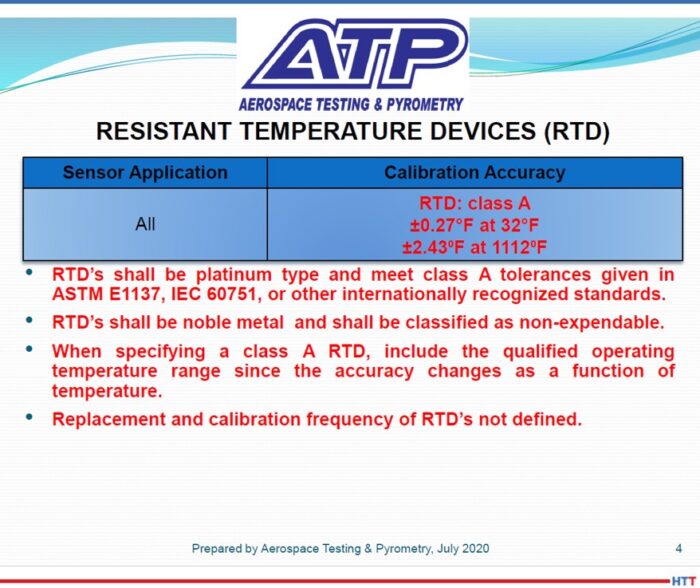
 RTDs in AMS2750F explained (photo source: Andrew Bassett, ATP)


Then we also added refractory thermocouples, which people weren't all that familiar with, unless you're dealing with the hot isostatic pressing (HIP) process.  We're seeing more and more of the HIP furnaces out there now, with all of the additive manufacturing that is going on.  We see people adding HIP furnaces everywhere, and a lot of those HIP furnaces are coming with type C thermocouples, because they are rated for these elevated temperatures that the HIP processes do.  I think the type C thermocouples are rated close to 4,000 degrees Fahrenheit.  We had to add some of these extra sensors that have been around for a while, but we wanted to bring them out a little bit further.

One of the other changes that was pretty significant—though I don't think it will affect the industry all that much—is that now we require thermocouples to be accurate to what's called “special limits of error.”  The previous revision allowed for two different types: You were allowed special limits of error, which the accuracy is + or –2 degrees Fahrenheit, or .4% of reading.  That was only required for a system accuracy test sensor or for a sensor that was being put in a Class 1 or 2 furnace.  All other sensors, such as TUS of load sensors, and class 3-6, we allowed for standard limits of air, which was + or –4 or .75% of reading, whichever is greater.

We did some polling of major thermocouple suppliers out there. With my personal experience and that of some of the other people on the committee, we kind of said, “Hey, you know what? No one really orders the junky stuff, the standard limits; everyone orders special limits of error.”  James LaFollette said, “Come to think of it, I don't think I've ever seen a purchase order that says give me the crappy stuff.  We all order special limits.”  So that's what we discovered – that no one was ordering the bare minimum because there wasn't a price difference between the two.  Everyone had already been ordering the good stuff, so we just made that a little bit of a tighter requirement.  Again, I don't think it's going to affect any suppliers out there.

I think the biggest change, when it came to thermocouples and sensors, was a big restriction that we put on what's called “expendable test sensors.”  This was dealing with the base metal thermocouples.  Base metal thermocouples are type K, type J, type T, type N, type M, and a couple other type base metals.
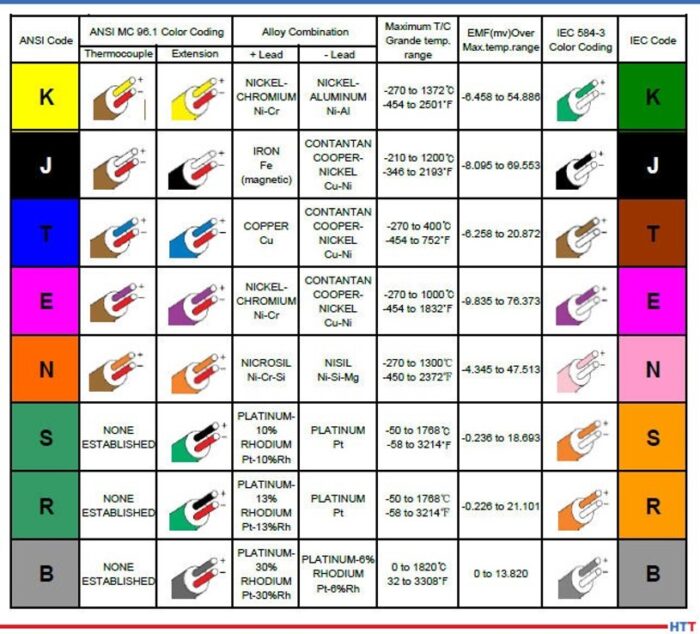
Click to read the Heat Treat Today article on thermocouples.


Primarily in the heat treating and thermal processing world, you pretty much see the K, J, N, and T.  We had done some studies as a sub-team within 2750 to look at the drifting of thermocouples, that is, where thermocouples start to lose their accuracy.  In the previous revision, we had some provisions in place that allowed people to use these expendable thermocouples that were attached to a temperature uniformity survey rack and were preserved.  They could use them up to three years or 90 uses when below 1200 degrees.  We thought that seemed kind of excessive on a 20-gauge wire that is covered with fiberglass coating.  They're probably not going to hold up, but maybe we should see if there is any drifting of these thermocouples.  So, we had one of the major thermocouple suppliers, Cleveland Electric Lab, run some drift studies on type K thermocouples, and we found out that these wires were actually starting to drift after three or four runs.  The drift study included a cycling test where they ran it up to temperature and back down 30 different times.  We asked, “Why don't we try to simulate how these thermocouples are going to interact coming in and out of thermal processing equipment?  Why not pull them out every single time and do it that way?”  Again, we found that thermocouples were drifting even further and even quicker.

At this point we decided we better put a restriction on this, and that gave the biggest uproar regarding the reuse of these thermocouples.  Previous drafts before the final release of the spec was, if it's used above 500, your expendable wire is one and done above 500 degrees.  A lot of the suppliers out there came screaming and said this is going to cost us millions and millions of dollars more in thermocouples.  But we stood firm and said, “Hey look, if you're using these test thermocouples to validate your furnaces, either through a system accuracy test or uniformity survey, you really do not know what your error of that wire is after the first use.”

Most of the major thermocouple suppliers will even state on certifications that they will only guarantee accuracy at the time of calibration.  Once it goes in a furnace, atmosphere and different conditions of the furnace will affect the wire.  We stood our ground, but we ended up backing off a little bit.  If you were using them strictly below 500, you're allowed to use them for 3 months (90 days) and you're going to have to keep a log.  If you're using them between 500 and 1200, we're going to allow you to use them for 90 days, but now you're only restricted to five usages.  And then again, above 1200, you use it once and throw it away.  That was probably the biggest hassle, trying to get that.  We did finally compromise on that three month or five usages.  I do see the burden on the suppliers because they were used to three years or 90 usages, so now it's down to three months or five usages.

DG:  I see on the chart that I've got here in front of me that base metal types of M, T, K, and E are all the three month or five use, but you've also got base metal type J and N which is three months or 10 uses.  But all of them, above 1200, one and done.
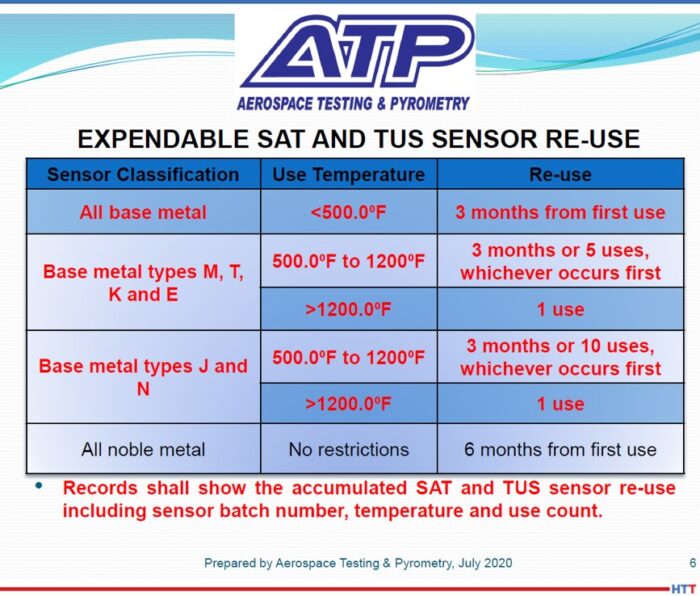
Table for SAT and TUS Sensor Reuse (photo source: Andrew Bassett, ATP)


AB:  Correct.  That's one of the things I was trying to explain to some of the suppliers that were having heartache about the original change of 500 one-and-done.  We only left it to the types M, T, K, and E; we always left this out of types J and N.  My personal experience with type J has been (and we've switched over to type J wire a while ago for testing below 1200 degrees),that it's a little bit cheaper in price than the type K wire, and there was always this allowance for doubling the amount of usage if you just switch over to type J or type N.

DG:  We have a few significant changes in the area of calibrations.  What's another area of change in this section?

AB:  One of the big things which really surprised me when we wrote it into the standard, but which was kind of overlooked by some of the suppliers, was the requirement of test instruments to have a .1 readability.  So when it deals with test instruments and also now data acquisition systems. Now, if you have a chart recorder that is on your furnace (most people are going to data acquisition systems, some sort of SCADA systems), that recorder must have a .1 readability.  That caused an uproar since that may create big changes.

Now, we don't put out these changes because we think it's a good idea; AMEC is data driven.  The big thing with the .1 readability is that we were actually fixing a flaw that has been in the spec since the first day it was written, when it was just rev. A.  We allowed for percentages of readings for your accuracy requirements.  Let's say, for instance, on your instruments that are on your furnace calibrated controller an if it's in Fahrenheit, you're allowed + or –2, but if it's in Celsius, it has to be + or – 1.1.  And if your instrumentation doesn't show .1 readability, how can you show compliance?  That question is one of the reasons—that is, fixing a flaw in specification.
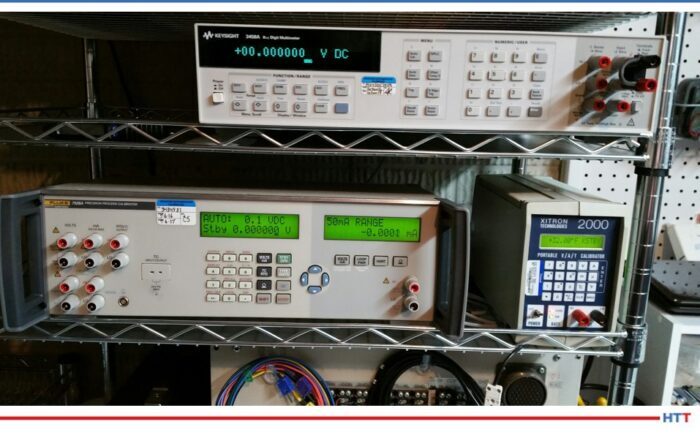
(photo source: www.atp-cal.com/laboratory/)


But we also allow for percentage of reading, which is + or –2 Fahrenheit or 1.1 Celsius or .2 % of reading, whichever is greater.  Let's say you have a calibration point at 1400 degrees, you're actually allowed  an error of 2.8.  If you can't show that decimal point readability, how can you show compliance?  That was one of the biggest issues.

Originally, the first draft said all digital instruments need to be .1 readability and then we backed that off to only say that the data acquisition system had to be .1 readability.  At the end of the day, the recorders or the data acquisition system is the proof.  As long as that shows the tenth of degree of readability, and it meets the requirements, then you're good to go there.

We did look at how many customers are already using digital data acquisition systems through NADCAP.  There's actually a NADCAP checklist question that talks about chart speed verification, and if you answer that “N/A” then you obviously have digital data acquisition.  At that time, we did look at that data and 78% of the NADCAP heat treating suppliers out there already had paperless systems.  On top of that, two years after the release of 2750F, so as of June 29, 2022, you're not allowed to have paper chart recorders anymore.  Everything is pushed to a digital data acquisition system 2 years after the release of this spec.  I'd say, that's another one of the bigger changes when it deals with the instrumentation.

So the biggest changes are the .1 readability for your chart papers and the two years after the release requirement to go with a paperless system.

DG:  Now question three: What are the changes that were made in the calibration section?

AB:  There were a few changes when it came to calibration.

One of the things we added this time was the calibration of timing devices.  A lot of facilities have timers or clocks that they're basing their times and temperatures, and again, there was no requirement to calibrate this.  Therefore, we added a whole section on calibration of timing devices.

There was some push back on that.  Certain people, who have suppliers who use certain control operated by computers and which are always synchronized in their server systems, asked if they were going to have to go out and buy calibrated stopwatches and sit at their PC to make sure it's within these new requirements.  We finally said, no, you don't have to do that, but if you can procedurally address how that whole system works—that your server is always verified—you would be okay as long as you procedurally address that.

Again, we were loose on the accuracy requirements.  Some of these external devices that you have only need to be calibrated every two years.  Comparing it to people's standards that they use—we personally do calibration of timers as well, and our standards are required to be calibrated every two years—we ended up just tossing these devices away because it's more expensive to send them back for recalibration than it is to buy new ones.  So, we gave some of the suppliers an easier way out.  But we just wanted to address, again, something that has never been brought up in the specifications, which, though not technically dealing in the pyrometry world, does sit on furnaces. We need to get these things looked at every now and then as well.

“So, we gave some of the suppliers an easier way out.  But we just wanted to address, again, something that has never been brought up in the specifications, which, though not technically dealing in the pyrometry world, does sit on furnaces.”

Some of the other changes come in the documentation.  We did change some things that need to be required for the documentation of your calibration results.  One of the things was that we need you to document the sensor that you're calibrating for that particular piece of equipment.  For instance, you have a vacuum furnace and most vacuum furnace control sensors are a noble metal type S or type R thermocouple, but then the load thermocouples that measure the parts inside might be set as type K or type N.  We just want you to denote that the control system is type S and the load thermocouples are type K.  Not real big game changers, it's not going to cause too many issues out there from the supplier base, it's just adding basically another column in your calibration reports to say what sensor you're calibrating.

We didn't go too overly crazy on the calibration portion.  The one thing, kind of in the calibration field, is we did add a new instrumentation type.  When you look at thermal processing equipment, it's broken down into two different sections.  You have your furnace classification which is your uniformity tolerance and then you have what's called your instrumentation type.  You have class 1 - 6 and you have instrumentation A – E, now instrumentation D+.  This was more for Safron Aerospace.  Cyril Vernault was very adamant that we add this D+ instrumentation because Safron's specifications state that they want this extra sensor that is basically 3 inches away from the controlling sensor, so they can measure if there is a big difference between these two sensors to determine if there is drifting of your thermocouples.  So we added this new D+ instrumentation.  We didn't realize this was big over in Europe, but it was nice to have someone like Cyril say that a lot of European suppliers use this and that he’d like to see it in AMS2750.  Again, having this broad range of people on the specification helped us find out what's going on in different parts of the world.

DG:  How about we close with the fourth part of thermocouples?  Could you delve into the expanded section on offsets?

AB:  Absolutely.  Always one of the areas, especially when it comes to NADCAP audits, is the use of offsets.  We basically broke it down into two different types of offsets that are allowed.  We have what's called a correction offset, which is basically either a manual or electronic means to bring an instrument back to a nominal temperature.  And we have a modification offset, which is just the opposite.  It takes either a manual or electronic offset or a shift in the temperature to bring it away from nominal.  There are different ways that people have used these offsets.  For instance, let’s say you go into a facility and you're doing your calibration of a controller, and the instrument is off linear by two degrees.  People would use the offset to bring the instrument back a nominal temperature.  Instead of maybe doing a full factory calibration, they would just go into the instrument, hit some magic buttons, and (say I need to offset it -2 because my instrument was two degrees high) set a two degree correction offset.

A modification offset generally is only going to be used for when you're doing a temperature uniformity survey.  Let's say it is skewed to one side of your temperature median. For instance, (I always like to use this in my pyrometry training class), we know temperature uniformity and I go in and do a temperature uniformity on your furnace at 1000 degrees.  I have to hold it to be + or –10.  When I get my final results and I look at everything with all my calculations, I have a survey that actually comes out to be 992 – 998 degrees.  It's well within the + or –10, but it’s skewed down to the lower end.

So, there's different things you can do to try to correct that. Maybe change air flow, or thermocouple location, but a lot of time, what happens is you get a furnace that was made in the 1940s and you're trying to make it comply to 2020 specifications.  The only thing you can do is go in and shift the controller away from the nominal to actually make it read hotter.  In this example that I'm giving you, what I would do is go in and put in an electronic offset and tell the controller to read colder now, as I will drive more heat into the furnace.  So, I go in and put a -5 degree offset into the control and now, in theory, when you do the survey,  you're shifting that temperature up by five degrees.  Now if you look at that split, it would be 997 – 1003—it’s more centered around your set point temperature.  That would be what's called a modification offset.  You're taking that TUS distribution and skewing it to better center around the set point.

We really did some “spelling” on this: we put some maximums, the amount of offsets that are allowed as we don't want people to go too crazy on these things, so we did put some offsets in there.  But I think we did a great job of trying to spell out what these offsets are being used for, how you're supposed to document them, and make sure that you're consistent with your practice every time.  Again, procedures will have to be written to fully understand how you're going to do the offset.  Am I going to put it electronically?  Am I going to do a manual offset, just shift my temperature up five degrees because I know my furnace is cold by five degrees?  I think with that whole new section in there, I think we did a good job of spelling that out for the suppliers.

DG: Thanks so much, Andrew for joining us on the podcast.

AB: Thanks for having me, Doug. Looking forward to chatting more with you about AMS2750F.

You can reach out to Andrew Bassett at https://www.atp-cal.com/contact/.

Doug Glenn, Publisher, Heat Treat Today

Doug Glenn, Heat Treat Today publisher and Heat Treat Radio host.


To find other Heat Treat Radio episodes, go to www.heattreattoday.com/radio and look in the list of Heat Treat Radio episodes listed.

Heat Treat Radio #38: Andrew Bassett on AMS2750F (Part 1 of 3) Read More »

AMS2750F: Expert Analysis

AMS2750F, a rewrite of the specification that covers pyrometric requirements for equipment used for the thermal processing of metallic materials, was released at the end of June. For this Technical Tuesday feature, Heat Treat Today asked a few experts in the aerospace industry to share their insights of this much anticipated revision that helps to better clarify issues with the previous revision. Specifically, Heat Treat Today wanted to know what they perceived to be the top 2-3 most important changes in revision F; what companies should do to prepare for these changes; and additional thoughts about the revision as it relates to aerospace heat treating.

Industry experts who contributed to this Original Content piece are Andrew Bassett, president, Aerospace Testing & Pyrometry, Inc., Jason Schulze, director of Technical Services; Special Process – Metallurgy, Conrad Kacsik Instrument Systems, Inc., Peter Sherwin, Global Business Development manager for Heat Treat, Eurotherm by Schneider Electric, Jim Oakes, president, Super Systems, Inc., and Doug Shuler, lead auditor, owner, Pyro Consulting LLC.


Andrew Bassett was on the subteam for AMS2750F as well as the previous revision AMS2750E and has been a member of AMEC and SAE Committee B since 2006. He shares some “inside baseball” background about this four year process, “The AMS2750F subteam utilized the Nadcap Pyrometry Reference Guide, the Nadcap Heat Treat Audit Advisories that pertained to Pyrometry, and the collective experience from the sub-team which dealt with the previous revision issues and problems. The AMS2750F sub-team had a broad range of backgrounds, with representatives from Boeing, Safran, Arconic, GeoCorp Inc, Nadcap-PRI, and Aerospace Testing & Pyrometry.”

What do you believe to be important changes in revision F?

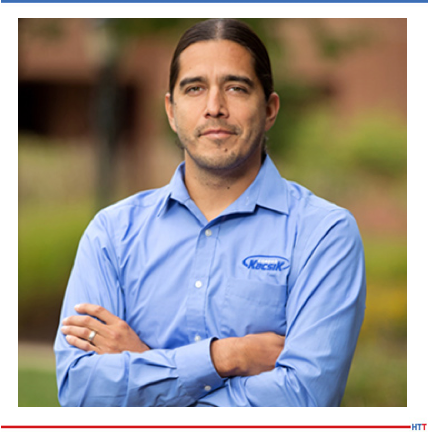
Jason Schulze, Director of Technical Services; Special Process – Metallurgy, Conrad Kacsik Instrument Systems, Inc.

Jason Schulze comments on offsets saying, “Offsets have often been a confusing subject throughout the years. How they are applied, removed and documented has caused confusion and has been a source of Nadcap findings. With the changes to the offsets section of AMS2750 in the new revision, these issues will be greatly reduced. Offsets have now been split into two categories; correction offsets and modification offsets. It will be important for suppliers to understand and implement the new requirements as well as use the same verbiage as this will hopefully alleviate further confusion.”

Andrew Bassett, President, Aerospace Testing and Pyrometry

Andrew agrees this is an important change regarding the offsets and further clarifies, “A “Modification Offset” is when an instrument is purposely, either through electronic means or manual means, shifts the accuracy away from the nominal temperature. This is typically done to “center a temperature uniformity” that may be skewed in one direction or another. The modification offset, when used properly, will shift the temperature uniformity more towards the set point of the thermal processing equipment. A “Correction Offset” is used to bring the instrument back to the nominal temperature. As always, a well defined procedure will be required on how the “Correction Offset” and “Modification Offset” will be introduced into your system.”

One of the biggest changes that caused a lot of controversy was the restricted re-use of expendable test thermocouples,” Andrew notes. “The AMS2750F subteam provided studies and data that showed that there was considerable drift of certain types of base metals thermocouples, especially when it came to Type “K” thermocouples. The previous revision of AMS-2750 already had restrictions on these types, but after providing data of the drift of these thermocouples, the team felt further restrictions were required for Expendable Base Metal SAT & TUS Sensors. Section 3.1.7.3 describes the limitations of these type thermocouples. Types “M”, “T”, “K” & “E” shall be limited to 3 months or five uses, whichever occurs first between 500F and 1200F (260C and 650C) and is limited to single use above 1200F (650C). Types “J” and “N” shall be limited to 3 months or ten uses, whichever occurs first between 500F and 1200F (260C and 650C) and is limited to single use above 1200F (650C).”

Peter Sherwin, Global Business Development Manager for Heat Treat, Eurotherm by Schneider Electric

Peter Sherwin comments on instrumentation, “From an instrument perspective our no.1 focus is the instrument accuracy specification. This has not changed for Field Test or Control and Recording Instruments (now in Table 7), however the impact of the decimal place for digital recorders could cause some issues for less precise instrumentation. In 3.2.3.1 All control, recording and overtemp instruments shall be digital 2 years after release of AMS2750F – this was not a surprise, and today’s overall cost (paper, pens, storage etc.) of paper chart recorders cannot match their digital counterparts. Digital time synchronization (3.2.3.19) is also sensible to ensure you have an accurate time record across a number of Furnaces/Ovens and charts – we are used to this for other regulations (e.g. FDA 21 CFR Part 11) and offer a SNTP/Time Synchronization feature in our Recorders.”

Jim Oakes, President, Super Systems, Inc.

Jim Oakes shared his pleasure with section 3.2.3.12, “I was happy to see the document address integrated recording/controlling data.  It states in section 3.2.3.12 when the control and recording system is integrated such that the digitally displayed control value and digitally recorded value are generated from the same measurement circuit and cannot be different, it is only necessary to document a single displayed/recorded value for the control reading.  This is happening through direct communications, so what you see on the controller is what you are recording electronically.  This saves a step and eliminates the need for additional documentation.”

Doug Shuler, Lead Auditor, Owner, Pyro Consulting LLC

Doug Shuler cites the auditor advising piece, “The top of the list has to be the overall progress we made by incorporating auditor advisories and pyrometry reference guide FQS into the body of the specification so users don’t have to ask themselves “What did I miss.”

How should companies prepare for these changes?

Jason Schulze’s advice to companies focuses on training, “Companies should receive concise training regarding the revisions within AMS2750F, including administrative and technical. As with any training, continuous courses may be necessary to ensure comprehension. I recommend performing a characteristic accountability for each and every requirement stated within AMS2750F.”

Peter Sherwin encourages companies to ready instrumentation for the standards, “Recent feedback from the MTI indicated that 3rd party audits to the new standard would probably start next year. However, if you are in the market for a new instrument then it only makes sense to ensure this meets the requirements of the updated standard.”

Doug Shuler sees the benefit of analysis, “Users should prepare by performing an internal or perhaps an external gap analysis to establish where their pyrometry system is today, and what has to be changed going forward.  Users don’t have to wait until AMS2750F and AC7102/8 Rev A are released and in effect before making changes.  The key is that if a user has an audit before the revised Nadcap Checklist AC7102/8 Rev A becomes the law of the land, they will have to declare compliance to AMS2750E or AMS2750F in full and will be held to that revision’s requirements.  Once AC7102/8 Rev A takes effect (best guess after January 1, 2021)  all audits will be done to AMS2750F.”

Andrew Bassett recommends, “First and foremost, get a copy of AMS2750F and start the review process. Since the document was a complete re-write, there is no change summary or change bars to point the supplier in the direction of what has changed. Spend time creating a matrix of the previous requirements (AMS2750E) and comparing to the new requirements (AMS2750F). I would suggest breaking this matrix down into four main sections: Thermocouples, Calibrations, System Accuracy Testing, and Temperature Uniformity Surveys. This will allow suppliers to work on each section without getting overwhelmed by the entirety of the specification. Currently at the time of writing this, there is no formal implementation requirement for AMS2750F. Typically this will either be dictated by the suppliers’ customers, or in the case of Nadcap, they will issue a “Supplier Advisory” as to when their expectation for implementation will be.”

Final Thoughts

Planning for the future will serve companies well for the long term encourages Doug Shuler,  “With a number of significant changes, nearing a complete rewrite, now is a good time to take a look at your internal procedures that may have become fragmented over the years and streamline them to the new revision.  Auditing for Nadcap for over 10 years has shown me one thing for sure.  Those companies that have a thermocouple procedure, a calibration procedure, a SAT procedure, an alternate SAT procedure, a TUS procedure, and maybe even multiple TUS procedures for different kinds of furnaces (Air, Vacuum, Atmosphere, etc.)  usually have a more difficult time with audits because the SAT procedure also addresses thermocouples, but doesn’t address correction factors because that’s in the instrument calibration procedure… See where this is going?  Consider writing one pyrometry procedure with sections in it just like the specification.  Then, the SAT section can refer to the thermocouple section for test thermocouples and to the instrument section for test instruments, etc.  It’s like re-writing AMS2750, but customized for your facility, your equipment, and your practices.  In the end, remember that the pyrometry portion of your Nadcap audit follows my P.I.E. acronym.  Procedures that Include all requirements and Evidence to show compliance.”

Paying close attention to the right data solution will alleviate potential headaches when dealing with both the new AMS2750F revision and the CQI9 (V.4 update) says Peter Sherwin, “Many commercial heat treaters will also have to cope with the update to CQI9 Version 4 at the same time! According to the MTI, your ‘end’ customers may request you perform your self-audit to the new standard from this point forward. There is a bit more time allocated to move to digital (3 years), but my advice would be to take advantage of digital solutions sooner rather than later. The right data solution should save you money over time compared to the paper alternative.”

Finally, amidst all the new changes AMS 2750F has offered, Jim Oakes assures, “…the pyrometric requirements that most of us are used to will still be very familiar as this document becomes the new standard.”


(Photo source: pixabay.com)


AMS2750F: Expert Analysis Read More »

Aerospace Standards in the Heat Treating Industry

Have you ever wondered how to create or revise AMS specifications? In this original Heat Treat Today Technical Tuesday feature, come along with Andrew Bassett, president of Aerospace Testing and Pyrometry and an expert in aerospace pyrometry specifications, as he shares his experience and knowledge in the process.

Andrew Bassett, President, Aerospace Testing and Pyrometry

Author’s Note: These comments are the non-binding opinion of the author and do not constitute an interpretation by SAE. Such opinions do not replace the need to ensure agreement between the supplier, customer, and cognizant engineering organization.

This article originally appeared in Heat Treat Today’s  March 2020 Aerospace print edition.


Those who are familiar with aerospace heat treating are accustomed to Aerospace Material Specifications (AMS) that guide heat treaters on how to process parts and raw materials. These specifications will mandate equipment requirements, atmospheres to be used, cleaning methods, soaking times and temperatures, and testing requirements, to name a few. The working committee, Aerospace Metals Engineering Committee (AMEC), is in charge of revising these specifications, which is required every five years. This is a long and sometimes tedious process of revising specifications with many knowledgeable experts involved.

There are various types of specifications that have been established by the SAE Technical Standards Board:

  1. Aerospace Material Specifications (AMS)
    • These technical reports contain specific performance requirements and are used for material and process specifications conforming to sound established engineering and metallurgical practices in aerospace sciences and practices.
  2. Aerospace Standards (AS)
    • These technical reports contain specific performance requirements and are used for design standards, parts standards, minimum performance standards, quality, and other areas conforming to broadly accepted engineering practices or specifications for a material, product, process, procedure, or test method.
  3. Aerospace Recommended Practice (ARP)
    • These aerospace technical reports are documentations of practice, procedures, and technology that are intended as guides to standard engineering practices. Their content may be more general in nature, or they may offer data that has not yet gained broad acceptance.
  4. Aerospace Information Report (AIR)
    • These aerospace technical reports are compilations of engineering reference data, historical information, or educational material useful to the technical community.

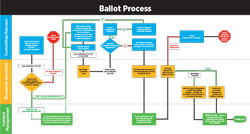
To create or revise an Aerospace Specification, a “sponsor” of the specification will request to either create a new or revise an existing standard with the approval of the chairperson. Once the approval has been granted, the sponsor will work to create and/or revise the existing document. When the draft document is complete, the draft is balloted for a 28 Day Ballot. Members of AMEC can make comments on the ballot with either a “T” comment or an “I” comment. The “T” comment is a technical error, missing requirement, or improper requirement that needs action by the committee. All technical comments should be accompanied by a reason for the comment and a suggested improvement to resolve the issue. The “I” comment is a non-technical correction. These may include spelling and grammatical mistakes, incorrect paragraph numbering, and the like. Each “T” comment must be discussed and voted on by the committee members and approved or disapproved. During the ballot process, members are asked to “Approve” or “Disapprove” the ballot. This process goes on until no more changes are required to the draft before the document is sent to the appropriate commodity committees.

The illustration (Figure 1) describes the creation/revision process for given specifications.


(Click on image to enlarge)

Figure 1. Ballot Process Flowchart from SAE


The projects for the revisions to AMS-2759 series of specifications started in 2009/2010 with many of the draft revisions waiting in “parking lots” until all the specifications were completed. Since their release in 2018, several of these specifications had to be revised again due to missing or omitted requirements or small changes to clarify issues.

Over the last eighteen months, the heat treat industry has experienced new revisions to the following specifications (revision dates):

  1. AMS-2759 Rev G Heat Treatment of Steel Parts General Requirements (04-23-19)
  2. AMS-2759/1 Rev H Heat Treatment of Carbon and Low Alloy Steel Parts Minimum Tensile Strength Below 220 ksi (1517MPa) (09-19-19)
  3. AMS-2759/2 Rev J Heat Treatment of Low Alloy Steel Parts Minimum Tensile Strength 220 ksi (1517MPa) and Higher (07-15-19)
  4. AMS-2759/3 Rev H Heat Treatment Precipitation-Hardening Corrosion-Resistant, Maraging and Secondary Hardening Steel Parts (01/07/19)
  5. AMS-2759/4 Rev D Heat Treatment Austenitic Corrosion-Resistant Steel Parts (04-28-18)
  6. AMS-2759/5 Rev E Heat Treatment Martensitic Corrosion-Resistant Steel Parts (04-28-18)
  7. AMS-2759/6 Rev C Gas Nitriding of Low Alloy Steel Parts (06-11-18)
  8. AMS-2759/7 Rev D Carburizing and Heat Treatment of Carburizing Grade Steel Parts (04-15-19)
  9. AMS-2759/8 Rev B Ion Nitriding (06-11-18)
  10. AMS-2759/9 Rev E Hydrogen Embrittlement Relief (Baking) of Steel Parts (10-18-18)
  11. AMS-2759/10 Rev B Automated Gaseous Nitriding Controlled by Nitriding Potential (06-11-18)
  12. AMS-2759/11 Rev A Stress Relief of Steel Parts (04-28-18)
  13. AMS-2759/12 Rev B Automated Gaseous Nitrocarburizing Controlled by Potentials (07-02-18)
  14. AMS-2759/13 Gaseous Nitrocarburizing (06-11-18)
  15. AMS-2769 Rev C Heat Treatment of Parts in Vacuum (07-12-19)
  16. AMS-2770 Rev P Heat Treatment of Wrought Aluminum Alloy Parts (04-08-19)
  17. ARP-1962 Rev B Training and Approval of Heat Treating Personnel (06-11-19)
  18. ARP-7446 Vacuum Gauge Calibration (03-06-19) New ARP

There are several more projects underway that include the revision of AMS-H-6875, Heat Treatment of Steel Raw Materials that will become a four-digit AMS Specification, AMS-2774, Heat Treatment Wrought Nickel Alloy and Cobalt Alloy Parts, AMS-2801, Heat Treatment of Titanium Alloy Parts and AMS-2750, Pyrometry, to name a few. As new technology emerges, such as additive manufactured metal parts, AMS standards will need to be revised or created to address the thermal processing of these parts.

AMS-2750 (Pyrometry) is one of the more contentious specifications, which is currently under revision, because it is the main specification for the testing of thermal processing equipment. This specification not only has an effect on commercial heat treaters working in aerospace, but this specification has been adopted in chemical processing/coatings for baking/drying ovens, composites for curing and bonding laminates, and as of January 28, 2018, the FDA Center for Devices and Radiological Health has added this standard to its list of recognized consensus standards database. For those who are heat treating medical devices such as needles, heart wires, titanium staples, and metallic joint replacements, AMS-2750 is now governing how the thermal processing equipment will be tested.

When I first became involved with AMEC in June 2008, the AMS-2750D (Pyrometry) was starting to be revised to AMS-2750E. I attended my first meeting in Niagara Falls, New York, with the expectation that I would be working only with a group of aerospace primes who write these standards. As it turned out, many of the members at AMEC are end users, such as captive and commercial heat treaters who are experts in the specifications in which they are involved. Since being in the field of pyrometry, I thought I would volunteer my time and expertise on the revision of AMS-2750. The sub-team group consisted of experts from Boeing, Honeywell, Carpenter Technology, Alcoa, Performance Review Institute (PRI), and Bodycote Thermal Processing with each team member bringing to the table his/her own knowledge and expertise in pyrometry. The process of revising this specification took four years to complete with numerous team meetings to discuss and propose changes to better clarify the previous revision. The final revision was finally published in July of 2012. Since then, I have been involved with other specifications such as AMS-2769 (Heat Treatment of Parts in a Vacuum), ARP-7446 (Vacuum Gauge Calibration), and the next revision of AMS-2750F.

Getting involved with AMEC and the various commodity groups is rewarding as it allows you to have a voice in the specifications that affect your business. You work with other members in the heat treat community to develop and create specification to enhance the industry, better the process, and continually strive to deliver quality parts or materials.

About the Author: Andrew Bassett is the president of Aerospace Testing and Pyrometry and is an expert in aerospace pyrometry specifications. He has 25 years of experience in the calibration and testing of thermal processing equipment. This article originally appeared in Heat Treat Today’s  March 2020 Aerospace print edition.


(source: Stefan Fluck on Unsplash)

Aerospace Standards in the Heat Treating Industry Read More »

Heat Treat Control Panel: Best Practices in Digital Data Collection, Storage, Validation

When processing critical components, heat treaters value and demand precision in every step of the process — from the recipe to data collection — for the sake of accurate performance of the furnace, life expectancy of all equipment, as well as satisfactory delivery of a reliable part for the customer.

So what’s the obstacle to achieving those goals? Gunther Braus of dibalog GmbH/dibalog USA Inc. says, “The general problem is the human.” Indeed, the need to remove the variable of human fallibility plays a significant role in the search and development of equipment that could sense, read, and record data separate from any input from the operator. “As long there is a manual record of values there is the potential failure,” adds Braus.

Now, as part of the quest for precision, particularly in the automotive and aerospace industries, many control system requirements are driven by the need to prove process compliance to specified industry standards like CQI-9 and AMS 2750. These standards allow for and frequently require digital data records and digital proof of instrumentation precision.

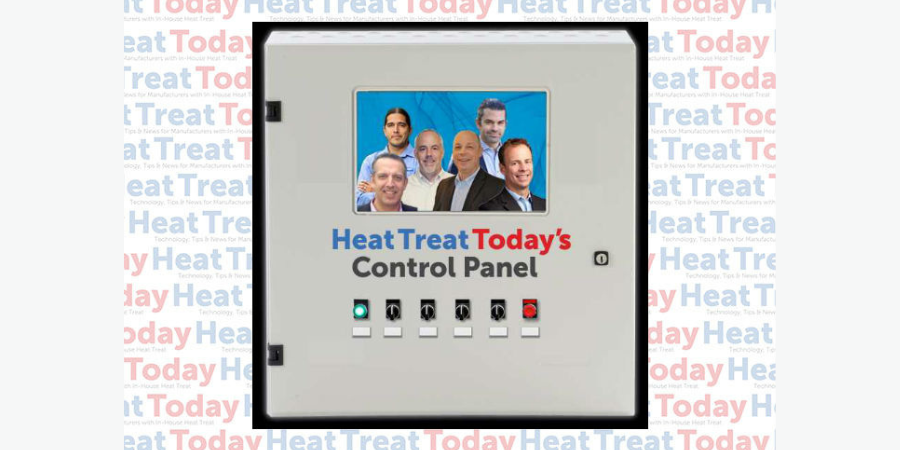
With this in mind, Heat Treat Today asked six heat treat industry experts a controls-related question. Heat Treat Control Panel will be a periodic feature so if you have a control-related question you’d like addressed, please email it to Editor@HeatTreatToday.com and we’ll put your question to our control panel.

Q: As a heat treat industry control expert, what do you see as some of the best practices when it comes to digital data collection and storage and/or validation of instrumentation precision?

We thank those who responded: Andrew Bassett of Aerospace Testing & Pyrometry, Inc.; Gunther Braus, dibalog GmbH/dibalog USA Inc; Jim Oakes of Super Systems, Inc; Jason Schulze, Conrad Kascik Instrument Systems, Inc.; Peter Sherwin, Eurotherm by Schneider Electric; and Nathan Wright of C3Data.

Calibration and Collection

Jim Oakes (Super Systems Inc.) starts us off with an overview of the equipment review process, the crucial component of instrument calibration, and digital data collection:

“Industry best practices are driven by standards defined by the company and customers they serve. Both the automotive and aerospace industries have a set of standards which are driven through self-assessments and periodic audits. Instrument precision is defined by the equipment’s use and is required to be checked during calibrations. The frequency of these calibration depends on the instrument and what kind of parts and processes it is responsible for.

The equipment used for these processes can be defined as field test instrumentation, controllers, and recording equipment. Calibration is required with a NIST-traceable instrument that has specific accuracy and error requirements. Before- and post-calibration readings are required (commonly identified as “as found” and “as left” recordings). During calibration, a sensitivity check is required on equipment and is recorded as pass/fail. The periodic calibration procedure is carried out not only on test equipment but also on control and recording equipment, to ensure instrument precision.

Digital data collection is a broad term with many approaches in heat treatment. As mentioned, requirements are driven by industry standards such as CQI-9 and AMS 2750. Specifically when it comes to digital data collection, electronic data must be validated for precision; checked; and calibrated periodically as defined by internal procedures or customer standards. Data must be protected from alteration, and have specific accuracy and precision. Best practice tends to be plant wide systems that cover the electronic datalogging that promotes ease of access to current and historical data allowing use for quality, operational, and maintenance personnel. Best practices in many cases are defined by the standards within each company, but the hard requirements are often the AMS 2750 and CQI-9 requirements for digital data storage.”

Industry Guidelines and Requirements

Andrew Bassett (Aerospace Testing & Pyrometry) has provided us with a reminder of the industry guidelines for aerospace manufacturing (via AMS-2750E, paragraph 3.2.7.1 – 3.2.7.1.5)

  1. The system must create electronic records that cannot be altered without detection.
  2. The system software and playback utilities shall provide a means of examining and/or compiling the record data, but shall not provide any means for altering the source data.
  3. The system shall provide the ability to generate accurate and complete copies of records in both human readable and electronic form suitable for inspection, review, and copying.
  4. The system shall be capable of providing evidence the record was reviewed – such as by recording an electronic review, or a method of printing the record for a physical marking indicating review.
  5. The system shall support protection, retention, and retrieval of accurate records throughout the record retention period. Ensure that the hardware and or software shall operate throughout the retention period as specified in paragraph 3.7.
  6. The system shall provide methods (e.g., passwords) to limit system access to only individuals whose authorization is documented.

“One of the biggest issues I see with one of these requirements will be point 5,” says Bassett. “The requirement is to be able to review these records throughout the retention period, which in some instances is indefinite. I always recommend to clients who may be upgrading or purchasing new digital systems that they should consider keeping a spare system in place to be able to satisfy this requirement. Who knows — today we are working on Windows 10, but in 50 years, will our successor be able to go back and review heat treat data when everything is run on Windows 28?”

Jason Schulze, Aerospace Heat Treating“This is a topic that yields great discussions,” adds Jason Schulze (Conrad Kascik). He directs us to a challenge he sees from time to time.

Within the Nadcap AC7102/8 checklist, there is this question: “Do recorder printing and chart speeds meet the requirements of AMS 2750E Table 5 or more stringent customer requirements?” This correlates with AMS2750E, page 12, paragraph 3.2.1.1.2 “Process Recorder Print and Chart Speeds shall be in accordance with Table 5”.

“To ensure the proper use of an electronic data acquisition unit used on furnaces and ovens, these requirements must be understood,” continues Schulze. “Because this system is electronic, it should be designated a digital instrument and not an analog instrument. In doing so, this helps determine what requirements apply in Table 5. The only remaining requirement in Table 5 for digital instruments is ‘Print intervals shall be a minimum of 6 times during each time at temperature cycle. Print intervals shall not exceed 15 minutes.’

With this in mind, it is important to realize that, if your time at temperature cycles are short cycles (such as vacuum braze cycles), the sample rate of data collection may need to be adjusted to ensure it is recorded 6 times during the cycle.

As an example, if the shortest cycle processed is 4 minutes at temperature, a sample rate of every 60 seconds would not conform to AMS2750E because, in theory, the maximum amount of recordings would be 4 times during the time at soak. Now, if the sample rate was modified to every 30 seconds, this would allow ~8 recordings during the time at soak, which then would be conforming to AMS2750E.

Within the realm of electronic data acquisition on furnaces/ovens, this seems to be a frequent challenge for suppliers.”

A Critical Variable: Process Temperature

Nathan Wright (C3Data) agrees and zeroes in on process temperature as a critical variable to be measured:

“No matter the heat-treating process being carried out, complying with AMS-2750 and/or CQI-9 requires that the heat treater measure, record, and control several different variables. One of the more common variables that must be measured, recorded, and controlled is process temperature.

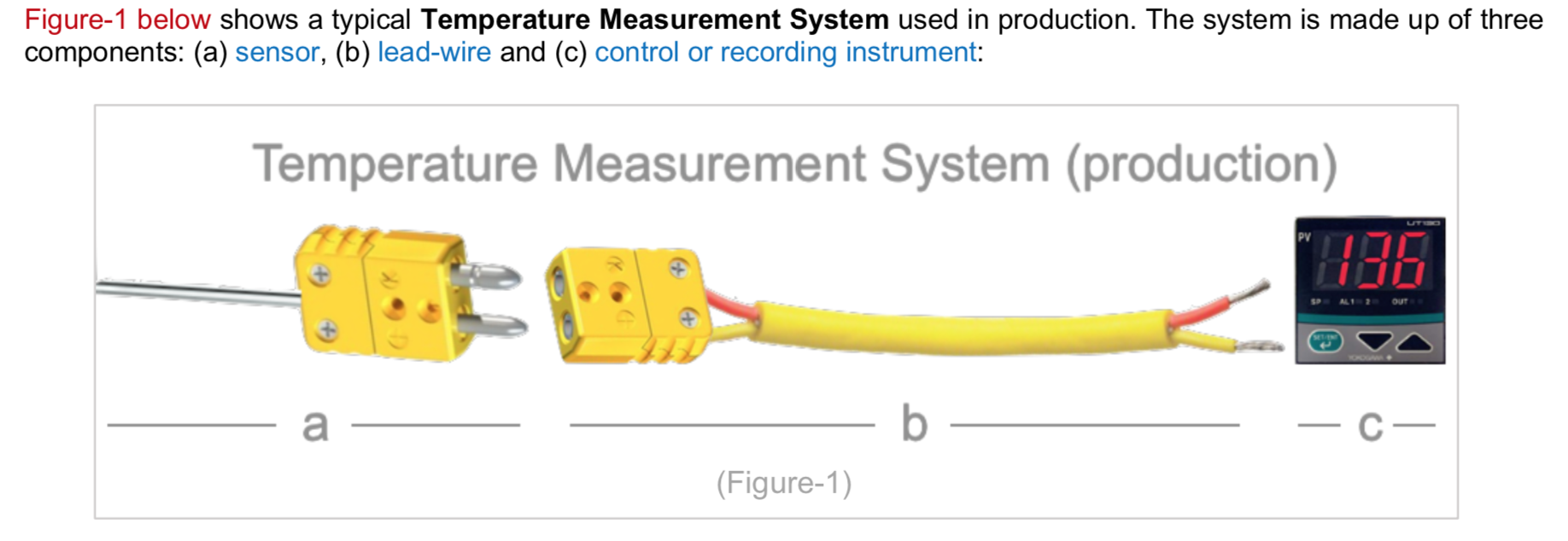
Measuring process temperatures requires the use of a precise measurement system (Figure-1 below), and the accuracy of said measurement system must be periodically validated to ensure its ongoing compliance.”

“The validation process is carried out through a series of pyrometric tests (Instrument Calibration and SAT), and historically these validation processes are highly error-prone.

In order to help ensure process instrumentation, process temperatures, and any other variable that impacts quality is properly validated it is good practice to begin automating compliance processes whenever and wherever possible. C3 Data helps automate all furnace compliance processes using software.”

A “Standard” Mindset

Gunther Braus (dibalog) chimes back in with some pertinent wisdom: “It is not sufficient only to record, you must live the standards like CQI-9, AMS, Nadcap or even your own standard you have set up, so you must survey the data. However, in the old times, there was a phrase: the one who measures, measures crap. In the end, it is all about surveillance of the captured data.

Where you store the data is a question of philosophy: personally, I prefer local storage in-house. Yes, we all talk about IOT, etc., and I do not want to start a discussion about security; it is more about accessing the data. No internet, no data. So simple. We are overly dependent upon cloud usage on the internet.

The automation of the instrumentation precision is so much effort in terms of automated communication between testing device and controller, from my point of view we are not there yet.”

A Look at the Standards In and Outside the Industry

Interesting question! writes Peter Sherwin (Eurotherm by Schneider Electric).

The aim is to record the true process temperature seen by the components being treated. However, there are many practical factors that can alter the accuracy of the reading. From the position of the thermocouple (TC), the TC accuracy (over time), suitability of the lead or extension wire, issues with CJC errors and instrument accuracy as well as electrical noise impacting the stability of the reading.

The standards do a good job to help by prescribing the location of TC, accuracies required for both TC and instrument, and frequent checks over time through TUS and SAT checks but note the specification requirements are maximum “errors”. And if you truly want to reach world-class levels of process control and reap the inherent benefits of better productivity and quality, you should aim to be well inside those tolerances allowed.

With 30yrs+ of data required to be stored (in certain cases, particularly aerospace), there should be some thought as to how and what form this should be stored in. There are many more options of storage when the data is in digital format.

  • Paper is very costly to store and protect.
  • The virgin data file should be secure and tamper-resistant and identical copies made for backup purposes held offsite.
  • The use of FTP is becoming more common to move files automatically from the instrument to a local server (with its own backup procedures to ensure redundant records in case of disaster).
  • Regular checks should be made to examine the availability and integrity of these electronic records.
  • Control and Data Instrument suppliers should ideally have many years of supplying instrument digital records with systems that can access even the earliest of data record formats.

We also look outside of the heat treat standards for truly best practices. The FDA regulation 21CFRPart11 and associated GAMP Good Automated Manufacturing Practice have been extended with the new document “Data Integrity and Compliance with Drug cGMP, Questions and Answers, Guidance for Industry”. These updates leverage A.L.C.O.A to describe the key principles around electronic records (see below). This industry is also leading the requirement for sFTP a more secure format of the FTP protocol.


Heat Treat Today will run this column regularly featuring questions posed to and answered by industry experts about controls. If you have a question about controls and/or data as it pertains to heat treating, please submit it to doug@heattreattoday.com or editor@heattreattoday.com.

Heat Treat Control Panel: Best Practices in Digital Data Collection, Storage, Validation Read More »