MANUFACTURING HEAT TREAT

Annealing Furnace Contracted for Belgium Plant

A Belgian stainless steel producer recently contracted with a plant supplier to the metallurgical industry to provide an annealing and pickling line for stainless steel cold strip.

SMS group will deliver the line to Aperam Stainless at its Genk plant in Belgium. Production start is scheduled for 2020. With this investment in state-of-the-art and future-oriented plant technology, Aperam will enlarge its product range by material grades for the most demanding applications and improve lead time and flexibility to meet the market demand.

The line will be equipped with a horizontal Drever annealing furnace and a multi-stage pickling section in addition to a four-high skin-pass mill stand and a side trimmer. The new annealing and pickling line will be the fourth one SMS group is going to install at Aperam’s Genk site.

The line will process both austenitic and ferritic grades.

Annealing Furnace Contracted for Belgium Plant Read More »

Burners 101 for Heat Treating Efficiency and Safety


Source: Control Engineering


Running a heat treat shop is more than just firing up a furnace to treat components; it’s doing so in a way that is both efficient and safe.

Today’s Technical Tuesday is a helpful article from Control Engineering about burners for gas-fired heat treating furnaces, their differences and how they are best utilized in different heat treating applications, technological advances in controls engineering, and combustion safety. The article draws on the skills and knowledge of several in the industry who have contributed to the advances and development in burner manufacturing, operation, and safety.

A couple of excerpts:

“With a careful engineering analysis, it often is possible to obtain more efficiency by optimizing either process or system control. As an added benefit, in many cases, such optimization does not require substantial physical hardware upgrades.” ~ Michael Cochran, marketing engineer, combustion systems at Bloom Engineering Company Inc.

“The goal of both regenerative and recuperative designs is to capture heat energy that would otherwise be wasted.” ~ Control Engineering


Read more: “Understanding Burners for Heat Treating Furnaces”


Burners 101 for Heat Treating Efficiency and Safety Read More »

Reader Feedback: On Ceramic Coatings

Here is what readers are saying about recent posts on Heat Treat Today. As is our policy, we allowed the original author to preview and respond to this reader feedback. See Greg Odenthal’s response at the bottom of this post.

Submit your reader feedback comments to editor@heattreattoday.com.


William (Bill) Jones of Solar Atmospheres Inc. on the Heat Treat Radio podcast interview with Greg Odenthal of ITC Coatings. Click here for the podcast (transcript here):

William R. Jones, FASM, Solar Atmospheres Inc.

Re: Heat Treat Radio: ITC Coatings

This would be a poor selection for a vacuum furnace as it is well known that ceramic coatings and the like are hydroscopic and will absorb water from the atmosphere when opening the furnace to air for work unloading and reloading, with adverse effects on following vacuum pump down, i.e., to pump out the absorbed water vapor.

With respect to ceramic lined refractory insulated atmospheric furnaces: I can respect the coating for sealing an older furnace lining for porosity and lining leaks to the outer furnace wall and for improving re-radiation to the work load with well-known surface emissivity improvement. This is not an easy coating to apply and will require maintenance “man-hours”. So one has to balance the coating time and coating cost compared to furnace out of production cost. Furnaces are like airplanes, when sitting on the ground for any purpose, they lose money.

Now, when looking at furnace hot zone efficiency, one has to review power losses both before and after changes such as coatings. With an electric furnace a totalizing wattmeter or with a gas totalizing gas meter similar to our utility company meters. Such data needs to be presented for both furnace before and after coatings on an exact furnace and production cycle.

William R. Jones, FASM

Solar Atmospheres Inc.


We offered Greg Odenthal of ITC Coatings the opportunity to respond:

Greg Odenthal, Director of Engineering & Technical Operations, ITC| International Technical Ceramics, LLC

Mr. Jones,

I cannot agree or disagree with you regarding your opinion that ITC Coatings are a poor selection for vacuum furnaces as we have never tested in nor targeted this industry. It is true that ceramic coatings are hydroscopic; however, I’m not sure just how much water/moisture a layer of ceramic coating only 1 to 2 mils thick will absorb. With that being said, any moisture absorbed would wick away in a very short period of time. Whether or not they are good for the vacuum heat treating industry is still up for discussion.

As for your comment regarding that this is not an easy coating to apply, I must tell you that you are wrong. I have been onsite on just about every installation that we have done and our crew size can be very small. For an average size heat treat or forge furnace — for example, 32’ L x 16’ H x 15’ W with a new ceramic fiber lining — a crew of two men can and have coated the entire square foot surface area in an eight (8) hour shift. The cost of the coatings and labor to install is pennies on the dollar compared to the cost of regularly scheduled downturns every 3 to 4 months to pack joints and cracks with new fiber, trying to prevent heat loss and increasing fuel consumption. We have current customers that have not done any refractory maintenance in four to five years and now only have one outage per year for their yearly furnace inspection. Once installed, the ITC Coatings increase a furnace’s efficiency by reducing refractory maintenance, reducing fuel consumption, improving temperature uniformity, improving product quality, improving turnaround times, along with a host of additional benefits, thus preventing the furnace from costing the customer money, unlike your grounded airplane analogy.

In regard to hot zone efficiency and gas/power reduction, we have been working with the gas supply companies in Canada who are currently monitoring our customers’ fuel usage and see the reductions. They are now beginning to give current and potential customers money for this type of upgrade, upwards of 50% of the cost to install ITC Coatings. We do not just sell ceramic coatings, we provide the customer with a complete engineered solution along with a total Btu savings analysis for each furnace we quote. Each Btu savings analysis is unique to that furnace and based on operational data supplied by the customer. We have also provided before and after thermal imaging of the furnace as proof that the heat transfer/loss through the refractory and to the shell is less, so you do not necessarily need totalizing meters to prove energy savings.

If you would like to learn more about ITC Coatings and our technology, I encourage you to contact me and discuss this topic in greater detail.

Regards,

Greg Odenthal

Director of Engineering & Technical Operations

ITC| International Technical Ceramics, LLC


We welcome your inquiries to and feedback on Heat Treat Today articles. Submit your questions/comments to editor@heattreattoday.com.

Reader Feedback: On Ceramic Coatings Read More »

Perfecting “Launch and Land” Systems Part of Aircraft Carrier’s Next Development Phase


Source: Navy Times


The next phase in development has begun in the construction of the nation’s newest aircraft carrier, the USS Gerald R. Ford,

The vessel returned to the Newport News, Virginia, shipyard recently for planned upgrades and repairs, including addressing problems involving the gear that’s used to catch fighter jets as they land and a ship propulsion problem that was created by a manufacturing defect.

Read more: “Aircraft Carrier Gerald R. Ford Enters Next Development Phase at Shipyard”

Photo credit: The Associated Press

Perfecting “Launch and Land” Systems Part of Aircraft Carrier’s Next Development Phase Read More »

Automated Machine Manufacturer Breaks Ground for Ohio Expansion


Source: Times-Reporter


A Dover, Ohio, engineering consultant group and manufacturer of custom automated machine equipment recently broke ground on a 25,000 sq ft design and manufacturing facility to expand their operations.

Gemini Industrial Machine Group, LLC, expects to open the facility in the spring of 2019, according to Jason Johnson, president of Gemini.

“Basically, we build equipment for area manufacturers,” said Johnson. “So they come to us with needs in automation or specialized equipment inside their facilities. We take that, and our engineers get to work, design it. We build it. We test it — everything in-house. And then I deliver it as well. It can be something as simple as a custom metal bracket or a fully automated robot that can process 20,000 parts in a shift and run millions of parts annually.”


Automated Machine Manufacturer Breaks Ground for Ohio Expansion Read More »

Marc Glasser on Heat Resistant Alloys

This is the first of three articles by metallurgist Marc Glasser on three individual heat resistant alloys. This article will feature RA 253 MA. Please submit your questions about heat-resistant alloys for Marc to editor@heattreattoday.com.


Alloy 253MA®, marketed in the United States as RA 253 MA®, is a unique stainless steel. It exhibits oxidation resistance to 2000°F. It has shown useful creep resistance in some high-temperature vacuum applications up to 2100°F. Since it is a stainless steel, it is more economical than heat-resistant alloys with higher nickel content. In addition, RA 253 MA exhibits higher creep strength than most heat-resistant alloys with higher nickel content. This alloy is one of the few alloys with measured creep strength up to and above 2000°F.

The Chemistry of RA 253 MA

The chemistry of RA 253 MA is shown in Table 1. The alloy contains additions of silicon and the rare earth metal, cerium, which together create a very adherent oxide up to temperatures between 1950°F and 2000°F. Furthermore, the nitrogen addition enhances the creep strength.


Table 1: RA 253 MA Chemistry

At first glance, RA 253 MA is similar to 309, in terms of chromium and nickel content. However, the silicon and cerium additions enhance the oxidation resistance and the nitrogen boosts the creep strength to more than triple that of 309 and 310 stainless steels at 1800°F. Above 1800°F, 309, 310, RA330, and 600 no longer exhibit usable creep strength, whereas RA 253 MA continues to exhibit usable creep strength up to temperatures of between 2000°F and 2100°F. Table 2 shows the creep properties (1% in 10,000 hours or 0.0001%) of RA 253 MA and other heat resistant materials.


Table 2: Creep Rates for RA 253 MA and Other Heat Resistant Materials

Average Stress, ksi, for 0.0001% per hour Minimum Creep Rate


The Implications in Light of the Performance

In practical terms, the implications of this performance include:

  1.  The ability to design parts and fixtures from thinner sections, thus reducing weights significantly, through proper engineering and design.
  2.  The ability to design and fabricate fixtures that can hold more weight per furnace load compared to a fixture of the same dimensions with a lesser alloy.
  3.  The relatively low nickel content of the alloy, allowing the material to be used successfully in OXIDIZING sulfur atmospheres.

RA 253 MA is best suited for high-temperature structural parts that will see oxidizing, inert, or vacuum environments. Other factors to be cognizant of when considering RA 253 AM include:

  1.  The alloy is a stainless steel and therefore subject to sigma phase embrittlement in the temperature range of 1150°F to 1600°F. This means that, over time, the intermetallic sigma phase can form. Sigma phase is quite brittle at room temperature. At operating temperature, the material is still ductile and usable. However, if sigma forms and the material cools to room temperature, care must be taken not to allow any shock impact. A sudden, hard impact from a forklift would be an example of such a shock impact that could break an embrittled basket. Once reheated to operating temperature, the brittleness is not a concern.
  2.  The oxidation resistance in wet (water vapor) environments decreases.
  3.  The alloy is not resistant to carburization or nitriding.
  4.  The alloy does not hold up in reducing sulfur environments.

Conclusion

In summary, RA 253 MA is an excellent choice for environments where a combination of oxidation resistance and superior creep strength are required. Its excellent creep strength allows for the fabrication of either lighter weight or higher weight capacity fixtures and components in high heat applications. Its high strength and higher nickel content compared to ferritic stainless steels make this grade worthy of consideration for automotive exhaust applications.

Even though RA 253 MA has a significantly higher price per pound than the current ferritic chromium-iron alloys, the high creep strength allows for lighter, thinner components, while nominal 11% nickel addition will provide for a more corrosion resistance than a ferritic alloy. Conversely, when RA 253 MA replaces a ferritic steel without making dimensional changes, the additional creep strength should result in a part with a longer life, which could reduce warranty costs. Finally, the higher oxidation limits can be utilized by design engineers to make a more efficient system, which can operate at higher temperatures.

253MA is a trademark material of Outokumpu.


Marc Glasser is Director of Metallurgical Services at Rolled Alloys and is Heat Treat Today‘s resident expert in process metallurgy, heat treatment, materials of construction, and materials science and testing.


Marc Glasser on Heat Resistant Alloys Read More »

Strengthen Your “Metal Matrix” with Precipitation Hardening


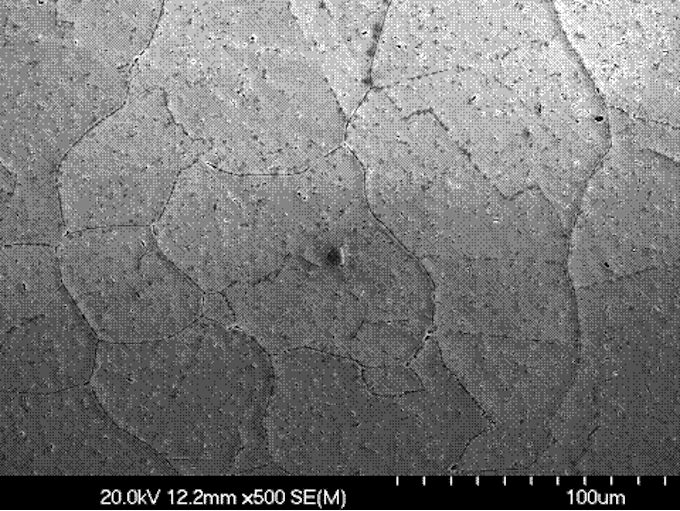
Titanium nitride precipitates in a precipitation hardened HSLA steel. Image copyright: University of Nevada, Reno via The Balance

Source: Multiple (see below)

You may know it by one name — Precipitation Hardening, or by another — Age Hardening, or Particle Hardening. Whatever term you use, if you are employing this process to strengthen aluminum, titanium, or forms of alloys, the right balance between material and application will bring you the right results.

Precipitation hardening is a heat treating method used to strengthen metal components through the utilization of controlled release of solid impurities — or precipitates — to form precipitate clusters.

“The formation of these precipitates is accomplished by using a solution treatment at high temperatures prior to a rapid cooling process. The solution heat treatment results in a single-phase solution while the rapid cooling results in a stable material by preventing the creation and propagation of lattice defects. This greatly strengthens the metal matrix. 

Precipitation hardening is typically performed in a vacuum, inert atmosphere at temperatures ranging from between 900º and 1150° F. The process ranges in time from one to four hours, depending on the exact material and the characteristics specified.” ~ The Balance

The process generally follows three steps (per AZO Materials):

  1. Solution treatment at high temperatures
  2. Rapid cooling
  3. Heat treatment to induce precipitation

According to Bodycote’s website, where more information is given regarding the process details, the outcome varies depending upon whether a solution treating-only method is used or a combination of solution treating and precipitation age hardening.


Read more about the types of metals treated by precipitation hardening, techniques, industrial applications, and more:

“Learn About Precipitation Hardening” (The Balance)

“Age Hardening – Metallurgical Processes” (AZO Materials)

“Precipitation Hardening: Stainless Steels” (Bodycote)


Photo credit: Bodycote

Strengthen Your “Metal Matrix” with Precipitation Hardening Read More »

Family-owned Pittsburgh Metals Manufacturer Acquired by Global Metals Supplier

An international technology group recently signed a contract to acquire a Pittsburgh-area family-owned company that manufactures a wide range of shear knives, blades, liners, wear plates, and accessories for the metals producing, processing, and recycling industries.

Bill Rackoff, president of ASKO (Photo credit: Pittsburgh Magazine)

ANDRITZ, headquartered in Graz, Austria, views the acquisition of ASKO as a complement to its ongoing service offerings for the metals industry.

“The combination of ASKO’s broad line of industrial knives and wear parts, and Andritz’s global position and engineering leadership, reinforces the partners’ strategies to provide advanced technology services and maintenance products to the global metals industry,” said Bill Rackoff, president of ASKO. “Both companies’ business strategies are based on delivering technical solutions that enhance customer value. The result of coordinating with Andritz’s global resources and talented metals team creates expanded opportunities for ASKO’s customers and associates.”

ASKO, headquartered in Homestead, Pennsylvania, and founded in 1933, serves practically all renowned international metals production companies and delivers its products from four locations: Homestead, PA; Rock Hill, SC; South Holland, IL, and Amsterdam, Netherlands. The company’s announcement states that ASKO will continue to operate as a separate legal entity and the present ASKO management team all remain. Bill Rackoff will continue to serve as President of ASKO and Peter Rackoff as Chief Operating Officer. There are no changes to ASKO operations, channels of sale and distribution, or the employment status of ASKO associates.

Among other offerings, ANDRITZ is a globally leading supplier of services to the metalworking and steel industries.

Family-owned Pittsburgh Metals Manufacturer Acquired by Global Metals Supplier Read More »

Lightweight Rocket Launchers Contracted by U.S. Army


With a recent contract to produce its lightweight High Mobility Artillery Rocket System (HIMARS) launchers and associated hardware, a global security and aerospace company headquartered in Bethesda, Maryland, now has the equipment in the inventories of four international partners.

The U.S. Army awarded Lockheed Martin a $218 million contract to deliver 18 HIMARS launchers to an unnamed international customer by December 2020. The HIMARS vehicles will be produced from the ground up at Lockheed Martin’s award-winning Camden, Arkansas, Precision Fires Center of Excellence.

HIMARS is a lightweight mobile launcher, transportable via C-130 and larger aircraft for rapid deployment, that fires Guided Multiple Launch Rocket System (GMLRS) rockets and Army Tactical Missile System (ATACMS) missiles. HIMARS consists of a launcher loader module and fire control system mounted on a five-ton truck chassis. A specialized armored cab provides additional protection to the three crew members that operate the system.

Photo: Lockheed Martin

Lightweight Rocket Launchers Contracted by U.S. Army Read More »

Steel Fabricator Plans Light Gauge Plant for Construction Industry


Source: Area Development


A steel fabricator based in Lansing, Illinois, recently announced plans to launch a new manufacturing plant in Lancaster County, South Carolina, to provide light gauge steel products to the construction industry in the area.

Synergy Steel Structures will manufacture steel studs, engineered floor and roof trusses and wall panels at the 32,000 sq ft facility.


Read more: “Synergy Steel Plans New Plant in Lancaster County, South Carolina”


Steel Fabricator Plans Light Gauge Plant for Construction Industry Read More »