

HEAT TREAT ECONOMIC NEWS

IHEA Monthly Economic Report: The Good. The Bad. The Ugly.

"That sense of euphoria over the rapid growth sustained since the start of the year has started to fade and not for the reason that was expected," states July's Industrial Heating Equipment Association’s (IHEA) Executive Economic Summary. Remember at the beginning of the year, there was an expectation that there would be growth, but it would hopefully be a bit slow. That was preferred because then "producers would be able to keep pace with demand and that would minimize the inflation threat."

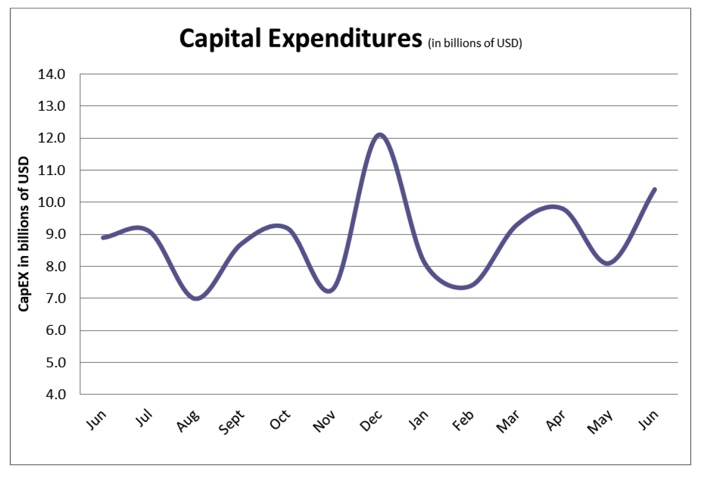
As indicated, when looking at the data for capacity utilization, there has been a great deal more investment in equipment, machinery, and technology in the last few months. The swift recovery of the economy convinced many companies they needed to move quickly to meet that surge in demand.

The report explains that "What we actually got was an economy on fire with a 6.5% growth rate in Q2. Suddenly the inflation threat was real as producers were quickly overwhelmed." But, as everyone was preparing for growth, Covid reared its ugly head again. "Now we see potential decline in the last half of the year as those protocols and restrictions reappear. "Will there be another lockdown? Will consumers retreat again and send the service sector back into recession?" Those are vital questions that are begging for answers.

Businesses had two possible responses to the early surge, both based on consumer action: add capacity to meet the demand and trust the surge will continue or hold tight and possibly lose business to competitors. The summary reports, "Until roughly a month ago, it would have been a good bet to assume that demand would continue to grow – all the signs and indicators were pointing that way. Today the story is far less clear. The resumption of pandemic protocols has been an immense disappointment and has created significant tension."

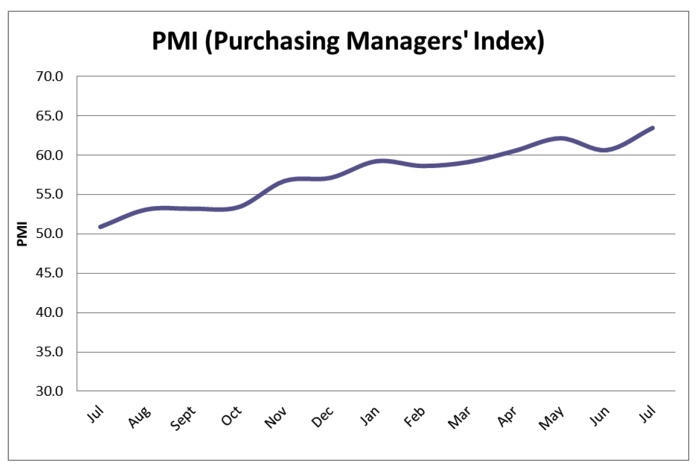
The data from the PMI has been getting progressively better and these are very high numbers in general. (The PMI index indicates expansion when the numbers are above 50 and contraction when they are below 50. The last time the index was even close to that decline was a year ago when the reading was 50.9 and it has been climbing ever since.) The unique aspect of the PMI is that it is current and honest – it is literally a monthly assessment of what industries are buying.

So, where does that leave the U.S. economy for the remainder of the year? There are three scenarios: the good, the bad, and the ugly. The good is one in which "people basically adjust to the protocols with some patience. . . . If that is the case, the expectation is that growth rates will be relatively unaffected." The bad suggests that "consumers do not adapt well and begin to shift their behaviors back to what they were last year – shunning events, restaurants, travel, and other public activity." And the ugly scenario could result if "the outbreak gets bad enough that lockdowns are reimposed."

The report concludes that "consumer growth and tension are not good companions." Time will reveal the consumer's chosen scenario.

Anne Goyer, Executive Director of IHEA

Check out the full report to see specific index growth and analysis, which is available to IHEA member companies. For membership information, and a full copy of  the 12-page report, contact Anne Goyer, executive director of the Industrial Heating Equipment Association (IHEA). Email Anne by clicking here.


IHEA Monthly Economic Report: The Good. The Bad. The Ugly. Read More »

IHEA Monthly Economic Report: Are You Experiencing Economic Whiplash?

"If you have the feeling that you are experiencing economic whiplash, you are certainly not alone. The last two years have quite literally dumped every conceivable economic issue on business and in an intense and often unpredictable manner," begins June's  Industrial Heating Equipment Association’s (IHEA) Executive Economic Summary. Because conditions are changing so quickly, it's been difficult for businesses to develop strategic plans.

The report explains, "In 2020 the world experienced a massively deep recession whose origins were truly unique – a recession by edict. That has been followed by a surging recovery that shattered the ability of the system to keep pace. This has led to severe shortages and very high inflation in a number of sectors." So, here we are in mid-2021 and the result is a two-tiered economy in which you have businesses recording high demand for their services  and other businesses that have yet to experience needed  recovery. Some consumers have money to burn, while others are declaring bankruptcy. And, inflation seems to the top issue for the business community. (Read the informative and well-written analysis about inflation in the full report. See below.)

Let's take a look at a few of the indices and how they are trending:

"The auto sector has been hammered harder than most by the supply chain disruptions and that has affected performance considerably. The sales numbers are down as low as they have been in months, but as near as anyone can determine this has nothing to do with consumer demand and everything to do with supply. The average price of a car is as high as it has ever been and is now over $40,000," states the summary. High prices, however, aren't deterring people from wanting to buy vehicles--the demand for cars is real. It's that the automotive industry,  ". . . can’t get them as the parts shortages just keep dragging on and on. It is now estimated that computer chips will not be available in the quantities needed until well into 2022." And here's an interesting fact, "The average age of a vehicle in the U.S. is now over 12 years and that is a record."

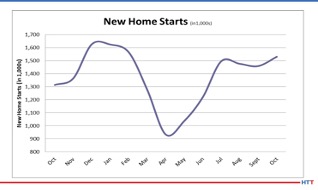
New home starts are up. The report says, "The housing sector is still far stronger than many had expected it to be given the high prices for homes. The demand is there as long as the mortgage rates are not rising and thus far, they have not. In fact, they have even fallen again. The higher end homes are in more demand than the lower end as these less expensive homes are the target for those who have been affected by the recession."

The housing sector is still far stronger than many had expected it to be given the high prices for homes. The demand is there as long as the mortgage rates are not rising and thus far, they have not. In fact, they have even fallen again.

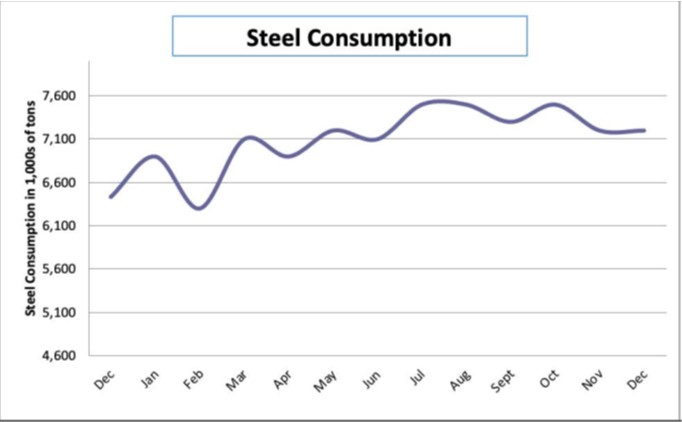
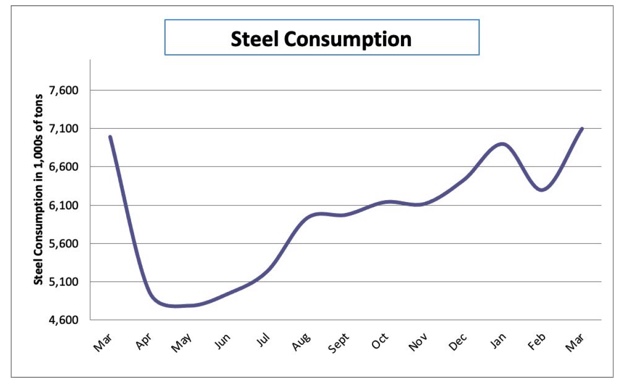
Steel consumption has also risen. "The levels of steel consumption continue to climb – somewhat erratically but they are climbing. This is a bit odd given what has been taking place in the sectors that consume the majority of steel in the U.S.--those sectors like automotive, commercial  construction and the uncertain future of office buildings." Why the demand for steel? The report continues, "The biggest motivator has been some version of stockpiling as many are expecting even higher prices in the future and are trying to get ahead of that hike. Then there has been demand for appliances and other goods as housing continues to see growth. Beyond the auto sector, there has been better demand in other transportation sectors as well as in construction and heavy machinery.

And finally,  factory orders are up. "The level of factory orders has started to advance and the timing for these gains is about what was expected. This is the time of year that retailers start to gear up for the holiday season and by all accounts they are expecting a better than average season. The consumer is still in a spending mood and still has cash available to spend."

One of the factors that has started to boost factory orders in the U.S. has been the shift to some reshoring activity as the global supply chain becomes more unreliable.

We're all on this wild economic roller coaster ride together, so hold on tight! It's quite the adventure!

Check out the full report to see specific index growth and analysis which is available to IHEA member companies. For membership information, and a full copy of  the 12-page report, contact Anne Goyer, executive director of the Industrial Heating Equipment Association (IHEA). Email Anne by clicking here.

Anne Goyer, Executive Director of IHEA


IHEA Monthly Economic Report: Are You Experiencing Economic Whiplash? Read More »

IHEA Monthly Economic Report: Be Careful What You Wish For

We are living in a volatile and ever-changing world right now— on many fronts. And so, when April's Industrial Heating Equipment Association’s (IHEA) Executive Economic Summary begins, "Be careful what you wish for – you just might get it," it causes one to pause. There have been areas of growth during the early months of 2021, but as the report states, "With growth come the challenges of growth. . ."

The demand for steel has been spiking and as a result the prices have been trending up as well. (Data courtesy of IHEA)

"Everything in this month’s report points to further growth and that is good except when it isn’t," the summary continues. What can challenge economic growth? Inflation and the three planks of inflation are commodity price hikes, wage hikes, and overall increase in money supply. Because of the growth, "the inflation threats are here to stay for a while." While the time frame isn't known, the two drivers that will contribute to its longevity or brevity are demand and supply. The report explains, "The demand side is pushing inflation for the moment – there is too much for the producers to keep pace with. The suppliers were not ready for this level of demand and remain a little cautious as far as how long that demand holds." It appears that the demand is real and that production will ramp up to meet the demand.

The one potential sticky point may be the money supply driver for inflation mentioned earlier. The economic report continues, "In normal circumstances there is a limit to inflation tolerance that stems from the willingness and ability to pay the higher prices." So, either the consumer has the means to pay the higher price or he deems it too high and will forgo the purchase. But today, with "close to $5.5 trillion in excess savings worldwide. . . the consumer will complain about the higher price, but then they will shrug their collective shoulders and pay anyway because they want the good or service offered and they have the money to pay for it. Those that will be left behind will be those that don’t have the money set aside or lack the ability to increase their personal money supply – the fixed income consumer and the company that is locked into their current pricing structure."

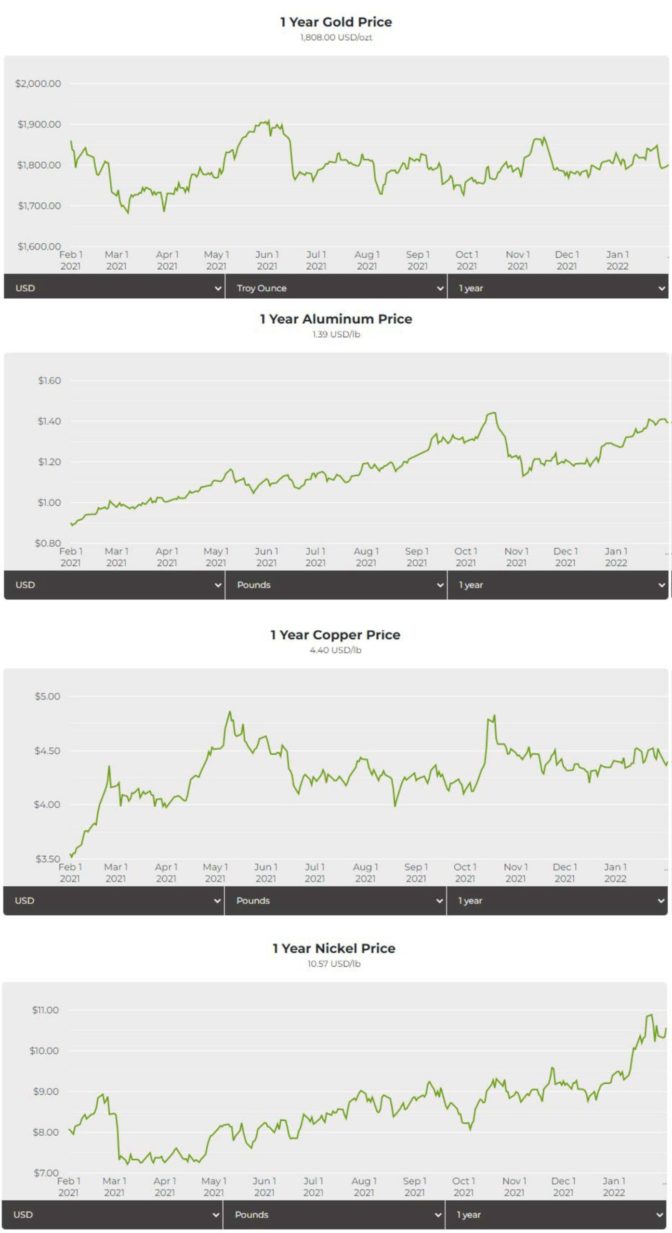
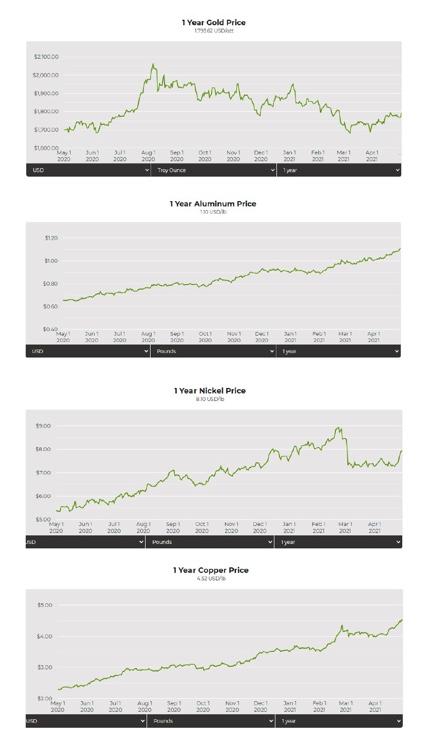
Copper, steel, aluminum and nearly everything else has seen sharp hikes to near record levels. The main reason for the price surge has been demand in excess of what had been predicted coupled with producers remaining on the cautious side. (Data courtesy of IHEA)

The report concludes with the expectation, barring no unexpected crisis, that "inflation pressures will ease by the end of the summer or early fall as the producers catch up with demand. This is the season of hurricanes and storms capable of creating issues that cascade through the markets and there is more fragility in the system than has normally been the case."

Check out the full report to see specific index growth and analysis which is available to IHEA member companies. For membership information, and a full copy of  the 12-page report, contact Anne Goyer, executive director of the Industrial Heating Equipment Association (IHEA). Email Anne by clicking here.

Anne Goyer, Executive Director of IHEA

IHEA Monthly Economic Report: Be Careful What You Wish For Read More »

IHEA Monthly Economic Report: Dark Economic Clouds Cautiously Giving Way to Bright Recovery

“It is not that there is no longer anything to be concerned about as far as the economy is concerned, but the constant worries about whether the impact of the recession would fade seems to be ending. . . . The aggressive recovery predictions that were dismissed a month or so ago are now seen as the most likely.” This optimistic introduction leads February’s Industrial Heating Equipment Association’s (IHEA) Executive Economic Summary.

There are three factors that account for this enthusiasm, the summary reports. The first is the acceleration of vaccine distribution. “The US is now ranked number five in the world in terms of numbers vaccinated (behind only a few Asian states like Japan and Taiwan).” This has helped to reduce pandemic protocols. The second factor is that consumers have money and are willing to spend it. The summary states, “There is an estimated $6 trillion on the sidelines between consumers, investors and the business community. The consumer alone sits on over $2 trillion.” And finally, the third factor is tied to the money that will be infused into the economy by the $1.9 trillion stimulus/rescue plan.

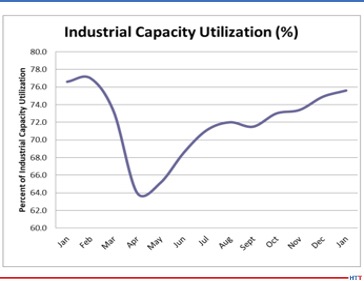
The measurement of capacity utilization is a key indicator for future activity. It basically measures how efficiently a manufacturer is operating – do they have slack capacity in terms of either the machinery or their workforce? At the moment, the capacity numbers are a very long way from provoking inflation.

But, there’s that “what if,” hanging out there. The report cautions, “There is always a caveat when talking economics and that stimulus money is behind some of the trepidation regarding the future of the economic growth pattern. The risk from the stimulus is that it will overheat the economy and trigger a serious burst of inflation. If that surge in prices is dramatic enough, it could provoke the Fed to hike rates and start to put a damper on the growth we are starting to see.”

There are three prime motivators for inflation. The first one, wage inflation, hasn’t been an issue since there are still millions of people out of work. The second motivator, which has been manifesting dramatically is the price of commodities. They have been rising quickly–think oil and lumber prices. The third motivator is the money supply issue which could potentially lead to much angst. “The US economy is about to get hit with nearly $2 trillion just when there is substantial growth underway. This has the potential to set off a cycle of money chasing money. There will be a substantial part of the consumer population that will see some of this money and will be eager to spend it. If there is too much demand and not enough supply the price of things will go up.”

In conclusion, it will be interesting to see the response from the Fed–currently, there doesn’t seem to be a desire to hike rates– as well as the spending of the consumer. Will they continue to spend on services or for long-desired products? Hopefully, there are economic sunny days ahead.

The purchasing managers’ index is fairly volatile at the moment, but the good news is that the numbers have been consistently in the 60s for the last several months and anything over 50 is considered expansionary.

Check out the full report to see specific index growth and analysis which is available to IHEA member companies. For membership information, and a full copy of  the 12-page report, contact Anne Goyer, executive director of the Industrial Heating Equipment Association (IHEA). Email Anne by clicking here.

Anne Goyer, Executive Director of IHEA


IHEA Monthly Economic Report: Dark Economic Clouds Cautiously Giving Way to Bright Recovery Read More »

IHEA Monthly Economic Report: What Is Our Future? The V, the Swoosh, or the W?

HTD Size-PR LogoStay buckled up, folks! The often-mercurial economic adventure continues. November’s  Industrial Heating Equipment Association’s (IHEA) Executive Economic Summary addresses the crossroad and the economic forecasts that are trending. The summary begins,  “The economy seems to be sitting at another crossroads, and thus far this year there have certainly been many of them. There are basically three forecasts in circulation as far as the coming year is concerned.”

The pandemic shutdown did not affect the construction sector in a significant way, and in many respects, it accelerated demand for homes.

The report defines the three outlooks — the “V,” the “swoosh,” and the “W”– and analyzes which model seems most realistic right now based on real time data, although we know that can change at any moment. The preferred “V”outlook “holds that there will be a rapid rebound in the next quarter or two and this will yield a rebound nearly as quick as the decline. To be honest, the time for the ‘V’ option has largely passed by. We would have had to see some truly dramatic numbers appear by now.”

So, if the “V” is an unlikely option, the summary states the “swoosh” might be the best option: “It asserts that there will be continued real growth in the first quarter of 2021 but tempered a little by continued consumer trepidation and the impact of the continued shutdown. This means that there is not a rapid rebound, but a drawn-out version that starts to look real by the start of Q2.”

The report continues, “The remaining option is the ‘W’ or the double dip recession and that is nobody’s preference. This would be the result of another hard and comprehensive lockdown. It is not likely the entire country would be subject to such a shutdown, but certain states will be affected more than others.”

There is growth, however. As we look specifically at the November indices, all but three of the eleven measured are trending in a positive direction. The summary states, “There are several near universal factors that are driving all of the index readings at this point. The first is a growing level of confidence regarding the performance of the economy in 2021. . . . The second factor stems from the first. That surge of activity will strain capacity in many sectors. . . . and the third is the state of the global economy.”

The major users of steel include construction, vehicle manufacturing, and the oil and gas sector.

Stayed tuned! The end of 2020 and beginning of 2021 promises to be full of excitement.

Check out the full report to see specific index growth and analysis which is available to IHEA member companies. For membership information, and a full copy of  the 12-page report, contact Anne Goyer, executive director of the Industrial Heating Equipment Association (IHEA). Email Anne by clicking here.

Anne Goyer, Executive Director of IHEA


IHEA Monthly Economic Report: What Is Our Future? The V, the Swoosh, or the W? Read More »

IHEA Monthly Economic Report: RVs, Robotics, and Technology

HTD Size-PR LogoWell, as we approach the end of November 2020 and assess the economic numbers from October, there is still no real clarity to  bring a sense of understanding to our crazy year. As the Industrial Heating Equipment Association’s (IHEA) Executive Economic Summary’s October report begins, “To note that there is nothing about this year that could be considered even close to normal or predictable would be the understatement of the year, if not the decade. This was the most unanticipated and bizarre recession experienced in modern history as it was not organic in any sense. It was an imposed recession that resulted from the attempt to deal with the pandemic and all the numbers for the year have been skewed to the extreme.”

However, the reports states, “This month’s indices are far better than they were a month or so ago, but almost every one of these data points demands an explanation before we have an idea what they might be telling us about the economy.” Of the 12 indices examined, nine of them were trending positive and only three were heading downward. Interestingly, though, “that only tells part of the story.”

The rebound in demand for factory orders has been a bit more consistent than the demand for durable goods and this reflects some shifts in consumer demand. It has been pointed out that consumers have been shifting their purchasing from services to goods and that has been reflected in a variety of ways.

For example, take the data for housing starts. The summary states, “The index showed a decline, but the news has been full of very positive reports on the state of the housing sector. The index shows both the data on single family homes as well as the multi-family unit and there has been a reduction in interest in the apartment option of late.” Additionally, the demand for both single-family and existing homes has been very robust.

The auto sector has also seen interesting movement. RV sales have “never been stronger and the demand for larger vehicles has been strong as people intend to travel in them.”

“There have been several trends emerging over the last few months and the data in these indices reflect them.” The report continues, “The most obvious and expected has been the shift in consumer interest from service spending to buying goods.” Those sectors that have benefitted the most from the shift have been manufacturers, transportation companies, and importers. “The bulk of these purchases have been online and that has spurred dramatic growth in the parcel delivery sector.”

While the U.S. still doesn’t compete effectively in the production of consumer goods, “there has been an increase in demand for the sophisticated machines the US produces – especially in the realm of robotics and technology.”

Companies are turning to technology and robotics at a faster pace than ever and that boosts machine sales.

In conclusion, the reports shares, “The early indicators as far as the economy is concerned continue to be transportation and the credit environment and, in both cases, there is renewed confidence regarding the future. The unfavorable numbers (such as bankruptcy and collections and disputes) have stabilized.”

Check out the full report to see specific index growth and analysis which is available to IHEA member companies. For membership information, and a full copy of  the 12-page report, contact Anne Goyer, executive director of the Industrial Heating Equipment Association (IHEA). Email Anne by clicking here.

Anne Goyer, Executive Director of IHEA
Anne Goyer
Executive Director of IHEA


IHEA Monthly Economic Report: RVs, Robotics, and Technology Read More »

IHEA Monthly Economic Report: “Who’s on First?”

pr logoDo you remember, or have you ever heard of the comedy duo of Abbot and Costello of the 1940s and early 1950s? One of their most popular skits is “Who’s on First?” which is hilarious, but its title, theme, and overall performance are apt reflections of the questions, frustrations, and confusing answers we are experiencing on a daily basis as we continue to navigate through uncharted waters.  September’s Industrial Heating Equipment Association’s (IHEA) Executive Economic Summary begins with questions we’d all like to know the answers to about the future of the economy/recovery and ends with continued hope. “There will soon be a debate as to what to call the period we are entering. Is this the post-pandemic recovery? Is it the second wave pandemic era? Is this the beginning of the ‘blue wave’ or the start of the purple revenge? Is this the end of the beginning or the beginning of the end? At this point a case could be made for any of these.”

(Photo Source: YouTube.com)

It’s always good to look at the data of the indices to get a pulse of what’s happening. Of the 11 indices, five are trending in the positive direction and six are trending negative, however, the report states that “the shifts have been subtle and it is hard to say whether the future trends will continue to follow the current pattern.”

The report continues, “In many respects the economy now seems in better shape than it was just a few months ago and far better than many had expected at this point. That is reflected in the indicators that showed improvement this month.” The gains were in the new automobile/light truck sales, steel consumption, industrial capacity utilization, metal prices, and factory orders.

Vehicle sales are sensitive to the performance of the economy. Demand is slowly coming back.

New home starts, capital expenditure, PMI new orders, credit, durable goods and transportation experienced a decline last month, however, in “many of these readings the changes from last month were minor and the numbers remain far stronger than they were even as recently as July and August. The economy is changing and that has meant decline for some and progress for others.”

The level of steel consumption has been rising steadily since falling into the doldrums.

While the upcoming election may bring changes, the summary states, “The reality is that the focus of the next year will be the same regardless of who wins the White House and/or Congress. The pandemic may dominate the economy as it has through 2020.” The projections for 2021 fall into two categories. The first scenario is one in which “the recovery will start picking up speed as this year ends and will continue to gain traction into the first half of next year before slowing down slightly.” The second scenario is the more cautious assumption based on an expected spread of the virus through the colder months. The good news is that in both scenarios the end of 2021 will see growth numbers that will look a lot like the numbers at the start of 2020.

Finally, given all the uncertainty, what should be on the watch list for business and manufacturers specifically? The summary concludes, “The key factors to watch will be those that reflect month to month changes and that will include the Purchasing Managers’ Index as well as the Credit Managers’ Index. Both look pretty solid right now but have shown some signs of concern as the growth spurt in the PMI has faded and the CMI is starting to show issues with the unfavorable factors. Two other indices to focus on will be capital expenditure and capacity utilization. If the manufacturers are worried about the future, they will be reducing their levels of capital investment (both in terms of machine purchasing as well as physical plant).” The only other early warning sign to look for is in transportation. Parcel activity is going to grow as the holiday spending season ramps up, which means paying closer attention to rail and truck volumes.

Check out the full report to see specific index growth and analysis which is available to IHEA member companies. For membership information, and a full copy of  the 12-page report, contact Anne Goyer, executive director of the Industrial Heating Equipment Association (IHEA). Email Anne by clicking here.

Anne Goyer, Executive Director of IHEA


IHEA Monthly Economic Report: “Who’s on First?” Read More »

IHEA Monthly Economic Report: Remarkable Recovery- Consumers Remain Cautiously Optimistic

Growth takes time, but celebrating the small steps and progress is good for the heart and soul– of people and country. “There has been a remarkable level of economic turnaround taking place in the last couple of months. Of the eleven indicators we watch there has been a recovery in every one of them,” so begins August’s Industrial Heating Equipment Association’s (IHEA) Executive Economic Summary.

Yes, the gains have come off record losses and numbers haven’t climbed back to where they were at the beginning of the year, however, as the report conveys, “Given the data that was showing up just a few months ago, the situation now could be far worse at this point and if there is a continuation of these recent trends there could be a recovery of that first quarter momentum by the beginning of the fourth quarter.

The report asks this question: With every index reading trending positive there is not much to contrast so the key issue is why. What is the prime motivation for the comeback and where might the weak points be?” Three factors are suggested for  the gains. The first is the elements of the lockdown have been lifted. “Where there has been a relaxation of the restrictions, there has been economic growth.” The second reason for the economic growth is a resumption of consumer demand. “It was hoped that consumers would be eager to resume their old habits but there was no guarantee, and there was some hesitation as far as consumption was concerned. That largely vanished by the middle of the summer.” The third growth factor was the producers’ willingness to meet the recovering demand. “Production levels have been increasing through the last few months and there has been little indication that activity was being slowed deliberately as a means by which to boost prices through manufactured shortages.”

What is a potential weak area that could adversely affect the economy? The short answer– the election. “Perhaps the most potent unknown surrounds the election. There is always a concern when the possibility exists for a change in leadership. That concern ramps up when there is more at stake than just the White House. The business community is affected more by [who] holds power in Congress as this is where those fiscal decisions are made.

To highlight just two indices, first, take a look at the New Home Starts where the housing market “is booming in almost every respect. The analysis states, “The surge has been seen primarily in the single-family home category as there has been an exodus of people from urban areas to the suburbs and exurbs.” Why? Because due to the lockdown restrictions, people are tired of cramped living conditions, and many are craving more space in the suburbs. “The majority of the factors that stimulate home buying are trending in a positive direction. Mortgage rates remain at very low levels and lenders are still willing to do these home loans.”

There have been people leaving cities they no longer feel safe living in and perhaps the most salient factor is the desire to end their long commutes. (Source: IHEA)

The second index that highlights a viable and healthy rebound is the Factory Order index. “The gearing up for the holiday season is well underway as the retailers have clearly signaled that they are expecting a very early buying season. They will be entering the period with an ‘inventory light’ strategy and will be turning the entire month into ‘Blackvember’ with early sales and discounts designed to capture the attention of the early shopper.”

The recovery of the factory order segment is perhaps better news than the rebound in durable goods and some of the other industrial indicators as it is coming at an ideal time. The gearing up for the holiday season is well underway… (Source: IHEA)

Resilient has often described Americans throughout our history, and this period in time is no different. Challenges make us stronger, and hopefully, wiser. Here’s looking to a continued growing economy and wisdom in decision-making.

Check out the full report to see specific index growth and analysis which is available to IHEA member companies. For membership information, and a full copy of  the 12-page report, contact Anne Goyer, Executive Director of the Industrial Heating Equipment Association (IHEA). Email Anne by clicking here.

Anne Goyer, Executive Director of IHEA


IHEA Monthly Economic Report: Remarkable Recovery- Consumers Remain Cautiously Optimistic Read More »

Looking Ahead: Industry Expansion in Uncertain Climate

We see the expansion plans of companies related to the heat treat industry, and we are with you: How? Why? At this time?

Heat Treat Today’s Original Content article seeks to illuminate some of these questions and frame industry expansion in real terms, as well as share reasons to be hopeful for the future. Featured in this article are Industrial Heating Equipment Association (IHEA) Economic Specialist Dr. Chris Kuehl, Managing Director at Armanda Corporate Intelligence, and Jason Orosz, President of Nitrex Heat Treating Services (HTS).


COVID-19 may own the spotlight today, but manufacturing’s tomorrow is getting some big-dollar investments.

– Jill Jusko, Looking for Good News in US Manufacturing? Major Expansion Plans Add Some Sizzle,” Industry Week

[spacer color=”3366ff” icon=”fa-question-circle”]

It is safe to say that manufacturers have taken encouragement from news of industry giants in the manufacturing industry announcing the status of their expansion plans. Last month, Industry Week covered several of these changes: Navistar International Corp. broke ground for a plant in San Antonio, TX; Canpack Group, based in Krakow, Poland, will build an aluminum beverage can plant in Pennsylvania; Tesla had already begun its Gigafactory located near Austin, Texas which is set to be operational by the end of 2021; and Nikola Corp. also broke ground on its 1 million-square-foot manufacturing facility in Coolidge, Arizona.

Ribbon Cutting with the Owners: Doug and Jackie Peters, Diana Wilkosz (VP), and Andy Wilkosz (President)
(photo source: Peters’ Heat Treating, Inc.)

In the heat treat world, we’ve seen companies, like Peters’ Heat Treating and Nitrex, celebrating plant expansions, opening new facilities and breaking ground to expand existing ones. Jason Orosz, president of Nitrex Heat Treating Services (HTS), illuminates that there is a backstory to the titillating headlines: “[many] recently announced expansion plans… were being formulated well before COVID-19 hit, and are based on assumptions about future business levels for 2021, 2022, 2023, and so on.” He goes on to recognize that, “for many industries, this year’s contraction will be seen as more of a temporary, but severe, loss of business than a permanent reduction.”

Still, what does this trend of expansion in the automotive industry in North America mean?

Dr. Chris Kuehl
IHEA Correspondent
Managing Director at Armanda Corporate Intelligence

Dr. Chris Kuehl, managing director at Armada Corporate Intelligence and IHEA’s executive economic summaries author, indicates that one must consider existing circumstances before one can understand the transition. For instance, setting up production sites abroad, Kuehl notes, typically has lower production costs, more than simply lower wages. In certain locations, one does not adhere to the same magnitude of regulations and restrictions that are implemented in the U.S. Additionally, access to raw materials is priority, and “setting up shop” closer to those foreign resources has helped to diminish production costs in the past. Lastly, Kuehl points out that thoughtful location of production centers abroad can open up new market opportunities for companies.

Looking at the current rise in production centers in the U.S. may mean three things, says Kuehl. First, the role of technology in capital distribution: “Technology and robotics [have] reduced the importance of cheap labor. The company using machines can worry about other factors. Now, they can think more about transportation costs and access to their market.”

Second, “working overseas is harder now than it was,” Kuehl comments. In  previous years, more countries have engaged in protectionism, and the trade wars of last year did not make life any easier. Now, COVID-19 is just another blow to international supply chains, having “stranded some 40% of global cargo and basically crushed the whole concept of JIT [just-in-time production system].”

Jason Orosz
President
Nitrex Heat Treating Services

This current disruption in the economy cannot be minimized. Orosz states that the current economic climate has impacted how capital is deployed, and can occur in construction being delayed, or perhaps firms holding their cash for any future, COVID-19-related disturbances.

And third: the new trend of “mass customization.” Instead of needing mass quantities of products being made cheaply — which drove the practice of “distance sourcing” — Kuehl highlights that the present “consumer wants infinite variety and specialization,” which, as it were “requires manufacturers be close to that market to understand what is needed and when.”

This trend of bringing supply-chains closer to home is cause for hope, though. “[I] think companies,” comments Orosz, “are optimistic that, going forward, an increasing portion of the supply chain for American multinationals will be U.S.-based vs. what may have been seen over the past few decades. If this trend proves true, it will certainly trickle down into the local industrial heating sector.”

[blockquote author=”Jason Orosz, President of Nitrex Heat Treating Systems” style=”1″]”Over the long term, expansion plans for stable, forward thinking manufacturing companies will proceed mostly unchanged. Of course, there are notable exceptions… but I think situations like that are the exception, not the rule.”[/blockquote]

From left to right : Groundbreaking with Tom Cooper (Vice President of Business Development), Bill Walter (Facility Manager), and Raja Gumber (Senior Account Manager)

Considering present events, Orosz notes that “over the long term, expansion plans for stable, forward thinking manufacturing companies will proceed mostly unchanged. Of course, there are notable exceptions like the passenger aerospace industry whose supply chain will be impacted for a number of years, but I think situations like that are the exception, not the rule.”

“Our expansion in Aurora is on track,” Orosz continues, as an anecdote to his point, “and we expect it to be operational mid-2021. Our main goals are to increase our overall production capacity and install the latest in new technology to ensure that the services we can offer our customers are on the leading edge of what’s possible metallurgically.”

Hope is the often idealized maxim of many societies: “Hope is the thing with feathers,” “we hope in the things unseen,” “our greatest glory is not in never falling, but in rising every time we fall.” But in times of crisis, how many of us choose to do the hard and essential thing: hope?

Looking Ahead: Industry Expansion in Uncertain Climate Read More »

IHEA Monthly Economic Report: Continued Climb and Steady Improvement

"There is one positive aspect when it comes to a dramatic drop as experienced in March and April of this year. When one has fallen that far there is nowhere to go but up! Since then there has been a steady improvement in almost every category." When one considers the challenging year 2020 has been thus far, and the dramatic hit the U.S. economy has taken due to the pandemic, this encouraging opening from the Industrial Heating Equipment Association’s (IHEA) Executive Economic Summary for the month of July is the bolstering news we all need to hear.

The report states, "The progress that has been made thus far has been contingent on several factors. The first is that many businesses have engaged in rebuilding their inventories in anticipation of an eventual economic recovery...hopes lie in a rebound by the fourth quarter. The second major motivator for recovery has been the willingness of the consumer to return to old habits as far as consumption. This has been a mixed experience as there has been some return to those old habits, but there have also been many new habits formed and these have all had their impact on business."

An uptick is evidenced in all but one of the measures and "even this showed only a very slight decline from the month prior." The summary also reports that "Of the twelve index readings tracked, all but one trended positively and in some cases the numbers registered this month were better than they have been in over a year."

The numbers have not been this high in well over a year and suggests that there is considerable optimism for the future. (Photo source: IHEA)

The summary shared, "The more interesting data was found in those categories that seemed to have fully recovered and even exceeded levels seen earlier this year and at the end of 2019. The New Orders Index from the Purchasing Managers’ Index was back to the 60s and that is a level that has not been seen in over a year. Given that the new orders sub-index is the forward looking part of the overall PMI, it bodes well for the recovery at the end of the year." Other areas that showed a jump was in transportation that always "provides some confidence about the future," the parcel delivery sector (not those tied to imports or exports, however), and the metals market, especially copper and aluminum. Lastly, "The production indicators such as durable goods and factory orders have shown progress as business tries to rebuild inventory levels but there is ongoing concern regarding new demand."

The price of metal commodities have been rising. (Photo source: IHEA)

Of those indices that trended  positively, "the majority remain distant from the readings that dominated at the start of last year." However, the data shows "a solid recovery in many areas." Albeit, it will take time before you can describe it as robust.

Steel consumption was the only reading that did not trend upward, however, it still was stable and looked similar to the previous few months.

The summary concludes, "The bottom line is that there is resilience in the economy despite the trials of the last few months. It now all depends on whether the pandemic necessitates a wider crackdown and a resumption of the conditions that collapsed the economy in the first place."

The report is available to IHEA member companies. For membership information, and a full copy of  the 12-page report, contact Anne Goyer, Executive Director of the Industrial Heating Equipment Association (IHEA). Email Anne by clicking here.

Anne Goyer, Executive Director of IHEA


IHEA Monthly Economic Report: Continued Climb and Steady Improvement Read More »

Skip to content