HEAT TREAT ECONOMIC NEWS

IHEA Monthly Economic Report: Robust Growth and Significant Gains

"It may not be time to start dancing in the streets, but the news this month is certainly a stark contrast from what it was last month." This note of encouragement begins the Industrial Heating Equipment Association’s (IHEA) Executive Economic Summary for the month of June 2020. The report continues, "Of the eleven indicators we watch, there were nine trending in a positive direction and not by a narrow margin. This was robust growth and significant gains."

The common theme among the nine indices reporting a positive trending was that "The lockdown was lifted and business was allowed to resume. The expectation was near universal and proved to be accurate. The vast majority of businesses promptly reopened to the degree they were able and that varied with the sector. The majority of the manufacturing community was able to resume operations with minimal adjustment."

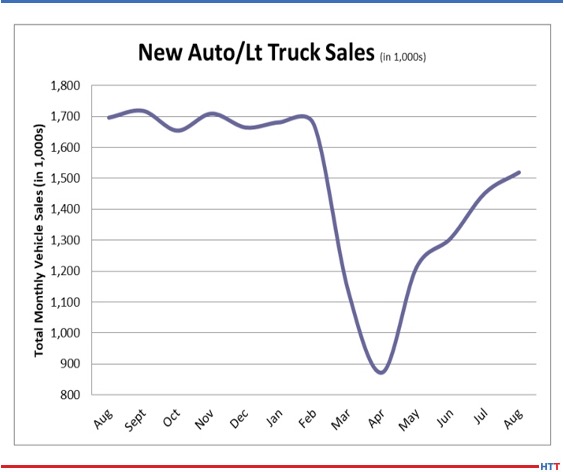
The recovery in automobile sales is impressive, but it will take awhile to offset the decline of the last few months. The summary explains how vital the health of the auto sector is to the overall economy: "It is hard to overestimate the importance of the overall auto sector to the health of the greater economy. It is not just the thousands of jobs in the assembly plants but the tens of thousands of jobs in the companies that supply the parts and assemblies. Not to mention the jobs in the dealerships, the service operations, the people in the insurance and financing communities, the marketing people and the guys that work the car wash. It is a massive economic engine and that is what led to the old phrase 'What’s good for GM is good for the nation.'"

The recovery in vehicle sales has been impressive.

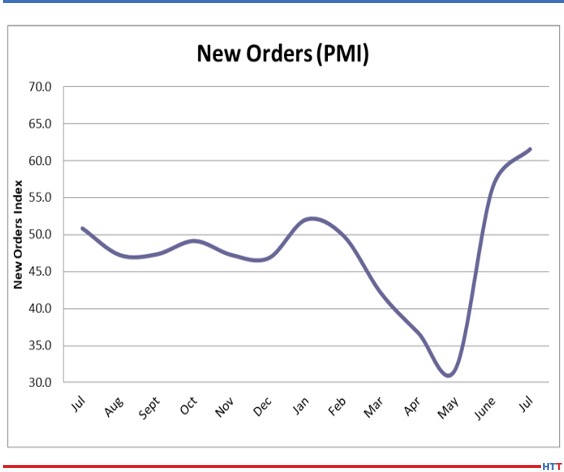
The Purchasing Managers' Index also reflected significant gains.  Last month it dropped to the 30s, which is the lowest it had been since its inception. The rebound was expected as the lockdown restrictions were loosened, however, it was much stronger than anticipated. The report explains, "The fact that this is coming from the more future oriented part of the index is also encouraging. This indicates there is more confidence in the future as the assumption is that there will be a further return to normal business operations. It is also an indication that new orders have been arriving in a variety of sectors as almost all of the measured categories saw an improvement. The notable exceptions have been aerospace and sectors tied to hospitality and travel in general."

The Purchasing Managers’ Index jumped back into positive territory in a big way.

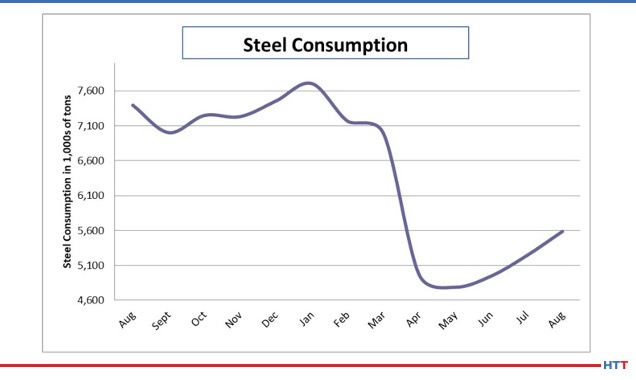
The two negative readings were in capital investment and steel consumption.  The summary cites, "The desire to invest in either new machinery or expansion is still very low as the future of the rebound remains in question. Most companies have been working off their inventory and have not needed to add anything – there is still plenty of slack. The investment outlook remains cautious. Steel consumption remains down as there has been a collapse in public sector activity and the commercial construction sector has not figured out demand as [of] yet. The vehicle sector is growing again, but carmakers are still working off their old inventory."

Reminding readers that the readings are still worse than they were before the pandemic and lockdown caused the economy to tumble, the summary states, "But the fact that a reversal has begun promises some continued expansion." A caution is offered, however, because "the economy remains in uncharted territory" due to the fact that this hasn't been a "normal recession."

Bottom line: There is hope. We'll take it.

The report is available to IHEA member companies. For membership information, and a full copy of  the 12-page report, contact Anne Goyer, Executive Director of the Industrial Heating Equipment Association (IHEA). Email Anne by clicking here.

Anne Goyer, Executive Director of IHEA


IHEA Monthly Economic Report: Robust Growth and Significant Gains Read More »

China Exclusion Request Granted

Recently, the United States imposed a 25% tariff on thousands of products from China, but permitted U.S. companies to request an exclusion from paying tariffs. In this article, Omar Nashashibi, founding partner of  The Franklin Partnership, LLC, and a resource of Industrial Heating Equipment Association (IHEA), explains the latest news regarding the exclusion and its relevance to structural components for industrial furnaces.


Omar Nashashibi,
Founding Partner,
The Franklin Partnership, LLC

The United States Trade Representative (USTR) has extended an exclusion for importers from paying a 25% tariff on industrial furnace components from China. The exclusion to the China Section 301 tariffs for structural components for industrial furnaces was extended in the Federal Register notice published on July 9, 2020 (85 FR 41267). The exclusion to the 25% tariffs, originally granted in July 2019 and set to expire on June 9, 2020, is now extended through December 31, 2020. The extension of the exclusion to industrial furnace components is one of twelve announced by USTR. Nearly 100 other products, including furnace casings, will see their tariff exclusions expire.

In July 2018, the United States imposed 25% tariffs on $34 billion worth of products imported from China (List 1). Of importance to the industrial heating industry, included in List 1 were parts of industrial electric furnaces and ovens as well as industrial induction or dielectric heating equipment (HTS 8514.90.80).

With this extension, all products meeting the description of “structural components for industrial furnaces” and are classified under the HTS code 8514.90.8000, will continue to be excluded from the 25% tariff. To claim the extended exclusion, importers must report the regular HTS code for the product, as well as the exclusion HTS code: 9903.88.52.

(Photo source: Twitter)

China Exclusion Request Granted Read More »

IHEA Monthly Economic Report: Don’t Be Faint of Heart; Rebound Coming

The  latest Industrial Heating Equipment Association’s (IHEA) Executive Economic Summary begins, “The lockdown recession has been with us for over three months now, and there are few that have not experienced the impact.” How true are those words. But, be encouraged, “By most accounts this will be the bottom, and future reports will start to show slow improvement . . . there have been consistent assertions that economic growth will rebound by the third and fourth quarter.” Some may doubt the optimism, however, “there are some indications that such a forecast may be realistic.”

The indices share a consistent theme in that all show a decline “that are nearly a straight line down.” Yet, there is one notable exception: the data for the Credit Managers’ Index reveals the same severe decline, but with an upward trend at the end. The summary explains, “The index is divided into favorable and unfavorable categories from the perspective of a credit manager. The favorables include categories such as ‘sales,’ ‘applications for credit,’ ‘dollar collections’ and ‘amount of credit extended’. The unfavorables include ‘rejections of credit applications,’ ‘accounts out for collection,’ ‘disputes,’ ‘slow pays’ and ‘bankruptcies’.”

The decline that was evident in March and April was due “almost entirely to the collapse in the favorable data.” But in May, they improved substantially. Interestingly and optimistically, “Credit managers tend to think in the future as they are most concerned with what shape a debtor will be in when they are due to pay. If a company has 90 or 120 or 180 days to pay the credit manager is not going to worry about them until that time. The fact that they are getting a bit more confident now indicates that they are starting to see some positive developments down the road and not all that far away.”

The upward trend in the Credit Movement shows positive progression down the road in the not too distant future.

The other indices share a woeful tale with record setting declines. The report explains, “There is no mystery at all as to why this is the case as the lockdown was universal and sudden. There was no time at all for business or the consumer to prepare, and there have been very few options available since the declaration.” However, the U.S. Labor Department released the latest job numbers and there were expectations that the unemployment number would hit 20%, but in reality the number was 13.4%.

So, where does the economy go from here? The summary cites three factors that will come into play: First, the attitude of the consumer — “If there is to be a real rebound the consumer will have to want to resume their old behaviors and soon.” Second, the action of the government — “[This] has varied from state to state. Some have been eager to reopen and others have put off this resumption until into 2021.” Third, the course of the viral infection — this will drive the first two factors.

Buckle up, folks, the wild adventure continues!

The report is available to IHEA member companies. For membership information, and a full copy of  the 12-page report, contact Anne Goyer, Executive Director of the Industrial Heating Equipment Association (IHEA). Email Anne by clicking here.

Anne Goyer, Executive Director of IHEA


IHEA Monthly Economic Report: Don’t Be Faint of Heart; Rebound Coming Read More »

IHEA Monthly Economic Report: Don’t Be Discouraged, Better Days Ahead, but Resilience Needed

The changes and current events occurring in our cities, states, country, and around the world are causing our heads to spin and our equilibriums to stagger. While information from the latest Industrial Heating Equipment Association’s (IHEA) Executive Economic Summary will come as no surprise for many, an unexpected, yet welcome projection will be sure to bring hope and encouragement to our weary spirits.

The report begins by explaining the incredible speed, fluidity, and “real time” fluctuations of information. “The data stream that informs the assessments we review each month has been affected right along with everything else in the economy. The changes have been taking place at a bewildering pace, outdated almost as soon as the data is collected.” Hence, because these numbers are so organic, “This set of numbers and graphs are only as accurate as they were a week or so [ago], and by now, they have all changed in significant ways.”

Despite the data pointing downward, almost universally, there are two of the twelve sectors assessed that have shown growth — steel consumption and capital investment. The summary states, “Steel consumption should be down given all the problems outlined in manufacturing and construction. There has been very little traditional demand for steel and that would lead one to expect deteriorating consumption. The slight uptick suggests that some users of steel are preparing for a return to higher prices down the road when there is an economic recovery and thus, they are trying to buy now while prices are low.”

Sectors buying steel now and storing it until they see their own demand start to recover.

The motivation behind the gain in the capital investment index has been similar to that of steel consumption.  “Now is the time to invest in new equipment or even expanded facilities as the prices are very low and there is some willingness to deal. This is a pattern that is nearly always seen during recessions . . .”

In a recession, acquisition of capital goods and physically expanding facilities occurs.

As to the rest of the numbers, the report says, “The first and most important is that this is an artificial recession imposed by a lockdown strategy intended to address another issue. In the simplest of terms, the economic crisis is collateral damage in the war on the COVID 19 outbreak.”

But, as we conclude, there is optimism as we get a glimpse of,  in the words of Paul Harvey, “the rest of the story.”

“There is a surprisingly level of confidence as far as the future is concerned. The analysts that have been looking at the expected progress of the economy, as well as the virus, still contend that we are in the midst of a “V” recession – one that falls very quickly but rebounds just as fast.  The assertion is that there is enough pent up demand to drive consumer behavior, and this will encourage business to respond quickly, and that will mean they will bring the majority of their workforce back from their “furlough,” and that will encourage even more consumer activity. . . It all becomes a matter of timing and the resilience of the consumer.”

The report is available to IHEA member companies. For membership information, and a full copy of  the 12-page report, contact Anne Goyer, Executive Director of the Industrial Heating Equipment Association (IHEA). Email Anne by clicking here.

Anne Goyer, Executive Director of IHEA

IHEA Monthly Economic Report: Don’t Be Discouraged, Better Days Ahead, but Resilience Needed Read More »

IHEA Monthly Economic Report: No Surprises Here

“It is the time to dare and endure.” Winston Churchill made that statement in 1940, and it is apropos today, as hopefully, many of us are coming to the end of the “stay at home” quarantine and will soon be free to roam again. It has also been said that it is during particularly difficult times where possibilities are mined and take flight. We will need those encouraging words in the days, months, and perhaps years ahead as evidenced in the latest Industrial Heating Equipment Association’s (IHEA) Executive Economic Summary. The report states, “This may well be the most distressing assessment of the U.S. (and global economy) since the recession of 2008. None of the bad news that follows will come as any surprise to anyone as we are all quite aware of the damage that has been caused by the reaction to the COVID 19 pandemic.”

The report explains the difference between the 2008-09 recession and that of 2020 – the current recession is an artificial one created by the forced shutdown of the economy. The U.S. enjoyed a robust economy and healthy job numbers at the beginning of the year. “The potential silver lining to all of this is that government … can reverse the process. The day that lockdowns are declared at an end, there will be recovery. Consumers will consume again, employers will hire again, producers will produce again. How much and how fast will be the prime questions.”

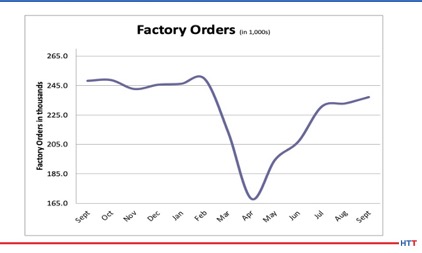
In the meantime, however, “Of the twelve indicators followed in this index, there are only four that are still trending in a positive direction and they will not be holding that distinction for long.” The durable goods numbers and factory orders numbers rose a little, but this only indicates there has been a delay in terms of industry response. The activity in the durable goods category is a lagging indicator. There has not yet been enough time for the reduction in activity to manifest in the numbers, i.e., airlines, heavy construction equipment, oil field machinery, farm equipment which have all taken major hits in decline.

Durable goods tracked a bit higher this month, however, be aware that its activity is a lagging indicator.

The summary continues, “The improvement in the transportation numbers may be a bit more realistic. There has been high demand in the parcel sector as everybody has been ordering things delivered.” The other sectors in transportation have not fared as well like ocean cargo, air freight, and the rail sector.

The transportation sector is showing some positive development.

The only other area that experienced a gain was in capacity utilization, “but that will shift as there is now considerably more slack in the system than was the case earlier.” Normally these numbers would reflect the pushes and pulls of supply and demand, but that process has been interrupted … and now almost every business has an overcapacity concern.

We are all living in a “waiting” mode anticipating the “all clear” proclamation. Then, as the summary report concludes, “Once some measure of control is achieved, the economy will be restarted, and then the focus will be on the speed of recovery.”


The report is available to IHEA member companies. For membership information and a full copy of  the 12-page report, contact Anne Goyer, Executive Director of the Industrial Heating Equipment Association (IHEA). Email Anne by clicking here.

Anne Goyer, Executive Director of IHEA

IHEA Monthly Economic Report: No Surprises Here Read More »

Heat Treat Fringe Friday: It’s a Beautiful Day in Pittsburgh’s Neighborhood 91

Heat Treat Fringe Friday

Sometimes our editors find items that are not exactly "heat treat" but do deal with interesting developments in one of our four key markets: aerospace, automotive, medical, or energy. As we approach the weekend, today's Heat Treat Fringe Friday, Best of the Web post focuses on an interesting development in additive manufacturing.


The hometown of Mr. Rogers is getting a new additive manufacturing neighborhood. The Barnes Group Advisors (TBGA), a large independent advanced manufacturing engineering consultancy, has released an impact study revealing the overall economic benefits of an additive manufacturing production campus at Pittsburgh International Airport.

Christina Cassotis, CEO, Allegheny County Airport Authority (source: Pittsburgh International Airport)

While the Pittsburgh Airport's other modernization projects have ground to a halt in the wake of the COVID-19 pandemic, Neighborhood 91 has happily been able to continue pressing forward with trying to sign tenants and pursuing plans surrounding the master developer. Overall, according to Allegheny County Airport Authority CEO Christina Cassotis, "We are still seeing interest expressed in Neighborhood 91 from throughout the world."

An excerpt: "According to the study, the innovative industrial park at Pittsburgh International Airport will create nearly 6,000 jobs over the next decade and will generate about $2.2 billion in wages over that same time period. The authors note that Neighborhood 91 will act as a catalyst for additive manufacturing AM industrialization and innovation with the creation of a cost-efficient ecosystem and the collection of smart people."

To read more about this story, click here.

(source: Neighborhood 91)

Heat Treat Fringe Friday: It’s a Beautiful Day in Pittsburgh’s Neighborhood 91 Read More »

IHEA’s Monthly Report: The Good Old Days

Automotive sales have been stable, which means the whole sector has been stable (Click image to enlarge)

February’s Industrial Heating Equipment Association’s (IHEA) Executive Economic Summary suggests, “The numbers revealed in this month’s index will someday be remembered as the ‘good old days.’ This will be the last version that can be termed “PCV” or pre-corona virus.” The report continues, “It will be important to look back on the last couple of months and remember that conditions looked pretty decent at the start of the year.”

The three indices that are trending positive include new automobile and light truck sales which reveal strongly that consumers favor their new vehicles. There was also a nice boost in steel consumption which suggests that there has been more construction activity in the public sector. Additionally, despite the threat, consumers remained active as factory orders were also up slightly.

While eight indices are trending downward, the summary reports, “The semi-good news is that several of the negative readings are only slight in that category.” The biggest declines were seen in “metal prices (and commodities in general) as well as capital expenditure, credit and transportation. The only one that really crashed hard was capital expenditure and that is partly due to the slump in manufacturing that started last year.”

The capacity utilization dip still registers in the high 70s (Click image to enlarge)

A little less dramatic in declines are the housing market, which still remains healthy although new home starts are down; and, capacity utilization, that has been sinking, but “is still not all that far off the pace considered normal.” The durable goods numbers and the data from the Purchasing Managers’ Index also slowed down, but not significantly.

“The next month will show drastic reductions in business activity in many sectors and the job losses will start to mount. The hope on the horizon is that COVID-19 behaves like others of its kind and starts to fade as the weather warms. If the worst of the impact is in March and April the recovery will be obvious by June and July.” states the report.

It is an uncertain time for everyone, and we can all resonate with this concluding thought, “It is hard to say what these numbers tell us. This is uncharted territory for the US.”


The report is available to IHEA member companies. For membership information and a full copy of  the 12-page report, contact Anne Goyer, Executive Director of the Industrial Heating Equipment Association (IHEA). Email Anne by clicking here.

Anne Goyer, Executive Director of IHEA


IHEA’s Monthly Report: The Good Old Days Read More »

Heat Treat Today’s Coronavirus Impact Update — Phase II

On February 27th, Heat Treat Today conducted an initial Coronavirus Impact Study. We wrote about the findings on March 4th. Click here to see that initial report. Considering the historical uniqueness of what is happening and the impact that the virus and, more importantly, the impact of the reaction that has been mandated by federal, state, and local governments, Heat Treat Today decided to conduct a slightly expanded follow up study (Phase II) on March 20th — roughly 3 weeks after the initial study. Below is an analysis of the results of Phase II and where possible a comparison between Phase I and Phase II results.

Publishers Note: The coronavirus/COVID-19 situation has been accompanied by media coverage that some describe as sensational and panic-creating. Heat Treat Today’s desire is to objectively report impacts without commentary and without increasing panic.

The Phase I (February 27th) survey netted more respondents, 113, than the Phase II (March 20) survey, 75. The decrease in responses may be attributed to the day of the week that the survey was deployed — Thursday for Phase I and Friday (late afternoon) for Phase II. The length of the survey may have also impacted the response rate — Phase II having several more questions than Phase I. Neither study has enough responses to be considered “scientific” and Heat Treat Today strongly recommends that no important decisions be made based on the results of these studies.

Additionally, the phrase “coronavirus” was used extensively in Phase I whereas “COVID-19” was used extensively and in place of “coronavirus” in Phase II. It is understood that these terms are different and stand for different things. For the non-medical professional, we assumed that these two terms will mean essentially the same thing and they were used interchangeably. Our apologies to medical professionals and other who know the difference.

Finally, this survey was sent to roughly 700 heat treat industry SUPPLIERS, not end-users. The desire was to see what impact the virus and the subsequent response of governments and businesses was having on the heat treat industry specifically, and not on the wider industrial economy as a whole.


Current Impact

Q: Has the coronavirus/COVID-19 ALREADY impacted your business?

The two studies were divided up into two broad sections: 1) what impact the virus has ALREADY had, and 2) what impact the virus is ANTICIPATED to have.

The percentage of respondents claiming that COVID-19 had already impacted their business essentially doubled from Phase I to Phase II going from roughly 40% to nearly 80%. And the number of respondents saying that there has been no impact fell from nearly half in Phase I to roughly 12% in Phase II. Below, Phase I results are shown first, then Phase II results.

Phase I (click to enlarge)

Phase II (click to enlarge)


Q: How has the coronavirus/COVID-19 ALREADY impacted your business?

The responses here were also significantly different. Please note that the charts below are not 100% comparable. While both green bars denote supply chain difficulties and both blue bars represent travel restrictions, there was a third option added to the Phase II options that was not in Phase I. Therefore, the tan or yellow bar actually represents two different answers between the studies as does the blue bar at the bottom. Please read these charts and the tables that follow them carefully to see the difference between the last two bars.

Suffice it to say, however, that while supply chain concerns did not increase significantly between the two studies, travel restrictions nearly tripled going from 30% in Phase I to nearly 90% in Phase II. Effectively, travel is banned in the North American heat treat industry … something never before experienced.

One final point. In the Phase II chart below, you’ll notice that the last option is “Other (please specify).” For the sake of relative brevity (!), these “Other” comments have not been included in this report. If you’d like to see these comments, please email htt@heattreattoday.com and request a full “Phase II Coronavirus Report.”

Phase I (click to enlarge)

Phase II (click to enlarge)


Q: What steps are you ALREADY taking to minimize the impact?

In Phase II, an additional question was asked regarding what steps have already been taken to minimize the impact of the virus. There was no equivalent question in Phase I. Below are the results. Please notice that the complete wording of the answers are shown in the table below the chart and the “Other (please specify)” answers are not shown, but may be obtained by emailing htt@heattreattoday.com.

Phase II (click to enlarge)


Anticipated Future Impact

In both studies, we then moved from the CURRENT situation to what people were ANTICIPATING for the future.

Q: In what ways to you anticipate that the coronavirus/COVID-19 will impact your business?

The top bar, the green one, represents an anticipated difficulty with a company’s supply chain — difficulty getting materials to manufacture their heat treat product or component. This number stayed at roughly 25% in both studies.

The green bar is also the same in both studies representing travel restrictions. This number, however, took a huge jump between Phase I and Phase II — 43% to 79%.

There was an additional answer added to the Phase II study so the tan/yellow bar represents two different things in the charts below. In Phase I, the yellow bar represented “Other” responses. In Phase II, it represents an anticipated drop off in business levels and it was this answer that gleaned the highest number of responses — just over 8 of 10 respondents anticipated a drop in business levels due to the virus.

Phase II (click to enlarge)

Phase II (click to enlarge)


Q: What steps do you anticipate taking to minimize the impact of the coronavirus/COVID-19?

There was another additional question added to the Phase II study asking what actions the company anticipated taking to reduce the impact of the virus. Below are the responses.

Phase II (click to enlarge)


Q: What impact will the coronavirus/COVID-19 have on your company’s bottom line?

On this question, it is safe to say that the answers were significantly less optimistic in Phase II than they were in Phase I. In Phase I, over 50% felt that the virus would impact their bottom line 5% or less. In Phase II, the “5% or less” answer was given less than 10% of the time, meaning that over 90% of the respondents anticipate that the virus will have a greater than 5% impact on their bottom line. In fact, the highest number of respondents chose “11-20%,” and the second largest group was the group anticipating “Over 20%”.

Phase I (click to enlarge)

Phase II (click to enlarge)


Q: How long do you anticipate the coronavirus/COVID-19 will impact your business?

This is another question where the answers were significantly different between the two studies. The “3 to 6 month” answer came in nearly identical on both studies sitting at roughly 60% in both cases. Marked changes occurred, however, on both sides of the “3 to 6 month” answer. Those anticipating an impact of “0-2 months” fell by nearly half from roughly 30% in Phase I to just over 17% in Phase II. The big gainer was in the “7 months or more” category where the numbers over doubled from only 10% in Phase I to 25% in Phase II. Obviously, the heat treat industry is bracing for a much longer impact than initially anticipated in Phase I.

Phase I (click to enlarge)

Phase II (click to enlarge)


Actual Sickness

The above question was the LAST question asked in the Phase I study. Phase II respondents were given the optional opportunity to answer one more personal question. The reason for asking this question was to get at the actual health impact of the coronavirus/COVID-19 verses the impact caused by the reaction of governments, media, and others who might be unduly heightening anxiety levels whether purposefully or unwittingly. As you can see from the chart and table below, nearly 80% of the respondents chose to proceed with the optional question.

Phase II (click to enlarge)


The question itself is rather long and can be read in the chart below. As you can see, of those proceeding to this more personal question, over 80% chose to actually answer the question. Of those answering the question, nearly 95% knew of no one in the heat treat industry (as defined by the question) currently infected with the coronavirus/COVID-19 and a full 97% knew of zero or one person infected. (Please note that the percentages above are based on a base of 38 people who chose to give a numeric answer.)

Phase II (click to enlarge)

A Complete Copy of the Report with “Other” Comments

If you’d like to see a complete copy of the Phase II results (with all personally-identifiable or company-identifiable information removed), please email htt@heattreattoday.com and request a copy of “Phase II Coronavirus Report.”

(source: Unsplash.com)

Heat Treat Today’s Coronavirus Impact Update — Phase II Read More »

IHEA’s Monthly Report: The US Economy Hits the Ground Running into 2020

“Optimism” may be a good description to highlight January’s Industrial Heating Equipment Association’s (IHEA) Executive Economic Summary. It states, “The US economy has started the year in better shape than had been expected. Now the attention of the economist has been focused on two questions. The first, why the headwinds that were expected to slow things down haven’t? And the second, how long can this situation be expected to last? Despite the predictions that consumers would become weary and businesses would begin layoffs at the start of 2020, “… some of the pressure was released with the ‘phase one’ deal with China and the consumer just seemed to power through their concerns.”

New home starts experienced an unexpected and encouraging rebound

The summary reports, “In looking at the index readings this month, the news is pretty good. Of the eleven, there are seven that are trending positive and four that are pointing in a more negative direction. The more important note is that the good news readings are very strong and the negative readings are not so dramatic.”

Of the seven positives indices, new housing starts experienced a dramatic rebound, and the housing sector is as strong as it has been in some time. Additionally, the reports states, “There was also some significant gain in terms of steel consumption. The automotive sector and the energy sector have helped boost demand.”


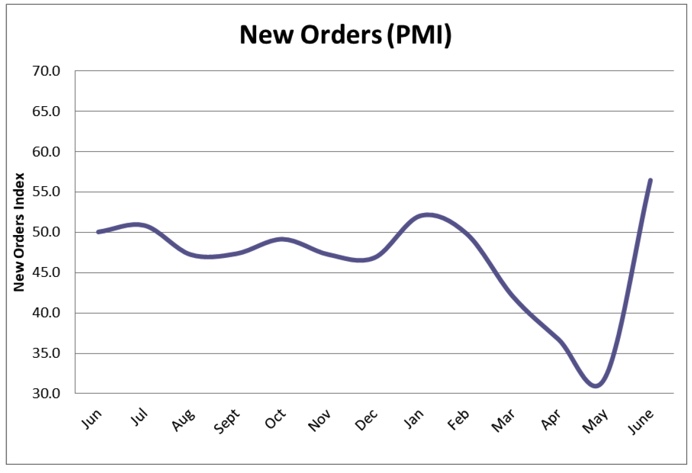
Significant growth in new orders after 5 consecutive months in decline

One other significant area of growth to note is the PMI, “There was a very impressive rebound as far as the Purchasing Managers’ Index was concerned. The overall index jumped back into expansion territory with a reading of 50.9 but an even bigger leap was noted in the New Orders index as it went from 46.8 to 52.0. Given the future orientation of the new orders data, this is good news indeed.” Other indices showing a positive growth were capital expenditures, durable goods, factory orders, and the credit manager’s index.

Those indices that weren’t as upward trending, but not “all that depressing” were new automobile/light truck sales, falling metal commodities prices due to lack of demand, and capacity utilization. The transportation index seems to be more of a concern, “The slip has been mostly in the rail and maritime sectors thus far as both have been affected by the trade wars and other interruptions in the global economy. The bottom line is that the bad news data has not been all that serious and most are likely to see some improvement in the future if the good news data keeps coming in.”

In conclusion, the news is better than expected this month with much growth. However, we can’t ignore the coronavirus and that its effect on the global economy has yet to play out completely.


The report is available to IHEA member companies. For membership information and a full copy of  the 12-page report, contact Anne Goyer, Executive Director of the Industrial Heating Equipment Association (IHEA). Email Anne by clicking here.

Anne Goyer, Executive Director of IHEA

IHEA’s Monthly Report: The US Economy Hits the Ground Running into 2020 Read More »

Coronavirus Impact on Auto, Aerospace Industries Uncertain

The Hubei province of China has now been shut down for three weeks due to the Coronavirus outbreak, and industries around the world–including automotive and aerospace–face continued uncertainty about the future while an industrial powerhouse roughly the size of Sweden sits quiet. Despite more than 900 lives having been claimed by the virus in China thus far, some companies, including Tesla and Airbus, have cautiously reopened and gone back to work with the government’s blessing while others remain shut.

Airbus’ Chinese division has been given permission by Beijing to “gradually increase production, whilst implementing all required health and safety measures for Airbus employees, which remains the top priority.” Their final assembly line in Tianjin has restarted operations. In response to the Chinese government’s statement, the company stated, “[We are] constantly evaluating the situation and monitoring any potential knock-on effects to production and deliveries and will try to mitigate via alternative plans where necessary.”

Meanwhile, the automotive industry continues to be plagued by shutdowns that are starting to impact global manufacturing. Hyundai Motor, General Motors, Volkswagen, Renault, and Toyota Motor have extended their suspension of operations. Factories in the Hubei province expected to open on February 13 have had that deadline extended, and some provinces and districts have instructed companies not to reopen until March 1. The province of Hubei accounts for 9% of all Chinese automotive production.

Razat Gaurav, CEO
Llamasoft

The impact of the shutdown is expected to extend beyond auto companies to manufacturers of auto parts as well. According to Razat Gaurav, CEO of Llamasoft, an AI-driven software development company that works with several automakers including Ford and General Motors, “Most OEMs single source components for new vehicles and China is a large supplier of those. Thus, there is exposed risk. The automotive industry has been going through a ‘regionalization’ trend for the last 5 to 8 years . . . Even so, there is a ripple effect in other parts of the world. For example, Hyundai is one of the first automotive companies announcing closures outside of China, at its South Korean factories; France’s Renault also announced a shutdown in its South Korea facilities. Fiat Chrysler warned it may need to halt production in one of its European plants due to a shortage of parts. While we have talked a lot about the manufacturers themselves, the impact on the supplier base is significant as well.”

Photo Credit: Business Insider/Getty Images

Coronavirus Impact on Auto, Aerospace Industries Uncertain Read More »

Skip to content