FEATURED NEWS

Effect of Heat Treatment on the Tensile Strength of ‘Elgiloy’ Orthodontic Wire

BOTW-50w  Source:  Dental Materials –

Elgiloy is the trade name of a cobalt–chromium–nickel superalloy that is offered for orthodontic use as wire. Despite some years of use, there is very little information in the dental literature on its mechanical properties, and especially on the effect of the hardening heat treatment (HT), that may be used after forming, on the tensile strength (TS) in relation to the four ‘tempers’ that are available.

Read More:  The Effect of Heat Treatment on the Tensile Strenght of “Elgiloy” Orthodontic Wires by S.M. Philip and B. W. Darvell

Effect of Heat Treatment on the Tensile Strength of ‘Elgiloy’ Orthodontic Wire Read More »

Nuclear Company Takes Delivery of Oxidizing Oven

A nuclear energy industry company recently took delivery of an electric oxidizing oven from Baker Furnace. The oxidizing oven will heat treat Inconel support trays that are used to hold nuclear fuel cell rods in place. The heat treating process provided by the industrial oven will extend the life of the trays and reduce production costs for the manufacturer.

The heat treating oven has a maximum temperature rating of 1350°F and work zone dimensions of 5’W x 5’H x 5’D. The unique Baker Furnace door design offers a lifetime no sag guarantee along with a pneumatic door locking mechanism. A recirculation fan provides approximately 25 air changes per minute through adjustable air distribution via sidewall ducts with the return air at the rear of the work chamber for temperature uniformity of ±25°F at 1300°F. The oxidizing oven utilizes a programmable temperature controller with ramp and soak capabilities.

 “At Baker Furnace, our design team focuses on durability and innovation. We have utilized our unique no sag door design with lifetime guarantee on equipment for years and now we are improving it with the added pneumatic door locking mechanism.” – Tim Bacon

Nuclear Company Takes Delivery of Oxidizing Oven Read More »

Novelis China Supplying Sheet for Aluminum-Intensive Jaguar XFL

BOTW-50w  Source:  Light Metal Age –

Novelis China is supplying aluminum solutions for the all-new, aluminum-intensive Jaguar XFL, the first Jaguar model from Chery Jaguar Land Rover Automotive Co., Ltd. Chery Jaguar Land Rover started up production at its Changzhu Plant – China’s first purpose-built aluminum body shop, where the Jaguar XFL will be assembled. Most of the aluminum alloys for the Changzhu body shop will be supplied by the Novelis sheet finishing and heat-treatment plant located in Changzhu, China.

Read more:

Novelis China Supplying Sheet for Aluminum-Intensive Jaguar XFL Read More »

Constellium to Feature High Speed Thermal Treatment

Jean-Marc Germain – CEO Constellium

Constellium N.V. (NYSE and Euronext: CSTM) announced today the official opening of a new state-of-the-art finishing line at its plant in Neuf-Brisach, France, for a total €180 million investment. The new line is designed to meet the growing demand for aluminium automotive body sheet.

With a production capacity of 100,000 tons, the new 240m (787-foot) long finishing line features high-speed thermal treatment, precise temperature control, highly efficient quenching process as well as greater flexibility on the thickness of processed alloys. This diverse range of innovative technologies will enable Constellium to manufacture high-quality aluminium products for automotive closure inners, outers and Body-in-White. The new finishing line is in the final stage of the qualification phase and has already started commercial production.

“On the heels of the launch of our new manufacturing plant with our joint venture partner UACJ Corporation in Bowling Green in the US, the opening of the new finishing line in Neuf-Brisach is another critical step in the execution of our worldwide automotive growth strategy,” said Jean-Marc Germain, Chief Executive Officer of Constellium. “It shows our continued commitment to serving the needs of automakers with our advanced aluminium products and solutions.”

 “We are thrilled to announce the capacity expansion of our plant in Neuf-Brisach with the opening of a best-in-class automotive finishing line,” said Arnaud Jouron, President of Constellium’s Packaging and Automotive Rolled Products business unit. “With top-notch technologies, a long-standing automotive expertise among our staff on both sides of the ocean, and an additional line located in the heart of Europe, we are well positioned to capture the growth for automotive body sheet in Europe and across the globe.”

Built in 1967, the Neuf-Brisach plant is an integrated aluminium rolling, finishing and recycling facility. In Neuf-Brisach, Constellium designs and produces a wide portfolio of coil and sheet products for automotive OEMs as well as food and beverage can customers. Adding to the production capacity of aluminium automotive body sheet in Neuf-Brisach, the opening of this additional finishing line is expected to significantly boost Constellium’s automotive body-sheet production capacity in Europe to meet anticipated automotive market growth.

In Europe, stricter regulation of vehicles’ CO2 emission have resulted in an increasing demand for aluminium. With the rising importance of lightweighting, aluminium automotive body sheet volumes are expected to reach 700,000 tons in 2020, up from 230,000 tons in 2012.

Constellium to Feature High Speed Thermal Treatment Read More »

Nadcap 18 Month Merit Status for Heat Treating Awarded to Solar Atmospheres

Solar Atmospheres announces that it has been awarded Nadcap 18-month Merit status for Heat Treating at the Souderton, PA facility.

Solar Atmospheres in Souderton has held Nadcap accreditation since 1995, maintaining merit status for the majority of that time. Having demonstrated their ongoing commitment to quality by satisfying customer requirements and industry specifications, the Nadcap Task Group has determined that Solar Atmospheres has again earned this special recognition.

“Achieving Nadcap accreditation is not easy; it is one of the ways in which the aerospace industry identifies those who excel at manufacturing quality product through superior special processes. Companies such as Solar Atmospheres go above and beyond achieving Nadcap accreditation to obtain Merit status and they should be justifiably proud of it,” said Joe Pinto, Executive Vice President and Chief Operating Officer at the Performance Review Institute. “Benefiting from a less frequent audit schedule reduces audit costs and associated pressures and demonstrates the trust that the aerospace industry has in Solar Atmospheres based on their past performance in Nadcap audits. PRI is proud to support continual improvement in the aerospace industry by helping companies such as Solar Atmospheres be successful and we look forward to continuing to assist the industry moving forward.”

Nadcap 18 Month Merit Status for Heat Treating Awarded to Solar Atmospheres Read More »

Jason Schulze on Understanding AMS 2750E — The 1st of Many…

Dan Bender, Understanding the Short Circuit Current Rating Jason Schulze, Conrad Kacsik Instruments, Inc.

Introduction

Within the aerospace heat treating field, Nadcap heat treat audits are a necessary part of doing business.  The requirement to obtain Nadcap approval is “flowed down” from primes like Boeing and Airbus to sub-tier suppliers and these approvals must be maintained. Nadcap heat treat audits are typically more difficult than other audits and this is due primarily to the inclusion of pyrometry.

My name is Jason Schulze. I’m a metallurgical engineer with over 20 years in the aerospace industry. I’ve been exposed to Nadcap in multiple commodities, although often focused in heat treat. I work with companies to insource and improve special processes, perform gap-analysis and internal audits as well as gain Nadcap approval. I am also contracted by PRI as an eQualern Instructor and teach multiple courses including pyrometry.

In the upcoming series of Heat Treat Today articles, I’ll present specific subjects related to Nadcap heat treat audits and pyrometry. In subsequent articles, I hope to be answering your questions – questions submitted by our readers.

In this initial article, I’ll focus on AMS2750E comprehension as well as offering a Quality based perspective with regards to accounting for each requirement within the specification.

Understanding AMS2750E

As with any specification, it must be read carefully. It would do no good to read the specification and attempt to implement it if you do not understand the material. On a scale of 1-10, with 1being zero knowledge of pyrometry, someone reading AMS2750E for the first time would need to be at least a 5 in order to properly comprehend and implement the AMS2750E Specification.

Most quality engineers are familiar with the term “bubbling” as it relates to blue prints. Bubbling a print is a practice in which each requirement is assigned a sequential number. Once this is done on the print, it is then logged onto a form which contains the designated number, its associated requirements, the subsequent result, and an accept/reject notice. Typically, this is done on machined parts that may have an intermediate process (such as heat treat) involved in their manufacture. When an intermediate process is performed, the specification is simply listed as the requirement and an accept designation is applied. The specification itself is not bubbled, but read by an engineer, and the applicable requirements flowed down.

My method is to bubble the specification itself. Take each requirement out of the specification and assign it a sequential number. Let’s call them “Characteristic Requirements”. Some paragraphs may have several requirements within a single paragraph; each would be separated and assigned its own sequential number. Let’s look at an example of this:

AMS2750E PG 19, PARA 3.4.5.1:

“The displayed temperature indication and/or recording of the sensor being tested as used in production, with appropriate offsets or correction factors, at any operating temperature, shall be compared with the corrected temperature indication of the test sensor on a test instrument”

It may seem that a single requirement is being put forward; but there are actually 7 contained within this one paragraph.

  1. The displayed temperature indication…
  2. and/or recording of the sensor being tested…
  3. as used in production…
  4. with appropriate offsets or correction factors [option for either]
  5. at any operating temperature…
  6. shall be compared with the corrected temperature indication of the test sensor…
  7. on a test instrument.

I have performed this task on both AMS2750D and AMS2750E. Revision E ended with 513 characteristic requirements, including tables and figures. Once bubbled, each requirement must be accounted for as they apply to your operations. For example, any requirement regarding a retort furnace would be designated “N/A” if your operation employed only vacuum furnaces. Of course, the continuing issue of comprehension arises at each step of this process. If you have a poor understanding of pyrometry it will be difficult to bubble AMS2750E, and nearly impossible to successfully complete the process of showing conformance.

AMS2750E Training

By training, I’m referring to comprehension of AMS2750E itself. Instruction on how to properly calibrate an instrument, perform an SAT or wire up a rack to perform a TUS will be much easier once AMS2750E is understood.

Several courses are offered through multiple companies.  Choosing one where you will obtain practical and sound advice concerning your specific operation as it relates to AMS2750E is the key. Get pyrometry training from an engineer who not only has performed the work in accordance with AMS2750E, but more importantly, has been involved in the actual manufacturing of heat treated hardware and has been through a live Nadcap audit. Knowledge in pyrometry may be one thing; its real-time application within an actual production environment is entirely different – and invaluable.

Conclusion

Ensure your comprehension of AMS2750E is in line with Nadcap’s expectations; training will be the key. This will expedite your success in implementing AMS2750E as it applies to Nadcap.

Submit Your Questions

Please feel free to submit your questions and I will answer appropriately in future articles. Email your questions to Doug@HeatTreatToday.com.


Jason Schulze on Understanding AMS 2750E — The 1st of Many… Read More »

Heat Treat TV: Cost of Heat Treat Poor Quality Highlighted

Heat Treat TV

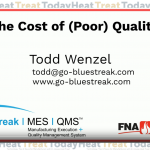
The cost of poor quality — with an eye toward eliminating it — was the topic of discussion at a recent heat treat industry conference (Furnaces North America). Todd Wenzel, President of Bluestreak|Throughput Consulting, made the presentation on October 4th in Nashville. By clicking on the image below, you’ll be taken to a post-event re-recording of the presentation.

Cost of Poor Quality Lead Slide

Heat Treat TV: Cost of Heat Treat Poor Quality Highlighted Read More »

Federal Firearms License Secured by AHT Corp.

WATERLOO, IA—Advanced Heat Treat Corp. (AHT) recently announced that it has received a Federal Firearms License (FFL) issued by the U.S. Department of Justice, Bureau of Alcohol, Tobacco, Firearms and Explosives at their facility in Monroe, Michigan. AHT now has licenses at all four of the company’s locations in Iowa, Alabama and most recently, Michigan. All licenses are available to view or download on the Quality section of their website: www.ahtcorp.com under the “About” section.

“While we are no stranger to processing firearms, the addition of this license will allow us to better serve those customers whose parts require an FFL,” stated Gary Sharp, President and CEO. “Our firearm customers have recently experienced better lubricity and corrosion resistance with one of our trademarked processes, UltraOx®, so we wanted to be better equipped to handle all of their parts for aesthetics and consistency. We are excited to now be able to expand that offering to our Michigan customers.”

Federal Firearms License Secured by AHT Corp. Read More »

MPG Announces Expansion of Indiana Facility

Metaldyne Performance Group (NYSE: MPG), a leading provider of highly engineered components for use in powertrain and suspension applications for the global light, commercial and industrial vehicle markets, announced plans to expand its operations in North Vernon, Ind., creating up to 126 new jobs by 2019.

The Michigan-based company will invest $30.6 million to lease and equip a 32,400-square-foot facility in North Vernon. With construction scheduled to begin later this month and operations slated to begin in 2018, the new building will be adjacent to its current 130,000-square-foot facility in North Vernon. Connected by a breezeway, the two buildings will provide expanded space for the company to increase production of its powder forged connecting rods, which major automobile manufacturers use to improve fuel-efficiency in their gasoline and diesel engines.

MPG currently employs more than 12,000 associates around the world, including nearly 200 in North Vernon. The company plans to begin hiring highly-skilled CNC machine operators and engineers in the first quarter of 2017.

“Our North Vernon manufacturing operations has been a strong performing plant for MPG and its customers for many years,” said Doug Grimm, president and chief operating officer at MPG. “We are excited about this new expansion, and we appreciate the support from the state of Indiana.”

The Indiana Economic Development Corporation offered MPG conditional tax credits and training grants based on the company’s job creation plans. These tax credits are performance-based, meaning the company is not eligible to claim incentives until local applicants have been hired. The city of North Vernon has also approved additional incentives at the request of the Jennings County Economic Development Commission.

“MPG, formerly operating as Metaldyne, has been a member of this community for many years and we are extremely pleased they chose the North Vernon facility for their expansion project,” said North Vernon Mayor Mike Ochs. “We very much appreciate their commitment and investment which will impact not only Jennings County but south central Indiana.”

Founded in 2014 from the merger of three metal-forming technology companies, today MPG is the world’s largest supplier of powder forged connecting rods. With its high-strength, lightweight designs, the company’s rods are ideal for use in high-efficiency engines, using a high-yield process that minimizes material waste. MPG operates more than 60 facilities around the world.


MPG Announces Expansion of Indiana Facility Read More »

Liberty House Group Creating Steel Sector in the UK

BOTW-50w  Source:  Recycling Today

The London-based metals trading and manufacturing company Liberty House Group (LHG) has launched a metal recycling business called Liberty Metal Recycling (LMR), which it says is a step toward it achieving its Greensteel vision to create a competitive and sustainable steel sector in the United Kingdom.

Read More:  Liberty House Group Launches Metals Recycling Business

Liberty House Group Creating Steel Sector in the UK Read More »