


BRAZING TECHNICAL CONTENT

A Braze New World: Sending Non-precious Braze Alloys into Space

The space industry is growing fast and is predicted to be worth over a trillion dollars by 2040.

Keith Ferguson, Senior Business Development Manager at Morgan Advanced Materials’ Braze Alloys Business, explains how braze alloys play their part in safe, reliable and sustainable space exploration. 


A Braze New World

The saying goes, “one small step for man, one giant leap for mankind.” This famous phrase uttered by Neil Armstrong is the perfect advertisement for space exploration and its importance to the future.

Less than a century old, space exploration has come on leaps and bounds since the first artificial satellite, Sputnik 1, was propelled into space in 1957. Since then, the world has witnessed marvels such as landing on the moon, the space shuttle program of the 1970s, and the launch of the International Space Station.

The importance of these missions and their subsequent value is immeasurable. Many might not realize on a day-to-day basis how space exploration has improved lives and the global economy to no end. This includes simple weather forecasting, broadcasting TV and radio, predicting natural disasters, monitoring for fertile land, forecasting sea level patterns, and even aiding research in muscular atrophy.

It’s little wonder then that this industry has significant value. The space industry was reportedly worth $384 million USD in 2017, growing at a rate of 7.4 percent. According to Morgan Stanley, it sees the industry growing to be worth $1.1 trillion USD by 2040.

However, there are challenges. Many believe that the millions of dollars and resources used to explore space could be better used on immediate threats to society like clean water, famine, poverty and more. Outside of external opinion though, there are internal operational challenges. Namely, space exploration needs to become safer and more sustainable.

A huge part of solving this challenge is in brazing alloys.

A Brief History on Brazing in Space

In simple terms, brazing joins two metals by heating and melting a filler (alloy) that bonds to the two pieces of metal and joins them. The filler must have a melting temperature below that of the metal pieces.

The use of braze alloys in space equipment is mission critical, as they allow sensors to be mounted as close as possible to engines to measure and monitor output and feed data back to operators. Indeed, they’ve already aided successful missions. Two of Morgan Advanced Materials’ braze alloys, RI-46 and RI-49, were specifically engineered and used by NASA on the Space Shuttle Main Engine, also known as the RS25.

Braze Alloys (Morgan in Space)

RI-46 specifically was developed as a replacement for the existing Nioro braze alloy, which is comprised of 82/18 Au/Ni (gold/nickel). RI-46 contains much less gold, adding in copper and manganese instead. This helped make the braze alloy significantly less dense and provided crucial weight savings, but also still operable from a wide range of temperatures, between -400°F to 1292°F (-240°C to 700°C).

These alloys have not only been critical for past space missions, but also for future missions. RI-46 and RI-49 have been adopted for NASA’s Space Launch System (SLS), a vehicle that is planned to take a crewed mission to Mars.

As alluded to already, developing new braze alloys is as much about performance as well as sustainability.

The Need for Non-Precious Alloys

It needs no mention that space exploration is a costly exercise. According to NASA, the average cost to launch a Space Shuttle is $450 million per mission. The Space Shuttle Endeavour, the orbiter built to replace the Space Shuttle Challenger, cost an eye-watering $1.7 billion USD.
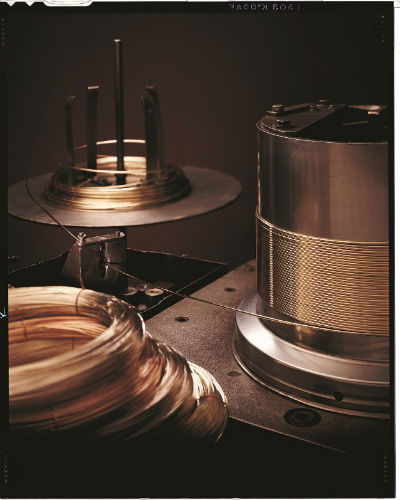
Wire Form Braze Alloys (Morgan in Space)

Bringing costs down is clearly required to keep space missions feasible. One key part of cost reduction is in reducing the use of precious metal braze alloys.

Precious metals like gold and palladium are becoming increasingly scarce. Of course, the cost of producing alloys from these precious metals is also increasing as a result.

However, there can be a reluctance to come away from using precious metal alloys. Years of research, development, and data mean these alloys are tested and reliable. When dealing with missions and equipment that run into the hundreds of millions of dollars and, more importantly, the lives of crew members, reliability becomes an overarching objective, and failures must be prevented.

To solve this issue, Morgan’s Braze Alloys business has been researching and developing non-precious metal alloys over many years. As seen from the RI-46 and RI-49 alloys, these solutions are just as strong as their equivalent high precious-metal counterparts, but at a fraction of the cost.

Non-precious metal alloys can be made from metals like nickel, chromium, and cobalt. Their success has already been seen in the aerospace sector, and now research is being pioneered into making them fit for going into orbit and beyond.

Space, for All to Enjoy

Space travel is not just for highly trained astronauts and public benefit; there is also a growing commercial aspect. Satellite TV and radio have already been mentioned, but billionaire entrepreneurs such as Richard Branson and Elon Musk have also been pioneering private space travel. The hope is that civilians might one day be able to enjoy outer space as well, albeit at potentially high prices.

Achieving this dream is of course hinged on safety and reliability, given that lives will be at stake. The key to improving these factors is being able to place sensors as close as possible to the spacecraft’s engine.

By enabling sensors to be placed near the spacecraft’s engine, mission control and crew can then accurately read and measure data and output. This includes fuel efficiency, temperature, gas flow and monitoring for fire detection or abnormalities. If these sensors are placed too far away from the engines, then data readings become inaccurate and missions can be compromised.

Recent news highlights why sensor technologies are critical, as a two-man space crew had to abort their flight to the ISS after a post-rocket launch failure. The Soyuz spacecraft started to experience failure 119 seconds into the flight, and seemingly, problems were reported by the crew first, not by mission control. The crew described feelings of weightlessness, an indication of a problem during that stage of the flight. Luckily, they aborted, ejected their capsule from the rocket, and returned safely to Earth.

While the cause of the failure is still to be identified at the time of writing, clearly, such a situation should not be happening. Any problems should be picked up by mission control, and not be reliant on crew judgment.

Active Alloys join ceramic sensors to engines. (Morgan in Space)

The challenge though is that some sensors are made from ceramic due to the need to resist corrosion and high temperatures, typically up to 1742°F (950°C ). However, these ceramic sensors then need to be joined to metallic parts of the engine.

This is where “active alloys” come in. Unlike regular braze alloys that join metal to metal, these alloys can join metal to ceramic, or even ceramic to ceramic. Industry standard active alloys like Incusil®-ABA and Ticusil® from Morgan’s range were developed up to 40 years ago but are still in use today. New alloys are also currently in development to withstand much higher temperatures.

A Never-Ending Journey

Morgan Metals and Joining Center of Excellence in Hayward, California (Morgan in Space)

Much like how there is still so much to learn and explore about space, so too is Morgan’s journey with braze alloys. Morgan Advanced Materials is not just committed to making the space industry more sustainable and safer, but it is helping with applications across all industries.

A key pillar of this is through Morgan’s highly specialized Metals and Joining Centre of Excellence (CoE), based in Hayward, California, as well as Morgan’s Brazing Department.

With highly trained researchers and scientists, Morgan’s Braze Alloys business can custom cater alloys to specific applications, run trials to test materials, braze cycles and fixturing. The whole operation, from powder atomization, to preform fabrication and brazing trials, can be looked after from start to finish.

Flexicore® (Morgan in Space)

One of the latest developments being pioneered at the Metals and Joining CoE is Flexicore®. This new technology transforms traditionally brittle alloys (such as AMS4777) into a flexible wire form. In many cases, this will be far superior to pastes in terms of repeatability and ease of use. Along with the operational benefits, Flexicore® will also allow for the use of nickel-based alloys to replace precious-metal alloys. Again, this will help to bring costs down for operators and manufacturers.

Watch This Space

Space travel, as Richard Branson predicts for his own Virgin Galactic programme, is only two or three flights away. We’re truly not far away from entering a new world, and brazing alloys will have their say on how the space industry turns out.

Morgan’s Braze Alloy solutions, like RI-46 and RI-49, as well as others like Palniro-1 and Palniro-7, can already be found across the various programmes and spacecraft. Through more research and development, who knows where this important industry could lead us to.


Morgan Advanced Materials plc is a global engineering company headquartered in Windsor, UK , and is a world leader in advanced materials science and engineering of ceramics, carbon, and composites, engineering high-specification materials, components, and sub-assembly parts to solve challenging technical problems. Markets that Morgan work in include healthcare, petrochemicals, transport, electronics, energy, defense, security and industrial.

A Braze New World: Sending Non-precious Braze Alloys into Space Read More »

Brazing Demands on the Rise for Aerospace Applications


Source: MRO-Network.com


The demand in aerospace manufacturing for brazing technology is likely to increase as the alloys developed and manufactured through the process are used for more applications — from turbine blades to rocket nozzles to hydraulic assemblies.

“Brazing is used just about everywhere—it’s difficult to classify.” ~ Ed Arata, brazing engineer, Morgan Advanced Materials

Brazing may be difficult to classify, but the process can be explained, and its subsequent value to aerospace design and manufacturing groups is explored in this Best of the Web article from MRO-Network.com


Read more: “Applications of Brazing in Aerospace Likely To Increase”

And keep an eye out for more on aerospace heat treating in the upcoming special aerospace manufacturing edition of Heat Treat Today.


Photo credit: MRO-Network.com

Brazing Demands on the Rise for Aerospace Applications Read More »

Heat Treat Tips: Burn Out vs. Bake Out

During the day-to-day operation of heat treat departments, many habits are formed and procedures followed that sometimes are done simply because that’s the way they’ve always been done. One of the great benefits of having a community of heat treaters is to challenge those habits and look at new ways of doing things. Heat Treat Today101 Heat Treat Tips, tips and tricks that come from some of the industry’s foremost experts, were initially published in the FNA 2018 Special Print Edition, as a way to make the benefits of that community available to as many people as possible. This special edition is available in a digital format here.

Today we offer one of the 101 tips, which was provided by AeroSPC and originally published under Miscellaneous Tips. 


Heat Treat Tip #42

Burn Out vs. Bake Out: What’s the Diff?

Many organizations use the term burn out and bake out to be the same event. Others have burn out understood to be 50°F above prior maximum temperature after the braze process for a short period. Bake out then is a “close to max” temperature of the oven maintained for over an hour. If your organization is using these terms, ensure that they are internally defined and in alignment with the terms used in your customer specifications.

This tip was submitted by AeroSPC.


If you have any questions, feel free to contact the expert who submitted the Tip or contact Heat Treat Today directly. If you have a heat treat tip that you’d like to share, please send to the editor, and we’ll put it in the queue for our next Heat Treat Tips issue. 

Heat Treat Tips: Burn Out vs. Bake Out Read More »

Dan Kay on Brazing Stop-Off Materials

Heat Treat Today will soon be launching Heat Treat Consultants, a resource that offers the most comprehensive listing of heat treat industry consultants. An example of the type of exchange we anticipate will result from this resource is provided below.  Click the link above for a sneak peek at our inaugural list of consultants and more information about contacting one of the experts listed. 
 [spacer color=”848484″ icon=”Select a Icon”]

Mike Dascoli, general manager of County Heat Treat in Millbury, Massachusetts, asked our publisher, Doug Glenn, about a product the company had used previously, “an alumina oxide powder to coat graphite fixturing plates . . . in our vacuum furnaces to stop off against braze alloy run off and eutectic melting.” Doug queried whether it was aluminum brazing or more conventional brazing of stainless or other metals and Mike specified, “No aluminum brazing . . .  used to be gold/nickel, silver alloys. Here at County, I am just looking to introduce some options. I remember we would mix the powder with the acetone and paint it on the carbon plates. Acetone evaporated quick and the powder was left behind. For us now, it’s more about a layer against eutectics when heat treating.”

Dan Kay, Kay & Associates Brazing Consulting &Training Services

Doug brought in one of Heat Treat Today‘s consultants, Dan Kay of Kay & Associates Brazing Consulting & Training Services, to assist in hunting down the answer to Mike’s question.

Dan Kay:

Hi Mike —

Yes, there are a number of brazing filler metal (BFM) manufacturers who also produce and supply brazing stop-off materials that can be painted onto graphite surfaces such as you mention in your note to Doug Glenn.  Here are just a few:  Surface Flow Technologies (Div. of LSN Diffusion Int’l) in Michigan, Wall Colmonoy Corp in Michigan, Vitta Corp in Connecticut, and Wesgo Metals (Div. of Morgan Advanced Materials) in California are some of the primary ones.  

Stop-off materials come in different colors, the coloring of them being merely to identify its manufacturer, since all stop-off materials use metallic oxide materials to create their “stop-off” capabilities, and all these oxide powders are essentially white, to begin with.  Thus, to differentiate the various stop-offs they began to color them so that people would learn to associate green stop-off with company A, pink stop-off with company B, red stop-off with company C, etc.

White stop-off products are essentially the weakest of all the colored stop-offs out there and are primarily aluminum-oxide products in a paint-like consistency.  The binders/gels used to make the stop-offs vary considerably from manufacturer to manufacturer are proprietary, and you’ll not get any of them to actually tell you about all the ingredients in them.  People are often surprised to hear that a product such as Phillips Milk of Magnesia, available in lots of stores or pharmacies, is actually a decent stop off (magnesium oxide) for a number of applications.

But you are correct to say that you can make your own in many different ways by merely mixing some aluminum-oxide powder, or titanium-oxide powder, etc., in with a variety of quick-drying solvents, perhaps also with a thin acrylic type cement to give it adherence, paint it onto graphite surfaces, and after evaporation you would be left with an adherent layer of that protective oxide barrier, so that it prevents direct contact of a metal (especially any iron-containing metals) with the graphite, since an iron-carbon reaction is to be avoided.  

I’d be happy to assist you further with this, if you have additional questions, since I’ve had much direct manufacturing experience over my 45+years in the brazing world, a lot of it involved in making BFMs, brazing stop-offs and cements, etc., and am pretty much aware of the companies today who make and supply such materials.

On my website at http://www.kaybrazing.com, you will see a tab on the homepage that shows “Brazing Suppliers”. By clicking on that tab you can see a listing of the different companies who produce these materials, and in that tabular section the name of each company (such as those I mentioned above) is a hotlink that will bring you directly to that company’s website so that you can search it for a specific type of product that you might desire.  It part’s of the service that I want to provide to users of my website.  I hope you will find it useful.

Let me know how I can help you further.

Best regards,
Dan

Daniel Kay
Kay & Associates
Brazing Consulting &Training Services
4 Lawton Drive
Simsbury, CT  06070
Phone:  860-651-5595

E-mail:  dan.kay@kaybrazing.com
Website:  http://www.kaybrazing.com


Heat Treat Consultants is a unique opportunity for personnel in the field to engage some of the industry’s knowledge powerhouses with questions about equipment, processes, management, troubleshooting — just about anything having to do with heat treating. We invite you to take a look at our inaugural crew of Heat Treat Consultants by clicking on the provided links, and we would be happy to help you make any connections. Just email Doug Glenn at doug@heattreattoday.com. You can also submit any questions or comments on Heat Treat Today articles to editor@heattreattoday.com.

Dan Kay on Brazing Stop-Off Materials Read More »

Will 3-D Printing Replace Brazing? NASA says “Yes.”

NASA’s recent tests to design a technique that would allow additive manufacturing to create durable 3-D rocket parts made with more than one metal show great promise for the technique to eventually replace the brazing process.

Engineers at NASA’s Marshall Space Flight Center in Huntsville, Alabama, tested NASA’s first 3-D printed rocket engine prototype part made of two different metal alloys through an innovative advanced manufacturing process. NASA has been making and evaluating durable 3-D printed rocket parts made of one metal, but the technique of 3-D printing, or additive manufacturing, with more than one metal is more difficult.

An image from a microscope reveals how the two metals, copper alloy and Inconel, mix and interlock to form a strong bond created by the innovative 3-D printing process during manufacturing of the igniter prototype. Credits: NASA/UAH/Judy Schneider

“It is a technological achievement to 3-D print and test rocket components made with two different alloys,” said Preston Jones, director of the Engineering Directorate at Marshall. “This process could reduce future rocket engine costs by up to a third and manufacturing time by 50 percent.”

Engineers at Marshall, led by senior engineer Robin Osborne, of ERC, Inc. of Huntsville, Alabama, supporting Marshall’s Engine Components Development and Technology branch, low-pressure hot-fire tested the prototype more than 30 times during July to demonstrate the functionality of the igniter. The prototype, built by a commercial vendor, was then cut up by University of Alabama–Huntsville researchers who examined images of the bi-metallic interface through a microscope. The results showed the two metals had inter-diffused, a phenomenon that helps create a strong bond.

A rocket engine igniter is used to initiate an engine’s start sequence and is one of many complex parts made of many different materials. In traditional manufacturing, igniters are built using a process called brazing which joins two types of metals by melting a filler metal into a joint creating a bi-metallic component. The brazing process requires a significant amount of manual labor leading to higher costs and longer manufacturing time.

Majid Babai (center), advanced manufacturing chief at NASA’s Marshall Space Flight Center in Huntsville, Alabama, along with Dr. Judy Schneider, mechanical and aerospace engineering professor at the University of Alabama in Huntsville and graduate students Chris Hill and Ryan Anderson examine a cross section of the prototype rocket engine igniter created by an innovative bi-metallic 3-D printing advanced manufacturing process under a microscope. Credits: NASA/MSFC/Emmett Given

“Eliminating the brazing process and having bi-metallic parts built in a single machine not only decreases cost and manufacturing time, but it also decreases risk by increasing reliability,” said Majid Babai, advanced manufacturing chief, and lead for the project in Marshall’s Materials and Processes Laboratory. “By diffusing the two materials together through this process, a bond is generated internally with the two materials and any hard transition is eliminated that could cause the component to crack under the enormous forces and temperature gradient of space travel.”

For this prototype igniter, the two metals–a copper alloy and Inconel–were joined together using a unique hybrid 3-D printing process called automated blown powder laser deposition. The prototype igniter was made as one single part instead of four distinct parts that were brazed and welded together in the past. This bi-metallic part was created during a single build process by using a hybrid machine made by DMG MORI in Hoffman Estates, Illinois. The new machine integrated 3-D printing and computer numerical-control machining capabilities to make the prototype igniter.

While the igniter is a relatively small component at only 10 inches tall and 7 inches at its widest diameter, this new technology allows a much larger part to be made and enables the part’s interior to be machined during manufacturing—something other machines cannot do. This is similar to building a ship inside a bottle, where the exterior of the part is the “bottle” enclosing a detailed, complex “ship” with invisible details inside. The hybrid process can freely alternate between freeform 3-D printing and machining within the part before the exterior is finished and closed off.

“We’re encouraged about what this new advanced manufacturing technology could do for the Space Launch System program in the future,” said Steve Wofford, manager for the SLS liquid engines office at Marshall. “In next-generation rocket engines, we aspire to create larger, more complex flight components through 3-D printing techniques.”


Will 3-D Printing Replace Brazing? NASA says “Yes.” Read More »

Essential Criteria for Brazing: Proper Joint Fit-up

Source:  Vac Aero International, Inc.

We look now at the third of the seven important criteria that should be followed in order to insure good brazing, namely, the importance of good gap clearance (joint fit-up). We’ll see how reasonably tight joint clearances can significantly improve overall joint quality, whereas poor fit-up often yields poor brazing results (which could then hurt the reputation of the company doing the brazing.)

Read More: Essential Criteria for Brazing:  Proper Joint Fit-up by Dan Kay

Essential Criteria for Brazing: Proper Joint Fit-up Read More »

New Brazing Audit Criteria Released by MedAccred

In response to industry demand, the MedAccred program has recently released new audit criteria for brazing. AC8102/1 MedAccred Audit Criteria for Heat Treating – Brazing will be used during MedAccred audits conducted at companies performing brazing in an atmosphere or vacuum furnace or  in a dip salt bath.

The new audit criteria were developed by the MedAccred Heat Treating Task Group which is comprised of technical experts from Johnson & Johnson, Stryker, GE Healthcare, Medtronic, Applied Thermal Technologies, Bodycote, Harterei Gerster, Hansen Balk, Lake City Heat Treating, Paulo Products and Solar Atmospheres. To date the Task Group is one of the most successful within the MedAccred program. It has released six audit criteria in total and has several companies who have already achieved accreditation; these include Solar Atmospheres, Hansen Balk and Bodycote.

The industry chairperson of the Heat Treating Task Group is Bruce Dall, Senior Staff Quality Engineer – Metal Injection Molding of Stryker. He is very proud of the achievements of the program to date:  “I would like to thank my fellow members of the Heat Treating Task Group for their hard work and the commitment they have shown in the development of these new audit criteria for brazing. In most other environments we are competing organizations but when we come together as a MedAccred Task Group, we are able to put aside our rivalries in the interest of quality and working towards consistently safer products for our patients. The fact that we are now seeing suppliers stepping forward to pro-actively gain a Heat Treating accreditation MedAccred is a strong indication of how important this program will be to the future of the industry and I am proud to be at the forefront of this effort.”

Companies interested in gaining accreditation for Heat Treating are encouraged to contact Justin McCabe, MedAccred Co-Lead (jmccabe@p-r-i.org) for more information. Companies achieving accreditation will be listed on MedAccred’s Qualified Manufacturers List (located at www.eAuditNet.com).

New Brazing Audit Criteria Released by MedAccred Read More »