An international high-technology group and tier-1 supplier of systems and equipment in the aerospace market recently announced a long-term agreement with a leading global provider of heat treatment and specialist thermal processing services.
Heat treater Bodycote also announced that its global network will support the agreement with the Paris-based Safran, operating initially from strategically located facilities in France and Belgium.
Safran is a part of the Safran Group, a French multinational aircraft engine, rocket engine, aerospace-component, defense, and security company. Under the agreement, Bodycote will provide manufacturing services which include thermal spray coatings, electron beam welding, hot isostatic pressing (HIP), heat treatment and others to Safran companies and their key strategic first-tier suppliers, in support of Safran’s civil aerospace programs, including but not limited to CFM LEAP for Safran aircraft engines, helicopter engine programs, and landing gear systems.
Aluminium stud meets steel sheet IPH researchers have already succeeded in creating a form-fit connection. Now they want to realize a material bond between the two parts. (Photo: IPH)
Groundbreaking research on a forging process in Hanover, Germany, has taken place in which bulk aluminum parts can be bonded with steel sheets during the forming process, eliminating the usual joining step. This would contribute to a faster and more efficient production of load-optimized components.
The Institute of Welding and Machining (ISAF) of TU Clausthal cooperated with the Institut für Integrierte Produktion Hannover (IPH) gGmbH in releasing their joint research aiming to be the first to combine two lightweight materials and construction approaches to make the process more efficient. The project, known as hybrid compound forging, focused on the challenge of integrating steel and aluminum with a third material to avoid brittle intermetallic phases.
The researchers’ idea is to form and join a steel sheet and a solid aluminum stud in one process step. In the past, the individual parts have been formed first and then joined in a second step, for example using stud welding. The idea of hybrid compound forging is to eliminate the subsequent joining step.
Hybrid compound forging The novel lightweight production process firmly bonds bulk aluminium parts to steel sheets – already during the forming process without an extra joining step. (Photo: IPH)
Since aluminum has a considerably lower melting point than steel, the joint forming process is more complicated. Moreover, the mixing of steel and aluminum creates brittle intermetallic phases, a material bond which is not strong enough and thus unsuitable for car manufacture. For this reason, the researchers employ zinc-plated steel sheets and aluminum studs: Zinc firmly bonds to aluminum as well as to steel without creating brittle phases.
Within the scope of the research project, the researchers are tasked with determining the most suitable process conditions – i.e. optimal temperature, pressure and speed for successfully forming and joining the two parts. They also try to identify the suitability of the novel process with respect to different types of sheet thicknesses and stud shapes and to determine the joining zone’s capacity to withstand load as well as the machinability of the hybrid part after joining. The researchers have already succeeded in combining sheet and bulk metal parts of different materials in one single forming step – but only as a prototypic form-fit connection between steel sheet and aluminum stud. In the current research project “Hybrid Compound Forging”, the researchers are going for a material bond using zinc as filler material which also offers advantages as to contact corrosion in the steel-aluminum material combination.
In the future, hybrid compound forging could be used in the automotive and aerospace industry to produce components, such as longitudinal beams, tail lamp mounts or cargo tie-down rings.
A new sintering line suitable for PTFE insulation has been designed and installed by a manufacturer for a producer of aeronautic cables. This machine is suitable for the thermal treatment of the insulation on conductors with diameter 1-7 inches.
In order to guarantee the uniformity of the process, WTM, which specializes in the application of materials for aircraft and aerospace cables and devices particular attention, focused on the definition of the temperature profile to be applied to the cable passing through the sintering ovens. Considering the maximum cable dimension, WTM, which is located in Austria and Italy opted for the induction preheating in the first part of the equipment. The sintering process occurs successively by means of three infrared ovens, equipped with independent control zones, each of them with a maximum temperature of 1022°F.
From the wheels of the Mars Curiosity robot to aircraft wings that can fold to different angles while in the air, NASA's Glenn Research Center in Cleveland is expanding the applications for a newly developed alloy that can "remember" and return to its original shape.
In December, Heat TreatToday reported on tires made from heat-treated, shape-memory alloy that results in a woven-mesh metal to provide NASA’s Curiosity robot an easier ride across the rough terrain of Mars. Earlier in January, NASA announced the recent flight series of Ptera, an aircraft with specially made wings meant to improve aerodynamics. The test maneuvers, which took place at NASA’s Armstrong Flight Research Center in California, were part of the Spanwise Adaptive Wing project, or SAW, which aims to validate the use of a cutting-edge, lightweight material to be able to fold the outer portions of aircraft wings and their control surfaces to optimal angles in flight, resulting in multiple in-flight benefits to to aircraft in the future, both subsonic and supersonic -- flying faster than the speed of sound.
SAW, which is a joint effort between Armstrong, NASA’s Glenn Research Center in Cleveland, or GRC, Langley Research Center in Virginia, Boeing Research & Technology in St. Louis and Seattle, and Area-I Inc. in Kennesaw, Georgia, intends to obtain a wide spectrum of aerodynamic benefits in flight by folding wings through the use of an innovative, lightweight material called shape memory alloy. This material is built into an actuator on the aircraft, where it has the ability to fold the outer portion of an aircraft’s wings in flight without the strain of a heavy hydraulic system. Systems with this new technology may weigh up to 80 percent less than traditional systems.
The Spanwise Adaptive Wing concept seeks to enhance aircraft performance through allowing the outboard portions of wings to adapt, or fold, according to different flight condition demands. NASA engineers believe this could create lateral-directional stability and reduce drag. Credits: NASA
The recent series of flight tests at Armstrong successfully demonstrated the material’s application and use by folding the wings between zero and 70 degrees up and down in flight. The shape memory alloy is triggered by temperature and works by using thermal memory in a tube to move and function as an actuator. Upon being heated, the alloy would activate a twisting motion in the tubes, which ultimately moves the wing’s outer portion up or down.
During the SAW test flights, which included long legs of flight in which the necessary maneuvers for the research could be done, onboard controllers heated and cooled the SAW actuators, folding the wing panels to different angles between zero and 70 degrees.
"We put the SAW technology through a real flight environment, and these flights not only proved that we can fly with this technology, but they validated how we went about integrating it," said SAW Principal Investigator Matt Moholt. "We will use the data from these flights to continue to improve upon the actuation system, including speed and smoothness of actually folding the wings, and we’ll apply them as we get ready to fly again in 2018."
Does anyone know the alloy being used in this application? If so, please email editor@HeatTreatToday.com, and we’ll repeat your answer to our entire audience once we receive it.
A manufacturing group headquartered in Berwyn, Pennsylvania, was recently selected by Boeing to supply components for applications on the 787 Dreamliner and 737 MAX programs.
The Triumph Group’s multiyear contract extends existing work Triumph Mechanical Solutions provides on the 787 program, as well as adds new 737 MAX content. Triumph Mechanical Solutions is an operating company of Triumph Integrated Systems, which services a broad portfolio of aircraft structures, components, accessories, and systems. This announcement follows a recent agreement with Boeing to provide major structural assemblies for the 767 program, including the production of horizontal stabilizers, doors, aft fuselage and center wing sections for both the 767 freighter and KC-46A Tanker variants.
Triumph’s subassemblies incorporate engineered products with build-to-model components and will be manufactured at the Triumph Mechanical Solutions facility in Windsor, Connecticut. Triumph Mechanical Solutions designs, develops, manufactures and supports highly engineered mechanical controls, actuation, and components.
The world’s largest provider of heat treatment and specialist thermal processing services announced that its hot isostatic pressing location in Belgium will take delivery of a new “Mega-HIP” unit which will be Nadcap capable to meet the demand of the European aerospace market over the next five years and beyond.
Bodycote expects the new high pressure, high-temperature Mega-HIP installed at their facility in Sint Niklaas, Belgium, to be operational by the end of 2018, meeting the growing demand of the European aerospace market over the next five years and beyond. This investment will increase Bodycote’s Nadcap HIP capacity globally.
Bodycote operates the world’s largest HIP equipment network with over 50 HIP vessels of varying sizes in multiple locations, providing its services and Powdermet® technologies for clients in medical, power generation, marine, nuclear, automotive, and electronics industries. The recently launched Powdermet® technologies incorporate patent-pending techniques that combine 3D printing with well-established net shape and near net shape (NNS) techniques. This hybrid technology reduces the manufacturing time and production cost of a part compared to producing the same part using 3D printing alone.
Processing capability can accommodate components which are nominally up to 2m diameter by 3.5 m high, and weighing 0.1kg to over 30,000kg. In addition to standard quality and environmental accreditations, Bodycote’s HIP facilities also hold ASTM and NORSOK accreditations.
Rotor Clip, a New Jersey-based manufacturer of retaining rings, wave springs, and self-compensating hose clamps and supplier to aerospace, automotive, industrial, oil & gas, and medical industries, has purchased a complete batch carburizing and austempering line.
The full line consists of a UBQA (universal batch quench austemper) furnace, a washer with transfer pump, temper furnace, transfer car, scissor lift table, and stationary table, all provided by AFC-Holcroft.
The UBQA furnace is designed for neutral hardening, austempering, and other heat treating processes where a controlled environment is required during the heating and quenching portions of the cycle. Parts subjected to the austempering process are shown to have improved mechanical properties such as strength and toughness along with improved dimensional control during processing.
Rotor Clip, which is celebrating its diamond anniversary, is headquartered in Somerset, New Jersey, with locations in Europe and Asia. The company’s products are found in components such as ABS brakes, air conditioning compressors, and steering gears to electric vehicle assemblies, and medical equipment.
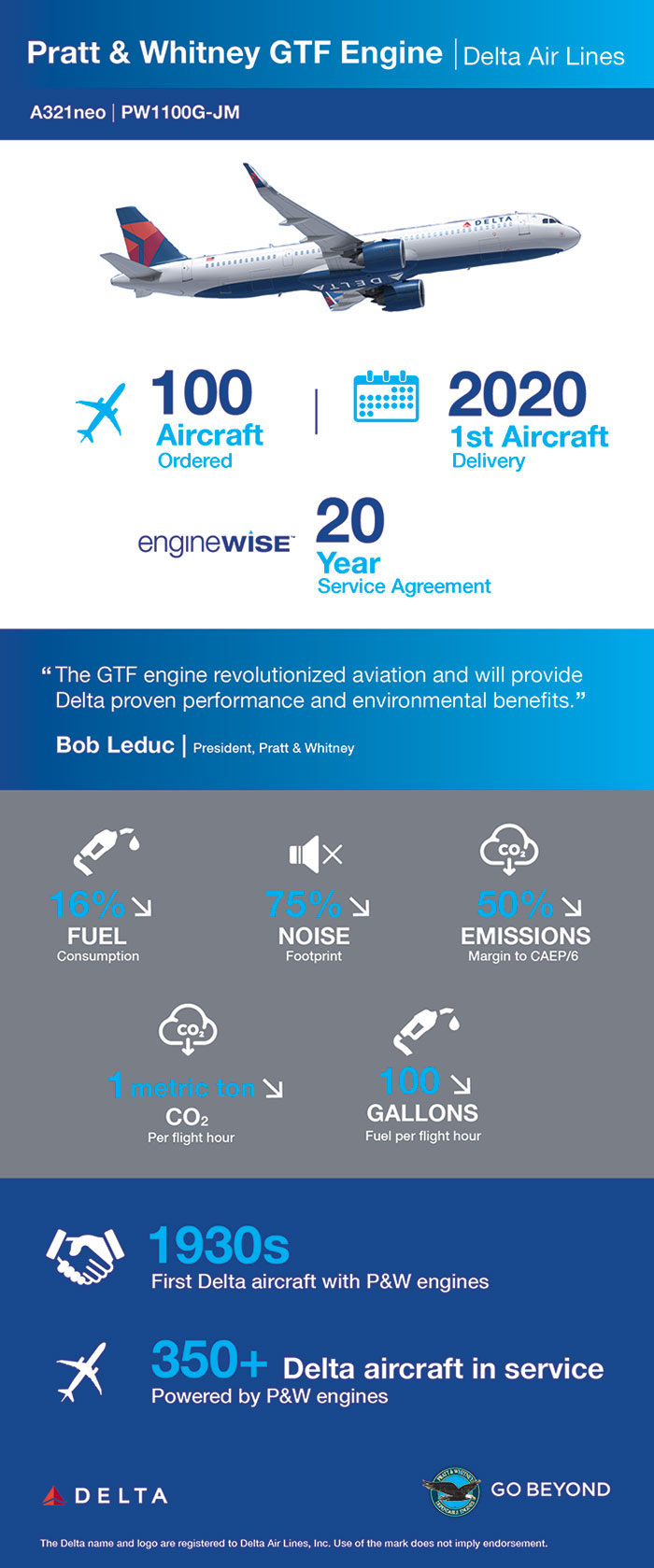
A global aircraft engine manufacturer recently announced Delta Air Lines and Airbus Group selected the company’s Geared Turbofan™ (GTF) engine to power Delta’s order of A321neo aircraft.
Pratt & Whitney, a division of United Technologies Corp., also released that the order consists of 100 firm aircraft and includes a 20-year EngineWise™ services agreement. Aircraft deliveries are expected to begin in the first quarter of 2020.
“This is the right transaction at the right time for our customers, our employees, and our shareholders,” said Delta CEO Ed Bastian. “Delta, Airbus, and Pratt & Whitney share the same commitment to safety, efficiency, innovation and continuously improving the customer experience. This order for the state-of-the-art A321neo with Pratt’s PurePower next-generation jet engines reflects our long-term commitment to these values for Delta people and all our constituents.”
“We couldn’t be more proud of our long-standing relationship with Delta, which dates back to the 1930s,” said Pratt & Whitney President Robert Leduc. “Fast forward nearly 90 years, and the GTF engine has revolutionized aviation technology, and will provide Delta with proven performance and environmental benefits. We are honored to power and support Delta’s new fleet of A321neo aircraft well into the future.”
Robert Leduc, President of Pratt & Whitney
Delta currently operates a fleet of more than 350 aircraft powered by Pratt & Whitney engines, including the JT8D, PW2000, PW4000 and V2500 engines.
Click this thumbnail for an infographic of the Pratt & Whitney Geared Turbofan™ (GTF) engine:
A Michigan-based supplier of custom copper, aluminum, and other non-ferrous metal forging recently broadened its investment in equipment and facilities, including a size expansion to a furnace for heat treating.
Weldaloy Products Company serves aerospace, astrospace, electronics, oil and gas, and other industries, providing heat treating, as well as product development, drafting, machining, packaging, non-destructive testing, and material conversion. Among other additions, a 2,000-ton press has undergone a modernization of its hydraulic system, including pumps, motors, and controls, upgraded ring roller controls. Weldaloy will be expanding its campus in Warren, Michigan, through acquiring two adjacent manufacturing facilities.
“These investments allow us to meet the needs of our customers,” said Kurt Ruppenthal, Weldaloy’s vice president and general manager. “Specifically, we’re increasing our capabilities as a supplier to the aerospace and astrospace markets.”
A new update on MPIF Standard 35 was issued in October 2017 by the Metal Powder Industries Federation (MPIF) for aluminum alloys often used in aerospace applications, providing design and materials engineers with performance requirements for specifying aluminum alloys in powder metallurgy. The new standards identify a Rockwell hardness of 75 for the AC-2014-32-T8 and 83 for the AC-2014-38-T8, values which refer to the heat treatment which the alloys undergo.