A North American heat treater in aerospace manufacturing acquired a three-cell vacuum furnace for multi-purpose operation from a U.S.-based manufacturer of vacuum furnaces. The system will bring the heat treater's carburizing processing in-house and contribute to the facility's ability to maintain takt time.
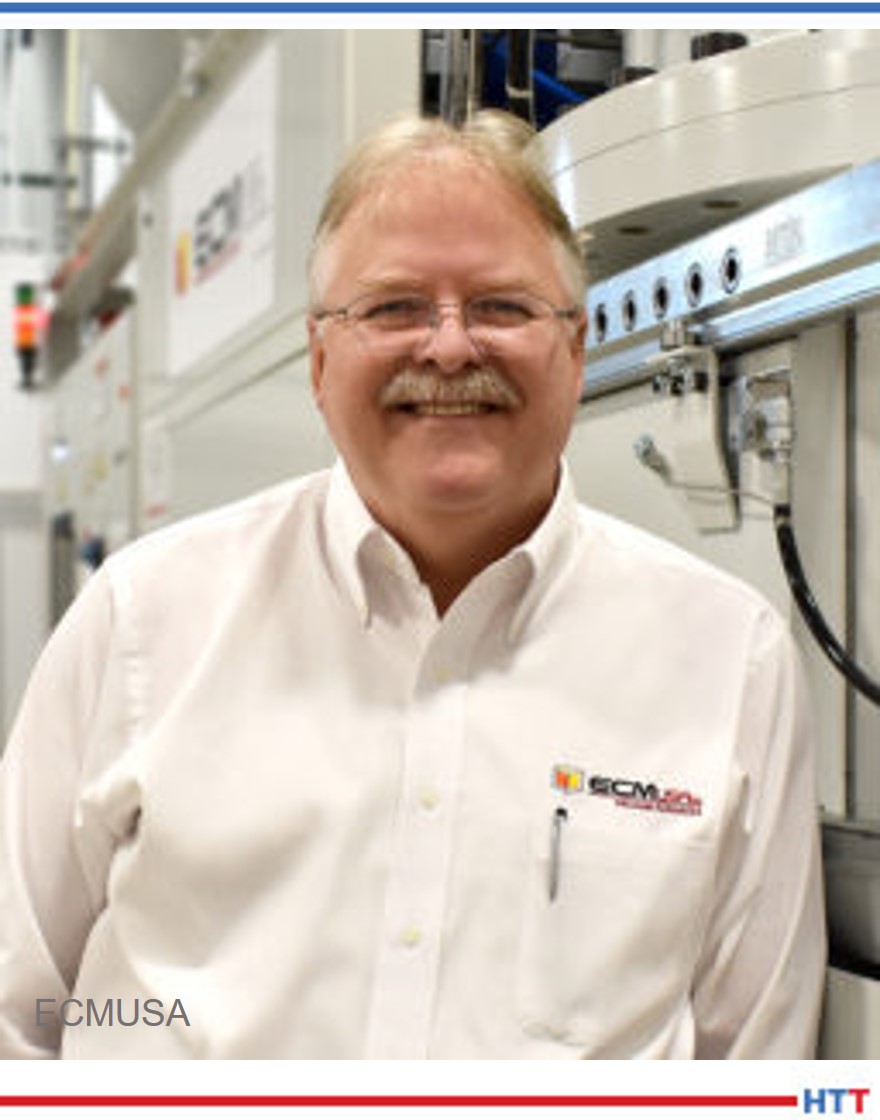
ECM USA's director of sales, Bill Gornicki, announced the purchase of a NANO system vacuum furnace for use in the North American aerospace market. The system will provide low pressure carburizing, hardening, brazing, and annealing, automation capabilities, cryogenics, tempering, and pre-washing. Both alloy and CFC fixtures will be used in this installation.
Heat Treat Today would like to thank and celebrate all the veterans who have served and helped to make the United States a place of freedom and liberty. Thank you for your service and for your sacrifice.
Heat Treat Today publishes eight print magazines a year, and included in each is a letter from the publisher, Doug Glenn. This letter first appeared in Heat Treat Today'sAugust 2021 Automotive print edition.
Doug Glenn Publisher and Founder Heat TreatToday
For those who might not know, AISTech is the annual conference produced by AIST, the Association of Iron & Steel Technology (www.aist.org), under the executive directorship of Ronald Ashburn and his capable staff, most of whom work out of Cranberry Township, Pennsylvania, just north of Pittsburgh and less than one hour from where I live (Go Steelers!). AISTech was not held in 2020 due to the response to COVID-19, but it was held this year in Nashville, Tennessee, on June 29 through July 1.
Here’s what I learned at AISTech this year:
(1)The steel industry is a rugged lot. Unsurprisingly, the men and women of the North American steel industry are not easily daunted. COVID hit many industries hard, and steel is no exception, but the folks in this industry are still up and swinging. Granted, the governors of most states deemed the steel industry as “essential” for COVID purposes (with the concept of governments identifying some industries as essential and others not being a topic for another day!) thus, most of the steel industry stayed active throughout 2020.
The fact is, the steel industry is a resilient and innovative lot, even in the midst of oppressive government restrictions on pretty much the entire economy. No where was that more evident than in Nashville. According to official numbers, roughly half of the usual 8,000ish attendees to AISTech were in Nashville. A pretty decent turnout considering that AISTech was one of the first significant face-to-face events to return to Nashville. Nashville was certainly happy to host the event and many from the steel industry showed up in person, without many masks or much social distancing, to enjoy a return to relative normal.
(2) The U.S. steel industry is one of the most innovative and aggressive in the world. The keynote speaker and this year’s recipient of the Steelmaker of the Year award, chairman, president, and CEO of Cleveland-Cliffs, Lourenco Goncalves, who has a column in this issue of Heat Treat Today (see page 8), explained that when it comes to steelmaking, no country on the planet holds a candle to the United States, especially when it comes to the amount of CO2 produced for each ton of steel created.
(3) During the press conference which followed the President’s Award Breakfast on June 30th, I asked Mr. Goncalves to comment on the use of hydrogen combustion. He took me to school (in a very gracious way) on the fact that hydrogen combustion, while not an emerging technology to be ignored, was not something commercially viable in the North American steelmaking industry and probably won’t be for many years.
In Europe, where the abundance of natural gas is not so great, hydrogen might be a more viable option in the near future, but that’s not likely to be the case here in North America where natural gas is abundant and relatively cheap. He also pointed out that a large constituent of natural gas is hydrogen, so in one sense, the North American steelmaking industry is already heavily invested in hydrogen, just not 100% hydrogen.
(4) Finally, I learned that (sorry aluminum fans) it is steel’s “game to lose” when it comes to which material will be used most heavily in the future of the North American automotive industry. While aluminum body panels have been popular of late, the fact is that steel “owns” the vast majority of automobile manufacturing and will continue to do so for two reasons: 1) the development of high-strength steels, and 2) the fact that it takes exceedingly less energy and the creation of vastly less CO2 to produce a ton of steel vs. a ton of aluminum. If you’re truly “green,” steel is the (unlikely) way to go.
I leave you with this. The July 2021 Investors Presentation which is publicly available on Cleveland-Cliffs’ website has a lot of very, very interesting information not only about the company, but about the North American steel industry as it compares to other countries and how steel compares to other materials such as aluminum, composites, etc. I recommend it for those who have more than a casual interest in steel. View the report here.
How can steel production be "green"? Where does the United States stand in steel production when compared to the rest of the world?
Lourenco Goncalves, chairman, president, and CEO of Cleveland-Cliffs, Inc. answers these questions and more in this article, originally published in Heat TreatToday'sAugust 2021 Automotiveprint edition.
Lourenco Goncalves Chairman, President, CEO Cleveland-Cliffs, Inc.
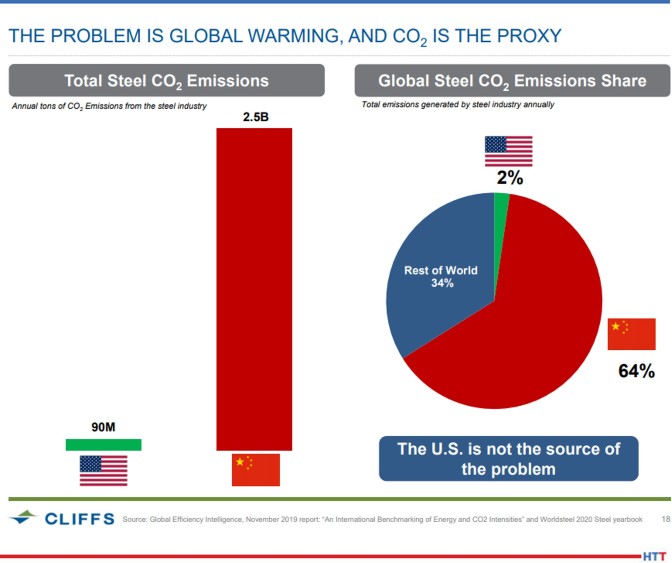
The United States is the benchmark of the world in all things steel. Amongst all major steelmaking nations, we have by far the greenest emissions profile. On average, each ton of steel produced in the United States generates 1.0 tons of CO2 emissions, compared to a ton of steel produced by China which generates 2.5 tons of CO2 emissions. The U.S. generates only 2% of all the greenhouse gas emissions from global steel production, while China contributes 64%.
The attributes that make our industry so green are the use of scrap, natural gas as both a reductant and energy source, and green iron ore pellets in blast furnaces. Because scrap cannot be used in a closed loop, natural gas and pellets allow for a healthy participation of low-carbon intensity virgin iron and steel units in a well-balanced ecosystem.
Steel’s emissions profile also makes it the lowest-carbon option compared to other materials perceived to be green, such as aluminum and carbon fiber. Adjusting for part weight, production of the equivalent volume of these competing materials generates 5 to 10 times more CO2 emissions than steel made in the United States.
This emissions profile is just one of many attributes that will support steel’s continued position as the material of choice in automotive light vehicle bodies. On top of being the greenest material and having a 100-year incumbency advantage, steel is more affordable than aluminum and is easier to weld, form, and repair or replace. Our continued innovation in advanced high strength steels (AHSS) has allowed us to produce thinner, lighter-weight, yet stronger materials, and closed the gap on the perceived density advantages that the aluminum industry has touted.
Even though we boast a low emissions profile, our work is not done. At Cleveland-Cliffs, we have made public our target to reduce greenhouse gas emissions by 25% by 2030. In our global discussion about decarbonization, the use of hydrogen (H2) as an iron-reducing agent has emerged as playing a key role in a carbon neutral future. While clean and leaving only steam (H2O) as its byproduct, large scale H2 use in steelmaking is an unproven technology that comes with enormous practical challenges, including safety and prohibitive costs. Knowing what we know today, we are probably decades away from H2 becoming part of any affordable and easily available technology.
At Cliffs, we don’t want to rely on breakthrough technologies, but rather deal with practical decarbonization options. Our efforts involve the use of the hydrogen contained in natural gas, which is actually a mix of 95% CH4 and 4% C2H6. Natural gas is used as the reducing agent at our new, state-of-the-art DRI facility in Toledo, OH, as well as a meaningful supplemental reductant in all eight of our blast furnaces. The abundance of cheap natural gas in the United States will continue to provide us ample opportunity to decarbonize.
Steel is the inevitable material of choice in a modern, greener world. As the largest flat-rolled steel producer in North America, Cleveland-Cliffs will remain on the cutting edge in shaping the future and further cementing our industry as the envy of the world.
About the Author: Lourenco Goncalves is chairman, president, and CEO of Cleveland-Cliffs, Inc.
Paulo Products was the recipient of the Commercial Heat Treater of the Year award presented by Heat Treat Today, in cooperation with The Metal Treating Institute (MTI). The award was initially decided and presented virtually in 2020, and was formally awarded in person on October 6, 2021 during the MTI Annual Fall Meeting awards banquet in San Antonio, Texas.
MTI awards the Commercial Heat Treater of the Year to the company that demonstrates they are making a positive impact in the community and the industry. The award is judged by a panel of previous recipients based on quality programs, pollution and hazardous waste control, community involvement, and leadership.
The award consists of a plaque and a $1,500 donation to the MTI Educational Foundation by Heat Treat Today in the name of the winning company. The donation was matched by MTI’s Educational Foundation. Paulo Products will award this $3,000 as a scholarship to a high school or college student pursuing an education towards heat treat.
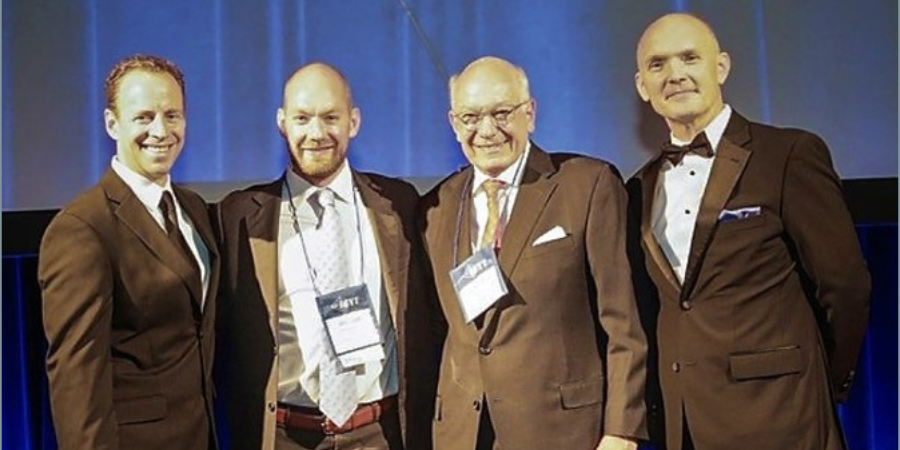
Photo: Paulo Products being recognized as 2020 Commercial Heat Treater of the Year. (L-R) Jim Oakes, Super Systems, Inc. & MTI President; Will and Ben Rassieur Paulo Products; Doug Glenn, Heat Treat Today
A manufacturer in the automotive industry has placed an order for a large-capacity, high vacuum furnace, equipped with a cooling station to increase the performance of the system. This furnace will complete their new production plant and aid in vacuum aluminum brazing various components.
Maciej Korecki Vice President, Business Segment Vacuum Heat Treatment Furnaces SECO/WARWICK (source: SECO/WARWICK)
SECO/WARWICK, the sister company of North American manufacturer SECO/VACUUM, provided the furnace to the automotive manufacturer of engines, filters, electric equipment, and cooling systems. For this project, the client required that the vacuum furnace have automatic loading and transportation of parts, as well as an increase in precise control of temperature uniformity and distribution.
"The equipment [. . .] has been installed in a new production plant that will significantly improve the capacity of the entire group," explains Maciej Korecki, vice president of the Business Segment of Vacuum Heat Treatment Furnaces at SECO/WARWICK. "A key to success in this project was the huge trust displayed by our partner and close cooperation at the design stage."
Looking for vacuum aluminum brazing furnaces? See listings for services and products in the Heat Treat Buyers Guide
Young people today get a bad rap. Karen Gantzer, managing editor at Heat TreatToday, disagrees! The leadership, initiative, and problem-solving skills of the 40 Under 40 Class of 2021 are truly inspiring. In the heat treat industry, it appears youth isn't such a bad thing after all. In this article, read what Karen has to say about some of the young people on the team at Heat Treat Today.
This article was originally published in Heat Treat Today's August 2021 Automotiveprint edition.
Karen Gantzer Managing Editor Heat TreatToday
I find it very inspiring to work with young people in this industry. Contrary to what is sometimes heard in the world at large, many of the young people I’ve had the privilege of working with in the North American heat treat market are intelligent, conscientious, respectful, hard-working adults worth their weight in gold. They’re a real pleasure to be around. As this column is being typed, Heat Treat Today is working on selecting 40 young leaders in the North American heat treat market to be inducted into the 40 Under 40 Class of 2021, a great honor for each person, and a great honor for the 120 previous inductees, the 40 Under 40 Classes of 2018, 2019, and 2020. It’s amazing how difficult it is to pick 40 each year from those nominated. Nearly all of them are more than qualified, but only 40 can be selected. The judges invariably struggle each year. That is a GREAT problem to have, and it speaks to the quality of the young people in this industry. Although these young people will probably never make it into one of the 40 Under 40 classes, I would like to mention several under-40 individuals who contribute substantially to the North American heat treat market each and every day – the young people of Heat Treat Today – all of whom are less than 40 years old and all of whom are simply stellar people.
Ellen Porter Billing, Accounting, Audience Development
Bethany Funk-Leone is the Heat Treat Daily editor as well as the Heat Treat Radio editor and resident idea person along with Doug. We sometimes have to pivot at the last minute and Bethany flexes with grace, determination, and wit, as she juggles multiple responsibilities and stays ahead of the game.
Brandon Glenn is our art and web design expert. When we need a logo or image, a tweak on the website, or a last-minute edit on the Heat Treat Daily, Brandon is our man; and he always comes through with precision, kindness and often a comment that makes us laugh.
Ellen Glenn-Porter wears several hats—billing/accounting/audience development—and makes sure that important admin is completed on time. She faithfully connects with you in the industry and is always diligent to make sure the rest of the team is aware of needs, encouragement, or concerns that are sent to her.
Lauren Porter Production Manager
Alyssa Bootsma Social Media Editor
Jonathan Lloyd Audio and Podcast Editor
Lauren Porter, Heat Treat Today production manager, is our newest team member. She has been Doug’s right hand person and done yeoman’s work in getting the print magazines, e-blasts, and other media out to you all as well as working with advertisers.
Alyssa Bootsma is our social media editor. She has taken excellent initiative on the various platforms and has grown our presence significantly. It has been exciting to see her grow and succeed in an area that had been unfamiliar to her, but one which she has embraced.
Jonathan Lloyd, Heat Treat Today's talented audio/podcast editor, ensures the excellence of Heat Treat Radio and other multimedia endeavors. His expertise and creativity in the audio and visual world is a huge asset as he helps us maintain a cutting edge.
The old-timers, Doug Glenn and I, couldn’t be happier to be working with this youthful group, who keeps us sharp and current! And, while they might never be in Heat Treat Today's40 Under 40, they are our "Top 6" list of great people serving the North American heat treat market.
A Michigan-based captive heat treater in the precision automotive and specialty fastener industry will receive a 6000 lb/hr continuous mesh belt furnace to complete its new line.
Can-Eng Furnaces International, the provider of the furnace, utilized their Level 2 Automation to enable the heat treater to track product status, diagnose equipment, and provide process data. The system will lower the heat treater’s energy requirements for the hardening furnace and reduce required atmosphere by one-third. The system is equipped with an automated bin-dumping loader, pre-washer, atmosphere-controlled mesh belt hardening system, oil quench, post wash system, temper furnace, in-line soluble oil system, and bi-directional conveyor discharge.







 A North American heat treater in aerospace manufacturing acquired a three-cell vacuum furnace for multi-purpose operation from a U.S.-based manufacturer of vacuum furnaces. The system will bring the heat treater's carburizing processing in-house and contribute to the facility's ability to maintain takt time.