

In this installment of Answers in the Atmosphere, David (Dave) Wolff, an independent expert focusing on industrial atmospheres for heat treat applications, examines what furnace owners should expect when their gas supplier conducts a technical assessment. Drawing on insights from Messer LLC, Wolff walks through the step-by-step process suppliers use to diagnose furnace atmosphere issues, from verifying process parameters to running detailed diagnostic surveys, and outlines the standards of technical competence, communication, and accountability that furnace owners should hold their industrial gas partners to.
This informative piece was first released in Heat Treat Today’s August 2026 Annual Automotive Heat Treating print edition.
This column picks up the conversation leveraging the technological know-how of your gas supplier. If you missed it, read Part 1 in the Heat Treat Super Brands (July 2026) print edition. What follows are the insights and best practices that Messer LLC shared with me on what you need to prepare for a technical assessment with your supplier.
Technical Assessment
First, since business models vary throughout the industry, be sure you understand whether or not technical support will entail a specific fee. When establishing your gas supply contract, furnace owners should seek out suppliers who provide a flexible approach that will be aligned with their needs.
A supplier will often follow these steps when providing technical support to identify, prevent, or correct issues in your heat treat furnace:
- Define and verify the problem to determine whether it originates from heat treatment, material handling, or operator error.
- Verify incoming material to ensure the issue is not caused by raw material condition or pre-processing steps.
- Check heat treatment process control parameters.
- Verify furnace atmosphere integrity, inspecting gas supply lines, furnace connections, piping leaks, deliveries, and any repairs.
- Evaluate furnace component, identify any changes in furnace structure or maintenance activities.
- Review process parameters to confirm whether temperature, time, gas composition, or gas purity have changed.
- Inspect exhaust systems, doors, and airflow, as disturbances can impact furnace performance.
After reviewing initial process data, a furnace atmosphere survey or targeted spot check may be conducted. This step may include:
- Establishing furnace baseline conditions
- Running furnace temperature profile tests
- Measuring oxygen, CO, CO2, hydrogen content, and dew point
- Conducting detailed modeling based on gas flows, heat transfer, or mass balances
Your provider may use advanced tools, such as Computational Fluid Dynamics (CFD) modeling, to analyze and resolve complex furnace atmosphere issues.
What to Expect: Evaluating Supplier Capabilities
Not all technical support delivers the same value. While many suppliers have strong technical capabilities, access can vary based on internal structures or business models. Some suppliers provide expanded support.
Furnace owners should expect their industrial gas partner to:
- Demonstrate strong technical competence and ability to identify root causes
- Communicate clearly in practical terms familiar to operations teams
- Deliver recommendations with a complete implementation plan including safety, training, costs, timelines, risks, and benefits
- Clearly define responsibilities between the furnace owner and gas provider
Final Thoughts
For furnace owners, the industrial gas supply space can seem like a lot of the same offerings, but a closer look at how technical support varies from one supplier to the next can significantly fine tune your operation’s ability to adapt and respond to your furnace needs. The key is to be honest about what your own operations can accomplish on its own before reviewing industrial gas contracts (more on contracts in the June 2026 “Answers in the Atmosphere” installment) and committing to a too low or too flexible plan for technical support.
About The Author:

Industrial Gas Professional
Wolff Engineering
Dave Wolff has over 40 years of project engineering, industrial gas generation and application engineering, marketing, and sales experience. Dave holds a degree in engineering science from Dartmouth College. Currently, he consults in the areas of industrial gas and chemical new product development and commercial introduction, as well as market development and selling practices.
For more information: Contact Dave Wolff at Wolff-eng@icloud.com.
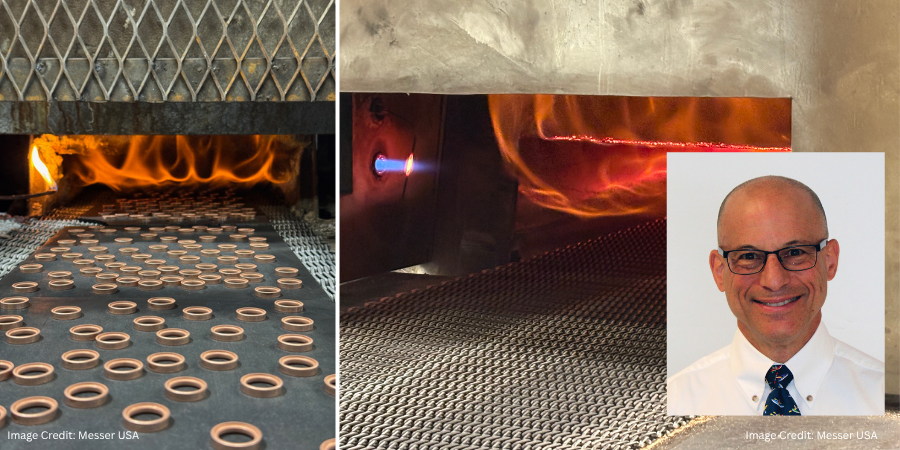
Main image shows piston rings being heat treated in a furnace using Messer’s HYDROPYRTM technology for sintering. | Image Credit: Messer USA