

In this Technical Tuesday installment of Answers in the Atmosphere, David (Dave) Wolff, an independent expert focusing on industrial atmospheres for heat treat applications, examines how technical support has evolved from a value-added service into a key differentiator among industrial gas suppliers. Drawing on industry history and insights from Messer LLC, Wolff explores the range of support models available today and the factors heat treaters should consider when evaluating gas supply partnerships beyond price alone.
This informative piece was first released in Heat Treat Today’s July 2026 Annual Super Brands Issue print edition.
Do you have the technical support you need? Not all industrial gas suppliers are the same when it comes to technical support and gas delivery offerings. A critical look must be taken to consider how much technical support you can be looking to your supplier for when signing a gas contract.
We’ll look at a bit of history of the differentiation of technical support offerings in the industrial gases space before homing in on how one specific has supplier, Messer LLC, offers their support so you can better evaluate the cost of gas supply alongside the level of technical support your operations may require.
A Bit of History
Industrial gases have long been treated as commodities, making differentiation among suppliers a persistent challenge. In the early years of the industry (through the 1950s), gas applications were narrowly utilized, especially for the primary steelmaking and refining industries, and most technical knowledge remained with these end user rather than the supplier.
To increase traction with their smaller manufacturing clients, industrial gas suppliers began pairing gas delivery with technical support to help these clients use gases safely and achieve productivity gains. This full-service model propelled increased industrial gas adoption across more general industries.
By the 1970s, the use of industrial gases had become more widespread to include industries like heat treating. Clients were increasing their knowledge of these gases and sought to improve labor and energy efficiency as well as reduce manufacturing costs.
This knowledge increase brought intensified competition for suppliers, prompting a shift toward offering range of service models. Some suppliers reduced or separated technical support to compete on price, while others continued to emphasize integrated service and application expertise. For example, in the 1980s Airgas reduced their technical support to provide a bare product approach at a lower price point. This action prompted other major gas suppliers to adjust their approach and offer technical support selectively, and at times for an additional cost.
Today, these technical support offerings are widely varied. The rest of the discussion is taken from an interview I was privileged to have with Grzegorz Moroz, program manager at Messer LLC.
Supporting Furnace Owners in a Changing Environment
Moroz first spoke about heat treaters’ long reliance on gases to maintain furnace atmospheres. Early-generation atmospheres, such as exothermic and endothermic gas, acetylene, and dissociated ammonia, were effective for their time. Over the past decades, industrial gas companies have advanced the safe use of nitrogen- and hydrogen-based atmospheres among others to deliver greater precision and tighter process control.
According to Moroz, furnace owners face multiple challenges:
- Higher quality expectations with shorter lead times and reduced costs
- Increasing safety and emissions regulations
- Greater automation across operations
- A less experienced and more transient workforce
Types of Support
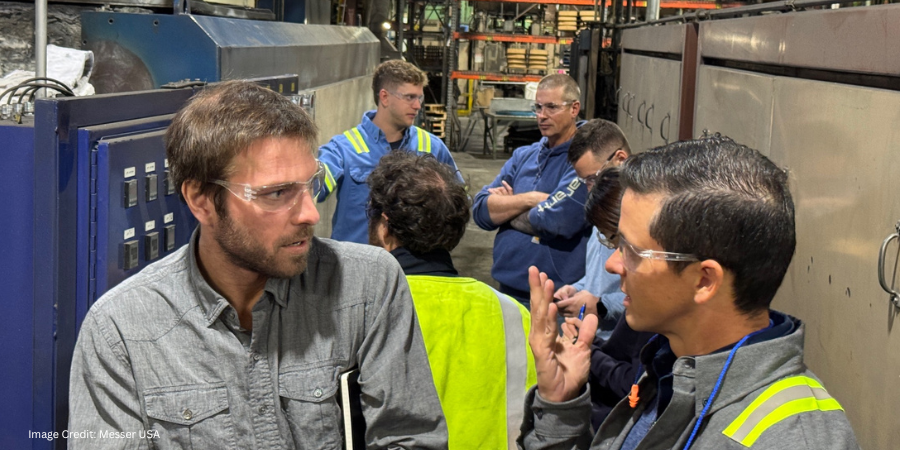
Industrial gas companies, Moroz continues, vary widely in the level of support they may offer. Some focus on gas delivery or a specific expertise, while others offer comprehensive technical, safety, and application support as part of the overall supply relationship. For Messer, solutions are tailored from a team of technical and product experts that support heat treating from efficient, safe, and reliable operations as well as play review.
Access to Support
There are different commercial models industrial gas providers employ to enable their services, explains Moroz. While most will not provide ongoing assistance to facilities supplied by their competitors to avoid conflicts of interest, practices vary across the industry. Even so, contract structures often limit many suppliers from being flexible in delivering technical resources. Informal technical advice may be provided occasionally from gas suppliers that maintain in-house expertise.
Multi-supplier arrangements are common. This may be due to increased volume demands, supply security, strategies, or differing gas specifications, so Messer routinely navigates this reality. However, be aware that larger suppliers often prefer being the sole provider of all gas requirements at a site.
In part 2, we’ll talk more about what’s involved in an installation technical assessment and considering the right industry supplier expert.
About The Author:

Industrial Gas Professional
Wolff Engineering
Dave Wolff has over 40 years of project engineering, industrial gas generation and application engineering, marketing, and sales experience. Dave holds a degree in engineering science from Dartmouth College. Currently, he consults in the areas of industrial gas and chemical new product development and commercial introduction, as well as market development and selling practices.
For more information: Contact Dave Wolff at Wolff-eng@icloud.com.