In the second of the two-part series, the Advanced Rapid Quench Jominy Tester application for automotive underbody parts is examined. In this article, Dr. Gopal Nadkarni, an associate professor of mechanical engineering at the University of Akron, explains how automotive manufacturers can integrate this little-used test methodology following existing industry practices. It also makes the case for updating the ASTM A255 Jominy test method to measure enhanced hardenability under modern industrial quenching conditions.
This informative piece was first released in Heat Treat Today’s August 2026 Annual Automotive Heat Treating print edition.
Introduction
In “The Jominy and Rapid Quench, Part 1: An American Story” (see Heat Treat Today: Induction Heat Treating, April 2026), the Jominy test adopted in the 1940s was shown to revolutionize how complex metallurgical phenomena in most steels during cooling could be understood using a simplified method of cooling a 4-inch bar of steel from one end. Since then, the ASTM A255: Standard Test Method for Determining Hardenability of Steel (Jominy test) has become the dominant form of characterizing steel behavior under multiple cooling conditions (ASTM International 2020).
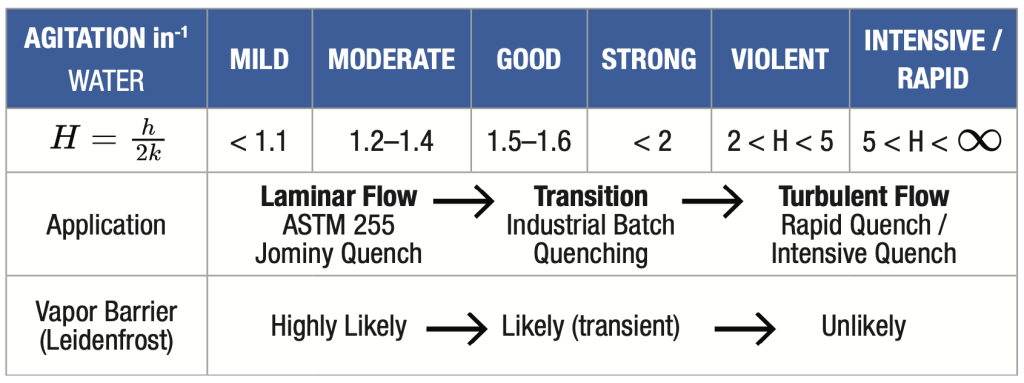
When the Jominy test was developed, quenching technology relied primarily on relatively mild water agitation (Figure 1). Industrial heat treatment has evolved dramatically since then. These advances raise an important question: Does the traditional Jominy test still represent the cooling conditions experienced by modern industrial components?
The answer is both yes and no. The conventional Jominy test remains an outstanding comparative tool because of its simplicity, reproducibility, and enormous historical database (Chandler 1994). However, improved understanding of quench heat transfer — specifically, the laminar umbrella flow underneath rapidly quenched Jominy test ends hides a “film boiling layer” that impedes heat transfer in the first critical seconds of quenching — suggests that the standard unintentionally limits the maximum cooling rate during the first critical seconds of quenching. Consequently, the hardenability curves engineers have relied upon for decades may not fully represent the hardening potential of steels subjected to today’s rapid or intensive quenching processes.
This article proposes extending the Jominy test’s usefulness through a modified methodology that better reproduces modern industrial quenching conditions while preserving the standardization that has made ASTM A255 indispensable.
Intensive Quenching for Industrial/Automotive Parts
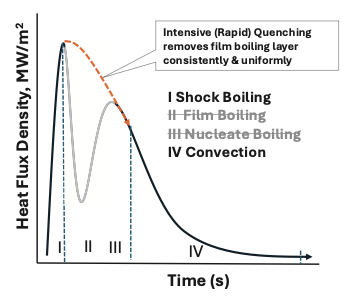
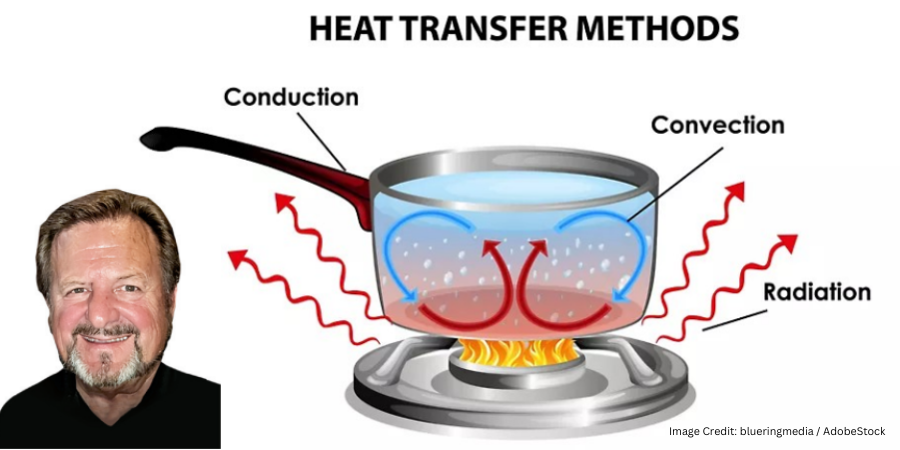
If methods existed to consistently remove the vapor barrier during the first few seconds of quenching, engineers could increase heat transfer substantially (Figure 2) to maximize hardenability. Dr. Nikolai Kobasko and Dr. Michael Aronov have worked at this theory for the last three decades, demonstrating significant material processing benefits with intensive (or rapid) quench practices. Other scientists have also teamed up with heat treaters in the U.S. to demonstrate commercial adoption of industrial parts (Totten, et al. 2024).
Today, intensive quench practices are being seriously assessed by several automotive manufacturers as a way to not only maximize hardenability, but also to control distortion after quenching, impart beneficial compressive stresses below the surface, and reduce spotty hardness, as well as lower cost and improve sustainability practices by employing lower alloy steels.
Automotive Designs Require Updated Tests
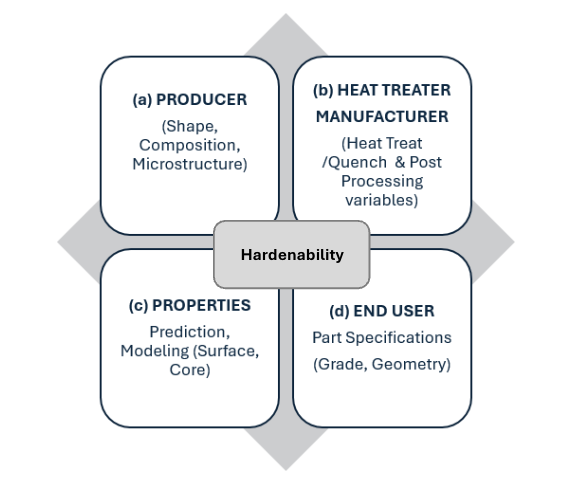
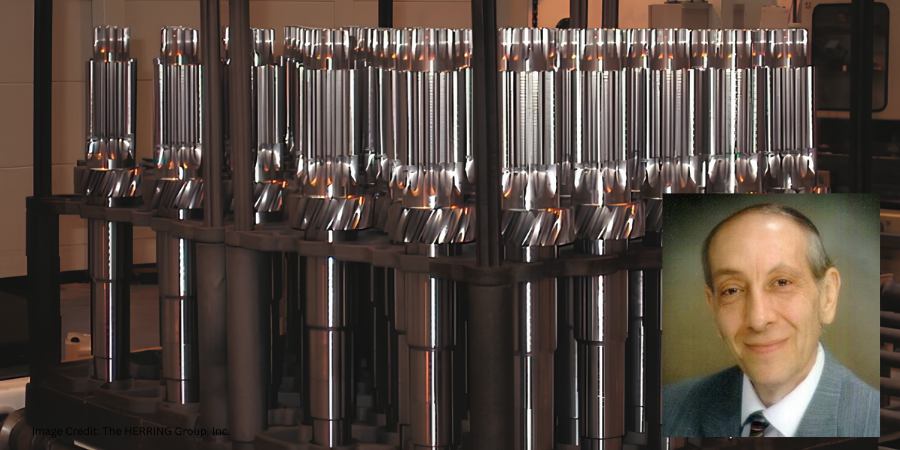
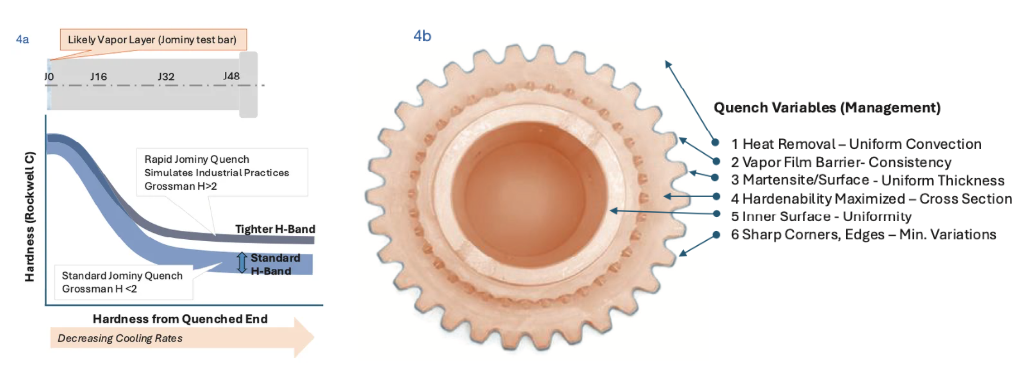
The automotive part production cycle is complex and requires close coordination across multiple stakeholders to achieve desired property outcomes (Figure 3). Designers often rely on “real test” data as input to finite element models to predict critical mechanical properties that correlate with structural life for fatigue, wear, or fracture resistance, with most of these parts being heat treated. They also lean on the correlating structure properties for required parts using the universal ASTM A255 Jominy test as a reference. While this serves as a unique fingerprint for the alloy used, it is by no means an ideal representation of hardenability because chemistry variations that result in a large H-band (Figure 4a).
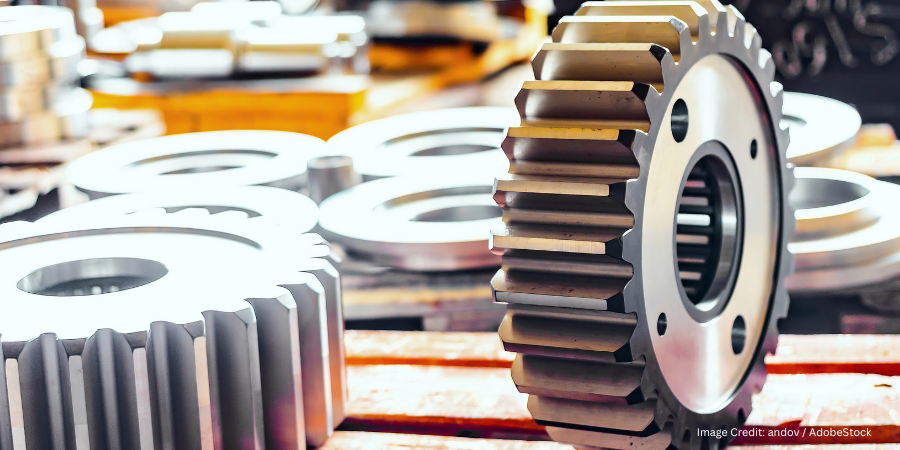
This approach also falls short because Jominy cooling rates do not reflect real-world quenching, which can be seen as enhanced hardenability under industrial conditions (Figure 4b). Heat treaters use high-velocity forced convective flow to create violent agitation, improve quench consistency, increase hardness, and break up the film boiling layer. However, complex parts like gears pose an issue: it is difficult to guarantee uniformity of instantaneous cooling rates and may only break up parts of the persistent vapor layer (Figure 4b). The result is uneven heat transfer and spotty hardness across the part.
Automotive part designers need consistent hardness to ensure reliable service and accurate life predictions, but industrial quench conditions do not ensure 100% removal of the vapor barrier. To ensure performance, automotive designers specify higher alloy steels than necessary. In addition, engineering drawings often specify suboptimal surface hardness (suboptimal hardenability) to stay within hardenability realities of accepted heat treatments. Increased costs are often necessary if parts do not hit design targets and require secondary processing (e.g., tempering, carburizing, carbonitriding).
Overcoming Slow Automotive Adoption
Despite excellent data over the past two decades (Kobasko, et al. 2010; Totten, et al. 2024) showing the usefulness of rapid quench technology in maximizing hardenability for bar/plate steels, the paradox is that the technology has been slow to be adopted. We can learn lessons on adopting new steel/processing technologies from the flat steel side used for body-in-white/chassis, where the entire supply chain came together (Auto/Steel Partnership) in 1987 and produced significant lightweighting programs like the 1994 ULSAB (UltraLight Steel Autobody).
If automotive OEMs desire to use the benefits of enhanced hardenability, they must work with the supply chain and standardization bodies (ASTM) to promote widespread adoption. This would allow performance and productivity gains to be adopted at scale quickly.
Intensive quenching has seen limited adoption in mass-produced automotive parts because engineers lack standardized material data that comes after industrial adoption. Therefore, their confidence in process repeatability at scale is not in place. Past experience with promising technologies like austempered ductile iron (ADI) reinforced caution around safety-critical components, especially when processing risks remain difficult to validate. As a result, rapid quenching faces less of a technology adoption challenge than a technology translation challenge: the industry must reduce perceived risk through shared standards, comparable data, and coordinated supply chain validation.
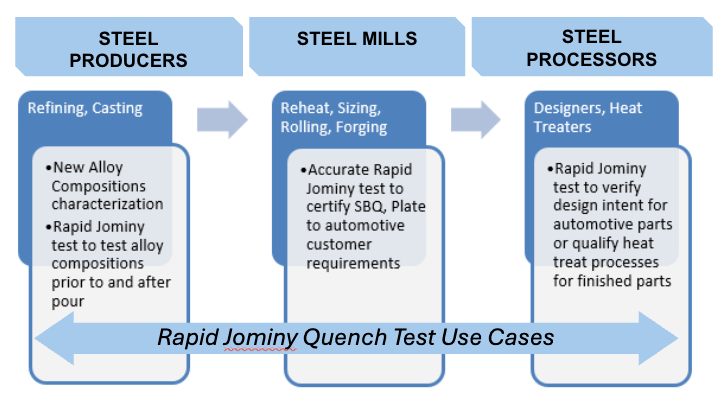
The good news is that we have standard methods characterizing hardenability that are well-established and reliable for thousands of grades of steel. For rapid quenching to be acceptable, we need to reduce risk and increase accountability across the supply chain. One way is to extend the current ASTM A225 standard Jominy test used by all (Figure 5) and use proven strategies that flat steel producers used to implement ultrahigh strength designs in steel.
From Theory to Practice: Removing the Vapor Blanket in the ASTM Jominy Test
In short, rapid quenching uses high-pressure, high-velocity water impingement to disrupt the vapor film almost immediately. This allows the surface to transition quickly into nucleate boiling and forced convection, dramatically increasing heat transfer.
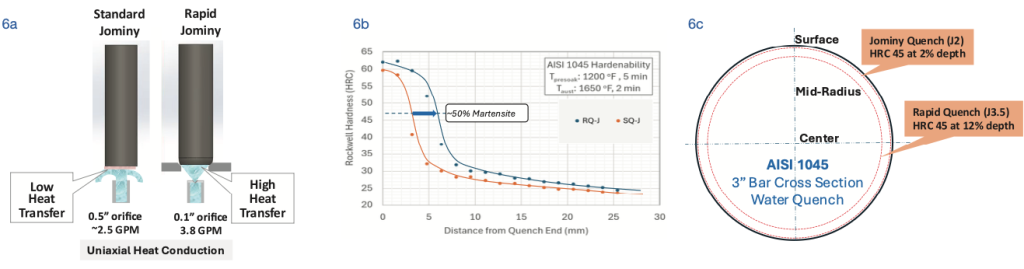
The Jominy test can track the improved hardenability results, if we can make a slight modification to the ASTM 255 test bar design. The modified Jominy test’s critical feature is a flat, tapered configuration versus the traditional flat end face (Figure 6a), and it ensures that the standard uniaxial quench condition is imposed when the bar is sealed in an enclosed chamber. This refinement improves flow control for consistent and repeatable results, therefore providing better alignment with standardized quench conditions used in industry. Another test bar version with a bar end was developed through a university-industry collaborative venture that is useful to measure enhanced compressive stresses (Funk 2021).
The modified bar has been proven to be a close twin of the standard 1-inch diameter bar. The current setup uses a high-pressure nozzle to break up the vapor layer similar to industrial quench conditions and is noticeably different from the laminar flow (H < 1.4) used in the ASTM A225 test. The flow conditions (velocities > 40 m/s, pressures > 120 kPa) have been optimized to ensure that the persistent vapor barrier never forms, achieving high heat transfer rates (H > 5) from the start of quenching till the end of the cooling period.
As a result, current low alloy automotive grades can be quickly analyzed and compared for properties as well as depth of hardening to published hardenability curves, allowing a useful screening tool for adoption.
If heat treaters and steelmakers want to cater to automotive clients who want to reap the benefits of rapid quenching, they need to understand whether their grades are suitable. The simplest approach is to use the rapid quench methodology that has been described here for low alloy steels of interest. This will ensure that true and maximized hardenability data can be used by design engineers to optimize automotive steel parts.
In a recent research study (Nadkarni, et al. 2025), both standard hardenability and true (enhanced) hardenability curves were developed for a benchmark AISI 1045 grade (Figure 6b). The 50% martensite line (45 HRC) is clearly deeper, indicating a significant increase in hardenability, with corresponding Jominy (J in 1/16″) distances moving from J2 to J3.5 (from 3.2 mm to 5.5 mm). An example of how the data can be used practically for a sample 3-inch bar shows that depth of hardening to HRC45 is likely to be significantly higher in rapidly quenched steels (Figure 6c).
The increased hardenability results shown for the benchmark AISI 1045 have been replicated for a wide variety of steels including AISI 1020, AISI 8620, AISI 6150, M50, and tool steels like H13. However, we need to be cautious about extrapolating the results to steels where significant retained austenite can form under enhanced quench conditions.
The significance of adopting such a practice into a new or modified ASTM standard will have global implications. Standardized adoption of advancing technology will support automotive manufacturers in optimizing the performance of their current steel compositions through more controlled distortion and reduced variability in material properties.
Acknowledgements
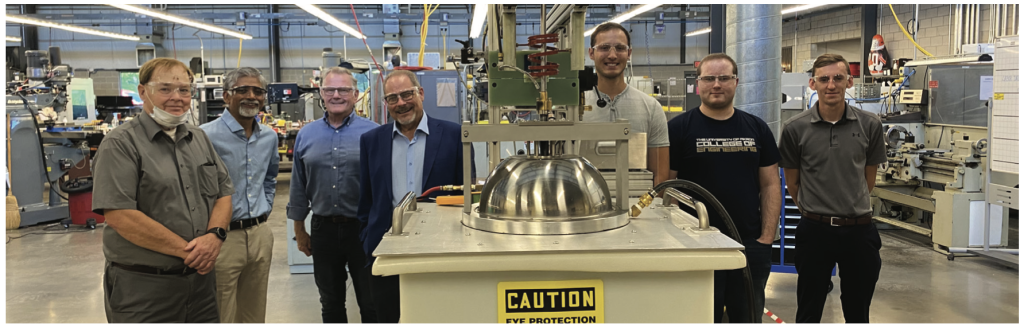
The author is grateful for support provided by Bill Stuehr (Induction Tooling Inc.) and Joe Powell (Akron Steel Treating), along with research funding for graduate and undergraduate students from the University of Akron Center for Precision Manufacturing and Forging Industry Education and Research Foundation (FIERF).
References
ASTM International. 2020. Standard Test Methods for Determining Hardenability of Steel. ASTM A255-20a. West Conshohocken, PA: ASTM International. https://doi.org/10.1520/A0255-20A.
Chandler, Harry, ed. 1994. Heat Treater’s Guide: Practices and Procedures for Irons and Steels. Materials Park, OH: ASM International.
Kobasko, N. I., M. A. Aronov, J. A. Powell, and G. E. Totten. 2010. Intensive Quenching Systems: Engineering and Design. West Conshohocken, PA: ASTM International.
Funk, Bethany. 2021. “Industry-Academia Partnership Developing New Jominy End-Quench Test.” Heat Treat Today 4, no. 6 (September): 56–61.
Nadkarni, Gopal. 2026. “The Jominy and Rapid Quench Part 1: An American Story.” Heat Treat Today 9, no. 4 (April): 25–27.
Nadkarni, Gopal, Nafi Bhuiyan, Saikishan Suryanarayanan, and Ryan Souders. 2025. “The Relevance of the Standard Jominy Test for Rapid/Intensive Quenching.” Paper presented at the Heat Treat 2025 Conference & Exposition, Huntington Place, Detroit, MI, October 21–23.
Totten, George E., Rosa Simencio Otero, Xinmin Luo, and Lauralice C. F. Canale, eds. 2024. ASM Handbook, Volume 4F: Quenchants and Quenching Technology. Materials Park, OH: ASM International. https://doi.org/10.31399/asm.hb.v04F.9781627084505.
About The Author:

Associate Professor of Mechanical Engineering
University of Akron
Dr. Gopal Nadkarni is an Associate Professor of Mechanical Engineering at the University of Akron and manages its Manufacturing Graduate Certificate Program. He brings extensive industry and innovation experience, having held previous leadership roles at industry and in technology ventures, with research and teaching focused on manufacturing, materials, and product design.
To contribute to ongoing industry-academia research regarding this topic, please contact Professor Gopal Nadkarni.
For more information: Contact Gopal Nadkarni at gnadkarni1@uakron.edu.