

Jim Roberts of U.S. Ignition engages readers in a Combustion Corner column about the modes of heat transfer at play in the heat treating world — breaking down advection and thermal conduction, from how forced air movement drives heating and cooling in furnaces to how Fourier’s law governs heat flow through direct contact, setting the stage for next month’s look at convection and radiation.
This editorial was first released in Heat Treat Today’s August 2026 Annual Automotive Heat Treating print edition.
A furnace guy walks into a heat treat facility and asks, “tropos metadosis thermotitas?” The furnace operators stare and say, “What are you saying? It’s all Greek to me!” But many of us know what it means: What mode of transfer? And that was the question of the last article where we looked at an intro to thermodynamics. This set us up for discussions on the four modes of heat transfer, a non-stop set of interactive processes that we then refine for our use in the heat treating world.
In that earlier discussion, we explained that there are several modes involved in heat transfer. Some are so simple to describe, but there may be several modes working at the same time to target the heat transference we seek. Modes of heat transfer and the Laws of Thermodynamics differ. Think of modes as the actual physical properties of heat transfer and thermodynamics that we can see and feel. The laws are the calculations and theory that allow us to check and produce the heat that is needed or to prove how much we need.
Our first mode of heat transfer is advection. Advection is the mechanism of thermal transfer that occurs when the thermal energy is transferred or transported from one space or object via the movement and the motion of a fluid. Pure convection, in the scientific sense, is strictly the heat transfer between heated bodies by gravitational lift or natural fluid movements.
In other words, heat rises… right? We’ve all heard it, witnessed it in a campfire or elsewhere. Advection is when the transfer media, mostly hot gases, is forced mechanically to swirl around and the item we desire to heat or cool. Speaking of heat transfer, we cannot forget that the door swings both ways. We can affect heat transfer from the standpoint of cooling things down too, and at that point, we discover that the hot gases or heat exchangers with air of liquid are using advection to pull the heat out. The plunge cool function of many furnaces relies on advection to pull the heat out of the parts at a controlled rate to cause a metallurgical change. So, the same laws apply, just in reverse!
One of the easiest ways to remember this difference is that advection actually adds energy to the process. It may be in the form of a blower providing combustion air for a burner, which creates the swirl of gases that are providing the heat transfer to the parts. Or, think of a fan pulling heat from a circuit board of electrical components. Advection is actually forced convection. If you have a modern convection oven or an air fryer, it is not really a convection oven. It’s an advection oven in the scientific world, since the fans involved are adding energy to move the fluid (air/gas) around those chicken wings and fries. The concern over this kind of added energy is in part what makes Data Centers such a volatile topic.
This leads us to our second heat transfer mode, thermal conduction. Thermal conduction is the transfer of heat by direct contact of two objects where there is a differential in temperature and energy. In other words, the temperature difference between two objects is the mechanism for heat transfer. Energy wants equilibrium, so it will always try to bring an item to its temperature by maintaining contact. It can be identified as thermal diffusion in Fourier’s law for heat conduction.
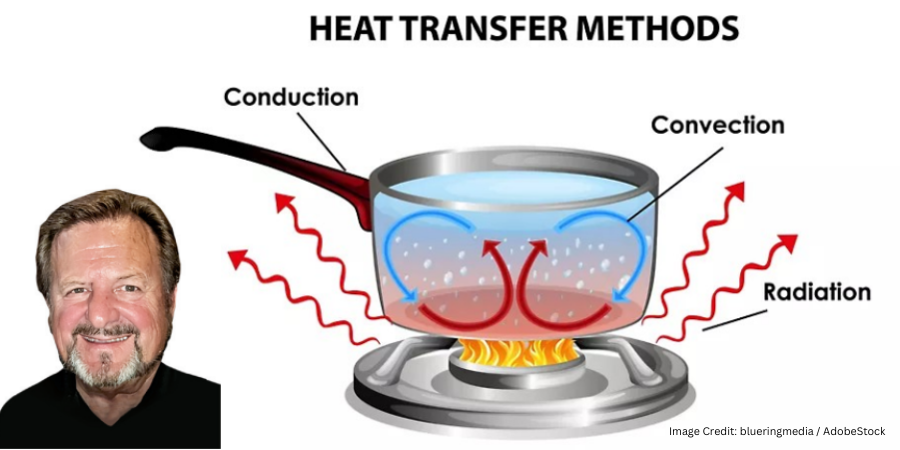
Fourier’s law states that eventually, through contact, the handle on the cooking pot will match the temperature of the pot surface because it is conducting the heat into that handle via thermal conduction. These types of considerations take place during calculations for furnace design, engine components, or household items; anything with a heat differential must be accounted for in our everyday lives.
As they say in the old country: choris thermotita, den yparchei ergo. Without heat, there is no work. That’s the loose translation, but it points out that we need to have all the components for heat transfer to be working for us to do this wonderful work called heat treating. And that shouldn’t be Greek to us.
Next month we will tackle convection and radiation.
About The Author:

President
US Ignition
Jim Roberts president at U.S. Ignition, began his 45-year career in the burner and heat recovery industry focused on heat treating specifically in 1979. He worked for and helped start up WB Combustion in Hales Corners, Wisconsin. In 1985 he joined Eclipse Engineering in Rockford, IL, specializing in heat treating-related combustion equipment/burners. Inducted into the American Gas Association’s Hall of Flame for service in training gas company field managers, Jim is a former president of MTI and has contributed to countless seminars on fuel reduction and combustion-related practices.
For more information: Contact Jim Roberts at jim@usignition.com.