


U.S. Steel

Decarburized Steel Critical for Induction Hardening Rotary Blades

For in-house heat treat operations, the number one goal is to produce a reliable product with consistent in-service performance. Yet supply chain and specialized processes can cause consistency stressors. In this article, Heat Treat Today underlines the importance of consistent feedstock for in-house induction heat treater, National Steel Rule, and how the essential mill process of controlled decarburization can be actualized.

This informative piece was first released in Heat Treat Today’s April 2026 Annual Induction Heating & Melting print edition.

If you have any comments or queries, on this article, let us know at editor@heattreattoday.com.

Para leer el artículo en español, haga clic aquí.


Introduction: Steel Rule that Bends

National Steel Rule manufactures rotary cutting rule for the corrugated box industry. Located in Linden, New Jersey, the company supplies products to the die making and die cutting industries globally. They have established a high standard of sourcing, researching, and testing material for their rule, in addition to a complete testing laboratory with both rotary and flat die cutting equipment.

Their steel rule is purchased from a mill that performs a controlled decarburization on the entire feedstock. When National receives the steel feedstock, they work the steel to create teeth, employing induction hardening as part of the process. The finished cutting rule is then sold to steel rule die makers who mount these blades and an ejection rubber on laser cut wooden boards. The manufacturer must ensure their rule blades are sound, as even microscopic cracks will open during the die cutting process.
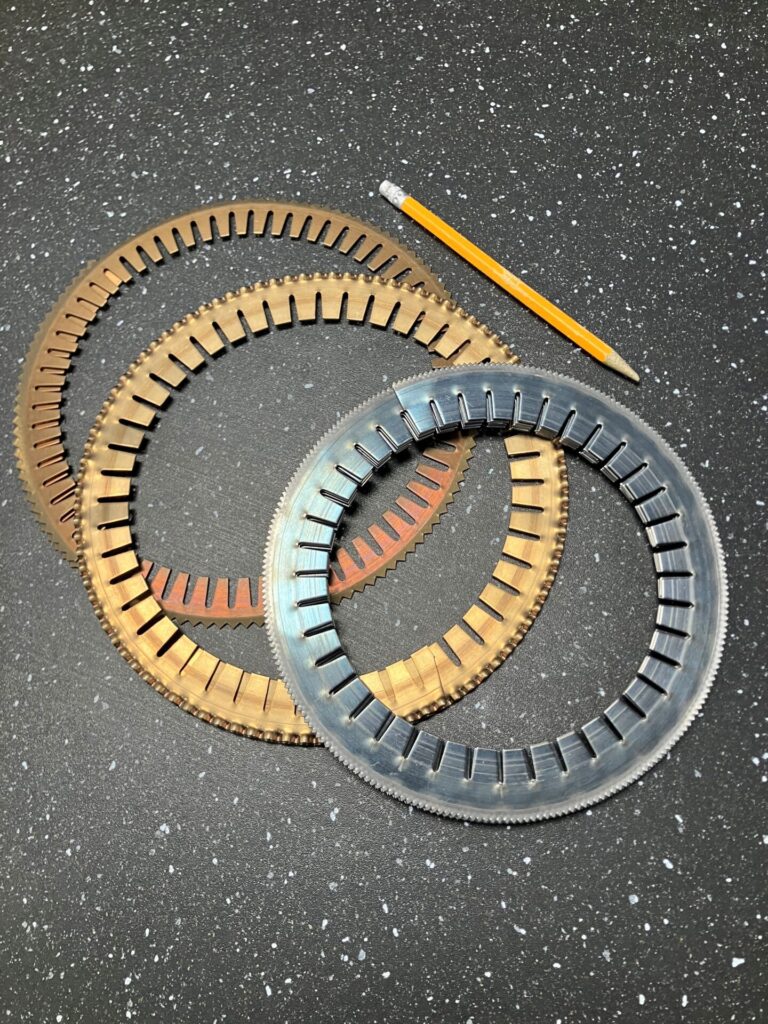
Figure 1. Small diameter bent rule | Image Credit: National Steel Rule

National’s rotary blades and other products rely on purchasing decarburized steel. “Flexibility and formability are paramount,” states Ed Mucci, president of the company, and Alexander Heucke, chief engineer. Cutting rule must be bent to form a circular blade; in service, that blade rotates to cut into the corrugated material. The curve geometry can be extreme, often bending up to a 7-inch interior diameter. As such, the purchase of decarburized steel is critical for the manufacturer’s business. At present, National sources the material internationally. Mucci explains, “Manufacturers aren’t using large quantities of decarburized steel, making it challenging to source, at least domestically.”

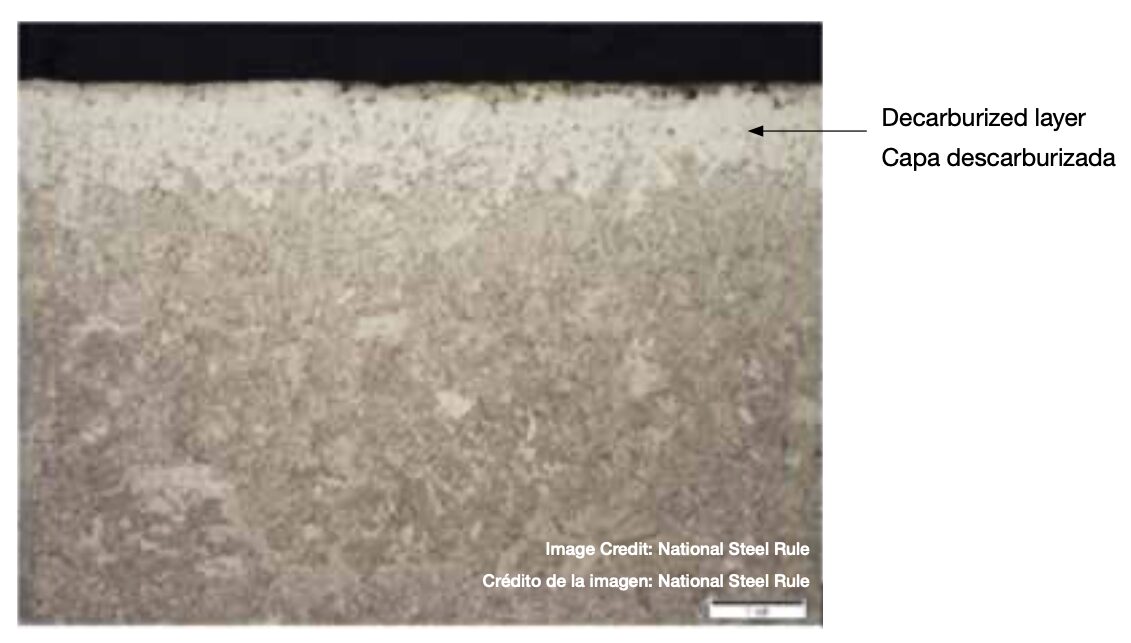
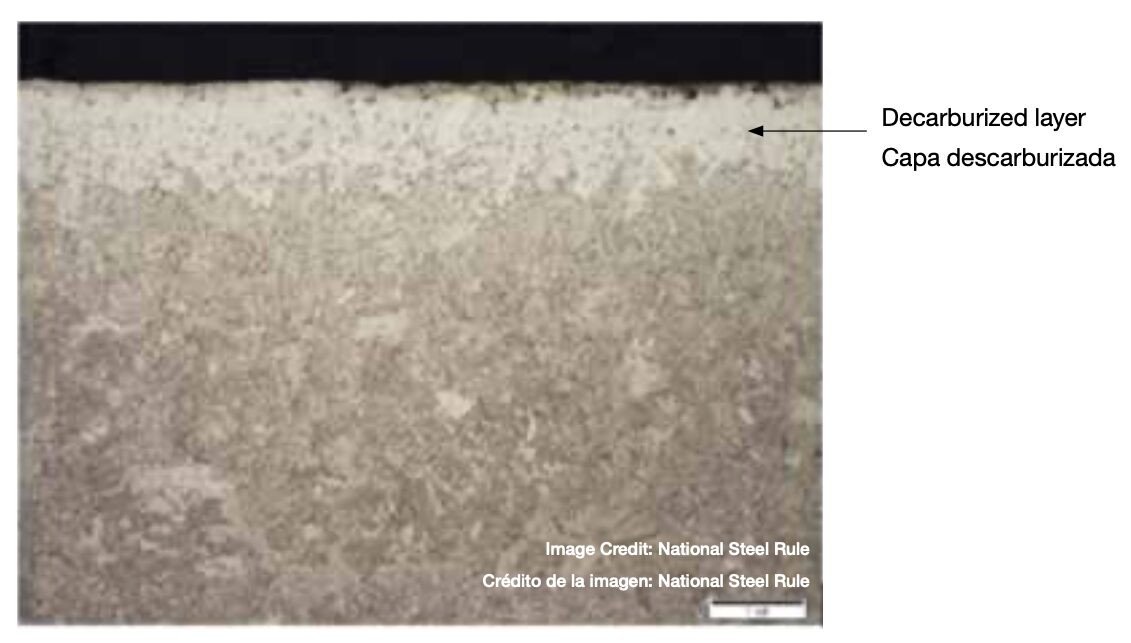
Rotary rule feedstock typically involves C36 (SAE 1036) to C50 (SAE 1050) carbon steel with a hardness range of 32–34 HRC. Mucci and Heucke note that their steel of choice has a total decarburization layer to a depth of 0.0005” depth, with partial decarburization of at least another 0.0005–0.00075”. This ensures that when the rule is bent, the surface stretches versus cracks. Bending the rule is itself a test of whether it has been properly decarburized, with metallurgical testing serving as a quality control verification that suppliers are producing the appropriate decarburization levels.

Precise Induction Hardening Teeth

While bending is essential to forming the appropriate curve, the teeth must be resistant to wear and breakage. National’s rotary cutting rule has performance expectations of at least 750,000 impressions on paper, itself a highly abrasive material. To do this, their in-house heat treat operations induction harden the edge of the rule to ensure a long die life.

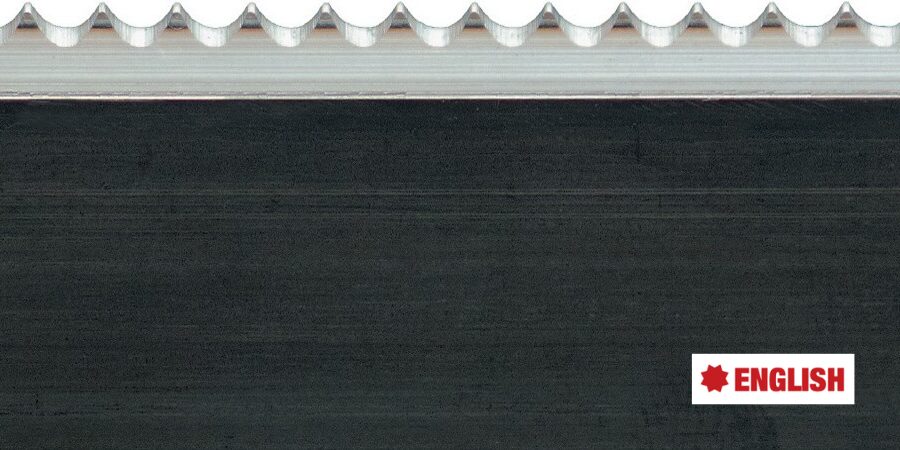
There are two methods used to harden the teeth. The primary method is to shave a profile into the strip steel and then induction harden this edge. Serrated teeth are then ground in. “This gives us better control of hardening depth,” according to Mucci and Heuke. The second method is to induction harden after the serrated teeth are ground in. “We have to make sure we don’t harden the teeth too deeply, or we can affect the bendability.”

Induction hardening involves short cycles, and as such requires careful process control to guarantee consistent results; temperature-indicating crayons that melt at a specific temperature are used as one of the process control methods. Hardness testing is performed as well.
Screenshot

Decarburization Revisited

“Usually, one tries to prevent decarburization or even add carbon,” states Mark Hemsath, executive consultant at WINGENS CONSULTANTS and longtime expert and innovator in the thermal processing industry. “Decarb often occurs by accident in poorly designed annealing systems, especially in continuous-type furnaces.”
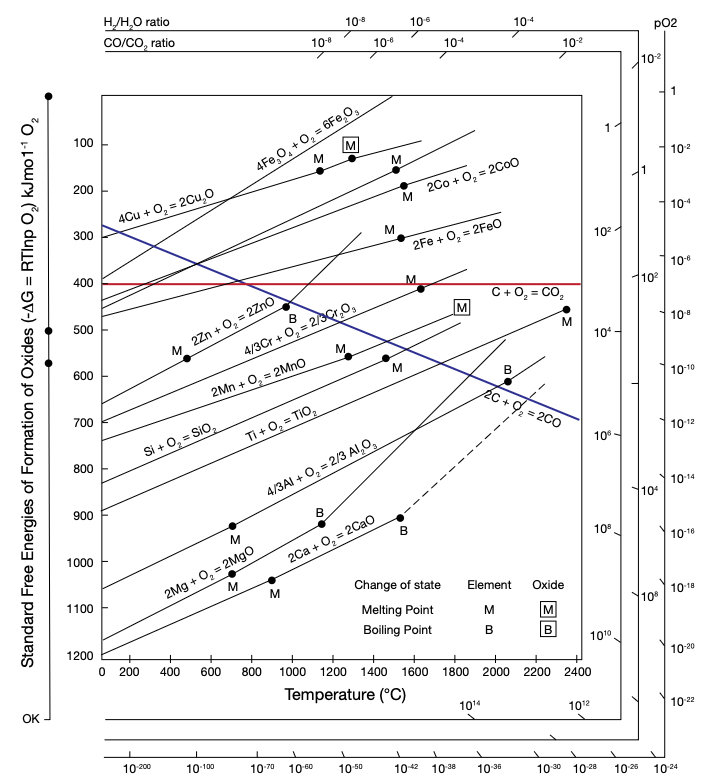
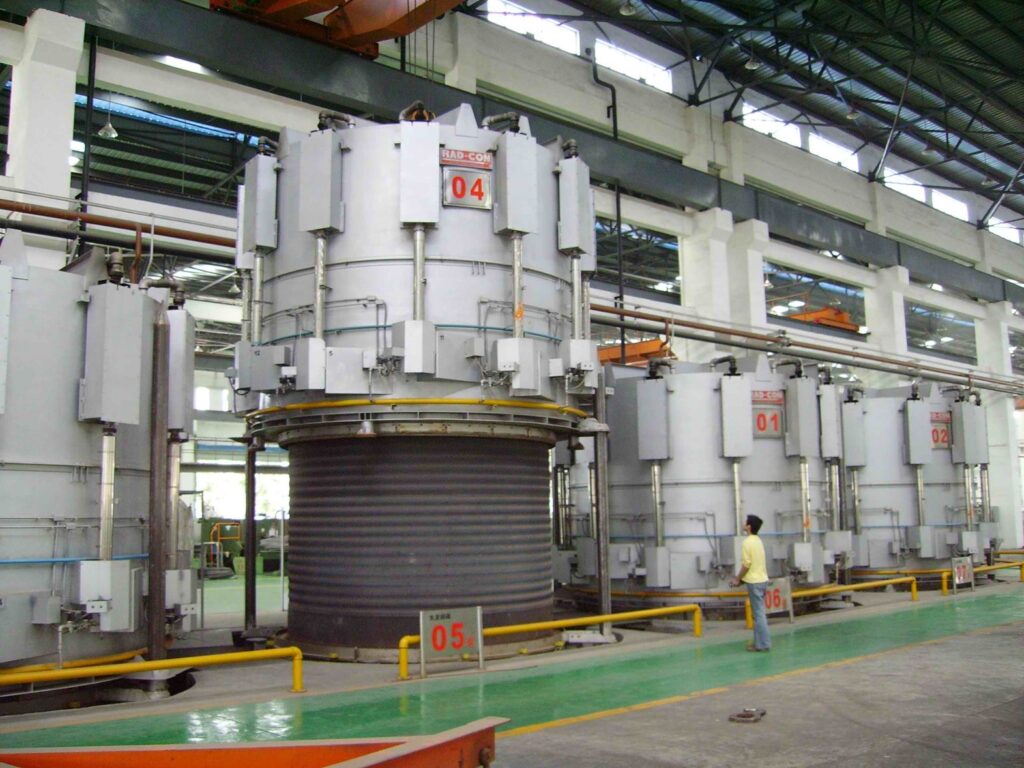
Figure 3. Ellingham Diagram depicting that hydrogen-to-water vapor relationship, the key to a successful, controlled decarburization.
Figure 4. Typical bell-annealing furnace | Image Credit: RAD-CON

Oxygen, in the form of air or water vapor, is key to the decarburizing process. Less carbon on the surface means a softer, more malleable steel, and while the art of a controlled decarburization process is well known, it can be challenging. Decarburization is a process usually performed below 1500°F. “The preferred method is to use water vapor or steam as a source of the oxygen,” notes Hemsath, pointing to the stability of hydrogen-to-water vapor (H₂/H₂O ratio) derived from the Ellingham diagram. These H₂/H₂O ratios indicate the non-oxidizing qualities of the gaseous mixture, which will allow it to be the carbon reducing agent in the atmosphere. Most furnace companies can provide the necessary equipment and customize size specifications to make it suitable for this special process, and these furnaces are typically retort-based bell or pit type.

Two Methods to Control the Decarb

There are two ways that a decarburization process can be intentionally completed. The first is decarburizing the entire product. In this method, even decarburization is applied to the entire coil sheet surface. “This cold rolled steel, typically with lower carbon, is used for appliances that need enamel adhesion,” Hemsath explained, noting U.S. Steel and AK Steel, now a part of Cleveland-Cliffs, have used this form of controlled decarburization.

Another form of decarburization is selective surface decarburization. Hemsath shared, “If selective decarburizing is required only on the edges, then you could keep the coils tightly wound and the decarburization would affect mainly the coil edges. There would be ingress of carbon loss, reducing towards the center of the wound coil surfaces.”

Conclusion

“Decarburized steel just isn’t in high demand,” according to Mucci, as “most industries are looking to harden and temper the steels they use.” In fact, preventative steel decarburization is more typical and often emphasized in trade shows, technical presentations, and in thermal processing publications. Yet there are products that rely on intentional decarburization to be successful.

Controlled decarburization at the mill brings challenges, in part because successful, consistent decarburization is not often cost effective for the North American thermal processing market. These challenges encompass regional access issues, niche market access, equipment selection needs, and technical process execution.

National’s experience underlines the challenges North American mills face in providing local, in-house heat treaters with reliably, well-controlled decarburized steel that will maintain service life.

Acknowledgements: Heat Treat Todayextends thanks to Dan Herring, The Heat Treat Doctor® at The HERRING GROUP, Inc., who was instrumental in the development of this article.

For more information: Contact Heat Treat Today’s Editorial Team at editor@heattreattoday.com.

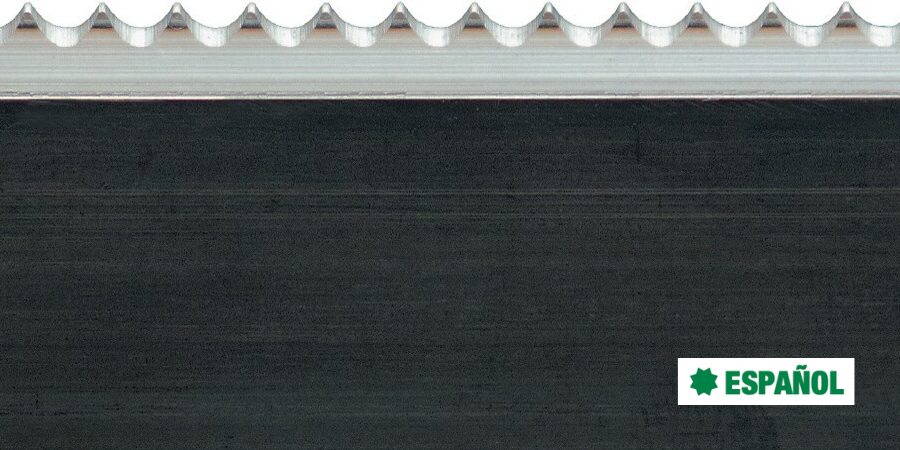
Main image: RP8 rotary rule edge hardened | Image Credit: National Steel Rule

Decarburized Steel Critical for Induction Hardening Rotary Blades Read More »
Acero Descarburizado: Crítico para el Endurecimiento por inducción de Cuchillas Rotativas

Para las operaciones de tratamiento térmico internas (in house), el objetivo principal es producir un producto confiable con un desempeño consistente en servicio. Sin embargo, la cadena de suministro y los procesos especializados pueden generar factores que comprometen la consistencia. En este artículo, Heat Treat Today destaca la importancia de contar con material base consistente para el tratamiento térmico por inducción interno de National Steel Rule, y cómo se puede implementar el proceso esencial de descarburización controlada en la planta proveedora de acero.

Este artículo informativo se publicó por primera vez en Heat Treat Today’s April 2026 Annual Induction Heating & Melting print edition. Traducido por Ana Laura Hernández Sustaita.

Si tiene comentarios o preguntas sobre este artículo, háganoslo saber en: editor@heattreattoday.com.

To read this article in English, click here.


Introducción: Regla de Acero que se Dobla

La empresa National Steel Rule produce reglas de corte rotativas para la industria del cartón corrugado. Ubicada en Linden, Nueva Jersey, la empresa suministra productos a las industrias de troquelado a nivel mundial. La compañía ha establecido altos estándares de abastecimiento, investigación y pruebas de material para sus reglas de corte, además de contar con un completo laboratorio con equipos de troquelado rotativo y plano.

Su regla de acero se adquiere de una planta proveedora de acero que realiza una descarburización controlada en todo el material. Cuando National recibe el material, procesa el acero para generar los dientes, empleando endurecimiento por inducción como parte del proceso (ver la imagen principal al inicio de este artículo). La regla de corte terminada se vende posteriormente a fabricantes de troqueles de regla de acero, quienes montan estas cuchillas junto con una goma de expulsión sobre tableros de madera cortados con láser. El fabricante debe asegurarse de que las cuchillas de las reglas estén libres de defectos, ya que incluso grietas microscópicas se abrirán durante el troquelado.


Figura 1. Regla de acero doblada de diámetro pequeño | Crédito de la imagen: National Steel Rule

Las cuchillas rotativas y otros productos de National dependen de la compra de acero descarburizado. “La flexibilidad y la conformabilidad son fundamentales”, afirma Ed Mucci, presidente de la empresa, y Alexander Heucke, ingeniero en jefe. La regla de corte debe doblarse para formar una cuchilla circular; durante el servicio, la cuchilla rota para cortar el material corrugado. La geometría de la curvatura puede ser extrema, llegando a doblarse hasta un diámetro interior de 7 pulgadas. Por lo tanto, la compra de acero descarburizado es crítica para el negocio del fabricante. Actualmente, National obtiene el material a nivel internacional. Mucci explica: “Los fabricantes no utilizan grandes cantidades de acero descarburizado, lo que dificulta su abastecimiento, al menos a nivel nacional”.

El material para las reglas rotativas suele ser acero al carbono C36 (SAE 1036) a C50 (SAE 1050) con un rango de dureza de 32–34 HRC. Mucci y Heucke señalan que el acero que utilizan presenta una capa de descarburización total de 0.0005” de profundidad, con una descarburización parcial adicional de al menos 0.0005”–0.00075”. Esto garantiza que cuando una regla se dobla, la superficie se elongue en lugar de agrietarse. Doblar la regla es, en sí mismo, una prueba para comprobar si se ha descarburado correctamente, y las pruebas metalúrgicas sirven como verificación de control de calidad para garantizar que los proveedores estén produciendo los niveles adecuados de descarburización.

Endurecimiento Preciso por Inducción de los Dientes

Si bien el doblado es esencial para formar la curvatura apropiada, los dientes deben ser resistentes al desgaste y la rotura. La regla de corte rotativa de National tiene una expectativa de desempeño de al menos 750,000 impresiones en papel, que es en sí mismo un material altamente abrasivo. Para lograrlo, las operaciones de tratamiento térmico internas endurecen por inducción el borde de la regla, garantizando una larga vida útil del troquel.

Existen dos métodos usados para endurecer los dientes. El método principal es maquinar el perfil de la tira de acero y posteriormente endurecer por inducción el borde. Posteriormente los dientes son rectificados. “Esto nos da un mejor control sobre la profundidad de endurecimiento”, comenta Mucci y Heuke. El segundo método consiste en endurecer por inducción después de rectificar los dientes. “Debemos asegurarnos de que el endurecimiento de los dientes no sea muy profundo, ya que esto puede afectar la capacidad de doblado”. El endurecimiento por inducción implica ciclos muy cortos, y por lo tanto requiere un control minucioso del proceso para garantizar resultados consistentes. Entre los métodos de control del proceso se utilizan crayones indicadores de temperatura, que se funden a una temperatura específica. También se realizan pruebas de dureza.


Figura 2. Detalle de la capa descarburizada | Crédito de la imagen: National Steel Rule

Revisitando la Descarburización

“Generalmente se intenta prevenir la descarburización o incluso agregar carbono a la superficie”, comenta Mark Hemsath, consultor ejecutivo en WINGENS CONSULTANTS y reconocido experto e innovador en la industria del tratamiento térmico. “La descarburización a menudo ocurre accidentalmente en sistemas de recocido mal diseñados, especialmente en hornos de tratamiento continuo.”


Figura 3. Diagrama de Ellingham que muestra la relación hidrógeno-vapor de agua, clave para una descarburización controlada exitosa.

Figura 4. Horno típico de recocido tipo campana. | Crédito de la imagen: RAD-CON

El oxígeno en forma de aire o de vapor es la clave del proceso de descarburización. Menor porcentaje de carbono en la superficie indica un acero más blando y maleable, y si bien el arte de un proceso de descarburización controlada es bien conocido, puede resultar un desafío. El proceso de descarburización suele realizarse por debajo de 1500°F (815°C). “El método preferido es usar vapor de agua o vapor como fuente de oxígeno”, señala Hemsath. Esto se basa en la estabilidad de la relación hidrógeno-vapor de agua (H2/H2O) derivada del diagrama de Ellingham. Estas relaciones H2/H2O indican las propiedades no oxidantes de la mezcla gaseosa, lo que permite que actúe como agente reductor de carbono en la atmósfera del horno. La mayoría de las empresas fabricantes de hornos pueden proporcionar el equipo necesario y personalizar las dimensiones para hacerlos adecuados para este proceso especial. Estos hornos suelen ser de tipo campana o tipo foso con retorta.

Dos Métodos para Controlar la Descarburización

Existen dos formas de realizar intencionalmente un proceso de descarburización. La primera consiste en descarburar todo el producto. En este método, la descarburización se aplica de manera uniforme en toda la superficie de la lámina o bobina. “Este acero laminado en frío generalmente con menor contenido de carbono, se utiliza en electrodomésticos que requieren una buena adherencia del esmalte”, explica Hemsath. Empresas como U.S. Steel y AK Steel (ahora parte de Cleveland-Cliffs) han utilizado esta forma de descarburización controlada.

Otra forma es la descarburización selectiva en la superficie. Hemsath explica: “Si la descarburización solo se requiere en los bordes, se podrían mantener las bobinas enrolladas firmemente, por lo tanto, la descarburización afectaría principalmente a los bordes. Se produciría una pérdida de carbono que disminuiría hacia el centro de las superficies enrolladas”.

Conclusión

“El acero descarburizado tiene mucha demanda, ya que la mayoría de las industrias buscan endurecer y templar los aceros que utilizan”, indica Mucci. De hecho, la prevención de la descarburización del acero es más común y suele destacar en ferias industriales, presentaciones técnicas y publicaciones de procesamiento térmico. Sin embargo, existen productos que dependen de la descarburización intencional para funcionar correctamente.

La descarburización controlada en la planta proveedora de acero presenta desafíos, en parte porque lograr una descarburización exitosa y consistente no suele ser económicamente viable para el mercado norteamericano de tratamiento térmico. Estos desafíos abarcan problemas de acceso regional, acceso a nichos de mercado, necesidades de selección de equipos y ejecución de procesos técnicos.

La experiencia de National destaca los desafíos que enfrentan las plantas proveedoras de acero de América del Norte para proveer a las empresas de tratamiento térmico interno, acero descarburizado de forma fiable y bien controlada que mantenga su vida útil.


Agradecimientos:
Heat Treat Today
agradece a Dan Herring, The Heat Treat Doctor®, The HERRING GROUP, Inc., quien fue fundamental en el desarrollo de este artículo.


Para más información:
Contacte con Heat Treat Today’s Editorial Team en editor@heattreattoday.com.

La imagen principal: Regla rotativa RP8 con borde endurecido | Crédito de la imagen: National Steel Rule

Acero Descarburizado: Crítico para el Endurecimiento por inducción de Cuchillas Rotativas Read More »

Steel Industry Acquisitions: Updates Following US Election

As U.S. election results were announced last week, several steel industry players are in the midst of acquisitions that could mean changes for in-house heat treat operators in North America.

Cleveland-Cliffs Expands North American Presence

Lourenco Goncalves
Chairman, President, CEO
Cliffs
Source: Cliffs

Cleveland-Cliffs Inc. (“Cliffs”) today announced that it has successfully completed its acquisition of Stelco Holdings Inc. (“Stelco”). The addition of Stelco enhances Cliffs’ position as the largest flat-rolled steel producer in North America, diversifies Cliffs’ end-markets and expands its geographical presence in Canada. Stelco will continue operations as a wholly-owned subsidiary of Cliffs, preserving the name and iconic Canadian legacy of the business.

Lourenco Goncalves, chairman, president and CEO of Cliffs, stated: “Today marks a transformative step forward for Cleveland-Cliffs. By bringing Stelco into the Cliffs family, we are building on our commitment to integrated steelmaking and good paying union jobs in North America. This acquisition allows us to further diversify our customer base and lower our cost structure. We are excited about the opportunities this acquisition brings and appreciate the warm welcome we have received from all government officials in Canada. We take our permission to operate very seriously and aim to continue the Stelco legacy with dedication and purpose.”

Nothing New: Questions for Nippon-U. S. Steel Acquisition

Takahiro Mori
Vice Chairman and Executive Vice President
Nippon Steel
Source: Nippon Steel

This past April 2024, U. S. Steel was heralding the merger with Nippon Steel as advancing their sustainable steel goals. Still, outgoing President Joe Biden and Vice President Kamala Harris as well as President-Elect Donald Trump and Vice President-Elect JD Vance have all spoken out with concerns to preserve American ownership of U. S. Steel. “And I couldn’t agree more with President Biden,” commented Harris recently along the campaign trail in September, “US Steel should remain American owned and American operated.”

At this time, the U. S. Committee on Foreign Investment has the proposed acquisition under review until late December 2024.

If the deal is approved before the January 2025 inauguration, that does not guarantee that Trump would not overturn the results. However, “The previous Trump administration said it would attract foreign investment and create new jobs,” commented Nippon Steel Vice Chairman and Executive Vice President Takahiro Mori. “This (acquisition) is extremely in line with such a policy.” He still aims to see the deal close before the end of the calendar year.

The press release for the Cliff’s story is available in its original form here.


Steel Industry Acquisitions: Updates Following US Election Read More »

U.S. Steel Acquires Interest in Arkansas Steel Company, First Step Toward Consolidation

A leading integrated steel producer headquartered in Pittsburgh, Pennsylvania, announced a joint venture partnership agreement under which it has taken the first step toward acquiring an Arkansas-based steel manufacturer.

Big River Steel, which operates a LEED-certified Flex Mill™ in northeast Arkansas, will expand U.S. Steel’s technological capability and geographic presence through this agreement. U.S. Steel has purchased 49.9% ownership interest with a call option to acquire the remaining 50.1% over the next four years.

David B. Burritt, president and CEO of U. S. Steel

The Big River flat-rolled mill has advanced technology that allows it to produce a wide product spectrum, including advanced automotive steels and electrical steels, and provide high-quality products and services to customers in the automotive, energy, construction and agricultural industries. Big River’s recently announced Phase II-A expansion is expected to double the mill’s hot-rolled steel production capacity to 3.3 million tons annually.

“Our new partnership with Big River is designed to accelerate our strategy to offer our customers the ‘best of both’ by bringing together the capabilities of integrated and mini-mill steel production,” said David B. Burritt, president and CEO of U.S. Steel. “Big River operates the most advanced, state-of-the-art and sustainable mill in North America, and our investment would ultimately strengthen our competitive positioning in highly strategic steel-end markets, creating an unmatched value proposition for our stakeholders.”

“We have been investing in leading technology and advanced manufacturing so that we can assemble a portfolio of competitive assets with distinct advantages to serve strategic markets to better position U.S. Steel to be an industry leader in delivering high-quality, value-added products,” added Burritt. “The investment in Big River, coupled with our announced investments at Mon Valley Works and Gary Works, would ultimately position U.S. Steel with three core market-leading, differentiated and technologically advanced assets that will enable us to compete with anyone, anywhere, for generations to come. Each of these locations would be able to focus on the products that each facility is best designed to produce. As an organization, we will be nimbler, more resilient and our teams will be more efficient. Collectively, these actions will help us continue to create long-term value for our stockholders, customers, employees and the communities in which we live and work.”

David Stickler, CEO of Big River Steel

“U. S. Steel’s decision to partner with us through this investment in Big River is a decisive vote of confidence in our company, our vision and our people,” said Dave Stickler, CEO of Big River. “After just over two years of operations, we have built a unique platform that features the most advanced technology in our industry, and the very finest steel technicians in the business. We have always called ourselves a ‘technology company that just happens to make steel.’ In U. S. Steel, we have a likeminded technology-focused partner with an enduring tradition of excellence and a commitment to innovation. We are very excited about the possibility for what we can do together. As the newest steel production facility in North America, I could not be more proud to be partnering with a company started by Andrew Carnegie more than 118 years ago.”

Closing of the transaction is anticipated on October 31, 2019.

U.S. Steel Acquires Interest in Arkansas Steel Company, First Step Toward Consolidation Read More »

Steelmakers Announce Investments of $5.6B in U.S. Steel Mills


Source: NWI Times

Two major international steel corporations recently announced plans to invest in existing steel mills in along the northwest Indiana lakeshore, as part of collective bargaining agreements reached with the United Steelworkers union.

ArcelorMittal, based in Luxembourg, and Pittsburgh-based U.S. Steel together will invest $5.6 billion into their U.S. operations in an effort to ensure that the local mills remain sustainable, including Gary Works, U.S. Steel’s largest mill.

Main image caption: David Burritt, president and CEO of U.S. Steel Corp., announces a major investment in the company’s Gary Works plant (in August).

Steelmakers Announce Investments of $5.6B in U.S. Steel Mills Read More »

Major Modernization, Revitalization to Begin at Steel Works Plant in Gary, IN


A leading integrated steel producer headquartered in Pittsburgh, Pennsylvania, recently announced plans to make significant upgrades to its works plant in Gary, Indiana.

David B. Burritt, president and CEO of United States Steel Corporation

U.S. Steel will apply a $750 million asset revitalization investment to the Gary Works plant to modernize and enhance the company’s flagship operation through building expansion and improvement, including the installation of new, state-of-the-art production equipment, machinery, and modernizing technology to meet customer demand in the automotive, energy and other industries.

“We are pleased to be making this significant investment at Gary Works, which will improve the facility’s environmental performance, bolster our competitiveness and benefit the local community for years to come,” said David B. Burritt, president and CEO of United States Steel Corporation. “Through the skill and determination of our employees, support from the state and city, without which this project would not be possible, and favorable trade policies with the strong Section 232 national security action on steel imports, we are experiencing a renaissance at U. S. Steel.”

Burritt was joined by Indiana Governor Eric J. Holcomb and Gary Mayor Karen Freeman-Wilson in the announcement.

Providing both steelmaking and finishing capabilities, Gary Works is U. S. Steel’s largest manufacturing plant and the largest integrated steel mill in North America.


Photo credit: The Oceania Times

Major Modernization, Revitalization to Begin at Steel Works Plant in Gary, IN Read More »

Leading Construction Steel Provider Restarts Illinois Blast Furnace

The leading supplier of steel sheet products to the diverse construction industry announced recently that it will restart the second of two blast furnaces (“A” blast furnace) at its Granite City Works, an integrated steelmaking plant in Granite City, Illinois.

U. S. Steel President and Chief Executive Officer David B. Burritt

The restart of the United States Steel Corporation’s “A” blast furnace will support increased demand for steel manufactured in the United States while allowing the company to continue to support customers during planned asset revitalization efforts.

“We are excited to announce that after the restart of the ‘A’ blast furnace on or around October 1, all of the steelmaking operations at Granite City will be back online, helping us meet an increased demand for American-made steel that has only grown since our March announcement,” said U. S. Steel President and Chief Executive Officer David B. Burritt. “After careful consideration of market conditions and customer demand, including the impact of Section 232, the restart of the two blast furnaces at Granite City Works will allow us to serve our customers’ growing demand for high-quality products melted and poured in the United States.”

U.S. Steel will hire around 300 new employees for the restart of blast furnace “A” that will support increased shipments beginning in the fourth quarter.  In March, U. S. Steel announced the restart of Granite City Works’ blast furnace “B” and steelmaking operations that brought back 500 positions, filled by new and returning employees. The restart of blast furnace “B” is in progress.

Leading Construction Steel Provider Restarts Illinois Blast Furnace Read More »

Restarting Blast Furnace, Steel Producer Focuses on Demand

With the restart of the second of its two blast furnaces, a major U.S. steel producer expects to step up its supply of American-made steel to support customers demand.

U. S. Steel President and Chief Executive Officer David B. Burritt

United States Steel Corporation recently announced it will restart “A” blast furnace at its Granite City Works, an integrated steelmaking plant in Granite City, Illinois.

“We are excited to announce that after the restart of the “A” blast furnace on or around October 1, all of the steelmaking operations at Granite City will be back online, helping us meet an increased demand for American-made steel that has only grown since our March announcement,” said U. S. Steel President and Chief Executive Officer David B. Burritt. “After careful consideration of market conditions and customer demand, including the impact of Section 232, the restart of the two blast furnaces at Granite City Works will allow us to serve our customers’ growing demand for high-quality products melted and poured in the United States.”

Photo Credit: CBS Pittsburgh 

Restarting Blast Furnace, Steel Producer Focuses on Demand Read More »

A Baker’s Dozen Quick Heat Treat News Items to Keep You Current


A Baker's Dozen Quick Heat Treat News Items to Keep You Current

Heat Treat Today offers News Chatter, a feature highlighting representative moves, transactions, and kudos from around the industry.

Personnel and Company Changes and Moves

  • Super Systems Europe recently announced that Rob Wilcox has joined the sales and engineering team, where he will also operate as a general consultant to help commercial and captive heat treaters improve the quality and efficiency of the entire operation, covering the UK and Ireland.
  • Brian Robbins, CEO of MidWest Materials, has been named Steel Man of the Year by the Association of Steel Distributors. "I am honored to be chosen for this prestigious award. My family has been associated with the steel industry for more than 65 years, and it is humbling to follow in the footsteps of my grandfather, Joseph Koppelman, founder of MidWest Materials, who was one of the earliest members of the ASD and served as its president 50 years ago," said Robbins, who served as president of ASD from March 2014 to April 2016. He led the association’s effort to rebuild the steel manufacturing sector by encouraging young talent to join the industry.
  • Ryan Kelly recently rejoined the team at Advanced Heat Treat Corp. (AHT) where he will be leading all quality initiatives as a senior quality specialist.
  • Senior Vice President Douglas Matthews has assumed day-to-day operations of Pittsburgh-based U.S. Steel’s Tubular division. He replaces David J. Rintoul, who retired to become the president and CEO of GrafTech, a graphite company that supplies technology to the steel industry.

  • Dana Incorporated announced the election of two more members to its board of directors: Michael J. Mack, who recently retired from Deere & Co., where he had served as chief financial officer; president of the company's Worldwide Construction & Forestry Division; and most recently as group president of John Deere Financial Services, Global Human Resources, and Public Affairs; and Diarmuid B. O'Connell, who spent the last 11 years at Tesla, most recently as vice president of business development.
  • International Thermal Systems (ITS) recently announced Tom Stricker as the new president. Stricker joined ITS in 2015 as the general manager of the Metal Packaging and Parts Washer product groups and brings more than 20 years of professional experience to his new role.
  • Herbert J. “Hawk” Carlisle has been elected to the Allegheny Technologies Incorporated (ATI) board of directors. General Carlisle is president and CEO of the National Defense Industrial Association (NDIA) and is a retired four-star general from the United States Air Force (USAF).

Equipment Transactions

  • A supplier of the battery industry received shipment of a nine tube gas-fired immersion tube lead melting and holding furnace from Lindberg/MPH, to be used in the production of lead plates for automotive batteries. The furnace has over 28,000 square inches of heat transfer area for efficient heating of the metal without super heating and the resulting metal losses. In addition, Lindberg/MPH announced the shipment of a three-zone tube furnace to an American University with a footprint which makes it ideal for research facilities with limited space. The maximum temperature rating for this tube furnace is 2012°F.
  • Ipsen recently designed and built a vertical, high-pressure quenching furnace, complete with twin cooling systems and a work volume of 350 cubic feet. During the testing phase, the furnace quenched with 1,000 horsepower (.75 megawatts) – a remarkable achievement that began as an idea just months prior.
  • An aviation engine repair services facility located in the western region of the United States recently received shipment of two vacuum furnaces from Solar Manufacturing. The customer witnessed full testing at Solar Manufacturing and approved shipment in late 2017. Both new furnaces are tailored specifically to fit the needs of aerospace engine component repair processing to the aerospace specification AMS2750E and incorporate the new SolarVac® 5000 supervisory control and data acquisition system (SCADA). The system provides gas quench rate control utilizing a variable frequency drive and precise temperature control from ambient to 2400° F (1316° C) utilizing digital power trimming technology.
  • An aluminum manufacturer received shipment of two electrically heated standard horizontal aluminum quench systems from Wisconsin Oven Corp., of East Troy, Wisconsin. The systems guarantee temperature uniformity of ±10°F at 775°F and 1075°F, ensuring that the furnaces meet AMS 2750E, Class 2 furnaces and Instrumentation Type C requirements. Each system is designed to heat 1000 pounds of aluminum to a 950°F operating temperature.

Accreditations, Certifications, Patents, and More

  • MedAccred has recognized Solar Atmospheres of Western PA for its commitment to continual improvement in medical device heat treat and brazing quality. In receiving the prestigious MedAccred Heat Treating accreditation, Solar Atmospheres has become only the eighth plant internationally and the fifth plant domestically to receive this certification.
  • H.C. Starck recently announced that it has received the certification for processing of “conflict-free” tantalum raw materials the seventh year in a row. The audit included the H.C. Starck Tantalum and Niobium GmbH subsidiary and the H.C. Starck Smelting GmbH & Co. KG associated company. This means all subsidiaries that process tantalum at the Goslar, Mito, Tokyo, Map Ta Phut, and Laufenburg locations remain certified. The audit was performed by the independent company SGS, acting on behalf of the Responsible Business Alliance (RBA, formerly Electronics Industry Citizenship Coalition EICC) and the Responsible Minerals Assurance Process (RMAP formerly Conflict-Free Smelter Program) as part of the Responsible Minerals Initiative (RMI, formerly CFSI).

A Baker’s Dozen Quick Heat Treat News Items to Keep You Current Read More »

Auto, Aero Manufacturers React to Reports of Kobe Steel’s Data Tampering

SPECIAL REPORT: — by Heat Treat Today Managing Editor, Laura Miller

Automakers and aerospace manufacturers worldwide are reacting to recent reports that employees at Kobe Steel, Ltd, continued to fabricate data regarding strength and durability of metals during and after an internal investigation, that management failed to notice the deception, and that, as a result, the company had violated statutory standards and shipped substandard products without customer knowledge or consent. This is contrary to previous Kobe assertions that all products affected by the scope of the investigation that had been sold had met safety and other standards.

The results of the original probe announced on October 8 were that data fabrication had only involved contract specifications agreed to with aluminum and copper customers, giving the impression that it was just a narrow scope of Kobe’s orders that were affected by the tampering. On Friday, October 20, however, Kobe Steel Group officials reported that industry standards had been violated and a new investigation had begun into the falsification of data at a facility that cuts and processes steel plate, and a plant in western Japan has been red-flagged for “obstructing company’s voluntary inspection” by concealing data.

Kobe Steel Executive Vice President Naoto Umehara (center) at a news conference in Tokyo, 10/20/17. (Photo by Kosaku Mimura, Nikkei Asian Times)

“There has been also some impact on our business as we have lost credibility,” Kobe Steel executive vice president Naoto Umehara said, noting that customers have been canceling orders. “But we can’t quantify the impact at the moment.”

No safety problems have been reported by any manufacturers using Kobe products.

A statement at the company’s website reads:

We are extremely sorry for our improper conduct. At this time, we sincerely and deeply apologize for the enormous amount of worry and trouble we have caused many of you in respect to the improper conduct concerning a portion of our products made by our company and group companies.

The Kobe Steel Group, together with its suppliers, is quickly working to determine how its products have affected safety and other factors. We are thoroughly analyzing the cause and are engaged in developing countermeasures to prevent a reoccurrence from happening. We are making sincere efforts to eliminate the burden on all parties concerned and to resolve these problems as quickly as possible.

In September, U.S. Steel and Kobe announced plans to build a new continuous galvanizing line for advanced high-strength steels for the automotive industry at the PRO-TEC Coating Co. subsidiary in Leipsic, Ohio. “U.S. Steel remains committed to our new Advanced High Strength Steel CGL and bringing solutions to our customers,” U.S. Steel spokeswoman Meghan Cox said Friday. It is unknown whether the PRO-TEC project will still involve Kobe Steel products.

For a list of companies that have received falsely certified parts or are checking whether they have received them, read “Factbox: Kobe Steel’s data fabrication leaves manufacturers scrambling“.

Sources: The National, Reuters, The Japan Times, Nikkei Asian Review, NWI Times, Kobe Steel, Ltd


Auto, Aero Manufacturers React to Reports of Kobe Steel’s Data Tampering Read More »