John Niggle, Business Development Manager, Pelican Wire
Edward Valykeo, Thermocouple Specialist, Pelican Wire
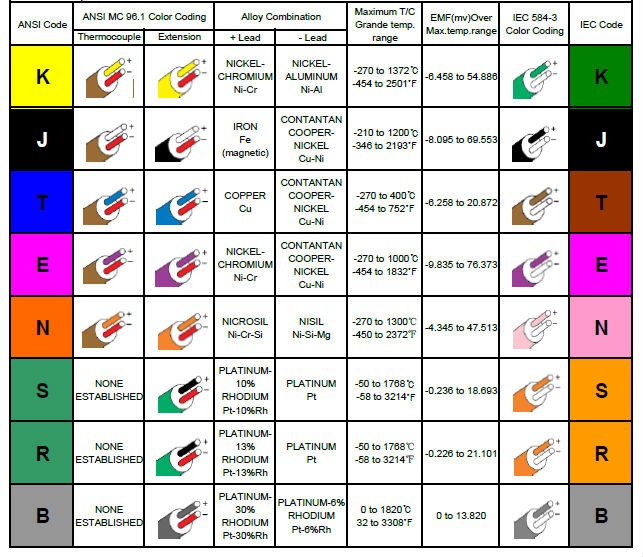
In June 2020, Heat Treat Today published a noteworthy technical article on the basics of thermocouples by John Niggle, Business Development Manager, and Ed Valykeo, Thermocouple Specialist, at Pelican Wire, Naples, FL. The article covers the different types of thermocouples, questions to consider when deciding which type of thermocouple to use, as well as a fascinating discussion on thermocouple wire and wire insulations. One feature of significant recognition is the chart included by Niggle and Valykeo:
Thermocouple Color Code Chart (photo source: "Thermocouples 101")
One of Heat Treat Today's editorial contributors and readers, Martin Reeves of Unitherm Furnace, LLC, saw this article and provided valuable information to the subject:
Martin Reeves, Owner, Fontec-global, LLC
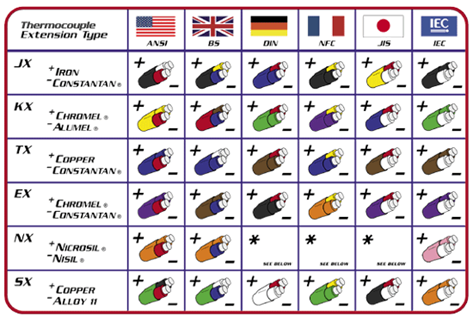
"Excellent article and a great base for understanding T/C's. Only one thing missing and that is the differences between US and international lead colours. These are very different and when equipment is sold overseas or imported this becomes important for T/C's to be wired correctly."
International Thermocouple Lead Colors (photo source: Martin Reeves)
We welcome your inquiries to and feedback on Heat Treat Today articles. Submit your questions/comments to editor@heattreattoday.com.
This is one of the best thermocouple basics articles you’ll read this year. It covers the different types of thermocouple, questions to consider when deciding which type of thermocouple to use, as well as a fascinating discussion on thermocouple wire and wire insulations.
Ed Valykeo, Thermocouple Specialist, Pelican Wire
John Niggle, Business Development Manager, Pelican Wire
Learn about thermocouples and their place in your heat treat department in this Technical Tuesday original Heat TreatToday article by John Niggle, Business Development Manager, and Ed Valykeo, Thermocouple Specialist, at Pelican Wire, Naples, FL.
This article appears in the upcoming edition (June 2020) of Heat Treat Today’sAutomotive Heat Treating magazine.
The six common types of temperature measurement sensors used in industry are thermocouples, RTD’s, infrared, bimetallic, liquid expansion and change of state devices. Thermocouples are by far the most used of all these sensors. Their popularity is due to their simplicity and ease of use, as well as their size and speed of response. For these reasons, thermocouples are commonly used in the automotive industry for purposes such as component testing, for example brakes, exhaust gas temperature measurement, and in oven temperature profiling in paint systems. Most importantly for readers of this article, thermocouples are widely used in heat treat applications as well.
A thermocouple is a simple, robust, and cost-effective temperature sensor used in a wide range of temperature measurement processes. It consists of two dissimilar metal wires that produce a voltage proportional to a temperature difference between either ends of the pair of conductors. Thermocouples are self-powered and require no external form of excitation.
Thermocouple materials can be divided into two groups based on their compositions. The two types are base metal and noble metal thermocouples. Base metal thermocouples are made of inexpensive and readily available metals such as nickel, iron, copper and chromium. Noble metal thermocouples are made of costly elements such as platinum, rhodium, gold, tungsten, and rhenium. This article will focus on base metal thermocouples.
For convenience, base metal thermocouples are identified by letter, K, J, T, E, and N. Type K and J are the most widely used in industry. Base metal thermocouples are chosen for use based on emf output, temperature range, and the most often overlooked, environment. Base metal thermocouples are used in a wide range of industries including medical, diagnostics testing, vehicle engines, gas appliances such as boilers, water heaters, and ovens. They are widely used in the heat treat industry. Thermocouples are invaluable in monitoring and validating critical processes.
Type K Thermocouple
Type K thermocouples are nickel based so they work well in most applications. Type K thermocouples have good corrosion resistance. They’re inexpensive, accurate, reliable, and have wide temperature ranges. Maximum continuous temperature is 2012°F (1,100°C).
Advantages:
Good for high temperature applications
Appropriate for use in oxidizing or inert atmospheres at temperatures up to 2300°F (1260°C)
Best in clean oxidizing atmospheres
Disadvantages:
Not recommended for use under vacuum or partially oxidizing atmospheres
Not for use in sulfurous atmospheres unless protected
Not recommended in a vacuum at high temperatures
Type J Thermocouple
Type J thermocouples consist of a positive leg of iron and a negative leg of copper nickel alloy. They have smaller temperature ranges and shorter lifespans at higher temperatures than the Type K. They are equivalent to the Type K in terms of expense and reliability. It is a good choice for general purpose applications.
Advantages:
Relatively high thermoelectric power
Appropriate for use in vacuum, air, reducing, or oxidizing atmospheres
Disadvantages:
The Iron leg is susceptible to oxidation
Should not be used in sulfurous atmospheres
Iron leg limited at subzero use due to rusting and embrittlement
Type T Thermocouple
Type T are very stable thermocouples and are often used in extremely low temperature applications such as cryogenics. They are found in other laboratory environments as well. The type T has excellent repeatability between –380°F to 392°F (–200°C to 200°C)
Advantages:
Very stable
Moisture resistant
Useful to 700°F (370°C)
Can be used in vacuum, reducing, or inert atmospheres
Disadvantages:
Lower temperature range
Type E Thermocouple
Type E are nickel-chromium versus copper-nickel thermocouple alloy combinations that produce the highest emf per degree of any of the base metal thermocouple alloy combinations. Type E can be used in temperatures from 300°F to 1600°F (149°C to 871°C).
Advantages:
Good in oxidizing atmospheres
Higher temperature range than type J
More stable than type K
Has the highest output EMF of any standard type
Disadvantages:
Vulnerable to sulfur attack
Only short-term use in a vacuum
Only short-term use under partially oxidizing conditions.
Only short-term use in alternating cycles of oxidation and reducing atmospheres
Type N Thermocouple
Type N thermocouple alloys are nickel based. Type N shares the same accuracy and temperature limits as the Type K. Type N has better repeatability between 572°F to 932°F (300°C to 500°C) compared to the type K.
Advantages:
Good in oxidizing or inert atmospheres
Less aging as compared to Type K
Better suited for nuclear environment
Disadvantages:
Do not use in sulfurous atmospheres
Slightly more costly than Type K
Thermocouple Color Code Chart
Questions to Ask When Choosing Thermocouples
Besides the metallurgy of the thermocouple, consideration needs to be given to the style of sensor, probe or wire, and construction of the wire that carries the signal from the sensor to the instrument reading the signal. The purpose of the sensor is to achieve the same temperature as the process it is measuring and relay that temperature to the process instrumentation. The process being measured should dictate the type of sensor. If the process would in some way damage the sensor or invalidate its accuracy through corrosion, flow, pressure, or another condition, then a probe style sensor would be best. If the temperature being measured is in a static environment like a paint booth in an automotive assembly plant, an engine and exhaust system on a test stand, heat treating oven, or even a fluid that is not flowing, then a wire style sensor should work. The wires can even be tack welded in smelting or forging operations in one-time use applications.
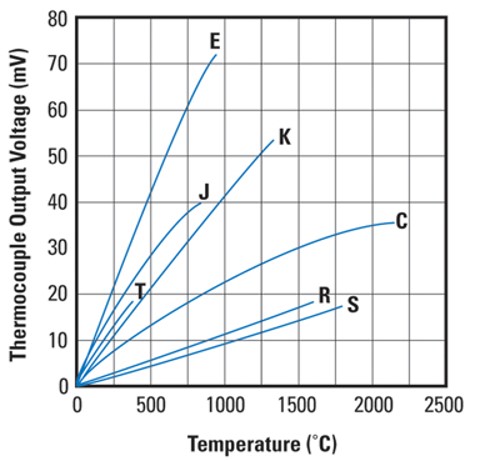
Thermocouple Output Voltage for Types E, J, T, K, C, R, S
Thermocouple Wire
Thermocouple wire construction or design has many factors to consider. These factors include accuracy, resistance to heat, abrasion, moisture and chemicals, flexibility, and durability as well as size constraints Accuracy falls into two classifications, Standard Limits of Error and Special Limits of Error. Special Limits of Error wire or conductor shares the same metallurgy with Standard Limits of Error but has better accuracy as the name implies. Standard Limits of Error wire or conductor would have a wider understood range of inaccuracy. A quick rule of thumb for understanding the accuracy divergence between special and standard limits of error; special limits of error tolerance ±2.0°F (±1.1°C) up to 500°F (260°C) and then 0.4% beyond 500°F (260°C). As an example, the tolerance for a special limit thermocouple at 1000°F would be ±4.0°F (±2.2°C) (1000 X .004). For a standard limit thermocouple, the quick rule of thumb is ±4.0°F (±2.2°C) up to 500°F (260°C) and then 0.8% beyond 500°F (260°C). Using the same example, the tolerance at 1000°F (538°C) for a standard limit thermocouple would be ±8.0°F (±4.4°C) (1000 X .008).
Extension grade is a third class or grade of wire that should also be mentioned. Extension grade wire should not be confused with either of the thermocouple grade wires mentioned previously. Extension Grade wire in fact should not really be considered a thermocouple grade wire, but rather a signal wire that carries the signal of the temperature being measured by the sensor to the process instrumentation. Typically, extension grade wire is not exposed to the same conditions that the probe and thermocouple wire would be. It is usually removed at a distance from the process being monitored, and as such, the requirements for the construction of the extension grade wire are not as stringent. For instance, the heat resistance requirement for the insulation would not be as high or critical. The maximum temperature extension grade wire is certified to is 392°F (200°C).
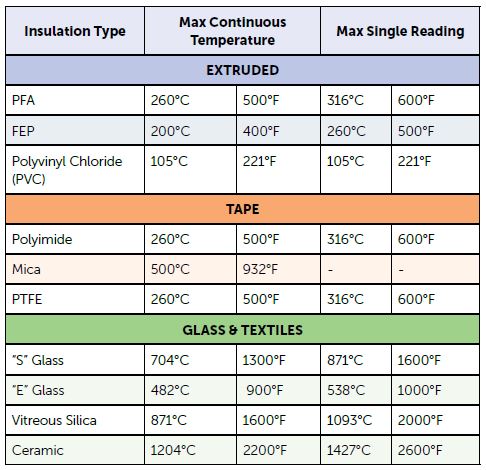
The choice of insulation is a critical factor in thermocouple wire design. Selection of insulation is influenced greatly by the atmosphere in which the wire will be operating. In the case of extension grade wires, the conditions will not be very demanding, for the most part, so PVC is a commonly used insulation. It has sufficient heat resistance for most environments, although not to the maximum certification temperature extension grade wire of 392°F (200°C), and has adequate moisture, chemical and abrasion resistance as well as flexibility. PVC is also an economical choice for insulation.
However, in many instances especially as the distance to the sensor and process temperature being monitored decreases, PVC does not have the properties necessary to withstand the conditions of those environments. This is particularly true of heat resistance with PVC being rated to 221°F (105°C ) only. Other insulations offer much higher heat resistance with the additional benefits of abrasion, moisture and chemical resistance if required. These other insulations can be broken down into 4 categories. Those categories are: extruded insulating compound, tapes, fiberglass, and high temperature textiles. Common extruded higher heat resistant extruded insulations would be fluoropolymer compounds like FEP and PFA. Heat resistance of these compounds range from 392°F to 500°F (200°C to 260°C). They exhibit excellent abrasion, moisture, and chemical resistance as well. They are also cost-effective solutions within their functional temperature ranges. Wires using fluoropolymer compounds for insulation are many times chosen for their smaller overall size.
Tapes most often used for insulating thermocouple wires are polyimide, PTFE, and Mica. They are normally chosen for higher heat resistance requirements. In the case of polyimide tape, it would be chosen when a lighter weight wire is desired. A desirable feature of PTFE tape is that it is a thermoset. Depending upon the tape, heat resistance is rated at 500°F (260°C) for polyimide and PTFE to 932°F (500°C) for the mica insulation. The polyimide tape has good abrasion, moisture and chemical resistance as does the PTFE. Mica is usually used to supplement PTFE and fiberglass insulations in dual insulation wire constructions. Flexibility of the wire is reduced with the use of mica tape. The overall dimensions of tape insulated wires are like wires with extruded insulation, except for mica taped wires as the mica tape increases the wall thickness of the wire.
Wire insulation types and temperature rating
If higher heat resistance is required, then the next logical insulation is fiberglass. Fiberglass insulation can be braided on the individual conductors, then braided again over both conductors to form the overall jacket; or the individual conductors can have fiberglass spiral wound, or ‘served’, around them with a braided overall jacket over both. This determination in construction is usually dependent on the gauge of the wire and the limitations of the braiding equipment.
The two types of glass encountered are E glass and S glass. E glass is rated for 900°F (482°C) and S glass for 1300°F (704°C). Glass insulated wires will have slightly larger walls than extruded, and tape insulated wires yield slightly larger overall diameters. While giving the user higher heat resistance than extruded or taped insulations, glass sacrifices some abrasion, moisture, chemical resistance and possibly some flexibility depending upon the wire gauge. Glass is seen in the automotive world because of the higher temperature requirements for component testing.
For more demanding heat resistance applications, there are the high temperature resistant textile insulations. These would be vitreous silica and ceramic fibers. Ratings for these insulations are 1600°F (871°C) for vitreous silica and 2200°F (1204°C) for ceramic. These insulations are also applied to wires on braiding equipment. These textiles produce a heavier wall than any of the other insulations previously mentioned so wires constructed with materials will have larger overall dimensions as well. Additionally, the insulations would be considered somewhat fragile and would lack abrasion resistance so they would best be used in a static environment. Applications requiring moisture or chemical resistance would not be recommended for these.
There are other options for thermocouple wire construction available including the gauge of the conductors, whether solid or stranded, shielding, drain wires, twisting, cabling, custom color coding or even applying a metal overbraid such as stainless steel or Inconel. While there are many constructions that are considered standard, not all applications are the same and there may be multiple processes with a facility requiring different types of sensors and wires. Given the critical nature of temperature in many manufacturing processes and testing scenarios, it is important that the data is gathered accurately, reliably and consistently to be relayed to the process instrumentation where the validity of the results can be trusted. It is best to consider as many factors and requirements as are known then consult with a manufacturer for the sensor and wires that would be best for the different processes being monitored.
About the Authors: John Niggle has been the business development manager at Pelican Wire since 2013 and has prior sales experience in process instrumentation. Ed Valykeo, a 40-year veteran in the wire industry, many with Hoskins, is a thermocouple specialist who has worked with Pelican for 10 years.
One of the great benefits of a community of heat treaters is the opportunity to challenge old habits and look at new ways of doing things. Heat Treat Today’s101 Heat TreatTipsis another opportunity to learn the tips, tricks, and hacks shared by some of the industry’s foremost experts.
Today’s tips come to us from Pelican Wire, covering Thermocouples. This includes advice about correcting irregular part distortion and finding solutions to cracked parts.
Thermocouple material is available in types K, J, E, N, T, R, S, and B. These thermocouple types can be separated into two categories: Base and Noble Metals.
Types K, J, E, N, and T are Base Metals. They are made from common materials such as Nickel, Copper, Iron, Chromium, and Aluminum. Each base metal thermocouple has preferred usage conditions.
Types S, R, and B thermocouples are Noble Metals because they are made of one or more of the noble metals, such as Ruthenium, Rhodium, Palladium, Silver, Osmium, Iridium, Platinum, and Gold. Noble metals resist oxidation and corrosion in moist air. Noble metals are not easily attacked by acids. Some Noble metal thermocouples can be used as high as 3100°F.
Heat Treat Tip #66
Culprits of a Stable Thermocouple
Factors affecting the stability of a thermocouple:
The EMF output of any thermocouple will change slightly with time in service and at elevated temperatures. The rate and change are influenced by metallurgical and environmental factors. The four factors that can induce EMF drift are: Evaporation, Diffusion, Oxidation, and Contamination.
Heat Treat Tip #67
Does Length Matter?
Does the length of a thermocouple wire matter?
In a word, “Yes.” There are several factors when considering the maximum length of a thermocouple assembly. Total loop resistance and electrical noise. Total loop resistance should be kept under 100 ohms for any given thermocouple assembly. Remember, the total loop resistance would include any extension wire used to complete the circuit. Motors and power wires can create noise that could affect the EMF output.
Type K Thermocouple Wire with PFA Heavy Bond (source: Pelican Wire)
Heat Treat Tip #69
Thermocouples Pros & Cons
Pros of thermocouples
1. high accuracy,
2. adaptable to harsh environments as well as high vibration,
3. fast thermal reaction,
4. wide operating temperature range,
5. good reproducibility,
6. low cost.
Cons of thermocouples?
1. Stray voltage pick is possible;
2. The cold junction and lead compensation are essential;
3. They are nonlinear;
4. They have a low output voltage, i.e., less sensitivity.
Heat Treat Tip #70
Type N Thermocouple (Nicrosil/Nisil)
Type N Thermocouple (Nicrosil/Nisil): The Type N shares the same accuracy and temperature limits as the Type K. Type N is slightly more expensive and has better repeatability between 572°F to 932°F (300°C to 500°C) compared to type K.
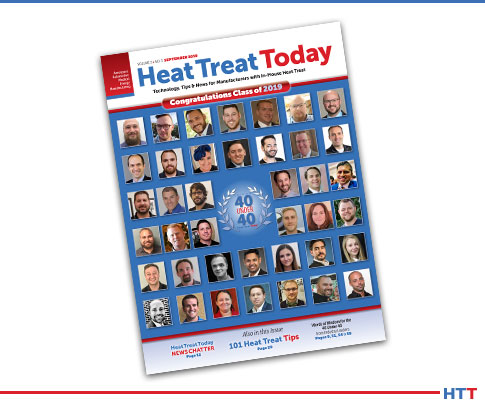
Heat Treat Today is privileged to oversee the 40 Under 40 recognition awards highlighting a group of young, up-and-coming talent in the North American heat treat industry every year. This year’s Class of 2019 is no disappointment–a group of industry elite, significant contributors to the heat treat market.
Every couple of weeks we highlight two of the current class of recipients. This week we introduce Ben Gasbarre of Gasbarre Thermal Processing Systems and Brinson White of Pelican Wire.
Name: Ben Gasbarre Company: Gasbarre Thermal Processing Systems Position: President
Ben has worked his way up through his family’s company which was founded by his grandfather and father. He earned a Bachelor of Science in Operational Management and Supervision from Penn State University and is currently working toward an MBA from the University of Michigan which he expects to finish by the end of this year. Ben is currently on the Industrial Heating Executive Committee and is a graduate of MTI’s YES Management Training Program. His roles at the company included Manufacturing Manager at Sinterite and C. I. Hayes. Soon after the acquisition of J. L. Becker, he moved to Plymouth, Michigan, where he was initially Manufacturing Manager, promoted to General Manager, and is currently the President of what is now Industrial Furnace Systems, a Division of Gasbarre Thermal Processing Systems, which continues to service and support J. L. Becker brand equipment. Ben has been instrumental in hiring personnel, managing the company (sales, engineering, manufacturing and service), improving project management, and enabling product development including IFS’s new vacuum purge nitriding furnace.
Nominated by: Gasbarre Thermal Processing Systems
Name: Brinson White Company: Pelican Wire Position: Director of Engineering
Brinson is responsible for the custom design and development and installation of custom manufacturing equipment, processes, and software which benefit the entire heat treat industry through improved products and performance. Brinson’s expertise in developing the tools necessary for these fine-gauge, high-temp solutions has served over 250 customers and end-users with improved products and technical expertise.
Nominated by: Pelican Wire
Read more about the feature at Heat Treat Today’s 40 Under 40 resource page and find out more about each of this year’s winners by clicking on their image. To nominate someone for the Class of 2020 40 Under 40, please click here.
Heat Treat Today offers News Chatter, a feature highlighting representative moves, transactions, and kudos from around the industry.
Personnel & Company Chatter
Mike Smith has joined Magnetic Specialties, Inc. as their new Business Development Manager.
Ipsen USA has announced the completion of its 2019 Corporate Academy class, which is part of an initiative to grow service capacity globally. Seven graduates will step into positions as field service engineers after several months of training and passing their final exam.
Tom Gundic recently joined Solar Atmospheres’ facility in Greenville, South Carolina, as their new plant manager.
Isostatic Toll Services Bilbao is pleased to announce the official opening of its new plant in Abanto-Zierbena, Spain, on January 29th.
Heating Furnace at Uddeholm AB, which is taking part in the electrical heating project
The Swedish Energy Agency has granted a new project that will explore the possibilities of electrifying heating processes. It will evaluate the potential of replacing gas-fired furnaces with electrically heated furnaces for material heating. Kanthal, part of the Sandvik Group, is taking part in the project.
Sean Toland has taken on the position of executive Vice President of Operations for Wire Experts Group, the parent company to Pelican Wire and Rubadue Wire, the second of which Toland is already serving as president.
NSA Industries, a provider of metal fabrication, machining, powder coating, and assembly operation, has acquired VitexExtrusion, a provider of aluminum extrusions, machining, and fabrication services for solar and automobile customers.
Jon K. Tabor is retiring from the position of Chairman Emeritus of Allied Mineral Products effective March 31, 2020. He will remain on Allied’s Board of Directors.
Vincent Esteve has been promoted to Business Development Manager at the ECM USA, Inc. subsidiary in Pleasant Prairie, Wisconsin.
Mike Smith, Business Development Manager, Magnetic Energies, Inc.
Tom Gundic, Plant Manager, Solar Atmospheres
Sean Toland, Executive Vice President of Operations, Wire Experts Group
Vincent Esteve, Business Development Manager, ECM USA
Jon K. Tabor, Chairman Emeritus, Allied Mineral Products
Equipment Chatter
Wisconsin Oven has shipped a Natural Gas (Direct) Fired Continuous Duty Conveyor Oven to an American manufacturer to be used for stress relieving steel snap rings used in automotive parts.
L&L Special Furnace Co, Inc. has shipped five model GS1714 furnaces to a worldwide leading manufacturer of chemicals and chemical coating products located in the Midwestern US.
Tenova LOI Thermprocess recently received an order from Joint Stock Company Pervouralsk Pipe Plant in Russia for a new roller hearth continuous furnace system for bright annealing stainless steel pipes in a 100% H2 atmosphere.
Lindberg/MPH announced the shipment of two Electrically Heated Nitrogen Atmosphere Pit Furnaces to the automotive industry for the purpose of heat treating automotive parts.
Natural Gas (Direct) Fired Continuous Duty Conveyor Oven
GS1714 Bench mounted box furnace
Roller hearth continuous furnace system
Electrically heated atmosphere pit furnace
Kudos Chatter
Kittyhawk Products OR LLC has been awarded Nadcap® accreditation for Heat Treating/Hot Isostatic Pressing (HIP). Kittyhawk Inc has held Nadcap® accreditation since 2014.
From Left to Right: Quality manager, AM/NS Calvert, Bobbie Hesley; GM supplier quality engineer, Mark Wu; AM/NS Calvert CEO, Jorge Oliveira and team members from the AM/NS hot dip galvanizing lines.
ArcelorMittal USA was recently honored with the General Motors Supplier Quality Excellence Award for three production facilities: AM/NS Calvert, Calvert, AL; Indiana Harbor; and I/N Tek and I/N Kote, New Carlisle, IN.
Heat Treat Today is pleased to join in the announcements of growth and achievement throughout the industry by highlighting them here on our News Chatter page. Please send any information you feel may be of interest to manufacturers with in-house heat treat departments especially in the aerospace, automotive, medical, and energy sectors to editor@heattreattoday.com
Heat TreatTodayoffers News Chatter, a feature highlighting representative moves, transactions, and kudos from around the industry.
Personnel & Company Chatter
Bharat Forge America Inc. will build an aluminum forging plant to manufacture automobile components in Sanford, North Carolina.
Ipsen USA recently announced the completion of an initiative to expand aftermarket services across the United States and Canada. Five regional sales engineers (RSEs) were hired over the last six months to assist customers with replacement parts, retrofits, upgrades, service, and technical support for any brand of atmosphere or vacuum heat-treating system.
An industrial heating technology company, Kanthal, recently launched an additive manufacturing service that will produce heating elements and components, as well as developing a new iron-chromium-aluminum alloy called Kanthal AM100.
GKN Aerospace has been selected as a key supplier on the new Gulfstream G700 business jet. The company is using its expertise in the design and manufacture of business jet empennages and thermoplastic components on the advanced aircraft. The rudder and elevators that are part of the empennage, as well as the floorboards, feature the latest thermoplastic technology. GKN Aerospace also produces the bonded fuselage panels for the new fuselage.
A ribbon-cutting ceremony recently marked the opening the new corporate headquarters and manufacturing facility of Process Cooling Systems, Inc. in Massachusetts.
Gasbarre Thermal Processing Systems recently partnered with Humberto Bastidas from Thermal Technic Furnace Solutions. Gasbarre will be working with Humberto and his team to launch a Spanish version of Gasbarre.com in the coming weeks and will assist with other marketing efforts in that region.
Equipment Chatter
A manufacturer of products from carbon recently provided large, custom Sigrabond Performance CFC fixtures to a North American aerospace company. By replacing the current alloy fixture with the new CFC fixtures from SGL Carbon, the customer increased part/fixture weight ratio from 62/38 to 87/13.
Two electrically heated multi-zone curing ovens were recently shipped to the composites industry by Wisconsin Oven for the purpose of curing carbon fiber threads.
A Model FB1046 floor-standing box furnace has been shipped by L&L Special Furnace Co, Inc., to a worldwide leader of high tech aerospace and associated components located in the Southeastern United States. The furnace will be used for processing aerospace parts and various thermal applications.
Danieli Olivotto Ferrè recently started up a tube roller hearth annealing furnace at Tenaris Tamsa, in Veracruz, part of one of the world’s largest manufacturers of steel pipe for the energy and automotive industries. The furnace is designed to treat steel tubes coming from cold or hot processing with a maximum throughput of 5 tons/h. The flexible furnace is able to perform different heat-treatment cycles, including normalizing, annealing, tempering and stress relieving. In addition, Danieli has been selected to supply the new electric arc furnace (EAF) melt shop and plate-/steckel-mill, as well as an electrical and automation package provided by Danieli Automation, for Nucor Corporation and its new greenfield plate steel mill complex in Brandenburg, Kentucky.
Dana Incorporated announced the expansion of a joint engineering agreement with Fendt, a worldwide brand of AGCO. Over the past three years, the companies have co-developed advanced Spicer® 980 independent suspended axles for the new Fendt 900 Vario series of large tractors.
Allegheny Technologies Incorporated announced it signed another 1-year agreement to extend and expand carbon steel hot-rolling conversion services for NLMK USA at its world-class hot rolling and processing facility, or HRPF, located in Brackenridge, Pennsylvania.
A global leading stainless steel manufacturer with headquarters in Spain, Acerinox, S.A., has reached an agreement for the acquisition from Lindsay Goldberg Vogel GmbH and Falcon Metals BV. of VDM Metals Holding GmbH, with headquarters in Germany and leading producer of specialty alloys.
A vacuum furnace for processing additive manufactured parts has been shipped to a large science and technology laboratory by Solar Manufacturing. The lab requires the furnace to further research and development work.
Through its subsidiary, Tenova Goodfellow Inc., Canada, Tenova installed and commissioned a peak shaver at VINA Kyoei Steel, Vietnam, providing continuous improvement for melt shop operations.
Kudos Chatter
A Ph.D. student at the University of Strathclyde in Glasgow, Scotland, Lewis Print is the inaugural winner of an international student award in industrial heating, the Kanthal® Student Award, presented by industrial heating technology company Kanthal. The award has been made for his work on the development of new technology for the production of silicon carbide (SiC) heating elements used in high-temperature industrial processes operating in the range 2012°F-2912°F (1100°C-1600°C).
At the October fall meeting in Vancouver, Canada, the Metal Treating Institute (MTI) recognized Mary Springer from Thermtech in Waukesha, Wisconsin, with the Heritage Award. The Heritage Award is MTI’s most prestigious award.
The Center for Materials Processing Data (CMPD) recently announced three organizations have committed to the Center’s inaugural Industry Member class: Pratt & Whitney (a founding industry member), MTS Systems Corporation, and Weber Metals. This commitment, operating to solidify its formation, has allowed CMPD to greenlight a pilot project focused on the material flow behavior as a function of temperature, strain rate, composition, and prior microstructure processing.
Pelican Wire was named the winner of the 25th annual Southwest Florida Blue Chip Community BusinessAward at this year’s luncheon and awards ceremony. Chosen by an independent panel of judges, the criteria are centered around overcoming adversity to achieve success.
ASB Industries, Barberton, Ohio, announced that Charles Kay, ASB vice president, was recognized as an ASM Fellow at the annual ASM Awards Banquet in October. The award citation states, “For global technical leadership in innovative thermal spray technologies, mentoring thermal spray practitioners, and sustained dedicated volunteer service to the thermal spray community.”
Heat TreatTodayis pleased to join in the announcements of growth and achievement throughout the industry by highlighting them here on our News Chatter page. Please send any information you feel may be of interest to manufacturers with in-house heat treat departments especially in the aerospace, automotive, medical, and energy sectors to editor@heattreattoday.com
A Dozen Quick Heat TreatNewsItems to Keep You Current
Heat TreatTodayoffers News Chatter, a feature highlighting representative moves, transactions, and kudos from around the industry.
Personnel and Company Chatter
Patrick J. DeCourcy, who has served as Allegheny Technologies Incorporated’s Senior Vice President, Finance and Chief Financial Officer since 2013, recently announced plans to retire. To ensure a smooth leadership transition, he will remain in his current role until his successor is appointed and will retire from ATI on March 31, 2020.
A leading manufacturer of products used in the transmission, distribution, and measurement of water in North America, Mueller Water Products, recently announced plans to build a new, state-of-the-art foundry in Decatur, Illinois. According to Mueller, this facility is expected to be one of the largest finished goods brass foundries in the world.
Jerry Bunch has recently joined Pelican Wire as a Design Engineer II, and Larry Brindise has been hired as IT Development Leader. Bunch will be reviewing production processes, ensuring technical oversight to manufacturing steps and working to support the company-wide ‘continuous improvement’ program. Brindise comes to Pelican Wire with some knowledge of the company, as he has previously served Pelican Wire as a professional software consultant. He comes on-board full-time to lead an ongoing ERP project and will continue to develop and implement software solutions to improve the entire customer lifecycle process.
It has been announced that Opti-Tech Scientific, a leading Canadian supplier of scientific equipment, will represent Buehler, an ITW Company, in Canada. Opti-Tech Scientific specializes in optical/digital microscopy, metallography, and hardness testing.
Allegheny Technologies Incorporated announced it completed the sale of its Cast Products business unit to Consolidated Precision Products Corp. (CPP) of Cleveland, OH.
A partnership has been launched between leading Enterprise Artificial Intelligence® provider Noodle.ai and SMS group, which digitalizes plant and equipment used in steel and nonferrous-metals production and processing, to jointly further optimize the world’s first learning steel mill for Arkansas-based Big River Steel. To help Big River Steel conserve resources and control energy output, the joint solution was created by implementing Noodle.ai’s learning algorithms into SMS group’s X-Pact® MES 4.0. Noodle.ai was able to seamlessly leverage the fact that SMS group’s X-Pact® MES 4.0 was engrained into the steel mill’s IT environment and into their SaaS (Software as a Service) applications. The new end solutions digitize applications throughout every stage of the steelmaking process – starting at the liquid phase all the way to strip finishing.
Equipment Chatter
Centorr Vacuum Industries announced it has shipped its new Sintervac AM™ furnace for the debind and sintering of additively manufactured parts for a leading 3D/Additive Manufacturing company.
A customer needed the lower sidewalls of its forge furnace shotcreted with 90,000 lbs of material. Onex Inc posted a video of the job on Twitter.
The Slovakian company U.S. Steel Košice – one of the largest integrated steel producers in Central Europe – placed a major order for the supply of an annealing and coating line (ACL) for dynamo steel strips to Tenova LOI Thermprocess, a worldwide leader in heat treatment lines and furnaces located in Essen, Germany.
Kudos Chatter
The Chemical Coaters Association International (CCAI) recently announced the second annual Women in Finishing FORUM will be held at the Embassy Suites South Bend at Notre Dame from May 6-8, 2020.
Metal heat treater Exactatherm, based in Mississaugua, Ontario, has been awarded Nadcap Merit status for heat treatment.
The International Titanium Association (ITA), Denver, Colo., announces that metallurgist George L. Durfee has been named the recipient of the ITA’s 2019 Lifetime Achievement Award. A member of ASM International, Mr. Durfee is a metallurgist who built his career around pioneering applied research projects for the titanium industry at forging company Wyman-Gordon Co.
Heat TreatTodayis pleased to join in the announcements of growth and achievement throughout the industry by highlighting them here on our News Chatter page. Please send any information you feel may be of interest to manufacturers with in-house heat treat departments especially in the aerospace, automotive, medical, and energy sectors to the editor at editor@heattreattoday.com
A Baker’s Dozen Quick Heat TreatNews Items to Keep You Current
Heat TreatToday offers News Chatter, a feature highlighting representative moves, transactions, and kudos from around the industry.
Personnel and Company Chatter
Tom Spicer recently joined Gasbarre Industrial Furnace Systems (OEM of J.L. Becker brand equipment) as a Field Service Technician. Tom brings over 20 years of industry experience to the Plymouth, Michigan, company, having previously worked with OEMs assembling and servicing equipment and in maintenance at a commercial heat treat facility.
Changes at DANTE: The month of May saw the transition of Dan Londrico and Stefan Habean from intern to staff engineer. Charlie Li moved from Vice President to President of the company, and Lynn Ferguson became Emeritus. Edward Lee, a mechanical engineering student at The Ohio State University, joined the DANTE team as an intern.
Sławomir Woźniak has been appointed by the Supervisory Board at the SECO/WARWICK Group to the role of President of the Management Board. The new President has been appointed for the same period as the joint term of the new Management Board, which spans the next three full financial years.
Ajax TOCCO Magnethermic / Emmedi would like to congratulate Don Gibeaut on his election to Chairman of the North American Management Board of Directors (NAMB) for the International Tube Association (ITA). Don is the product manager for ATM’s Tubular Products Division.
A materials technology engineering group recently completed a partial acquisition of a provider of metal additive manufacturing (AM) services and advanced end-use components. Sandvik acquired a 30% stake in privately owned Beam IT, which supplies metal AM end components to demanding industries, including automotive, energy and aerospace, and holds several relevant quality certifications to serve these industries.
A new hot isostatic press (HIP) has been delivered and installed at Paulo’s Cleveland Division. The furnace was built by Quintus Technologies. The 30,000-sqft expansion to house the HIP vessel is complete and will provide the Cleveland Division room for additional expansion to support customer needs.
GE Additive recently announced that the company has made a significant investment in its electron beam melting (EBM) technology, with the purchase of an additional 17 A2X systems and 10 Spectra H systems. Avio Aero, a GE Aviation company, currently operates a fleet of 35 Arcam machines at its recently expanded site in Cameri, Italy. The additional EBM systems will be installed at GE Aviation and Avio Aero facilities in the US and Europe and will be used primarily for the production of titanium aluminide (TiAl) blades on the low-pressure turbine for the GE9X engine.
Metal Exchange Corporation (MEC), headquartered in St. Louis, MO, is forming a new joint venture with Novellini Industries Srl in Mantova, Italy. Called novALmec, the newly formed company will supply aluminum billet capacity to the European market.
Charlie Li, DANTE
Lynn Ferguson, DANTE
Equipment Chatter
An automotive supplier recently ordered a nitrocarburizing furnace for a new component line for a major carmaker. SECO/WARWICK commissioned the high-volume, horizontal retort furnaces, which will allow the customer to produce parts for North American suppliers. In addition to ferritic nitrocarburizing, the furnaces can provide clean, stress relief processing.
Four atmosphere controlled, aluminum coil annealing furnaces, which will be used to anneal automotive body stock and common alloy sheet coils, have been ordered by a leading U.S. aluminum producer from Consolidated Engineering Company.
A quench tank has been installed by Baker Furnace, a division of Thermal Product Solutions, for a supplier in the heat treatment industry. The customer had two quench tanks and three drop bottom furnaces and needed the third quench tank in order to optimize quench loads per day.
Kudos Chatter
During the 2019 CCAI Annual Meeting in Hilton Head, South Carolina, the Chemical Coaters Association International held their annual awards ceremony to recognize the CCAI Chapter Users and Suppliers of the Year and announce the 2019 James F. & David J. Wright Lifetime Achievement Award recipient. The 2018-19 Chapter Award winners are: Central States Chapter – Frank Laster, A-1 Paint Powder and Sandblasting LLC and Ron Cudzilo, George Koch Sons LLC; Georgia Chapter – Wayne Pettyjohn, Georgia Power Company; Las Vegas Chapter – Tony Sclafani, AR Iron, LLC and Sercy Spears, TIGER Drylac, Inc. USA; Northern Illinois Chapter – Matt Ambrose, Henkel Corporation; Salt Lake City Chapter – Ginny Phommavongsay, Martin Door Mfg.; Southern California Chapter – Shivie Dhillon, Sundial Powder Coating, Tony Sclafani, AR Iron, LLC and Luis Hernandez, Coral Chemical Co.; Twin Cities Chapter – Mark Walsworth, Retired and Jim Henningsen, Troy Chemical; West Michigan Chapter – In memory of Herb Knape, Knape Industries Inc., and Jason Meekof, Industrial Metal Cleaning; and Wisconsin Chapter – Justin Jarmuz, Wacker Neuson Corp. and Matt Roeser, DuBois Chemical Co.
During the July 9th Collier County Board of County Commissioners meeting, Pelican Wire was named the Collier County ‘Business of the Month’ and was recognized by the Board for being a manufacturing leader in Collier County for over forty years.
On July 11th, Solar Atmospheres hosted 28 high school students enrolled in the Summer Engineering Institute (SEI) at Lehigh University. The group also included a few members of Lehigh University undergraduate students and staff. The SEI program, under the guidance of Director Dr. Laura Moyer, is a two-week residential program, running two sessions back to back. Students are nominated by faculty of local high schools, and the program specifically targets under-represented groups including girls, first-generation students, and students who might otherwise have limited opportunities to study in the fields of science, technology, engineering, and math (STEM).
Heat TreatToday is pleased to join in the announcements of growth and achievement throughout the industry by highlighting them here on our News Chatter page. Please send any information you feel may be of interest to manufacturers with in-house heat treat departments especially in the aerospace, automotive, medical, and energy sectors to the editor at editor@heattreattoday.com
A Dozen Quick Heat TreatNews Items to Keep You Current
Heat TreatToday offers News Chatter, a feature highlighting representative moves, transactions, and kudos from around the industry.
Personnel and Company Chatter
Joyce Paliganoff (Midwest RSE), Patrick Heiser (Southeast RSE), and Larry Gomez (West/Northwest RSE) were recently hired by Ipsen USA as part of an initiative to double the number of Regional Sales Engineers (RSEs) by year-end.
A $9M investment provides needed space for capacity increases for Mercury Marine, which recently opened its 23,500 square foot expansion to its diecasting facility, where the company will manufacture complex blocks, driveshafts, and gearcases for Mercury outboards. In addition, Mercury will add another 4,500-ton die-cast machine giving the company two of the largest of its kind in North America.
SPIROL employees, company executives, board members, state representatives, and other honored guests gathered to celebrate the completion of the major expansion to SPIROL’s world headquarters and largest global manufacturing facility located in Northeastern Connecticut.
Digital manufacturing company, Protolabs has launched production capabilities for its metal 3D printing service. The new capabilities use secondary processes to improve the strength, dimensional accuracy, and cosmetic appearance of metal parts.
Equipment Chatter
A manufacturer in the automotive industry recently purchased an electrically heated enhanced duty walk-in series oven from Wisconsin Oven Corporation. The batch oven will be used for pre-heating racks of plastic parts prior to painting.
A leading supplier of high-quality automotive parts commissioned a Brinell hardness testing specialist for a second bespoke system for the intricate inspection of automotive suspension components. The challenge that Foundrax faced was that the hardness test location as specified by the car manufacturer was in an extremely tight space, hemmed in on three sides by vertical sections and almost no test area to work with. As many of these parts are hollow, there is no other position which would be strong enough to allow for a reliable test.
A retort box furnace was shipped and installed at the facility of an aerospace components manufacturer based in the southern U.S by L&L Special Furnace Co., Inc. The furnace is used to de-binder ceramic matrix composite components deployed in the aircraft industry. The main function of the furnace is to remove all organics and other materials used in the product prior to placing it in a high-fire vacuum chamber. This de-bindering process is extremely important and allows for a finished product that is not only very strong but also lightweight.
No. 824 is a 500°F (260°C), modified universal oven from Grieve, currently used for housing a vertical conveyor system at the customer’s facility. Grieve also shipped No. 797, a 260°F (127°C), clean room cabinet oven, to be used for drying coating on printed circuit boards at the customer’s facility.
Qinghai Zhuofeng New Material Co., Ltd, based in China, recently received shipment of two continuous annealing and processing lines, each with an annual capacity of 110,000 tons, from technology Group ANDRITZ.
Kudos Chatter
In 1986, Dave Strand was hired by Wisconsin Oven Corporation as a shop worker. In 2019, he retires as President & CEO of Thermal Product Solutions, LLC, the parent company of Wisconsin Oven. Dave Strand has dedicated 33 years to the continued growth of Wisconsin Oven Corporation.
Dave Strand
During the HEAT TREAT 2019 conference, Fluxtrol Inc., in conjunction with the ASM Heat Treating Society, will be recognizing and awarding academic researchers and young scientists in the field of thermal processing. Two Fluxtrol/ASM awards will be given, the “Prof. Valentin S. Nemkov Academic Research Award,” and the “Fluxtrol Student Research Award”.
In an effort to continually improve the workplace environment for all Employee-Owners, the Pelican Wire leadership team recently announced a new, comprehensive “Paid Family Leave” benefit. This expanded paid-leave benefit includes maternity/paternity leave and leave for primary caregivers of immediate family members with a serious health condition requiring
full-time care.
Heat TreatToday is pleased to join in the announcements of growth and achievement throughout the industry by highlighting them here on our News Chatter page. Please send any information you feel may be of interest to manufacturers with in-house heat treat departments especially in the aerospace, automotive, medical, and energy sectors to the editor at editor@heattreattoday.com
A Baker’s Dozen Quick Heat Treat News Items to Keep You Current
Heat TreatTodayoffers News Chatter, a feature highlighting representative moves, transactions, and kudos from around the industry.
Personnel and Company Chatter
Kestrel Company, an investment corporation founded by Shelby Ray, has purchased the remaining assets of Eagle Steel Products from Shirley Ohta, who founded Eagle in 1982. The new ownership, led by Ray, expects to maintain its woman- and minority-owned business status. Eagle operates a steel and metal products warehousing and distribution facility in Louisville, Kentucky.Kestrel Company will be doing business as Eagle Steel & Metal Products.
Jerram Dawes has recently joined Phoenix Temperature Measurement (PhoenixTM) as Sales Manager, bringing 20 years experience of working for a well-known temperature profiling equipment supplier.
Kimberly A. Fields recently joined Allegheny Technologies Incorporated (ATI) as Executive Vice President with full P&L responsibility for the Flat-Rolled Products Group, succeeding Robert S. Wetherbee, who held this role until becoming ATI’s President and CEO. Ms. Fields brings 20 years of global experience with a focus on growth and operational excellence.
After almost 9 months away from the company, Ed Valykeo has recently returned to Pelican Wire as the company’s thermocouple specialist. With almost four decades of experience in the wire manufacturing space, Ed is recognized as an industry expert within the thermocouple wire manufacturing world. In his career, Ed has been an active member of ASTM for over twenty-five years and spent almost two decades in various technical positions at Hoskins Manufacturing, an industry pioneer.
American Posts LLC has acquired Ohio-Kentucky Steel, which provides slitting of steel and aluminum. American Posts, LLC was established in March 2005 and is the last manufacturer of steel u-posts in the United States.
Brelie Gear Co, Inc. has announced plans to build a new 36,800 sq. ft. facility on a recently purchased 4.3-acre site in Waukesha, Wisconsin. Brelie will be moving from their current plant in Milwaukee to the new, larger plant. The new larger space will continue to run as a full-service gear manufacturing facility that houses the latest in equipment technology and automation.
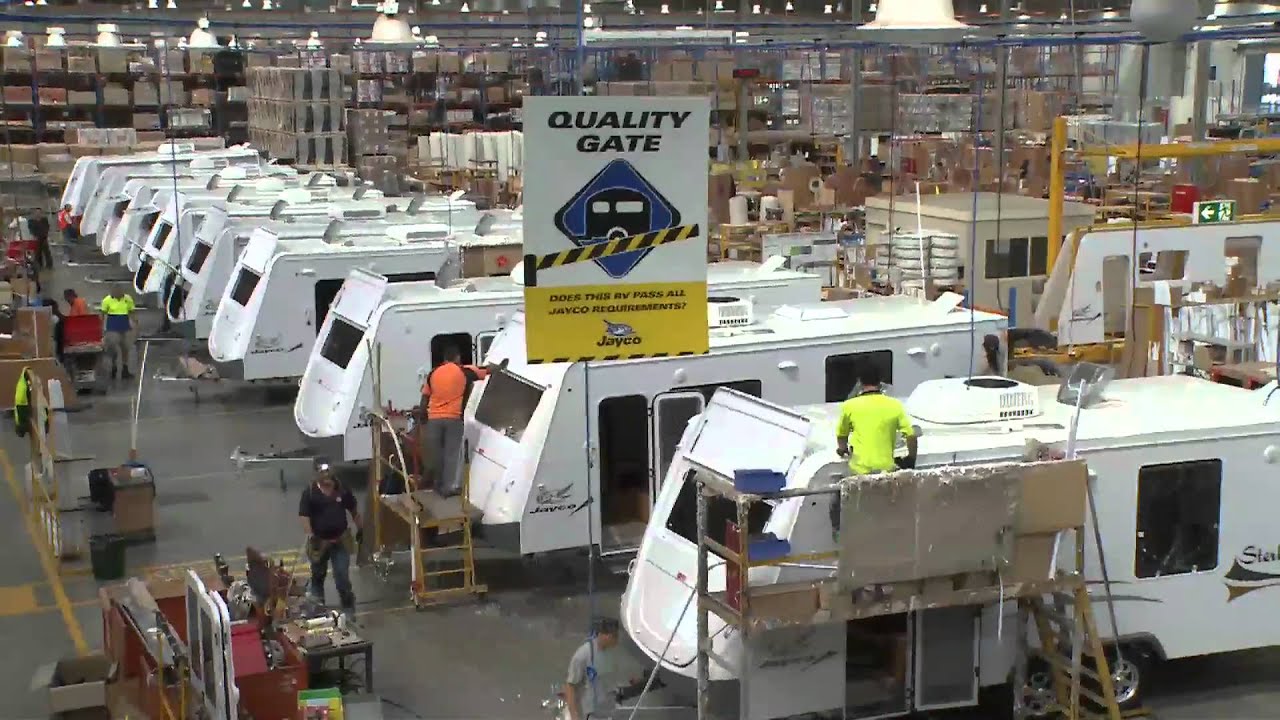
Sage Metals Private Ltd., a portfolio company of Delos Capital and a manufacturer of specialty metal products, has acquired Jayco Manufacturing. Based in Grand Prairie, Texas, Jayco is involved in the assembly, integration, and production of precision custom metal-formed components for a variety of industrial and consumer end markets.
Kestrel Company purchased the assets of Eagle Steel Products. The company is now Eagle Steel & Metal Products.
Jerram Dawes has recently joined Phoenix Temperature Measurement (PhoenixTM) as Sales Manager.
Kimberly A. Fields recently joined Allegheny Technologies Incorporated (ATI) as Executive Vice President.
Ed Valykeo has recently returned to Pelican Wire as the company’s thermocouple specialist.
Brelie Gear Co, Inc. has announced plans to build a new 36,800 sq. ft. facility in Waukesha, Wisconsin.
Sage Metals Private Ltd. has acquired Jayco Manufacturing.
Equipment Chatter
A 2-zone indirect gas-fired heavy duty walk-in furnace was recently shipped to a global manufacturer in the composite industry. Wisconsin Oven Corporation announced that this project passed the stringent temperature uniformity requirements to meet BAC 5621 Class 1 Furnaces and Instrumentation Type D specifications.
A vacuum purge semi-continuous Active Only® CAB furnace was recently commissioned by SECO/WARWICK for a North American automotive aftermarket manufacturer.
Nucor Steel Marion, Inc., based in Marion, Ohio, granted SMS group the Final Acceptance Certificate (FAC) of the supplied walking beam furnace shortly after successful commissioning. The NOx content of this furnace is close to 25 parts per million. The furnace is designed according to innovative pre-fabrication methods and features proprietary SMS ZEROFlame burners.
Five Blue M Standard mechanical convection ovens were recently shipped to a global manufacturer of automotive parts by Thermal Product Solutions.
A 2-zone indirect gas-fired heavy duty walk-in oven shipped to a global manufacturer in the composite industry.
A vacuum purge semi-continuous Active Only® CAB furnace was delivered to a North American automotive aftermarket manufacturer.
Final Acceptance Certificate (FAC) was issued for a walking beam furnace shortly after successful commissioning.
Five Blue M Standard Mechanical Convection Ovens were recently shipped to a global manufacturer of automotive parts.
Kudos Chatter
The Powder Coating Institute (PCI) recently introduced the third video in the Powder Coating, A Better Kind of Paint consumer video series. Powder Coating: A Stronger Kind of Paint rounds out the “Stronger, Greener, Better” portion of the series. PCI also introduced a PCI Certification Program promotional video, which features three PCI certified companies sharing the benefits of certification and their experience with the process.
The HPC4Manufacturing (HPC4Mfg) Program recently awarded nearly $3.8 million for thirteen projects designed to stimulate the use of high-performance supercomputing in U.S. manufacturing. These projects will address key challenges in U.S. manufacturing proposed in partnership with companies and improve energy efficiency across the manufacturing industry through applied research and development of energy technologies. Each of the thirteen newly selected projects will receive up to $300,000 to support work performed by the national lab partners and allow the partners to use HPC compute cycles. Awardees include: (1) Arconic Inc. will partner with ORNL to model rolling processes to observe the evolution of porosity in a project titled “Computational Modeling of Industrial Rolling Processes Incorporating Microstructure Evolution to Minimize Rework Energy Losses”. (2) United Technologies Research Center (UTRC) will partner with ORNL to understand microstructure evolution during heat treatment of additively manufactured parts in a project titled “Predictive Tools for Customizing Heat Treatment of Additively Manufactured Aerospace Components”. (3) Steel Manufacturing Simulation and Visualization Consortium (SMSVC) and ArcelorMittal USA will partner with ANL to improve the efficiency of the reheat furnace process in steel manufacturing in a project titled “Application of High-Performance Computing (HPC) to Optimize Reheat Furnace Efficiency in Steel Manufacturing”.
Heat TreatTodayis pleased to join in the announcements of growth and achievement throughout the industry by highlighting them here on our News Chatter page. Please send any information you feel may be of interest to manufacturers with in-house heat treat departments especially in the aerospace, automotive, medical, and energy sectors to the editor at editor@heattreattoday.com.









 Name: Ben Gasbarre