

Medical Heat Treat News

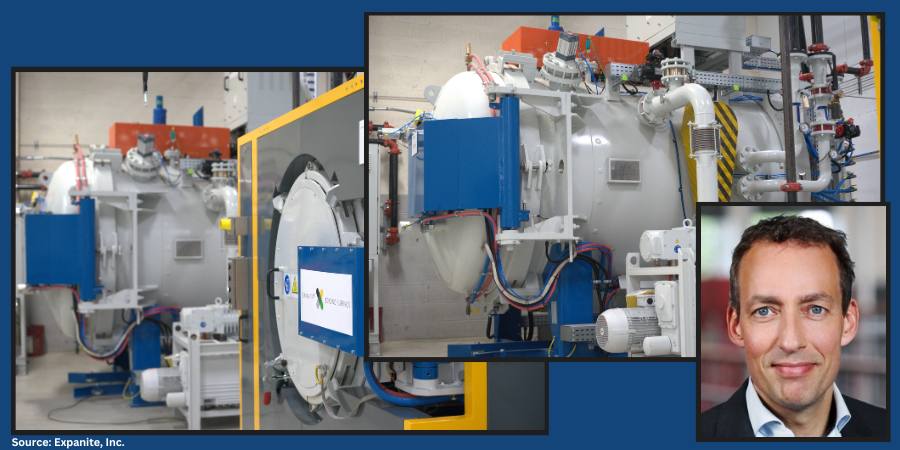
Heat Treater Triples Surface Hardening Capacity at Ohio Facility

A heat treating company that processes stainless steel, titanium, and other specialty alloys is expanding its operations with a major investment in a larger facility, tripling its heat treatment and surface hardening capacity. The automotive and medical devices industries are among those the company serves at its Twinsburg, Ohio, location.

Thomas Sandholdt
CEO
Expanite, Inc

With the new equipment, Expanite Inc., a subsidiary of Expanite A/S, based in Denmark, will be able to meet the growing demand for advanced surface hardening and heat treatment solutions. The new furnaces, installed by SECO/WARWICK, have chamber sizes up to 24x24x36 inches and process larger and more complex components. This expansion will allow the company to meet its commitment to sustainability by offering greener alternatives to traditional technologies.

“Our investment is all about meeting the growing demands from our North American customers,” said Thomas Sandholdt, CEO of Expanite. “We’re now able to handle much larger volumes while maintaining the fast lead times and flexibility that our customers expect from Expanite.”

“Our expanded capabilities mean we can now offer our full range of Expanite technologies, including the processes for titanium, right here in the U.S.,” said Claus Løndal, country manager for Expanite North America. “This allows us to serve a wide range of customers while reducing lead times and costs.”

Besides the proprietary Expanite processes, standard vacuum heat treatment processes are offered, including hardening of tool steels (D2, A2, M2, H13, etc.), austenite annealing of stainless (304, 316, etc.), precipitation treatment of PH-steels (17-4PH, 13-8PH, etc.) and specialty treatment of alloys (Inconel 718, MU-metal etc.). The addition of vacuum heat treatment solutions extends the company’s capabilities, offering more solutions, and greater flexibility and ensuring clients receive hardening solutions tailored to their specific needs. In this expansion, Expanite is bringing its patented technology for hardening of titanium to North America.


Heat Treater Triples Surface Hardening Capacity at Ohio Facility Read More »
Schilling Forge Increases Capacity with Car Bottom Furnace

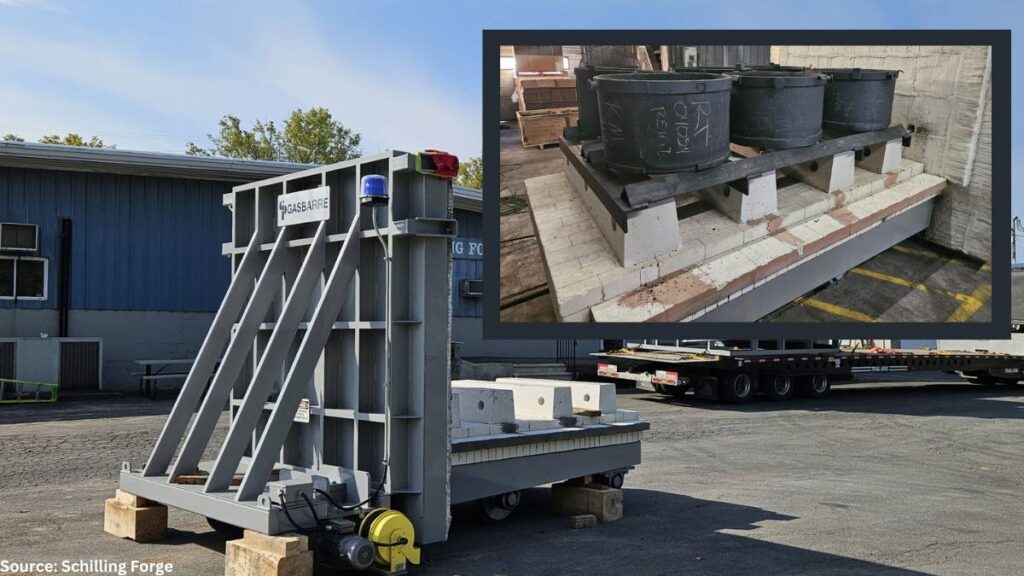
Schilling Forge, a supplier of precision forgings based in Syracuse, NY, recently increased its annealing capacity with a car-bottom furnace. The company produces forgings for a variety of industry segments in medical manufacturing, including surgical, dental, orthodontic, and endoscopic.

The furnace, designed and manufactured for the company by Gasbarre Thermal Processing Systems, is electrically heated with an operating range of has a work zone of 60” x 84” x 40” with a 9,000-lb load.  It is electrically heated with operating range of 1250°F to 1600°F (732°C to 871°C).

“We are excited about the arrival of our new Gasbarre car-bottom furnace that increases our annealing capacity by 67%,” reported Schilling Forge on a LinkedIn post. “You can see our survey posts where we attached our thermo-couples at 9 various locations to verify the temperatures throughout the cycle.


Schilling Forge Increases Capacity with Car Bottom Furnace Read More »

Adamus Expands Heat Treating Capabilities with Vacuum Furnace

Adamus, a punch tool manufacturer for the pharmaceutical industry, has enhanced its heat treating operations with a vacuum furnace. The company manufactures punch tools and spare parts for tablet presses, capsule presses, and blister machines, and the new furnace is intended for processing a wide range of punches used in tablet production.

Maciej Korecki
Vice President, Vacuum Furnace Segment
SECO/WARWICK
Source: SECO/WARWICK

Adamus contacted us for the fourth time,” said Maciej Korecki, vice president of the vacuum furnaces segment at SECO/WARWICK. “This time, the partner wanted to replace an older, inefficient vacuum furnace with oil hardening, with a modern, more ecological and more economical vacuum furnace with gas hardening. Vector will perfectly meet these needs. It is compact, so it will not take up much space, it is efficient and ensures process purity, which is extremely important in the pharmaceutical industry.”

Vector vacuum furnace
Source: SECO/WARWICK

The Vector vacuum furnace on order solves Adamus’s challenge to grow production in order to meet their increased demand for the number of punch hardening processes for tablet production. The presses produce components that are integral to the manufacturing process in the pharmaceutical industry, which maintains demanding standards, procedures, and technical parameters.

“The challenge is the constantly growing demand for our punches and spare parts used for units operating in pharmaceutical plants,” said a representative of Adamus, based in Poland. “However, it is important to choose well-thought-out solutions which will be used in many processes when expanding the machine park, ensuring the highest quality of production.”

The press release is available in its original form here.


Adamus Expands Heat Treating Capabilities with Vacuum Furnace Read More »

Fringe Friday: Furnace Designed To Fit Medical Industry Supplier Specs

We’re celebrating getting to the “fringe” of the weekend with a Heat Treat Fringe Friday covering news about a Class A safety batch furnace delivered to a supplier to the medical industry. The components manufacturer needed equipment that would accommodate the doorway dimensions of its facility and found a Pennsylvania-based international industrial and laboratory furnace manufacturer able to design one to fit the specs. 

While not exactly heat treat, “Fringe Friday” deals with interesting developments in one of our key markets: aerospace, automotive, medical, energy, or general manufacturing.


A supplier to the medical industry recently purchased a Class A safety oven from an international industrial and laboratory furnace manufacturer. The Pennsylvania-based provider designed the batch furnace for ease of move-in and installation, modified to an overall height of 79 inches and width of 45” to accommodate the ceiling height and doorway dimensions at the client’s facility.

Blue M® manufactured the furnace with a temperature range of 15°C (59°F) above ambient to 316°C (601°F). The temperature is controlled by a Watlow EZ Zone PM controller with advanced PID control algorithm. The controller offers TRU-TUNE™ adaptive control for tight control and auto-tune for a quick, efficient start up.

 “Blue M offers customers the flexibility to request engineered-to-order modifications to our standard oven designs,” said Jonathan Young, product manager at Blue M. “This Class A oven features custom exterior dimensions to accommodate the customer’s facility ceiling height and doorways. This is the second unit with these special dimensions that this customer has ordered.”

The interior chamber has dimensions of a 48″ W x 24″ D x 48″ and is constructed with 304 stainless steel. All of the seams and ports of the interior chamber are Heli-Arc welded vapor tight to prevent fume infiltration and buildup of flammable materials between the chamber walls. The unit includes five (5) 304 stainless steel slotted shelves with rolled fronts for ease of product loading. Each shelf is capable of holding a 75lb product load.

Blue M is located in New Columbia, PA, owned by Thermal Product Solutions.

The press release is available in its original form here.


Fringe Friday: Furnace Designed To Fit Medical Industry Supplier Specs Read More »

Heat Treater Launches Expanded HIP Capacity Production at South Carolina Facility

A U.K.-based thermal processing service provider announced it has begun production at its facility in Greenville, SC, where it recently expanded its hot isostatic pressing (HIP) services. The site houses heat treating operations, EDM, and other capabilities to serve the aerospace, defense, power generation, medical, and general industries.

HIP Product Fabrication – metal part from powder metal
Source: Bodycote

The additional HIP capacity at Bodycote‘s Greenville location was commissioned to service the development and processing of advanced materials for industries situated within the Southeastern U.S. as well as other Bodycote facilities in the supply chain. With HIP capacity now in full production, Bodycote is able to meet the rising demand for highly reliable additive manufacturing post-processing. The company has more than HIP vessels of varying sizes in multiple locations. Processing capability can accommodate components nominally up to 6.5ft in diameter by 12ft high, and weighing over 30,000kg.

The press release is available in its original form here.

Featured photo: HIP furnace being lowered into place


Heat Treater Launches Expanded HIP Capacity Production at South Carolina Facility Read More »

Titanium-Copper Alloy May Improve 3D Process for Medical, Aerospace Applications


Source: Today’s Medical Developments


A new category of high-performance titanium-copper alloys for 3D printing is being considered for medical device, aerospace, and defense applications, and heat-treating may improve the process further.

In a collaborative project, leading researchers from RMIT University, CSIRO, the University of Queensland, and The Ohio State University studied the problem of titanium alloys being prone to cracking or distortion due to cooling and bonding together in column-shaped crystals during the 3D printing process. But a titanium-copper alloy developed by the research team seems to have solved this dilemma.

“Of particular note was its fully equiaxed grain structure,” said Professor Mark Easton from RMIT University’s School of Engineering in Today’s Medical Developments. “This means the crystal grains had grown equally in all directions to form a strong bond, instead of in columns, which can lead to weak points liable to cracking. Alloys with this microstructure can withstand much higher forces and will be much less likely to have defects, such as cracking or distortion, during manufacture.”

More from this Best of the Web:

CSIRO Senior Principal Research Scientist, Dr. Mark Gibson, says their findings also suggest similar metal systems could be treated in the same way to improve their properties.

“Titanium-copper alloys are one option, particularly if the use of other additional alloying elements or heat treatments can be employed to improve the properties further,” Gibson says. “But there are also a number of other alloying elements that are likely to have similar effects. These could all have applications in the aerospace and biomedical industries.”


Read more: “Adding Copper Strengthens 3D-Printed Titanium”

Main photo credit / caption: RMIT University / 3D-printed titanium-copper bars with titanium powder and copper powder.

Titanium-Copper Alloy May Improve 3D Process for Medical, Aerospace Applications Read More »

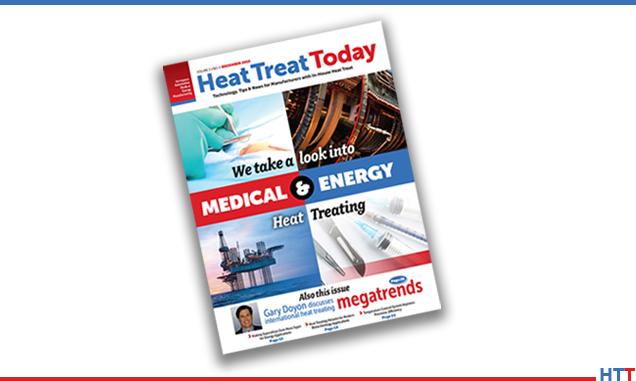
Heat Treat Today Launches Live Link to Digital Edition of 2019 Medical/Energy Heat Treat Issue

Heat Treat Today has launched Medical & Energy Heat Treating special edition in print and digital form, the fifth print magazine and the third in a series of industry-specific quarterlies.

The print edition of Medical & Energy Heat Treating entered the mail stream mid-December and landed in the mailboxes of 6,000 medical and energy manufacturing suppliers and OEMs. The digital edition is available by clicking here.

In this special magazine, Heat Treat Today delivers quality content both new and original as well as a round-up of past medical- and energy-related news, technical articles, and tips, including:

  • “Medical Alloys: Their Uses & Heat Treatments” / Diagnostic guidewires, minuscule screws for implants, complex surgical tools operated robotically, and the sophisticated metals and alloys used in their development.
  • Making Superalloys Even More Super for Energy Applications
  • “Heat Treating Melanin for Modern Biotechnology Applications” / Developing an annealing process for eumelanin, an electrically conductive type of melanin.
  • “Temperature Control System Improves Precision, Efficiency on Heat Treat Equipment: A Case Study” / A century-old die-forgings producer’s journey of improving its temperature process control system.
  • “Megatrends with Gary Doyon” / During a wide-ranging conversation, Gary Doyon, president and CEO of the Inductotherm Group, discusses international heat treating megatrends, as well as cybersecurity, immigration, the impact of electric vehicles on the heat treat supply chain, and Brexit.

If you haven’t done so already, you might want to join one of Heat Treat Today’s LindedIn Groups: “Leaders in Medical Heat Treat” and “Leaders in Energy Heat Treat“.  You’ll need to sign in to LinkedIn before you can join the group.

Go here for the digital edition, or go to www.heattreattoday.com and click on the Resources tab to link to the Digital Edition.


Heat Treat Today Launches Live Link to Digital Edition of 2019 Medical/Energy Heat Treat Issue Read More »

NY Med Device Outsourcer Acquires Assets of Maker of Complex Braided Biomedical Structures

A medical device outsource manufacturer based in Clarence, New York, which offers heat treating capabilities, recently announced its purchase of certain assets of a manufacturer of complex braided biomedical structures for disposable and implantable medical devices.

Integer Holdings Corporation’s acquisition of US BioDesign, located in Quakertown, Pennsylvania, will add differentiated capability for complex braided and formed biomedical structures to Integer’s broad portfolio.

Integer president and CEO Joe Dziedzic

Founded in 2011, US BioDesign serves the cardiovascular, neurovascular, and general surgery markets with nitinol, stainless steel, polymer, and other braided structures that are enabling the next generation of structural heart, peripheral vascular, neurovascular and electrophysiology products. They also provide product development, material testing, and post-processing services, including electropolishing and packaging.

“The acquisition of US BioDesign assets will allow us to partner with our customers to enhance patient lives in new ways,” said Integer president and CEO Joe Dziedzic. “US BioDesign has demonstrated engineering prowess in the area of complex braided and formed biomedical structures, which will set us apart from the competition as we partner with customers to develop life-saving medical devices.”

Tom Molz, currently president and CEO of US BioDesign

“We are excited to bring our complex braided biomedical structures and capabilities to the leader in medical device outsource manufacturing,” said Tom Molz, currently president and CEO of US BioDesign. “Our combined capabilities, engineering and innovation will allow us to accelerate our growth while better serving our customers and their patients worldwide.” Molz will continue to cultivate the complex braiding business while reporting to Payman Khales, president of Integer’s cardio and vascular business.

NY Med Device Outsourcer Acquires Assets of Maker of Complex Braided Biomedical Structures Read More »

Special Metals, Alloys Finding New Uses in Medical Device Manufacturing


Source: Medical Design Briefs


Diagnostic guide wires, minuscule screws for implants, complex surgical tools operated robotically—these are standard devices and equipment in the innovative and technology-rich medical arena, and sophisticated metals and alloys are regularly being used in their development, thanks to continuing advancements in medical technology.

“Titanium has been a consistent performer for a number of years, tantalum is emerging, and copper is re-emerging, while advancements in technology are creating a worldwide demand for a variety of other metals along with new versions of long-established standards. Niobium and nitinol are ideal for use in both internal and external medical applications.”

In this Best of the Web feature, author John Schmidt summarizes the metals industry’s “long history of innovation, development, and processing metals and alloys, in step with medical devices development,” including a quick guide on how these sophisticated materials are giving hope and life through their use in medical treatment.


Read more: “Special Metals Make Unparalleled Medical Devices Possible”

Photo caption/credit: A sampling of pacemaker-related components made of a titanium alloy / Ulbrich Stainless Steels & Special Metals

Special Metals, Alloys Finding New Uses in Medical Device Manufacturing Read More »

Medical Devices Manufacturer Expands In-House Heat Treating Capabilities

A medical device manufacturer has upgraded its in-house heat treating capabilities with a dual-chamber furnace system, which will give the company the same pyrometry requirement in its medical device production as materials and parts produced for the aerospace and defense industry in terms of furnace/oven calibration, classification and performance requirements.

Richard Conway, DELTA H chief technology officer and founder

Straits Orthopaedics in Penang, Malaysia, commissioned DELTA H TECHNOLOGIES for a second dual-chamber aerospace heat treat (DCAHTTM) furnace system. The furnace system, controls, and software are designed for full compliance to the medical accreditation program “MedAccred” as well as the US FDA’s recent recognition and adoption of the Society of Automotive Engineers (SAE) Aerospace Materials Specification 2750 (AMS2750) pyrometry standard.

Mr. TH Su, CEO of Straits Orthopaedics

“Previously medical device pyrometry standards varied somewhat from manufacturer to manufacturer,” said Richard Conway, DELTA H chief technology officer and founder. “With the adoption of the well-established AMS2750 standard, there is a consistent requirement across the industry.  For DELTA H this is an exciting opportunity in a market that now has the same uncompromising demands for performance and accountability which our thermal processing systems are designed for.”

“DELTA H is making great contributions to our heat treating technology which is delighting all our customers,” Mr. TH Su, CEO of Straits Orthopaedics.


Medical Devices Manufacturer Expands In-House Heat Treating Capabilities Read More »

Skip to content