


Honeywell Thermal Solutions

Hydrogen Combustion: An Approaching Reality?

How long until heat treat operations use hydrogen for combustion? Considerations like cost and pipeline infrastructure are key in answering this question. For these industry experts, the consensus is clear: It is uncertain when, but hydrogen is coming. Doug Glenn, publisher of Heat Treat Today, moderated a panel of four industry experts in 2023 during which they addressed topics about advancements and challenges surrounding hydrogen combustion. Read an excerpt of their answers below. For the full interview go to www.heattreattoday.com/hydrogen2023.


What’s New for Hydrogen?

Dr.-Ing. Joachim G. Wuenning
President/Owner
WS Wärmeprozesstechnik GmbH

Joe Wuenning: In Europe, several steel companies are getting large funds to really go in on the hydrogen road to make green steel. If you have green steel, you will also convert the downstream processes. These places are large locations where the steel plants are running.

Automotive companies will ask for green steel. How long will it take until the heat treat shop will get to the point of using hydrogen for combustion is uncertain, but I’m sure it will be, in the end, coming also there.

Brian Kelly
Applications Engineering Manager
Honeywell Thermal Solutions

Brian Kelly: We have seen projects secured that have come to fruition firing on hydrogen. They’ve fired on hydrogen to prove it works and then moved back to natural gas since the H2 supply is not readily available.

What we’ve seen in the U.S. is a slowdown in some of the inquiries and questions about hydrogen. There may be a slowdown in the fervor of the talk about hydrogen, but it is certainly in the background and maybe a little bit more towards how do we be more green until hydrogen gets here?

Robert Sanderson
Director of Business Development
Rockford Combustion

Bob Sanderson: We’ve seen more inquiries, specifically from a lot of laboratory users who are trying to develop new engines, processes, and combustion products and looking for all the support and the technology to safely handle transport and bring that hydrogen into the lab under various test conditions.

A few users, too, want to understand: If they make the change to hydrogen, what’s going to happen with the rest of their systems?

Mark Hannum
Manager of Innovation and Combustion Laboratory
Fives North American Combustion

We have seen some early hydrogen requests going on which have tapered off a bit. I think it goes hand in hand with users becoming more familiar with the systems and having more of their questions answered. But I think some of it also depends a bit on the market pressures and the demands. The cost of natural gas has gone down dramatically. It’s going down faster than the cost of hydrogen is coming down. Hydrogen is going to keep coming down and keep becoming more and more affordable. Then it will reenter into the marketplace.

Mark Hannum: Probably the biggest thing is some of the regulatory and law changes that have happened. The Inflation Reduction Act certainly puts in place a lot of supports for hydrogen production and hydrogen-based systems for decarbonization.

Burgeoning Users of Hydrogen

Kelly: New inquiries have come from a lot of different places for us. We’ve had food and beverage, some heat treating, and plastics. Some of the inquiries have been waste to energy, sequestering CO2, and capturing the hydrogen. That’s how we’re going to produce it.

Wuenning: Our business is in the steel and heat treating industry. I’m not so much in touch with the other industries, but I think it would come from everywhere — everywhere the people are willing to pay for it. Of course, we have never beat natural gas on price, so far. Hydrogen is never going to come free out of the ground. But we all know the reasons why we want to get rid of the fossils.

In heat treat, we see another tendency, and that is the use of ammonia. We try to check out whether we can use ammonia because with hydrogen you need pipeline connections, and it will take quite some time until the pipelines will carry hydrogen to the last little heat treater somewhere in the countryside.

Hannum: One of the nice things about hydrogen is if you have a clean source of water and electricity, you might be able to make hydrogen in a remote location. You might not need to pipeline it; you could make the gas and use it on site.
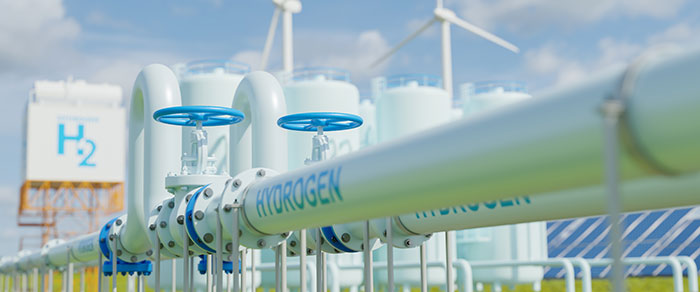
The need for pipeline infrastructure is a key issue in the use of hydrogen.

In the steel industry in Europe, these major investments are being played out and committed to, but we’re years away from being adopted, for day-in and day-out use.

There are a lot of segments that are performing really meaningful tests at the industrial scale because they’re all trying to de-risk the switch from natural gas to hydrogen. Are there any process-side impacts that they need to understand that would impact product quality or product suitability or any of those things? All that stuff is going on now, and I think it’s going to take a couple of years for everyone to sort of work through and have a good understanding of whether there’s anything they need to be worried about beyond just the fuel switch itself, if there’s any process.

Sanderson: A lot of the push I’ve seen has come out of the aerospace and the automotive industries, not so much on the products that they make but more on the manufacturing side of it.

Advancements and Challenges with Hydrogen

Sanderson: We’re doing a lot more work now with stainless materials. There is quite a bit of involvement using stainless and other materials that have higher nickel contents and other materials to help work into the grain boundaries.

Working with hydrogen has some unique challenges compared to other fuels. It’s the smallest atomic molecule out there and it just wants to permeate into everything. With a lot of the higher, high-end pressures, there is a lot of chance of steel embrittlement, but if you can get away from those higher ends and try and get down to more usable, friendly working pressures, you don’t stand as much risk on the hydrogen embrittlement and dealing with leaks and permeability. So, just helping people understand that those are some of the changes that need to come into play for a safe, long-term solution in their applications.

Hannum: We have installed some hydrogen-firing capability in our lab; it was about a $400,000 investment. So, at this point, we can fire a substantial amount of input for longer durations than we could before. So, that’s really helpful when we’re looking at what the impacts are across our entire burner product range, when we look at a conversion from natural gas to hydrogen.

It also lets us perform some process-based studies where we can really simulate industrial processes and have a longer duration hydrogen firing. So, we’ve been able to support some customers by simulating some of their processes here and actually firing the materials that they
would normally fire at their plant to look at hydrogen impact on those materials.

We’ve also gone to a couple of our customer sites and participated in studies with them. One of those earlier this year, right after THERMPROCESS, was Hydro Aluminum in Spain; we melted aluminum with hydrogen without any natural gas. That was, I think, the first industrial scale melting of aluminum with hydrogen.

Wuenning: We have now put into place an electrolyzer for making our own hydrogen, and not relying on the bottles coming in or on ammonia supply. We installed a big ammonia tank so that we can run the ammonia tests on site, develop the crackers and account for them. And, of course, we are involved in several research projects together with universities and some sites that do all these things to try it out.
Kelly: The latest this year is an investment for one of our factories to have an electrolyzer-type system, so a full-blown, cradle-to-grave type of system to be able to produce the hydrogen. Muncie is investing in that whole substructure with the capability of increasing to tube tankers before the electrolyzer comes so there is significant investment on that end. And from the product end, we’ve just kept testing and looking at the whole product line, not just burners, but all the controls and things to be associated with hydrogen firing.

In addition to the controls behind the system, we must also think about the development of simpler and/or more complicated systems. These updated systems are necessary because of changes in air/fuel rations and all the concerns that pop up when using different fuels.

These systems need to take into account what the process is requiring, namely holding tighter air/fuel ratios and also being less dependent on low temperature air-heating applications, but also being able to use higher temperatures and higher oxygen rates with some excess air. We’ve been working on those types of systems and looking at that when the clients are in a situation where they can fire on either fuel. How critical it is to hold capacity and air/fuel ratio and things of that nature, and how can we make that as easy as possible for the client?

But, yes, a lot of activity on that basis. And even in product development looking at the future — lower NOx and lower emissions burners that go in conjunction with hydrogen. In the lower and high temperature range, we’ve got to look at a burner that can fi re via flex-fuel type burner. Maybe not just hydrogen and natural gas but something in biofuels or renewable-type fuels.

About the Experts

Joachim (Joe) Wuenning is the owner and CEO of WS Thermal Process Technology.

Brian Kelly is the applications engineering manager at Honeywell Thermal Solutions.

Robert Sanderson is the director of business development at Rockford Combustion.

Mark Hannum is the manager of the innovation and combustion laboratory at Fives North American Combustion.

For more information: Visit www.heattreattoday.com/hydrogen2023


Find Heat Treating Products And Services When You Search On Heat Treat Buyers Guide.Com

Hydrogen Combustion: An Approaching Reality? Read More »
New Sustainability & Decarbonization Initiatives for Heat Treat

op-ed

Searching for sustainability resources? Check out this first installment of the Sustainability Insights series, from the Industrial Heating Equipment Association (IHEA) for what’s available to in-house heat treaters across the industry.  

Discover the resources IHEA provides in their web-based Sustainability area and a new webinar series launching May 11.


One thing is certain, and it's that there is great deal of uncertainty about how to begin addressing issues of sustainability and decarbonization. As heat treaters begin to receive more and more questions about decarbonization, IHEA saw an opportunity to help the industry and began developing a variety of initiatives relating to sustainability and decarbonization in the industrial heating equipment industry. 

Getting Started with Sustainability 

Contact us with your Reader Feedback!

The first step towards decarbonization is understanding this is a topic that will not go away. While they may not see any immediate consequences, heat treaters need to at least begin preparing now for what is quickly approaching. Before long, clients are going to be demanding heat treaters show that they are lowering their carbon emissions. Thinking,This will not affect my business,” will be detrimental in the long term.  

IHEA recommends to start by considering efficiency and getting an initial assessment of carbon footprint. The fastest, easiest way to reduce carbon footprint is to burn less fuel by investing in efficiency improvements. As a side benefit, operating costs are also reduced. IHEA's current combustion courses do have content on efficiency and low carbon fuels and a webinar series specifically designed to help everyone understand how to determine their initial accounting of their carbon footprint. 

Future Plans 

The deeper driving forces that will affect our industry regarding sustainability are regulations, incentives, and energy economics. Rapidly changing environmental policy, growing technology incentives, and a shifting relative cost of fuels (and alternate fuel options like hydrogen) are opening new pathways for businesses to factor carbon footprint and sustainability into their operations. 

Because of these upcoming changes, IHEA is developing a wide array of services and tools that will help those looking to lower carbon emissions determine the best approaches for their heat treat facilities. An entirely new body of content will be developed that will be at the leading edge of this industrial revolution.  

To kick things off, IHEA has developed a Sustainability area on their website that features the foundation of information the industry needs. The Sustainability area includes the following sections: Sustainability FAQs, Sustainability Terms & Definitions, and Sustainability Resources. The Sustainability section will continue to expand by adding content and resources on a regular basis.

Additionally, IHEA is launching a series of webinars that will start the process of walking companies through the complicated issues related to decarbonization: 

  • May 11: Thermal Processing Carbon Footprint (click to register/read more)
  • June 15: Defining Greenhouse Gas (GHG) Emissions to Target NET-ZERO 
  • July 20: DOE Tools and Programs for GHG Reduction 
  • August 24: Ongoing Sustainability: Industry Best Practices for Continual Improvement 

The goal is to provide unbiased education for everyone involved in the process heating industry. The webinars are complimentary. Visit www.ihea.org and click on the "EVENTS & TRAINING" tab.  

Brian Kelly
President at Honeywell Thermal Solutions

Recently elected IHEA President Brian Kelly of Honeywell Thermal Solutions says, “IHEA is taking a leadership role because we see that this will be an ongoing and changing landscape for the industry for years to come. With the years of collective expertise of our membership we feel that we can provide information, education, and guidance to help everyone navigate what is sure to be a challenging environment.” Kelly continued by saying, “In the end, we want to be a source to count on to help our entire industry in their sustainability journey as it will be a long and winding road that will be different for everyone.” 

For more information:

Visit www.ihea.org. 


Find heat treating products and services when you search on Heat Treat Buyers Guide.com


New Sustainability & Decarbonization Initiatives for Heat Treat Read More »

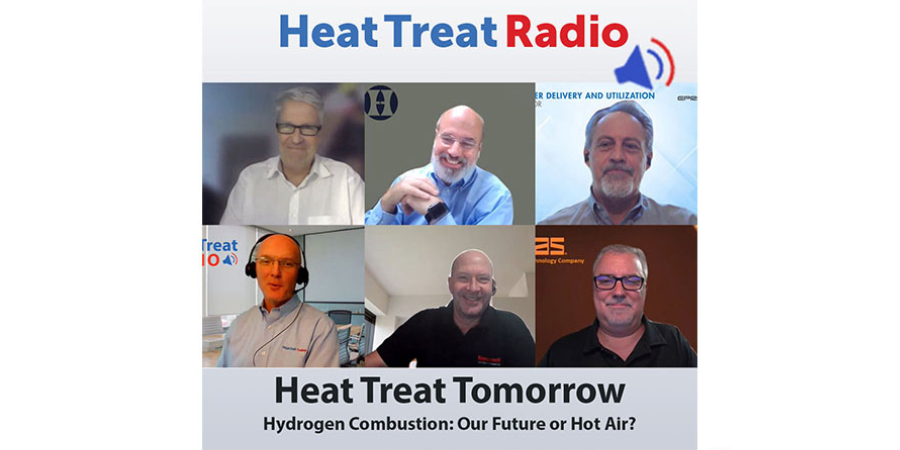
Heat Treat Tomorrow – Hydrogen Combustion: Our Future or Hot Air?

OCDoug Glenn, publisher of Heat Treat Today, moderates a panel of 5 experts who address questions about the growing popularity of hydrogen combustion and what heat treaters need to do to prepare. Below is an excerpt of this lively and compelling discussion. 

To view the 1-minute trailer or register to watch this FREE video, go to www.heattreattoday.com/2021-09-H2-Vid

Today’s Technical Tuesday was originally published in Heat Treat Today's December 2021 Medical & Energy print edition.


Introduction

Doug Glenn (DG): Welcome to this special edition of Heat Treat Radio, a product of Heat Treat Today. We’re calling this special episode “Heat Treat Tomorrow: hydrogen combustion. Is it our future or is it just a bunch of hot air?” This discussion is sponsored by Nel Hydrogen, manufacturers of on-site hydrogen generation systems. I’m your host, Doug Glenn, the publisher of Heat Treat Today and the host of Heat Treat Radio. I have the great privilege of moderating this free-for-all discussion today with five industry experts who I’d like to introduce to you now.

Perry Stephens
Electric Power Research Institute (EPRI)

Dr.-Ing. Joachim G. Wünning
President
WS Wärmeprozesstechnik GmbH

First, Perry Stephens. He is the principle technical leader of the Electric Power Research Institute (EPRI) and currently leads the end-use technical subcommittee of the low carbon resource  initiative (LCRI) which is a collaborative eff ort with the Gas Technology Institute (GTI), and nearly 50 sponsor companies and organizations. They aimed at advancing the low carbon fuel pathways on an economy-wide basis for the achievement of decarbonization. EPRI is a member of the Industrial Heating Equipment Association (IHEA).

Joachim Wuenning (Joe Wuenning) is the owner and CEO of WS Thermprocess Technic Gmbh [WS Wärmeprozesstechnik GmbH] in Germany and WS Thermal Process Technology, Inc. in Elyria, Ohio. Joe’s company has been on the cutting edge when it comes to hydrogen combustion. In fact, the last time I heard you, Joe, was at the Thermprocess show in Düsseldorf, where you gave the keynote address regarding the advent and development of hydrogen combustion. Joe’s company has been a leader in hydrogen combustion. Joe’s company is an IHEA member as well. Joe is our European representative, and may provide us with a different perspective.

John Clarke is the technical director of Helios Electric Corporation (Fort Wayne, Indiana), a company that specializes in energy and combustion technologies. John is also a regular columnist for Heat Treat Today and a past president of IHEA.

Jeff Rafter is vice president of sales and marketing for Selas Technologies out of Streetsboro, Ohio and has a rich history in the combustion industry as well, including many years with Maxon Corporation. He’s got 28 years of industrial experience in sales, research and development, and marketing. He’s a combustion applications expert in process heating, metals refining, and power generation and has also served 10 years on the NFPA 86 committee and holds a patent for ultra-low NOx burner designs. He is also an IHEA member.

Finally, we have Brian Kelly with an equally rich history in combustion, spending most of his years at Hauck Manufacturing in Lebanon, PA, where he did a lot in sales and engineering before they were purchased by Honeywell. Brian currently works for Honeywell Thermal Solutions and is also an IHEA member.

Gentlemen, thank you for joining us. Let’s just jump right in. Brian, since I picked on you last, let’s go to you first on the questions.

Is Hydrogen Combustion the Future?

DG: Is this hydrogen combustion thing coming? And, if so, how soon and what’s driving it?

Brian Kelly (BK): It is coming and there is going to be a lot of back and forth in that it doesn’t make sense and all that. It is here. We’re seeing inquiries from customers that ask, “Hey, do we have burners that do this, control systems and stuff that do that?” The news that I get emails on, for example, is that with one of the steel companies in Europe, they already said their plan is totally going to be hydrogen. We’re delivering billets right now of hydrogen.

So, yes, it’s coming. Is it coming soon? It’s here today. Widespread? That’s going to be a longer road. I think you’re going to hear from people that know more about it than I do, but, certainly from industry buzz, we’re testing burners, we’re making sure our burners run on partial hydrogen, full hydrogen, safety valves, control valves, and all that is definitely within a lot of the testing that we’re doing right now beyond the usual R&D on lower emissions burners and things of that nature.

Jeff Rafter (JR): I have a slightly different answer, but I agree with Brian. I think hydrogen combustion has been here for over a century. The difference has been, it’s been largely restrained to a few industries that have a regular hydrogen supply. A great example would be refining and petrochemical industries. We have had, for literally decades, burners designed to burn pure hydrogen, for example, in applications like ethylene crackers.

The fundamentals of hydrogen combustion are very well known. The next evolution that we’re currently in the process of seeing is taking more industries into an availability of hydrogen as a fuel and modifying designs and process heating equipment to accept it. There are fundamentally a lot of changes that occur when you switch the fuel, and we can get into more of those later with more relevant questions, but it doesn’t come without challenges. There is quite a bit to be done, but I think the fundamental science is already well-known. There is a lot of design work to be done and there is a lot of economic and supply development yet to be had.

John Clarke (JC): Yes, I certainly think it is coming, but the timing is uncertain. And, when I say “coming,” I mean deployed in a certain or large volume. When we simply talk about hydrogen, I do think the order of deployment is somewhat predictable and when it comes to pure hydrogen, I think it will likely be deployed first for transportation, and only after that need is met, as a process heating fuel, widely. Now, if there is a breakthrough in battery technology, this order of deployment may change. But, right now, it looks like hydrogen represents an opportunity for higher energy density for long haul transportation. And, if we’re pushing hard to reduce CO2 or carbon emitted, I think policy will be implemented in a means to maximize a reduction of carbon. That’s where I think they’ll be pushing harder.

Now, that said, partial hydrogen, blending hydrogen into natural gas, is likely to occur perhaps sooner than that.

Joachim Wuenning (JW): Not really. I think a lot of things were said correctly and I strongly believe it has to come. If you believe in climate change, it must happen because we cannot use fossil fuels forever. I also don’t believe that we will have an all-electric world. I don’t believe in nuclear power, so we cannot get all our energy from that, therefore, chemical energy carriers will be necessary for storage and long-haul transportation. Is it coming soon? Of course, it is hard to predict how fast it will be. Now, fossil fuel is cheap so it will be hard to compete with as hydrogen is likely to be more expensive.

But certainly, what we see is the requirement from our customers to have hydrogen ready burners. Because, if they invest in equipment at that point, why would they buy a natural gas only burner. They should, of course, look for burners which are able to do the transition without buying all new equipment again. So, we have a lot of projects momentarily to demonstrate the ability of the equipment to run with hydrogen or natural gas and, preferably, not even readjusting the burners if you switch from one to another gas.

Perry Stephens (PS): I’ll try to add something a little different. At EPRI, we’re charged with providing the analysis and data from which other folks, like these gentlemen, are going to try to base important business decisions. Our work hasn’t focused specifically on hydrogen, but, more generally, the class of alternate energy carriers — molecules, gas, or liquid — that can be produced in low carbon first energy ways through renewable energy sources. A lot of our work is focused on understanding the pathways from the initial energy which as a biomass source, solar, wind, could be nuclear, could be hydro. These sources of electric power that ultimately have to be used to produce this low carbon hydrogen. One other pathway is hydrogen or hydrogen-based fuels produce the steam methane reformation process which uses a lot of hydrocarbons but would then require carbon capture and sequestration. The CO2 from these processes could be employed in a circular economy fashion. So, we look at all of these.

The real challenge is the challenge of cost. How do you produce this hydrogen or alternate fuel? And there are many other potential fuel molecular constructs that could be deployed. Ammonia is one being discussed in some sectors. And then how do you transport them, store them, and what is their fuel efficiency and the cost of either new equipment or conversion of existing equipment to deploy those. We’re not specifically focused on hydrogen. It is a very important energy carrier. It can be blended with fossil fuels in the near-term and then maybe expanded in the long term to higher percentages up to pure hydrogen depending on the application, depending on where you produce it. These costs must be evaluated and that is a big job that we’re doing at EPRI with our LCRI initiative right now. We are trying to understand that techno economic analysis, that is, what makes the most sense for each sector of the economy.

Why Not Electricity?

DG: Thanks, guys. Joe had mentioned global warming, a driving force here. Why not electricity? Why don’t we just convert everything over to electricity? Perry, you’re with EPRI, let’s start with you on that. Instead of going just straight-out hydrogen, why not just go to electricity?

PS: I think the question again rephrased might be, “when electricity and when hydrogen” because I think that’s really what we’re trying to decide. There are interesting areas of research involving catalysis techniques that dramatically improve the net energy efficiency of chemical processes, for example, that might make direct electrification of certain processes more competitive. There are electric technologies for the low- to midrange temperatures that are attractive and use pieces of the electromagnet spectrum to produce transformation of products, heating and/or other transformations, that are very cost effective today. So, we judge that a portion, maybe something approaching 30% of the remaining fossil fuel, could be electrified. A certain chunk, a quarter, maybe reduced consumption through energy efficiency, 30% or more through electrification. It’s that difficult-to-electrify piece. Steam-based processes and other direct combustion processes where electric technologies — for one reason or another, don’t look like they offer a strong solution, at least today — that we’re really concerned with. And, both in steam production and direct combustion of fossil fuels today, many cases we’re looking at having to have some sort of alternate combustible fuel.

JC: I’m not sure I completely agree with your question. In some ways, clean hydrogen, or environmentally or low carbon hydrogen, is electricity. It is simply a different means of storing electric power because the source of that is going to be some sort of renewable power, more likely than not, photovoltaics, wind, hydroelectric; those are going to be the electricity we use to break down the water to generate the hydrogen that we then go ahead and store. So, the alternative is whether we use batteries or hydrogen to store this electricity and make it available either in a mobile setting, in a car or a truck, or off-peak times, at times when we are not able to generate electricity from renewables.

I think the question really is more along the line of end use. When are we going to be using electricity for the final end use? We’re kind of process heating guys around this table. I think it’s going to come down to economics, for the most part. And I don’t think we’re quite there yet.

JW: Electricity is fine for some applications. I’ve driven an electric car for the last 10 years, but in long range, I drive the fuel cell hydrogen car from my father, so different technologies for different purposes. There might be batch processes where I can have a break of a week if there is no sunshine and do the batch processing when electricity is available. But if I have a continuous furnace with 100 megawatts which should run 365 days a year, it will be tough to produce the electricity constantly from a renewable basis to fulfill all these requirements. I think it’s just more economic and makes more sense to use the right technology for the right processes. It’s not an either/or. Use the right technology for the right application.

BK: I would just back what Joe says. It can be selective to industry, the furnace type, or the type of material being processed. I know I’ve dealt in my career with a lot of the higher temperature type applications — ceramics and heat treating and things of that nature. If you start getting above 2000 degrees Fahrenheit and up, and especially dealing with airspace, uniformity has a lot to do with it.

Electricity can be hard to get that uniformity without moving fans and having fans that operate at higher temperatures is another challenge. It’s extremely challenging and a big cost factor. What most people have said here is that it is probably not either/or. We see a lot of electricity being used but we’re fossil fuel burner guys, so we’re going to push that efficiency and that kind of cost.

You’re not going to want to miss the rest of this thought-provoking discussion. To watch, listen, or read in its entirety, go to www.heattreattoday.com/2021-09-H2-Reg.

Heat Treat Tomorrow – Hydrogen Combustion: Our Future or Hot Air? Read More »

Heat Treat Radio #63 (Special Video Edition): Heat Treat Tomorrow – Hydrogen Combustion: Our Future or Hot Air?

Doug Glenn, publisher of Heat Treat Today, moderates a panel of 6 industry experts who address questions about the growing popularity of hydrogen combustion and what heat treaters need to do to prepare. Experts include Joe Wuenning, WS Thermal; Jeff Rafter, Selas Heat Technologies; Brian Kelly, Honeywell Thermal Solutions; John Clarke, Helios Electric Corporation; and Perry Stephens, EPRI.

Get IMMEDIATE access to this 60-minute, highly-informative discussion.

Heat Treat Radio #63 (Special Video Edition): Heat Treat Tomorrow – Hydrogen Combustion: Our Future or Hot Air? Read More »

New Additions to the 2020-2021 IHEA Board of Directors and Officers

Scott Bishop, incoming president of IHEA (source: IHEA)

Jeff Valuck, incoming VP of IHEA (source: IHEA)

The Industrial Heating Equipment Association (IHEA) recently announced its 2020 – 2021 Board of Directors and Executive Officers. The new executive officers are Scott Bishop of Alabama Power Company as president, Jeff Valuck of Surface Combustion as vice president, and Brian Kelly of Honeywell Thermal Solutions as treasurer. Outgoing president Michael Stowe of Advanced Energy assumes the role of president emeritus.

Brian Kelly, incoming treasurer for IHEA (source: IHEA)

IHEA also welcomes new board member Alberto Cantu of Nutec Bickley. Alberto has been involved with IHEA since 2011 and participates on the Safety Standards and Codes Committee.

Alberto Cantu, incoming board member of IHEA (source: IHEA)

IHEA President Scott Bishop, who is highly involved in IHEA’s Infrared Division, says, “It is an honor to serve as IHEA’s president for the 2020-2021 term.  I look forward to continuing the great work IHEA has done for more than 90 years.  Also, during this unprecedented time I would like to encourage our members to be proactive in finding ways to better serve our industry and make an impact.” Bishop has served as IRED chairman, presented at numerous workshops and seminars, and provided key support in the recent revision of the Infrared Process Heating Handbook for Industrial Applications. 

Michael Stowe, outgoing president of IHEA (source: IHEA)

“I am very excited about this new role,” Cantu states. “I think it will be a great opportunity to connect with colleagues in the industry and help move it forward,”


New Additions to the 2020-2021 IHEA Board of Directors and Officers Read More »

Skip to content