heat treat radio

Heat Treat Radio #30: Dr. Shahrukh Irani on Job Shop Lean

Welcome to another episode of Heat Treat Radio, a periodic podcast where Heat Treat Radio host, Doug Glenn, discusses cutting-edge topics with industry-leading personalities. Below, you can either listen to the podcast by clicking on the audio play button, or you can read an edited version of the transcript. To see a complete list of other Heat Treat Radio episodes, click here.


Audio: Dr. Shahrukh Irani of Lean & Flexible LLC

In this conversation, Heat Treat Radio host, Doug Glenn, interviews Dr. Shahrukh Irani of Lean & Flexible LLC about how manufacturers with in-house heat treat might implement the Job Shop Lean concept, thereby increasing profits and efficiencies. Listen to learn whether your company might benefit from examining its processes and making parts of its daily operations more lean, flexible, and ultimately more profitable.

Click the play button below to listen.


Transcript: Dr. Shahrukh Irani of Lean & Flexible LLC

The following transcript has been edited for your reading enjoyment.

DG: We're going to discuss how manufacturers with in-house heat treat might implement lean manufacturing concepts to increase profits and efficiencies. But first, I'd like to give a shout-out to John Tirpak, who I've know for many years, and his recommendation to talk to today's guest, Dr. Shahrukh Irani.  I first met John when I was involved with the creation of a magazine called Forge, a publication that is still published by BNP media and serves the North American forging industry.  John is a very accomplished engineer, metallurgist, and C level management guy with a lot of energy and vision. He knows the metals, forging, and heat treat industry, and it is on his recommendation that we're talking to Dr. Irani today, so thanks, John.

Dr. Shahrukh Irani, President, Lean & Flexible LLC

Dr. Irani is the president of a one person consulting company, Lean & Flexible LLC.  Lean manufacturing isn't a topic discussed too frequently in the heat treat world, but there are significant benefits to be gained by doing so.  That's why today's conversation with Dr. Irani should be of significant benefit to you, especially if you're a high mix/low volume manufacturer, as opposed to a low mix/high volume manufacturer.  While the bulk of heat treat today's audience are manufacturers with their own in-house heat treat departments, many of these departments heat treat a wide variety of parts and therefore qualify as high mix, low volume producers.  Our friends in the commercial heat treat world will also find this episode beneficial since most of their business is built around high mix/low volume job shop type work.

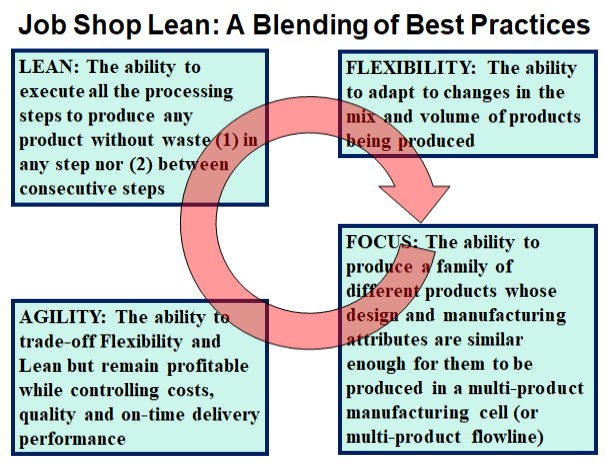
SI:  My company's name is Lean and Flexible.  I am just a one person consulting gig.  The name pretty much tells everybody what I think needs to be done.  When you are high mix/low volume, (especially if you are job shop, but not necessarily job shop), you want to be lean, which is waste-free, efficient; but then you want to be flexible.  You want to be able to do a whole variety of parts in different quantities. Everybody can talk lean; but when you try to become flexible, all of those things that your favorite consultant taught you to believe kind of work against you.  You have to be agile.  Agile is the speed with which you can change your world and do different types of heat treat. That's pretty much what my consulting company does.

DG:  Very briefly, with respect to your background, I know that you've been in academia for a while, but when you met John, you spun off this new company.  Tell us briefly about your academic background, and also if you don't mind, tell us about maybe any interaction with Toyota, which, of course, is the big company when it comes to lean.

SI:  I began my academic career after I got my PhD in 1990 and straight for about 22 years, from 1990 to 2012, I was in academia.  I read that book, Lean Thinking, which talked about Toyota in 1999, and it really got me interested.  What is called lean, or what is called the Toyota Production System, is just industrial engineering, but very hands on.  Toyota basically figured out industrial engineering the way that the rest of us, especially in America, never did. And that's basically what lean is--Toyota style industrial engineering.

When I began in 2003 when John met me, his challenge to me was, look, research is fine, but I deal with custom forge shops.  They make batches of 50 and 100.  They don't make 200,000 cars a year.  So throw all that Toyota flavor of lean out the window.  You give me some lean stuff that I can benefit these custom forging suppliers who send parts to the DOD.  That's how this whole idea of job shop lean was born. Industrial engineering, which is the math and the science, and then blended with this very hands on, very practical industrial engineering that came out of Toyota.  I think that's very key.  I don't think the world recognizes that we actually teach a profession, that there are professionals called industrial engineers, but how do they practice the Toyota method of industrial engineering, that that education is just academic.

DG:  I saw a statement on your website that maybe ties in here.  Maybe you could expound on this a little bit.  I thought it was a very interesting statement.  You have a statement on your website that says this: "Where industrial engineering meets the Toyota production system." Can you expound on that a little bit? Exactly what does that mean, and why you have that on your website?

SI:  Sure.  Look at me.  I was an academic for 22 years.  I never worked at Toyota, so I never had the benefit of their expert lean implementers teaching me.  But I was an industrial engineer.  So when I read things like value stream mapping and one piece flow and a little Japanese was Kaizen, Jidoka, Poka Yoke, Kanban; when you distill those practices down, at the bottom of it is pure industrial engineering.  Like when you smelt iron, the slag comes to the top, but what remains is that pure molten iron. That is industrial engineering.

I did not work at Toyota, but I was an industrial engineer.  So what choice did I have to develop this thing called job shop lean for John, who was like, “Hey, you've got to benefit heat treaters who have pre-machining and post-machining.” All I had was my industrial engineering, and then I remastered it.  I started asking myself if this academic theory is good.  What is the practical version?  So I looked to the Toyota production system industrial engineering, and I distilled that down and I connected it to all.  So all this is metal standard stuff I was taught and read doesn't fit.  So I did a Frankenstein kind of thing.  I took what worked, and I took the science of industrial engineering and blended it together.  And that is what I teach and practice today. It's industrial engineering done my way. It works, I fail, I succeed, learn from my mistakes.

DG:  I mentioned to you earlier that our primary audience are manufacturing companies who have their own in-house heat treat departments, so they're somewhat in-line perhaps.  But I don't know that many of the industrial manufacturing companies that we deal with really think of lean being an element of their heat treat operations.  So, my question to you is could you come up with, on the spur of the moment, say, 3 to 5 of the most common opportunities that are missed by these manufacturers with their own in-house heat treat departments, if they're not thinking lean and flexible? What are some of the opportunities that they're missing?

SI:  I'll give it a stab. First thing is you look at the total flow. Look at sawing, turning, milling, grinding, drilling, heat treating, force grind machining, assembly.  You look at heat treating as a process, as a department.  Just as you would organize any facility, you ask, ,"Can you identify your value streams?"  And heat treatment just becomes a department, a step, in those value streams.  All you care about is I get bar stock and I get forging and I machine it through and I heat treat it, improve its properties, force heat treat machining, assembly, and ship.  That's the first thing that I don't know, and please correct me, I don't know that these manufacturers who have heat treating simply as a process inside their four walls, but that's the first thing that they've done. Have they designed flexible line, flexible cells? Heat treatment is kind of un-lean. It's process driven.  It's very incompatible with, say, grinding or CNC machining, and it's batch intensive.  The control aspects of heat treating process, spherodizing and annealing and stress relieving are a lot more involved.  But that's important.  The first thing is, have we identified our value streams?
The second thing is do we schedule?  How do we schedule the shop?  There are challenges, but it's not that the challenges are insurmountable. I find that scheduling is the second massive weakness in just about any manufacturer, whether or not they're or aerospace or mining.  Whether or not they have heat treat inside or heat treat outsourced, that is the second thing.  Scheduling is a big weakness.

The third thing is that heat treatment definitely has process control software that's monitoring the recipes and the heat treat cycles of the furnaces and other processes.  Great; but what's missing is the third thing, and that's communication.  Multiple manufacturers have heat treatment right smack in the middle of their facility and their pre-heat treat and post-heat treat process steps.  I don't believe that they have utilized their control systems more as a communication system to pre-heat treat work centers and post-heat treat work centers.  They could be using the software as machine monitoring systems, but they can also use that as manufacturing execution systems.  I think that's the third weakness.  They have not really connected the heat treat to "Hey, I need to go buy money. And every time product builds up in a batch, I'm losing money." That's the cost of inventory.  That's my third observation.  They treat this incompatible area, heat treat or furnaces, and we feed them as their own little baby; but they forget the fact that there are pre- and post- links.

One last thing I did some reading about the equipment that you have for heat treatment. I'm not sure, but when I looked at these furnaces, they are all big, long boxes.  I don't know that that's the best design of the equipment in that particular industry.  In lean, in assembly, they are driven by one-piece flow.  They are driven by one person attending multiple stages.  They are driven by visual management.  And I didn't get the feeling that the big, long boxes that they built were designed for one-piece flow but that they were designed for transfer batch flow, which is what the other sectors of industry are doing.  Why should all the parts be on the bottom on the conveyor?  Could they be bucket spiral conveyors?  Could you use the vertical rather than the horizontal?  I think that machine design could learn. And especially if you've got heat treatment inside a bigger facility, you've got to be a lot more creative about how to get one-piece flow, visual monitoring, communication to other departments.  I feel that may be a lost opportunity.

DG:  The design of the equipment is an interesting aspect to discuss. A lot of times the reason those furnaces, (you're talking continuous furnaces in this case, or semi-continuous furnaces), are long, straight lines with an entrance on one end and an exit on the other, it is a design issue.  It is an expense issue. Certainly, there are furnaces out there that can do a U-shape or a serpentine shape, or things of that sort, or even use vertical.

The issue tends to be in a lot of this, the material transfer becomes quite a bit more expensive and a potential maintenance issue, which nobody wants, when we have to transfer baskets or parts on a belt. Transfer systems work well at ambient temperatures; but when you get them up in the high temperatures, you've got a problem.  But your point is well taken.  I think that the point is, let's take a look at not only the layout of the facility and how we're using it, but the design of the equipment itself could certainly benefit by that.

That brings me to a question here.  You and I talked to John Tirpak a little bit and threw this question out, and I thought it was kind of interesting.  He said recognizing heat treatment is often characterized with fixed, monumental pieces of equipment.  What can be done on either side of the heating and cooling operations to lean out the process?  I think his point is well taken.  Most people think this is a huge piece of equipment.  We can't really lean out this piece of equipment. Maybe that's true; maybe it's not. But I would like to ask you, can we lean out a large static piece of equipment, let say, and if not, are we just talking about leaning out the processes before it and after it?

SI:  I cut my teeth with the so-called job shop lean for high mix/low volume in forge shops. So I didn't have the benefit of going into some little family line area and doing one piece flow for textile products or table assembly. It was forges. So what happens with forges is you've got saws and then you've got pre-heat treat furnaces and then you have the big presses and hammers. They are monumental from the get-go.  Then once the part gets hammered, it then drops into a wire mesh container, and then some time later the forklift guy comes and drags it off and goes and dumps it some place in the yard.  Of course you look at things like right sizing.

A wonderful example that came out of the Toyota world was Ford had built this massive 10 million dollar washing machine that was supposed to be capable of washing many different types of parts, but its up-time was maybe 60%. Toyota went to the local Lowes and bought dishwashers, and they changed the inside of the dishwashers and sized the machine to the volume and the shape of the parts.  They "right-sized."  They took something that everybody thought was "Oh, that's a monument," and made it flexible, and anything flexible is unreliable.  Anything flexible is hard to learn to use.  I think that's the whole idea.  You have to look at these monuments and say, "What can we do pre-?"

I know that the furnace has to do batches.  But how much time that the furnace is just burning oil and electricity and doesn't have a load inside of it?  If you ask what is the total time that I've got metal inside the furnace, that is the true value added utilization of that big, hot, long box.  Like welding.  I don't care about how wonderful a welding station is.  I'm asking, what's the arc time?  And also, within that arc time, how many of the parts have produced with good welds? That's all I care about.  So I think that's what people have to look at, especially those who have heat treatment inside the four walls.  They have to use what is called theory of constraint.

They might say we've got heat treat as the constraint.  How do we optimize throughput? Then we have pre-heat treat work. How do I flow work so that I'm putting the right orders in the right quantity in the right sequence, always available to go and do that big, long box?  And then post constraint; how do I flow product after the heat treat process?  People have to use things like theory of constraints and continuous flow, but then they have to adapt the concept.  Personally, I believe that the monument thing, once people like you are brought to think about the process, how to break down the constraints of batch, the time that it takes to get that heat cycle stabilized from the previous cycle, I think the creativity has to be unleashed.  You recognize the limitations; but if you look at things like right-sizing, downsizing, pool scheduling, buffer management, overall shop scheduling, water spiders who know exactly when they must bring a load to the furnace, water spiders who know when they should take a load from the furnace to the grinding work centers.  I think that communication and continuous flow capability, that is how you de-monument the monument.

DG:  Your company name is Lean & Flexible, but it seems to me that one of the products, if you will, that you're offering is something called job shop lean.  Can you explain what it is and what is the value of it?

SI:  So John [Tirpak] came around and said look, I love your research, but I don't want this lean stuff that everybody and their dog is doing.  There was MIT and there was Michigan and everybody was having their own program, lean this and lean that.  Fundamentally, what they were doing was driven by going and copycating what Toyota was doing.  But the fundamental observation that I had was there are essentially two types of manufacturers, at least.  There are the OEMs, the John Deeres, the Toyotas, the Boeings.  They assemble stuff.  You can't take a jet assembly line and make dishwashers on it, right?  Then on the other hand, you have these job shops with, what I would say Mom and Pop, but they want to be flexible.  They cannot make money by making the same thing, 120,00 pieces of it in the year.  They basically are in small volumes, lots of part numbers and different requirements, mature properties, a lot of customers.  That creates a lot of uncertainty, that work environment.  But whereas the Toyota side is "we will of course use the same assembly line, we might make vans, we might make cars, but we're going to push out just these 4-wheel things. Job shop lean was born.

I stepped back and I said everybody's talking lean, but all this lean stuff is just for assembly.  Half the tools don't even work in high mix/low volume environments.  So that's when the buzz word "job shop lean" came about.  I look at those manufacturers where they've got issues of  shifting bottlenecks, they've got issues of suppliers jerking them around, they have lots of changeovers in their set-ups, all their parts go different routes around the shop – that's basically what we call a job shop.  But John says, you need to tell me what you're going to do at these fourteen companies that I'm going to set you up with. I had to come up with a plan that I'm going teach my students, thus and such, then we're going to place them at these Ford shops, I'm going to mentor them remotely from Columbus, Ohio, but they'll be so knowledgeable and they themselves are so good, they'll be able to implement this, this, this at your fourteen plants.

And those tools, what works and what doesn't work, that's true.  You can't have one-piece fluid heat treatment.  You can't do tatk time. A CNC lathe works at a totally different speed compared to a furnace.  A CNC lathe can make a piece and pass it on.  In heat treatment, you cannot.  You have to have a certain amount of mass inside at all times.  You can change over a CNC mill within 30 minutes.  Try doing that on a furnace with its own recipe from one drum to another.  That's what job shop lean is basically saying.  We're not going to learn from Toyota what 90% of US manufacturers need to because they're all high mix/low volume.  Please listen to me, I've got some knowledge.  Toyota was an inspiration, but at a certain point, because they are not telling me the answers to high mix/low volume situations, I'm going to find them myself.

DG:  There are a number of companies and people that are going to be listening to this that might ask the question, "How do I know if my company or my in-house heat treat department is a candidate for some sort of lean analysis?  Would we benefit by having some sort of lean analysis?"  What would you encourage those people inside?  What are the signs that they should be looking for in their company that says they should seriously consider some sort of lean philosophy or lean analysis of some sort?  What would be the red flags, let's say?

SI:  I have a job shop lean assessment tool.  It's a 5-page, yes/no type of questioning.  If anyone is interested, all they have to do is send me an email and they'll receive that Word document.  Put an X to answer all the questions and send it back to me, and I should be able to give them very quickly just walking down their replies, it should be very easy to figure out if yes, you are eligible for this high mix/low volume lean approach because you've got heat treatment and a lot of pre-heat and post heat treat process.  That's one step.

The second step would be to get your camera out and take a walk through the facility.  In your mind, you have a generic part that you make and you're basically imagining yourself to be that part.  You put the camera on your helmet and then you start to walk and talk me through the process.  The second thing would be to send me a video. And then we do a Zoom session and walk me through that video.

DG:  So, it's more or less a virtual video tour of a typical part and how it's processed.

SI:  Yes.  I have right now in the age of COVID-19, where instead of worrying about doing business, it's an open offer that I phone the study group for job shop lean, and the only expectation is that I will do as much as I can to work with you via remote with no strings attached; but if you want to get the job shop lean, then you should do a pilot project and you should follow the method.

I'm recording all of my lectures and posting them online on Vimeo so that anyone can access it, no strings attached, no financial expectation.  But the third thing is, do something.  Do a pilot project.  Do what we did at Sysco Forge Group 20 years ago.   Do what we did at Aluminum Precision Products.  Unless you do it, you're not going to get a sense of "Wow, I didn't even know that we've got 20 types of cutting tool inserts," you know?

DG:  Yes.  I think with lean, it's not a topic that is often discussed in the heat treat world, and I think the issue here is that there is a lot that people don't know that they don't know.  So it's really a discovery process and to that extent, I would encourage people to reach out to you to at least start that discovery process.

Let's talk quickly as we wrap up here, let's talk about some contact information, so people can get in touch with you.  What is the web address to at least go there and start looking a little bit more at what you're doing?

SI:  www.leanandflexible.com


Doug Glenn, Publisher, Heat Treat Today
Doug Glenn, Heat Treat Today publisher and Heat Treat Radio host.


To find other Heat Treat Radio episodes, go to www.heattreattoday.com/radio and look in the list of Heat Treat Radio episodes listed.

Heat Treat Radio #30: Dr. Shahrukh Irani on Job Shop Lean Read More »

This Week in Heat Treat Social Media


Welcome to Heat Treat Today's second installment of This Week in Heat Treat Social Media. As you know, there is so much content available on the web that it's next to impossible to sift through all of the articles and posts that flood our inboxes and notifications on a daily basis. So, Heat Treat Today is here to bring you the latest in compelling, inspiring, and entertaining heat treat news from the different social media venues that you've just got to see and read!

If you have content that everyone has to see, please send the link to editor@heattreattoday.com.


1. Plibrico Company Sponsors Project for Shriner's Hospitals for Children

The Plibrico Company recently sponsored a Happy Craft Day for Shriner's Hospitals for Children, during which many locations took part in assembling craft kits for kids needing a smile.


2. Innovations and Services on the Front Line

During this difficult and uncertain time, many companies are offering support to fight the spread of COVID-19, and some have come up with unique innovations.

Stack Metallurgical Group has announced its support for manufacturers in fighting the pandemic:

Similarly, Inductoheat has made a statement in the same vein:

ION HEAT has come out with the first prototype of its mechanic lung ventilator:

And Proceq USA Sales Manager Tom Ott demonstrates how to recharge a Proceq UT8000 flaw detector using a common USB power pack:


3. Good Friday Furnace Repair

Capital Refractories' Research & Development Manager Julie Hardy shared images of a 12 ton holding furnace repair that took place on Good Friday:


4. Reading and Podcast Corner

You may have a bit more time to catch up on the reading and podcast listening you've been yearning to do. May we recommend two brief written items of interest and an informative podcast.

Park Ohio Turns 100

Ipsen USA recommends their paper on vacuum furnace maintenance

And, for your listening pleasure, be sure to download the latest Heat Treat Radio episode entitled, Heat Treat Modeling with Justin Sims.


5. 101 Uses for Heat Treat Today Tape

Roseanne Brunello of Mountain Rep came up with a festive use of Heat Treat Today packing tape:

"Heat Treat Today comes through again..."


6. Launch into Your Socially Distanced Weekend with the Family Lockdown Boogie

No explanations necessary. Happy Friday, everyone!


This Week in Heat Treat Social Media Read More »

Heat Treat Radio #28: Heat Treat Modeling With Justin Sims

Welcome to another episode of Heat Treat Radio, a periodic podcast where Heat Treat Radio host, Doug Glenn, discusses cutting-edge topics with industry-leading personalities. Below, you can either listen to the podcast by clicking on the audio play button, or you can read an edited version of the transcript. To see a complete list of other Heat Treat Radio episodes, click here.


Audio: Heat Treat Modeling With Justin Sims

In this conversation, Heat Treat Radio host, Doug Glenn, interviews Justin Sims of DANTE Solutions about heat treat modeling. As the heat treat world moves farther way from mysterious black box processes, find out how the latest advances in heat treat simulation software can help your company model specific processes and materials in advance, leading to less guesswork and more profit.

Click the play button below to listen.


Transcript: Heat Treat Modeling With Justin Sims

The following transcript has been edited for your reading enjoyment.

We're going to talk to Justin Sims, lead engineer at DANTE Solutions, Inc., about heat treat modeling.  It's a pretty interesting topic.  With all the advances and sensors and computing power, the heat treat world is moving further and further away from the mysterious black box processes of yesteryear and is allowing companies to model specific processes and specific materials in advance so that there is less guesswork and more profit.  DANTE provides the means by which companies can accurately predict what is going to happen to their part during the heat treat process.

DG: Justin is not only the lead engineer at DANTE Solutions, he is also the author of an article that just appeared in the March 2020 issue of Heat Treat Today and the title of the article was Process Innovation To Reduce Distortion During Gas Quenching. It was a pretty interesting article, something worth reading if you haven't already.  It has to do with DANTE controlled gas quench.

JS:  I got my bachelors in mechanical engineering degree from Cleveland State.  I graduated back in 2015.  I actually started interning at DANTE in 2014 and went full-time in 2016.  I've been the lead/principal engineer at DANTE with mainly responsibilities of managing projects, training our DANTE users, and offering support to our DANTE users.  I helped develop our patent-pending DANTE controlled gas quenching process, which you had just mentioned, and then also a little bit of IT, marketing, sales, and shipping. Being a smaller company, we can kind of do it all.


Fig. 1: Bevel gear axial distortion comparison for an oil quench, high pressure gas quench, and a DANTE Controlled Gas Quench


DG: Tell us briefly about DANTE.

JS: DANTE Solutions is an engineering consulting and software company.  We offer consulting services as well as licensing our software.  We mainly focus on the aerospace industry, the auto industry quite a bit as well, and we've been starting to get into the mining and energy sectors also.  As I said, we are a smaller company.  There are six of us right now. Two to three guys mainly focus on the software side, and the rest of us focus on more of the training, the support, and the consulting side of the business.

DG: DANTE is located near Cleveland, OH, and Lynn Ferguson, who has been in the heat treat industry for many, many years, was one of the founders. Let's talk about the genesis of the software. Would you say the software is the core product that DANTE Solutions offers?

JS: Yes, it is. We mainly stay in consulting to stay current and to give those users who don't have the capability to run our software (either they don't have the hardware or they don't have the analysts to be able to do such a thing), so we still offer our consulting services for them. But mainly, software is our main line of business.  DANTE was actually formed back in 1982 as Deformation Control Technology, Inc., and we changed our name in 2014 to actually reflect more of the software side, so that's when we changed to DANTE Solutions, Inc.

The project itself that DANTE came out of actually started in 1994 and 1995.  It was a collaboration between Ford, GM, Eaton Corp. and then four national labs--I believe they were Los Alamos, Sandia, Oak Ridge, and Lawrence Livermore--and then us as Deformation Control Technology.  The whole project came out because those large automakers were claiming millions of dollars of lost scrap from distortion.  It was starting to become a major issue and they wanted a way to be able to model the process and be able to optimize the process a little bit better.  After that project ended, DANTE somehow ended up with the software, which has worked out well, as we've been able to commercialize it and we've been updating all the material models and the material database for the last 20 years.  It's actually come quite a long way.

DG:  How did you segue over from auto industry into aerospace?

JS:  It just happens that the aerospace components cost a whole lot more than the auto industry components.  It was a natural fit once they realized that this software was viable and could do what they needed it to do.  And aerospace seems to be more receptive to modeling because their parts are so expensive.

DG:  Let's try to put a little flesh on the bones here. For a manufacturer who has their own in-house heat treat for aerospace, automotive, energy or whatever, what makes this software attractive?  What makes it viable?  Why would someone want it, and why and how do they use it?

JS:  Let's start with viability.  The first thing is that it is easy to use.  DANTE is a set of material routines that link with Abaqus or Ansys finite element solvers.  These are solvers that engineers and analysts in the industry already know pretty well, so there is not a lot of learning of new software.  DANTE is just a material model, so all you're really responsible for is the material name and what microstructural phases you're starting with.  Then we have the ability to modify a few of our control parameters, activating different models; we've introduced stress relaxation, carbon separation, carbide dissolution, and all these different models that you can activate.  But the biggest thing that trips people up . . . [is] understanding your process.  We like to work with people a lot on trying to help them understand what type of thermal behavior their processes are actually imparting on components.  We've done a lot of work with setting up their essentially quench probes and be able to turn around and be able to take that back to heat transfer coefficients that get put into the model. As far as DANTE is concerned, it is fairly easy to use.

We've also developed what they're calling ACT (Ansys Customization Toolkit).  It is essentially a series of buttons where you would click on these buttons, fill out information, and then essentially run your models. Abaqus, for the new version of DANTE, we've also developed a plug-in that essentially does the same thing.  So DANTE has become very point-and-click.  In this world, I think people like that simplicity.

Fig. 2: Axial distortion of a press quenched bevel gear

The next big one would be the accuracy that everybody is concerned about.  Our accuracy is due to the models that we use and the algorithms that we employ.  There are two types of accuracy.  I've touched on the boundary condition accuracy, and that is how your process behaves thermally.  That accuracy can be tough to get.  It's very doable and we've helped people achieve some really amazing accuracy.  The relationship I like to use here is people know static loading models and a lot of engineers have run static loading models.  The loads that you put on these static models are going to determine what deflections you get.  If your load is not correct, then your deflection will not be correct.  In heat treat modeling, the thermal boundary condition is your load.  The more accurate your heat transfer coefficient can be, the more accurate your results are.  But, with that being said, you can still gain a lot of valuable information from being close enough.  We'll talk a little bit about that with the uses and whatnot.

The first important model type that we use is the mechanical model.  We use a multiphase internal state variable model.  A conventional plasticity model considers stress as a function of strain only, where the internal state variable model actually accounts for the history of deformation by relating the stress to dislocation density.  It actually accounts for the history of deformation, which is very important as the steel goes through all the stress reversals that it does going through the process.  Our mechanical model defines each phase, so austinite, pearlite, ferrite, bainites martensite, tempered martensite, all of them, as a function of carbon, temperature, strain and strain rate.  It also accounts for the trip phenomenon.

For our phase transformation model, we like to use analytical models instead of TTT CCT diagrams, and we do this because you don't get any transformation strain information out of the diagram.  So you have no idea how much it is deforming.  In order to figure that out, we like to use dilatometry tests to fit to our analytical models.  We also account for carbide growth and dissolution during carburizing, which is becoming a major point of interest due to the high alloy content of some of these steels that they're now trying to carburize.

DG:  Let's talk a bit more about where manufacturers, who have their own in-house heat treat, might use DANTE's software tool.

JS:  One of the big things we like to use it for is what we call sensitivity analysis.  This would be, "what happens if my normal process has a little bit of variation?"  Or, "what happens if my process parameters change a little bit?" We've also worked into the model now normal material variation.  So if your alloy content is a little on the high side, how would the material behave?  If it's a little on the low side, how will it behave? [This] is a big deal.  One example would be, "I just designed a new part and I want to make sure that it behaves given the range that I know my process can vary."  All processes will vary.  This is no way to make the process exactly the same every time.  Also, in the sensitivity, you can ask the question, “What process variable is a distortion or stress most sensitive to?"  By finding out what process variables cause the most sensitivity, then those are the process variables you really need to pay attention to during processing, then the other ones you can just make sure they're in range and leave them alone.

Development and design are two of the big ones that we're trying to get out there that this software can be used for.  Everybody knows that it can be used for troubleshooting.  Once something goes wrong, yes, sure the software is great and we help figure out a problem; but why not find the problem before it ever even happens?  We've been trying to get people to use it for development of new carburizing and nitriding schedules as well as new recipe and design, and even novel processes.  You had mentioned our DANTE controlled gas quench.  That actually was conceived through all the modeling that we do and watching the response of the material and saying, “Wait a second.  If we can control the martensite transformation rate, we can really control the distortion, so let's see if we can do this.”  Things like that can come out of the software.  Design as well, of optimizing shapes for quench.  You can even do quench to fit, which is, "I know my part distorts this much, so let me machine it distorted and then it will fall into shape."  Optimizing processes.  All of that can be done through design development, and you can find these problems before they ever happen.

Another really big one that I like, and Lynn, our owner, is really keen on this one, is the understanding of your process.  When you start to set up these models, you have to ask a lot of questions about your process.  What is the HTC of my process, which relates back to agitation in the tanks, part racking, flow directions?  You really need to know times and temperatures of every step in your process.  So not just the heat to quench, but what about all those transfers in between?  All of that needs to be done.  So you end up asking a lot of questions like that.

The other one that I always like to say is that the heat treat software removes the black box.  In the past, you know what goes in and you know what comes out, but what happens in the middle is kind of a mystery.  The software helps you figure out what exactly goes on during your process.  It can be very eye-opening.

Fig. 3: Minimum Principal stress of a carburized and oil quenched spur gear

DG:  I've talked with James Jan and Andrew Martin over at AVL, and we talked about a variety of ways they use some of their software, and they mentioned that they work with you guys as well, and they were talking about not even just like a quench agitation, flow direction, and things of that sort, but part orientation as it goes into a quench.  I assume that would be something also that you guys would be able to help analyze, right?  Which way to even put the part into the quench?

JS:  Sure, sure.  And we've done that.  The one that comes to mind is a long landing gear.  This landing gear was about 3 meters in length, and we looked at even slight angles going into the quench tank can have serious consequences on the distortion.  That is definitely something that we've looked at in the past.

DG:  Just that orientation would help, but maybe eliminate vapor stage, or whatever, I assume?  Or pockets?

JS:  Right. And even beyond that, it sets up thermal gradients in different locations of the part.  So now instead of cooling one section faster, you're cooling it a little slower and that kind of thing.  That also relates back to actual vapor stages and how bubbles get trapped.  But that goes back to defining boundary conditions, which is where software like AVL's FIRE can really be helpful in understanding flow patterns.  There is a beneficial relationship there.

DG:  There are a host of different materials that people are using.  How broad is the database, as far as the different types of materials, that you can analyze and model?

JS:  That is a good question.  We have a lot of low alloy, medium alloy, and carburizing grades of steel, the 1000 series, the 8600 series, 9300 series, those types of materials.  We've also worked with some of the high alloy aerospace grades like C64 and the Pyrowear 53 and that sort of thing.  But right now, it's all steel.  There is a lot of talk about being able to do aluminum.  We get that question a lot.

DG:  I was wondering about that specifically- aluminum and/or of course, when we talk aerospace, we're talking titanium.  So titanium is not on the table at the moment?

JS:  It is, but it isn't.  The interesting thing is that there is a phenomena precipitation hardening that goes on in aluminum and titanium.  But it also goes on in these high alloy steels.  It is a secondary hardening mechanism.  We've been working on that and we feel that once we can handle secondary hardening in steel, then the jump to aluminum and titanium should be pretty straightforward.

DG:  So to recap, for those of us who are not as well-versed in the product as you are, basically you've got a simulation software that takes into account the material that is being used, also the thermal process (the recipe), which would include both a controlled heat up and potentially a controlled quench.  Is that a reasonable way to describe it in a very broad way?

JS:  Yes. And also, even the steps before that, like carburizing.  If the part is carburized, you would carburize it first.  Or nitriding; we've just introduced those models.  You can literally do the entire process.  And it's not just quenching either.  We've done martempering, austempering, normalizing, all of these things.  Most all normal thermal processing, DANTE can handle.

DG:  The last question I want to ask is, Who is the ideal person/company that would really find the product/service that you're providing useful? I know you mentioned aerospace and automotive, but can we be more specific than that? Where are you finding the most success?

Fig. 4: Displacement versus temperature curves showing the shift in martensite start temperature for 3 carbon levels

JS:  That's a tough question. Generally, everybody that has used our software has found real benefit in it.  We've tried to get testimonials from a lot of folks, but this can be difficult because of their companies.  But from Cummins, we've gotten good responses and also from GM we've gotten good responses.  One of them has used it to actually introduce new material and replace legacy material that is now saving them quite a bit of money.  GM has used it to look at process design and optimization.  But I would say mainly the people that are going to benefit the most are the folks that have an analyst to be able to do the simulation almost on a daily basis.  It's one of those things where the more you do, the more you see and the more you understand what is happening.  But really anybody that does heat treatment can benefit from understanding what's going on in their process.

DG:  You mentioned Cummins, and I'm looking at your website, and I just want to read a paragraph:

DANTE heat treat simulation software has been a great boon to Cummins.  Since we've started using their software, we have gone through several projects that have increased our understanding of heat treatment and some of which have saved us production costs.  One example was enabling us to gain the leverage needed to make a material and process change on a legacy product that is now saving us at least 25% on material costs.  The team at DANTE Solutions has always been very accommodating and is very quick to give assistance and feedback whenever troubles arise, even when the troubles are caused by other parts of the simulation and not DANTE itself.  I look forward to working with DANTE team in the coming years as we expand our list of engineers who use this software. -- Brian W. at Cummins

So that leads me to one other question.  When a person interacts with you, are they buying software as a service?  Is it cloud-based or is it something that they purchase a license for one computer, one user?  How does it work?

JS:  There are a couple of different ways.  They can lease it annually or they can essentially buy the software and lease a license annually.  The software can go either on their computer or it can go on a server at their company.  We also have options for corporations where you can essentially get software at different locations.  We have a lot of options and we can work with customers if they [have] unique needs.  That's one of the benefits of being a smaller company, we're pretty flexible like that.

DG:  DANTE's mission statement from their website has a nice ring to it: “DANTE Solutions is determined to promote the use of simulation in the heat treat industry.  From design to troubleshooting, DANTE Solutions believes everyone can benefit from a little simulation in their life.”

If you'd like to get in touch with Justin Sims at DANTE, please email me, Doug Glenn, directly at doug@heattreattoday.com and I'll put you in touch with Justin.

Doug Glenn, Publisher, Heat Treat Today
Doug Glenn, Heat Treat Today publisher and Heat Treat Radio host.


To find other Heat Treat Radio episodes, go to www.heattreattoday.com/radio and look in the list of Heat Treat Radio episodes listed.

Heat Treat Radio #28: Heat Treat Modeling With Justin Sims Read More »

This Week in Heat Treat Social Media


Welcome to the inaugural column of Heat Treat Today‘s first offering of This Week in Heat Treat Social MediaAs you know, there is so much content available on the web that it’s next to impossible to sift through all of the articles and posts that flood our inboxes and notifications on a daily basis. So,  Heat Treat Today is here to bring you the latest in compelling, inspiring, and entertaining heat treat news from the different social media venues that you’ve just got to see and read!

If you have content that everyone has to see, please send the link to editor@heattreattoday.com.    


1. Entropic Time (Backwards Billy Joel Parody) by A Capella Science

Let’s start your Friday off with this energetic, fun, and educational video that Paul Mason of Thermo-Calc Software shared. (And, you’ll be singing the song all day! You’re welcome!)


2. COVID-19

We have all been affected by the COVID-19 virus. It has produced experiences that none of us has ever ventured through before in our lifetime.

This week in the heat treat industry, we’ve received numerous cancellations of spring and early summer trade shows. See how  Austria’s Reed Exhibitions is helping with the healthcare needs of those in Vienna.


Additionally, many of the heat treat companies have shared their statuses and plans for business via social media posts. Here are a few of them:


3. What’s So Cool About Manufacturing?

Check out Abbott Furnace Company’s collaboration with Saint Mary’s Area Middle School to introduce kids to the world of manufacturing.


4. Reading and Podcast Corner

You may have a bit more time to catch up on the reading and podcast listening you’ve been yearning to do. May we recommend two brief articles written by industry experts and an informative podcast.

Check out Gerry McWeeney’s article, “Pros and Cons of Remote Monitoring in Heat Treat”


For those of you interested in medical devices.


And, for your listening pleasure, be sure to download the latest Heat Treat Radio episode entitled, Women in Heat Treat, with Ellen Conway Merrill and Rosanne Brunello.  They will inspire you!


5. Launch into Your Weekend with a Reading by Jackson

No additional caption needed! Happy Friday, everyone!

(Editor’s Note: Users of Firefox may have difficulty playing the below video. If so, please use another browser like Chrome.)


This Week in Heat Treat Social Media Read More »

Heat Treat Radio #26: Cutting Edge Trends in Data with Peter Sherwin, Eurotherm by Schneider Electric

Welcome to another episode of Heat Treat Radio, a periodic podcast where Heat Treat Radio host, Doug Glenn, discusses cutting-edge topics with industry-leading personalities. Below, you can either listen to the podcast by clicking on the audio play button, or you can read an edited version of the transcript. To see a complete list of other Heat Treat Radio episodes, click here.


Audio: Cutting Edge Trends in Data: Peter Sherwin, Eurotherm by Schneider Electric

In this conversation, Heat Treat Radio host, Doug Glenn, discusses future trends in data with Peter Sherwin of Eurotherm by Schneider Electric. Learn more about coming trends in data collection, including bringing current technology to the heat treat world and cybersecurity.

Click the play button below to listen.


Transcript: Cutting Edge Trends in Data: Peter Sherwin, Eurotherm by Schneider Electric

The following transcript has been edited for your reading enjoyment.

DG (Doug Glenn):  Data topics are not new to Heat Treat Radio.  We’ve had multiple podcasts where we’ve talked specifically about data collection, data use, and data reporting. Jim Oakes, for example, from Super Systems Inc., spoke to us back in January of 2019 about heat treating data. Nathan Smith from C3 Data also spoke to Heat Treat Radio in September of 2018 about data and, more recently, George Smith and Daniel Graham from SBS Corporation spoke to Heat Treat Radio about heat treat data.  There were several other interviews that we did that hit on data even though it wasn’t the main topic of the interview.  You can access all of these previous episodes of Heat Treat Radio by Googling or Binging Heat Treat Radio, or by entering www.heattreattoday.com/radio into your browser.  Today, however, we’re going to discuss future trends in data.  Let’s jump into the interview with Peter Sherwin.

We are here today with Peter Sherwin from Eurotherm by Schneider Electric. Peter and I have known each other for a number of years, and he is one of my go-to guys for the latest in technology and advancements and trends in the heat treat industry, especially when it comes to data or process control, power control, temperature control and that type of thing.  We want to talk about trends. Since we’re at the beginning of 2020, I thought we would spend some time with Peter talking about some trends and things of that sort. We have a couple of preliminaries to get out of the way though.  First off, you are with Eurotherm by Schneider Electric.  If you don’t mind, elevator pitch about Eurotherm and Schneider Electric and let us know what they do.  Then I would like for you to brag about yourself for a moment and tell us a little about your background.  Let’s start with Eurotherm first.

Global Business Development Manager for Heat Treat, Eurotherm by Schneider Electric

PS (Peter Sherwin):  Eurotherm is now, for nearly 5 years, part of Schneider Electric whose overarching theme is energy and automation solutions.  As far as Eurotherm, we specialize in precision temperature power and process control as well as data management solutions, particularly impacting things like operational efficiency of the heat treat plant and reducing the cost of complying to regulations.  That’s really what we aim for.

From a personal view and background, to have an open conversation, these are my views.  They may or may not be backed up by the views of Eurotherm and Schneider Electric, but it just gives me a bit of freedom to talk openly.

I’ve been with the industry for the past 30 years.  I started in a captive heat treater called Reynold Chain in the UK and through my career have worked for different captive as well as commercial heat treaters and even a furnace OEM.  But for just over 11 years, I’ve been working for Eurotherm.  We are a supplier to the heat treat industry, and heat treatment is one of our key verticals and actually our largest vertical business within Eurotherm.  Currently, I run that vertical globally, so I am very fortunate to have the opportunity to see heat treatment from different aspects across different cultures and regions.

DG:  You are global.  We should, in fact, say that your title is a global business development manager for heat treat.  So you are ‘knee deep’ if not ‘waist deep’ in heat treat pretty much around the clock.

PS:  I am.  That’s my vertical.  That’s my background.  I grew up as a trained metallurgist and have taken that forward in my career.  I still practice that now and again, so it’s very useful to have that background.

DG:  You are global, in the true sense of the word, because before we turned on the record button, you were telling me about your upcoming trips to India, Thailand and wherever, so you’re out and about and do see a lot of things.  For our listeners edification, your perspective, because you’re not just looking at the North American market, you can speak to some global trends and things of that sort which will certainly be impactful.

So, you and I ran into each other last at the ASM heat treat show in Detroit in October of 2019, just a few months ago, and you were gracious enough to have myself and a couple of our Heat Treat Today staff people over to talk about some of the latest things Eurotherm is doing.  I would like to start by asking you about those things.  Talk about some of that stuff that’s going on and then we can dig deeper into some of the trends as we go forward.  Tell us about what Eurotherm is, in fact, doing with some of the data acquisition and whatnot.

For more Heat Treat Radio, click image above

PS:  It’s really expanding from the base of having devices that can capture data, whether its a PID controller or a data recorder, and then being able to do more with that information to really have an impact on operational efficiency.  I think we demoed a few different platforms to you.  We have to look more at cyber security these days with any kind of offer, so that’s kind of wrapped into any of the solutions that we provide today.  But we look to predictive maintenance solutions.  I think I demonstrated a health app on one of the machine advisor programs.  We looked at the way that we can now control and manage energy much better with energy SCADA systems and we even had OEM furnace solutions where you could tie in the expertise of an OEM to the end users to give them online access to certain information so they can actually provide better service. And from a shop floor perspective, I think one of the solutions that caught a bit of buzz at the show was the augmented reality solution where you can use a tablet in front of a furnace, hold it up and through the camera you’re actually getting live information about what’s happening on that furnace.  You can actually access documentation directly like electrical diagrams.  It just makes the whole process of being able to maintain and operate a furnace much more efficient.  So just a few of the solutions that we talked about.

DG:  Yes, all very fascinating and very impressive.

Heat Treat Today has done several past podcasts on process controls and trends in data, data acquisition, and things of that sort.  We talked with Jim Oakes from Super Systems, we’ve talked with Nathan Wright from C3 Data, and we’ve even talked with two gentlemen from SBS Corporation, George Smith and Daniel Graham, about some of their systems and all of them had a lot of very interesting things to say.  But historically, a lot of the data collection that has gone on has been specifically for process validation, but I think almost all of these gentlemen, and I think including yourself, I’d like to get your comment on this, they see a lot of data collection now because of the volume of data we can take going beyond process validation. What are your comments about that?

Photo credit: research.samsung.com

PS:  I think it’s quite useful to understand why we collect data for the process and then because of that we can expand it for use in other applications to have an impact on operational efficiency.  Just taking the point about validating the process.  So heat treatment is part of one of the so-called special processes because it has the ability to impact a part’s physical integrity and induce stresses within a component. And it’s in a class of thermal treatments, chemical treatments, and mechanical treatments that can actually do this.  But because you don’t then test after the treatment for those stresses, and because that is more difficult and costly, you have to be very sure about how you process.  So that means that you need qualified personnel, approved equipment, defined procedures and also have some verification of those procedures and the process that the parts have gone through.  At the core of it, it’s very important that you’ve got very good data integrity for just validating the process. One thing at Eurotherm that we’re quite lucky and fortunate about is that we do work in other industries. One of the other industries is the life science industry and requiring to work for FDA standards means that you have to follow processes such as ALCOA+. Now, that’s not the company, it’s an acronym about how you actually capture and store and attribute the data to make sure that you’ve got that level of integrity throughout the process of data management. It’s something that with certain key clients we go a little bit deeper than the AMS 2750 standard or the CQI9, as far as being able to catch full audit trails to ensure that you’ve got that good data capture. If you’ve got that good data capture, you can then move forward with that to be able to use it for other areas, and that is where we get into operational efficiency and also having an impact on quality.  From my perspective, I’ve been with the industry for the last 30 years and I’ve seen this trend.  Thirty years ago, it was very much operator heavy.  You could be one on one with an operator and a machine and the machines were either manual or semi-automated; they were not full automated like the furnaces that we’ve got today.  So there was a lot of training of operators and different skill levels that you needed back in, say, the 90’s.  As time has moved on, those processes have become more automated and they have operators running multiple machines.  For them to be able to do that, we’ve got to present information in a way where if they’ve only got a few seconds or a few minutes at a furnace, they can really pick up the detail of what’s happening.  That’s where we start to get into operational efficiency to effect how we use labor within a heat treatment department.

The other interesting trend as we’ve moved through the decades has been the development of regulations such as AMS 2750 and CQI9. There have been more requirements for tests and task tracking. We’ve actually needed additional QA personnel or resource to counter that requirement and make sure that we comply with those regulations. And that’s also for some technology solutions. I think that’s what Nate was talking about in his podcast about his platform trying to reduce the cost of compliance regulations. And we do the same.

DG:  Regarding standards, what do you see coming in the near future for the heat treat market? What’s relevant?

PS:  Relevant for the heat treaters today is what’s coming this year with the update of the standards of AMS 2750 that will go to F version, due sometime in the summer, and also CQI9 issue 4.  That will come earlier, maybe just after the first quarter.  Obviously, we look at these standards.  We have a number of people that are on the ballot or have some involvement with the standards, and the feedback is this move from being in a paper environment to paperless.  Electronic records is going to be big for both of those standards.  They are going to give heat treaters some time to actually move if they do currently still use paper.  But ultimately, over the next 2 or 3 years, you’ll see pretty much all heat treaters using electronic records and digital paperless systems because that’s the requirement of the standards.

DG:  Maybe jump into a little bit more of the operational efficiencies.  Is there anything more that we can say about that?  Are there any trends that you’re seeing on how data and data management is going to help us with operational efficiencies?

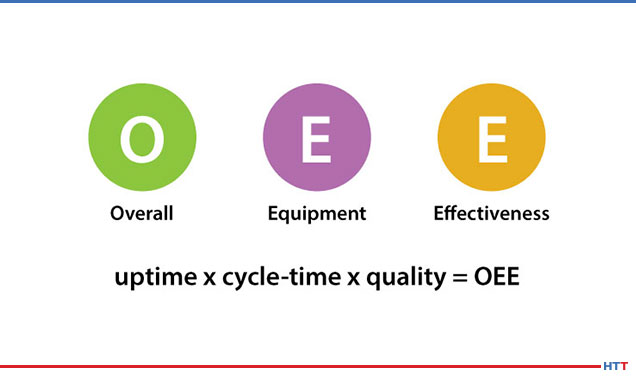
PS:  Quite an interesting trend with a subject called Overall Equipment Effectiveness (OEE).  This is a KPI (key performance indicator). I don’t think it’s widespread currently within the heat treatment industry, but I see it in pockets when I travel around the world.  OEE is made up of three components, the first being up-time (the the availability of the furnace), second component being the cycle time, so where are you against the design performance that you might have got from the furnace OEM for how fast and well that cycle should run.  And the third component is quality-how many parts do you get through right first time without needing to go back through any rework or even get into rejects.  So now there is a bit of a push of, ok, so how can we use technology solutions to help companies improve their OEE?  It used to be just on the manufacturing floor, but it’s now migrating a bit more to the heat treatment department, so this is something that we’ve looked at what we can do.  We’re fortunate to be part of the larger Schneider Electric and we can rely on some of their resources and we’ve been able to tap into platforms that already offer OEE type solutions.  So that is something that we’re seeing as a trend and something that we have solutions for, and I think it’s going to be a topic for this year.

DG:  You mentioned OEE, up-time, cycle-time, and quality. I assume that built into that also is equipment utilization, right? It’s not just that the equipment is up (as in not broken down), but also in use, correct? Are we minimizing the gap times between loads, assuming it’s a batch system?

PS: Yes. It’s actually quite specific on up-time. It ignores plant maintenance because it kind of says, you have to do that to have a good running department, but it does concentrate on maybe three areas. Furnace breakdowns, so if you have something unexpected that happens.  It also looks at waiting times, and that can be split into waiting times from a labor perspective, have you got the resources to actually run the furnace, or are you getting gaps because of that?  And it could be fixtures or parts, so what you’re going to load into the furnace, are all of those ready, or are you waiting on those because you’re waiting on your customer or are you waiting on a pre-process?   So, yes, it looks at all of those areas and identifies where those gaps are.  It shows you where you’re getting trends, maybe a trend from one shift to another, so you can actually look at taking action to resolve that because it’s very valuable, the up-time of a furnace.

DG: Let’s talk about AI, analytics, machine learning and impact on things like preventative maintenance and, to a certain extent, this effects operational efficiency as well because we’re talking up-time on equipment. What are you hearing? What are you seeing?

PS: I capture a lot of this in the bubble of IoT and Industry 4.0 solutions. There are a lot of buzz words out there. There is a lot of hype, I think, over the past few years. Now some of that hype is starting to manifest itself into real solutions, but I think those have really only come out over the past couple of years. So what we do in this space is we have some predictive maintenance solutions that include a health application. Pretty much out of the box, you have data coming into an algorithm and it gives you information about the health of that particular asset. You can track that over time and so it can give you an indication of when you’re starting to get a problem, it may be on a component level on a furnace, or it may be across the entire furnace itself, but it gives you some kind of prediction so you can take action before something fails. If I go back a year or so, you kind of had to build discrete models to make this happen, and the result was as good as the model that you built. I think those have improved and they’re a bit more user friendly. And this is just going to improve over time. So I think predictive maintenance is going to be a topic that we’ll start to see having an effect this year and, as time goes on, the value of that will just increase.

DG:  I know there are several different furnace and/or induction equipment companies in the industry that already have preventative, predictive maintenance programs out there.  Do you think that’s going to continue to grow?  Are we going to see more and more of that?

PS: Yes, without a doubt. And, in fact, one of the packages that we put together allows an OEM to provide those services to their end users. You’ve got different tiers of OEM that some can afford to invest, which is quite a substantial amount in actually providing these types of solutions. Others, not so much. There are platforms now out there that enable all OEMs to kind of jump on the bandwagon of predictive maintenance and be able to offer those remote services.

One of the areas that will come out this year, just to give you a sneak peak of it, is based on the augmented reality aspect.  We already have an augmented reality solution.  We work with a number of OEMs with that, but the technology has evolved to the extent [that] you can pick up a tablet, hold it up against the furnace, and [it] give[s] you valuable information about the running characteristics of that furnace.  You can pick documentation up and electrical drawings, all from that tablet, all live. But what we will be able to do in 2020 is also get a remote view from an OEM actually dialing directly into that tablet and seeing what that person on the shop floor is actually seeing in front of them and being able to give them far better advice and better direction in case they’re trying to sort out an issue, to hopefully resolve that issue in a much faster time as well as cut down the cost of traveling all the time to site.

DG:  Your interaction with the furnace manufacturers and/or induction equipment manufacturers, in fact you cooperate with them to help provide these systems to their end users as well.

PS:  It is because of this other trend that we’ve seen with the workforce, particularly in North America.   You’ve got quite a large set of baby boomers that have been retiring over the past few years and that is coming to an end, and then you’ve got millennials coming in with completely different skills.  They are very tech-savvy, so some of these new solutions that we’re offering, they can get on board and get up to speed very quickly, but they lack the experience that the baby boomers have had because some of the guys and girls in the industry have been working for like 30, maybe even 40 years.  They’ve amassed all of this experience and certainly that can potentially go out the business.  So we’re using some of this technology to take hold of some of that expertise and augment the knowledge that the younger engineers have so that they can get up to speed a lot quicker.

DG: The younger generation are much more comfortable with a smartphone than a furnace, but if you can put some of that knowledge about the furnace on that smartphone, voila, you’ve got yourself a more quickly trained younger generation.

PS: The side effect of that is also having modern technology within a furnace department, you can start to then attract some of these younger engineers.  Because if you don’t have that, there are opportunities for them elsewhere in different industries and higher technology.  So we’re all competing for a limited labor pool, and updating the technology is going to have an impact on you being able to employ people a lot easier.

DG: We did a Heat Treat Radio interview with the CEO of the Inductotherm Group, a gentleman by the name of Gary Doyan.  I asked him this same question.  I said, “So is all the hype about Industry 4.0, is it true?” I think that the issue he got to was, just because you can collect the data doesn’t mean you ought to collect the data.  That brings me to the question: There is so much data out there; what do we do with it?  Just because we can collect it, should we?  And what are we going to do with all the data?  How do we assimilate it?  How do we make sense out of it?

Digital Dashboards (Photo Credit: Eurotherm)

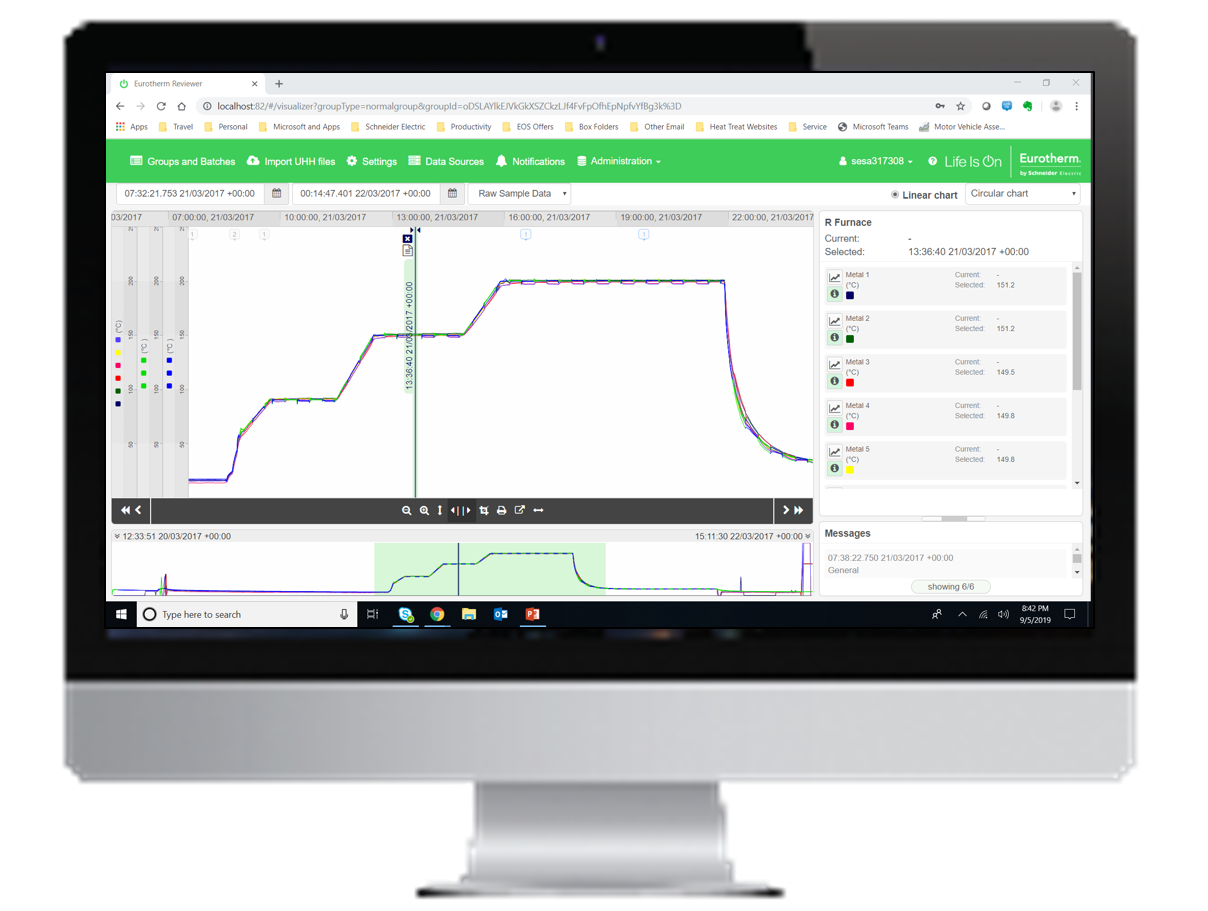
PS: Let me rewind the clock a little bit to when I first started in the industry and you had manual process cards.  Not a lot of paper chart recorders around, and those that were around were probably just logging the temperature rather than any other data point.  That has really changed.  From the 2000s onward, you’ve had paperless charts within the industry, SCADA systems, a lot of information.  So you’ve gone from this scarcity of data to data overload.  As you’re trying to do more and more with operational efficiency, we’re just getting more and more data points.  We’re fortunate, in a way, and I think Jim mentioned this on his call, that with the PLCs, etc., and the other devices we have on the shop floor, we’re collecting that data anyway.  So it’s not so much the issue about capturing data, it’s been about we’ve got this massive data, we’ve got this potential overload, we don’t have the time, resources, and even sometimes the expertise to make sense of all of this information, so where do we go from here?  I think this is another trend that we’re seeing. It developed in 2019, and it’s going to continue — the use of dashboards. I believe Nate touched on this as well in his interview. If you can collect that information and collate it and put it into a format that is just easy to understand and quick to get a view about what’s happening, what’s happened, what’s the direction, you can make better and quicker decisions.  We see dashboards and dashboarding as a trend that’s going to just explode, as far as in the heat treatment department because you need to be able to provide that information in a better way. An example of that is what we discussed about OEE. OEE comes with its own dashboard to give you a quick view about what’s happening across your process. That’s another trend for 2020.

Digital Dashboards
(Photo Credit: Eurotherm)

DG: Yes. Actually making sense of the data in bite size, quick pictures. Two more questions. I always have to ask this because I think everybody wants to know about it: cyber security. A lot of these systems that we’re talking about are either cloud-based or they have some vulnerability to outside intrusion. Can you talk a bit about any type of trends you’re seeing in cyber security?

PS: This is interesting. I started looking at all the IIOT and Industry 4.0 stuff back in 2013 and the trend for 2013–2018 was ‘what’s possible?’ What’s possible with the cloud, and with these edge devices, etc.?  The last two years, you’ve then moved into ‘what’s practical?’ Because we’ve seen a lot of these cyber security issues, even within our own industry, where you’ve had furnace OEMs and end users get involved with ransomware situations, not necessarily directed at the process control layer, but more targeted to ERP systems, etc., and you could get these potential viruses through USB connections, emails coming in where you click on one of those emails and then you open up this door for hackers to come through. So it has certainly become more of an issue. We were quite early in looking at this from an industrial product point of view, and we looked at starting to harden devices to enable them to withstand cyber security attacks. The latest range of controllers, the EPC3000 range, have a level of cyber security built in. They meet what’s called an Achilles Level One standard. We are also looking, even with our legacy products, to improve their cyber security requirements and try to meet some of the requirements from this international standard IEC62443. That is being built up to try and improve the safety, availability, integrity, and confidentiality of all of the components and systems that you’ve got within your plant. We, as well as Schneider Electric, have followed that, and it’s interesting to see the resource requirements that have gone from pretty much when we’re dealing with products in the past, there was very little talked about or even planned with cyber security, to it now being the number one. This leads everything. We have to have our software development life cycle start with cyber security. So, yes, it’s accelerated and it’s right. If you open up these ports for people to come in, it can work both ways. Obviously, you’re pushing information out, you can spread information across the plant, everyone gets to know what’s going on, but you can then have other people coming in that you don’t want. You’ve got to be a little bit more careful.

Very simple things I would promote to any heat treater today, and that is start looking at manage switchers and firewalls for your operation. We do have white pages on this that actually go through some of the rudimentary things that you should do from a cyber security perspective. I’m happy for people to contact me or maybe we can give you something, Doug, that you can put up on your website so they can just access it.

Eurotherm White PaperEditor’s Note: Click on “White Paper” image to be linked to the white paper referred to in this section.

DG:  Yes, that would be good to do.  We could at least put a link over to your site so people can look at those white papers. I think that would be helpful.

I’ve got a final question for you, and it’s regarding your average every day heat treater, manufacturer of some product, aerospace, automotive or whatever, who has his own in-house heat treat shop.  Let’s say they’re not doing a lot right now with IIOT, how would they get started?  What would be your suggestion on how to get rolling on using data more effectively, if you will?

[alert color=”green” icon=”fa-check”]Click here to be linked to the heat treat section of Eurotherm’s website.[/alert]

PS: There’s got to be a purpose, and that purpose usually is to have an effect on, say, something like operational efficiency.  Trying to assess where they are now and where they want to get to and using something like overall equipment effectiveness, it is down to a KPI so you can get a percentage.  You’ve got people that are world class that are like 85%, so the average is around 60%, and you’ve got some laggers that are around 40% as far as OEE. So getting that benchmark of where you are, getting an aspiration of where you want to be, and then contact anyone, like an instrument supplier that is touching on the IIOT world, like Eurotherm or others that are out there to help you on that journey.  There is a lot of support.  There are a lot of offers out there now that have all come up over the last couple of years.  So don’t hesitate to reach out.  There are people that know about this stuff and that can help, and they do want to sell it to you! Don’t be afraid of picking up the phone or sending an email because people are out there to support you. If the heat treat business as a whole improves, then everyone improves. That should be how people focus on things.

Doug Glenn, Publisher, Heat Treat Today
Doug Glenn, Heat Treat Today publisher and Heat Treat Radio host.


To listen to more Heat Treat Radio episodes, click here.

Heat Treat Radio #26: Cutting Edge Trends in Data with Peter Sherwin, Eurotherm by Schneider Electric Read More »

Heat Treat Radio #25: A Discussion with David Wolff, Nel Hydrogen, Part 2


Welcome to another episode of Heat Treat Radio, a periodic podcast where Heat Treat Radio host, Doug Glenn, discusses cutting-edge topics with industry-leading personalities. Below, you can either listen to the podcast by clicking on the audio play button, or you can read an edited version of the transcript. To see a complete list of other Heat Treat Radio episodes, click here.


Audio: A Discussion with David Wolff, Nel Hydrogen, Part 2

In this episode, Heat Treat Radio host, Doug Glenn, continues his conversation with Nel Hydrogen Heat Treat Manager David Wolff about the use of hydrogen in heat treat processes.  Listen to this second part of a two part conversation to find out more about the various delivery systems available, the economics of using hydrogen, and whether using hydrogen might make sense for your specific heat treat application. If you missed Part 1 of the series, click here.

Click the play button below to listen.


Transcript: A Discussion with David Wolff, Nel Hydrogen, Part 2

The following transcript has been edited for your reading enjoyment.

This Heat Treat Radio episode/transcript is based on the e-book shown above. Click on the image above if you'd like to get your own download of this 18-page e-book.

Doug Glenn (DG): Welcome to part two of this 2-part series on the use of hydrogen in heat treat processes. Today we are wrapping up a conversation we started last time with David Wolff of Nel Hydrogen.  This 2-part series is based on the content of an eBook recently published by Heat Treat Today in cooperation with Nel Hydrogen entitled “Hydrogen Generation and its Benefits for Heat Treaters.”

In part one, we discussed some hydrogen fundamentals.  Things like what purpose hydrogen plays in the heat treat process. We hit on safety issues, the processes where hydrogen is typically used, and other atmosphere generation systems and how they compare to hydrogen, as well as several other hydrogen basics.  In this episode we're going to dig deeper into several topics, including the various delivery systems available, the economics of using hydrogen, and whether or not using hydrogen might make sense for your specific heat treat application.

We're going to get back to our discussion with David Wolff of Nel Hydrogen.  Remember, this is part 2.  If you'd like to read the transcript or listen to part 1, click here. Now back to the interview.

DG:  Let's talk about typical modes of delivery for hydrogen. My understanding is we're talking about bulk delivery from some of your gas companies, generated hydrogen, which, as you mentioned, could be endo or exo, that does produce some percentage of hydrogen, but then also we've got a product that you guys are offering, which is a hydrogen generator.  Let's talk about those delivery methods just briefly, maybe summarize them, their advantages/disadvantages, etc.

Delivered atmosphere options

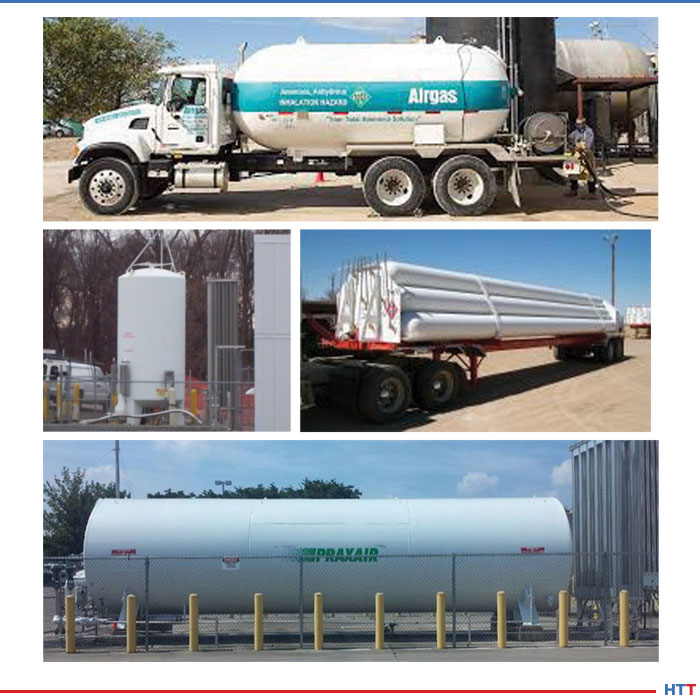
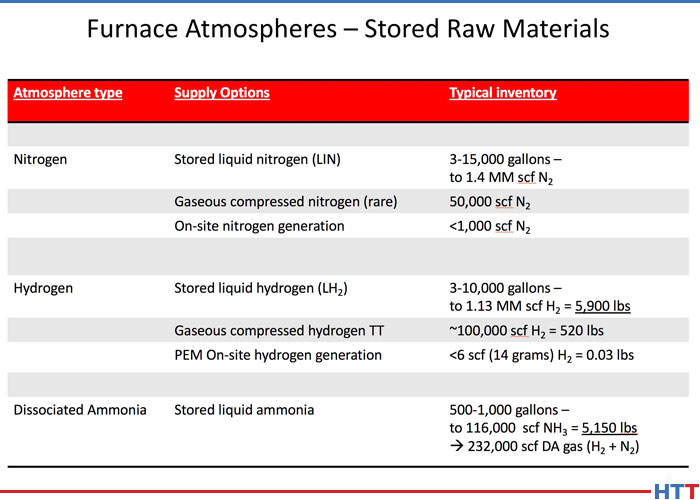
David Wolff (DW):  While nitrogen and argon, the diluent gases are available anywhere on earth because they are components in the air, hydrogen is only available by generating it from a hydrogen containing material, such as methane or from water. Delivered hydrogen needs to come from a hydrogen plant that may be hundreds of miles away from any particular customer.  In most cases, if you're buying hydrogen, say from an industrial gas provider, that hydrogen has come from a plant where it's made, cleaned, and then packaged or processed in a way for efficient delivery.  It might be liquefied or it might be compressed and then it's trucked to thermal processing customers for storage and subsequent use.  Your delivered hydrogen is coming from some chemical or other facility, which may be quite far away.

As you mentioned, Doug, the two historically significant sources of generated, what I will call “blended atmospheres,” typically fall under the name "generated atmospheres," and I'll group endo and exo together because they're really made in a very similar way, and then dissociated ammonia.  Endo and exo are made by thermally cracking natural gas, which is primarily methane, and endo and exo describe two very similar processes for making an atmosphere which consists of hydrogen, water, carbon monoxide, and carbon dioxide.  The ratios of those gases differ whether you're using endo or exo gas, but both gases contain all four-hydrogen, water, CO2, and CO.  As long as your process can utilize all four of those gases, then endo and exo are quite economical, particularly today when methane or natural gas is so cheap.  You don't have to be that old to remember that natural gas at one time was not so cheap. I remember not so long ago where natural gas was about five times what it costs today. There was a period of time when endo and exo were not attractive in industry because of the cost.

Now ammonia dissociation or DA (dissociated ammonia) has a popular and cost-effective technique for generating a kind of general use furnace atmosphere where you store ammonia and then you use a heated catalytic reactor to crack that ammonia into a gas which is 75% hydrogen balance nitrogen.  DA has been used for many, many decades, and in fact there are many methods which have standardized on DA.  It is still popular.  The challenge with DA is it requires the storage of ammonia, and ammonia is ever more unwelcome in communities because if it leaks, it creates a hazardous material response incident.

DG:  You've got storage issues there.  It's very obvious when ammonia leaks, you can tell with your nose, it is a harmful gas, so you've got to be very careful with the storage of it.  That is the point.

DW:  And there is one other issue, and that is if you're using DA, you can't get pure hydrogen.  Because you're starting with a gas which is 25% nitrogen, so no matter how much you dilute it by adding pure hydrogen, it is still going to have nitrogen in it.  If you want pure hydrogen for the ultimate in flexibility, it can be helpful to generate pure hydrogen.

The final thing you asked me to talk about was the equipment that Nel Hydrogen provides, which is electrolytic on-site generation of pure hydrogen.  That has become newly attractive because we've managed to reduce the capital cost of electrolysis equipment and we've managed to improve the energy efficiency, the hydrogen production versus the electricity used.  And in an environment where it is harder and harder to store hazardous materials like ammonia or pure hydrogen, it is interesting and attractive to be able to make cost-effective, process pressure, dry, pure hydrogen which you can then custom blend into whatever diluent gas you want, whether it's nitrogen or argon, in the exact ratio needed for your parts.

Atmosphere generation systems

DG:  Exactly, because you're talking about the endo or exo, you've got a range there of how much hydrogen, or what percentage of hydrogen you can have, whether you run it rich or lean, and things of that sort. With DA (dissociated ammonia),  your looking at 75% hydrogen/25% nitrogen, basically very little deviation from that. With a system where you are on-site hydrogen generating, you can dilute it at whatever percentage tickles your fancy.

DW:  Exactly. And by definition, the metallurgist will assist you to run the most dilute mixture that meets your metallurgical needs. Because that's how you save the most money, by diluting the hydrogen as much as the metallurgy will allow.

DG:  Very briefly, for those who might not know, tell us about the technology inside of your equipment, the proton exchange membrane and things of that sort.  Explain how it works, and then I'd like to ask you what kind of capacities can these systems that you supply, how many CFH or however you measure it, how much can you produce for a process.

DW:  It is easy to explain because we've all done it in high school chemistry.  Virtually every person among us, in high school chemistry, has used a direct current from a battery and two electrodes to crack water with an acid or base in it to make hydrogen and oxygen bubbles.  We're doing exactly the same thing, but we're doing it on an industrial level.  Our equipment uses an electrolyte, which is made by Dupont, to enable us to crack water into hydrogen and oxygen and maintain the two gases on two different sides of a solid membrane.  That has important safety advantages because the hydrogen and oxygen can never mix. We make very pure hydrogen.  The only impurity in that hydrogen is water.  As manufactured in our equipment, the hydrogen is wet with water.  The only purification that we do to that hydrogen is we dry it.  And we dry it to the specification for industrial grade either gas or liquid hydrogen.  In essence, it is a replacement for gaseous compressed, or liquefied hydrogen, that you might have delivered to your facility.

The raw materials that we require are simply electricity and de-ionized water, and we require also cooling water for some of our larger scale equipment.

DG:  The contention is that there are some real potential benefits to some heat treaters by having on-site hydrogen generation.  What are the advantages and then, are there some heat treaters who shouldn't even consider using hydrogen?

Stored atmosphere raw materials by the numbers

DW:  Getting rid of the need for on-site hazardous material storage is a huge benefit.  That is a major benefit- zero hazardous materials inventory.  Cost predictability is often even more important than having the lowest absolute cost at any point in time.  With hydrogen generation, most of the cost is in the capital and in the electricity that you use to drive the equipment.  So cost predictability is much better, for example, than with ammonia, natural gas, or with delivered hydrogen.

On-site electrolytic hydrogen generation makes pure hydrogen as compared with exo, endo, or DA.  And the hydrogen that you're using is very, very pure.  It is 99.9995% or better, so it's the equivalent of very, very pure delivered hydrogen.  We provide very dry hydrogen.  One of the drawbacks to the generated hydrogen in exo, endo, and DA is that those gases are not as dry, so you often need a higher hydrogen level in order to achieve similar scavenging of oxygen.  People find, for example, when they replace DA with generated hydrogen and nitrogen, they can often use a more dilute blend.  So rather than having to use 75/25, they might be able to use 50/50, saving money.

Finally, the generated hydrogen from Nel equipment is available at considerable pressure, 200 to as high as 435 Psi.  That makes it easier to use a pressure-based blender to selectively blend hydrogen and nitrogen to your desired furnace atmosphere blend.

DG:  How big are these systems?

DW:  We have equipment anywhere from 4 cubic feet an hour of pure hydrogen up to 19,000 cubic feet/hour of pure hydrogen.  The cost of the equipment goes up as you get bigger.  I think the 'sweet spot' for generated hydrogen is probably not to try to compete with the largest endo and exo facilities.  I think a thermal processor might choose to utilize a generated hydrogen for those materials and processes that require pure hydrogen or a purity of atmosphere unattainable with endo or exo.

Endo and exo are really good technologies and especially today with inexpensive natural gas.  If you can use those, God bless you, use them.  But if today you're using DA or you're using delivered hydrogen, then I think you might find it very worthwhile to choose a hydrogen generator which might have a capacity of 200 or 400 or 1000 cubic feet an hour for your process.  And, in doing so, you might find that, as compared with certainly DA, you can use a leaner blend and save money as well as get better process results.

DG:  What are the maintenance issues that we're seeing with on-site generation equipment?

DW:  There are two types of normal maintenance required.  All of our equipment is designed with internal flammable gas detectors.  That's important from a safety point of view.  That protects you from any leaks within the equipment, it also protects the facility if there was any flammable gas in the facility atmosphere, the hydrogen generator would shut down.  Those internal flammable gas detectors need to be calibrated once every 3 months.  The nice thing is that it only takes 15 minutes, but it is a planned, required maintenance operation that must take place every 3 months and takes 15 minutes.  And of course, we train you how to do that.

In terms of schedule maintenance of a more involved type, our equipment is designed to be maintained once per year.  Again, we train our customers to do that, or we can offer to come in and do it ourselves.  It is a kind of maintenance that is very straightforward and can be done by a mechanical or electrical technician.  It includes replacing parts, such as the water pump, that have a defined life-time.  And we recommend that those parts be replaced on a proactive point of view in order to eliminate nuisance failures.  For example, a water pump might last 3 years or 25,000 hours, for example.  And really, that's it.  Like any process equipment, you can have failures and we have set up a robust service capability so that we can diagnose and get people parts as quickly as possible so that they can keep their equipment running with the highest on-stream time possible.  Especially for customers in other countries, we often recommend that they have on-hand a kit of parts that we call 'recommended spares kit', which is a very cost-effective way to have the parts available that we have seen fail in the field, so that they don't have to wait for shipped parts to show up.  As soon as a failure is diagnosed, they can put in the parts and they can be right back on-stream and then we can replace any parts that were taken from the recommended spares kit.

DG:  I next asked Dave to address the economics of the system.  How does on-site hydrogen generation compare to other gas delivery systems?

DW:  In terms of economics, the cost of on-site generated hydrogen is really very straightforward.  It is the capital cost of the equipment, the cost of the electricity and water inputs and the cost of annual maintenance.  The equipment can be a purchase or a lease.  And because you're acquiring the equipment, of course there is an economy of scale to consider.  Small volumes of hydrogen is smaller equipment.  And then, in that case, we find that most people find the generator capital cost for smaller users might be around $2.00/hundred cubic feet.  That is the capital cost of the equipment depreciation.  As the size of the hydrogen generator increases (that would be tube trailer users or liquid hydrogen users), the capital cost of the equipment drops below $1.00/hundred cubic feet.  So as equipment gets bigger, the capital cost per unit of production falls.  Our largest capacity equipment, intended for very large scale manufacturing, which might be used, but might be too large for most thermal processors, has a fixed cost as low as 20 cents/hundred cubic feet.  So you can see there is economy of scale.

Now the energy cost of the hydrogen is most of the variable cost.  Water is almost nothing.  Depending on the specific model of the system chosen, it requires between 15 and 19 kilowatt hours of electricity to make a hundred cubic feet of hydrogen.  Here in the US, in 2018, the US industrial electrical rate was about .07/kilowatt hour average.  So the average in the US in 2018 was 7 cents.  If you multiply that by 15 – 19 kilowatt hours/hundred cubic feet, then you get an electric variable cost of between $1.05 and $1.53/hundred cubic feet.  So you add that variable cost to the fixed.

Your annual maintenance is somewhere between $2,000 and $5,000.  Obviously, that is a bigger hit for the smaller users than your larger users.  Altogether, the cost of hydrogen for on-site water electrolysis in the medium volume range of interest to the thermal processing industry ranges from a high, at the low end of the use, of about $4/hundred to as little as $2/hundred for users of larger volumes, say your liquid hydrogen users.

DG:  Best candidates for on-site generation and then, are there some people who shouldn't?

DW:  The best candidates for on-site hydrogen generation are those for whom the technique, equipment, and product quality, the hydrogen quality, provide competitive advantage.  So very compact equipment, zero hydrogen inventory, very pure hydrogen with relatively low maintenance, highly predictable costs and the ability to blend any hydrogen atmosphere to pure hydrogen down to forming gas, are all advantages of on-site electrolysis hydrogen.

We observe that captive heat treating operations often prioritize the characteristics of on-site hydrogen generation because they see a direct effect on product quality and ease of integrating heat treating processes into their facility.  So they are more interested in- is it safe, is it pure, is it easy to operate than is it the cheapest possible hydrogen.  Because of the capital cost (this equipment is not cheap), the best candidates for on-site hydrogen are going to use the equipment hard.  The closer to 24/7, the less expensive, the capital cost contribution to your cost structure.  So use it hard.

There are a few usage characteristics that argue against on-site hydrogen and similarly would make endo, exo, or DA less attractive.  If you've got a temporary requirement for hydrogen, or a batch process that occurs irregularly or with long time gaps between batches, or you have a portable requirement, or where your actual atmosphere required might still be under development.  In all of those cases, frankly, you'd be better to start out with delivered gases, at least until you understand the requirements of the process and the scheduling for the gas use until you establish a predictable pattern.

Finally, endo, exo, and DA are really good technologies to make a hydrogen containing atmosphere. If the cost of the atmosphere is the most important factor and the safety issues of ammonia storage and CO containing atmospheres are acceptable, and the characteristics of the exo, endo, or DA atmosphere are acceptable to your processes, then those may be a good choice.

Doug Glenn, Publisher, Heat Treat Today
Doug Glenn, Heat Treat Today publisher and Heat Treat Radio host.


End of Part 2.

Part 1 of this two-part series aired on January 30, 2020. To find that episode, click here. To find other episodes, go to www.heattreattoday.com/radio and look in the list of Heat Treat Radio episodes listed.

Heat Treat Radio #25: A Discussion with David Wolff, Nel Hydrogen, Part 2 Read More »

Heat Treat Radio #24: A Discussion with David Wolff, Nel Hydrogen, Part 1


Welcome to another episode of Heat Treat Radio, a periodic podcast where Heat Treat Radio host, Doug Glenn, discusses cutting-edge topics with industry-leading personalities. Below, you can either listen to the podcast by clicking on the audio play button, or you can read an edited version of the transcript. To see a complete list of other Heat Treat Radio episodes, click here.


Audio: A Discussion with David Wolff, Nel Hydrogen, Part 1

In this conversation, Heat Treat Radio host, Doug Glenn, engages Nel Hydrogen Heat Treat Manager David Wolff in a conversation about hydrogen generation and its purposes. Find out more about what hydrogen is best used for, what hydrogen can do for your company, why hydrogen is preferred to nitrogen, and how to safely use it to the best effect.

Click the play button below to listen.


Transcript: A Discussion with David Wolff, Nel Hydrogen, Part 1

The following transcript has been edited for your reading enjoyment.

Doug Glenn (DG):  We're here today with David Wolff from Nel Hydrogen and we're going to be talking a bit about on-site hydrogen generation.  This really has come about because of an eBook that David and one of his colleagues, a gentleman by the name of Chris Van Name, and Heat Treat Today worked on together.  The eBook was based on a presentation that you gave at FNA 2018.

Dave Wolff (DW):  You're correct.  The eBook was based on the FNA (Furnaces North America).  I did an expansion on it for Fabtech 2019.

DG:  I want our readers to know you before we jump into the content of the book.  If you don't mind, Dave, would you just give us your name, rank, serial number, etc.

This Heat Treat Radio episode/transcript is based on the e-book shown above. Click on the image above if you'd like to get your own download this 18-page e-book.

DW:  I've been in the industrial gas industry for my whole career, (hard to believe), going well over 40 years now.  I've been a little over 20 years at Nel Hydrogen.  Before we were called Nel, we were called Proton Onsite.  I joined relatively early in Proton's history.  Proton was begun in order to commercialize attractively cost on-site hydrogen using water electrolysis.  I found that incredibly exciting, as I came from the industrial gas industry, and I witnessed first hand the importance of having cost effective access to hydrogen in order to succeed in materials processing. Prior to Proton, I was with Messer, who is now back in the United States; and I was with Air Products for about 13 years prior to my time with Messer.

DG:  So you've spent, let's say, 40 years in the industrial gases industry and most recently, and a good bulk of that time, with what was called Proton Onsite, now called Nel Hydrogen.  For our reader's sake, Nel in the US is headquartered out of New England?

DW:  Yes.  Nel, in the US is headquartered in Wallingford, Connecticut, which was where Proton was based. Nel's worldwide corporate headquarters is in Norway. Nel is a corporation related to the historical Norsk Hydro, which has been around since 1927 and involved with water electrolysis since the early 20's.

DG: So today we want to talk about hydrogen, but we're going to talk specifically about on-site hydrogen generation. But before

Delivered atmosphere options

we get there, if you don't mind Dave, give us a quick rundown on just the role of hydrogen in your normal, typical heat treat process.  What does hydrogen do for us?

DW: You start with the fact that hydrogen is a reducing gas, which means that it can prevent or even reverse oxidation.  For example, you can put oxidized parts through a hydrogen atmosphere furnace and they'll come out the other end, say if it's a belt furnace, bright and shiny.  At the elevated temperatures used in metal thermal processing (heat treating), the rate of oxidation is increased, so you have to protect the metal so that it doesn't discolor from oxidation. And more concerning, oxidation will interfere with braze material flow in brazing and will prevent proper sintering of powder metal fabricated parts, so oxidation is a real problem in thermal processing.

DG: Right. So the reason of the brazing and whatnot is because of contamination on the surfaces, right? You don't get a solid braze or a solid sinter.

DW: Exactly. Now hydrogen is not the only reducing gas. CO (carbon monoxide) can also be used. But CO is highly toxic, so it is not routinely used, except if it's created incidentally in the process of making endo or exo gas.

Some people wonder why nitrogen alone is not sufficient as a heat treating atmosphere.  It's inert, right?  But it's essentially impossible to flow enough nitrogen through an atmosphere furnace to eliminate all of the oxygen molecules. And if you did try to flow that much nitrogen through the furnace, you would rob all of the heat out of the furnace.  So the attractiveness about hydrogen is it grabs and immobilizes the stray oxygen molecules preventing oxidation but still enables you to manage the flow rate in your furnace.

DG: There are some vacuum furnace heat treaters who place a piece of metal or some substance inside of their furnace (they call it a 'getter'), which basically attracts those undesirable elements out of the atmosphere.  In a sense, hydrogen (not exactly, but in a sense) can be kind of that 'getter' that goes and 'gets,' if you will, the oxygen pulls it out of that atmosphere, where nitrogen you have to be pushing it out.  You'd have to be putting so much nitrogen through, you still might not get rid of all of the oxygen, whereas if you have some hydrogen, it pulls it out.

DW:  You're exactly right.  The hydrogen acts as a chemical 'getter' and so it's analogous.  A couple of other things I should mention.  In addition to its role as a reducing gas to prevent or reverse oxidation, hydrogen has the highest heat conductivity of any gas.  So the high heat conductivity of hydrogen means that parts heat up faster in a hydrogen containing atmosphere, and they cool off faster too.  The high heat conductivity allows for higher productivity by faster cycles in batch heat treating and faster transport speed through continuous furnaces likes belts and pushers.  Parts heat up fast and they cool down quickly.  The alternative, if you have lower hydrogen content in your atmospheres, is longer furnaces, slower belt speeds, or longer back furnace cycles.

DG: Coefficient heat transfer hydrogen is the best for pulling heat out or putting heat in, so you're looking at process efficiencies there as well.

DW: Productivity. One final thing. While vacuum furnaces are widely used and yield terrific results, a vacuum furnace creates an inert atmosphere, not a reducing atmosphere.  So a high vacuum furnace can prevent oxidation, but typically not reverse it. So in many cases, a wisp of hydrogen is often used to create a partial pressure hydrogen atmosphere in vacuum furnaces.  For example, for powder metallurgy, you enhance the sintering by reducing the surface oxidation on the powder particles.

DG: We've hit on what hydrogen can do, and I think we've already hit on this next question, which is the typical heat treat processes. Brazing you've mentioned, sintering you've mentioned; what else would we typically use a hydrogen atmosphere for?

DW: Let's start with making sure that people are aware that hydrogen is used only in furnaces which are designed for hydrogen

Atmosphere generation systems

atmosphere. They have to have the right flow path, they have to have electrical parts and safety systems such as flame curtains, which are expressly designed to safely use hydrogen. Also, and importantly, the newest thermal processing equipment is highly automated for safe use of hydrogen. While hydrogen can be used safely in older equipment that is also designed to use hydrogen, it's important to follow procedures which are specifically designed around hydrogen use. So those are key considerations.

DG: I think we ought to emphasize the caveat that you're issuing. Hydrogen does have its issues, and we need to be careful with the use of hydrogen. So don't just go throw hydrogen into your furnace. It is very, very important that the safety concerns be followed.

DW:  So hydrogen is used to provide atmospheres for processes like annealing, brazing, glass metal sealing and all types of sintering including PM, MIM, and AM. Hydrogen is also widely used for processing magnetic materials, motor laminations and things like that. Keep in mind that both synthetic or blended atmospheres and also generated -- and by "generated" we typically refer to exo, endo and DA (dissociated ammonia) -- those atmospheres contain hydrogen as the primary reducing gas. As I mentioned earlier, exo and endo gas also contain CO, which is also a reducing gas, and exo and endo are often used in atmospheres for hardening. Typically you don't use a pure hydrogen atmosphere for that because that will tend to soften your parts.

DG: We've covered some of the processes that are involved, and you've alluded to this Dave, but let's flesh this out a little bit

Stored atmosphere raw materials by the numbers

more--we don't often use hydrogen alone. Often it is used as one component with other gases. Let's talk about why that is. Besides the obvious safety issues of using 100% hydrogen, let's talk about why we don't see 100% hydrogen and what we're often mixing with.

DW: I like to use an analogy here. Think of hydrogen gas in a furnace atmosphere, kind of like dish washing detergent. When you're washing dishes or processing parts, the function is to clean the parts, either the metal parts or cups and saucers. Dish washing detergent is diluted with water. Hydrogen is typically diluted with nitrogen or possibly with argon. In both cases, whether you're washing dishes or processing metal parts, the detergent is more expensive than the diluent. Hence, the idea is to use only as much detergent (hydrogen) as is needed to get the job done.

There are major differences between thermal processing and washing dishes. One major consideration is that the metal that is being thermally processed is actually chemically and metallurgically interacting with the furnace atmosphere. So you have the surface effect, which is the chemical effect, but also you have a metallurgical effect. That's how metals are softened and also, in the case of carbon, hardened. Obviously dishes are unaffected by the dish washing process other than having their surface cleaned.  So that is part of the reason that atmosphere composition is greatly dependent on the metallurgy of the parts that you're processing. That is also the area where metallurgists have the greatest knowledge and provide unique process knowledge and value.

DG: So basically, you're going to use as little, if you will, or an appropriate portion of hydrogen to get the job done, and that is very much dependent on materials being run, processes being performed, etc. Correct?

DW: Exactly. The workhorse thermal processing atmosphere is a nitrogen atmosphere with a variable amount of hydrogen depending on the metal being processed. Carbon steel, for example, can be processed in a 4–5% hydrogen blend with the balance of the atmosphere being 95–96% nitrogen. This blend is so widely used that it has been given a nickname, so called forming gas. Some metals react adversely with hydrogen and cannot be processed in a hydrogen containing atmosphere at all. An example of that would be titanium. Titanium, which is so widely used for aerospace and also medical applications, is not processed in hydrogen at all, and that is why batch vacuum heat treating is so popular in aerospace and medical because there is a lot of titanium use.

DG: My understanding is that hydrogen causes embrittlement when we're dealing with titanium.

DW: Exactly. It causes damage to titanium parts. Batch processing also enables you to do lot tracking and other things which are important in both aerospace and medical.

Aluminum is another commonly heat treated metal that doesn't require hydrogen.  Aluminum is basically generally heat treated in pure nitrogen.  But other metals that do use hydrogen containing atmosphere include copper and brass, as I mentioned, magnetic steels and stainless steels. Generally, the steels, other than carbon steel, will require an atmosphere in the 30–60% range of hydrogen in nitrogen while certain grades of stainless must be heat treated in 100% hydrogen. Often the 300 series of stainless, people prefer to use 100% hydrogen for that.

Doug Glenn, Publisher, Heat Treat Today
Doug Glenn, Heat Treat Today publisher and Heat Treat Radio host.


End of Part 1.

Part 2 is scheduled to be released on February 13th. Check back here for a link to that episode or go to www.heattreattoday.com/radio after February 13, 2020, and look for Part 2 in the list of Heat Treat Radio episodes listed.

Heat Treat Radio #24: A Discussion with David Wolff, Nel Hydrogen, Part 1 Read More »

Heat Treat Radio #21: James Jan & Andrew Martin on Development of Modeling Software

Welcome to another episode of Heat Treat Radio, a periodic podcast where Heat Treat Radio host, Doug Glenn, discusses cutting-edge topics with industry-leading personalities. Below, you can either listen to the podcast by clicking on the audio play button, or you can read an edited version of the transcript. To see a complete list of other Heat Treat Radio episodes, click here.


Audio: James Jan & Andrew Martin on Development of Modeling Software

In this conversation, Heat Treat Radio host, Doug Glenn, publisher of Heat Treat Today, interviews Ford Motor Company’s James Jan about Ford’s cooperation with AVL on the development of modeling software to help predict and avoid cracking on aluminum cylinder heads. Andrew Martin from AVL also joins the conversation with what exactly it is they did with Ford.

Click the play button below to listen.


Transcript: James Jan & Andrew Martin on Development of Modeling Software

The following transcript has been edited for your reading enjoyment.

Mr. James Jan, Ford Motor Company (JJ): My name is James Jan. I graduated from the University of Michigan in Ann Arbor, and I have a Ph.D. in mechanical engineering and during my Ph.D. studies, I focused on multiphase flow. Basically it is the full mechanics but we deal with multiple phases—usually it is a mixture of liquid and gas. I graduated in 1994 and I’ve been working with industry, the automotive industry, to be more specific, since my graduation. I have worked in the auto industry for 20+ years, since 1994. However, I’ve been involved in quite a few different subjects in my career even though they are all sensor or fluid mechanics, spent three years writing software (which is also a CFD software), and I work on the intake exhaust manifold and work on the local problems. I was pulled into Ford for this current project back in 2011. That was the time I got very heavily involved in the development of the heat treat process. Before that CFD, but after that it’s about heat treat.

Doug Glenn, Heat Treat Radio (DG): As Mr. Jan says, he is now heavily involved with heat treat, specifically on modeling of the quenching process for aluminum cylinder heads. I asked Mr. Jan to explain the issue that Ford was having. But before he describes the situation, it is important for you to know that Ford was addressing this issue long before nearly all other car manufacturers and is, in fact, a leader in industry with regard to resolving this highly technical heat treat and product design situation. Here is how Mr. Jan describes the situation that set the ball rolling nearly 20 years ago at Ford.

Structural failure in valve bridge area

JJ: The reason that they wanted to solve the problem is because during the heat treat process there are a lot of cracks. The cracking problem during heat treating has been a quality concern for Ford for many, many years. I would say that the problem has been there for 20 some years. In the past, during the cracking process, one of the remedies would be to do a lot of trial and error. For example, during water quench if they see a crack, they switch to air, and if the air doesn’t work, then they switch to polymer. Or if this is cracking somewhere or in some location, they add more material in that area. So, it’s pretty much like responding to the problem, rather than trying to understand the problem and to predict the problem. So that is where the whole thing comes in that the researchers started the project in 2002 because they believe that they really needed a tool to predict the problem rather than responding to it.

DG: So, the problem Ford was having was decades old. And it is a problem that many manufacturers have. It is the age-old problem of being able to predict residual stresses formed during the quenching process that ultimately result in cracking and component failures. Ford, like many other manufacturers, were simply doing trial and error until they got the right combination of part geography, heat treat cycle, and quenching medium and quench orientation. The problem is, that process takes a long, long time and it costs a huge amount of money. Here is Mr. Jan describing the issue with a trial and error approach.

JJ: Every time they make a change to a design, they have to build a prototype part. There will be cost involved because when you build the prototype, you still need a die, you still need the testing process, and then once you have built it you have to run the test to see if it cracks or not. This back and forth just simply takes too much time and too much cost.

DG: The thinking was that if the design engineer and manufacturing engineer could talk earlier in the process, it would help save time and money. Specifically, it would be better if the design engineer could interact with some sort of predictive modeling system that fairly accurately represented the heat treating and quenching portion of the manufacturing process to predict residual stresses and potential cracking issues before they happened. If that were possible, it would save Ford thousands if not hundreds of thousands of dollars. Here is Mr. Jan describing the idea.

JJ: This has something to do with the product development process. When any company tries to development product, their first objective is to satisfy the functional requirement. So basically, if you have an engine and you want a certain horsepower, you want to make sure your engine will satisfy the horsepower. At the beginning of design, their only concern is about functionality, they don’t care about anything else. Once the design is fixed, somebody needs to make it. I belong to manufacturing engineering, so we do not deal with designing, we deal with how to make that part.

During the design process, they usually do not have manufacturing information. Once the design is done, which is usually pretty late in the design cycle, the part has pretty much been determined already. Then we come to manufacturing and we try to quench it, and find, “Oh, gee, it’s cracked.” Then we tell product development, “We have a cracking problem,” and they say, “I wish you had told me earlier.” That is where the problem comes in. Because we are not able to know if the process works or not until we have a physical part, so that’s why Ford’s research tried to initiate a project that said even though design is still ongoing and the manufacturing generally has not started yet, let’s try to do some virtual process simulations to see whether it will crack or not.

DG: The specific tool that Ford was looking for was a tool that could predict multiphase flow quenching outcomes, what many of our listeners would recognize as the Leidenfrost Effect or vapor boiling. According to Mr. Jan:

JJ: The boiling process, because the physics is very complicated, we couldn’t find any commercial software on the market that would solve the problem. So, we contacted AVL at the time.

DG: As Mr. Jan said, since they weren’t able to find any commercially available software to predict the multiphase Leidenfrost Effect, they turned to AVL. So, Heat Treat Radio put a call into AVL Powertrain Engineering in Plymouth, Michigan, and spoke with Andrew Martin, who is the direct of advanced simulation technologies. We asked him about AVL’s relationship with Ford.

Andrew Martin, AVL (AM): Our relationship has gone back to about 20 years now. Twenty years ago, Ford was seeing cracking in the cylinder heads—and not only Ford but many of its competitors out in the marketplace. So, this was something they wanted to explore. AVL as a company, currently at about 10,000 engineers, has always had a strong relationship with Ford. We develop engines and transmissions together, and things like that. Ford came to us and asked can you look into this? They knew that we had a good CFD code and we were doing a lot of multiphase work, especially on things like fuel injection and boiling in water jackets and things like that. They knew we had a reputation in those areas, so they wanted to work with us on coming up with some sort of a simulation and analysis approach for the boiling that occurs during quenching analysis. Between us, we did the research and that led to a technical paper that was published, I think ASME, but that was in 2002. James (Jan) was involved in that paper back then as well.

DG: I asked Andrew to briefly describe the cylinder head issue that Ford brought to them.

AM: Cylinder heads are very complicated because they have so many cavities. When you quench something like that, then the vapor gets trapped in certain areas and that can lead then to localized residual stresses.

DG: And what did AVL have to bring to the table?

Boiling regimes

AM: Previously, they were doing it the old-fashioned way, they were doing with thermocouples. They would thermocouple a cylinder head and quench it and then look at the data and get the HTCs (heat transfer coefficients) from it then feed that back into the CFD code and then make some assessments about the residual stresses and the distortion. But that is a very expensive way of doing it and it doesn’t lend itself very well as a designing tool. They wanted to find some mathematical approach for doing that. James is extremely experienced in CFD and has used a whole bunch of our CFD codes that compete with AVL FIRE. But he then started using FIRE and realizing that given all the tools that he had at his disposal, FIRE was the one that was giving the best results for doing this boiling analysis.

DG: Andrew referred to AVL FIRE which is a brand name of a specific product offered by AVL. I asked him to briefly explain that product.

AM: AVL FIRE is a CFD (computational fluid dynamics) code. It is an engineering discipline that is quite common and quite popular. We then used CFD to model the boiling that goes within a tank of water and the interface between the component and the water, the so-called film boiling barrier. We model what happens with FIRE CFD code, we model what is happening at the transition of the interface between the metal component and the water. Because when something that hot gets plunged into water, it is quite an interesting thing that happens—it is called the Leidenfrost Effect. Initially, what happens is the component is so hot, it forms a film around the outside of it, a vapor film, and perversely that vapor film then insulates the component from the water. That film slowly breaks down then you get into nucleate boiling and things like that, and that becomes a lot more aggressive and the cooling happens much faster until you eventually get a single phase. But actually modeling the boiling process is what the CFD code does. That is the secret sauce that we’re bringing to the party here.

DG: And, in fact, this secret sauce that Andrew refers to is quite unique. Earlier, James Jan from Ford mentioned that the AVL model was able to handle multiphase analysis, where most other models simply ignored one of the phases, usually gas, and focused exclusively on the interaction between the hot metal and water. I asked Andrew to unpack this more sophisticated modeling process and what developments have been made since they initially started working with Ford.

AM: Since then, it’s matured a lot further within the software. We now have different meshing approaches and we’ve also moved beyond water as well, of course. A lot of quenching is done in water, but there is also a lot of gas quenching, so blown air quenching, which takes longer but is less aggressive. And then we’ve got into steels as well. The original work we did with James was more on aluminum and that doesn’t have the same phase transformation issues as steel does. So

Typical simulation results

we’ve done a lot more work with steel recently, where we have to take account of that latent heat, that then forms a sort of a knee in the cooling, so we then model that. When we doing steel, of course, we’re using oil more commonly, so then we have different properties of oil to consider, different fluid properties of that. Most recently and what has been very interesting, we’ve been involved with a Canadian casting company on spray quenching. There you have a mix

between blown air and actually liquid itself where we’re spraying a jet of fluid at the component. Mathematically, that is a heck of a lot more complicated because you have to model the spray and you have to model the Ledienfrost Effect and the cooling and so on.

DG: Given the solution that AVL brought to Ford, I was curious if both Ford and both AVL were happy with the partnership. First, James Jan from Ford on how Ford and AVL worked together to develop the tool.

JJ: As a matter of fact, even though AVL worked with us to provide us the technology, it is not like we just go buy it and use it.

Simulation variables

Actually, we worked together about 3 to 4 years. On our end, we provided a lot of testing data because we work with a university and we also have an experiment facility inside Ford. When they provided the tool to us, it is still like a banana. They have the basic formulation working but they haven’t tested or validated, so there are 3 to 4 years where we were actually working like partners. It is not like, ok, I’m going to Home Depot, buy a tool and come home and use it. No. We actually did not put the AVL tool into production use until 2015. So there was about 3 to 4 years of time going back and forth trying to improve software. Until today, we still own a small piece of the technology, that is proprietary to our company Ford. Even though to AVL and buy their software and they bring it home, they may not produce the same results that we do, because we have a secret recipe in Ford.

AM: We’ve been very happy with the willingness of Ford to develop the process further, to mature it. They saw that we had something that was useful and beneficial and brought value, but actually James has been phenomenal, because he’s really pushed that agenda as well, and written papers and taken it to conferences, and I think he’s been very impressed with what AVL FIRE has been able to do, so he will talk to anybody about it. So we love it.

DG: Finally, I asked Andrew Martin from AVL who, in his estimation, would also benefit from the AVL fire and similar products, and what changes are being made for the future.

AM: It’s casting companies for sure. I was talking to a British company that makes castings, like high-end blocks for Astin Martins and Land Rovers and so on, and they have certain specifications they have to meet. They are not allowed to have a residual stress more than a certain level in a certain direction. Now how do they know that that’s the case? They can actually cast a few and then heat treat them and then cut them up and see how the material releases, but that rather destroys the actual component in the first place. So companies like that that want to know where are the residual stresses in the component and they want that as something that they can certify the component for, it is very good for that sort of company. Automotive is an obvious candidate, but also we’ve been doing a lot more work in aerospace where the residual stresses that they do want to know where are they and how much are they. Things like landing gears and stuff like that.

DG: And how about the future?

AM: Well, our software is developed over in Europe. I talked to Dr. David Greif the product manager the other day asking him where are we going with this. We’re making it a lot more easy to use. We’re putting workflows in place in AVL FIRE that sort of lead the user through the steps needed to predict the residual stresses and so on. The meshing of the components got a lot simpler using this polymeshing and it more leads you by the hand, as opposed to being a general purpose CFD code where you’ve got to build your own methodology to start off with. FIRE has a methodology built in for doing quenching and that’s brilliant. We’re doing a lot of work with gears at the moment. We’re working with a vacuum furnace company in Wisconsin called ECM Group and they’ve been using AVL FIRE for predicting the residual stresses in the components, so we’ve got a great relationship with ECM and that’s taking us in different directions as well. They are especially doing work on the gear side, so that’s been interesting.

DG: In fact, the whole relationship between Ford and AVL is interesting, as well as the ability to bridge the gap between design and heat treatment. Specifically, the quenching part of heat treatment. With advances in technology and modeling packages like AVL’s FIRE, high volume producers like Ford and other automotive, as well as aerospace manufacturers, have the opportunity to save significant dollars by modeling the process before they jump into the manufacturing process with both feet.

This interview is a follow up to an article in Heat Treat Pro, a publication of ASM International, “Using Virtual Tools for Quenching Process Design” by James Jan and Madhusudhan Nannapuraju. Images from powerpoint presentation and provided by AVL.

Doug Glenn, Publisher, Heat Treat Today
Doug Glenn, Heat Treat Today publisher and Heat Treat Radio host.


To find other Heat Treat Radio episodes, go to www.heattreattoday.com/radio and look in the list of Heat Treat Radio episodes listed.

Heat Treat Radio #21: James Jan & Andrew Martin on Development of Modeling Software Read More »

Heat Treat Radio #17: Heat Treat Megatrends with Gary Doyon

Welcome to another episode of Heat Treat Radio, a periodic podcast where Heat Treat Radio host, Doug Glenn, discusses cutting-edge topics with industry-leading personalities. Below, you can either listen to the podcast by clicking on the audio play button, or you can read an edited version of the transcript. To see a complete list of other Heat Treat Radio episodes, click here.


Audio: Heat Treat Radio: Heat Treat Megatrends with Gary Doyon

In this conversation, Heat Treat Radio host, Doug Glenn, interviews Gary Doyon, president and CEO of the Inductotherm Group, based in Rancocas, New Jersey on megatrends in heat treating. Inductotherm Group develops and manufactures advanced technologies, products, and systems for the heat-driven transformation of metals and specialty materials, providing localized manufacturing, engineering, service, and support in every region of the world through 40 full-service companies providing 50 individual product lines organized into 10 global brands. In addition, Doug asks Gary talk about a broad range of heat-treat related topics, including design change, electric vehicles, recycling materials, Brexit, immigration’s impact on U.S. manufacturing, a younger workforce, USMCA, and cybersecurity.

Click the play button below to listen.


Transcript: Heat Treat Radio: Heat Treat Megatrends with Gary Doyon

The following transcript has been edited for your reading enjoyment.

Extra support for this episode of Heat Treat Radio is provided by the Industrial Heating Equipment Association, IHEA, where leading companies in the thermal processing industry meet to discuss ways of advancing the industry. IHEA, on the web at www.ihea.org.

THERMPROCESS, the largest heat treating trade show in the world is just around the corner, as of the original airing of this Heat Treat Radio episode in mid-June 2019, and there is no better way to prepare for that event than to spend some time talking with someone in the heat treat industry who has a uniquely global perspective.

Hi, and thank you for joining us. I’m your Heat Treat Radio host and publisher of Heat Treat Today, Doug Glenn, and the gentleman we are talking to today has been in the industry for over 30 years and is CEO of over thirty metals-related companies around the globe, many involved directly in the North American heat treat market. You’d recognize many of the company names. Take, for example, Inductoheat, Radyne, Thermatool, Banyard, as well as Consarc and PVT. Today we’ll talk about international heat treating megatrends with our guest, Gary Doyon, president and CEO of the Inductotherm Group.

Before we get to Gary, let me remind you that you can keep current with all things heat treating by visiting Heat Treat Today’s website: www.heattreattoday.com or by receiving one of our many E-newsletters. You can subscribe by visiting our website. And, if you’d like more information on THERMPROCESS, that huge heat treat show I mentioned above, jump on your browser and go to www.thermprocess-online.com. You can also Google “Heat Treat Radio THERMPROCESS” and be taken directly to a previous episode of Heat Treat Radio where we interviewed Eva Rowe from Thermprocess.

DG: On today’s episode, in anticipation of THERMPROCESS, which is being held in Dusseldorf, Germany, on June 25–29, we’re going to talk with Gary Doyon, one of the most qualified individuals in the heat treat industry to discuss international megatrends. Our conversation is fast-paced and wide-ranging, covering topics as diverse as cybersecurity, immigration, the impact of electric vehicles on the heat treat supply train, and Brexit.

First, let’s learn a bit more about the man, Gary Doyon.

GD:  My name is Gary Doyon. I’ve been with Inductotherm Group for 33 years. I started off in sales in Connecticut at a company called Thermatool and progressed up through operations. I took over a Thermatool group which was a number of companies and then eventually got into the management of the Inductotherm group which is some 40 companies around the world, and today my title is president and CEO of that group.

Global Growth of Heat Treat Industry

DG:  First question for Gary: Geographically, where do you anticipate higher than average and lower than average growth in the heat treat world over the next 5 to 10 years?

GD:  Geographically, I think the above average is going to be seen in the next 5 to 10 years in North America for sure, Asia—India especially, and Brazil if it can get its political identity issues under its belt. Not above average are Europe, Middle East, and Africa.

DG:  In the above average group, you said, “especially India.” Why is that?

GD:  India right now is a 6% GDP growth, year-on-year, and it’s going to grow up from there. If you visit India, you’ll see the infrastructure is poor and they are investing a lot in it. They are making a ton of cars. They are getting into the possibility of aerospace manufacturing of parts, land-based turbines, and things of that nature. They want to become more self-sufficient on all the infrastructure needs which means metal production of the utmost volume, and their foundry and steel-making businesses are rising incredibly fast.

Technology Trends in Heat Treating

DG:  Let’s move from geography to technology. Where do you see above-average activity? And where below average activity?

GD:  Technically, powder metallurgy and 3D printing probably have the largest potential impact on thermal processors from a disruption standpoint. The composition of the steels and metals used in 3D or powders affect the heat treating practices because what’s good for part making may not be good for heat treating. Today the regular methods of part making like forging or casting are cheaper in volume, but they are not as flexible in the design change of parts. I see that the pace of design change is slowing down, especially in automotive, because the automotive producers seem to be actually practicing standardization in power train and frame and engine programs, so this may mean that the flexibility of 3D powders is less valuable while volume producing by traditional methods will stay more economical. We’ll have to see what happens about that.

DG:  Interesting. You say the pace of design change is slowing down, especially in the automotive industry?

GD:  I believe that, yes. I believe that the carmakers internationally have decided to standardize and do less design changes which means it will increase the volume of parts per their vehicle spectrum. That’s good for thermal processors today because they may be able to use the same processes they have in place for years to come.

Environmental Concerns

DG:  How about the evolution of electric vehicles?

GD:  The evolution of electric vehicles I think will cause a shift in the types of metal parts that are heat treated. You will go to much more gears versus crankshafts, camshafts, and things like that. But it seems to me that the EV progress is going to be dictated more by the two larger issues. One is the ability to produce better battery technology for longer trips and for faster charges, and what comes with that is the faster you charge, the larger the electrical peak load is needed. The whole issue of the electrical grid sizing for peak load or how to charge for the higher demand charge that comes with rapid charging—this all remains to be seen. If they can’t get over those subjects, then I think EV evolution is going to be stagnated. Then there is the big one which is recycling of the batteries. As far as thermal processors getting into gear heat treating, etc, that may or may not elevate as fast as they may think, depending on these issues, in my opinion.

I think another technical/situational event that is happening is the worries of legislation on climate change. I think it may have an impact on the thermal processors, especially the gas-fired or the flame-type systems people. Despite the science that they’ve put in for minimizing any sort of output from those kinds of processes, perception is reality on furnaces. So, again, on that we will see what happens.

The other issue I think we should bring up is composites. I think composites will always have a place, but the recycling ability of these also flies in the face of climate change worries. The ability to recycle metals easily, in my opinion, will always be a natural positive for metals, which then affects metal processors.

DG:  It sounds like environmental concerns will act more as a restraint than a stimulant on the growth of electric vehicles in the next decade, due primarily to the recyclability issue?

GD:  I believe so. I think the excitement about getting into electric vehicles and composites causes a lot of upfront research and development, but then it hits into the face of the reality of the electrical grid, environmental considerations—the realities of living in America especially, where no one wants more power lines in their backyard, etc. In a lot of ways, it’s the same as renewable energies and how that stagnated a bit when people don’t want to have windmills in their backyard. I think these are real situations that could cause stagnation of these technologies for the next 5 or 10 years.

DG:  Beyond 5 to 10 years, do you see us ultimately moving to electric vehicles?

GD:  Yes, it’s inevitable. I think the race is going to be between creating good hydrogen or another fuel type of engine, and if they can’t do that economically, they’ll have to go to electric vehicles, no question.

Growth in North America Heat Treat Industry

DG:  Let’s focus in on North America for a moment. Where do you see North America excelling throughout the next decade or two?

GD:  If you want to talk about America, I think the real growth is in aerospace. The design changes in aerospace, especially in the jet engine, the turbines, the gearing components, and how these metals are made to get the weight out and how they’re heat treated to give the fatigue strength and the strength that it wants for that application. I think automotive trends will still likely be led by American companies, both the traditional companies and others like Tesla and Rivian. I think that’s another important consideration going forward. As far as America goes, leadership, medical devices, medical procedures using electron beam laser therapies, induction—these are technologies used by heat treat processors. These will be led by Americans and this is a new business for some of these companies to get into at the end of the day. I believe firmly that manufacturing will keep returning to the U.S. as the trend towards these fair trade raises the want to invest in America in manufacturing. The renewed interest in good jobs that you hear from politicians also bodes well for America’s growth.

DG:  Which driver do you think is more important for America’s growth: low energy costs or the political trade climate?

GD:  I think the political trade climate is absolutely the most important thing. If you take China, for instance. I look at the China trade war as not really a war, but it’s finally heightened public discussion on what should have always been happening and that a continued robust negotiation between the U.S. and China on specific trade items should have been happening and is happening now. I think the U.S. is putting their foot down harder than we have before. Once that settles down, I think a better trade situation benefiting both countries can become a reality.


As we continue below, we’ll talk about some really interesting topics such as Industry 4.0 and the big warning that Gary has for companies getting involved, as well as cybersecurity and working with the younger generation. But first, a special thanks goes out to Anne Goyer and all of the good people over at the Industrial Heating Equipment Association (IHEA) for their support of Heat Treat Radio. In case you didn’t know it, IHEA provides top caliber training for many of your heat treating needs. In fact, on September 24th and 25th, IHEA is bringing three of their most popular training courses to the home of the rock and roll hall of fame, Cleveland, Ohio. Whether it’s their combustion seminar, their safety standard seminar or their process heating seminar, someone on your heat treating team will find one or more of these seminars valuable. You can find out more about these seminars by visiting IHEA’s website at www.ihea.org.


DG:  I next asked Gary about how the heat treat business world has changed over the past decade. Here’s what he had to say:

A Decade of Changes in Heat Treating

GD:  One, I think customers have far less technical staff than they had 10 years ago and that pushes companies like ours to offer much more services and technical support and maintenance throughout the life of the machinery that we sell.

I think that a huge issue is the legal issues forcing companies to pay more attention to terms and conditions and safety and contractual issues. I think that has become much more prominent over what, when I was younger, the handshake type climate of 20 years ago.

Industry 4.0—and Over-Digitization?

I think that the push towards Industry 4.0 has companies approaching us wanting a lot more automation connectivity while simultaneously, they want to increase the digitization of data. This trend towards smart factories could provide a rush to provide a lot of data without understanding if it is productive or not, and that could lead to a very costly system and mass amounts of nonproductive data. This happened in the early days of ERP and ISO implementation, and I see it happening again.

DG:  Perhaps we are swinging too far with data collection and collecting data just because we can.

GD:  Yes, usually what happens, I think, is that companies that are not used to data collection will hire people that are used to data collection and so they won’t be as concerned about getting the key points of their process to make sure the process is robust, but they want to just capture every piece of data. That is a very costly thing for people to both implement on the machinery and implement on their factory floor. I think people should measure twice and cut once, and you should really think hard about what your goals are before you lay out that smart factory.

The Industry 4.0 was driven by the Germans back in the mid-2000s, and in a lot of ways, it was driven to give a competitive edge to European companies over low-cost countries like China or India. The thought there was that their advantage in science and computerization would give them the ability to have a factory with far fewer people or more knowledge. It’s been a top-down approach pushing different manufacturers into the Industry 4.0 so they can get this production data. I would believe that heat treaters would be very concerned about people coming in and telling them they need 30 data points on every part that they make when only 15 are relevant to the quality of that part. I think that is tantamount in what the heat treaters need to push back on, which is information that is useful and productive versus information for just information sake.

They will say to us, “Okay, on this crankshaft, we need these 40 data points,” and they will force people to do that. Then we will say, “In order to do that, we have to destructively cut every fifth piece, we have to do this, we have to do that.” And then they will say, “No, no no, this is what our R&D people want, so you have to do this.” Then we’ll say, “OK. This is the cost to do this. What do you want for maintenance?” And they will say, “Well, for maintenance, we don’t want to have anybody that knows about the machine, so we want you to prepackage all of the power supply in three boxes so if there is a problem with part of the power supply, you’ll take this part out and just slip a new part in—without having maintenance intelligence.” And we will say to them, “Well, okay, we get that, so instead of a $500 capacitor, now you give us 30K to redo the inside of the power supply.” That’s where their engineering and production people want to push you. Then you get with purchasing and the purchasing person says, “What are you talking about? We aren’t doing any of that. We want the lowest cost equipment and a $500 capacitor; we don’t want to have ‘the works in the drawer.’”

I believe we are at this cross point. In Germany, because they invented Industry 4.0, they put a lot more muscle into this, and I think that’s why some of their competitive disadvantage is happening. If you come into America, they are asking for it, but they’re not killing you yet, but they’re going to.

Remember when ISO came in and everybody made the same mistake with ISO. They let the ISO auditors tell them that they needed to document every little thing they did in their entire company, and most people’s companies got brought to a standstill. Over time, they developed it down to just the most important things you needed for processes, and then your plant ran better. That is where we are right now in some of this Industry 4.0. I don’t want to sound too negative because it has a lot of positives to it, but the implementation of it will make it or break it, for sure.

DG:  But that is the way new technologies are adopted. It’s like when a child gets a new toy for Christmas, the first several days they spend 100% of their time with it because it is shiny and new, but later on they either forget about it completely or strike a more sensible balance of when to play with that new toy.

GD:  That is 100% correct. But if you’re setting up a $100 million factory, and you get it wrong, that’s a big problem.

Lower Costs and Customer Support

DG:  Let’s jump back to the question about how the heat treat business world has changed over the past decade. You mentioned customers have far less technical expertise. You mentioned the more litigious environment that we live in and the importance of those terms and conditions. And then the demand for data and the emergence of Industry 4.0 and perhaps our somewhat mindless collecting of data. Does anything else jump to mind?

GD:  I think the difference between companies that are so-called full-service companies and ones that aren’t is a huge issue for heat treaters to be selecting equipment from. One of the negative trends has been a huge separation between engineering and production departments and purchasing departments, especially in the larger companies. That puts more emphasis on price than the real needs of what that company looked for, and in the short-term, that can favor the price-leading suppliers—on the short run, the people that give it a lower price. But in the longer run, these customers need support. They just don’t have the people in there, and it cannot serve them well if they don’t work with the right company.

Geopolitics and Trade

DG:  Let me throw out some geopolitical names and tell us what pops to mind. Brexit—

GD:  I don’t think Brexit has very much effect. It certainly is not going to affect the way the media says, because at the end of the day, I believe European Union regulations have added costs and dissuaded innovation in Europe, therefore I believe Brexit is good for the British because it possibly leads to more pressure for other people to leave the union, and they’re going to open up to have less regulation and cost. It is very costly to do business in Europe.

DG:  China. Any additional thoughts on China?

GD:  I think China is a huge trading partner for us today, but I think it’s going to be a much more equitable one in the future, once we get over this short-term tension between them and once we get our “win-win” attitudes in line with each other, I think it’s going to be a phenomenal trading partner going forward.

DG:  North Korea.

GD:  I don’t think they have any effect on us today economically. It could become a new market in the future, but today they have no effect on us economically whatsoever.

DG:  How about Venezuela?

GD:  When I was younger, Venezuela was a serious energy player. We sold a lot of equipment in Venezuela and Venezuela was obviously one of the major energy exporters in the world, so reviving their economy and becoming a market, if they can do that, I think would be good for especially the South American hemisphere area. But, unless they get their political stances straight, they’re just going to remain where they are.

DG:  Brazil?

GD:  Brazil sort of lost its way in the last couple of years from a manufacturing standpoint and a socialist trend in Brazil took away a lot of the desire to invest in Brazil. They had lots of union issues, a tremendous amount of union issues, especially with things like pensions and extra costs like that. And then secondarily, their stance on imports and how they stop other countries from exporting to Brazil has turned off a lot of people from investing in Brazil. The new president there says he’s going to bring back fair trade, and if he does that, I think Brazil could become a world player again.

Immigration, Labor, and Retaining Younger Employees

DG:  Let’s talk for a minute about U.S. immigration and how it’s impacting your business and the heat treating economy generally.

GD:  U.S. immigration is mostly a southern border issue, in my opinion, and it is mostly an issue with people from South America, not really people from Mexico. I think this has to be worked out by Congress, and Congress is just being silly in the view that it isn’t an issue. It’s been an issue for 40 years, and they have no answers for it. I think we have to have a system in place, as we have for years and years and years, and outside of asylum, anybody that wants to come in should enter through this system.

DG:  How about the U.S. labor market for you? And what are you hearing from your customers regarding their ability to find qualified workers?

GD:  For my customers, I hear that all the time. I have been with this company for 33 years and many of the people that are in our group have more years than I do. I think we have 3200 in our group and I would say half of those employees have over 12 or 15 years with the company. One way we’ve been able to hang onto people is, by having 40 companies globally, we give the people the opportunity to travel to these companies or relocate to another area of the U.S. or to another part of the world. I think if you can keep the younger people challenged, give them this ability to try another area of their life, pay them fairly, and most importantly, if you can show them a future through a well-developed succession planning effort so that they think they have a chance to get promoted in the future, I think they’ll stay with you for a long time.

United States-Mexico-Canada Agreement (USMCA)

DG:  Let’s talk about two more topics. The new North America trade agreement—USMCA—and then cybersecurity. What are your thoughts on USMCA?

GD:  I think the USMCA, the way I understand the legislation, is that a big part of it is raising wages in the lower cost areas of Mexico, and I think evening the wages out will even out the flow of trade between the three countries versus just flowing to the lowest cost country because of the low wages. Personally, I think that wage increase is a good thing. Henry Ford proved that out a long time ago when he gave his workers unheard of type wages. I think that at the end of the day, it will create a better middle class and that feeds into the economy like a gas pedal and becomes self-sustaining, even if inflation rises a few percentage points. I think people shouldn’t buy the media hype about things like robots doing away with a lot of jobs in the United States. To me, all this talk stems from academics and politicians who haven’t spent much time of their life in the business. We have a situation right now where our unemployment is below 4%, so that means that most people that want to work are working. How do you grow that economy? I think you grow that economy by paying people more money and then they can use that money to buy what they want and it becomes a self-fulfilling prophecy.

Cybersecurity

DG:  Last question: Cybersecurity—What are you seeing?

GD:  We’ve seen a tremendous increase in email intrusions with people tricking our customers into remitting payments to scammed accounts. This is especially bad because it strains our relationships with our customers. At the end of the day, there is no clear person to blame: it is this unknown person on the internet. As an example, we had a customer recently that gave us a $900,000 down payment, and he remitted it to a bank account that he had received on a scammed email where they had taken our invoice that we had put into the email, and they had changed it to their bank number, and so the $900,000 was put into that scammer’s bank account, and they withdrew about $120,000 of it before the proper government officials could shut it down. We have got that back now and there have been some arrests made, but I can think of 20 or 30 of these situations happening just in the last 5 or 6 months.

DG:  Have you changed the way you do business because of it?

GD:  Yes, what we’ve done is we’ve gone out to try to tell our customers that we will no longer put any sort of remittance information in email form anymore. We will only do that in an encoded or encrypted manner which we will send directly to their accounts payable people. We will also duplicate a message to them of what the bank they should be using is, not the account number and what have you, and so when things line up correctly, they should remit the payment. Otherwise, they should treat everyone that has some skeptical information, and not pay us. We’d rather not get paid than give it to a scammer.

The other problem I see on cybersecurity is again going back to Industry 4.0. I think the people that are trying to implement this smart factory, or what people like to call “the internet of things.” It is a highly digitized handshake between machinery and then up and down to management, from shop floor management all the way through upper management of the company. These are easy targets for pirates. I think that’s an important thing to think about. Most companies do not have the capabilities of really protecting themselves from these kinds of threats, so I think simpler is better in any of these areas.

Just as a little bit of color, I am an autonomous vehicle skeptic and I am this way for two reasons: One is that the sensors needed for these truly autonomous vehicles and roads being all autonomous and transportation being autonomous, they’re definitely not good enough yet in all weather conditions. But I think the most important thing, unlike airplanes where you can afford to have multiple systems, people are never going to be able to afford a vehicle that has multiple computer systems. I think the potential for hacking, for economic reasons, political reasons, and terrorism reasons are just because some bad behavior on some kid in his back yard can affect this autonomous vehicle information grid. I have my doubts about autonomous vehicles because of cybersecurity.


DG:  Gary was very gracious with his time and answered a boatload of questions, many of which were able to include in this podcast. You’ll notice that I asked Gary to keep this noncommercial, so he hardly ever mentioned any of his company names or any specific products. We would, however, like for you to know, that Inductotherm Group is exhibiting at THERMPROCESS and GIFA in Hall 10 Stand B42 which perfectly straddles both of those shows. If you’re headed to Dusseldorf this year, I’d strongly encourage you to stop by and meet Gary and take a look at all the products he so politely refrained from mentioning in this podcast.

If you’d like to get in touch with Gary Doyon, feel free to email me directly at doug@heattreattoday.com and I’ll put you in touch with him.

If you’d like more Heat Treat Radio, you can simply Google “Heat Treat Radio”. Believe it or not, we are the first thing that comes up. Apparently, no one else is using those three words. From there, you’ll be able to link over to our website where you’ll find 18 other Heat Treat Radio episodes, including one on Inductotherm founder, Hank Rowan. Also, if you have a topic you’d like to see covered on Heat Treat Radio, please contact me directly by email. Again, that’s doug@heattreattoday.com.

Don’t forget that additional support for Heat Treat Radio is provided by the Industrial Heating Equipment Association (IHEA), where technical training is on the schedule for this September 24th and 25th in Cleveland, Ohio. Check out their website: www.ihea.org and learn more about the combustion seminars, safety and standard seminar, and their process heating seminar.

This and every other episode of Heat Treat Radio is the sole property of Heat Treat Today and may not be reproduced in part or in full without prior written approval from Heat Treat Today.

Jonathan Lloyd from Butler, Pennsylvania, produced and mixed this episode. I am your host, Doug Glenn. Thanks for listening.


Doug Glenn, Publisher, Heat Treat Today
Doug Glenn, Heat Treat Today publisher and Heat Treat Radio host.


To find other Heat Treat Radio episodes, go to www.heattreattoday.com/radio and look in the list of Heat Treat Radio episodes listed.

Heat Treat Radio #17: Heat Treat Megatrends with Gary Doyon Read More »

Heat Treat Today’s Aerospace Digital Edition Goes Live

Heat Treat Today has launched Aerospace Heat Treating special edition in print and digital form, the second print magazine and the first in a series of industry-specific quarterlies.

The print edition of Aerospace Heat Treating entered the mail stream on March 27 and landed in the mailboxes of 6,000 aerospace manufacturing suppliers and OEMs. The digital edition is available by clicking here or on the image to the right.

In this special magazine, Heat Treat Today delivers quality content both new and original as well as a round up of past aerospace-related news, technical articles, and tips, including:

  • “Airplanes Don’t Fly Without Heat Treating” / An introduction to vacuum heating, the unsung hero of commercial and military aviation.
  • “Not Your Grandfather’s Heat Treat Shop” / What has changed in the heat treat industry over the last few decades?
  • “The Heat Treatment of Aerospace Fasteners” / The critical issue of strength-to-weight in fastener applications and materials.
  • “What To Do With All the Data?” / Data capture and management are the topic of this abridged transcription of a recent Heat Treat Radio interview.
  • “Diffusion Bonding in Vacuum Furnaces” / In aerospace heat treating, one application many manufacturers turn to is diffusion bonding.
  • A whirlwind tour of a heat treat shop from the perspective of an industry safety consultant.
  • “How Much Does Poor Quality Cost?” / There’s good quality cost and poor quality cost – and one will cost your bottom line more than the other.
  • “In-Situ Hardness Testing of Large Aerospace Structures: A Case Study” / How a custom-designed fixture and hardness testing unit solved a major aerospace engine manufacturer’s hardness testing dilemma.

In June, Heat Treat Today will be publishing another special edition, this time focusing on the automotive industry. It will be sent to 6,000+ automotive industry contacts. If you have automotive-related editorial content or if you would like to have your promotional message in this issue, please email doug@heattreattoday.com or editor@heattreattoday.com as soon as possible.

If you haven’t done so already, you might want to join Heat Treat Today’s “Leaders in Aerospace Heat Treat” LinkedIn Group. Click here or on the image to the left to be taken there. You’ll need to sign in to LinkedIn before you can join the group.


Heat Treat Today’s Aerospace Digital Edition Goes Live Read More »