

Electrification and hydrogen offer pathways to CO₂-neutral process heat, but the best approach depends on temperature, throughput, and existing infrastructure. In this Technical Tuesday installment, Dr. Christian Schwotzer of RWTH Aachen University and his co-authors, explore practical applications, economic considerations, and the risk of stranded investment as industry moves away from fossil fuels.
This informative piece was first released in Heat Treat Today’s October 2026 Ferrous & Nonferrous Heat Treatments/Mill Processing print edition.
A study from the Umweltbundesamt (the Federal Environment Agency in Germany) provides a technically grounded pathway for achieving CO₂-neutral process heat across energy-intensive industries. The details of this study can be found in “CO₂-Neutral Heat Generation Technology Progress,” Heat Treat Today Vol. 9, no. 1. What follows is the practical application of these findings for manufacturers.
Best Applications, Electrification vs. Hydrogen
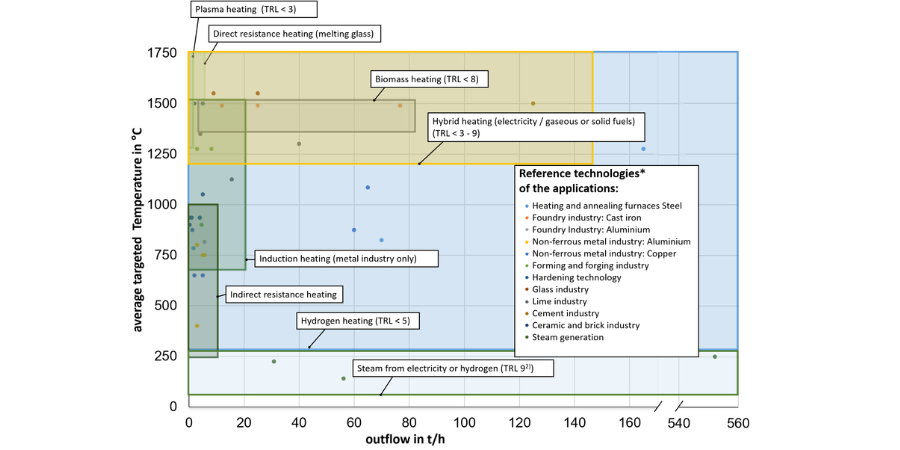
Simplified application fields for the considered alternative technologies can be defined based on characteristic metrics such as plant throughput and process temperature (average target temperature). Additionally, other parameters need to be considered, such as the technology readiness level, the effort required for technical retrofitting, or energy efficiency.
There are electric heating technologies available for use in metal and mineral industries with a throughput of less than 20 tons per hour and a process temperature of up to 1000°C (1832°F). However, the technological boundaries are constantly evolving, and its application fields are continuously expanding. Some technical solutions are now available at higher processing temperatures, such as inductive melting of metallic materials. However, processes that require high process temperatures and high throughput, such as burning and melting in the mineral industry, are still in their early stages of development and have a low TRL. For these applications, heating technologies with a high energy density, such as hydrogen or bio-based energy carriers, are necessary to replace solid carbon carriers.
It has been observed that electrification is well established for many industrial applications that require lower process temperatures (< 1000°C or < 1832°F) and smaller plant capacities (< 20 t/h). This presents an opportunity for rapid adoption of the technology. Even though electric heating technologies are already advanced for some applications in the metal industry, they are not commonly utilized in Germany. The reasons behind this issue are complicated and involve various factors, such as specific aspects of production, the space required, the infrastructure, and the cost differences between electricity and fossil fuels. The electrification of continuous processes can lead to higher plant and space requirements since multiple smaller, intermittent electrical facilities are usually needed to match the production capacity of a single fossil-fueled plant. Additionally, the required infrastructure, such as electrical connection capacity at the site, poses a challenge. Moreover, the historically low economic viability compared to gas heating has particularly hindered investment in electric heating.
Heating with hydrogen can be advantageous for applications that require high energy densities due to high productivity and process temperatures. Traditionally, these applications have been operated with natural gas, and currently, no fully electrified alternative can be quickly deployed. Hydrogen can be used as an option for all gas-heated applications. It can be beneficial where electrification is hindered by insurmountable technical obstacles or where no energy efficiency gains are possible through electrification.
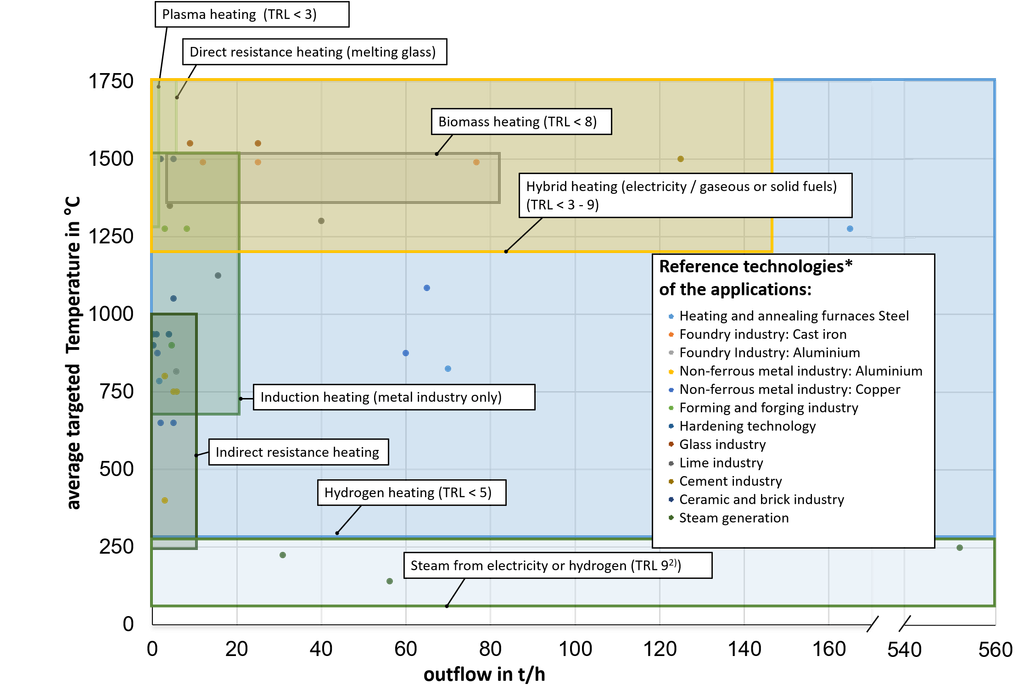
Notes: *Application-specific data based on industry analyses; a total of 40 applications (displaying the respective reference technology and, if already available on a large scale, the electrical alternative); not all reference technologies can be replaced by alternative technologies (especially electrical ones) with identical production volumes; the technology readiness level (TRL) of the overall system is low for many applications.
1) For the use of hydrogen in the metal and mineral industries, the technology readiness level of the overall plant is rated as low (TRL < 5) due to the lack of hydrogen availability, the deployability in pilot or demonstration plants, and the effects on the process have not yet been sufficiently tested in many cases. However, individual components (e.g., burners) often already have a significantly higher TRL.
2) In contrast to the use of hydrogen in the metal and mineral industries, the downstream process steps or product properties remain unaffected in steam generation. Hydrogen-fired steam generators are commercially available for large-scale use (TRL 9) and are already in use in industries with internal hydrogen flows, such as the chemical industry.
The Numbers: High Risk of Stranded Investments
The service life and modernization cycles of many plants typically range from 20 to 50 years. Consequently, new investments significantly impact the long-term transformation of the existing infrastructure. Since long service lives and modernization cycles can substantially slow the transformation process, early climate and energy policy signals are crucial to prevent investments in new, durable fossil-fuel plants.
For CO₂-neutral technology to be adopted in the market, it must first be available and economically viable. The rate at which it diffuses into the market is also influenced by factors such as its lifespan, modernization cycle, and the age of the existing plant stock. The conditions for market diffusion can vary across different industries and applications and can be categorized into different groups.
For the year 2040, four groups (A, B, C, and D) are defined, which differ in terms of the economic attractiveness of the CO₂-neutral alternative technology and the proportion of CO₂-neutral plants in the existing stock (Figure 2). In Group A (“Advanced”), applications are included where economically attractive CO₂-neutral technologies are available early and can be replaced relatively quickly due to short plant lifespans. These applications can achieve complete defossilization (in the calculated scenario, over 80% diffusion) by 2040 and are found in glass manufacturing and steam generation. In Group B (“Boosted”), applications exist for which attractive CO₂-neutral technologies are available by 2040, but which show lower diffusion due to longer plant lifespans. This group includes foundries and forming technology companies. Applications whose CO₂-neutral technologies are economically less attractive but can greatly benefit from potential diffusion are assigned to Group C (“Cornered”), which includes copper processing and hardening applications. Where there is a lack of economically viable CO₂-neutral technologies and rapid diffusion, applications are assigned to Group D (“Delayed”). This group includes cement, lime, aluminium, and steel production, where particular risks for fossil fuel lock-ins exist, thus necessitating action.
The speed of development towards a CO₂-neutral industry depends on the time it takes to replace an old plant with a new one. For many applications, there is a risk that although the CO₂-neutral plant is economically attractive, it may not be constructed due to the presence of an existing fossil fuel plant and its modernization cycle. Furthermore, there is an economic risk associated with replacing fossil-fueled plants prematurely before they reach the end of their lifespan. Since the service life of plants can span several decades, even strong economic signals may have a delayed effect. Long service lives and modernization cycles significantly slow down the transformation process. Therefore, early climate and energy policy signals are crucial to prevent investments in new fossil plants. Additionally, in many applications, it is anticipated that fossil fuel plants will not reach the end of their technical lifespan.

Cost differences between conventional and CO₂-neutral plants arise mainly from energy costs. Consequently, to enhance the economic competitiveness of CO₂-neutral alternative technologies, two conditions are critical: (1) The availability of climate-neutral electricity and hydrogen at competitive prices, and (2) an increase in the price of CO₂.
Conclusion
To achieve the goal of defossilizing the German industry, it is necessary to provide CO₂-neutral process heat. The analysis of the current state of technology in the metal and mineral industries, as well as steam generation, as part of the results presented in this study, shows a great heterogeneity in the plant fleet, and highlights the high proportion of fossil fuels used along the process chains.
The examination of CO₂-neutral alternative technologies indicates that a transition by 2045 is technically feasible, with electrification and hydrogen playing central roles. The heterogeneity of the plant fleet in the industry requires differentiated approaches, where an industry-specific transformation strategy should consider the characteristics of the production processes. The risk of stranded investments due to long modernization cycles underscores the urgency of early climate and energy policy signals to prevent investments in new fossil plants and to promote the market diffusion of CO₂-neutral technologies.
References
European Commission. 2014. Annex G – Technology Readiness Levels (TRL). Extract from Part 19 – Commission Decision C(2014)4995, “Horizon 2020 – Work Programme 2014–2015. General Annexes.” Brussels: European Commission. https://ec.europa.eu/research/participants/data/ref/h2020/wp/2014_2015/annexes/h2020-wp1415-annex-g-trl_en.pdf.
Fleiter, Tobias, et al. 2023. CO₂-Neutrale Prozesswärmeerzeugung: Umbau des industriellen Anlagenparks im Rahmen der Energiewende. Dessau-Roßlau: German Environment Agency (Umweltbundesamt). https://www.umweltbundesamt.de/publikationen/co2-neutrale-prozesswaermeerzeugung.
All results in this article derive from the study “CO₂-neutral process heat generation” (German: “CO₂-neutrale Prozesswärmeerzeugung – Umbau des industriellen Anlagenparks im Rahmen der Energiewende: Ermittlung des aktuellen SdT und des weiteren Handlungsbedarfs zum Einsatz strombasierter Prozesswärmeanlagen”). The authors of the article would like to thank everyone who contributed to the study, listed in the published study. The study and further documents are on the website of the Federal Environment Agency in Germany (Umweltbundesamt): https://www.umweltbundesamt.de/publikationen/co2-neutrale-prozesswaermeerzeugung.
This editorial is published with permission from Heat Treat Today’s media partner Heat Processing, which published this article in March 2024.
About The Authors:

Dr. Christian Schwotzer
Department for Industrial Furnaces and Heat Engineering
RWTH Aachen University, Germany
schwotzer@iob.rwth-aachen.de

Katharina Rothhöft, M.Sc.
Department for Industrial Furnaces and Heat Engineering
RWTH Aachen University, Germany
rothhoeft@iob.rwth-aachen.de

Dr. Tobias Fleiter
Fraunhofer Institute for Systems and Innovation Research
Karlsruhe, Germany
tobias.fleiter@isi.fraunhofer.de

Dr. Matthias Rehfeldt
Fraunhofer Institute for Systems and Innovation Research
Karlsruhe, Germany
matthias.rehfeldt@isi.fraunhofer.de

Dr. Fabian Jäger-Gildemeister
Federal Environment Agency of Germany (Umweltbundesamt)
Dessau-Roßlau, Germany
fabian.jaeger-gildemeister@uba.de