MANUFACTURING HEAT TREAT

More Accessible Design-to-Launch Services Unveiled with IT, AM Technologies Partnership

Sudip Singh, Global Head, Engineering Service at Infosys Ltd

An end-to-end product development service using metal additive manufacturing (AM) technology was announced last month by two leading companies partnering to help customers accelerate their deployment of AM, also known as 3D printing, for volume production of end-use metal components.

Engineering and IT services company Infosys will apply its engineering processes and design for AM knowledge to manage product development projects from concept through to launch. Renishaw, a leader in metrology and additive manufacturing technologies, will support Infosys through its global network of Additive Manufacturing Solutions Centres, which provide access to Renishaw’s metal AM technology, which is used in series production of high-performance parts for aerospace, medical, automotive, oil and gas, mould and die, and consumer products.

“Additive manufacturing enables us to design and make innovative products with spectacular gains in performance and efficiency,” said Sudip Singh, Global Head, Engineering Service at Infosys Ltd. “Infosys has developed a rich knowledge base of AM design best practices, coupled with powerful design tools to analyze and optimise product designs, so that we can take full advantage of the flexibility that AM offers.”

Marc Saunders, Director – Global Solutions Centres at Renishaw

“Whilst additive manufacturing can create complex geometries in a single process step, some level of finishing is generally required to produce functional products,” said Marc Saunders, Director – Global Solutions Centres at Renishaw. “Renishaw’s knowledge of metrology, machining and finishing processes can help customers to develop an integrated manufacturing solution for their innovative new product.”

The two companies are currently working together on projects for customers located in Europe, Asia, and North America.

More Accessible Design-to-Launch Services Unveiled with IT, AM Technologies Partnership Read More »

Sophisticated All-Metal Hot Zone Delivered

A uniquely engineered, high-temperature refractory metal hot zone has been delivered by the furnace division of an international supplier of refractory technology metals and technical ceramics to one of its furnace customers. The engineering team of the German manufacturing firm H.C. Starck fabricated a 1600°C hot zone designed to operate in a vacuum, with certain inert gases or in a reducing atmosphere. By simulating the temperature of each layer, it was ensured that the proper materials were applied throughout the hot zone.

 ”H.C. Starck is excited to deliver the first of its kind refractory metal hot zone,” said Andreas Mader, President and CEO of the Fabricated Products Division. Supplying growth industrial sectors such as the electronics sector, the chemical industry, medical technology, aviation and aerospace, energy and environmental technology, and machine and tool building from its own production locations in Europe, America, and Asia, the company employs 2,500 people in the USA, Canada, the UK, Germany, China, Japan and Thailand.


Sophisticated All-Metal Hot Zone Delivered Read More »

U.S.-Produced Aluminum Cladding Adorns Façade of South African Mall


Source: AlCircle


To achieve a distinctive look that can be seen from a distance, a shopping mall in the economically developing township of Waterfall City, located between Johannesburg and Pretoria in South Africa, has turned to a U.S. manufacturer of flat-rolled aluminum products to cover the cladding of its parking garage with a façade made of sheets of aluminum measuring 1,437 x 3,880 mm (4.7 x 12.7 ft.), each treated with weather-resistant coating and classified for fire protection. The unique wave-look of the façade was achieved by laying aluminum plates horizontally.

Read more: “Novelis Does Cladding for South Africa Mall with Its ff2 Pre-Painted Aluminum Facade”

U.S.-Produced Aluminum Cladding Adorns Façade of South African Mall Read More »

Tool and Die Failure, Heat Treatment Causes and Corrections

George Vander Voort has a background in physical, process and mechanical metallurgy and has been performing metallographic studies for nearly 50 years. He is a long-time member of ASTM Committee E-4 on metallography and has published extensively in metallography and failure analysis. He regularly teaches MEI courses for ASM International and is now doing webinars. He is a consultant for Struers Inc. and will be teaching courses soon for them.  His website, www.georgevandervoort.com, not only details his consulting services but also houses over one hundred articles, studies, or instructional graphics on topics related to physical, process and mechanical metallurgy. The following is an overview and an excerpt of failure factors from “Identifying the Cause of Tool and Die Failure”, published in 2016. There are particular elements to this study which relate to the heat treat industry.

Steels used for tools and dies differ from most other steels in several aspects. First, they are used in the manufacture of other products by a variety of forming processes. Second, tools and dies are generally used at a higher hardness than most other steel products; 58 to 68 Rockwell C is a typical range. Dies for plastic molding or hot working are usually used at a lower hardness, typically from 30 to 55 Rockwell C.

These high hardness values are required to resist anticipated service stresses and to provide wear resistance. However, the steels must also be tough enough to accommodate service stresses and strains without cracking. Premature failure caused by cracking must be avoided, or at least minimized, to maintain minimum manufacturing costs. Unexpected tool and die failure can shut down a manufacturing line and disrupt production scheduling. Tools and dies must also be produced with the proper size and shape after hardening so that excessive finishing work is not required. Heat-treatment distortion must be controlled, and surface chemistries must not be altered. Because of the careful balance that must be maintained in heat treatment, control of the heat-treatment process is one of the most critical steps in producing successful tools and dies. In addition to controlling the heat-treatment process, tool and die design and steel selection are integral factors in achieving tool and die integrity.

The following list is excerpted and abridged to highlight phases or processes related to heat-treat. The explanation behind each factor is available at the original post.

A number of factors can be responsible for tool and die failures. They include:

1. Mechanical design. The design must be compatible with the steel grade selected, the procedures required to manufacture the tool or die, and the use of the tool or die. . . .

The importance of good design cannot be overemphasized. Poor design can cause or promote heat-treatment failures before any service life is obtained, or it may reduce service life dramatically.

In designing a tool or die, a host of factors must be considered. In practice, separating the design stage from grade selection is difficult because the two steps are interdependent. The choice of a certain grade of steel, such as one that must be brine- or water-quenched, will have a substantial bearing on all aspects of design and manufacture. In general, any steel grade that requires liquid quenching demands very conservative, careful design.

Air-hardening grades tolerate some design and manufacturing considerations that could never be endured by a liquid quenching grade. The design must also be compatible with the equipment available–heat-treatment furnaces and surface-finishing devices, for example. . . .

2. Grade selection. The grade of steel selected must be compatible with the design chosen, the manufacturing processes used to produce the tool or die, and the intended service conditions and desired life. . . .

3. Steel quality. The material must be macrostructurally sound, free of harmful inclusions to the degree required for the application, and free of harmful surface defects.

Despite the care taken in the manufacture and inspection of tool steels, faulty materials occasionally cause tool and die failures. However, such problems are rare. The most common of these defects are voids from secondary pipe, hydrogen flakes, surface cracks, porosity or microvoids, cooling cracks, segregation, and poor carbide distributions. Improper control of annealing may also produce non-uniform carbide distribution or carbide networks that may influence heat-treatment uniformity, lower ductility, or impair machinability.

4. Machining processes. The machining processes used to produce the tool or die must not alter the surface microstructure or surface finish and must not produce excessive residual stresses that will promote heat-treatment problems or service failures.

Machining problems are a common cause of tool and die failures. It is generally best to avoid machining directly to the finish size unless pre-hardened die steels are used. Obtaining perfect control of surface chemistry and size during heat treatment is difficult. Thus, some final grinding is usually needed after heat treatment. The presence of decarburization is generally quite detrimental. Also, because stresses are high in heat treatment and in service, rough machining marks must be avoided. Identification stamp marks are another common source of failures in heat treatment and in service; they should be avoided.

5. Heat-treatment operation. Heat treatment of tools and dies must produce the desired microstructure, hardness, toughness, and hardness at the surface and in the interior.

Improper heat-treatment procedures are the single largest source of failures during heat treatment, in subsequent processing steps, or in service. Each tool steel grade has a recommended austenitizing temperature range, which is generally rather narrow; a recommended quench medium; and recommended tempering temperatures and times for optimum properties. Some grades are more forgiving than others.

6. Grinding and finishing operations. Grinding and finishing operations must not impair the surface integrity of the component.

7. Tool and die setup. Alignment of tools and dies must be precise to prevent irregular, excessive stresses that will accelerate wear or cause cracking.

8. Tool and die operation.


Read the full study and report, including images of tool steel failure examples, at “Identifying the Cause of Tool and Die Failure”.


 

Tool and Die Failure, Heat Treatment Causes and Corrections Read More »

Hoa Phat Orders 4 Blast Furnaces to Increase Production at Dung Quat Complex

Vietnamese steel producer Hoa Phat Steel has awarded a contract to an Italian steel production technology specialist for the design, supply, and supervision of four greenfield blast furnaces.

The project is part of the new Dung Quat iron and steel making complex committed to by Hoa Phat, which currently operates a 2 million metric ton per year (mtpy) iron and steel making plant in Hai Duong. The scope of the project also includes the hot blast mains, bustle mains, tuyere assemblies, level 2 automation systems and pulverized coal injection systems. The new plant will add 4 mtpy to Hoa Phat’s annual steelmaking capacity.

The four blast furnaces will have a 1080 m³ working volume and are designed for an annual production of 1 million tons of hot metal each. The furnaces will be supplied by Danieli Corus and equipped with the company’s high conductivity cooling and lining design based on copper plate coolers combined with graphite and silicon carbide refractories. The four furnaces will be completed and commissioned in sequence, with the fourth being scheduled for delivering the first hot metal in 2019.

Hoa Phat Orders 4 Blast Furnaces to Increase Production at Dung Quat Complex Read More »

Paulo Announces New Plant in Monterrey, Mexico

Heat treatment service provider Paulo has begun construction on a greenfield facility in Monterrey, Mexico.  The new plant will be completed in the fourth quarter of 2017 and processing of heat-treatment will begin in the first quarter of 2018.  Paulo will initially occupy 50,000 sqft with expansion up to 110,000 sqft.  Monterrey was chosen for its robust manufacturing community with close proximity to major providers of automotive, agriculture, aerospace and other industrial components.

Paulo will continue to add equipment throughout 2018.  Initially, the plant will serve the automotive industry, processing parts manufactured in Mexico. Paulo will also leverage automation with multiple robotic loading cells to improve safety in material handling while leaning production steps.


Paulo Announces New Plant in Monterrey, Mexico Read More »

SSAB Modernizes Hot-Dip Galvanizing Line No. 3 at Finnish Facility

Swedish specialty steel producer SSAB will modernize its continuous hot-dip galvanizing line No. 3 in Hämeenlinna, Finland. The upgrade essentially involves switching the old air-knife into a new air knife system from Duma-Bandzink with strip stabilization and the integration of an inductive booster in the furnace. The conversion measures will be implemented in cooperation with SMS group, Drever International and EMG Automation. The measures will be realized at the end of this year (2017).

The installation of a new Duma-Bandzink Jet-Pro air knife system with EMG eMASS® strip stabilization – in the so-called “Integrated Solution” – will help to save zinc and improve the quality of the coating. The line will be designed for strips between 0.4 to 3.0 millimeters thick and 650 to 1,550 millimeters wide. In the process section, the strips will be zinc-coated at speeds of up to 160 meters per minute. Inductive strip pre-heating to about 350 degrees Celsius will increase the capacity of the furnace.

SSAB Modernizes Hot-Dip Galvanizing Line No. 3 at Finnish Facility Read More »

Italian Manufacturers Order Annealing Furnaces from Austrian Heat Treatment Supplier

Two major Italian manufacturers have ordered bell annealer furnaces to expand their existing lines.

Leading bolt manufacturer, Fontana Luigi S.p.A., based in Veduggio, has commissioned an expansion to an existing HICON/N2® bell annealer facility for heat treatment of non-pickled steel wire coils. Both phases will be nearly identical in design to ensure flexibility between the facility components to achieve maximum throughput capacity. The start of production is scheduled for July 2018 for the new phase.

Ori Martin S.p.A., an electric furnace steel mill facility in Brescia, purchased the supply and installation of an additional gas-fired HICON/N2® bell annealer facility to heat treat unpickled steel wire coils in a controlled nitrogen process atmosphere. The clear inside diameter of the new facility, which will go into operation May 2018, is 4,050 mm, with a stack height of 2,500 mm.

Austrian heat treatment supplier Ebner provided and installed the equipment for both companies.

Italian Manufacturers Order Annealing Furnaces from Austrian Heat Treatment Supplier Read More »

Joe Powell Comments on Marquenching and Austempering

Last week, we ran a news release about ThermoFusion in California expanding their heat treat capabilities to include marquenching and austempering (click here to see that release). In that short article, some comments were made about the aggressiveness of various quench methods and their effect on distortion and cracking.

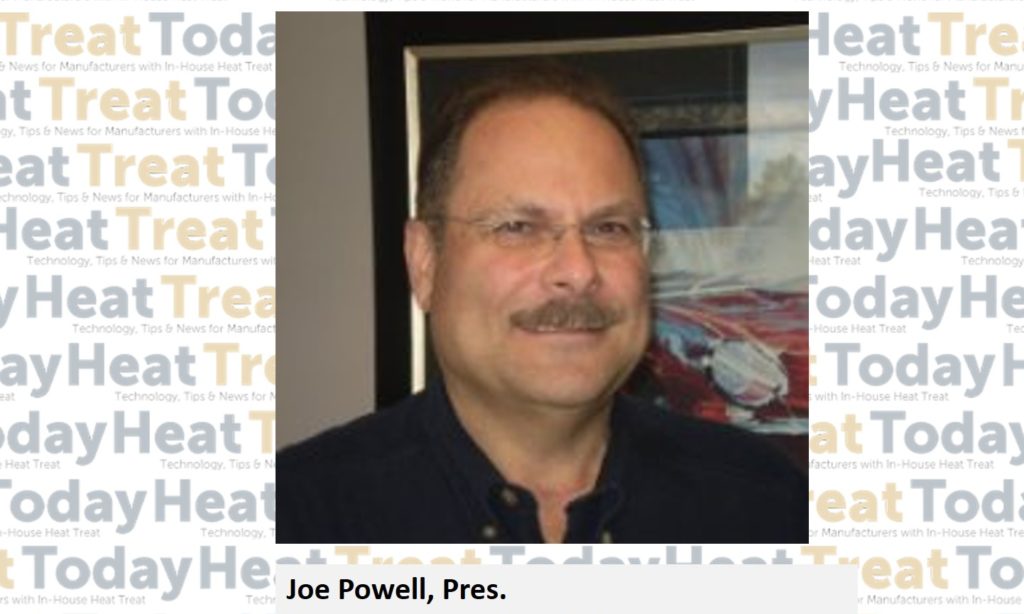
Joe Powell, of Akron Steel Treating Company, Integrated Heat Treating Solutions, LLC, IQDI Products, LTD., and IQ Technologies Inc, one of the heat treat industry’s foremost experts on quenching, wrote in to help educate all of us a bit more on the finer points of quenching. Below are his comments. Joe can be reached at JoePowell@akronsteeltreating.com.


Doug,

In your recent article, you stated that Marquenching and Austempering use a “less aggressive” quench cooling rate, “and reduce distortion caused by rapid temperature change (thermal shock)” which is only half true.  The main mechanism that allow a molten salt quench to reduce distortion is the elimination of mixed phase cooling – there is no slow film boiling (gas) phase cooling mixed with the high-evaporative cooing phase of nucleate boiling, but only a single phase of all liquid convection cooling.   It’s the non-uniformity of cooling at the surface of the part that will distort or crack the part not so much the rate of cooling.

Joe

Joseph A. Powell, President
Akron Steel Treating Company

Integrated Heat Treating Solutions, LLC
IQDI Products, LTD. 
IQ Technologies Inc

Joe Powell Comments on Marquenching and Austempering Read More »

UPC Energizes Aging Carburizing Cell for Axle Gears Manufacturer

A U.S.-based axle gears manufacturer recently commissioned hardware and software enhancements to add to their existing heat treat cell and automation.

Migration of legacy controls was not economically feasible, and after investigating options to boost equipment functionality, the customer opted to integrate a new PLC that bridges the gap between the heat treat cell and new robotic loading cell. The new control system installed by United Process Controls, Inc., (UPC) provides operators with a quick display of the furnace status, functions, and operational data of three AFC Holcroft carburizing pusher furnaces. Furnaces were similarly adjusted to liaise with the new robotic loader. In addition, material handling data from the registers of the old PLCs was transferred to the new robot cell to help increase the factory information system. UPC was also retained to program and connect the updated furnace controls, including the new conveyor line, and charge cars to the factory information system.

UPC Energizes Aging Carburizing Cell for Axle Gears Manufacturer Read More »

Skip to content