

HEAT TREAT RADIO

Heat Treat Radio #12: ITC Coatings

Welcome to another episode of Heat Treat Radio, a periodic podcast where Heat Treat Radio host, Doug Glenn, discusses cutting-edge topics with industry-leading personalities. Below, you can either listen to the podcast by clicking on the audio play button, or you can read an edited version of the transcript. To see a complete list of other Heat Treat Radio episodes, click here.


Audio: Heat Treat Radio: ITC Coatings

In this conversation, Heat Treat Radio host, Doug Glenn, interviews Greg Odenthal of ITC Coatings, a company based in Fort Worth, Texas, which manufactures and installs high-temperature, energy-efficient ceramic coatings. Increasing the efficiency of your furnace by even 5 to 10 percent would a good thing. Doug and Greg are going to introduce you to a spray-on product that increases furnace efficiency by, on average, 10 to 15 percent and sometimes as high as 25 percent. It can be applied to nearly any furnace surface and can be applied in less than a week in most cases, sometimes even within a single day.

Click the play button below to listen.


Transcript: Heat Treat Radio: ITC Coatings

The following transcript has been edited for your reading enjoyment.

Thanks for joining us. I’m Doug Glenn, your Heat Treat Radio host and publisher of Heat Treat Today. Before we jump on the phone and call Greg Odenthal at ITC Coatings, let me encourage you to visit www.heattreattoday.com, especially if you’re a manufacturer with in-house heat treat operations. Our website targets content for heat treaters in the aerospace, automotive, medical, and energy sectors well as general manufacturing. We update the site with at least one new piece of content every weekday, and we typically publish technical content on Tuesdays, our Technical Tuesday feature.

So let’s get rolling on today’s podcast. I got on the phone and called Greg Odenthal. Greg is the director of engineering and technical applications for ITC Coatings. Let’s jump right into the phone call.

Doug Glenn (DG): So, this is Doug Glenn with Heat Treat Radio. We’re here today, on the phone, with Greg Odenthal from ITC Coatings. So, we wanted to talk about a relatively interesting, not necessarily new, but perhaps new to many captive heat treaters and many heat treaters in the industry. It has to do with helping the insulating properties of furnaces and things of that sort. So, let’s start. First thing I want to do is welcome Greg. Greg, thanks for joining us, I appreciate you being here.

Greg Odenthal (GO): Thanks, Doug. I appreciate it. It is good to be here.

DG: So, without a lot of detail at this point, because we’ll get into a little more detail as we move forward, if you could give us the thirty-second elevator pitch on the product. And maybe as you are doing it, just tell us a bit about the company: the company name, where you are located, that type of thing.

GO: Sure thing. So it is ITC Coatings. We are located in Fort Worth, Texas. I sit in my office in Pittsburgh, Pennsylvania, and we also have a business development office in Raleigh, North Carolina. So, we manufacture and install high-temperature, energy-efficient ceramic coatings. These coatings have a multitude of uses in heat treat furnaces, kilns, reheat furnaces in the steel world. And really, anybody who is looking to reduce fuel consumption, reduce factory maintenance, increase product quality, should be looking at using our products.

What is it? Water-Based Ceramic Coatings

Greg Odenthal, Director of Engineering & Technical Operations ITC – International Technical Ceramics, LLC (ITC Coatings)

DG: Right. So, it is an energy saving product. It is applied to refractories. Without giving away the secret sauce, because we know there is a secret formula, give us a sense of what we are dealing with here. Is it a castable material? Is it a wool material? Is it a spray-on material? What is it? What is it made of? How does it work?

GO: Well, it’s neither of those. It is ceramic technology, and it’s ceramic coatings. These are water-based ceramic coatings that are applied only mils thick on top of a current existing refractory. That refractory can be castable, gunite, shotcrete, ceramic fiber, fire brick, insulating fire brick, hard brick — it has a multitude of uses. Unfortunately, at this point, I cannot disclose the chemical makeup because it is proprietary. But I will tell you that there is nothing in our coatings that one wouldn’t find in any of the current refractories in use today.

DG: So you are not introducing some sort of a strange, alien substance into the furnace, necessarily. It’s just normal material but it is formulated in such a way that you can get some pretty outstanding energy efficiencies.

GO: Absolutely. We take what’s currently being used in the market and based on percentages and what we have, we make a pretty unique product.

DG: A lot of people will say, well, this is a brand new product; if we buy it, if we use it, are we going to be the guinea pigs here? Tell us a little bit. What is the history? Has it been around a long time? Is it relatively new?

GO: Our product has been around since 1980. There was a gentleman and his wife, Feriz Delkic and Alice Delkic, that invented this product. They invented it for their own use. Ferris was manufacturing kilns back in the 1980s. He wanted his kilns to be the most efficient kilns on the market. So, in order to do that, he invented a ceramic coating to apply to the inside of the kiln over top of the refractory. And, low and behold, come to find out that now his kilns are the most efficient kilns on the market. Having that technology in his pocket, he kind of ventured out and tried to persuade or get the world to start using his coatings to reduce fuel consumption, increase product quality, [along with] a host of benefits that come along with it. We can talk about it a little later. So, yes, it has been around since 1980. It’s nothing new to the market. But, like you had made mention at the beginning of the interview, it’s probably new to quite a few people because if you never heard of it or you don’t realize what’s on the market, then, yes, it could be a new product.

The Savings

DG: Right. And just so we know — I mean, we’ll mention this at the end as well — people can find out a little bit more on your website: www.itccoatings.com. We will mention that again at the end. So, Greg, realistically, what type of energy savings are we talking about? You can give us low end, extremely great high end. But realistically what’s in the middle as well? What are you seeing as far as energy savings?

GO: Depending upon the application and depending upon the condition of the refractory, we’ve seen energy savings anywhere from 7 to 10 percent all the way up to 20 to 25 percent reductions in fuel consumption. Because of the broad range, you know, if I’m going in and I’m applying this coating on a brand new refractory lining, say it’s brand new fiber lining or even a brand new brick lining – that refractory is pretty intact. Obviously, it’s new. You don’t have a lot of spalled refractory or cracks or things of that nature so your fuel consumption at that point is low to begin with. The coatings at that point on a new lining are going to protect that refractory from the harmful effects of heat and thermal shock and spalling. It will increase its life. When you get into a lining that has been around for several years and it’s got a lot of wear on it, a lot of spalling, thermal cracking shocks, things of that nature, you’ve got a lot of avenues for heat to penetrate into that lining and escape through the shell. So, obviously, your fuel consumption is much greater. There is a broad range, but like I said, it depends upon the application and current condition of the refractory.
DG: So, roughly speaking, a person that was going to use it could expect anywhere from 10 to 25 percent, 7 to 25 percent. Somewhere in that range?

GO: Yeah, I would say the average that we see currently today on installations is anywhere from 10 to 15 percent. On an average.

DG: That’s fair. And the way this works, just so we’re clear – it’s a reflective material. Is that right? I mean, essentially, is that how we are saving?

GO: Yes, yes, it is. It reflects probably about 90 percent of all the radiant energy that the burners put out.

DG: Right. And it’s most effective in the radiant spectrum, so to speak?

GO: Absolutely. When you get into the radiation, into the temperatures that most of our customers and our target audiences are operating at – when you are at 1200 degrees, 1500 degrees, the major mode of heat transfer is radiation which [is] temperature to the fourth power, that’s what we are after. We’re after re-radiating from the burners back into the furnace to capture that energy and reduce your fuel consumption. You know, you still get convection and conduction through coatings. That heat transfer still takes place, but at much lower temperatures and we aren’t really concerned about it. It’s the radiation spectrum that we’re after.

Application — DIY or Letting the Pros Handle It?

DG: So, just to kind of prep you and prep the people who are listening about what we are going to be talking about – we are going to talk in a minute about applying the product, and what does it take, dry out times, if any, and surface prep and stuff like that. But before I ask you about that, just to kind of whet our appetite here – do you have any good examples of installations, kind of case studies, that you could share, that might be of interest?

GO: We do have several listed on our website. I encourage listeners, obviously, to go to our website. We’ve had many successful applications over the years. One of the latest that we’ve just done here probably four or five months ago was McConway & Torley here in Pittsburgh in one of their austenitizing furnaces where we coated the entire ceramic fiber lining. Their major reason for using the coatings was they wanted to be able to reduce their turnaround time. And we did – by twenty minutes! Which now allows them to treat one additional load per week. It may not seem a lot but when you start applying the numbers and the savings to it, it’s pretty significant. So, one additional load per week for these guys is a significant amount of profit to their bottom line per year.

Along with that, like I said, which was one of the main reasons why they wanted to use this coating — we reduced their fuel consumption. We improved their temperature uniformity. You know, they were around plus or minus 40 degrees, we now have them down to plus or minus 25 degrees. So a big significant change there. Their refractory life is going to increase probably, and this is on an average as well, but their refractory longevity and life is going to increase three to five times. So, their maintenance on that fiber lining is going to greatly reduce. Fiber shrinks upon heat — it’s non-reversible. So you’ve got to shut the furnace down periodically and pack the joints with new fiber and continue running but the problem is the new fiber you just used to pack these joints as soon as you turn the furnace on the fiber shrinks. It’s just a constant maintenance nightmare, especially in a fiber-lined furnace. That was one of the latest that we did, but we have had numerous other applications throughout the years, specifically in the steel industry. We’ve got successful applications — ArcelorMittal, Nucor Steels, EVRAZ Rocky Mountain Steel in Colorado. And as far as heat treaters and forging houses — Finkl Steel in Chicago, Union Electric here in Pittsburgh. So we’ve got quite a laundry list of successful applications.

DG: All right, so let’s talk a little bit about application of the product. Just in a nutshell, what does it take to apply it? Is this a thermal spray? How do you apply it?

GO: It’s applied by spraying it on. It’s not thermal, thermally sprayed or applied. You know, the best way to apply it is — I tell a lot of our customers that want to do this themselves – the best way to apply it is to go to Home Depot or Lowes and buy yourself a textured drywall popper spray gun. You can get them for $70 or $80 and use that to apply it. It’s okay for heat treat furnaces that aren’t very large in size. We’ve done those that may be 32 feet long by 16 feet wide and 15 feet high — somewhere in that range. It’s okay in that size. When you move into a reheat furnace in a steel mill, there are sprayers that can be rented or purchased. They are also drywall spray guns, but they are self – contained with a 15-gallon hopper on the unit, so that the actual applicator is only holding onto a gun and not a hopper full of material. Which can get pretty heavy over time.

DG: Right. So it’s basically as simple as painting your house with a spray gun.

GO: Yeah, pretty much. You know some people will ask me, well I’ve got a paint sprayer here, can I use that? And the answer to that is “No.” Paint sprayers have filters and screens in them, and the problem is you’re going to filter out and screen out all of the ceramics that are in it, so, really all you’d be applying is the water that it’s mixed with.

DG: Okay, okay. So I assume you recommend that your team, your crew, applies it. It can be done by the homeowner, so to speak — the furnace owner — but probably better if your guys apply it?

GO: I would say initially, “Yes.” We always want to come in and do the first one, two, three applications for a customer. And during those applications, if they want to learn, they are more than welcome to sit there with us while we mix and apply so that they could get a good general knowledge and hands-on training at the time, to be able to move forward and apply it themselves. We do have some certified product installers around the country: NorHeat Treatment, Inc, out of Canada, Thermal Coating Solutions here in Pittsburgh. We do have some other people down south that do it for us. We have a gentleman over in Chicago that handles more or less our cement world and energy world, but, yeah, so, it can be applied by the customer but we definitely recommend ITC do the first one or two installs. Then you can learn the ropes.

Prep, Downtime, Restart

DG: Right. Now, how about surface preparation? So, I’m a, I’m a manufacturer, I’ve got a furnace in-house. It is up and running 24/7/365. I don’t want it to be down long. How much surface prep do I have to do if I take this thing out of service? How long is it out, and what do I need to do to get the surface ready, and how long, in fact, does installation and or any dry-out process take?

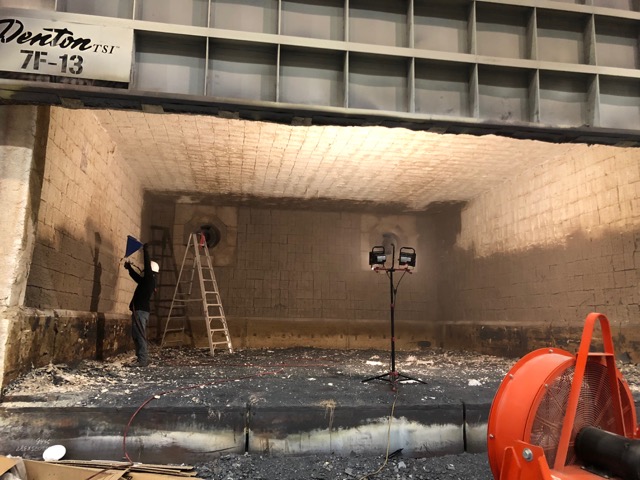
GO: Well, again, I’ve been in some furnaces that are in really, really bad shape. So, surface prep, on a ceramic fiber-lined furnace — depending on how hard you run it, the fiber starts to devitrify and it gets the black crusty layer over that fiber which is really no good anymore. It’s just a glassy phase that has no insulating value to you whatsoever. So, that needs to be removed. It’s depending on the size of the furnace, depending on the size of the crew, but most installations that I have been involved with – three to four days at the most. And that can even apply to a large pusher type reheat furnace in a steel mill. You know, day one would be surface prep, clean up the refractory if it needs it. Days two, three, and four would be applying the coatings. And then after that, we are done. We get out of the way. If you’ve got a brand new furnace, we can walk in, open the door, and we can have that sprayed in eight to ten hours. You can have that done in one day. Like I said, application really depends on the condition of the refractory.

DG: Right. And as far as dry out, I mean a lot of times with a refractory installation, there’s dry out times, that type of stuff. What are we looking at? Does this stuff have to be dried out? Do we need to go low heat for quite a while or does it dry like paint?

GO: Once it’s applied, the recommendation is to let it dry for 24 hours. And, then, when you start the furnace, I say, 100 degrees an hour, when you get to about 250 or 300, I like to hold it there, maybe for an hour, just to start to drive that mechanical water out of it. And then after that, 100 degrees an hour to operating temperature because then you are going to start forming the chemical bond and drive off the chemical water. You are going to sinter that coating. And you have to remember, these are only mils thick, so it’s not like conventional refractories where you’ve got 8, 9, 10 inches, and you’ve got to hold per hour, per inch thickness at 250, and then 600 and then 9 . . . You know there’s no holds just due to the thinness of the application.

The Fine Print

DG: Okay, so once we put the ITC coating on, and we’re getting ready to fire up the furnace, do we have any concerns about any volatiles, any type of dangerous chemicals going to be off-gassing during that process or during the life of the product?

GO: Absolutely not. The coatings contain no harmful VOCs. So there is no off-gassing, and they’re not harmful to you or the environment. So, no, no volatiles.

DG: So, the other question that jumps to my mind is – you know every material has a different thermal coefficient of expansion when it heats up. It grows or shrinks in a different way. So, you are applying this mils-thin coating/surface over — you can put it over brick, you can put it over fiber. When they heat up, grow and expand and contract differently. Do we have issues here with this coating here cracking/spalling, that type of thing, because of the base material?

GO: No, we do not. The way the coatings are designed, the binder system is designed to move with the dimensional change of the substrate. When you’re at ambient temperature, they are very hard — like a coffee cup if you think about ceramics. But when you get into the 2200 degree/2300 degree range, you know everything at that point starts to soften up a bit – things grow and move. The binder system in the coatings allows the coatings to move with the dimensional change of the substrate. So, no, we do not really have any issues with expansion. And that holds true for metal as well. We’ve got a coating that is specifically designed to coat metal parts and increase the life of metal parts due to high-temperature oxidation of the metal.

DG: Okay. And how about, along the same line, I’m thinking that if there is any type of cracking at all — which sounds like there is not — but in some of these furnaces, especially if we’ve got high-velocity air flow inside of let’s say, for example, some sort of an annealing furnace that just requires high convective heat, a lot of airflow, a lot of velocity. Do we have any concerns about wind erosion so to speak?

GO: No, not necessarily. You know, if you’ve got high velocity, some furnaces do have a fiber lining in them with some velocity, and it tends to sometimes tear the fiber off, but once the coatings are applied, you’re encapsulating that fiber. And again, like I said, it’s got a hard shell to it. So, no, any velocity we are not really too concerned about velocity.

DG: It wouldn’t be an issue. Very briefly then, let’s just talk about what products are offered. I was looking through the website, [and it] looks like you’ve got three new install products if you will, and two fix it products. Can you just kind of run us down through those — what ‘s the difference between them, all that good stuff?

The Line-Up

GO: Sure, sure. So, you are right. We’ve got five products that we offer. Our workhorse product that can go over top of any kind of refractory – it’s very versatile high-temperature coating and it’s proven to achieve outstanding energy savings and refractory protection. That is our ITC100HT. Next is the ITC296A; that is a high purity top coat. It is resistant to salts, acidics – anywhere you have a very strange atmosphere or bad products of combustion. Some of our customers burn oil or they burn coke oven gas which develops vanadium and that vanadium starts to attack the refractory linings. So, in that instance, I would apply the 296A over top of the ITC100 to prevent any additional chemical attack to the 100HT. After that, we have ITC213 which is our coating for metals. It is specifically formulated for metal surfaces. And that can go over top of carbon steel, stainless steels, alloys, you know any type of metal surface. And what it does is, we’re preventing the erosion of that metal due to oxidation at high temperatures. There is a surface prep to the metal. Most metal we are going to put it over, unless it is brand new, and even brand new metal a lot of times you’ll have oils or machine grease from manufacturing. That all needs to be removed and the best way to do that is sandblast. Sandblast the part, put a very nice profile on it, and then apply the coatings.

DG: I see this also can be applied on graphite.

GO: You know, it can, depending upon how much graphite is actually in the product. On mag-carbon brick, we have a very hard time applying it do to the high percentage of graphite in the mag carbon brick. We can coat electrodes, so, it just depends on the percentage of graphite.

DG: Okay. So that’s 213?

GO: That’s 213. And then, after that, we have two repair products that are trowelable-consistency materials. And these are used, ITC200EZ and ITC148, [for] heavy-duty ceramic repairs. The 200 EZ is used mostly in the ceramics and pottery world. It’s a durable compound used to repair broken, chipped, cracked brick, castable fiber material – things of that nature. ITC148 heavy duty; you’ll find this in use where we’ve got a lot of abrasion — heavy industry like the steel mills. Guys will repair ladle lip rings. They’ll repair deltas sometimes for an EAF furnace. It’s very strong, And it’s got an abrasion resistant compound for repairing areas that are exposed to harsh environments and mechanical abuse. You know, like I said — ton issues, ladles, door jams on furnaces — things of that nature.

DG: Okay. So those are the two repair products. And I do see from looking at your website right now that you do actually have install kits and things of that sort so that you can buy the product and you can also buy some of the equipment necessary for installing.

GO: Yes, we do. Those kits, again, are geared toward the hobbyists, the smaller ceramics guys. You know when you get into the manufacturing world, you are going to want a much bigger, heavy-duty sprayer. But, we do. We do offer kits to the smaller hobbyists and ceramic people.

DG: It might be worth saying that for some heat treaters who want to get started, who want to test this out on one of their smaller box furnaces, one of these kits may be a good way to start. Some of the bigger furnaces would be worth doing, too.

Okay, wrapping up here just shortly, any temperature range that this is not good in? I think you mentioned it’s okay for those lower temperature ranges, but it starts getting really effective when you are in the radiant heat spectrum. Any heat too high?

GO: No, not really that I have come across. You know the sweet spot on our bat is anywhere from 1600/1700 anywhere upwards of 3600/3800. You get into the medical waste incineration at those temperatures. You know, back in the day when Feriz was the original inventor, when he was out pushing his product, there had been testing in some product applications on the launchpad at NASA. So, I’m not exactly sure what the exit velocity and temperature of the combustion coming out of the rocket is, but I’m sure it’s pretty high and a pretty high velocity. He coated some of the process piping on the launch pad. Not that I have run into any temperatures that are too high for us. Again, the sweet spot on our bat, anywhere from 1600 to 3600s is not an issue.

DG: Well, safe to say, if our heat treaters are experiencing the temperatures and velocities of a NASA launchpad, we might want to talk to them about their process a little bit.

GO: I would think they would have a bigger problem than refractories.

DG: Yeah, exactly. Alright, super, so the last couple things I see that I wanted to mention here are, first off, these materials, most of them you can buy in gallons, or even pint sizes. I guess a lot of them come in different sizes, correct?

GO: We package it in pint sizes for the smaller hobbyist and smaller home kiln heat treater and knife makers, and then for when you get into the industry, we’ve got it in gallon containers and five-gallon containers.

DG: Okay, super. And then I also noticed, very nice to see, by the way, let me compliment you on this, I see your website is e-commerce friendly. So, people can actually go on and buy right online, I assume.

GO: You can buy right off our website. All of the information is listed there. You can buy with a credit card, or you can even go to the website.We do have what is listed as office@ITCCoatings if you are using a PO. You can go to that email and submit a PO for materials. So there are several ways to buy the product.

DG: Okay, so if you want to send an email, office@ITCcoatings.com will also get you there. Very good. How about, just as a reminder, website to find out more is www.itccoatings.com. With an S. You could take a look there. Also, Heat Treat Today will have an article on our site as well at www.heattreattoday.com. Be glad to connect you up with Greg. Well, if anybody has any questions and you would like to get a hold of Greg directly, just email me at doug@heattreattoday.com. Be glad to put you in touch with Greg if you have more questions. So, Greg, thanks a lot for the time. I appreciate it. If there is anything you want to add before we sign off?

GO: No, I think we covered quite a bit today. I appreciate you having me. Thank you very much. It was enjoyable.


So if you’re looking for a way to increase the thermal efficiency of your furnace, maybe as much as 10 to 15 percent, why not give Greg a call? Again, drop me an email at doug@heattreattoday.com if you’d like to get in touch with Greg.

You can listen to other Heat Treat Radio podcasts by doing one of three things. You can go to The Google and search for Heat Treat Radio, we’re the first thing that pops up. Or, you can go to www.heattreattoday.com and click on Heat Treat Radio under the Resources Tab. OR, you can go to iTunes or SoundCloud and search for us there.

If you have a topic you’d like to see featured on Heat Treat Radio, please drop me an email.

Heat Treat Radio is the sole property of Heat Treat Today and may not be reproduced without specific, written approval and appropriate attribution.

This issue of Heat Treat Radio was mixed and produced by Jonathan Lloyd, Butler, Pennsylvania.

I’m your host, Doug Glenn. Thanks for listening.

 

Doug Glenn, Publisher, Heat Treat Today
Doug Glenn, Heat Treat Today publisher and Heat Treat Radio host.

To find other Heat Treat Radio episodes, go to www.heattreattoday.com/radio and look in the list of Heat Treat Radio episodes listed.

Heat Treat Radio #12: ITC Coatings Read More »

Heat Treat Radio #11: Laser Heat Treating with Laser Hard

Welcome to another episode of Heat Treat Radio, a periodic podcast where Heat Treat Radio host, Doug Glenn, discusses cutting-edge topics with industry-leading personalities. Below, you can either listen to the podcast by clicking on the audio play button, or you can read an edited version of the transcript. To see a complete list of other Heat Treat Radio episodes, click here.


Audio: Heat Treat Radio: Laser Heat Treating with Laser Hard

In this conversation, Heat Treat Radio host, Doug Glenn, interviews two families who have been at their manufacturing game for multiple generations. Not long ago they joined forces to establish a new company — Laser Hard, Inc. — and to introduce one of the most cutting edge-heat treat technologies around today: laser heat treating. For many of you who have difficult-to-heat treat parts, whether it’s because of blind holes, or the fact that the part is too big to move, or perhaps you’d like to significantly reduce, if not eliminate, post-heat treat hard machining, you’re going to find today’s Heat Treat Radio episode on laser heat treating especially interesting.

Click the play button below to listen.


Transcript: Heat Treat Radio: Laser Heat Treating with Laser Hard

The following transcript has been edited for your reading enjoyment.

Click the image to connect to Heat Treat Radio

In this episode of Heat Treat Radio, let’s talk about one of the most cutting-edge heat treat technologies around today — laser heat treating.

Thanks for joining us. My name is Doug Glenn and I’m your Heat Treat Radio host and publisher of Heat Treat Today. You can find us on the web at www.heattreattoday.com or simply by Googling Heat Treat Radio. And here’s something new, Heat Treat Radio is now on iTunes! On the website, we update our heat treat content daily, and if you’re a manufacturer with an in-house heat treat department, you’re going to love our site.

Although it sounds Star Treky, laser heat treating is a pretty well-established technology, especially in Europe, but not so much in the United States. The applications are intriguing to say the least – as is the way it is being introduced into the United States – and as are the two families introducing it. One family – long time heat treaters. The other family – long time laser welders and laser cladders. Both minding their own businesses – literally – both thinking about ways to better serve their customers. These two businessmen were from the same small town in Pennsylvania, and they paired up to create a new company called Laser Hard.

And that’s where our story begins.

Introducing Doug Peters of Peters’ Heat Treating and Blair Learn of Phoenix Laser Solutions

Doug Glenn (DG): First, let me introduce you to the two patriarchs: Doug Peters of Peters’ Heat Treating, and Blair Learn of Phoenix Laser Solutions.

Both Doug and Blair are seasoned veterans in their respective industries, and both have children involved in their family businesses in Meadville, Pennsylvania – a mid-sized city about 40 minutes south of Lake Erie and 20 miles from the Ohio state border. These two patriarchs have known each other for years – primarily because Phoenix Laser had been sending heat treating to Peters’ Heat Treating.

Doug Peters, Peters’ Heat Treating Inc.

Peters’ Heat Treating started in 1979, and here’s Doug Peters with a short history of Peters’ Heat Treating.

Doug Peters (DP): We basically started because there was a need in the area for a commercial heat treater. I heard about it from clients of mine. I was in the insurance business and I finally got tired of listening to everybody saying that the place needed a good heat treater so we started one. That expanded to Erie in ’82, then opened the production plant on 13 acres up here in 2013.

Doug and his wife Jackie have three kids involved in their business: Christopher, who helps with IT and other special projects at the heat treat company, and then husband and wife team Diana Peters Wilkosz and her husband Andy Wilkosz who are both heavily involved in Laser Hard as well as the heat treat company.

The other patriarch in this picture is Blair Learn, father of three boys, Chris, Dave, and Mike, all of whom are owners of Phoenix Laser Solutions. Here’s Blair with a brief history of his family business.

Blair Learn, Phoenix Laser Solutions

Blair Learn (BL): So we started here in 2008, but we’ve been laser welding for 25 years. We used to have a design and build plastic injection mold hut. We would build high cavitation molds, and we needed a laser there to fix the day-to-day bumps and dings — you know, DCRs and stuff.

Besides the laser heat treating technology, which we’ll get to in just a minute, the thing that excites these two seasoned entrepreneurs is seeing their 20- and 30-something kids run with a new business. Doug Peters says it well.

DP: I think one of the things that’s most interesting to me is that the two patriarchs have stepped back and this company truly belongs to our sons and daughters.

DG: And who are these sons and daughters? Well, there are more than we have time to put in this podcast, but let me introduce them all to you now and then we’ll hear from just two of them.

Introducing Chris Learn and Andy Wilkosz of LaserHard, Inc.

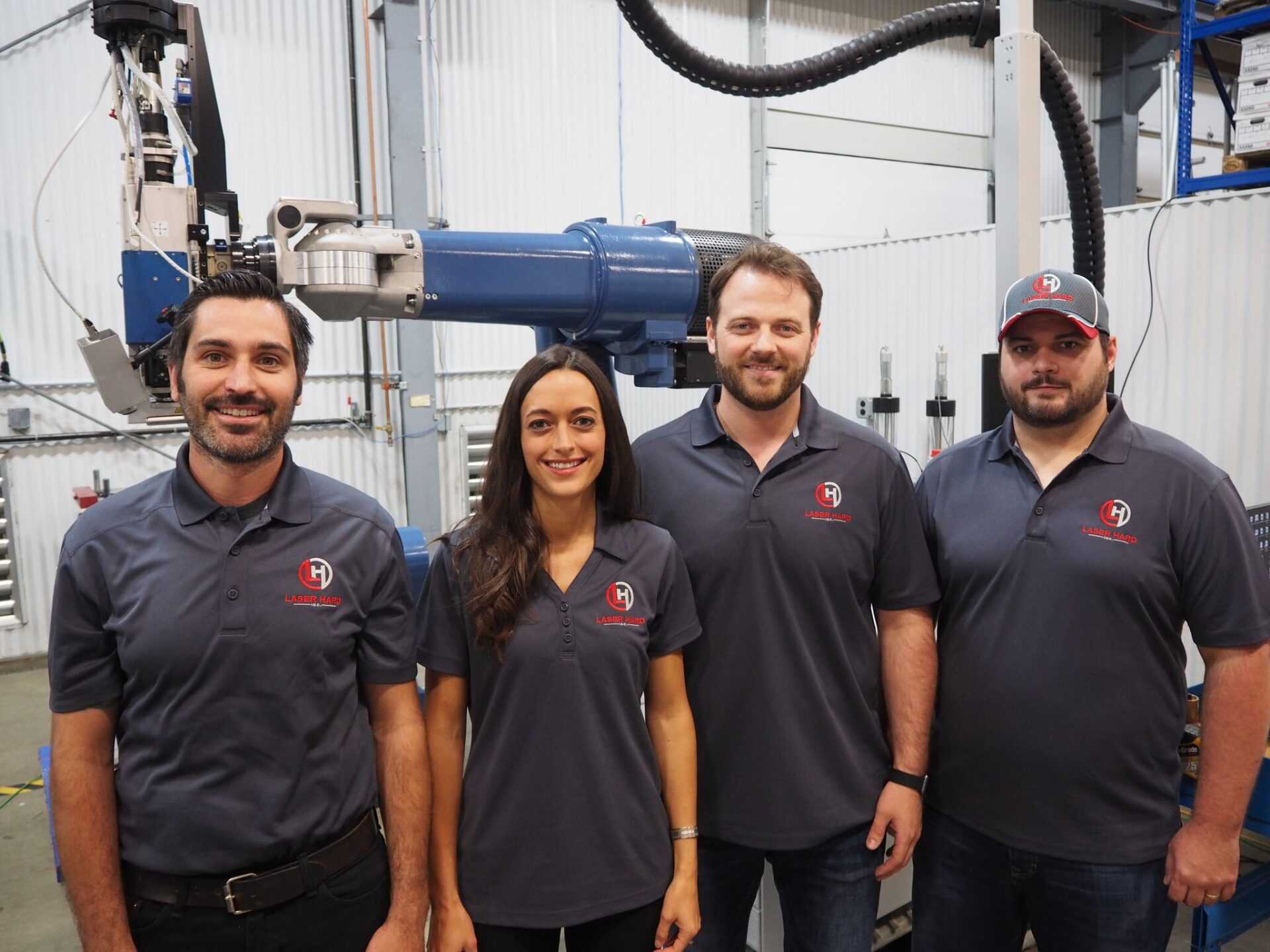
Laser Hard, Inc:: Andy Wilkosz, Diana Wilkosz, Chris Learn, David Learn

On the Peters’ Heat Treating side of the business is, as I mentioned before, Diana Wilkosz, maiden name, Peters. Diana is the marketing brains behind Laser Hard and oversees marketing, HR, and finance for Peters’ Heat Treating. This is a good time to mention that Laser Hard can be found on the web at www.laserhard.com, a website undoubtedly put together by Diana and her team.

We’ll hear from Diana’s husband, Andy Wilkosz, in just a few minutes.

From the Phoenix Laser Solutions side of the business is two of the three brothers, Chris and Dave Learn. Dave is treasurer and Chris is president. Both of the patriarchs, Doug Peters and Blair Learn, are heavily involved in sales and oversight of the new company.

Now, let’s hear from Chris Learn.

Chris Learn (CL): Yeah, my name is Chris Learn. I’m the owner of Phoenix Laser. And I pretty much oversee the shop floor. Mainly on the laser welding side.

DG: And now, as promised, let’s hear from the spokesperson from the Peters’ Heat Treating side of the business – Andy Wilkosz.

Andy Wilkosz (AW): I’m Andy Wilkosz, vice president of Laser Hard. I also work for Peters’ Heat Treat.

DG: So these are the players. But what about the technology – laser heat treating. Pretty fascinating stuff. Listen as we go back to Andy as he discusses cutting-edge robotics and real-time, feedback-loop pyrometry that makes this laser heat treating system so much different AND BETTER than other laser heat treating systems.

AW: So, I was part of the team that worked on initial startup and all the initial projects associated with the robot and the laser system. Some of the things that set it apart from the traditional lasers and systems that are out in the marketplace now is this has the Fonhoffer Control System so there is onboard optical pyrometry which is a very strong tool for this. A traditional laser is almost like a guess-and-check type of method where you adjust the wattage, see if you achieved the hardness, and in this system, we have the optical pyrometry that has a feedback loop that reads the temperature of the part and then it can control which is really important as a part’s geometry changes. We are going to be able to have better repeatability and control for our customers’ parts. Now, obviously it’s always best if you get one set up part but if the customer just has one part, we are much more likely to get it right and not hurt their part with some of the hazards that could be associated with laser-like melting.

DG: Doug Peters expounded as well on some of the advantages of the Laser Hard heat treating system.

DP: You can locally heat treat parting lines. You can locally heat treat shear areas in a cut off die. You can, instead of having to heat treat the whole part — basically the strength, Doug, is that you can finish a part, we can locally heat treat and then you can put it to work. So the precise heat of a laser enables us to not have to temper everything. In Europe, as they employ this technology, they don’t temper much, if anything because they don’t need to, because of the way this works. Right now I can tell you that the main strength I see in this thing is the precise placement of the treatment, whether it be cladding or heat treating, and the areas that we can direct the beam that you cannot get at with any other technology or method of heating. So, in other words, if you have a blind hole that is two inches deep, I can put a beam into the bottom of the hole and I can harden just the bottom of the hole, and you can’t do that with induction or flame. And with traditional heat treating you are going to have the hard finish cost associated with the distortion as part of the base heat treating cycle.

DG: With laser, you can get in the hole, do the job, and be done with no additional post treatments.

DP: Exactly. And no post hard finish time either — which is huge. The majority of time in building a tool is generally in hard finish time.

DG: And finally, Chris Learn also had something to say about the advantages and application of laser hardening. Chris Learn…

CL: It’s heavily being used in the automotive industry for very large plastic injection tools. So they got this very large plastic injection cavity or core and they are just locally heat treating the parting line and the shut offs. Where before they would have to buy a more expensive material and you know, rough machine it, then heat treat the entire huge block and then finish machine it, you know, with hard milling or eem processes that are very expensive, where now they can just buy a cheaper material, finish machine it and then laser harden just the part you need.

Portability

One of the other benefits of this new laser heat treating service being offered by Laser Hard is its portability.

One of the other benefits of this new laser heat treating service being offered by Laser Hard is its portability. Andy Wilkosz commented on the unit’s portability and its potential application in the gear market.

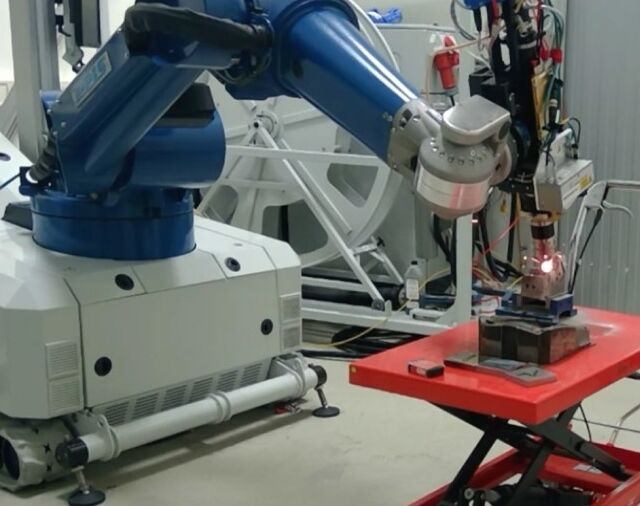
AW: Another powerful aspect of this is we are hoping to really serve the gear market as well. Where in traditional heat treating, what you run is going to be limited on your furnace size. With this robot having the ability to move around — it’s on tank treads — and the range that it can articulate to, you are only limited by what you can get to. So we have the ability to do very, very large parts.

DG: I don’t know if you caught what Andy said. He said that the laser heat treating unit was on “tank treads.” Those tank treads along with a robotic laser heat treating or cladding arm allow the unit to move on-site to where the part is located and once there to move around the part as needed to do whatever process needs done whether it be heat treating or cladding.

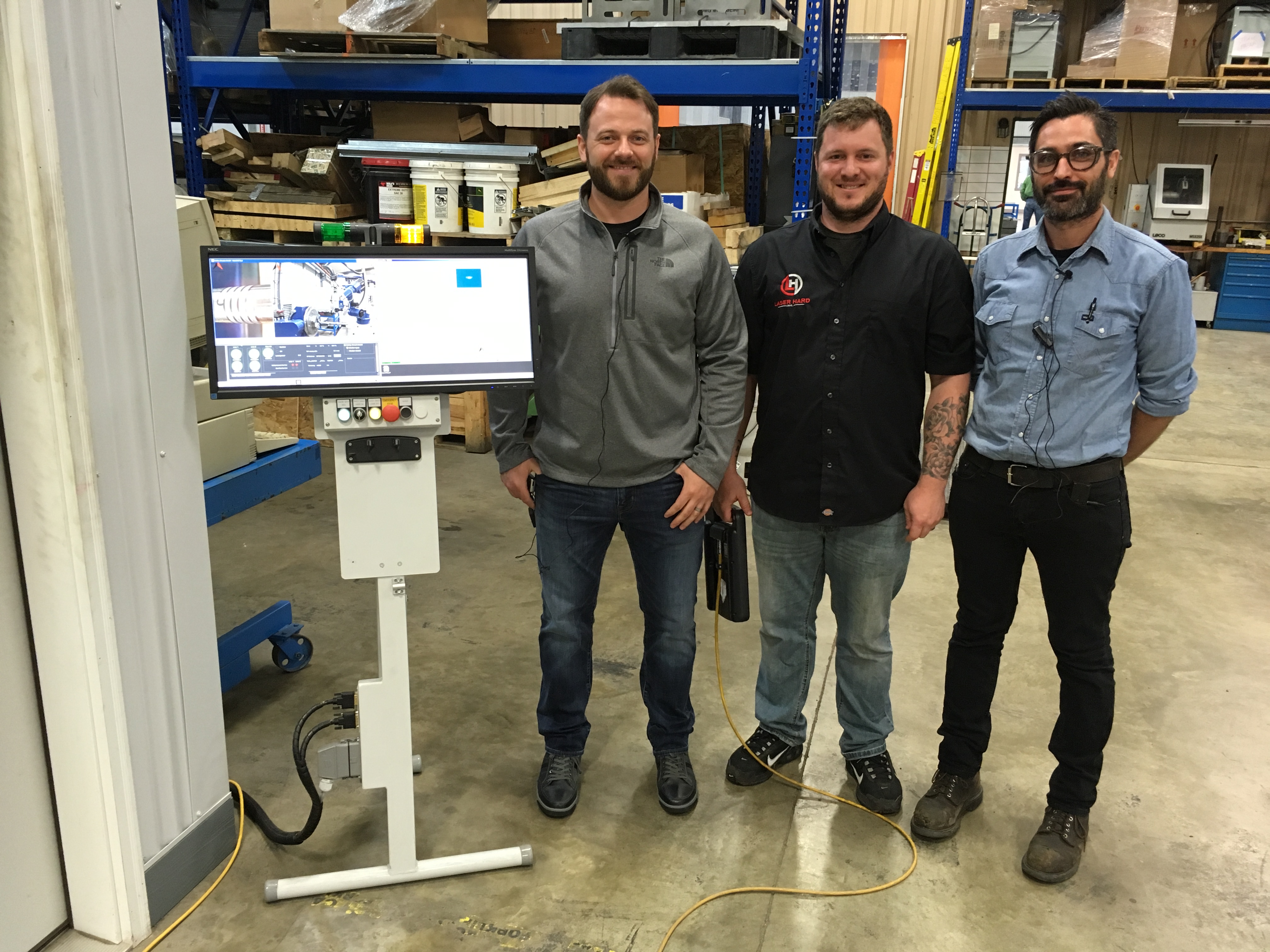
As we left the Laser Hard offices and went into the shop to see the unit in action, I asked Chris Learn about the unit’s mobility as well – the ability to take that machine on-site.

CL: So I think the biggest reason for taking this piece of equipment mobile is if the workpiece is too large to transport. Or if it’s too expensive and too risky to transport. So, it’s a very high-cost situation that instead of taking the part here and having us manipulate it here at our shop, even though we have a ten-ton crane, some parts that we deal with are twenty tons, thirty tons. So, it’s a size restriction. Sometimes it’s going to make sense to take this on site.

DG: I next asked Andy to give us a brief explanation of how the unit works. Here’s Andy, and again, please pardon the background noise from the laser welding shop.

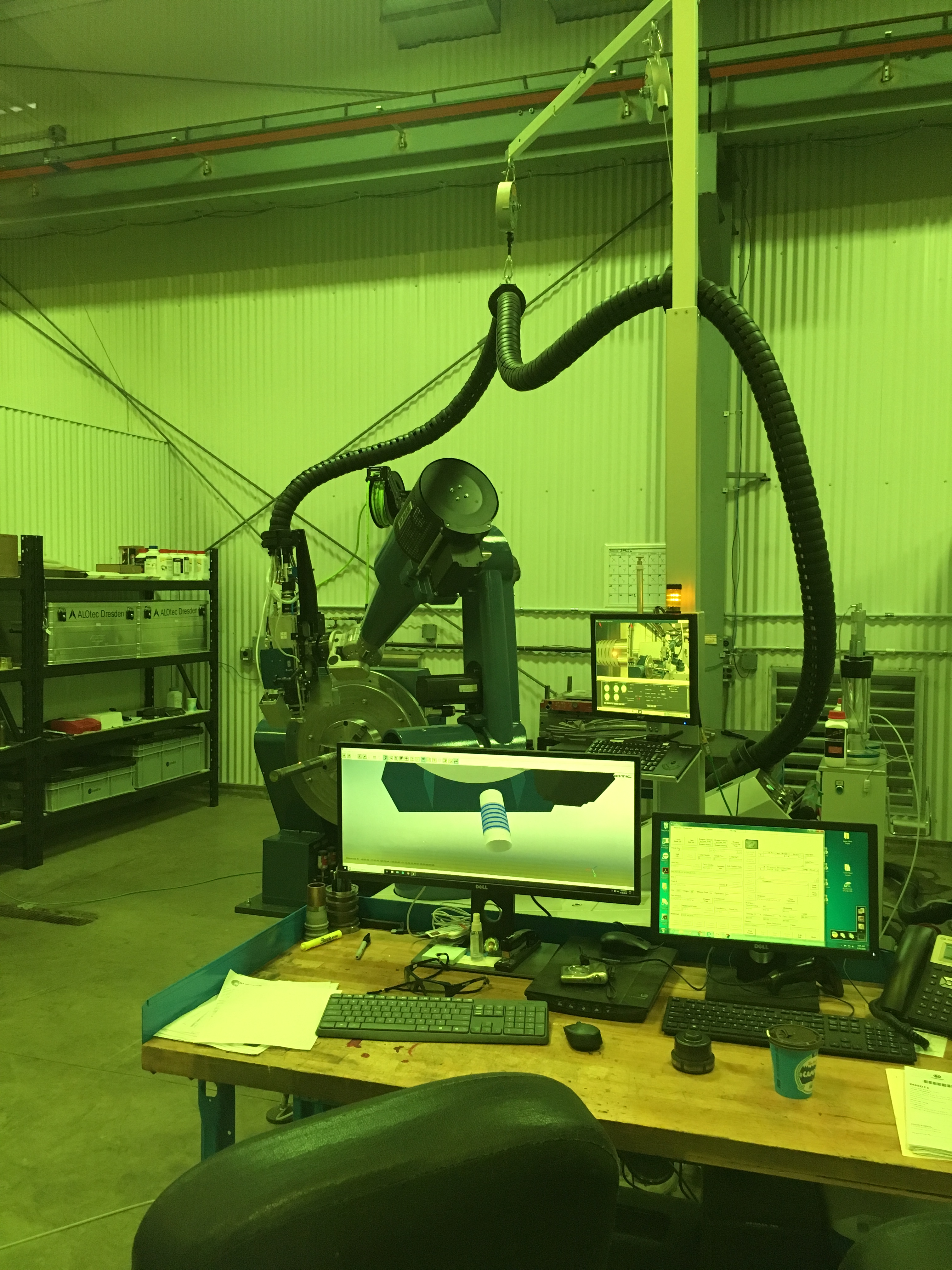
AW: Right now, we have a part chucked up in the rotary axis and with the laser scan technology that we have on the laser, it interfaces with the software on the computer and what Mason can do is, we’ll rotate the part, as he rotates the part, it requires image information through the scan and it will actually build a 3D model of the part and its geometry on the computer. Then once we have that on the computer, we can use the computer to draw and program the path of the heat treat or the laser hardening pattern – whether it be a spot or in this case it’s a round bar and what we are going to do is we are going to traverse the bar in a spiral candy cane/barber pole pattern so that you can harden the entire surface. The beam size is about, the max width is, we’ll say 850,000, it’s a little bit more than that but we’ll use round numbers. So if you want to harden an area larger than that, what you end up doing is making multiple overlapping passes.

DG: To actually see the equipment in action, you’ll have to link over to Heat Treat Today’s website and search for Laser Hard. We’ll have an article there with photos of the players and a brief video of the laser heat treating system in action.

Click below or here to view a video of the equipment in action.


Here’s what’s important to remember:

  • This laser heat treating and cladding system has a real-time feedback loop that makes it possible to not guess at whether the heat treating process being run is being run correctly.
  • This laser heat treating and cladding system is portable and can go on-site to perform any process needed.
  • For large parts or for specialty parts where shipping is problematic, this laser heat treating system may be just the ticket you’ve been looking for.

The young team at Laser Hard, backed by the two industry veterans, are bringing an innovative new heat treating technology to the United States.

If you’re interested in knowing more about Laser Hard and the services they provide, feel free to visit their website at www.laserhard.com or contact me directly and I’ll put you in touch with one of the key players. More information, including photos of the Laser Hard team and the equipment, as well as a short video of the equipment in use, can be seen by visiting Heat Treat Today’s website and searching for Laser Hard. 


Stop back at Heat Treat Today’s site frequently. We update the site daily with information pertinent to heat treaters with in-house heat treating departments, especially those in the aerospace, automotive, medical, and energy sectors, as well as general manufacturing.

If you’d like to hear more Heat Treat Radio, you can do that in one of three ways:

  • You can Google “heat treat radio” – we’re the first thing that pops up,
  • You can visit www.heattreattoday.com and find “Heat Treat Radio” under the Resources tab,
  • Or, as I mentioned at the beginning of the podcast, you can find “Heat Treat Radio” on iTunes or on SoundCloud.

If you have a specific topic you’d like covered on Heat Treat Radio, please feel free to contact me directly with your suggestion. My email is doug@heattreattoday.com.

Heat Treat Radio podcasts are the sole property of Heat Treat Today and cannot be reproduced without permission and appropriate attribution.

This episode of Heat Treat Radio was produced and mixed by Jonathan Lloyd, Butler, Pennsylvania.

My name is Doug Glenn. Thanks for joining us.


Doug Glenn, Publisher, Heat Treat Today
Doug Glenn, Heat Treat Today publisher and Heat Treat Radio host.

To find other Heat Treat Radio episodes, go to www.heattreattoday.com/radio and look in the list of Heat Treat Radio episodes listed.

Heat Treat Radio #11: Laser Heat Treating with Laser Hard Read More »

Heat Treat Radio #11: Laser Heat Treating with Laser Hard

Welcome to another episode of Heat Treat Radio, a periodic podcast where Heat Treat Radio host, Doug Glenn, discusses cutting-edge topics with industry-leading personalities. Below, you can either listen to the podcast by clicking on the audio play button, or you can read an edited version of the transcript. To see a complete list of other Heat Treat Radio episodes, click here.


Audio: Heat Treat Radio: Laser Heat Treating with Laser Hard

In this conversation, Heat Treat Radio host, Doug Glenn, interviews two families who have been at their manufacturing game for multiple generations. Not long ago they joined forces to establish a new company — Laser Hard, Inc. — and to introduce one of the most cutting edge-heat treat technologies around today: laser heat treating. For many of you who have difficult-to-heat treat parts, whether it’s because of blind holes, or the fact that the part is too big to move, or perhaps you’d like to significantly reduce, if not eliminate, post-heat treat hard machining, you’re going to find today’s Heat Treat Radio episode on laser heat treating especially interesting.

Click The Play Button Below To Listen.


Transcript: Heat Treat Radio: Laser Heat Treating with Laser Hard

The following transcript has been edited for your reading enjoyment.

Click the image to connect to Heat Treat Radio

In this episode of Heat Treat Radio, let’s talk about one of the most cutting-edge heat treat technologies around today — laser heat treating.

Thanks for joining us. My name is Doug Glenn and I’m your Heat Treat Radio host and publisher of Heat Treat Today. You can find us on the web at www.heattreattoday.com or simply by Googling Heat Treat Radio. And here’s something new, Heat Treat Radio is now on iTunes! On the website, we update our heat treat content daily, and if you’re a manufacturer with an in-house heat treat department, you’re going to love our site.

Although it sounds Star Treky, laser heat treating is a pretty well-established technology, especially in Europe, but not so much in the United States. The applications are intriguing to say the least – as is the way it is being introduced into the United States – and as are the two families introducing it. One family – long time heat treaters. The other family – long time laser welders and laser cladders. Both minding their own businesses – literally – both thinking about ways to better serve their customers. These two businessmen were from the same small town in Pennsylvania, and they paired up to create a new company called Laser Hard.

And that’s where our story begins.

Introducing Doug Peters Of Peters’ Heat Treating And Blair Learn Of Phoenix Laser Solutions

Doug Glenn (DG): First, let me introduce you to the two patriarchs: Doug Peters of Peters’ Heat Treating, and Blair Learn of Phoenix Laser Solutions.

Both Doug and Blair are seasoned veterans in their respective industries, and both have children involved in their family businesses in Meadville, Pennsylvania – a mid-sized city about 40 minutes south of Lake Erie and 20 miles from the Ohio state border. These two patriarchs have known each other for years – primarily because Phoenix Laser had been sending heat treating to Peters’ Heat Treating.

Doug Peters, Peters’ Heat Treating Inc.

Peters’ Heat Treating started in 1979, and here’s Doug Peters with a short history of Peters’ Heat Treating.

Doug Peters (DP): We basically started because there was a need in the area for a commercial heat treater. I heard about it from clients of mine. I was in the insurance business and I finally got tired of listening to everybody saying that the place needed a good heat treater so we started one. That expanded to Erie in ’82, then opened the production plant on 13 acres up here in 2013.

Doug and his wife Jackie have three kids involved in their business: Christopher, who helps with IT and other special projects at the heat treat company, and then husband and wife team Diana Peters Wilkosz and her husband Andy Wilkosz who are both heavily involved in Laser Hard as well as the heat treat company.

The other patriarch in this picture is Blair Learn, father of three boys, Chris, Dave, and Mike, all of whom are owners of Phoenix Laser Solutions. Here’s Blair with a brief history of his family business.

Blair Learn, Phoenix Laser Solutions

Blair Learn (BL): So we started here in 2008, but we’ve been laser welding for 25 years. We used to have a design and build plastic injection mold hut. We would build high cavitation molds, and we needed a laser there to fix the day-to-day bumps and dings — you know, DCRs and stuff.

Besides the laser heat treating technology, which we’ll get to in just a minute, the thing that excites these two seasoned entrepreneurs is seeing their 20- and 30-something kids run with a new business. Doug Peters says it well.

DP: I think one of the things that’s most interesting to me is that the two patriarchs have stepped back and this company truly belongs to our sons and daughters.

DG: And who are these sons and daughters? Well, there are more than we have time to put in this podcast, but let me introduce them all to you now and then we’ll hear from just two of them.

Introducing Chris Learn And Andy Wilkosz Of LaserHard, Inc.

Laser Hard, Inc:: Andy Wilkosz, Diana Wilkosz, Chris Learn, David Learn

On the Peters’ Heat Treating side of the business is, as I mentioned before, Diana Wilkosz, maiden name, Peters. Diana is the marketing brains behind Laser Hard and oversees marketing, HR, and finance for Peters’ Heat Treating. This is a good time to mention that Laser Hard can be found on the web at www.laserhard.com, a website undoubtedly put together by Diana and her team.

We’ll hear from Diana’s husband, Andy Wilkosz, in just a few minutes.

From the Phoenix Laser Solutions side of the business is two of the three brothers, Chris and Dave Learn. Dave is treasurer and Chris is president. Both of the patriarchs, Doug Peters and Blair Learnare heavily involved in sales and oversight of the new company.

Now, let’s hear from Chris Learn.

Chris Learn (CL): Yeah, my name is Chris Learn. I’m the owner of Phoenix Laser. And I pretty much oversee the shop floor. Mainly on the laser welding side.

DG: And now, as promised, let’s hear from the spokesperson from the Peters’ Heat Treating side of the business – Andy Wilkosz.

Andy Wilkosz (AW): I’m Andy Wilkosz, vice president of Laser Hard. I also work for Peters’ Heat Treat.

DG: So these are the players. But what about the technology – laser heat treating. Pretty fascinating stuff. Listen as we go back to Andy as he discusses cutting-edge robotics and real-time, feedback-loop pyrometry that makes this laser heat treating system so much different AND BETTER than other laser heat treating systems.

AW: So, I was part of the team that worked on initial startup and all the initial projects associated with the robot and the laser system. Some of the things that set it apart from the traditional lasers and systems that are out in the marketplace now is this has the Fonhoffer Control System so there is onboard optical pyrometry which is a very strong tool for this. A traditional laser is almost like a guess-and-check type of method where you adjust the wattage, see if you achieved the hardness, and in this system, we have the optical pyrometry that has a feedback loop that reads the temperature of the part and then it can control which is really important as a part’s geometry changes. We are going to be able to have better repeatability and control for our customers’ parts. Now, obviously it’s always best if you get one set up part but if the customer just has one part, we are much more likely to get it right and not hurt their part with some of the hazards that could be associated with laser-like melting.

DG: Doug Peters expounded as well on some of the advantages of the Laser Hard heat treating system.

DP: You can locally heat treat parting lines. You can locally heat treat shear areas in a cut off die. You can, instead of having to heat treat the whole part — basically the strength, Doug, is that you can finish a part, we can locally heat treat and then you can put it to work. So the precise heat of a laser enables us to not have to temper everything. In Europe, as they employ this technology, they don’t temper much, if anything because they don’t need to, because of the way this works. Right now I can tell you that the main strength I see in this thing is the precise placement of the treatment, whether it be cladding or heat treating, and the areas that we can direct the beam that you cannot get at with any other technology or method of heating. So, in other words, if you have a blind hole that is two inches deep, I can put a beam into the bottom of the hole and I can harden just the bottom of the hole, and you can’t do that with induction or flame. And with traditional heat treating you are going to have the hard finish cost associated with the distortion as part of the base heat treating cycle.

DG: With laser, you can get in the hole, do the job, and be done with no additional post treatments.

DP: Exactly. And no post hard finish time either — which is huge. The majority of time in building a tool is generally in hard finish time.

DG: And finally, Chris Learn also had something to say about the advantages and application of laser hardening. Chris Learn…

CL: It’s heavily being used in the automotive industry for very large plastic injection tools. So they got this very large plastic injection cavity or core and they are just locally heat treating the parting line and the shut offs. Where before they would have to buy a more expensive material and you know, rough machine it, then heat treat the entire huge block and then finish machine it, you know, with hard milling or eem processes that are very expensive, where now they can just buy a cheaper material, finish machine it and then laser harden just the part you need.

Portability

One of the other benefits of this new laser heat treating service being offered by Laser Hard is its portability.

One of the other benefits of this new laser heat treating service being offered by Laser Hard is its portability. Andy Wilkosz commented on the unit’s portability and its potential application in the gear market.

AW: Another powerful aspect of this is we are hoping to really serve the gear market as well. Where in traditional heat treating, what you run is going to be limited on your furnace size. With this robot having the ability to move around — it’s on tank treads — and the range that it can articulate to, you are only limited by what you can get to. So we have the ability to do very, very large parts.

DG: I don’t know if you caught what Andy said. He said that the laser heat treating unit was on “tank treads.” Those tank treads along with a robotic laser heat treating or cladding arm allow the unit to move on-site to where the part is located and once there to move around the part as needed to do whatever process needs done whether it be heat treating or cladding.

As we left the Laser Hard offices and went into the shop to see the unit in action, I asked Chris Learn about the unit’s mobility as well – the ability to take that machine on-site.

CL: So I think the biggest reason for taking this piece of equipment mobile is if the workpiece is too large to transport. Or if it’s too expensive and too risky to transport. So, it’s a very high-cost situation that instead of taking the part here and having us manipulate it here at our shop, even though we have a ten-ton crane, some parts that we deal with are twenty tons, thirty tons. So, it’s a size restriction. Sometimes it’s going to make sense to take this on site.

DG: I next asked Andy to give us a brief explanation of how the unit works. Here’s Andy, and again, please pardon the background noise from the laser welding shop.

AW: Right now, we have a part chucked up in the rotary axis and with the laser scan technology that we have on the laser, it interfaces with the software on the computer and what Mason can do is, we’ll rotate the part, as he rotates the part, it requires image information through the scan and it will actually build a 3D model of the part and its geometry on the computer. Then once we have that on the computer, we can use the computer to draw and program the path of the heat treat or the laser hardening pattern – whether it be a spot or in this case it’s a round bar and what we are going to do is we are going to traverse the bar in a spiral candy cane/barber pole pattern so that you can harden the entire surface. The beam size is about, the max width is, we’ll say 850,000, it’s a little bit more than that but we’ll use round numbers. So if you want to harden an area larger than that, what you end up doing is making multiple overlapping passes.

DG: To actually see the equipment in action, you’ll have to link over to Heat Treat Today’s website and search for Laser Hard. We’ll have an article there with photos of the players and a brief video of the laser heat treating system in action.

Click below or here to view a video of the equipment in action.


Here’s What’s Important To Remember:

  • This laser heat treating and cladding system has a real-time feedback loop that makes it possible to not guess at whether the heat treating process being run is being run correctly.
  • This laser heat treating and cladding system is portable and can go on-site to perform any process needed.
  • For large parts or for specialty parts where shipping is problematic, this laser heat treating system may be just the ticket you’ve been looking for.

The young team at Laser Hard, backed by the two industry veterans, are bringing an innovative new heat treating technology to the United States.

If you’re interested in knowing more about Laser Hard and the services they provide, feel free to visit their website at www.laserhard.com or contact me directly and I’ll put you in touch with one of the key players. More information, including photos of the Laser Hard team and the equipment, as well as a short video of the equipment in use, can be seen by visiting Heat Treat Today’s website and searching for Laser Hard. 


Stop back at Heat Treat Today’s site frequently. We update the site daily with information pertinent to heat treaters with in-house heat treating departments, especially those in the aerospace, automotive, medical, and energy sectors, as well as general manufacturing.

If you’d like to hear more Heat Treat Radio, you can do that in one of three ways:

  • You can Google “heat treat radio” – we’re the first thing that pops up,
  • You can visit www.heattreattoday.com and find “Heat Treat Radio” under the Resources tab,
  • Or, as I mentioned at the beginning of the podcast, you can find “Heat Treat Radio” on iTunes or on SoundCloud.

If you have a specific topic you’d like covered on Heat Treat Radio, please feel free to contact me directly with your suggestion. My email is doug@heattreattoday.com.

Heat Treat Radio podcasts are the sole property of Heat Treat Today and cannot be reproduced without permission and appropriate attribution.

This episode of Heat Treat Radio was produced and mixed by Jonathan Lloyd, Butler, Pennsylvania.

My name is Doug Glenn. Thanks for joining us.


Doug Glenn, Publisher, Heat Treat Today
Doug Glenn, Heat Treat Today publisher and Heat Treat Radio host.

To find other Heat Treat Radio episodes, go to www.heattreattoday.com/radio and look in the list of Heat Treat Radio episodes listed.

Heat Treat Radio #11: Laser Heat Treating with Laser Hard Read More »

Heat Treat Radio #10: John Vanas on SX Oil Lifters

Welcome to another episode of Heat Treat Radio, a periodic podcast where Heat Treat Radio host, Doug Glenn, discusses cutting-edge topics with industry-leading personalities. Below, you can either listen to the podcast by clicking on the audio play button, or you can read an edited version of the transcript. To see a complete list of other Heat Treat Radio episodes, click here.


Audio: John Vanas on SX Oil Lifters

In this conversation, Heat Treat Radio host, Doug Glenn, tours Euclid Heat Treating Company with owner John Vanas and discusses a nano-technology parts washing solution.

Click the play button below to listen.


Transcript: John Vanas on SX Oil Lifters

The following transcript has been edited for your reading enjoyment.

If you’re a manufacturer and you use parts washers to remove oil residue from metal parts as part of your manufacturing process, or if you’re a commercial heat treater who washes parts, today’s Heat Treat Radio episode should be especially interesting to you. Why? If you thought there was nothing new in the parts washing arena, you’ll be shocked at what you’ll learn today. Let me whet your appetite. What if I told you there is a parts washing additive out there where you only had to add .3 ounces — that’s right, .3 ounces — to every gallon of wash water? And what if I told you that you could run that solution for 3 to 4 months without adding any chemicals? And what would you say if I told you that the oil skimmed off of your wash bath would have a lower water content than anything that you’re currently using? And what would you say if I told you your maintenance team would never have to check the concentrations of your wash water again? Not enough? Okay, let me give you one more. What if I told you that when you were done with the bath, you could just dump it down the drain?
Sounds too good to be true, right? Well, buckle up, because Heat Treat Today is going to take you where no heat treat washing system has ever gone before.

For today’s episode of Heat Treat Radio, your host, that’s me, Doug Glenn (I’m also the publisher of Heat Treat Today, which you can find on the web at www.heattreattoday.com), took a road trip to Euclid, Ohio, to visit with a current user of the wonder wash additive I just described to you. It was a rainy day, so any raindrop noises you hear are, in fact, raindrops.

John Vanas (JV): This is our rotary retort building.

Doug Glenn (DG): Ok, great.

JV: And this is Euclid Heat Treating Company. I am John Vanas. It was established in 1946 by my father. So we have been around for 72 years.

DG: 72?

JV: 72 years. I have been here 46 years.

DG: And it is a family business, right?

JV: Yes, a family business. I have got three kids working here and we are probably the most diverse commercial heat treater in this area. We do a lot of different things: induction, rotary retort, batch, pit, nitriding, ferritic nitrocarburizing, and intensive quenching. We have got quite a bit of different processes that we do.

John and I are on a walking tour of his six-building commercial heat treat complex just northeast of Cleveland, Ohio. As he mentioned, Euclid Heat Treat Company is no fly-by-night establishment. John’s dad started the business and has passed it down to John who is well on his way to passing it on to his kids. Before we jump into the specifics of the “wonder wash” additive, which by the way, is not the name of the product — it is called SX Oil Lifter — but before we jump into the specifics of that additive, here is a bit more about the family business.

DG: So you got it from your dad?

JV: Yes.

DG: Roughly, when?

JV: Actually he passed in 1991. I have been running it since 1974. We had a general manager who ran the plant and he passed away, so they threw it to me. I was here for two years and my dad said, “It’s your baby. I am going to Florida.” So, that’s alright.

DG: And you have three kids?

John Vanas’ children: Deidre, John, and Claudine

JV: Three kids.

DG: Which are Deidre, John ….

JV: ….. and Claudine. They work here. John runs production, Deidre is going to be the General Manager, pretty much, and Claudine does the finance work. And I just try to keep everybody in line.

The Plant Floor: Where the Magic Happens

John and I were standing at the entrance of his rotary retort building, as I mentioned, one of the six buildings, located just off of 222nd Street in Euclid. As we were working our way to washer end of one of his rotary retort furnace lines, John explained the markets he serves with these furnaces.

JV: Two rotaries we’ve got an AGF 139 and an 1814, so this is a large retort that quenches into polymer and this one quenches into oil and goes right through the wash and out the other end to the finished product. Not too many people do rotary work anymore. There are a few of us around, but the beauty of this is the parts tumble and they get even case all over where with a belt furnace they mask each other by laying on each other, so it’s a good technology. Kind of a niche market for us.

DG: So it’s primarily fasteners?

JV: Fasteners, little stampings, just a little bit of everything. You can see here these are actually plugs for automobile and truck oil pans. We do a ton of these things. There’s a little stamping here that we’re running. You name it, if you have to have even case hardness we can do it in these two furnaces.

We then moved our way to the discharge shoot at the back end of the first rotary retort furnace where parts fell into an oil quench and then on into a spray washer. John wanted me to see that the oil being pulled out of the washing solution was almost 100% pure oil; very little, if any water. Here’s how John tells it:

JV: So we load through the retort into the oil quench then into a wash. This is a spray washer. Then we’ve got one of these hula hoop type tooth skimmers that skim the oil off into this drum. If you can see that; that’s almost pure oil. This is the XS Oil Lifter in here. But that’s almost pure oil. There is no water in there.

A heat treat washer solution that minimizes waste and maximizes green

We spent a few more minutes discussing John’s rotary retort lines and the washers associated with it, including a disc skimmer and another bucket of, as John describes it, “pure oil — there’s no water in there.” The point being, there is a cost savings when you send this oil out to be processed since there is very little water in the oil.

We next walked by Euclid’s intensive quench system which is essentially an IQ furnace sitting on top of an 11,000-gallon quench tank. Euclid’s intensive quench capabilities is another unique offering for the company. 

From Skepticism to New Product Line

After leaving the intensive quench and rotary retort building, we got into the meat of our conversation as we walked in the rain between buildings. The wonder-wash additive which I mentioned, called SX Oil Lifter, I asked John to tell me a bit more about that product. 

DG: So John, one of the reasons I came over is we want to talk about this SX Oil Lifter.

JV: Yes, this is a new product that was introduced to me, and I tried it just on a whim because I didn’t think it was going to work in a small wash that we’re going to see over here in one of our other buildings. And it worked so well, I’ve got it now in six washers.

DG: Maybe before we go back into the noise of the building, it was introduced to you by whom?

JV: Actually by a friend of Bill Lohn, he’s my partner. So we decided to give it a try. I put it in a washer and it worked so well that we put it in other washers. It lasts 3 to 4 months and then you change it. You never have to add anything to it, which is the beauty of it. And it just does a great job. So after 3 to 4 months, usually you get oil in the washer and up on the walls of the washer. It just gets kind of scummy. We’ve had some people use it and not change it for 6 months. It just depends on what you’re washing and how often you’re washing.

DG: Now, Bill found out about from who?

JV: He found out about it from a friend of his that was using it for another type of washing and they had initially had developed through industrial but no one was using it for that, so we negotiated with the company to get the license to do it by industrial type of washing. So now we’re the partners and we’re really the company for the industrial side. We’re trying to introduce it to the heat treating industry because once you try it, you’re going to like it.

Nano-Invasive Technology

DG: So just to be clear on it, it’s not a washer, it’s a chemical, but it’s not a chemical-chemical. It’s very biodegradable….

JV: It’s biodegradable. You can probably drink it. When you’re done with it, you can just put it down the drain. If you have oil that you haven’t skimmed off, you can let it settle out and drain it off that way, but most people just dump it right down the drain. There is nothing biologically harmful about it. There is nothing to harm the sewer. Our people test our sewers once a month here and they have found nothing. So that’s how we dispose of it, we just dump it down the drain.

DG: You were also mentioning about the quantity that you have to put in.

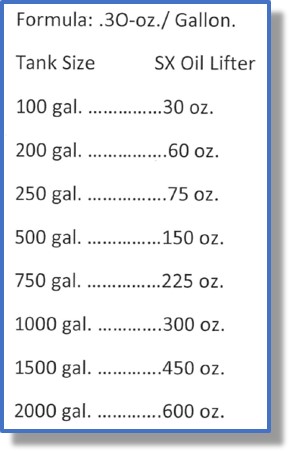
JV: Yes, it’s 3/10ths of a percent per gallon.

DG: So for a typical quench tank, what do you put in?

SX Oil Lifter Dosage Table

JV: Well this quench tank here has 750 gallons and I think we’re putting 80 ounces in there.

DG: And that 80 ounces will last you for 3 to 4 months, and maybe longer.

JV: Yes, then when you’re done, you dump it down the drain, clean it out and redo it.

DG: Ok, one other thing I wanted to ask. You said they call it “nano-invasive technology”?

JV: Yes, nano-invasive technology. What we found out is it does not actually dissolve in the water like your Tide or some other detergent or Simple Green. So, it’s in there and it’s lifting the oil, but it’s not dissolved in there, so when you’re dumping the fluid, you’re not dumping a dissolved chemical. And the fact that it is not dissolved, you don’t pull off that chemical you don’t have to add. You add water through your float valve, but you won’t add more product. The water evaporates, the product does not.

Seeing the Wonder Wash in Action

From there we went into the big batch building where three Super Allcases (a product of Surface Combustion) were located along with an older Lindberg IQ and a number of temper furnaces.

John showed me a batch wash that had just had the fluid changed the weekend prior, after 3 to 4 months of use. According to John, they probably could have gone longer, but that is the interval his maintenance team established to clean and change out the washing fluid. All the maintenance team did was wash down the inside of the washer and remove all the oil residue, skim off the oil from the top of the bath, and then dump the wash fluid down the drain. That’s it.

From the big batch building, we moved on to induction building.

JV: We have different stations and different power sources. We probably have about a dozen power sources and probably 40 different stations for doing different things. We’ve got a bolt machine there that he’s working on. We have a rotating machine there for different gears. We do a little bit of everything in here. We’ve got it crammed into the building pretty good. We just had this mezzanine put in and put the power sources up on top.

John’s father started the induction division. It was one of his special interests. John indicated that Euclid does a lot of work with local induction genius, as John describes him, Bill Stuehr of Induction Tooling out of North Royalton, Ohio, not far from Euclid.

The last building we entered was the vacuum and pit building.

JV: Here we have our vacuum equipment, our pit furnace, and our little batch furnace.

This building had about a dozen different vacuum and pit furnaces. After hitting this last building, we went back to talking a bit more about SX Oil Lifter and especially on the cost savings.

Pouring Savings into the Tank Instead of Down the Drain

DG: I assume there are cost savings here, right?

JV: Yes, it’s going to be about a third of what most people are using, from what we can determine. At least from what we used to use. We used to use a product from one of our oil suppliers and it would kinda make a funny-looking emulsion on the surface. And when we skimmed it off, we’d have to put it in the tank, let it settle out, drain it off until we got down to the oil and take the oil out. But we found out that we were getting a pretty good percentage of water in the oil when we sent it to the recycler. So he would charge us for getting the water out.

DG: So when you changed over the oil lifter, you didn’t have any problem with your current equipment that you used to separate the oil out I assume, right? There was no adverse effect?

JV: No, it was the same skimmer we always used, but it was just much more efficient.

DG: And you’re getting much better purity?

JV: Yes, we’re pretty much getting all oil in the tanks from the skimmers instead of an all water mixture.

When we walked back outside and headed back to John’s office, I asked him to repeat the cost savings information.

JV: It looks like from what we’ve seen from what our products we used to use, it’s going to be about a third.

DG: So you’re saving two-thirds?

JV: Yes. Plus, again, the beauty is, you don’t have to add all the time. You don’t have to have somebody coming in titrating. You can’t titrate this stuff. You can’t figure out what the percentage is because it’s such a small percentage, it doesn’t show up. We’ve tried several different methods to try to determine if we’ve got the right mix still in the tank, but we’ve come to the conclusion that you can’t. So, you put it in, you use it for 4 months or 3 months. When it starts to get to the point where perhaps it’s not cleaning the oil off well enough, you dump it and refill it.

DG: And you judge that not by taking any chemical composition of the solution, you just watch the parts, and if you’re seeing oil residue, it’s time to change.

JV: Exactly. And that kinda flies in the face of someone with technical knowledge, but that’s the way it works. You can tell if you’re washing off quench oil, if you start getting a smokey temper load, obviously you’ve got too much oil in there.

Once we got back to John’s office, I pressed him even more on the cost savings.

JV: We know the product we were using before was pretty expensive and I’ve talked to people who have tried and it and they said we’re putting a 55-gallon drum a month into our washer of the product we’re using now. And I said, well you won’t be doing that with SX Oil and I know that stuff is pretty expensive.

We further quantified the savings by talking about the money saved on oil processing because of less or no water in the oil being processed, plus the time savings of not having to test concentration levels of the wash. John had more to say about the time savings.

JV: Just talking to some other people who have tried the product, they said we’re going to save a lot of money because we have a guy who has to titrate it, has to add to it, and we don’t have to do that anymore.

DG: And they’re paying for that, I assume. They’re paying for that service or they’re paying one of their employees.

JV: Usually one of their employees. But it’s time-consuming and it’s a lab situation and titration. And with this, you don’t have to do anything.

I asked him if he had ever run into any problems with the product. He said that one customer called complaining the parts washed in the product were rusting faster than normal. After John and his fellow user discussed it for a while, they concluded that the product was doing such a good job of removing the oil from the surface, that it was more prone to rusting. What was the solution? John is working on adding a rust preventative to the product to help minimize the issue.

If it sounds too good to be true, it’s not. Here’s a brand new product. In fact, a brand new nanotechnology product, that

  • requires only .3 ounces per gallon of water,
  • lasts for 3-4 months minimum depending on your workload and oiliness of your products,
  • results in an almost pure oil skimming which minimizes oil reprocessing fees,
  • frees up your maintenance team to do other things besides worry about the washer,
  • and best of all, when you’re done, dump it down the drain.

If you’d like more information about SX Oil Lifter, please visit our website www.heattreattoday.com and search for SX Oil Lifter. We’ll have a full article about the product on the website along with a link to the product’s website. You can also email me directly if you’d like to get in touch with John Vanas at Euclid Heat Treat in Euclid, Ohio. My email address is doug@heattreattoday.com.

If you’d like more Heat Treat Radio, including our series on metallurgical poster children where we interview young, new metallurgical minds, please visit our website www.heattreattoday.com and click on Heat Treat Radio. Visit the website frequently. We post at least one heat treat news or technology item every weekday. Our content is targeted at manufacturers with in-house heat treat departments, especially in the aerospace, automotive, medical and energy sectors. Again, visit us at www.heattreattoday.com.

And finally, if you have a specific topic you’d like to see covered on Heat Treat Radio, please contact me directly at doug@heattreattoday.com.

Heat Treat Radio podcasts are the sole property of Heat Treat Today and cannot be reproduced without permission and appropriate attribution. This episode of Heat Treat Radio was produced and mixed by Jonathan Condon, Butler, Pennsylvania.

My name is Doug Glenn. Thanks for joining us.

To receive a copy of Euclid’s Safety Data Worksheet for SX Oil Lifter, contact Doug Glenn at doug@heattreattoday.com.

Doug Glenn, Publisher, Heat Treat Today
Doug Glenn, Heat Treat Today publisher and Heat Treat Radio host.


To find other Heat Treat Radio episodes, go to www.heattreattoday.com/radio and look in the list of Heat Treat Radio episodes listed.

Heat Treat Radio #10: John Vanas on SX Oil Lifters Read More »

Heat Treat Radio #9: Tom Morrison on Why Manufacturers Should Send Their Entire Heat Treat Team to FNA 2018

Welcome to another episode of Heat Treat Radio, a periodic podcast where Heat Treat Radio host, Doug Glenn, discusses cutting-edge topics with industry-leading personalities. Below, you can either listen to the podcast by clicking on the audio play button, or you can read an edited version of the transcript. To see a complete list of other Heat Treat Radio episodes, click here.


Click the play button below to listen.

Metal Treating Institute CEO, Tom Morrison, talks with Heat Treat Today’s Doug Glenn about 2018’s largest heat treat event, Furnaces North America, which will be held in Indianapolis, Indiana, from October 8-10, 2018. Find out why manufacturers with in-house heat treat shops should not only attend FNA 2018, but why they should send the entire team to this once-every-two-year event. And when you come to the end of the podcast, click over to Heat Treat TV to see a recently released FNA 2018 promotional video that will whet your appetite for the event.

FNA 2018


To find other Heat Treat Radio episodes, go to www.heattreattoday.com/radio and look in the list of Heat Treat Radio episodes listed.

Heat Treat Radio #9: Tom Morrison on Why Manufacturers Should Send Their Entire Heat Treat Team to FNA 2018 Read More »

Heat Treat Radio #8: Karen Stanton and HTA’s “Coming to America” Story

Welcome to another episode of Heat Treat Radio, a periodic podcast where Heat Treat Radio host, Doug Glenn, discusses cutting-edge topics with industry-leading personalities. Below, you can either listen to the podcast by clicking on the audio play button, or you can read an edited version of the transcript. To see a complete list of other Heat Treat Radio episodes, click here.


What would the Australian Ministry of Defense have to do with heat treating in Southern California?

Karen Stanton, Director–Corporate & Strategy of Heat Treatment Australia (HTA), explains how a growing Australian aerospace and defense market propelled HTA’s launch of their first non-Australian heat treating shop, which is today located in Sante Fe Springs, California, within a reasonable distance of customers and suppliers alike.

Listen to Heat Treat Radio’s podcast (Episode #8) with Karen’s description of how expansion into the southern California heat treat market seemed to be the most reasonable move for an agile and growing company like HTA.

Click the play button below to listen.


Doug Glenn, Publisher, Heat Treat Today
Doug Glenn, Heat Treat Today publisher and Heat Treat Radio host.


To find other Heat Treat Radio episodes, go to www.heattreattoday.com/radio and look in the list of Heat Treat Radio episodes listed.

Heat Treat Radio #8: Karen Stanton and HTA’s “Coming to America” Story Read More »

Heat Treat Radio #7: Former Bodycote CEO Re-Enters Heat Treat Market

Welcome to another episode of Heat Treat Radio, a periodic podcast where Heat Treat Radio host, Doug Glenn, discusses cutting-edge topics with industry-leading personalities. Below, you can either listen to the podcast by clicking on the audio play button, or you can read an edited version of the transcript. To see a complete list of other Heat Treat Radio episodes, click here.


Audio: Former Bodycote CEO Re-Enters Heat Treat Market

In this conversation, Heat Treat Radio host, Doug Glenn, interviews John Hubbard, longtime CEO of Bodycote who retired in 2009 and has recently re-entered the market with an aggressive capital investment company located in Baltimore, Maryland. This 20-minute Heat Treat Radio interview gives you all the important news about what Mr. Hubbard and the Calvert Street Capital Partners (CSCP) are planning. To date, CSCP, under the leadership of Mr. Hubbard, have snagged top talent from the industry, including Mike Sobieski and Don Longenette, and are actively pursuing the acquisition of well-established and profitable commercial heat treat across North America.

Our aerospace, automotive, medical, and energy manufacturers with in-house heat treats will find it encouraging to hear what John has to offer.

Click the play button below to listen.


Doug Glenn, Publisher, Heat Treat Today
Doug Glenn, Heat Treat Today publisher and Heat Treat Radio host.


To find other Heat Treat Radio episodes, go to www.heattreattoday.com/radio and look in the list of Heat Treat Radio episodes listed.

Heat Treat Radio #7: Former Bodycote CEO Re-Enters Heat Treat Market Read More »

Heat Treat Radio #6: Peter Hushek on Reducing TUS Failures

Welcome to another episode of Heat Treat Radio, a periodic podcast where Heat Treat Radio host, Doug Glenn, discusses cutting-edge topics with industry-leading personalities. Below, you can either listen to the podcast by clicking on the audio play button, or you can read an edited version of the transcript. To see a complete list of other Heat Treat Radio episodes, click here.


Audio: Heat Treat Radio: Peter Hushek on Reducing TUS Failures

In this conversation, Heat Treat Radio host, Doug Glenn, interviews Peter Hushek about Virtual Visual Surveys, a new 3D software that will help minimize temperature uniformity survey failures. Listen to Peter’s description of how this innovative new tool can help aerospace heat treaters know what’s going on inside the furnace during a TUS.

Click the play button below to listen.


Doug Glenn, Publisher, Heat Treat Today
Doug Glenn, Heat Treat Today publisher and Heat Treat Radio host.


To find other Heat Treat Radio episodes, go to www.heattreattoday.com/radio and look in the list of Heat Treat Radio episodes listed.


Heat Treat Radio #6: Peter Hushek on Reducing TUS Failures Read More »

Heat Treat Radio #5: Shaymus Hudson of MIT

Welcome to another episode of Heat Treat Radio, a periodic podcast where Heat Treat Radio host, Doug Glenn, discusses cutting-edge topics with industry-leading personalities. Below, you can either listen to the podcast by clicking on the audio play button, or you can read an edited version of the transcript. To see a complete list of other Heat Treat Radio episodes, click here.


Audio: Heat Treat Radio: Shaymus Hudson of MIT

In this conversation, Heat Treat Radio host, Doug Glenn, interviews Shaymus Hudson from the Department of Materials Science and Engineering at Massachusetts Institute of Technology (MIT) to discuss interesting new developments at MIT as well as his roots and experience in the metals and heat treat industry.

Click the play button below to listen.


Doug Glenn, Publisher, Heat Treat Today
Doug Glenn, Heat Treat Today publisher and Heat Treat Radio host.


To find other Heat Treat Radio episodes, go to www.heattreattoday.com/radio and look in the list of Heat Treat Radio episodes listed.


Heat Treat Radio #5: Shaymus Hudson of MIT Read More »

Skip to content