When tensile, shear or combination loads place a demand on bolted joints, heat treatment is a crucial step in the manufacturing of the high-strength fasteners often required to withstand the pressure.
“About 90 percent of fasteners are steel based and the required strength level is usually developed in steel fasteners using quenching and tempering processes.” ~ IEEE GlobalSpec
The authors of this week’s Technical Tuesday describe the standard industrial applications that call for heat-treated bolts or fasteners, environmental considerations that factor into determining heat treatment processes, the types of heat treatment according to the grade of steel, and more.
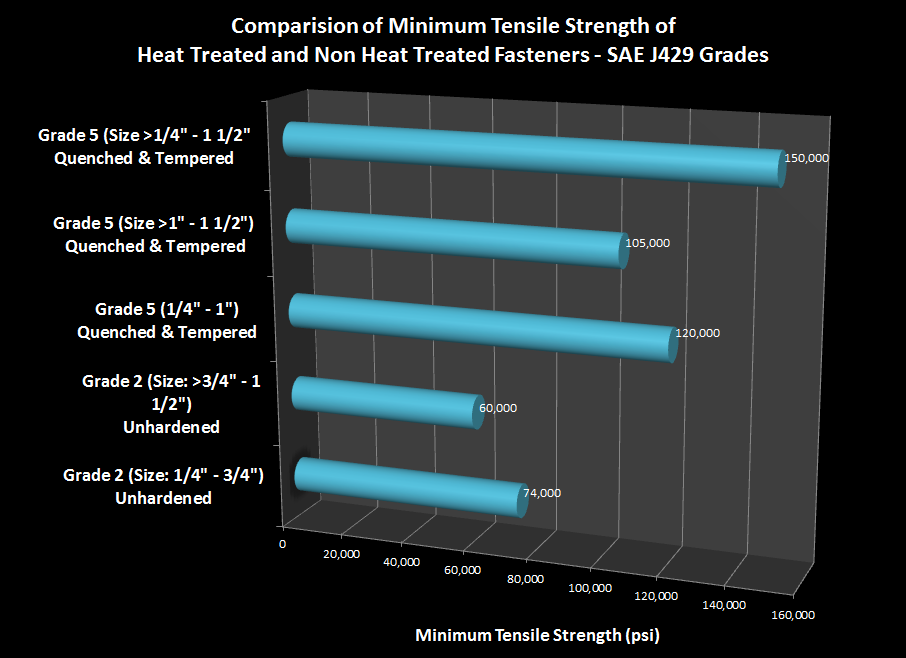
Comparison of minimum tensile strengths of heat treated and unhardened SAE J429 grade fasteners. Source: Bayou City Bolts
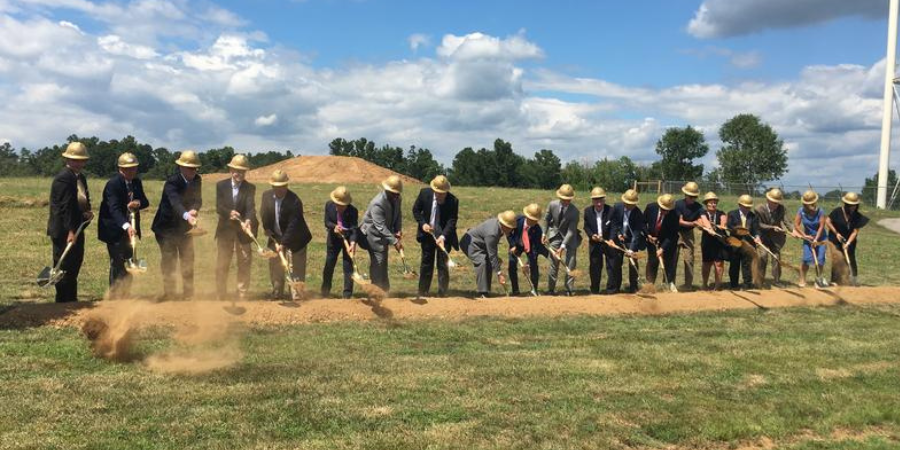
A Korean automotive parts maker recently broke ground on a manufacturing facility in Murray, Kentucky, that will house forging, heat treating, and machining gears and drivetrain parts, as well as administrative and design departments.
DAE-IL Corp. (DIC), headquartered in Ulsan, South Korea, will manufacture automotive transmission gears at the 295,000-square-foot plant being built in the Murray-West Industrial Park in Calloway County. The company expects to produce gears of the powertrain for internal combustion engine vehicles as well as gearboxes and differential assemblies for new cars.
“DIC is the best-specialized gear manufacturer in Korea,” said Johnny Kim, DIC president. “As global demand for our product is growing rapidly, [we]want to have this new facility here in the United States to satisfy our U.S. customers. I heard that Kentucky is at the heart of automotive and aerospace industries and has contributed growth to the national economy. With the highly skilled workers of this community, we will continue this trend for sure.”
“DIC will be at the forefront of the advancement of electric vehicles,” Kim added.
15 Quick Heat Treat News Items to Keep You Current
Heat Treat Today offers News Chatter, a feature highlighting representative moves, transactions, and kudos from around the industry.
Personnel and Company Chatter
Advanced Heat Treat Corp (AHT), which provides heat treat services and metallurgical solutions, announced today the addition of three new sales and marketing employees: Vasko Popovski, Jason Taylor, and Lindsey Newcomb. Popovski will focus on heat treat needs in the Great Lakes area. Taylor will cover sales in the southeast region of the country. Newcomb, Marketing Manager in the corporate office located in Iowa
Dr. Guido Kleinschmidt, who is a member of the Managing Board of SMS group GmbH, is the new President of METEC, the International Metallurgical Trade Fair and Congresses from 25 to 29 June 2019. He was elected unanimously at the recent meeting of the steering committee of the four trade fairs GIFA, METEC, THERMPROCESS, NEWCAST. The election was necessary because the former METEC President Marcel Fasswald had left SMS group to join Thyssengroup Industrial Solutions AG as Chief Operating Officer.
Giantonio Toldo, Operations Manager for Element Materials Technology (Element) Padova laboratory in Limena, Italy, has been appointed as the Vice President of the Italian Association for Metallurgy’s (AIM) Technical Committee for the Control and Characterization of Materials.
OMG Inc. recently announced four promotions in supply-chain management and operations: Wayne Ringenbach was promoted to director of Manufacturing, which includes heat treating; Brad Bedard was promoted to director of Supply Chain Management; Chris Mowatt was promoted to director of Manufacturing Engineering; and Geri McCarthy was promoted to director of Operations.
Samuel, Son & Co., Mississauga, Ontario, has acquired Sierra Aluminum, Riverside, California. Sierra is a supplier of aluminum extrusions and related products to a number of end markets, including construction and transportation. Sachin Shivaram has been named president of Sierra Aluminum Group, following Ed Harris’s decision to retire from the company.
A heat treating equipment supplier based in Plymouth, Michigan, recently shipped a pair of 36” x 48” x 36” electrically heated temper furnaces to a major drive supplier in the Southeast. Gasbarre Furnace Group/J. L. Becker designed the furnaces, which operate from 300°F to 850°F with a temperature uniformity of ±5°F, to preheat workloads prior to hardening and temper workloads after hardening.
An India-based conglomerate recently contracted Can-Eng Furnaces International Limited to design, manufacture, install, and commission an aluminum automotive casting heat treatment system for its new greenfield North American expansion in South Carolina. The new system will service three distinct aluminum product groups with unique treatment cycles.
A global manufacturer of thermal-processing equipment recently shipped a custom Gruenberg bench oven to the movable machinery industry. The bench oven is rated for Class B operation per the NFPA 86 specifications. Thermal Product Solutions (TPS) designed this bench oven to be used in the customer’s testing and product development department to process various mechanical apparatuses affixed to a Ling Dynamic Electronic Shaker. The maximum temperature rating of this Class B oven is 1022°F (550°C) and the work chamber dimensions are 36” W x 36” D x 36” H. In addition, TPS delivered a Gruenberg cabinet oven to the research and development industry. This Class B oven will process up to 5 gallons of water per batch from 1500 lbs of metal powder. The maximum temperature rating of this Class B cabinet oven is 250° F and the work chamber dimensions are 48” W x 48” D x 48” H. Both Gruenberg ovens are constructed from a structural steel frame that supports the fully welded 304 stainless steel chamber liner and the exterior sheet metal.
Grievehas built a 1,250°F, horizontal airflow cabinet oven used for heat treating at the customer’s facility. With workspace dimensions of 38" by 38" by 38", it has 12"-thick insulated walls comprising 2" of 2,300°F ceramic blanket and 10" of 10 lb./cu. ft. density Rockwool.
A vacuum space simulation system was recently shipped to a company that manufactures equipment for space. Tenney Environmental designed this system to test ionic thruster chips for space vehicle systems. The simulator will allow the customer to test their products in-house, while replicating outer space conditions. The dual cryopump vacuum system is sized specifically to maintain the high vacuum while the thrusters are firing inside the vessel.
An industrial manufacturer recently purchased a custom car bottom furnace from LEWCO, based in Sandusky, Ohio. The electrically heated oven, which is rated for a maximum temperature of 1,300°F., is used for annealing steel parts, featuring a workspace of 72”W x 140”D x 90”H, and manufactured and designed to NFPA 86 “Class B” standards.
Gasbarre Furnace Group/J. L. Becker ships electrically heated temper furnaces
Can-Eng Furnaces International shps aluminum automotive casting heat treatment system
Thermal Product Solutions shipped a custom Gruenberg bench oven
TPS delivered a Gruenberg cabinet oven
Grieve built a 1,250°F, horizontal airflow cabinet oven
Tenney Environmental built a vacuum space simulation system
LEWCO shipped a custom car bottom furnace
Kudos Chatter
Liebherr-Aerospace Toulouse SAS, center of excellence for aerospace air management systems within the Liebherr Group, has obtained accreditation from NADCAP (National Aerospace and Defense Contractors Accreditation Program) for its Materials Testing Laboratory.
A leading provider of vacuum impregnation technology, Godfrey & Wing, passed its transition audit for ISO 9001:2015/IATF 16949 certification from Smithers Quality Assessments (SQA), an accredited third-party registrar. The IATF 16949:2016 certification is the recently published revision to ISO/TS 16949: 2009, one of the most widely used international standards in the automotive industry. The standard acts as a supplement to ISO 9001: 2015 for automotive quality management systems.
Bonnell Aluminum, a subsidiary of Tredegar Corporation also recently announced that its aluminum extrusion manufacturing facility in Newnan, Georgia, has achieved certification under IATF 16949:2016.
In January of 2018, Logik Precision Inc. (LPI), a CNC machining, water jet, EDM and welding/fabrication service provider primarily operating in the oil & gas industry, selected QMSC, which provides quality management consulting services and is the developer of QMS, to provide professional consulting services to transition the organization from ISO 9001:2008 to the current revision of 2015. QMSC performed gap audit, completed revisions to the quality management system, performed employee training, and represented LPI during the registrar audit which was conducted on July 11th and 12th. Logik Precision successfully demonstrated compliance and commitment to its quality program. The audit was closed with zero findings and no observations. QMSC will provide ongoing fractional Quality Director services to assist LPI with continuous improvement.
Liebherr Aerospace obtains NADCAP
Godfrey & Wing passes audit for ISO 9001:2015/IATF 16949 certification
Heat TreatToday is pleased to join in the announcements of growth and achievement throughout the industry by highlighting them here on our News Chatter page. Please send any information you feel may be of interest to manufacturers with in-house heat treat departments especially in the aerospace, automotive, medical, and energy sectors to the editor at editor@heattreattoday.com.
A global provider of a comprehensive range of materials and product qualification test, inspection and certification services recently announced the acquisition of a Nadcap and ISO 17025 accredited laboratory headquartered near Cleveland, Ohio.
Element Materials Technology (Element) acquired Orbit Industries, Inc. (Orbit) strengthening its leadership position in non-destructive testing (NDT) for the aerospace industry.
Charles Noall, president and CEO of Element
With over 30 prime approvals, Orbit, which also operates out of four other satellite inspection facilities across Ohio, Pennsylvania, and New York, specializes in ultrasonic, liquid penetrant, magnetic particle and chemical processing for raw materials, semi-finished and finished products, including landing gear components, airfoils, and aluminum wheels.
“We are delighted to welcome Orbit, a world-class inspection facility, to the Element Group,” said Charles Noall, president and CEO of Element. “In the past few years, we have invested heavily in expanding our NDT platform in order to meet the strong-ramp up in engine and structure production that the aerospace industry is experiencing. The addition of Orbit complements our existing aerospace NDT facilities in California, Connecticut, Houston, Portland and Monterrey, Mexico, strengthening our footprint, capacity, and capabilities and enabling us to deliver cost savings for our clients.’”
John Alexandrovic, CEO, Orbit
“Since our formation in 1965, we have become one of the leading providers of NDT services to aerospace primes and Tier 1 suppliers in the United States,” said John Alexandrovic, CEO, Orbit.” We see partnering with Element as an opportunity to expand our capabilities and capacity so we can continue to offer our customers testing solutions of the best quality, lead time and price in the industry.”
Element is one of the world’s leading providers of aerospace non-destructive testing services to the global aerospace sector. Its facilities across the Americas and Europe specialize in the latest state-of-the-art testing and inspection services, including high-demand services such as digital x-ray, immersion ultrasonic, and etching services.
An Arkansas-based steel producer for automotive and electrical markets recently announced the expansion of its LEED-certified facility, doubling its hot-rolled steel production capacity to 3.3 million tons annually.
Dave Stickler, CEO of Big River Steel
In addition, the expansion at Big River Steel’s Flex Mill™, which began operations in early 2017, will facilitate the company’s ability to produce even higher grades of electrical steel, demand for which is expected to increase with continued focus on energy efficiency and the increase in hybrid and electric vehicle sales.
“Our $1.2 billion expansion will further cement Big River Steel’s position as a global leader in terms of advanced manufacturing and environmental stewardship,” said Dave Stickler, Big River Steel’s chief executive officer. “Announcing this investment less than 18 months after beginning operations is a testament to the hard work and great success of the men and women on our team.”
Engineering efforts are already underway with SMS group GmbH, the primary technology provider, and major construction activity will begin later this year and continue for approximately 24 months. In addition to doubling its hot-rolled steel production and enhancing its electrical steel capability, Big River is also contemplating the installation of a next-generation coating line focused on automotive applications.
Vacuum furnace heat treaters know that one of the most critical parts of their system is the pump oil, but it may be a bit overwhelming trying to determine which is the right kind of oil is needed. Selecting the correct vacuum pump oil starts with knowing your pump.
“‘Oil’ is a bit of a misnomer because modern pump oil technology has evolved well beyond the original distilled petroleum products. There are now double- and triple-distilled oils available, as well as hydro-treated oils, low sulfur oils, silicone-based synthetic oils, and flushing oils used to clean the pump. Due to the wide variety of formulations available, these are often now referred to as pump ‘fluids’ rather than pump ‘oils’.” — VAC AERO International
“Different pump oil formulations are specifically designed for different pumps and different vacuum applications,” notes VAC AERO, and a key factor in learning how to select the correct pump oil is the understanding of vapor pressure, viscosity, and distillation methods, as well as solvent refining, hydrotreating, synthetic oil (Perfluoropolyether), flushing oil for vacuum pumps, and diffusion pump oils.
Heat TreatToday will soon be launching Heat Treat Consultants, a resource that offers the most comprehensive listing of heat treat industry consultants. An example of the type of exchange we anticipate will result from this resource is provided below. Click the link above for a sneak peek at our inaugural list of consultants and more information about contacting one of the experts listed.
[spacer color=”848484″ icon=”Select a Icon”]
Mike Dascoli, general manager of County Heat Treat in Millbury, Massachusetts, asked our publisher, Doug Glenn, about a product the company had used previously, “an alumina oxide powder to coat graphite fixturing plates . . . in our vacuum furnaces to stop off against braze alloy run off and eutectic melting.” Doug queried whether it was aluminum brazing or more conventional brazing of stainless or other metals and Mike specified, “No aluminum brazing . . . used to be gold/nickel, silver alloys. Here at County, I am just looking to introduce some options. I remember we would mix the powder with the acetone and paint it on the carbon plates. Acetone evaporated quick and the powder was left behind. For us now, it’s more about a layer against eutectics when heat treating.”
Dan Kay, Kay & Associates Brazing Consulting &Training Services
Doug brought in one of Heat Treat Today‘s consultants, Dan Kay of Kay & Associates Brazing Consulting & Training Services, to assist in hunting down the answer to Mike’s question.
Dan Kay:
Hi Mike —
Yes, there are a number of brazing filler metal (BFM) manufacturers who also produce and supply brazing stop-off materials that can be painted onto graphite surfaces such as you mention in your note to Doug Glenn. Here are just a few: Surface Flow Technologies (Div. of LSN Diffusion Int’l) in Michigan, Wall Colmonoy Corp in Michigan, Vitta Corp in Connecticut, and Wesgo Metals (Div. of Morgan Advanced Materials) in California are some of the primary ones.
Stop-off materials come in different colors, the coloring of them being merely to identify its manufacturer, since all stop-off materials use metallic oxide materials to create their “stop-off” capabilities, and all these oxide powders are essentially white, to begin with. Thus, to differentiate the various stop-offs they began to color them so that people would learn to associate green stop-off with company A, pink stop-off with company B, red stop-off with company C, etc.
White stop-off products are essentially the weakest of all the colored stop-offs out there and are primarily aluminum-oxide products in a paint-like consistency. The binders/gels used to make the stop-offs vary considerably from manufacturer to manufacturer are proprietary, and you’ll not get any of them to actually tell you about all the ingredients in them. People are often surprised to hear that a product such as Phillips Milk of Magnesia, available in lots of stores or pharmacies, is actually a decent stop off (magnesium oxide) for a number of applications.
But you are correct to say that you can make your own in many different ways by merely mixing some aluminum-oxide powder, or titanium-oxide powder, etc., in with a variety of quick-drying solvents, perhaps also with a thin acrylic type cement to give it adherence, paint it onto graphite surfaces, and after evaporation you would be left with an adherent layer of that protective oxide barrier, so that it prevents direct contact of a metal (especially any iron-containing metals) with the graphite, since an iron-carbon reaction is to be avoided.
I’d be happy to assist you further with this, if you have additional questions, since I’ve had much direct manufacturing experience over my 45+years in the brazing world, a lot of it involved in making BFMs, brazing stop-offs and cements, etc., and am pretty much aware of the companies today who make and supply such materials.
On my website at http://www.kaybrazing.com, you will see a tab on the homepage that shows “Brazing Suppliers”. By clicking on that tab you can see a listing of the different companies who produce these materials, and in that tabular section the name of each company (such as those I mentioned above) is a hotlink that will bring you directly to that company’s website so that you can search it for a specific type of product that you might desire. It part’s of the service that I want to provide to users of my website. I hope you will find it useful.
Let me know how I can help you further.
Best regards,
Dan
Daniel Kay
Kay & Associates
Brazing Consulting &Training Services
4 Lawton Drive
Simsbury, CT 06070
Phone: 860-651-5595
Heat Treat Consultants is a unique opportunity for personnel in the field to engage some of the industry’s knowledge powerhouses with questions about equipment, processes, management, troubleshooting — just about anything having to do with heat treating. We invite you to take a look at our inaugural crew of Heat Treat Consultants by clicking on the provided links, and we would be happy to help you make any connections. Just email Doug Glenn at doug@heattreattoday.com. You can also submit any questions or comments on Heat Treat Today articles to editor@heattreattoday.com.
A leading manufacturer of magnesium dissolvable metals and dissolvable elastomers recently broke ground on a 12,000 sq. ft. expansion to its magnesium foundry, which will increase its metal processing, heat treatment, machining, and storage capabilities.
Andrew Sherman, CEO of Terves
Terves Inc announced that the H3-classified magnesium metal processing facility at its site in Euclid, Ohio, will include additional permanent mold and materials handling and storage space, and the addition of sand casting, squeeze casting, and diecasting capabilities for custom magnesium and magnesium alloys and composites, and allows for further expansion of build-to-print component CNC machining services. These additions enable the company to support aerospace and defense magnesium applications in addition to Terves’ leading position in the dissolvable oilfield tool market.
“Dissolvable Metals are the New Composites as far as oilfield tools are concerned,” said Andrew Sherman, CEO of Terves. “Oilfield tools made from composite materials were adopted in the industry about two decades ago and today occupy a sizable market share. We are seeing a major adoption and growth trajectory for oilfield tools made from dissolvable magnesium materials. At the end of 2017, roughly 2% of all frac plugs deployed in the field were being made using dissolvable metals and the market is expected to grow to 5% of all frac plugs deployed in the field by the end of 2018 – a 250% growth in one year, with adoption and use increasing through 2025.”
Terves products are used for making frac balls, plugs, slips, seals and several other components used in oil and gas well completion and production and have been used for completing tens of thousands of stages in North America, Europe, South America, Asia, and MENA regions.
A global leader in fully integrated freight car systems for the heavy haul rail market has added a new, complete furnace line to meet a growing need for additional heat treatment capacity.
Amsted Rail® purchased the UBH line from AFC-Holcroft, a manufacturer of turn-key heat treating systems for multiple applications based in Wixom, Michigan. The line includes a batch style carburizing furnace, two expansion modules to increase endothermic generator gas output, a rotary hearth reheat furnace for press quenching, and a continuous integrated parts washer and temper furnace.
“The batch furnace itself has an effective load size of 72 inches by 72 inches by 56 inches with a gross load capacity of 13,000 lbs, which is considered very large for this type of equipment, but is, in fact, one of AFC-Holcroft’s standard sizes,” stated Tracy Dougherty, sales manager at AFC-Holcroft. “The ability and experience to provide equipment for reliable processing of such large loads is just one of the benefits that AFC-Holcroft is able to offer, and one more thing that sets us apart from our competitors.”
Amsted Rail is headquartered in Chicago, Illinois, and has locations spanning the globe in every significant railroad market. The equipment is scheduled to ship to a joint venture facility located in Eastern Europe in the third quarter of 2018.
A special report from Heat Treat Today publisher, Doug Glenn.
Mr. Chad Spore, John Deere, speaking on “OEM Perspective on the ThermProcess Industry”
Chad Spore, materials engineering supervisor for John Deere, addressed the assembled guests of the International ThermProcess Summit, in Buckhead, Georgia, on the first day of the event, Tuesday, July 31, 2018. The presentation, which included encouragements to other manufacturers with in-house heat treating as well as industry suppliers to continue to innovate, was received with great interest by the nearly 100 attendees at this 2nd biennial event.
Omar Nashashibi, The Franklin Partnership, spoke on “Trump’s Washington: The New Normal?”
The attendees also enjoyed an excellent presentation from Omar Nashashibi. Mr. Nashashibi, as a-politically as possible, presented an excellent perspective on the first years of the Trump Administration. Whether you like Trump or not, Mr. Nashashibi made it clear that Trump was doing something that no other president has done in quite some time — he’s fulfilling all of his campaign promises to one degree or another. It was a balanced presentation with many positives and negatives.
Dr. Amber Selking, Selking Performance Group will be speaking on “Driving Consistent Performance Excellence”
The two-day event concludes today with keynote speaker and event emcee, Dr. Amber Selking of the Selking Performance Group, giving a presentation on “Driving Consistent Performance Excellence.”