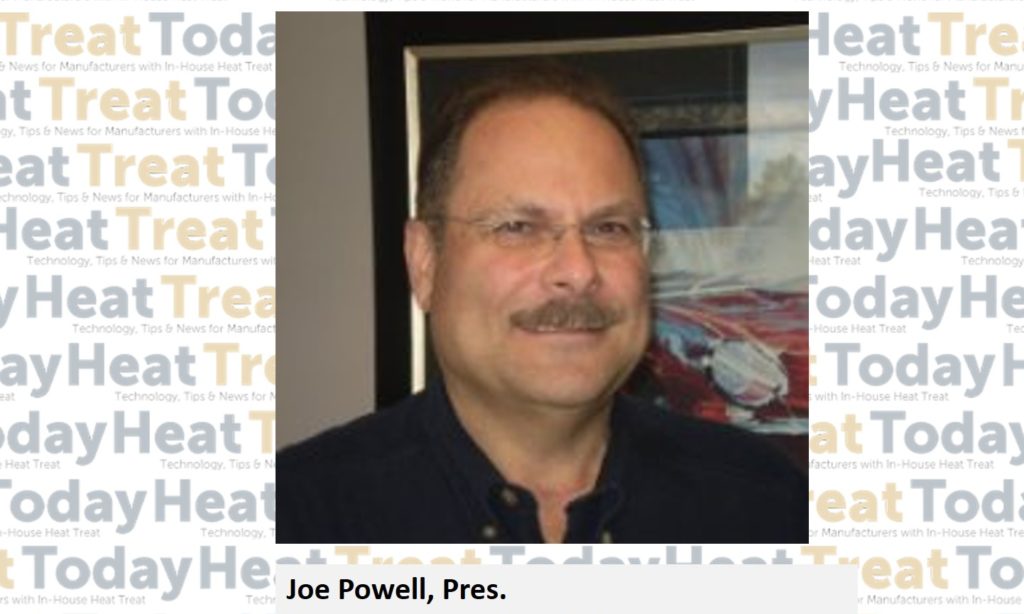
Publisher’s Note: Joe Powell, President of Akron Steel Treating Company and IQ Technologies, raises a very compelling point that part designers should work closely with heat treaters to achieve the lowest possible cost of production. In his introduction, he lists out some lofty goals that were set by an ASM Committee back in 1999…a meeting I was fortunate to attend. The goals were lofty then, and they continue to be lofty now. Mr. Powell offers a road map for getting closer to these goals.
Enjoy the read.
Doug Glenn, Publisher
By Joe Powell, President, Akron Steal Treating & IQ Technologies
It’s now 2017, almost 18 years since the ASM R+D committee set forth its Vision 2020, a list of goals for the heat treating industry by the year 2020:
BACKGROUND AND INDUSTRY NEEDS
Industry needs have been determined from the information brought forth by various
committee efforts and surveys over the last five years. Heat treating industry executives identified many of these needs, and prepared a view of the ideal future. This view has been named Vision 2020, and the established performance targets, based in energy, environment, productivity and quality, and industry performance are:
- Reduce energy consumption by 80%
- Improve insulation
- Achieve zero emissions
- Reduce production costs by 75%
- Increase furnace life ten-fold
- Reduce the price of furnaces by 50%
- Achieve zero distortion and maximum uniformity in heat treated parts
- Return 25% on assets
- Create 10-year partnerships with customers.”
It appears our industry has a way to go before meeting the Vision 2020 goals. Whether you work for a captive heat treating division of a part manufacturer or do heat treating at a commercial heat treating shop for many different part manufacturers, the goals set forth in 1999 are still worth pursuing.
What can we do to speed up the process of achieving these goals?
The above goals can be summarized as making “better parts” at a total lower cost of manufacture. Heat treating is a crosscutting technology. To become more efficient in the heat treating process we must look at not only our heat treating processes, but also look concurrently “upstream” and “downstream” from the heat treating process. All the parties in the part making value stream must collaborate to eliminate waste in each of their own processes as well as the waste that occurs from the interaction between each process. Doing the proper processes in the right order is also key to eliminating waste. For example, create a “near net shape” part before carburizing so the carburize layer that took so long to diffuse into the part is not removed in the post-hardening grinding operation.
[blocktext align=”left”]Heat treating considerations must become part of the design and engineering processes from their inception. Heat treaters must give their input for what material is best for the part application, considering not only the desired part fit and function, but the needed physical and mechanical properties. [/blocktext]
Two of the above goals: “reduce production costs by 75%” and “achieve zero distortion and maximum uniformity in heat treated parts” will require innovations in not only heat treating processes, but also heat treating equipment. The modeling of the heat treating process must become an integral part of the FEA modeling of the part design. The designer should focus on fit and function as well as achieving the needed mechanical properties, all at the lowest overall cost of manufacture. Part design engineers cannot meet these goals employing the same heat treating processes and using the same alloys of material that have been used for the last 100 years. Innovations in heat treatment must be developed collaboratively, crosscutting the many silos of expertise that are needed for making the part.
Part distortion after heat treatment costs part makers billions of dollars each year in post-heat treat operations. Achieving predictable part distortion after quenching with optimal grain refinement for a given alloy of steel depends on selecting the proper heat treat methods, e.g., proper racking, uniform heating, uniform atmosphere protection and most importantly the proper quenching process. However, the selection of the optimal quenching method is only enabled by a coordinated choice of the type of alloy used. Although higher alloy steel allows the use of gas quenching, air hardening steels usually mean higher cost. In addition, a higher hardenability steel does not always equate to the optimal hardness, ductility and part compressive surface stress state. The part designer must work with both the steel maker and the heat treater to optimize all three dimensions of hardened part properties.
Again, heat treating considerations must become part of the design and engineering processes from their inception. Heat treaters must give their input for what material is best for the part application, considering not only the desired part fit and function, but the needed physical and mechanical properties. If we are to minimize waste in post-heat treat operations to achieve proper fit and function, at the lowest overall cost of manufacture, we need to collaborate with all the parties in the part making value chain.
Heat treating equipment in most heat treating departments is the same basic designs as decades ago. The sunk costs in equipment the heat treater often dictates what heat treat processes will be done to the parts with little or no regard to the effect heat treatment has on total overall cost of manufacture. Since heat treatment costs are typically between 5% to 10% of the total part cost, demonstrated cost savings from innovative heat treatments alone are rarely enough to justify a change to a new type of processing equipment even if demonstrated to be clearly better.
However, if the total cost of heat treatment includes an examination of the waste created “upstream” and “downstream” of the heat treatment process, often a change in heat treat processes can be shown to have a much larger effect on lowering he overall cost of parts making while making a better part for the end-user. Achieving a proper balance of hardness and ductility in the part can be enhanced by also achieving a higher compressive surface stress state after quenching. Higher compressive residual stresses can significantly increase part performance or yield higher power density at nominal cost. Regardless of part hardness, compressive residual surface stress will usually enhance part wear and fatigue performance. But to enable the optimal intensive quench that gives compressive residual surface stresses requires the part designer to collaborate with the heat treater.
A faster quench cooling rate usually will provide higher hardness to a deeper level in the part for a given alloy of steel. Most heat treat metallurgists believe the higher cooling rate also means more part distortion or a higher probability of part cracking. So many parts are designed around higher alloy air hardening grades of steel to get lower distortion after quenching. However even gas quenching can cause unacceptable distortion in thin parts with complex shapes.
[blocktext align=”right”]Modern heat treat process modeling and intensive quenching practices have shown that the relationship between the probability of part cracking and rate of quench cooling is a bell curve. [/blocktext]
Modern heat treat process modeling and intensive quenching practices have shown that the relationship between the probability of part cracking and rate of quench cooling is a bell curve. While it is true at very low cooling rates, such as gas quenching and molten salt quenching, there is a very low probability of part cracking, we also now know that at very high cooling rates which are uniformly applied to the part shell from the very beginning of the quench, the probability of part cracking is also very low. The key is to eliminate the non-uniformity part cooling caused by film boiling at the very beginning of the quench process.
The benefit of “uniform + intensive” quench cooling is predictable part distortion and optimal grain refinement for a given alloy of steel. In addition, intensive quench cooling develops “current” compressive surface stresses that hold the part like a die. Even after tempering, high residual compressive surface stresses remain when designed into the part with the proper material alloy selection and the proper uniform and intensive quench process make for better parts at a total lower cost. An added benefit is the elimination of the oil quenchants for increased safety, decreased environmental impact and cleaner parts without washing.
CONCLUSION:
As heat treaters today, we must find the optimal processes and apply them in the best available equipment that eliminates the pains of heat treating from distortion and non-uniform properties for not only our customers, but our customers’ customer. Obviously, we heat treaters cannot do this in a vacuum. (Pun intended!) Heat treating is integral and crosscutting with many different process technologies in the part making value stream.
For the heat treating industry to achieve the goals set forth for us so long ago, we must collaborate with all the other members in the part making value chain to optimize the heat treating processes we have always used and in some cases find new ways. The simple fact is everyone at each step of part design and manufacture must collaborate to eliminate waste for the benefit of all in the lean value stream. The order of processing is also very important. To get it all right, the part making value map cannot be done from the individual silos of expertise.
Therefore, the selection of the optimal heat treatment process for a better part at a lower overall cost of manufacture is only enabled by a collaboration of the part designers, material makers and manufacturing engineers all working with their heat treater.