

Bethany Leone

Fringe Friday: Mechanical Prosthetic Design Challenges Industry Norms

We’re celebrating getting to the “fringe” of the weekend with a Heat Treat Fringe Friday installment: a Q&A between Bethany Leone, managing editor at Heat Treat Today and Fergal Mackie, founder and CEO of Metacarpal, on the development of a fully mechanical prosthetic hand engineered for demanding real-world environments. This discussion highlights the role of precision machining, material selection, Aluminum 7075, and surface engineering in developing lightweight, durable systems designed to withstand harsh daily use.

While not exactly heat treat, “Fringe Friday” deals with interesting developments in one of our key markets: aerospace, automotive, medical, energy, or general manufacturing.


A Solution to Address Real-World Challenges

Experiences from users working in demanding environments helped shape the development of the GEM, a fully mechanical bionic hand from Metacarpal designed to prioritize durability, maintainability, and adaptive gripping functionality. From construction sites to commercial kitchens, these real-world applications reinforced the need for a prosthetic system capable of withstanding harsh conditions without relying on electronics vulnerable to failure.

The Engineering Behind the Prosthetic

Fergal Mackie
Founder & CEO
Metacarpal

In the following Q&A, Heat Treat Today managing editor Bethany Leone speaks with Fergal Mackie, founder and CEO of Metacarpal, about the materials, mechanical engineering, manufacturing methods, and surface treatments behind the development of the GEM prosthetic hand.

Bethany Leone: What shortcomings in existing prosthetics did the GEM aim to overcome?

Fergal Mackie: Currently, around half of prosthetic hands are rejected — this reality has plagued upper-limb prosthetics for a long time. The Metacarpal GEM addresses several critical shortcomings that drive prosthetic abandonment rates. 

While myoelectric/robotic devices have shown promise, despite 30 years of intensive research, even the most expensive devices are still rejected at a high rate. 

“The advancements of the last decade in the arena of upper limb prosthetics have not yet achieved a significant change in prosthetic abandonment within this study cohort.”

For many users, particularly heavy-duty users, electronic systems present problems including battery dependency, sensor failures from sweating, response delays, and high costs. These systems require complex calibration, intensive training periods, and frequent maintenance that disrupts patient care. Many users struggle with inconsistent muscle signals needed for electronic control. I encountered users who described using expensive electronic devices as paperweights or permanently attached to hairdryers because these were the only reliable uses they found. These are devices that often cost upwards of $100k. 

Traditional mechanical hooks controlled by body-motion remain the most popular prosthetic hand in the world. This is a design that has not changed in around 150 years. Research shows 74% of military veterans prefer body-powered solutions for their reliability and feedback. They are inherently functional, robust and reliable, however, limited to a single grip and their appearance is often stigmatized, particularly for new amputees.  
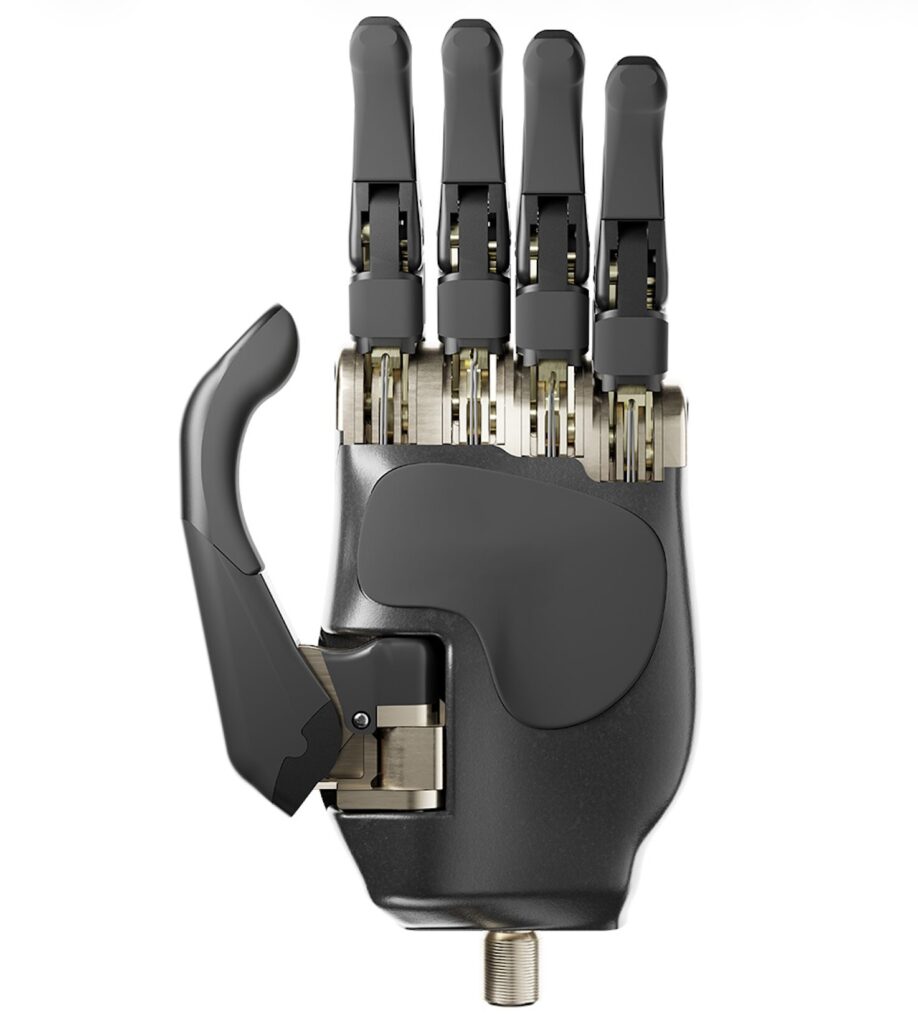
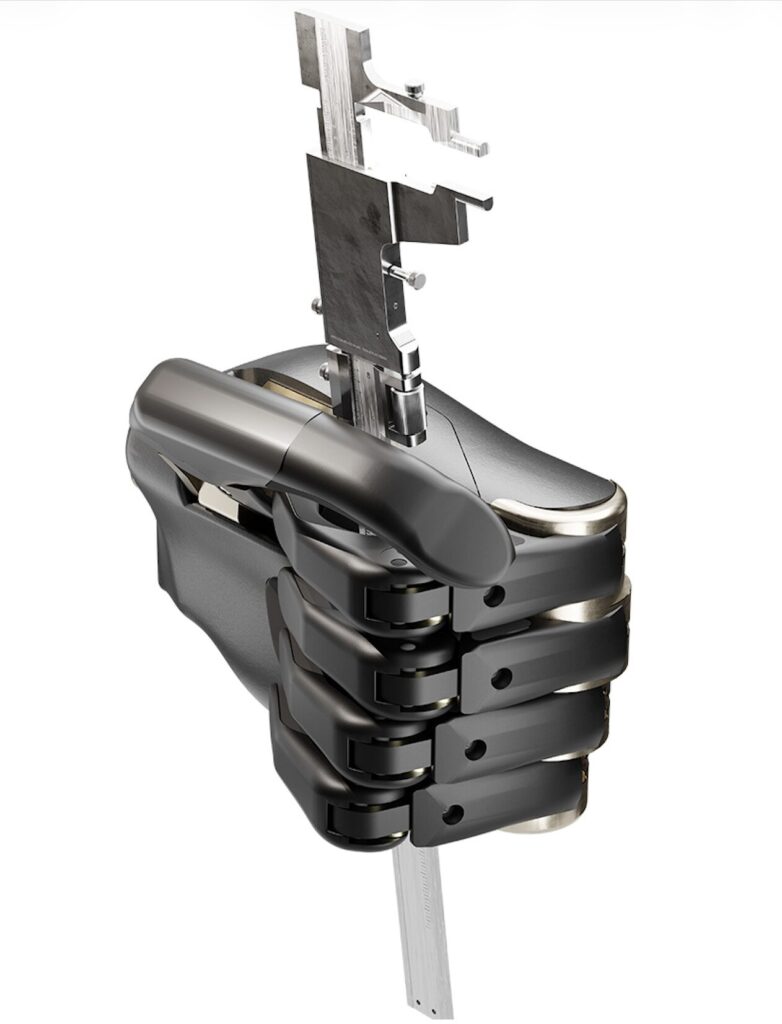
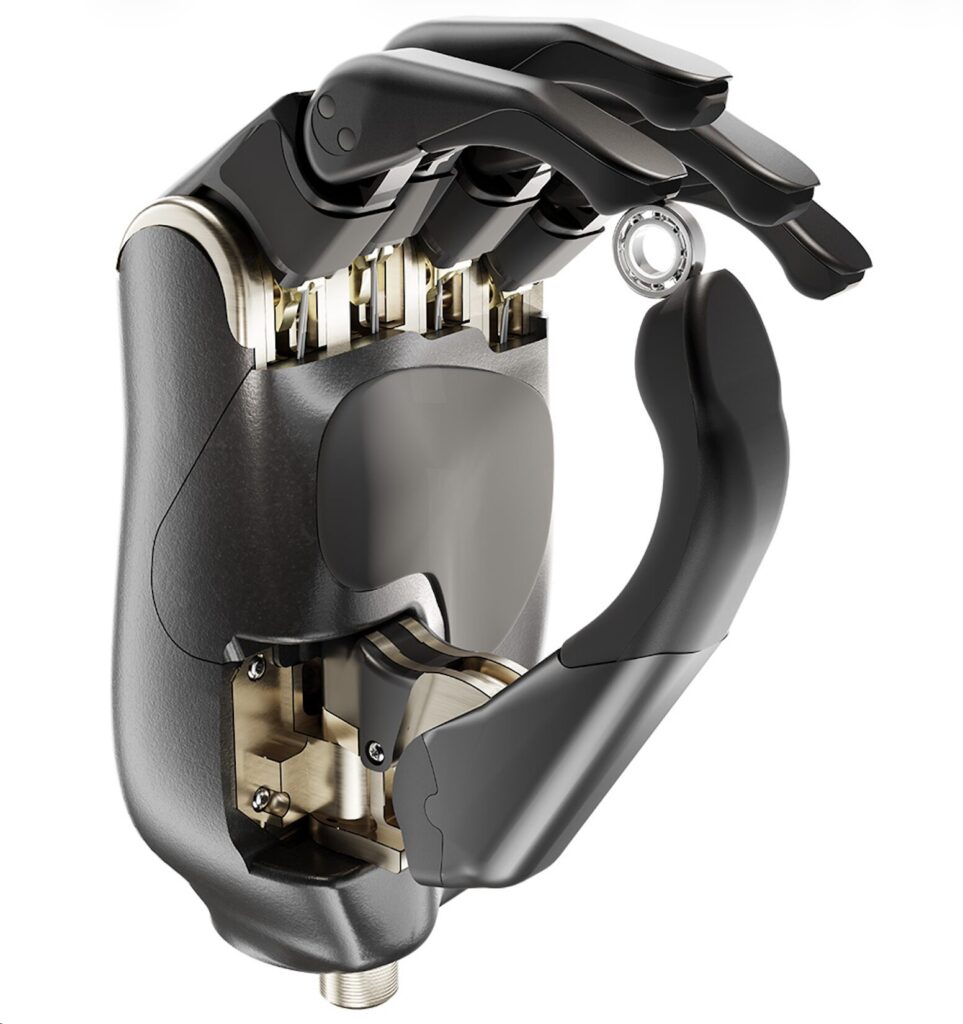
GEM prosthetic hand | Image Credit: Metacarpal

GEM is the first fully mechanical bionic hand. It bridges the gap between the practicalities of traditional hooks, and expensive electronic hands that offer features but lack reliability. It pairs the most desirable features of the robotic hands, however, for the first time, fully controlled and powered by body motion. This mechanical design brings unparalleled reliability and durability.

Electronic prosthetics typically fail in wet, dusty, or extreme temperature conditions where many users work. Construction workers, mechanics, and others in physically demanding occupations need devices that function reliably in challenging environments without electronic vulnerabilities. One construction worker I met had burned through a dozen robotic hands in fifteen years, eventually returning to using a hook because nothing else could survive a construction site. 

The device addresses the estimated 50% of amputees who choose not to use current prosthetic options due to functional limitations, reliability concerns, comfort issues, weight problems, and poor fit that make existing solutions impractical for daily use. According to the Journal of Hand and Microsurgery, upper limb loss affects more than half a million individuals in the United States, with estimates that those numbers may double by the year 2050. 

Bethany Leone: What design criteria shaped the development of the GEM?

Fergal Mackie: The Metacarpal GEM design centers on force reduction and mechanical reliability to address the primary reasons users abandon prosthetic hands. I engineered the device to operate below 38 Newtons of force, the research-established threshold that prevents fatigue in both men and women during extended use. This force reduction represents the most critical design constraint I solved.

Our patented Reactive Grasp Technology uses 13 pulleys to achieve five-finger adaptive grasping through purely mechanical means. Each finger moves independently, allowing the hand to conform to object shapes rather than closing simultaneously like conventional devices. This mechanical advantage system reduces operational force while providing immediate proprioceptive feedback through the harness system, functioning like a bike brake where users have direct connection to the grip and can feel the force they’re applying. 

The device weighs less than one pound yet supports 110-pound carry loads and 198-pound vertical push forces. I achieved this strength-to-weight ratio through high-quality materials selected for durability, with minimal maintenance required. The waterproof design eliminates electronic vulnerabilities that cause failures in wet, dusty, or extreme temperature conditions. 

Users access three distinct grip patterns by rotating the thumb position: lateral grips for flat items like phones or books, power grips for heavy lifting, and pinch grips for detailed tasks. This multi-grip functionality, without electronics, sets the GEM apart from traditional body-powered hands that offer only a single fixed grasp. 
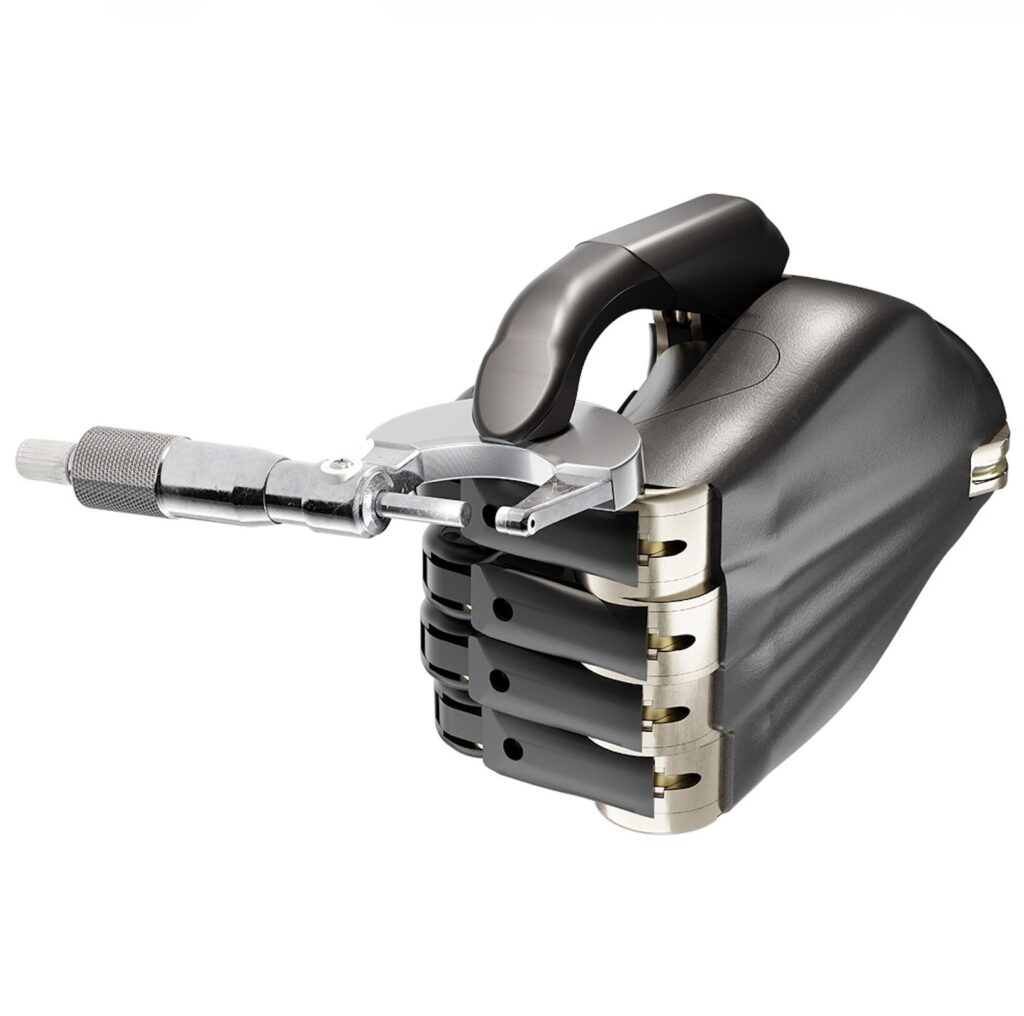
The most challenging performance constraint involved creating multi-articulation through mechanical systems alone. While electronic hands achieve multiple grip patterns through motors and sensors, I had to engineer purely mechanical solutions that provide sophisticated functionality without complexity. The pulley system that enables independent finger movement while maintaining force feedback required extensive engineering to balance functionality with reliability. Field serviceability became an unexpected advantage when an early trialist working in an Italian restaurant could disassemble, clean, and restore full functionality after flour contamination without having to ship the device back to the manufacturer.

Research shows that only 3% of major amputations involve the upper extremity, yet these users face unique challenges with device satisfaction and daily use compared to lower extremity amputees. 

Bethany Leone: How does the GEM compare to a biological hand in terms of durability and environmental resistance?
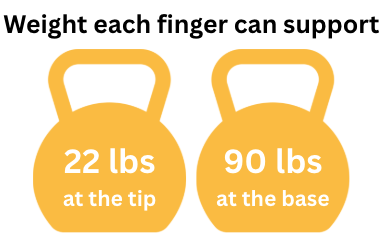
Fergal Mackie: The Metacarpal GEM delivers measurable performance that exceeds many biological hand capabilities in specific areas. Each finger can support 22 pounds directly on the tip, and around 90 pounds at the finger base. It does this, without flexing the wrist or any of the natural body impulses that would lower the impact making it much stronger than any natural hand in many respects. 

GEM maintains full functionality when exposed to water, dust, extreme temperatures, and chemical spills that would damage electronic systems. Construction workers and mechanics use the device in environments where electronic prosthetics fail completely.  

Environmental resistance represents a key performance advantage. The GEM functions in wet conditions where electronic prosthetics typically fail, dusty environments that interfere with sensors, and temperature extremes that affect battery performance. This reliability enables users to maintain consistent performance across work and recreational activities. 

The hand is designed with a metal solid skeleton that supports a soft exterior — inspired by the design of a natural hand. Then, using cables, the fingers and thumb are actuated, again, similar to the role of tendons of a hand.

However, when a natural hand is scratched or bruised, it has a unique advantage: it will heal over time. While this is something we have not yet achieved, the fingers and soft covers can be simply replaced in minutes, making good-as-new restoration possible. 

Bethany Leone: What materials are used in the prosthetic?

Fergal Mackie: GEM is made primarily from machined Aluminum 7075, or “aircraft aluminum,” from the central chassis to the fingers. This builds a rigid skeleton that is strong yet extremely lightweight. We then use stainless steel parts with bronze bushings for hardwearing, low-friction surfaces. We selected a mixture of aluminum bronze and phosphor bronze throughout the hand, depending on the specific strength requirement of the part.

It then pairs this with a flexible TPU cover. The flexible material allows this part to be made as a single part that physically wraps around the hand. Then, for gripping surfaces, we opt for nitrile rubber that is equally durable and high friction.

Bethany Leone: What manufacturing methods were critical to the device?

Fergal Mackie: The hand is made from custom-machined parts, primarily milling operations, for all major components. Tolerances go as low as 8 microns! This is to aid with critical running surface contacts that ensure the product’s longevity over years of use, preventing any further finger stiction.

The only tooled parts are the finger grips. Because they are common across all fingers, these are compression molded for their uniformity and are less tolerant than sensitive components.

The most complex part to make is actually the cables in the hand. This took years of testing to fully understand and is now a crucial part of Metacarpal’s IP. We are able to manufacture loops of cable made from the world’s longest fibers that are then cyclically pre-stretched within a millimeter of accuracy to the cable’s final length, where adjustment mechanisms accommodate the specific cable lengths.

These parts arrive at our design and manufacturing facility in the National Robotarium in Edinburgh, Scotland. Here, each component is carefully assembled into each hand. First, going through inspection, storage, assembly, burn-in, factory acceptance testing, and then sent for sale.

Bethany Leone: What thermal or surface treatments were important to the design?

Fergal Mackie: Because the GEM is to be used in all environments, surface treatments are very important to prevent corrosion, especially when in contact with different metals. All aluminum parts are anodized, and all exposed parts use type 3 hard anodizing for an incredible rugged finish.

While that is the majority of surface treatments used, we do have an array of parts for a new product, yet unreleased, that will require extensive hardening processes to get the necessary properties. 

Bethany Leone: What design decisions challenged industry norms?

Fergal Mackie: The Metacarpal GEM challenges fundamental industry assumptions about prosthetic hand design by achieving multi-articulation through purely mechanical means rather than electronic systems. While the prosthetics industry has moved toward adding sensors, processors, and complex electronics to improve functionality, Metacarpal reimagined the entire approach through mechanical engineering innovation. 
The device breaks industry norms by delivering sophisticated grip patterns without batteries, sensors, or electronic components that typically define advanced prosthetic hands. The patented Reactive Grasp Technology uses 13 pulleys to enable five-finger adaptive grasping, providing functionality that rivals electronic systems through mechanical solutions alone.

Force reduction represents another departure from industry standards. The GEM operates below 38 Newtons of force while traditional body-powered hands often exceed this threshold, causing user fatigue and abandonment. This engineering approach prioritizes user comfort over conventional design assumptions about acceptable operational forces.

The immediate fitting philosophy challenges clinical workflows that typically require extensive training periods and complex calibration processes. The device functions immediately upon fitting, reducing the time and complexity prosthetists face with traditional prosthetic solutions.

Environmental durability standards exceed industry norms through waterproof design that functions in conditions where electronic prosthetics fail. Construction workers and mechanics use the device in wet, dusty, and extreme temperature environments that would damage conventional electronic systems. 

The design philosophy represents a paradigm shift from the industry assumption that more technological features equal better performance. The GEM demonstrates that breakthrough innovation comes from rethinking fundamental approaches rather than adding complexity. 

Bethany Leone: What are Metacarpal’s plans for future innovation, either of this design or an adjacent design?

Fergal Mackie: We’re currently working on creating add-on solutions that expand the functionality of GEM even further, making the product even more valuable. We’re also working on expanding the patient population that can access GEM with optimal solutions by developing a suite of add-ons that optimize the hand for different levels of amputation. Every patient has a unique limb difference and associated difference designs and associated issues and it is crucial that Metacarpal meet these. This includes more sizes, pediatric designs and colors so that each prosthetic is personal.

Fringe Friday: Mechanical Prosthetic Design Challenges Industry Norms Read More »


Message from the Editor: When Technology Recruits

Heat Treat Today publishes twelve print magazines a year and included in each is a letter from the editor. This letter is from the April 2026 Annual Induction Heating & Melting print edition. In today’s letter, Bethany Leone, managing editor at Heat Treat Today, shares her insights on how modern technology shapes not just heat treat operations, but the people those operations can attract — and why understanding the difference between a “high performer” and the right fit may matter more than chasing the unicorn hire.


Twenty first century heat treat operations benefit from adopting new technologies. Beyond technical performance, however, new technologies also play a role in shaping and attracting the modern workforce.

Let me state plainly: this is not a pragmatic assertion to adopt new technologies to satisfy workforce trends. Technological advances should first be evaluated by their technical merit. While not the primary driver, the fact is technology influences hiring realities.

When heat treat shops are looking to attract talent, one key factor — for better or worse — is the appeal of advanced technology. There is a pretty direct relationship between having up-to-date technologies and heat treat operations’ ability to attract leading talent. This was a central point in a conversation I had with Josh Hale at International Search Partners. As we look at an industry seeking to hire young talent and “high performers,” what follows is a summary of nuggets that Josh Hale shared.

“High Performer”?

First, what does “high performer” mean? This definition is probably more important than you think since not every role should be designed for a high performer: the term “high performers” describes individuals who do their job at top level; often these are people who crave ownership, innovation, and drive constant growth in their careers. Their value is pushing and supporting change, and this bent makes them a good fit for dynamic environments in which to keep growing their careers.

A mismatch can occur when single product heat treat operations want a high performer. Since consistency is the priority, making hiring decisions to attract “high performers” can lead to (a) difficulties filling that position and/or (b) such hires looking to change, innovate, or possibly leave that company.

A strong production workforce is essential, but a mismatch can also occur here. High performers in this field will likely rise through the ranks from the shop floor to management positions — they drive their own change and change around them. However, when hiring leads fill these positions inherently built on qualities of dedication and reliable excellence, the same problems arise if they are holding out for a high performer.

Just a quick note: There is fierce competition for production leads from similarly paid, less dangerous jobs (like retail). Josh notes successful companies stay ahead by employing these 21st century changes:

  • relaxing non-essential barriers (e.g., drug testing, minor record blemishes)
  • offering flexible schedules
  • incentivizing overtime opportunities
  • providing training support

Young Workforce

Look at the world around young people: whether in the classroom or driving their first vehicle, digital integrations have augmented so much of their life and work. Expectations of how systems function have that foundation. Analogue or visibly outdated systems can unintentionally signal technological stagnation, even if the underlying process is sophisticated.

Technology that Attracts

Legacy equipment and systems often deter both young people and high performers before hiring discussions even begin.

What technologies does Josh see attract top talent? In order of importance:

  1. Digital interfaces and controls. Digital systems signal modernity, clarity, and operational control. For many entering or growing their careers in the workforce, this is the baseline expectation of a professional environment.
  2. Clean processes, like induction and vacuum heating. Clean technologies in a historically flame-filled industry speak to innovation and long-term growth.
  3. Internal lab equipment and testing. A culture committed to testing is one that embraces precision, accountability, and continual development.

In Sum

Fit matters. It’s fine to seek a unicorn hire, but unicorns are always hard to find. Figure out what the operation needs — a high performer or someone else — and consider hiring needs during conversations about technology investment.


Bethany Leone
Managing Editor
Heat Treat Today
Contact: Bethany Leone at bethany@heattreattoday.com

Message from the Editor: When Technology Recruits Read More »

Heat Treat Audio

Heat Treat Today publishes twelve print magazines annually and included in each is a letter from the publisher, Doug Glenn. This letter from the March 2026 Annual Aerospace Heat Treating print edition highlights the growing presence of heat treat-focused podcasts in North American market, spotlighting both The Heat Treat Podcast with Carlos Torres and Heat Treat Radio, including the transition to a new host, Heather Falcone and the continued evolution of digital content in the industry.

Feel free to contact Doug at doug@heattreattoday.com if you have a question or comment. 


It’s amazing to me that there are at least two professionally done heat treat podcasts in the North American heat treat marketplace. There are actually more than two podcasts, but the two I’m speaking of are ongoing and very targeted toward the North American heat treat industry. Check the end of this column for a link to some of the other podcasts I won’t be discussing at length here.

The Heat Treat Podcast with Carlos Torres

Let’s start with the podcast that it not part of Heat Treat TodayThe Heat Treat Podcast with our friend Carlos Torres. Carlos is the CEO of TORSA Group Mattsa and a director at Mattsa Furnace Co. in San Luis Potosi, Mexico. Carlos’ video podcast is housed on YouTube (www.youtube.com/@theheattreatpodcast) and has roughly 70 episodes. Carlos cooperates with Super Systems Inc. (SSI) in Mexico, so it is no surprise that Episode #1 from 2021 featured SSI president and all-around great guy, Jim Oakes. Carlos is a very engaging podcast host and has interviewed the likes of Tracy Dougherty, AFC-Holcroft; John Hubbard, former CEO, Bodycote; Chip Keough of the Atmosphere Group; Chad Wright from Wirco; and many other industry notables including Joe Powell, Ben Rassieur, Karen Stanton, Jason Orosz, Jim and Andy Orr, Andrew Bassett, and Trevor Jones.

When Carlos first started his podcast, I joked with him that there was no way he could keep up the pace of turning out good quality heat treat interviews. That was at least four years ago — I was wrong. Carlos continues to do a great job interviewing and posting helpful, timely heat treat content.

Heat Treat Today

The podcast that is a part of Heat Treat Today is Heat Treat Radio. By the time this column is published in March of 2026, Heat Treat Radio will have deployed over 131 episodes since 2016. Initially, the podcasts were strictly audio, but since January 2023, episodes have been video, audio, and transcribed. The list of industry notables is too long, but suffice it to say, it is impressive.

Heat Treat Radio’s new host, Heather Falcone

The BIG news regarding this podcast is that starting last month (February 2026), Heat Treat Radio has a new host, Heather Falcone, former CEO of Thermal-Vac Technology and currently the CEO of Falcone Consulting. Since 2016, I’ve had the pleasure (and responsibility) of hosting the Heat Treat Radio. Heat Treat Today‘s managing editor, Bethany Leone, has been hugely instrumental in the scheduling and production of episodes for the past four years. Both Bethany and I have handed over the reins to Heather, and we are very excited about how the podcast will morph and grow under Heather’s leadership.

By the way, Heather, in her previous life, was interviewed by both The Heat Treat Podcast (Carlos Torres) and Heat Treat Radio. She is, by every measure, an industry legend in her own right.

The nice thing about having Heather take the lead is her ability to “talk turkey” with other industry experts…something I was not able to do being a lowly “publishing guy,” and her creativity and technical savvy when it comes to digital products like audio and video productions. We’re very excited to have Heather on the Heat Treat Today team.

If you have a topic you’d like to see covered on a future episode, or if you know of someone that you think Heather should interview, please reach out directly to Heather at heather@heattreattoday.com.

Whether it’s The Heat Treat Podcast or Heat Treat Radio, I hope you find some of the heat treat audio (and video) helpful.

As promised, here’s a link to some other podcasts. Heat Treat Today provides this link on the Heat Treat Radio landing page: https://www.heattreattoday.com/media/heat-treat-radio-lp/other-industry-podcasts/.

Doug Glenn
Publisher
Heat Treat Today
For more information: Contact Doug at
doug@heattreattoday.com

Heat Treat Audio Read More »

Message from the Editor: Decisive Actions

Heat Treat Today publishes twelve print magazines a year and included in each is a letter from the editor. This letter is from the March 2026 Annual Aerospace Heat Treating print edition. In today’s letter, Bethany Leone, managing editor at Heat Treat Today, shares her insights on the tension between a surging editorial workload and the need for thoughtful, deliberate decision-making — and why choosing clarity over the rush may be the most important discipline we can practice in the busiest of seasons.


The holidays are past; the fervent rush of “let’s get things done!” has arrived. I’ve sensed the pressure build as the editorial team faces limited time, increased volume of articles, and competing priorities. Navigating the excitement to publish technical articles and make public news statements becomes the work of editing.

Influx of Activity

This past month brought an increased editorial interest from industry suppliers and partners. Industry experts writing about new technologies often are busy with developing those products and refining the processes. So when these individuals take the pen (the keyboard), we seize the opportunity to bring their thoughts to you. This ensures the wider North American heat treat community is benefitting from the treasure trove of instruction, guides, and practical warnings to best operate equipment and maintain processes in a timely way.

You’ve likely heard murmurs of events and in-person engagements. Case in point: Heat Treat Today’s Helium Leak Detection Seminars launches this month. These also have occupied our time as the editorial team prepares content and carves out time to follow up with new people, meet remotely with folks, and even attend webinars ourselves. All of this means processing editorial content sooner than usual and anticipating industry trends that come out of these forums.

This increase in editorial volume necessitates more focus and less time to reflect. As a curious and systems-oriented person, these times of focus, while invigorating, leave me wishing for time to reflect, research, and develop better processes. This is not order for the sake of order, but to ensure that articles truly capture and deliver the value that authors intend, and that they do so at the right time for readers.

All Movement, No Time to Think

It is now that I feel the first inclinations of the dreadful “r” word: rush.

There is no allure to rushing. In American culture, we do find ourselves busy, but rushing is never appealing — it is all activity without the direction of a thoughtful decision. The “r” word in the editing world means a missed opportunity to define an unclear metallurgical term or printing a graph too small that causes readers to squint. Bring that word up in an audit and everyone becomes uncomfortable. Hurriedly chip off February ice from your windshield to get to work and drive off dreading if your wallet was left behind in the rush.

More ideas, asks, input, and even adjacent activity by colleagues can often bring less margin. If only I could have time to think and execute everything all the time in a day, then I’d be happy! But instead of wishful thinking, I find the best first step is to stop yearning for an unchanging balance of priorities and readjust the expectations for output (or thought life) that I once held, even as recently as the day before. External demands pushing us into action require decisive thinking. The goal is clarity under constraint, not just endurance in the excitement.

Marching Orders

In all of this, remember: on the opposite side of my editorial conundrum is a slew of experts seeking to connect with you, our readers. In their own way, they too are in “execution” mode. Take advantage of their efforts and send us your feedback (editor@heattreattoday.com) whenever a question or idea strikes, or if you have more to add than that which was covered in the scope of an article.

And of course, here I am: send me your technical articles! You may find me joyfully drowning in grammatical questions, image requests, or word count conundrums.


Bethany Leone
Managing Editor
Heat Treat Today
Contact: Bethany Leone at bethany@heattreattoday.com

Message from the Editor: Decisive Actions Read More »
Message from the Editor: Restless

Heat Treat Today publishes twelve print magazines a year and included in each is a letter from the editor. This letter is from the February 2026 Annual Air & Atmosphere Heat Treating print edition. In today’s letter, Bethany Leone, managing editor at Heat Treat Today, shares her insights on the restlessness stirred by recent shifts in the heat treat industry — and why sitting with uncertainty, rather than rushing to diagnose it, may be the most intentional form of leadership we can practice right now.


Recently, we have observed the shift in industry brain trust. In fact, if you follow the Heat Treat Daily, there have been a lot of significant acquisitions, announcements of growth, and refocusing of efforts. Yet no singular statement emerges to define what this moment is for the heat treat industry. This constant movement and reorienting is exciting, but what does it mean?

To recap some highlights, a brazing icon retired — Dan Kay, our tribute to him later in this publication (p. 49). Innovator and furnace expert Mark Hemsath joined forces with WINGENS CONSULTANTS as an executive expert. Major industry suppliers continued to consolidate under more international leadership, and we wait to see how priorities at these organizations will be recalibrated.

While all of these changes are decisive moves, there is hardly a definitive direction to describe where the heat treat industry is going. With the world at our fingertips, digital projections and instantaneous AI analysis feed the desire to know what to expect, what to avoid, what to get excited about. Data is the bread and butter of informed decisions, though tempered with discernment. A lack of satisfying answers, however, exposes how easily we can overuse data to create a safety net from uncertainty or seek a quick diagnosis for a discomfort whose true nature may be far more complex.

And so, we find ourselves without clear answers about what these industry shifts ultimately mean. Perhaps some are already making projections, but for me, I’m sitting in a restless state about what we should expect for the rest of the year. Still, restlessness isn’t something to “seek and destroy,” as my immediate inclination often is. Sitting with it can make space for true stewardship.

Stewardship

Stewardship takes the present form. The emphasis is simple: What is in my control now to change, cultivate, care for? Lots of garden terms with this word! This idea of stewardship shows up for me in small ways. The closest I am to gardening is the peace lily who stares at me while my one-year-old takes another swat at her leaves, brown and crinkled from the drafty air. Here’s the thing — stewardship, at least in this season, is not the one-plant garden. It’s knowing to cultivate joy in the one-year-old… and waiting to see if the peace lily survives.

Another key aspect of stewardship is listening. Stewardship happens after the pause that listens to the unsettled state. This attitude allows uncertainty, complexity, and even contradictory messaging. As leaders of wherever life finds us, listening to the noise and waiting through the discomfort of not having an answer is what precedes intentional action.

Waiting for the Meaning

If you have been observing the changes in industry with bated breath, continue the waiting. No need to diagnose. Dedicate yourself this year not to the novel goals of January, but the essential approach of not balking at the restlessness that you may find yourself in. It is enough to tend to what is immediately entrusted to you.


Bethany Leone
Managing Editor
Heat Treat Today
Contact: Bethany Leone at bethany@heattreattoday.com

Message from the Editor: Restless Read More »
Message from the Editor: Matching Materials

Heat Treat Today publishes twelve print magazines a year and included in each is a letter from the editor. This letter is from the January 2026 Annual Technologies To Watch print edition. In today’s letter, Bethany Leone, managing editor at Heat Treat Today, shares her insights on the widening gap between material science and industrial engineering in heat treatment — and what leaders can do to make smarter material decisions.


I recently spoke with an industry educator who is also a metallurgist and an engineer. She stressed the need for heat treat leaders to make informed decisions, blending industrial engineering and materials science expertise — just one is only half of the conversation. Our current era is reckoning with the fruit of underprioritized materials science education.

This concern arose several times at industry trade shows last year, both in lectures and conversations with attendees. While academic institutions have been pivoting to close this materials gap, the difficulty remains: Are the components that we design and for which we curate heat treat processes around making use of the best materials?

Barriers to Material Matching

The question of performance is prevalent: Are we designing with the right material in mind? Additionally, this age of advanced manufacturing and additive manufacturing challenges what we know to be the best material for an application; a new superalloy on the market may offer unforeseen abilities as well as risks. There is also the practical concern of time and supply chain; the tariffs of 2025 have brought this concern close to home, no pun intended.

There are other practical concerns when it comes to materials, as I was informed by Malur Narayan. As the CEO of Xtrium, an AI-powered materials matching and intelligence platform that connects materials to real-world applications, he is attuned to the specific challenges around this question. According to Narayan, there are missed revenue opportunities by failure to consider materials that are common in industries outside of one’s own.

Moreover, even if the desire to innovate or examine new materials and processing methods is fostered, the typical months of discovery handicaps time and action steps. This makes sense because, as Narayan summarized, just because an alloy manufacturer developed an extremely useful alloy for applications in one industry doesn’t mean they are reaching clients in other industries. From that supply side, it takes market research to prove the use case in those alternative sectors.

Furthermore, there has not been an effective single-source of truth for users to navigate and compare properties against.

What Can You Do?

Talk with your materials supplier. A number of alloy suppliers can be accessed on HeatTreatBuyersGuide.com and searching www.heatreattoday.com for their published articles can yield helpful insights as to what other applications and treatments are within reach. Additionally, Xtrium is releasing an AI-native online search and discovery engine which is designed to match materials to real-world applications in minutes, cutting down the traditional months of manual research.

Xtrium tool screenshot | Image Credit: Xtrium

Look across industries for new applications. We will explore more about innovative materials applications and the benefit they have in alleviating the heat treat process in future editions of the magazine. If you have your own use case, please reach out to share your story.

Brace yourself. There are heat treat processing modifications that allow users to take advantage of less expensive alloys. We will be excited to share more on one of these innovative solutions in an upcoming magazine.

References

Karlsruher Institut für Technologie (KIT). 2025. “Scientists Forge New ‘Superalloy’ That Could Revolutionize Jet Engines and Power Plants.” SciTechDaily. https://scitechdaily.com/scientists-forge-new-superalloy-that-could-revolutionize-jet-engines-and-power-plants/.


Bethany Leone
Managing Editor
Heat Treat Today
Contact: Bethany Leone at bethany@heattreattoday.com

Message from the Editor: Matching Materials Read More »
Message from the Editor: Elbowing a Captive Audience

Heat Treat Today publishes twelve print magazines a year and included in each is a letter from the editor. This letter is from the November 2025 Annual Vacuum Heat Treating print edition. In today’s letter, Bethany Leone, managing editor at Heat Treat Today, shares her insights on the value of in-person visits to captive heat treat facilities and announces a new editorial series aimed at spotlighting North America’s best in-house operations.


There is nothing like walking your shop floor. I’m talking for me, not for you. But perhaps you agree!

When I leave my neighborhood, I often pass a steel operation with atmosphere heat treat furnaces sitting snugly by the door. In the winter, the building’s windows are flung open. In the summer, workers head out of the building toward the parking lot (seemingly) every hour. And I want in.

Regrettably, I have yet to elbow my way into that fine establishment to see what’s going on, but hopefully one day I will.

This Editor’s Page is very self-interested: I want to see your heat treat operations.

At Heat Treat Today, we’re on a mission to spotlight North America’s best captive heat treat facilities — the quiet powerhouses who are making gears harder, shafts straighter, and production lines hum with thermal precision. And we’re willing to travel to do it.

Whether you’re in Ontario or Ohio, Monterrey or Michigan, we want to be on your shop floor, taking notes, asking questions, and celebrating the know-how that keeps your operation running strong. In-person site visits give us an unmatched opportunity to understand your process flow, your constraints, and what really makes your team tick. It’s the difference between writing about heat treating and actually getting into it.

A New Editorial Series: “An Inside Look at In-House”

We’re calling this editorial series “An Inside Look at In-House.” Our aim is to profile exceptional in-house heat treat operations to hear their stories: Why they changed a process, added automation, doubled down on legacy equipment, or resisted the pressure to outsource. Even when change isn’t the story, stability might be. If you haven’t altered your heat treat process in twenty years, that might be the very reason we want to feature you.

Why Open Your Doors?

I am not naive, though. Your work home is not an open-door environment. So why let us in?

We respect your time and value your trust. Our editorial team works with every contributor closely to ensure accuracy and clarity with absolutely no trade secrets exposed and no photos published without your consent. In return, you get visibility for your team, credibility for your investment in captive heat treating, and a chance to shape the conversation in your industry. Dare I ask you to envision the front magazine cover of Heat Treat Today splashed with a picture of you and your team?

Whether you have a story to tell or you’re simply proud of what your people do, we want to talk with you. Maybe even walk, too.

Get in Touch

Reach out to me directly at bethany@heattreattoday.com. If you’re lucky, Doug Glenn might even come with me — or instead of me! (You can request either one of us, but no guarantees.)

Let’s open the doors and shine a light on the hidden heroes of heat treat. We’re ready when you are.


Bethany Leone
Managing Editor
Heat Treat Today
Contact: Bethany Leone at bethany@heattreattoday.com

Message from the Editor: Elbowing a Captive Audience Read More »

Navigating Heat Treaters’ Most Defining Moments

We like to celebrate the wins for good reason: they inspire us when times get tough. Regardless of where you find yourself in the North American heat treat community, you will face challenges that may redirect your life and prompt you to question your goals or values. Given this universal experience, we asked respected individuals from across the industry to share the hardest decisions of their professional lives. Just as successes inspire resilience, these challenges offer lessons in navigating the toughest moments of your career.

This inspiring piece was first released in Heat Treat Today’s September 2025 Annual People of Heat Treat print edition.


“No Jerks” Rule, with Sarah Jordan

Sarah Jordan
Founder & CEO
Skuld, LLC

For Sarah Jordan, president and CEO of the cutting-edge casting startup Skuld LLC, hard decisions have paved the path of her career. An earnest visionary — and as down-to-earth as they come — Sarah has made a habit of launching startups for the metal processing industry. Today, she leads a team that has developed a toolless, net-shape casting process and the equipment to perform it, advancing the way parts are formed while minimizing post-processing needs.

It comes to no surprise that her hardest decision came while forging this path. In 2009, Sarah’s first startup, Aesir Metals, faced fall-out from the 2008 economic recession. The impact was most acute when their largest customer informed them that they were unable to pay.

Faced with this reality, Sarah had to make the painful choice to close the company. Just after Christmas that year, every employee was let go. “And that’s awful when everybody’s…you know, they’re counting on you, their families are counting on you.” It was her first time navigating such a challenge, and while it was difficult, it became a formative experience.

Leading her current company, Sarah operates with a “‘no jerks’ rule.” She says culture and people are critical, and the postmortem of Aesir Metals revealed other opportunities for improvement. While mistakes are inevitable — learning requires that — she moves forward, determined not to repeat the same ones.

Upgrade Your Skillset, with Kevin Walters

Kevin Walters
Research & Development Manager
OMG Inc.

Kevin Walters‘s official title is R&D manager at OMG Inc. out in Massachusetts — however, his nickname “Father of Interns” is extremely fitting. With decades of engineering experience, Kevin has dedicated 25 of them (and counting) to mentoring interns, first at Spalding Sports Worldwide and now at OMG. Using his own career for reference, he tells them this story.

Approaching his forties with four boys near or in their teenage years, Kevin began thinking seriously about his career trajectory. He knew that to stay relevant in engineering, he needed to expand his skillset. In this field, the rule is simple: upgrade your abilities or risk becoming obsolete. The question was how.

“I’m a guy who likes to fix stuff — work with my hands,” Kevin told me. The typical career-advancement routes didn’t seem like the right fit: waiting for an opportunity to open up in the company could take too long, a doctorate might pigeonhole him into academia, and an MBA didn’t align with his engineering focus. It took five years of consideration, conversation, and research to find the right path.

That opportunity appeared when he learned about a management degree specifically tailored for engineers. With Spalding’s full “blessing” and tuition reimbursement program, Kevin enrolled at Western New England University, taking two courses per year while balancing his job and his sons’ baseball games. In five years, he had earned his Master’s of Science in Engineering Management.

These kinds of programs have become more widely available, and Kevin encourages his interns to pursue them. “Engineers, if they don’t upgrade their skillset, become obsolete,” he says. “I see too many engineers who graduated with their four-year degree — did great things at the beginning of their career — but because technology is advancing and they’re not learning with it, they are not as useful as they used to be.”

Each summer, Kevin continues mentoring one or two interns, urging them to think strategically about building their résumés and preparing for an industry that never stops moving.

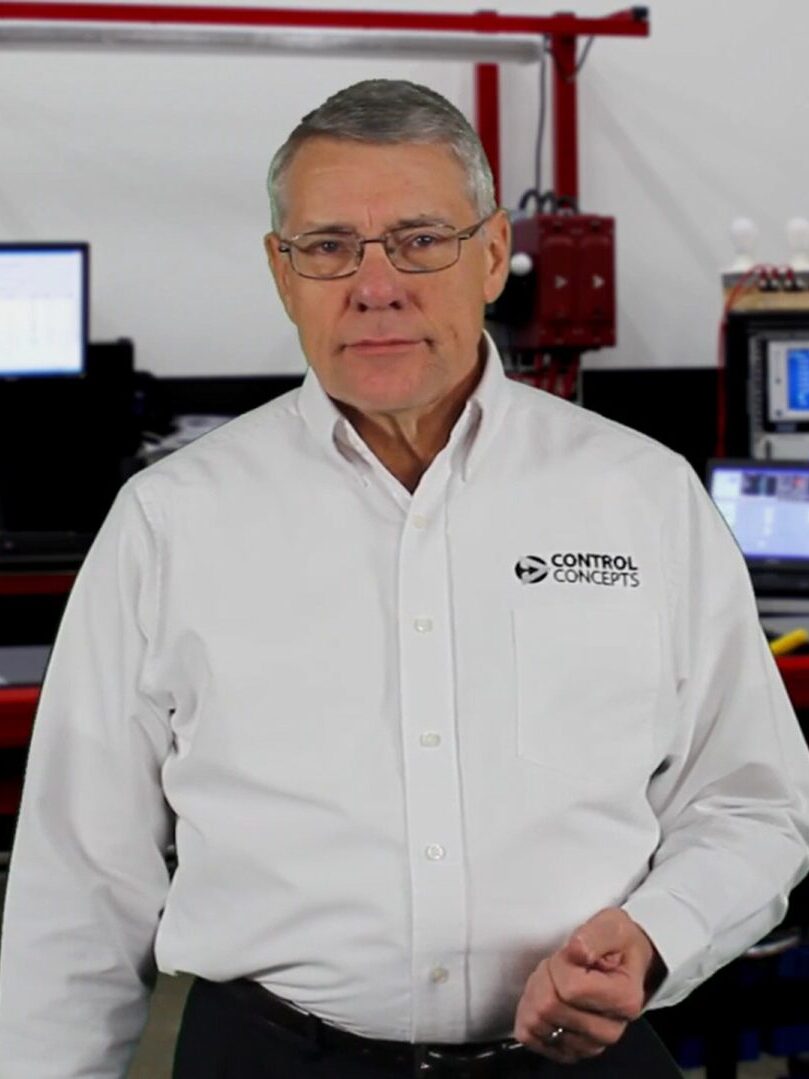
It’s the People, with Dan Bender

Dan Bender
Director of Sales
Control Concepts

As Dan Bender reflects on his 47 years in industry, many as director of sales at Control Concepts, one priority has guided him: bring in business so the people in manufacturing have a job, can feed their families, and keep a roof over their heads.

In the late ’80s and early ’90s, there were a lot of mergers and acquisitions of companies by holding firms. A general attitude that “work is work” within industry started to emerge. He observed that people were being treated as just another factor of direct manufacturing costs.

This inhumane approach was augmented by a larger lack of pride in the business by the leadership. He also perceived that businesses were treated as financial investments; leadership seemed to be just concerned with flipping the company for a profit. Eventually, these factors reached Dan’s workplace.

Desiring more from his employer and wanting to be useful and productive in a place where people mattered, he parted ways. He reflects, “I left a pretty good job and went out to try some other things, realizing I still had a family to support.”

Over the next few years, he explored different roles, leaning on the counsel of friends and mentors from outside the heat treat industry, many of them from his church. Then, in 2008, the recession hit. Dan was working for a European company when it eliminated nearly all North American positions, and for the first time in his career, he was out of a job.

“That was tough,” he commented. “That was a hard, a hard thing…I did some interviews, I had some possibilities, I had some decent things, but I wanted to find somewhere where…people are important.”

His faith was central to that search, and in time, he found the right fit at Control Concepts. While it was not the best offer at the time, it was “what made me feel good, and it [did turn] out to be very financially rewarding for me.”

Choosing to stick with his principles also meant staying in an industry where he had built decades-long relationships. Dan says he looks forward to seeing those connections at tradeshows like Heat Treat 2025 this fall and Furnaces North America next year. “It’s to me, you know…that’s a blessing that I can have conversations with those people and feel a real sense of knowing they are very interested in what you’re doing as well as you being interested in what they’re doing at this stage in their career and your life.” Serving the heat treat industry, and the people in it, is why Dan has no plans to retire anytime soon.

Never Stand Still, with Bill Stuehr

William (Bill) Stuehr
President & CEO
Induction Tooling Inc.

What do you do when an unforeseen market collapse changes the fabric of your business? William (Bill) Stuehr, engineer, founder, and CEO of Induction Tooling Inc., has a clear answer: make a plan and move forward. “I’m a pragmatist,” he says. “I look at things the way they are, then I make decisions and proceed with what has to be done. That’s all.”

In 2005, Bill built a brand-new facility to expand his operations from 14,000 to 30,000 square feet. Business had been picking up for induction heating since the 1980s and ’90s, and manufacturers of driveline components were interested in induction. Induction was becoming more accepted on two fronts: first, as a green energy source; second, as an integrated manufacturing step in cell production, allowing automotive components such as wheel bearings and axle shafts to come out finished at the end of the line. With the expectation to expand to 50 employees by 2015, the city even granted Induction Tooling a tax abatement to encourage expansion and boost the local economy.

The critical moment happened in 2009, beginning on the heels of the 2008 financial crisis. With the housing collapse, people stopped purchasing automobiles, and the automotive industry went reeling. In April and June, General Motors and Chrysler appeared before U.S. Congress after filing for bankruptcy. Bill’s tier 1 automotive manufacturing customers began shutting down operations. “I had never seen it in my career, ever.”

Work was running out. Bill made the hardest decision of his career: “I had to lay off half of my workforce. I went from 28 people to 14 in less than a year.” Some of them had been with him since he started in the late 1970s. “It was out of my control. I tried to keep them on as long as possible without suffering the financial hardship of my own.” Even in hard times, the company covered all employee medical insurance, a practice Bill maintains to this day.

By 2012, the market showed signs of recovery. Bill pivoted the business to focus almost exclusively on CNC automation for rebuilding tooling — a move that met the needs of their tier 1 customers with high production rates and sidestepped the challenges of rehiring or retraining a large workforce.

Commenting on today’s market, Bill revealed it had never truly recovered. “The buyers of the automotive companies had the time to seek outsourcing worldwide.” He continued, explaining that over the course of the four years that followed the crash, there was enough offshoring of driveline components to an enthusiastic, energetic workforce with new facilities and abilities. Reshoring to the U.S. has not gained back the momentum that it had, though perhaps that will change with the priorities of the current U.S. administration.

From those years came a few lasting lessons. First, embrace automation to keep the business profitable, especially when attracting young talent is a struggle. Second, when hard times come, make a plan and commit — but remember that you can’t control time, the weather, or other people. Bill sums it up with gritty simplicity: “You never stand still; you just keep going. ‘What do I have to do and how can I get it done?’ That’s it.”


Bethany Leone
Managing Editor
Heat Treat Today
Contact: Bethany Leone at bethany@heattreattoday.com

Navigating Heat Treaters’ Most Defining Moments Read More »

Message from the Editor: AI, Where Are You?

Heat Treat Today publishes twelve print magazines a year and included in each is a letter from the editor. This letter is from the October 2025 Ferrous & Nonferrous Heat Treatments/Mill Processing print edition. In today’s letter, Bethany Leone, managing editor at Heat Treat Today, shares her insights on where artificial intelligence stands in the heat treating industry nine months into 2025.


In January 2025, the heat treat industry was envisioning operational improvements thanks to leaps in artificial intelligence (AI) developments. Now, nine months later, are we still searching for AI?

Managed by AI

Daniel Llaguno, President of NUTEC Bickley

For many industry players, AI has started in the office before the furnace. This can look like creating manuals, writing emails, and reading contracts to interpret legal language.

Daniel Llaguno, president of NUTEC Bickley, calls this the early stages of AI adoption. His company has leveraged AI for onboarding and training new employees — a low-risk, high-value application.

Like many suppliers, they are exploring how AI could eventually reshape furnace development, likely on an open-loop system first (versus a closed-loop where AI receives furnace information and immediately sends back direction to the furnace controls on how to respond).

The Furnace Floor

Jason Orosz, President of Global Heat Treating Services

The next step is already visible: integrate AI into existing IIoT platforms that manage floor operations. Platforms that you may already have considered are QMULUS by NITREX, PdMetrics by Ipsen, and Edge Process Management (EPM Data) by Eurotherm, a Watlow company. These are just a sampling of advanced management systems on the marketplace, and ones that are at different stages of incorporating AI and machine learning for process optimization.

QMULUS has already deployed across all North American Heat Treating Services locations, according to Jason Orosz, president of Global Heat Treating Services. He says AI has been useful in “helping with analysis, troubleshooting, and quality control” — themes you will hear repeatedly in early AI applications.

Evolving To Meet Expectations

Michael Mouilleseaux, General Manager of Erie Steel, Ltd

What should AI integration into furnace operations look like? Michael Mouilleseaux, general manager at Erie Steel, has commented that heat treat AI should help the industry shed its “black magic” reputation. He envisions advanced analysis that could, for example, “correlate intergranular oxidation (IGO) results with furnace integrity checks (i.e., leaks), eventually establishing hard limits for allowable leak rates.”

Still, obstacles remain. “I think it’s going to be a while before commercial heat treaters can relinquish furnace control over to an AI,” Orosz added, specifically commenting on maintaining furnace parameters. This makes sense due to the need for commercial heat treaters to conform to client specifications. Rather, he says in-house heat treat operations “are likely going to be the first movers in that area since they can make their own rules.” For readers of this publication — who primarily are coming from these types of operations — that should be an encouragement: you have a key role to innovate.

Lee Rothleutner, Manager of Materials R&D, The Timken Company

One other key factor for this integration to occur within operations comes with acknowledging the heavy digital capacity that AI requires. Lee Rothleutner, manager of Materials R&D at The Timken Company, commented on this very point, writing to me that for high-quality digital data, the heat treat industry needs to commit not just to the investment but to maintaining a robust data collection and storage infrastructure. He also foresees one pathway of AI integration beyond preventative maintenance, noting, “AI applications can extend to process optimization, quality control, and energy efficiency improvements.”

What To Do Now

For successful integration of AI technology, the common denominator is that management teams are being encouraged to constantly try new ways to innovate with AI.

The first thing you need to do is open an email and send me your AI integration story. Just kidding. (Not really.)

After that, you need to read Peter Sherwin‘s article on page 34 of this issue where he discusses a new development in standardization that should accelerate AI’s role in industry.

Finally, if you are attending ASM Heat Treat 2025 this month, bring your AI to the table … literally, if you have a booth. Showcase what you’ve been doing at your location or become a part of the conversation. Lee Rothleutner, quoted above, will be participating in a panel discussion on this very topic in the afternoon of Tuesday, October 21.

The Heat Treat Today booth is #944. Not everyone is accustomed to the rapid pace of tech adoption; we want to help one another understand the risks and potential that AI brings, and your stories are critical. I look forward to talking with you.

References

Glenn, Doug, and Llaguno, Daniel. 2025. Interview by Heat Treat Today. Private recording, February.

Loepke, Mike. 2025. “Digitalization Propels Heat Treating to Industry of the Future.” Heat Treat Today 7 (8).


Bethany Leone
Managing Editor
Heat Treat Today
Contact: Bethany Leone at bethany@heattreattoday.com

Message from the Editor: AI, Where Are You? Read More »

Message from the Editor: ASM Executive Leadership Forum

Heat Treat Today publishes twelve print magazines a year and included in each is a letter from the editor. This letter is a pre-release from the December 2025 Annual Medical and Energy Heat Treat print edition. In today’s letter, Bethany Leone, managing editor at Heat Treat Today, shares about the ASM Heat Treat show of 2025.


Attending the bi-annual Heat Treat show is always a thrill. The ASM Heat Treat Society did not disappoint, bringing a full line up of technical sessions and engaging panels to attend between walking the busy show floor, itself packed with cutting edge research presentations and informative booths of key players. I had the opportunity to attend more sessions than usual this year to hear what concerns in industry were being raised at this event. 

On Monday, October 20, ASM President Dr. Navin Manjooran, chaired the first ever Executive Leadership Forum, bridging the concerns and forecasts of industry leaders with the bold training methods of frontline academic leaders. The event was specifically hosted for the IMAT conference attendees at the collocated 33rd Heat Treating Society Conference and Exhibition. 

Dr. Manjooran underlined the intent of creating stronger collaborations between these two groups, with the first moderator, Renee Parente, director of Technology and Product Engineering at Advanced Micro Devices (AMD), further emphasizing the goal of accelerating innovation through open discussions like these. 

Industry Panel 

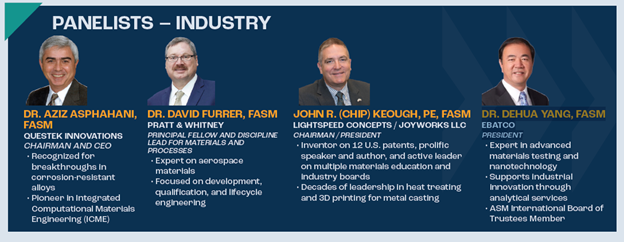
At this forum, the first panel included a Q&A portion moderated by Renee Parente with the following four industry panelists: 

  • Dr. Aziz Asphahani, FASM, chairman and CEO of Questek Innovations 
  • Dr. David Furrer, FASM, principal fellow and discipline lead for materials and processes at Pratt & Whitney 
  • John R. (Chip) Keough, PE, FASM, chairman and president at Lightspeed Concepts/Joyworks LLC 
  • Dr. Dehua Yang, FASM, president at Ebatco 
ASM Executive Leadership Panel Industry Panelists
Source: ASM International

From this panel came key thoughts on how research in the business world was being developed to further commercial efforts. First, there was a consensus that corporations were investing in research internally but were instead looking to start-ups to absorb the energies of research and development needs. While academic-industry partnerships were valuable, the concern over IPs was reviewed with Dr. Furrer adding that it is commitment to collaborative internal research efforts and external research industry partnerships that is most meaningful. He also added that the new generation of engineers are entering the workforce with new tools of industry at the ready to implement, and this shift needs to be welcomed to keep pace with the speed of innovation.  

Another important thread of discussion in this panel was the need to both accelerate the development of higher performance materials (Dr. Asphahani), as well as implement this development in a connected manner across engineering counterparts, like the quality, manufacturing, and design departments (Dr. Furrer) for effective product development.  

Academic Panel 

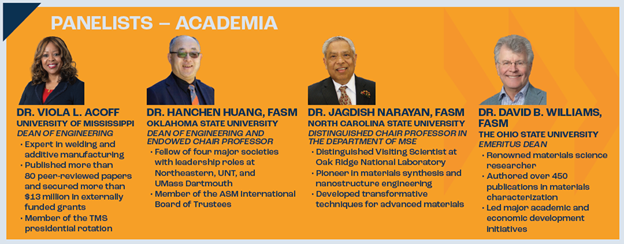
The academic panel revealed specifics on exciting current and developing efforts to train the rising workforce. Dr. Viola L. Acoff, the dean of engineering at the University of Mississippi, passionately shared the success of her breakthrough course design to retain freshmen metallurgy students through a hands one MTE 101 course, which includes access to a fully functioning foundry and efforts to grow already present real-world industry experience through industry-sponsored programs. 

ASM Executive Leadership Panel Academia Panelists
Source: ASM International

While the panel acknowledged the ongoing efforts to prepare students to use AI and other technologies of Industry 4.0 (and 5.0), there was a mixture of other emphases, including: 

  • the “plug-and-play” graduate who does not need remediation training at their first job (especially emphasized by Dr. Christopher Berndt, distinguished professor, Surface Science and Engineering at Swinburne University of Technology
  • a focus on developing materials engineers who think critically 
  • a close look at the publication system, with some specifically advocating the need to rethink this system as the barometer for engaged students and commercially focused research 

The four-person academic panel was completed by Dr. Hanchen Huang, FASM, dean of Engineering and endowed chair professor at Oklahoma State University, and Dr. David B. Williams, FASM, dean emeritus at The Ohio State University. The moderator was Dr. Zi-Kui Liu, FASM, Dorothy Plate Enright Professor in MSE at The Pennsylvania State University

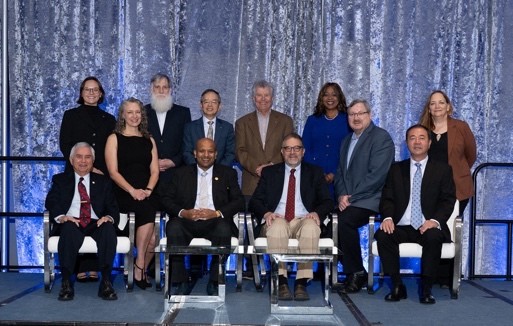
Panelists pose with Dr. Navin Manjooran (front, center right) and Master of Ceremonies Nicole Hudak Nicole Hudak (back left).

Audience 

I sat in a room amidst several dozen heat treat decision makers from both the commercial and teaching ground of heat treat, ranging from student and early career to research veteran and recently retired. Audience members asked their questions after both of the panels and mingled after the session to share a few words amongst ourselves and the generous speakers.  

Clearly, concern for the next generation of materials experts to meet industry needs — both in training and in availability of personnel — was of primary importance. Be it the question of how industry was investing in secondary and primary education interventions or a side discussion questioning how the leaders of both panels were driving young people toward entrepreneurial competition, the room buzzed with interest. 

Summary 

One comment Dr. Furrer shared outside of the panel session was his interest in how the focus of academia was shaping the opportunities available to upcoming industry leaders and engineers. 

Despite the government panel being unable to participate in the forum due to the ongoing government shutdown, this forum proved to be emblematic of Dr. Manjooran’s summary of ASM’s most important attribute: the ability through connections — memberships, partnerships, etc. — to advance materials worldwide.  


Bethany Leone
Managing Editor
Heat Treat Today
Contact: Bethany Leone at bethany@heattreattoday.com


Message from the Editor: ASM Executive Leadership Forum Read More »