Heat TreatToday publishes twelve print magazines a year and included in each is a letter from the editor, Bethany Leone. In this installment, which first appeared in the January 2025 Technologies To Watchprint edition, Bethany reports on the changing landscape of the industry and the resulting challenges, according to a poll on LinkedIn. Respondents shared their views on uniformity and temperature control, residual stresses, managing downtime, and more, and our editor gives her summary of the feedback.
Feel free to contact Bethany at bethany@heattreattoday.com if you have a question or comment.
January 2025 Magazine
Now granted, heat treating isn’t in a romantic relationship, but this 2025, there are many relationships that have vied for the industry’s attention over the past decade plus. 2025 seems to be the year to scratch the itch that heat treaters have: Is it time to try something new?
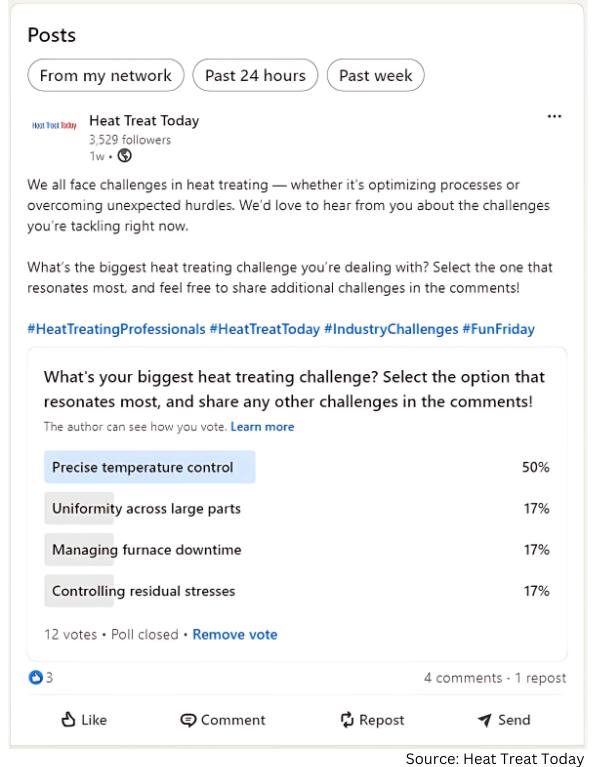
Recently, Heat TreatToday released a poll on LinkedIn. We asked what the number one challenge that heat treat experts faced in the North American manufacturing industry. There were several big-ticket items that we offered: Precise temperature control, uniformity across large parts, managing furnace downtime and controlling residual stresses. Unsurprisingly, temperature control was voted as the top challenge of the four choices, though it was surprising that few respondents piped in on the topic of residual stresses.
Yet perhaps the most important engagement came from a commenter who addressed using legacy materials in changing industry requirements. How closely are we thinking about the future that materials — use of legacy materials as well as different legacy materials — have on our work in heat treatment? (Ok, your work. We all know that I’m leaving the discovery and application to you!)
As the commenter noted, the choices in the poll are all critical characteristics, and therefore factors heat treatment practitioners should already be concerned with. If you are looking at your heat treat operation’s relationship with a variety of processes and technologies and think that the relationship is ideal as can be, great.
But if you are in the “seven-year itch” camp — that is, there is some relationship with a process or technology that is on the rocks — this new annual magazine we are releasing each January highlights the heat treat technologies to watch for in 2025. It’s time to reevaluate the relationship your heat treat operations have with current technologies.
Technological Relationships Under Consideration
The heat treat industry is navigating a rapidly evolving landscape shaped by new materials and technologies. Additive manufacturing (AM), or 3D printing, introduces unique material requirements that challenge traditional heat treating. Complex geometries and the use of non standard alloys in AM demand processes tailored for uniformity and precision at an unprecedented level. These disruptions, coupled with constant innovations by researchers in materials science, are prompting a reevaluation of whether conventional heat treating methods are needed as is, or even at all. Check out the AM quiz on page 24 to get up-to-speed on some of these developments.
Meanwhile, robotics and AI are revolutionizing how operations are managed. AI-powered predictive maintenance is becoming indispensable, helping to minimize furnace downtime by identifying potential failures before they occur. Machine learning enhances furnace control systems by refining temperature cycles and gas flow in real time, ensuring consistency and efficiency. How are these systems working for heat treaters? Read the case study article on page 10.
Digitalization technologies, such as smart sensors and IoT-enabled systems, are making it easier than ever to monitor and analyze heat treating operations. These tools, combined with advanced software, empower operators to make data driven decisions and reduce energy consumption. Several articles in last month’s magazine release focused heavily on these technologies, but the conversation persists in the commentaries found on pages 17 and 27.
The question for 2025 is clear: Are heat treaters ready to adopt these innovations and adjust their processes to align with the needs of tomorrow’s manufacturing? Have your operations found the perfect relationship with these new technologies? Tell me what you’re finding to be most difficult to address in 2025 so we can examine that relationship in future editions.
Industry experts agree: 2025 is a year of significant, high-tech developments. In this Technical Tuesday, hear from three heat treat industry consultants on current and incoming technological advances, from miniaturization and customization to artificial intelligence.
Michael Mouilleseaux, general manager at Erie Steel, Ltd, opens the discussion by asking what role AI has in a perfect world of heat treating; Thomas Wingens, president of Wingens Consultants, predicts six major technologies to look for in 2025; and Dan Herring, a.k.a. The Heat Treat Doctor® and owner of The HERRING GROUP, Inc., points out how the trend toward smaller is affecting the heat treat industry.
This informative piece was first released inHeat Treat Today’sJanuary 2025 Technologies To Watch in Heat Treating print edition.
AI’s Place in Heat Treating?
by Michael Mouilleseaux
The benefits of AI are purported to be the ability to reduce the time required to complete complex tasks, such as data analysis, while reducing human error and providing both unbiased decision making and data-driven system enhancements … and by the way, it can operate 24/7 without breaks!
Does AI have a place in heat treating?
Here’s what I would want my heat treat AI (HT AI) to be able to do with a gas-fired atmosphere furnace.
Combustion System:
My HT AI will continuously monitor the free oxygen of all the burners and keep them at a perfect ratio, thereby optimizing performance and gas consumption. It will track these changes and provide analysis of any trends that it “perceives,” so to speak.
My HT AI will continuously monitor combustion air pressure and message me in time to have the air filters changed before it affects performance. It will track this and provide historical and prescriptive information.
My HT AI will periodically perform a “tube check,” whereby it will shut off combustion in a tube and monitor the free oxygen, recognizing that any diminishment from “atmospheric” O2 levels indicate the potential of a tube leak. It will track this and provide analysis of any trends that it perceives.
My HT AI will track when system thermal stasis is achieved, monitor gas consumption for each discrete heat treat cycle, provide analysis of trends that it perceives, and recommend thermal cycle changes to optimize these cycles.
My HT AI will facilitate the optimization of the critical human assets in process engineering, product quality and equipment maintenance.”
Michael Mouilleseaux
Atmosphere Control System:
My HT AI will continuously monitor the atmosphere flows required to achieve the requirements for each heat treat cycle. It will track “atmosphere recovery” and provide analysis of any trends that it perceives (i.e., increased usage as a precursor to a furnace leak).
My HT AI will periodically perform a furnace check, whereby it compares the composition of the Endo gas in the furnace to that exiting the generator, providing a measure of furnace integrity. It will track this and provide analysis of any trends that it perceives.
My HT AI will confirm “tube check” data (see above) with atmosphere usage to evaluate its potential effects on process integrity and make actionable recommendations. It will track these incidents and provide analysis of any trends that it perceives.
My HT AI will provide assurance of system performance and actionable information.
Shoot for the Moon:
My HT AI will have the unique ability to integrate metallurgical results with process information and thereby provide the ability to optimize the heat treating process AND metallurgical results.
My HT AI will allow me to input material chemical and hardenability data and, by comparing actual results with the calculated, or prospective results, provide confirmation of the thermal and quenching segments of the process.
My HT AI will be able to correlate IGO results with furnace integrity checks (i.e., leaks) and over time establish hard limits for allowable leak rates.
My HT AI will be able to correlate actual retained austenite levels in carburized case with furnace carbon potential and make data-driven process modifications to optimize this.
My HT AI will be able to correlate the shape of the case depth curve with the carburizing cycle and the material type, and it will make data-driven process modifications to optimize this.
My HT AI will have the ability to develop new heat treat thermal cycles specific to my furnaces extrapolated from existing data.
My HT AI will provide a level of system performance heretofore not achieved, that not only assures adherence to established standards but provides a clear path of continuous improvement via data analysis and actionable actions. Product results will be validated by total process control, and total process control will assure attainment of product results.
My HT AI will facilitate the optimization of the critical human assets in process engineering, product quality and equipment maintenance.
In short, my HT AI will afford the heat treating community the ability to finally jettison the mantle of “black art” and join the community of high-tech engineered processes.
About the Author:
Michael Mouilleseaux General Manager Erie Steel, Ltd
Michael Mouilleseaux has been at Erie Steel in Toledo, OH, since 2006 with previous metallurgical experience at New Process Gear in Syracuse, NY, and as the director of Technology in Marketing at FPM Heat Treating LLC in Elk Grove, IL. Having graduated from the University of Michigan with a degree in Metallurgical Engineering, Michael has proved his expertise in the field of heat treat, co-presenting at the 2019 Heat Treat show and currently serving on the Board of Trustees at the Metal Treating Institute.
2025 will be the year of invention and application. There are six major technologies to be looking out for: AI management software, giga casting for the EV industry, high-pressure quench furnaces, thermal processing specialty materials, processing for steel enrichment, and practices for cleaning consistency.
AI Management Software
Some new heat treat shop management software is now available. It utilizes artificial intelligence to save labor while documenting all processes in real time. The software easily adapts to the way we work and is much easier to learn and implement than the software of the past. I see this as the number one investment item for commercial heat treaters in 2025, as it is the cheapest and easiest way to automate with a great ROI while increasing quality and customer service.
Giga Casting
With Tesla as the main driver, very large so-called “GIGA” H13 aluminum dies of 3 to 8-ton weight have really taken off in the last years, in particular for new electric car models, and the demand for very high pressure quench furnaces is increasing in the U.S. (more to come in a later article).
Vacuum Oil Quenching
However, even with the most advanced designs and high-pressure efforts, gas quenching with nitrogen has its limits, and the use of helium is not considered anymore because of its immense cost, even with a recycling system in place. Vacuum oil quenching has become a viable alternative in recent years not only in combination with LPC (low-pressure carburizing) but also with the use of materials like AISI 52100 that would be typically heat treated in atmosphere integral quench furnaces but show lesser distortion with the variation of pressures over the oil bath, which can shift the oil boiling phase peak to lower temperatures (e.g., from 650°C (1200°F) at atmospheric pressure to 400°C (750°F) at 1 mbar pressure). Some new modern vacuum oil quench furnace designs have recently entered the market, showing excellent surface cleanliness and distortion results. Aside from the better quality, they offer a much safer, cleaner and more pleasant work environment.
Specialty Materials
In general, we see a higher demand for the thermal processing of specialty materials; for example this is seen with the hydrogen decrepitation of titanium, tantalum, niobium, or rare earth element materials, powder processing or sinter processes, and surface diffusion processes.
Steel Enrichment
Enriching stainless steel with nitrogen is not new, but it is gaining momentum and more applications. One method for\ low-temperature processes on austenitic stainless steels around 370°C (690°F) is called S-phase case hardening, and the high temperature version around 1100°C (2010°F) is called solution nitriding. Both processes were initially established in the early 90s in Europe but seem to be gaining momentum and more comprehensive applications worldwide over the last years.
Figure 1. For 2025, “We see more fully enclosed vacuum solvent cleaning in heat treat shops to ensure a higher standard and consistency of the surface cleaning results compared to the fading of water cleaners.” – Thomas Wingens, WINGENS CONSULTANTS
Cleaning Consistency
Speaking of surface processes: The cleaning of components has been a thankless process, especially in commercial heat treatment, as it is seen as a necessity that is not necessarily paid for by the clients but is necessary to have uniform dissociation on the surface of a part to ensure a uniform case (e.g., nitriding case). There are well-defined standards for temperature uniformity and hardness testing, but cleaning consistency needs to be addressed, as it can be very impactful. We see more fully enclosed vacuum solvent cleaning in heat treat shops to ensure a higher standard and consistency of the surface cleaning results compared to the fading of water cleaners.
About the Author:
Thomas Wingens President WINGENS CONSULTANTS
Thomas Wingens has been an independent consultant to the heat treat industry for nearly 15 years and has been involved in the heat treat industry for over 35 years. Throughout his career, he has held various positions, including business developer, management, and executive roles for companies in Europe and the United States, including Bodycote, Ipsen, SECO/WARWICK, Tenova, and IHI-Group.
Everywhere we turn today, the products we use are getting smaller, more compact and more powerful. This is true across all industries, from aerospace to automotive, from medical to electronics, and from energy to semiconductors to name a few. Today, miniaturization, portability and customization have become major design objectives for almost all manufacturing segments.
These trends are irreversible and are, or will be, found even in the most unlikely of places — both in mining of resources taking place deep under the ocean floor and eventually on other planets. The key question then becomes, how will all of this influence our heat treating operations?
Miniaturization, Portability and Customization Today
Given the ever-increasing demand for higher performance in a smaller footprint, we have often focused our energies on taking existing products and adapting them for use. But in the long term, this is not sustainable. For example, not only is gear noise reduction critical in our submarines, but the medical and robotics markets are continuously searching for smaller, more efficient, more application specific and more intelligent drive systems and motors with increased torque density.
Heat treatment will experience a metamorphosis and emerge more broadly as thermal treatment. The age of metals as we have known it has become the age of materials: ceramics, composites, powder materials, glasses, polymers, fiber-reinforced plastics, and even nanomaterials.
Dan Herring, The Heat Treat Doctor®
Another example, although not new, is miniaturization in vehicle electronics, especially as it relates to data collection where demand is high for smaller, more powerful and, yes, cheaper components. Integration into the electronic control units via on-board power systems has seen the need for more cables in vehicles and positioning connectors, which means more contacts/connections on the electronic components without significantly increasing the installation space.
Similarly, there is a huge demand for portability. This is true not only in our electronics (just think about how cell phones or computers have changed over the last ten years), but there is a growing need for portable medical devices so that medical care can be brought to the patient rather than the other way around. For example, longer battery life and lighter weight are critical for devices such as portable oxygen concentrators.
What Does This Mean for the Heat Treatment Industry?
Looking ahead, we will see both short and long-term changes to our industry. Happening today and continuing in the near term, heat treaters are working closer than ever with design and manufacturing engineers as they focus on products that reduce environmental impact, are produced at lower unit cost, and with improved part quality. Still, the era of mass recalls must come to an end. And the cost of heat treating is less than it was even a decade ago. But as manufacturing demand evolves due to consumer expectation, process and equipment flexibility will become keys to meeting the highest quality standards in an on-demand world.
Historically, changes in the heat treat industry has been evolutionary and incremental in both nature and effect. There have been notable exceptions such as the invention of the oxygen probe or low pressure vacuum carburizing. But to meet the manufacturing demands of the future, change will need to be more revolutionary and abrupt in nature, a game changer.
Given the ever-increasing demand for higher performance in a smaller footprint, we have often focused our energies on taking existing products and adapting them for use. But in the long term, this is not sustainable. For example, not only is gear noise reduction critical in our submarines, but the medical and robotics markets are continuously searching for smaller, more efficient, more application specific and more-intelligent drive systems and motors with increased torque density.
Dan Herring, The HERRING GROUP, Inc.
Heat treatment will experience a metamorphosis and emerge more broadly as thermal treatment. The age of metals as we have known it has become the age of materials: ceramics, composites, powder materials, glasses, polymers, fiber-reinforced plastics, and even nanomaterials. As a result, we will find ourselves needing, for example, to expand our heat treat capability and equipment to deal with such items as process temperature ranges from -200°C to 1850°C (-330°F to 3360°F) or greater or at pressure/vacuum levels heretofore only achievable in laboratories or specialty applications.
As product sizes decrease, load sizes will become smaller out of necessity. And as a result, our heat treat equipment must be small lot capable with tighter controls to achieve higher quality along with tremendous process flexibility.
Final Thoughts
History’s enduring legacy is that change is inevitable. Just think back to how the heat treatment industry has evolved, from the campfire to the blacksmith to the modern heat treater, from the artisan to the era of mass production, from the art of heat treating to the science of heat treatment. The lesson is that to adapt, one must constantly innovate and invent. Miniaturization, portability and customization in whatever form they take are here to stay. Perhaps even teleportation (the ultimate miniaturization?) isn’t that far off after all, considering flight was unheard of a little over a century ago.
About the Author:
Dan Herring (The Heat Treat Doctor®) The HERRING GROUP, Inc.
Dan Herring has been in the industry for over 50 years and has gained vast experience in fields that include materials science, engineering, metallurgy, new product research, and many other areas. He is the author of six books and over 700 technical articles.
Heat TreatToday publishes twelve print magazines a year and included in each is a letter from the editor, Bethany Leone. In this installment, which first appeared in the December 2024 Medical & Energy Heat Treatprint edition, Bethany addresses the ongoing discussion about automation in industry, the data on how it affects labor, and the way forward for manufacturing and the government.
Feel free to contact Bethany at bethany@heattreattoday.com if you have a question or comment.
You can afford it.
Supervisors, you can afford to raise wages. Skilled laborers, you can afford to purchase a home.
Maybe you’ve heard these hopeful statements before? You can afford it, says economist Mark P. Mills, executive director of the National Center for Energy Analytics, by leaning on automation. Far from destroying jobs, tools like AI and robotics enhance productivity and require highly skilled laborers who, in turn, can and should be compensated. This editor’s page summarizes some of Mills’ main points and how these might be considered in the heat treat industry.
Labor Market Needs Automation
In a recent article released in City Journal, the economist draws attention to what he sees as a new norm for the labor market: the successful bargaining for higher wages by the Longshoremen’s Association. The result of the union’s strike means a starting salary of $80k and a mid-career salary of $150k. Mills terms this “The Great Inversion,” where we see salaries for the trades supersede 90% of salaries for college graduates.
His argument that this is the new norm rests on three points. The first is that population has been in decline; this is exacerbated in the trades by the fact that the average age for skilled tradesmen is older than the average age across U.S. manufacturing.
Secondly, though there is a trend of young workers choosing a career in the trades, not enough would fill the generational chasm that is opening as the older generation leaves the workplace. This means there is still a demand for skilled labor.
Thirdly, industrial manufacturing creates consumable goods, for which there is no end to want, unlike in food and agriculture where there is a limit of consumption. As people grow wealthier, they can afford more “wants” — even if it’s going out to eat at restaurants where iPads automate server-kitchen communications.
Even with the population decline, individuals continue to gain wealth and want to spend it, Mills explains. In this situation, particularly where we have efforts and interests in America restoring industrial productivity, the argument is that automation will allow companies to keep up with the demand for consumable goods while filling the labor gap. This result means a need for upskilling workers to work with robotics, automation software, and AI on the manufacturing floor.
Automation in Heat Treat
In the heat treat industry, I’ve heard several perspectives on this topic. Robotics and automation don’t take away jobs, some claim; they only improve labor market jobs that are there. At another’s operations, the installation of an automated piece of instrumentation didn’t result in any immediate layoff, but did result in the company not having to train an operator to fill a position since that position was no longer available.
The fact is that the pro-automation side relies on addressing situations where there is a lack in able workers in the labor market. This demonstrates that jobs are being filled by automation.
Turning to employment opportunity, it is hard to argue with Mills’ outlook that automation in jobs increases wages and profits. He supports this claim saying, “data show that, over the last half of the twentieth century, even as manufacturing productivity rose (that is, fewer labor-hours per output), the U.S. manufacturing workforce remained surprisingly unchanged and really started to shrink only when an increasing share of manufactured goods were imported — namely, when the production and labor were exported.” Interestingly, while he acknowledges the role of companies in offshoring goods in the last century, he puts focus on the difficult environment for businesses in meeting the government regulations in America. Therefore, he offers three steps forward addressed at government (in)action:
The U.S. government must look for ways to make the country more amenable to industrial expansion that go beyond subsidies with caveated use.
Policymakers must avoid intervening in the economy when a system isn’t broken. (Here, Mills addresses cost and reliability issues tied to state and federal energy policies.)
The trifecta of policymakers, unions, and manufacturers need to welcome advances in automation.
Mills points out that in order for automation to be successful, skilled laborers need to welcome it and help it, emphasizing that, like the Longshoremen’s Union strike, automation allows for wage increase.
My question to you in the heat treat industry is: What is your job function in the industry? How have you benefited from automation (AI, robotics, digitalization) initiatives in the industry? What concerns — or hopes! — do you see that have yet to be addressed? Write to me. And if any article on digitalization in this magazine strikes you, I would love to hear that, too.
References
Mills, Mark P. “The Longshoremen’s Strike and the Great Inversion.” City Journal, October 8, 2024. https://www.city-journal.org/article/the-longshoremens-strike-and-the-great-inversion.
What are advanced management systems and how does deep integrative system management software help automotive heat treaters improve processes while saving on time and unnecessary expenses? Explore the future of software technology for the management of heat treating operations in this Technical Tuesday by Sefi Grossman, founder and CEO of CombustionOS.
The heat treating industry is on the brink of a technological transformation. Just as the momentous adoption of websites and emails transformed the nature of work for manufacturers, the advanced software systems are thrusting us into a new era of simplicity, automation, and deep integrations.
This article explores how advanced systems — an application of ERP (enterprise resource planning) and MES (manufacturing execution systems) combined with the power of AI — is revolutionizing facility operations, enhancing quality, efficiency, and profitability.
What Are Advanced Systems?
Advanced systems simplify, streamline, and automate operations by lifting the data burden off of plant personnel. While most existing systems focus on the part inventory workflow, more advanced systems go beyond by directly integrating into the heat treat process to track at bin/tray/tree level.
This requires real-time scheduling control, barcode scanning, digitizing recipe and process (no more paper), and direct sensor/PLC integration. Because of its critical nature, an advanced system is most likely an on-premise and cloud “hybrid solution” that is not crippled by internet connectivity issues. This allows it to still utilize rapidly evolving cloud systems that provide external services like messaging, big data storage, and AI to name a few.
Precise Processing
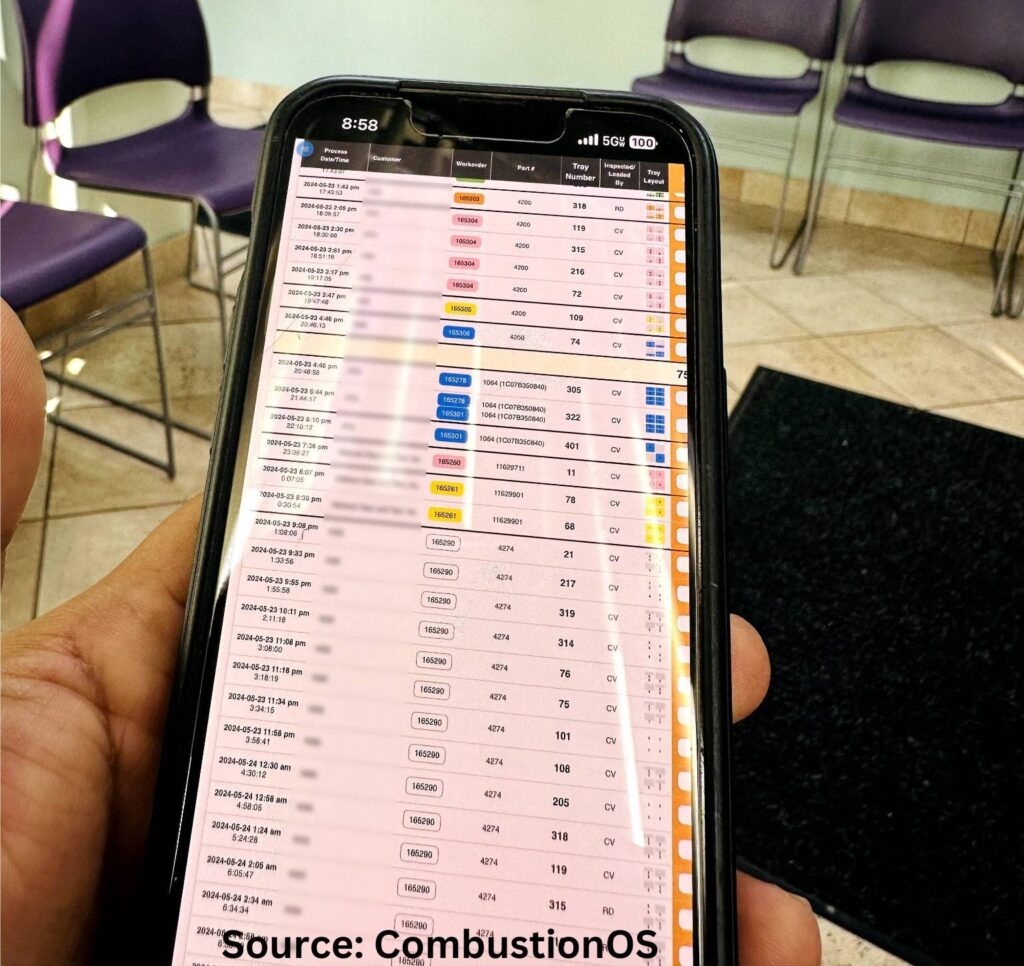
Figure 1. CombustionOS developers spend extensive time with operators and plant managers to create interfaces that are intuitive and easy to use. Pictured is access to job data stats from a mobile device being used outside of the manufacturing plant.
Repeatable, accurate methods to ensure optimal time, temperature, and atmosphere of the decided heat treatment processes are possible with advanced systems.
Utilizing existing sensors and hardware interfaces, data is collected in short intervals, transformed into meaningful data formats, and stored in a database. Network technologies such as HTTP, Modbus, and other analog to AI technologies make this possible with minimum additional hardware. The data is managed locally on the facility network, and synchronized with cloud services for further processing, analysis, and long-term history storage.
With a close monitoring of all these variables, facilities can tighten acceptable specification ranges. Deep integration with equipment ensures that data flows seamlessly from sensors and devices to the central system.
This real-time data collection and processing enables facilities to monitor operations continuously and make informed decisions quickly. For example, integrating data from temperature sensors, pressure gauges, and other monitoring devices ensures that all critical parameters are tracked and managed effectively. Additionally, if a temperature reading deviates from the acceptable range, the system can immediately alert the relevant personnel, allowing them to take corrective action before it becomes a critical issue.
In addition to quality assurance, integrated artificial intelligence tools optimize job scheduling. Unlike traditional date/time calendar methods, AI systems predict job completion times based on real-time process data. This is particularly useful for roller furnace setups, where continuous processing occurs, but it is also beneficial for batch furnaces. Optimized scheduling improves resource allocation and operational efficiency, ensuring that jobs are completed on time and to the required specifications. The difference between a “calculation algorithm” and AI is that, with AI, you do not have to pre-program it. It automatically learns and adjusts for known variability in your hardware and even the personnel that are operating the equipment.
Finally, the automation of these systems captures and records all necessary information accurately. This reduces the risk of non-compliance, improving the overall quality of the final product. For example, a Detroit-based heat treating facility reported that accessing real time data to ensure compliance with industry standards has allowed them to spend 40% less time on documentation tasks.
Figure 2. Having increased control over the process gives more peace of mind to operators that components perform as needed.
Alleviating Burden on Maintenance and Inventory
Predictive maintenance is one of the most significant applications of AI in the heat treating industry. Traditional maintenance schedules are often based on fixed intervals, which can lead to unnecessary downtime or unexpected failures. AI driven predictive maintenance, on the other hand, uses real-time data to determine the optimal times for maintenance activities. This approach not only reduces downtime but also extends the lifespan of equipment.
A Detroit-based heat treating facility implemented an AI-driven predictive maintenance system (PMs) and saw a 25% reduction in equipment downtime. By analyzing data from critical parts, inventory, process tracking history, and various sensors, the AI system could predict when components were likely to fail, allowing the maintenance team to inspect and address issues proactively beyond their standard PMs. This not only improved operational efficiency, but also saved significant costs associated with emergency repairs and unplanned downtime.
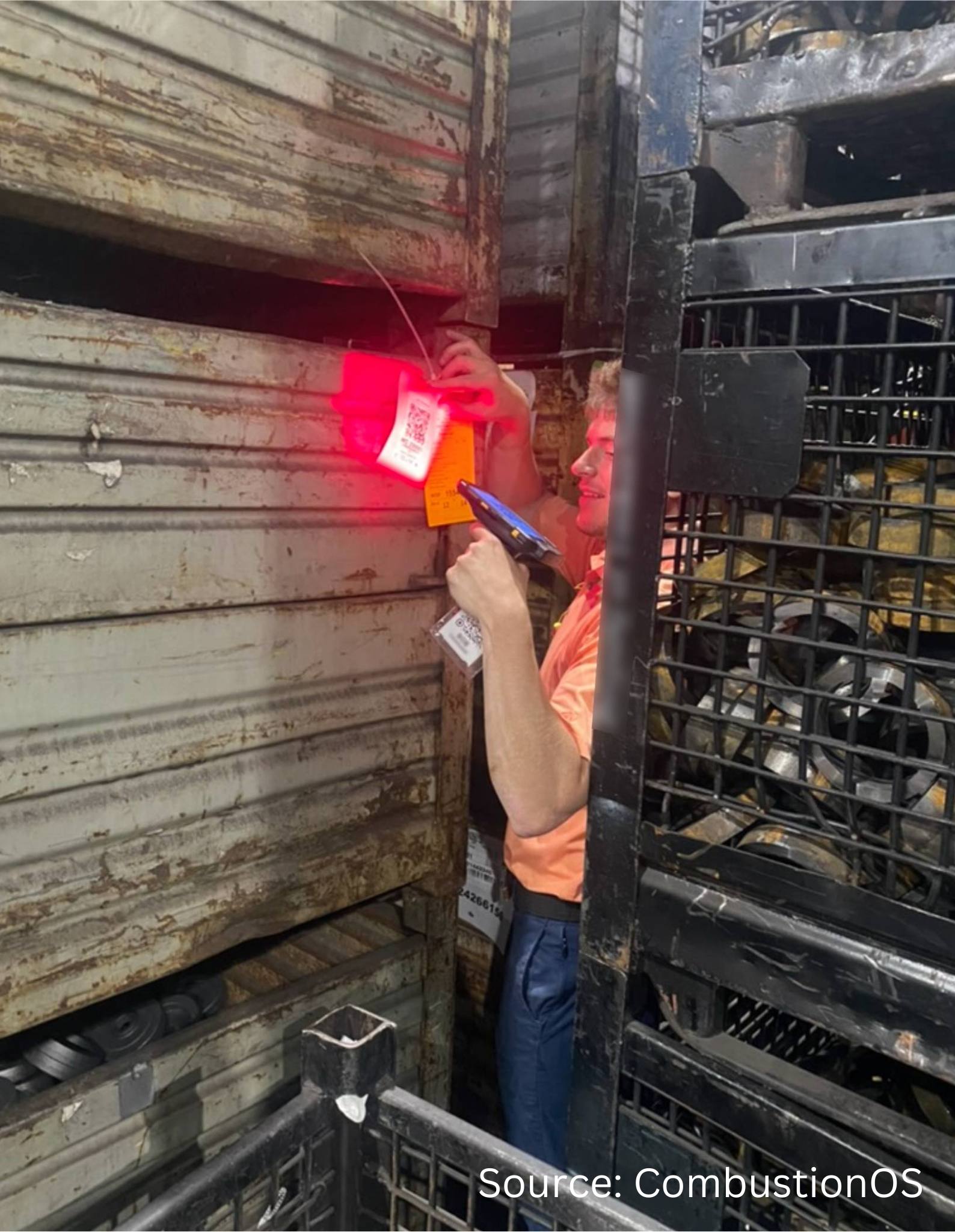
Additionally, the integration of QR codes for inventory and process tracking enables quick and accurate data entry compared to manual logging. For instance, when racking parts out of bins, operators can simply scan QR codes, which automatically update the system with the relevant information. This not only speeds up the process but also minimizes the chances of human error.
Reducing Operational Costs
The adoption of advanced ERP and MES systems has led to substantial cost savings for many facilities. These systems reduce operational costs through the implicit automated integrations that technologies like CombustionOS bring. Here are just a few ways that operational costs have been cut:
Decreasing shipping and receiving management from three to just one employee
Minimizing rework costs by timely process alerts
Reducing personnel by replacing constant manual oversight with accurate, digital tracking systems
Lowering administrative costs by utilizing a more efficient and accurate invoice automation platform
Case Study: A client reported comprehensive cost savings, including a 20% reduction in shipping and receiving time, fewer logistics and furnace operators needed, a 33% decrease in rework costs, a 15% savings in maintenance costs, and a 25% reduction in accounting overhead. These efficiencies translate into substantial payroll savings and improved profitability.
How To Implement
Figure 3. When racking parts out of bins, operators can simply scan QR codes, which automatically update the system with the relevant information.
One of the most significant advancements in heat treating technology is the deep integration with various equipment types. Unlike traditional ERP systems, which often lack true integration, advanced systems work backwards from equipment data, building ERP functionalities around this integration to ensure seamless and accurate data flow.
First, there are advanced systems that can handle data from both digital and analog sensors. So, for heat treaters who are juggling a variety of sensors and systems, looking for an integrative advanced system that has adaptability will ensure compatibility with existing equipment while keeping an eye on cost. Facilities can continue using their current equipment while benefiting from advanced monitoring and control capabilities.
Second, advanced ERP/MES systems can take collaboration with multiple vendors. Rather than uproot current systems and relationships, work with an advanced systems provider who is able to collaborate with other software and systems. Advanced ERP/MES systems provide comprehensive solutions that include deep equipment integration and full ERP functionalities. This approach reduces the complexity and cost of integration, ensuring that all components work together seamlessly.
Key Applications
Most operations in a heat treat department will benefit from advanced systems due to the time-saving automations that the system integrates. But many heat treaters are looking to adapt and integrate older systems and often more complex designs, like roller hearth furnaces. Here are some steps that experts will take to guide you through to make the digital integration smooth and effective:
First, it is important to understand you don’t need to boil the ocean. Starting with a more advanced inventory tracking system that employs barcodes can set the underpinnings for a more integrated system while providing immediate benefits to your logistics.
Then, it is also key to get a deep understanding of your current process and map out your operational workflow. Using a flowchart program helps visualize the process to make sure all stakeholders are on the same page.
Some aspects of your current process are probably outdated (perhaps created by someone who is no longer at the company), while others are key to the core of how you operate. Understanding the difference is crucial to make sure you unlock potential automation without disturbing your core process and flow.
You’ll then need to prepare every required form, document, chart etc. that you use in the operation. For process control, recipes, and lab testing, provide many parts/iterations to capture the complexity.
Finally, take inventory of any existing digital systems you have adopted, like inventory tracking, spreadsheets, or custom software. The existing system network, including servers, Wi-Fi setup, and hardware (PCs, printers, scanners, etc.) will be utilized as much as possible in the transition to reduce the need to purchase and set up different equipment.
The future will require constant innovations and thoughtful leveraging of increasingly advanced systems. Unlike static, homegrown, or “pieced together” solutions, the most advanced systems are constantly updated with new features, ensuring they remain at the cutting edge of technology. Engaging directly with plant personnel to understand their needs and challenges allows systems like CombustionOS to evolve and improve continuously.
The heat treating industry is on the cusp of a technological transformation, driven by advancements in ERP, MES, and AI. These technologies offer the potential to enhance quality, efficiency, and profitability, making them essential for the future of manufacturing. By embracing automation, integrating advanced AI capabilities, and committing to continuous innovation, the industry can achieve new levels of operational excellence.
About the Author:
Sefi Grossman Founder & CEO CombustionOS Source: Author
Sefi Grossman has been at the forefront of technology revolutions for the past two decades and has been leading the technology company CombustionOS for nearly seven years.
Artificial intelligence remains a hot topic for every industry, not least heat treating. Understanding the how and why of AI’s potential impacts on the industry, however, is not so easily apparent.
Today’s article, written by Joe Coleman, cybersecurity officer at Bluestreak Consulting, breaks down the pros and cons of implementing AI, to help you decide if artificial intelligence might be a beneficial addition to your heat treat operations.
Joe Coleman, cyber security officer, Bluestreak Consulting
As all of you are aware, artificial intelligence (AI) is getting more and more attention, and companies are beginning to use AI to help with many aspects of running their businesses. I’m sure you’ve heard of ChatGPT and other intelligent user interfaces (IUI). You may be one of those businesses considering the idea or experimenting with it to access its potential benefits for your business.
Like any industry, there are quite a few pros and cons associated with using AI to improve the heat treating processes. This article will outline some of these advantages and disadvantages. Always make sure you do your own research before jumping into the AI world because it’s not always what it seems.
What Is Artificial Intelligence (AI)?
Artificial Intelligence is the simulation of human intelligence in machines that are programmed to think and learn like humans. It includes a wide range of techniques and approaches, including machine learning, allowing computers to perform tasks that typically require human intelligence, such as understanding natural language, recognizing patterns, solving problems, and making decisions. AI systems are designed to learn from data, improving their performance over time without direct programming. These technologies find applications in many areas, from virtual assistants and language translation services to autonomous vehicles and industrial diagnostics, revolutionizing industries and helping to shape the future of technology
Pros of AI in Heat Treating
Quality Improvement:
AI systems can monitor and help control the heat treatment process in real time, ensuring you have consistent quality and to minimize defects.
Predictive analytics in AI can anticipate potential defects, allowing for corrective actions before they occur.
Increased Efficiency:
AI algorithms can optimize processing parameters and reduce bottlenecks, leading to faster and more efficient heat treating processes.
AI-driven automation can improve employee labor throughput and increase overall production speed.
Cost Reduction:
By optimizing utilities usage and resources, AI can help reduce the plethora of operational costs within heat treating facilities.
Predictive maintenance generated by AI can prevent costly equipment breakdowns and production downtime.
Customization and Personalization:
AI algorithms can analyze customer requirements and tailor heat treating processes to their specific needs.
Improved data analysis can lead to the development of new and specialized heat treatments for different metals and alloys.
Data Analysis and Information:
AI systems can process enormous amounts of data generated during heat treatment, collecting valuable information that can be used for process improvements and better-quality management.
Pattern recognition and statistical process control (SPC) analysis by AI can identify trends and correlations that could normally be overlooked.
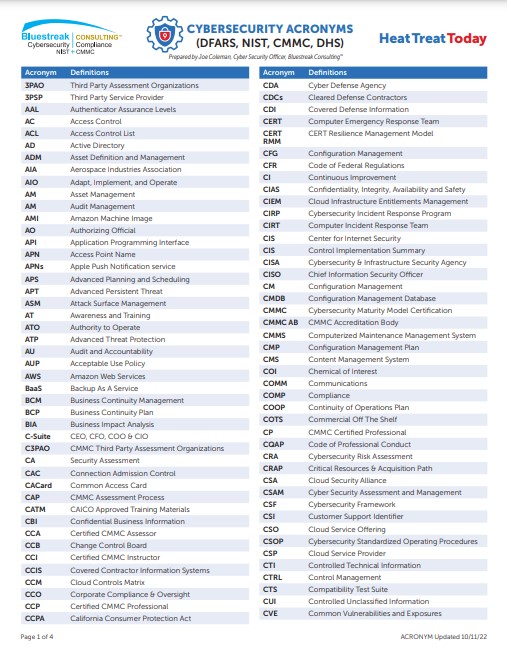
Click image to download a list of cybersecurity acronyms and definitions.
Cons of AI in Heat Treating
Initial Investment:
Implementing an AI system requires a significant initial investment in the technology, training, and infrastructure, which may be a showstopper for smaller businesses.
Dependency on Technology:
Dependencies on AI systems can be a problem if there are technical glitches or breakdowns, disrupting the entire heat treating process.
Data Security and Privacy:
AI systems rely heavily on data. Ensuring the security and privacy of sensitive data is critical, especially when dealing with Controlled Unclassified Information (CUI), your proprietary heat treating processes, and sensitive customer information.
Ethical Concerns:
AI decision-making processes raise ethical questions, especially if the technology is used in critical applications, ensuring fairness, transparency, and accountability in AI decision-making is essential.
Skilled Workers Replaced:
Automation using AI might reduce the need for certain manual tasks, potentially leading to skilled workers losing their jobs without the necessary skills to operate or maintain AI systems.
Here’s the bottom line: You should always do your own research to see if AI is a good fit for your business. AI is not always better. There are upsides of using it, and there are definitely downsides to using it. You can’t always trust AI to give you the best information, so always make sure you confirm the information it is giving you through V&V (verification and validation).
At the Metal Treating Institute’s (MTI) national fall meeting, held October 9–11 in Tucson, AZ, Jay Owen gave an excellent presentation entitled, “Artificial Intelligence: Be Afraid or Be Excited.” Contact MTI by visiting www.heattreat.net.