

aerospace heat treat

A Tour of Common Hazards in the Heat Treat Industry

Rick Kaletsky, Owner, Safety Consultant

Safety is a concern to all industries, but it’s of paramount importance for the aerospace manufacturing sector. Join us on this whirlwind tour of a heat treat shop from the perspective of an industry safety consultant, Rick Kaletsky. Rick’s a funny guy, but don’t let that detract from the critically important information he has to share. Rick Kaletsky is an MTI OSHA Safety Consultant and the author of the popular book, OSHA Inspections: Preparation and Response, 2nd Edition.

This column is being supplied courtesy of the Metal Treating Institute and was first published in the Heat Treat Today Aerospace magazine in March 2019.


With all of the bright and shiny new gadgets and technology in the heat treat industry, it’s easy to overlook the wealth of the “same old” classic hazards, which may not have been properly dealt with in the shop. It is critical to address these basic (often severe) risks/violations rather than be distracted by trying to identify new-to-the-forefront issues. Please note that this list is surely not all-inclusive. I’ll make this concise as we tour the shop and highlight areas that demand attention.

Let’s take a look:

  • Are you still allowing obstacles to impede immediate access to exits, fire extinguishers, electrical disconnects, and emergency eye fountains?
  • Are you permitting unguarded (or improperly guarded) power transmission equipment, highlighted by chain drives, belt drives, couplings, and gears?
  • Have you adequately guarded fan blades?
  • Are you adhering to the (chemical) hazard communication program— especially the labeling, safety data sheets, and
    training? (Also, don’t forget the Globally Harmonized System.)
  • Is the lockout/tagout program (relating to unexpected energization and release of stored energy) sufficient— attaining ZES (zero energy state addressing electrical, mechanical, pneumatic, hydraulic, spring, thermal, steam, gravity+), only one “available” key per personal lock, machine-specific procedures, and more?
  • What kind of permit-required confined-space program have you implemented—a detailed, super priority, tackling matters of oxygen deficiency, vapor ignition, entrapment, and so on, with a fully integrated plan including (but not limited to) space identification, permit system, calibrated instrumentation, attendants, and non-exposed rescuers?

All set now? WAIT! There’s more that is routinely violated on a regular basis. These items above, and more to follow, are not simply matters of technical non-compliance with the law of the land. They are scenarios waiting to ambush workers and leave them with burns or worse (from fire, explosion, and electrical sources), mangled digits and limbs, blindness, lung damage, and many other examples of preventable misery.

Abatement can be motivated by a desire to avoid “breaking the law and paying the price.” It can be motivated by ethics and the sincere “touchy feely” desire to “do the right thing.” Yet it can also be motivated by a company’s knowledge that employee protection is good business, with very tangible, financial results. The cost of occupational injuries and illnesses can decimate your profit line far more than direct medical costs. It is worth considering all of the follow-up medical bills, cleanup, overtime, downtime, insurance rate increases, and much, much more, not to mention the enhanced OSHA penalties.

Pardon the diversion; now for a look at some more key questions:

  • Is heat stress considered to be a very real concern (and met head-on as an occupational hazard) rather than viewed as a mere matter of degrees of comfort?
  • Has there been a full assessment of personal protective equipment needs?
  • Is safety-toed footwear required, as determined by such an assessment?
  • How about eye protection (consider different forms for different hazards), hand protection (again, particular types for particular risks), hearing protection, flame-resistant/retardant clothing, and whatever else is brought to light by way of a thorough assessment considering each task to be performed?
  • Are the extinguishers conspicuous, fully charged, and professionally tested on a timely basis?
  • Who is expected to use the extinguishers, and have those employees been “hands-on” trained?
  • Are compressed gas cylinders well-secured, capped (where designed to be), and properly separated (oxygen from fuel gas, in storage)?

Have I offered enough tips? No? Okay, here are just a few more points to ponder:

  • Are electrical cords in good condition, without (for instance) stripped/cut/burned insulation, damaged/missing grounding prongs, or similar damage? (Remember that portable electrical tools can be double-insulated, as an alternative to grounding.)
  • Is there accurate, unambiguous, easy-to-read labeling on disconnects, breakers, controls, and so on?
  • If there are breaker slots without breakers, are those spaces filled with blanks?
  • Are electrical boxes and similar apparatus equipped with approved covers?
  • Are forklift trucks and similar vehicles properly maintained, with emphasis on steering, brakes, horn, tires, overhead guard, and fork movement reliability; are all operators suitably trained?
  • How about the elimination or deep mitigation of trip and slip hazards?
  • What have you done (including by engineering means and specific training) to decrease exposure to ergonomic hazards, especially regarding backs?

There’s always more that can be done to improve safety and minimize risk in the shop, and it’s usually something easily overlooked in regular safety checks that turns up flagged in a review. But don’t let the procedure blind you to the most important reason we stress safety in the shop: the welfare of our employees.

A Tour of Common Hazards in the Heat Treat Industry Read More »


DELTA H Commissions Heat Treating System to AAR Corp

DELTA H commissioned a Dual Chamber Aerospace Heat Treat (DCAHTTM) to AAR Corp. at Indianapolis International Airport. AAR is a leading provider of aviation services to commercial airlines and governments worldwide. At its Indianapolis MRO facility it performs heavy maintenance with a focus on the Boeing 737.

Kelly Sauer,
VP of Quality, AAR

The DELTA H dual chamber furnace meets our needs as an effective, efficient and complaint heat treatment solution,” stated Kelly Sauer, AAR Corp’s Vice President of Quality.

Ellen Conway Merrill,
VP, DELTA H

“As the largest independent MRO in North America and one of the top five MRO providers in the world, it’s truly humbling to have earned AAR’s trust for their in-house heat-treating capabilities,” stated Ellen Conway Merrill, DELTA H Vice President. “The commissioning service at AAR Indianapolis included full qualification testing as well as training certificates for operators and QC/QA. The DELTA H DCAHTTM furnace system enabled AAR to quickly qualify for not only aluminum, but also aging of PH stainless steel and titanium.”

The DELTA H DCAHTTM furnace features dual chambers operable to 1200°F and 500°F with precision control and temperature uniformity, and a roll-away stainless-steel quench tank. The system qualifies as Class 2 (+/-10°F) per AMS2750E and includes all controls, data acquisition technology, and spares parts package to be in full compliance with all aerospace pyrometry standards and National Aerospace and Defense Contractors Accreditation Program (Nadcap).

DELTA H Commissions Heat Treating System to AAR Corp Read More »

The Nadcap Accreditation Process Explained

          Source: Vac Aero International Inc.

Nadcap accreditation is looked on by most of the heat treating world as a significant achievement and a guarantee of quality. It not only permits a company to perform heat treating for the Aerospace/Defense industries but also tells customers that this company has a high standard of quality.

So what is it, and how does it work?

In this HTT Best of the Web Technical Tuesday feature, Vac Aero International takes readers through the entire Nadcap accreditation process from start to finish, examining what it is, how it works, and troubleshooting problem areas.

An excerpt: “Nadcap accreditation benefits not only the company being audited but helps ensure their customers receive products and services that meet or exceed both their expectations and requirements. The audit and accreditation processes result in continuous improvement in multiple areas, with deficiencies (i.e., nonconformances) identified and corrected based on specific rules (i.e., guidelines) to ensure each process meets or exceeds industry standards.”

Vac Aero gives a detailed look at the common pitfalls in the accreditation process, useful resources and training courses to help companies prepare for their audit, and what to do after the audit is complete.

Read More: The Nadcap Accreditation Process by Vac-Aero International

Photo Credit: TAV Vacuum Furnaces

The Nadcap Accreditation Process Explained Read More »

Airbus to Increase Production of U.S. Aircraft

Airbus will expand operations in the U.S. by increasing the production rate of A320 family aircraft at its U.S. manufacturing facility in Mobile, Alabama, to seven per month by the beginning of 2021 as part of its plans to produce 63 of this aircraft per month. With plans already in place for production of four A220 aircraft per month in Mobile by the middle of the decade, Airbus is on track to produce more than 130 aircraft in Mobile each year for its airline customers.

C. Jeffrey Knittel,
Airbus Americas Chairman & CEO

Airbus Americas Chairman and CEO C. Jeffrey Knittel said, “Airbus has been manufacturing in the U.S. for many years now through our helicopter, aircraft, and satellite products. This increase in commercial aircraft production in Mobile is an exciting expansion of our significant industrial investment in the U.S., and it continues Airbus’ positive contribution to American aerospace.”

Airbus plans to open its new final assembly line for the A220 in Mobile this year and deliver the first U.S.-made A220. They are on track to deliver their 200th U.S.-built A320 family aircraft in the summer.


Airbus to Increase Production of U.S. Aircraft Read More »

Gulfstream Awards GAMPS 5101 & 5102 Certification to Heat Treater

Gulfstream recently awarded Solar Atmospheres of Western Pennsylvania with material processing specification approvals for GAMPS 5101 and 5102. Specification GAMPS 5101 relates to the heat treatment of low alloy steels and GAMPS 5102 is associated with the annealing and precipitation hardening of PH stainless steel. Compliance to these two specifications are important to ensure that flight-critical raw materials and parts are heat treated and tested properly.

Michael Johnson,
Sales Manager
Solar Atmospheres of Western PA

“This prime approval not only gives our current customer base permission to use our location for thermal processing of Gulfstream components, it also gives them the ability to run larger loads of 40,000 – 60,000 lbs. at a time, due to our large furnace sizes,” stated Michael Johnson, Sales Manager. “The larger loads reduce the number of certifications, furnace charts, and mechanical testing documentation that is typically required post heat treating.”


Gulfstream Awards GAMPS 5101 & 5102 Certification to Heat Treater Read More »

Doncasters Implements New Operating Model for Production

Doncasters Group Ltd., based in Burton upon Trent, UK, has made financial changes to allow for increased focus on precision casting and superalloys production. They are implementing a “new operating model” and will organize into two geographic divisions led by two managing directors, Jason Mays in the U.S. and Simon Ward in Europe.

Jas Sahota,
CEO of Doncasters Group Ltd.

“This is a significant positive development for Doncasters, our people, customers and suppliers. The agreement we have reached with our lenders will provide the necessary stable platform for DGL to deliver on its future strategy,” said CEO Jas Sahota of the agreement. Ownership of the group will transfer to the senior lenders, which is expected during Q1 2020.

Doncasters’ casting operations —including Certified Alloy Products, Doncasters Precision Castings – New England, and Doncasters Southern Tool, all in the U.S. — are investment casting plants producing aerospace and industrial gas turbine parts, aerospace structural castings, and more.

The superalloy business produces vacuum- and air-melted ferrous, nickel-base, and cobalt-base superalloy bar stock used to cast and fabricate turbine blades and vanes and other components for aerospace engines and land-based gas turbines, hot-end turbocharger wheels, medical prostheses, and other components requiring high metallurgical integrity.

Photo Credit: Foundry Management & Technology

Doncasters Implements New Operating Model for Production Read More »

NATO Agrees to Surveillance Aircraft Contract with Boeing

NATO and Boeing have announced a $1 billion agreement to update and modernize the Alliance’s AWACS surveillance aircraft fleet.

NATO Secretary General Jens Stoltenberg and the president of Boeing International, Sir Michael Arthur, met at Melsbroek Airport in Brussels to mark a major investment in the Alliance’s fleet of AWACS surveillance aircraft. NATO’s investment will ensure the surveillance aircraft continue to support the Alliance’s missions to 2035.

Jens Stoltenberg,
NATO Secretary General

“NATO AWACS have been our eyes in the sky, supporting our operations for decades, from patrolling American skies after 9/11, to our operations in Afghanistan, and as part of the Global Coalition against ISIS,” said the Secretary General.

He welcomed the contract with Boeing, which will provide NATO’s 14 AWACS aircraft with sophisticated new communications and networking capabilities. 16 NATO Allies, on both sides of the Atlantic, are funding this modernization, and companies from Europe and North America are working together to provide high-tech capabilities.

Sir Michael Arthur,
President of Boeing International

“NATO AWACS is a symbol of trans-Atlantic excellence, in terms of technology and partnership between Boeing, NATO and Europe. This modernisation programme will ensure the aircraft continue to thrive,” noted Sir Michael Arthur.


Photo Credit: Virginia Mayo/AP

NATO Agrees to Surveillance Aircraft Contract with Boeing Read More »

In-Situ Hardness Testing of Large Aerospace Structures – A Case Study

This article originally appeared in Heat Treat Today’s March 2019 Aerospace print edition.


How a Custom Designed Fixture and Hardness Testing Unit Solved a Major Aerospace Engine Manufacturer’s Hardness Testing Dilemma

Situation: A major aerospace engine manufacturer wanted to ensure the appropriate hardness of a specific section of a heat-treated engine housing. They wanted to non-destructive test the actual housing and not test shims. They wanted to do the test in-house so as to not stall production by having to ship the part out for testing. Another reason they did not want to ship the parts out for testing was the size of the parts. Some of the parts had a diameter as large as 40 inches (102 cm), 20 inches (51 cm) high, and 900 lbs (400 kg). The aerospace company also wanted an automated, full-proof system that reduced the chance of human error.

Figure 1

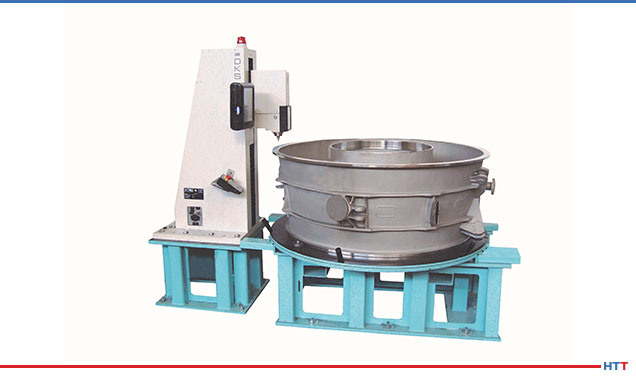
Solution: The solution came in the form of a custom-built hardness testing machine and an innovative fixture to hold the engine housing. As can be seen in Figure 1, AFFRI USA, located in Illinois, designed a fixture to hold both a custom-designed hardness testing machine as well as a fixture to hold the engine housing.

The Hardness Testing Machine

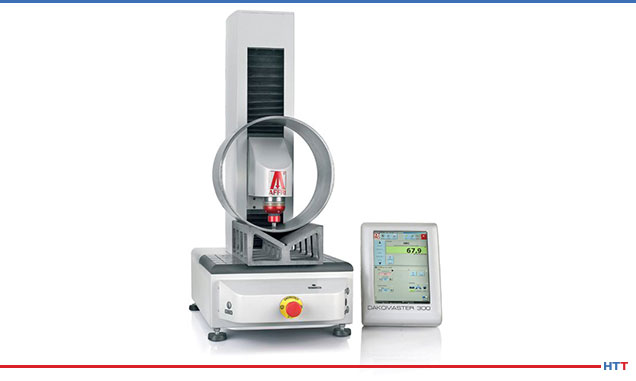
The specific hardness testing unit chosen for the job was DAKOMASTER 300. Typically, this unit is a tabletop unit as shown in Figure 2. For this specific aerospace application, the unit was modified so that it could be securely attached to the steel

Figure 2

construction holding fixture. Additionally, the custom-built unit was adapted so that the measuring head had a much greater vertical and horizontal range to accommodate varying height engine housings. The engine housings varied in size from as large as 110 inches (2.8m) in diameter and 39 inches (1m) high to the smallest being approximately 16 inches (400mm) in diameter and 9 inches (250mm) tall. The typical vertical working distance range on the tabletop unit is approximately 12 inches (300mm) while the custom unit has a vertical working distance range of 39 inches (100cm). The measuring and loading head of the unit was designed so that no misalignment would occur with the engine housing. If effective, the machine utilized what can be considered a self-clamping technology that structural deflection is absorbed ensuring an accurate and absolute reading in varying test conditions. Finally, to eliminate potential operator error, once in place, the test is initiated by a single button eliminating the need for operator engagement.

The Fixture Table

Since part and machine stability is critical for accurate hardness tests, providing a stable base for the large aerospace parts was a critical part of the solution. The company wished to execute multiple tests in multiple locations around the flange face of the engine housing. Some tests were to be conducted on the outer edge of the housing and some tests were to be conducted on the inner edge of the housing. To do this, the fixture holding the engine housing was designed so that the entire housing could move closer to or further away from the test machine. Additionally, the housing had to be rotated so that the machine could test completely around the perimeter of the housing flange face. To accomplish this, the part fixture was equipped with heavy-duty bearings so that the entire engine housing was able to be easily rotated. Once rotated to the desired location, the table would move closer to or further away from the test machine to pinpoint the exact spot for the test.

The Results

Simply stated, the results were excellent. Hundreds of tests have been run on a wide range of engine housing diameters, all with success – all well within the 1% tolerance. Being able to conduct in-house testing has helped smooth production. Having hardness testing equipment that is flexible enough to handily negotiate large or small engine housings saved the company money from needing to purchase several hardness testing machines and fixtures. Tests can be run quickly and simply by rotating the part fixture table and operator error has been virtually eliminated with the single push-button equipment. The hardness testing equipment provided for this aerospace company is capable of performing HRC, HRB, HRT, HRN measurements all in conformance with ASTM E-18. HTT

About the Author: AFFRI is an Italian-based international designer and manufacturer of state-of-the-art hardness testing systems for over 60 years. The company’s North American headquarters is located in Wood Dale, Illinois. This article originally appeared in Heat Treat Today’s March 2019 Aerospace print edition and is published here with the author’s permission.

In-Situ Hardness Testing of Large Aerospace Structures – A Case Study Read More »

Link between Heat Treatment and Fatigue Crack Growth of αβ Titanium Alloys

Source: Outlook Biz


Titanium alloys have a high tensile strength because of density ratio, high corrosion resistance, and ability to withstand moderately high temperatures without creeping. Because of these features, titanium alloys are used for aircraft development.  This  article, from Outlook Biz, highlights the research done by IRT Saint Exupery in which they assessed the potential use of the Ti-6Al-4V ELI alloy in aerospace applications, specifically in relation to heat treatment and fatigue crack growth.

Researchers from IRT Saint Exupery assessed the impact of microstructure on the fatigue crack growth resistance of αβ titanium alloys.


Read more: “Link between Heat Treatment and Fatigue Crack Growth of αβ Titanium Alloys”


Photo Credit: Outlook Biz


Link between Heat Treatment and Fatigue Crack Growth of αβ Titanium Alloys Read More »

Aluminum Alloy Achieves Ultimate Tensile Strength in Heat Treating

An aluminum alloy developed and patented five years ago has been identified as one of the strongest aluminum additive manufacturing powders commercially available.

Mike Bond, Director of Advanced Material Technology at Aeromet

Aeromet’s A20X™ surpassed the key 500 MPa UTS mark following a recent research project involving aero-engine giant Rolls-Royce and additive manufacturing equipment specialist Renishaw. Heat-treated parts produced using A20X™ Powder have achieved an Ultimate Tensile Strength (UTS) of 511 MPa, a Yield Strength of 440 MPa and Elongation of 13%. Crucially, parts additively manufactured with A20X™ Powder maintain high-strength and fatigue properties even at elevated temperatures, outperforming other leading aluminum powders.

“Since bringing the A20X™ alloy to market for additive manufacturing 5 years ago we have seen significant adoption for high-strength, design-critical applications,” said Mike Bond, Director of Advanced Material Technology at Aeromet. “By working with Rolls-Royce, Renishaw, and PSI, we have optimized processing parameters that led to record-breaking results, opening up new design possibilities for aerospace and advanced engineering applications.”

The HighSAP project was backed by the UK’s National Aerospace Technology Exploitation Programme (NATEP).  A20X™ Powder for additive manufacturing is derived from the MMPDS-approved A20X™ Casting alloy, the world’s strongest aluminum casting alloy, which is in use by a global network of leading aerospace casting suppliers.

Aluminum Alloy Achieves Ultimate Tensile Strength in Heat Treating Read More »

Skip to content