In this episode of Heat Treat Radio, host Heather Falcone sits down with Dan Herring and Dr. Ed Roliński to explore how manufacturers can choose the right nitriding process for their application. The conversation compares gas, plasma, and salt bath nitriding while examining the role of part design, failure modes, white layer, distortion, and process economics. Learn why making informed nitriding decisions early — and understanding the fundamentals behind the process — can help improve part performance and avoid costly problems downstream.
Below, you can watch the video, listen to the podcast by clicking on the audio play button, or read an edited transcript.






The following transcript has been edited for your reading enjoyment.
Introduction (00:05)
Heather Falcone: Hi, I’m Heather Falcone, and welcome to Heat Treat Radio. Let’s just say for today’s topic, the doctors are in.

We’re talking about a new article written by our guests called [“Nitriding Selection Guide: Gas, Plasma, or Salt Bath?”] Joining me are Dan Herring and Dr. Edward Roliński, who are known to the industry as The Heat Treat Doctor® and Dr. Glow, respectively.
Dan has been in the industry for over 50 years. He spent the first 25 years in heat treating prior to launching his consulting business, The HERRING GROUP, in 1995. He’s the author of six books and over 1,000 technical articles. He’s also no stranger to Heat Treat Radio, having been a guest several times over the years.
Edward is a consultant in the heat treating industry and a distinguished senior scientist, having spearheaded research on the plasma and ion nitriding since the 1970s. He holds advanced degrees in manufacturing technology and metallurgy, including a PhD and Doctor of Science. He’s authored numerous influential technical chapters and articles.
Why Nitriding Decisions Should Start with Design (01:45)
Heather Falcone: We’re talking about your article that you wrote called [“Nitriding Selection Guide.”] So straight out the bat, we have to know more about getting the process choice right early.
You make the case that nitriding decisions should be made early in the design process. From your experience, what’s the most common reason people struggle to select the right nitriding approach, and what question would you want them to ask earlier than they usually do?
Dan Herring: It’s an understanding of why nitriding, the process of nitriding, should be chosen, or should be the correct technology choice. To me, there are three factors that apply. One is the fact that you get consistent high quality. It’s easy, in fact easier than most technologies, to manage distortion.
Notice I didn’t say control distortion, just manage it. If we can ever control distortion, we’d be in business. And the third one is, that you get, really enhanced performance. These factors — consistent quality, managing distortion, and excellent performance characteristics — are really the secrets, if you want to call it that, of successful manufacturing of products today.
Let me expand on that just a little bit. From a quality aspect, I think we’ve all come to appreciate that failure is just not an option. It can be extremely devastating, if not, in some cases, unfortunately catastrophic. We’ve seen that in our lifetimes. We listen to the news and there are huge product recalls of different components, some in the area of automotive and aerospace, others in baby formula, farm products, and things of this nature.
There is a trend that started in the late 1990s and has continued into the early 2000s and today of the need for higher reliability of our products and greater performance while we’re reducing the envelope — we’re making components and products in this world, manufacturing smaller and smaller components.
There’s a real push for high reliability and absolute performance of the product. Of all the case hardening processes — boriding, carburizing, carbonitriding — all of these are high-temperature processes. By the I mean processes that are run above 1200°F or above 650°C. Inherently, they produce a greater amount of distortion. I think I’m accurate in saying it’s more challenging (notice I didn’t say absolutely difficult) to control that dimensional change.
Whereas low temperature processes, such as nitriding in any of its forms, whether it be gas, plasma, or salt bath, minimize distortion. And because of the temperatures they operate at, they reduce any transformational stresses that have occurred.
From an engineering perspective, because we’re talking about design engineers and why they would choose nitriding, it’s really critical to understand two things. What must the component endure in service? In other words, what must it do? How must it function? Or from an engineering perspective, what are the product requirements? And the second question is, how will we make it? How will the component part be made? In other words, what are the process requirements?
So those are the key questions from an engineering perspective that, during the investigation, will lead you to choosing nitriding, at least in my mind, as a very viable alternative.
Heather Falcone: Ideally, we’re looking at that in the design phase, like you had said, but so many times, once they’re all in on manufacturing a product, the special processing is at the end of the supply chain. So that’s really interesting that you brought that up. Let’s put that more forward into the design phase so that we’re not risking products so far down the line.
Too many dollars in, can’t make any decisions or changes at that point, you’re kind of stuck with what you’ve got. That’s really great insight there. What do you think, Edward?
Edward Roliński: Yes, those are very good points. What’s important is to have a design engineer come to heat treaters and ask, “How can you help us?” My question would be, “What’s your expectation for failure mode of this component? What do you think? How would it fail?” And then we can discuss rolling contact fatigues or bending fatigues or friction or corrosion.
And for instance, the designer can come and say, “We are going to manufacture 10,000 small gears a week, and they will be made of powder metal products. I suspect that there could be a failure at the root of the tooth, bending fatigue, or rolling contact fatigue on the flank. How would you improve durability of this product?”
I would know the answer very quickly in this specific situation because this is a low-density powder metal product, and I assume that the density is less than 7.3 grams per cubic centimeters. We must stay with plasma nitriding because gas nitriding, if applied to this situation, or salt bath could penetrate porosity in the gears and nitride the component entirely through the entire thickness. It would become brittle and useless.
Plasma nitriding could be used here because of that. Also, good control of the process allows us to control thickness of specific portions of a nitrided layer. What we do by nitriding generally and specifically here is introduce residual compressive stresses to the surface.
That’s very important. There are many other examples that could be treated the same way or similar way. A design engineer should be able to predict the failure mode of the component. If it fails, how does it fail?
Understanding and Controlling the White Layer (10:22)
Heather Falcone: On that topic, the article covers white layer specifically. You kind of touched on that. We want to control the depth of what’s deposited on that surface so that we can, balance wear, fatigue, erosion resistance, post-processing needs. So if we’re designing all that in, where do you see misunderstandings that cause downstream problems?
Edward Roliński: The so-called white layer is white when we etch a cross-section of the sample with nitro. This represents the white layer which doesn’t etch, which is built of iron nitrides, Fe4N and Fe23N, with some carbon additionally if needed. The range of the white layer that could be produced is very broad in gas nitriding.
In gas nitriding, this could be produced up to one thousand white layer. Unfortunately or fortunately, plasma nitriding is a process that I call a low nitriding potential process. The white layer is always comparatively thin, which has many benefits and safety.
If something changes in the atmosphere when we are producing components, it won’t change white layer. It will stay still comparatively thin, between 10–15 micrometers thick. In the gas layer, it could go up to one and a half thousand, which is really a problem. It’s been a problem at the beginning of gas nitriding years for probably 60 or 80 years of gas nitriding. The problem was with the white layer, because it was always too thick.
For instance, people started nitriding high-performance crankshafts using gas nitriding, and unfortunately, the white layer was always too thick. So we had to grind off this portion, which made costs higher. When plasma nitriding was invented and then appeared on the market, it was like a panacea for solving problems of gas nitriding. The white layer never got too thick.
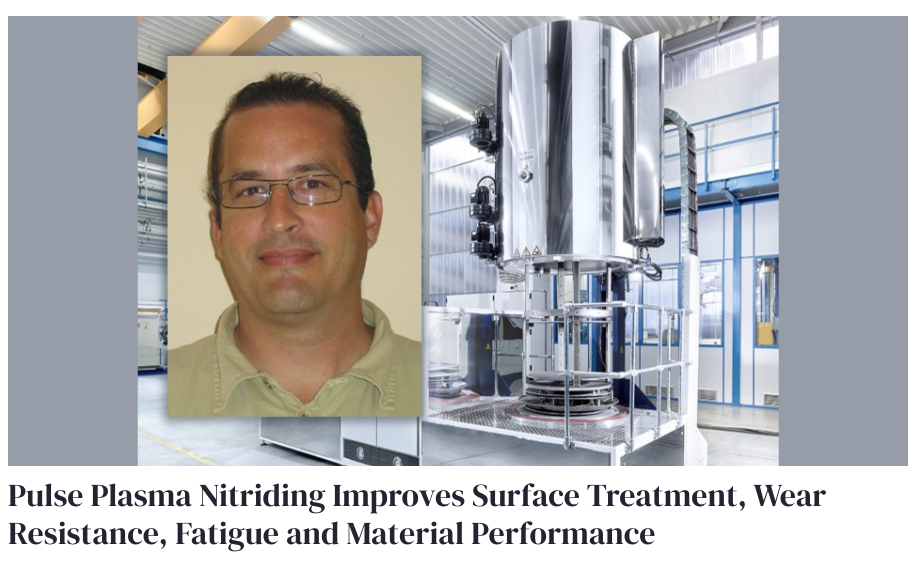
Obviously, there was progress with gas nitriding. People learned in the ’70s and ’80s how to precisely control the thickness of the white layer by controlling nitriding potential of the atmosphere. These are benefits of both processes now. We can produce thin white layer.
Now gas nitriding is used for high-performance crankshafts for these racing cars, which are the best in America, as well as small planes. That’s my examples here taken from practicality and theory of the processes.
Heather Falcone: Those are pretty practical. Those are products that we would use every day, and we want them to work, so that quality control level is vital. If we don’t want to scrap out hardware or affect overall safety, it’s important to have those considerations when we’re selecting the most ideal form of nitriding.
Dan Herring: I think what Edward and I are both saying is that it is very critical for the design engineers to engage with metallurgists very early in the design process. Obviously mechanical engineers, electrical engineers, industrial engineers, and other types of engineers get a course or two in metallurgy in their undergraduate or graduate professions, but they really don’t major in that particular aspect. What I would say to design engineers, engineering managers, and managers of manufacturing engineering is to engage with metallurgists.
And if you don’t have metallurgists on staff, and this is neither Edward nor I are making a commercial out of this, but consult with a metallurgist and understand from a metallurgical perspective how this is going to affect design. And now we’ll talk about white layer a little.
Heather Falcone: Sounds good. I love that point. That’s very critical. And materials science kids are graduating more every day, starting to get popular again, so we’re really hopeful that we’ll start to get a new influx of that next generation to keep this knowledge going.
Dan Herring: Absolutely. But with respect to white layer, and Edward has brought up some excellent points. I’ll just add some of the benefits of white layer. We have high hardness, we have excellent wear resistance, we have good corrosion resistance, and, even from a lubricity standpoint, we have good lubricity.
Some of the limitations though, and what Edward was talking about, is that you have brittleness of the white layer. It’s extremely hard, but extremely brittle. And in many cases, it either has to be minimized with either a gas or plasma technology, or it has to be eliminated, completely, which plasma, certainly Orion, has the capability of doing. And in highly stressed components, there can be fatigue issues.
So you get enhanced tribological properties in one hand, but you have to be careful in the other that you’re, just like everything else we do in life, you have to control the process in order to have a predictable outcome.
Heather Falcone: Which makes sense because in practice, nitriding choices are often influenced by these types of questions. So how do you recommend people balance their ideal technical requirements with the real-world constraints like fatigue without compromising part performance? Dan, do you want to take that one first, or are we back on Edward?
Edward Roliński: I just wanted to add here important things, the properties of white layer, as Dan mentioned, excellent corrosion resistance, wear resistance. But there are two types of white layers. One is epsilon type, which contains more nitrogen, which is hard and has all the benefits against corrosion and, gamma prime white layer, which is Fe4N, which is more elastic. So in torsional or bending fatigue situations, gamma prime is allowed and good. It’s important to note that for kinetics of a process, there always should be a white layer on the surface, because it has 6–7% of nitrogen, so it’s like sliding from a high hill fast.
When you eliminate the white layer, percentage of nitrogen is only 0.1–0.2 maximum in steel. That’s why the nitriding process is like sliging from a very little hill; it’s much slower. As such, the process would not be economical. It would take 100 hours to get no white layer and deep enough total diffusion versus 24 hours with little white layer.
Economics are important here for nitriding. Cost is passed to the customer, so that’s important.
Heather Falcone: 24-hour cycle time is already a lot of time for a facility to be taking up a piece of equipment with a single run. So I think mitigating that cycle time, making sure that we understand our ultimate result is going to be one of those decisions that we’re looking at earlier in the process so that we’re not overburdening our heat treaters. What do you think?
Edward Roliński: That’s a very good point here, because in majority of the situations, wear resistance is critical.
Fatigue is probably much less common problem. Therefore, so-called ferritic nitrocarburizing, which is nitriding doped with carbon, is a process which is used very often.
Approximately, 60–70% of all nitridings is FNC, ferritic nitrocarburizing, because the process is fast and short (2–4 hours), there’s a high concentration of nitrogen at the surface, and higher temperature use. It’s very economical. Cost is an important factor.
Choosing Between Gas, Plasma, and Salt Bath Nitriding (22:40)
Dan Herring: After the decision has been made that we are going to consider nitriding as a technology, then the next question has to consider which form of nitriding: gas nitriding, ion or plasma nitriding, or even salt bath nitriding.
The article, which featured in the [August] print edition, presents a discussion of the pros, cons, and benefits or each nitriding process. We’ve tried to take all three technologies and not introduce our own prejudices, if you will, into the article, but instead give a reasonable perspective to all three technologies.
Then design engineers can say, “I understand,” to paraphrase a movie, “the good, the bad, and the ugly” with respect to the process.
After, that decision is made, the next logical choice is whether to do it in-house in my own facility or outsource it to a commercial heat treat source. Many factors go into that decision: the capability, either internally or externally, the quality, the cost. Regardless of the choice, what’s important and often overlooked is that when you select a certain nitriding process and it fails, your first reaction cannot be that you selected the wrong choice and switch to another form of nitriding or or abandon nitriding completely. The key to heat treating in all types of heat treating is to control the process and equipment.
Oftentimes, this aspect is overlooked. Consider: is the process in control, is the maintenance on the equipment being done properly so that the process itself has a chance of success?
To use a baseball analogy, if I’m the home run hitter and I come up to bat but we’re two runs down, no matter how far I hit that home run, I could hit the longest home run in Major League Baseball history, and we would still lose by one run. I need someone on base, preferably two people on base, so that when I hit the home run, we win the game. Similarly, process and equipment variability are critical to the home run hitter, which is nitriding coming to the plate.
Edward Roliński: That’s very important. Also I wanted to add that if I as a designer and manufacturer of certain parts have thousands of small parts and they need to be nitrided all over, how do I do this? Obviously, plasma nitriding, which is an environmentally friendly process, doesn’t apply here because only a portion that is not masked off gets nitrided.
We have to attach this part to cathode, put it down, or hang it, and the area which is touching the cathode won’t nitride. This is obviously also a benefit of plasma on the other hand. If we want to mask off specific areas, we just put a steel foil around diameter, put a bolt inside the threaded hole, and it’s protected.
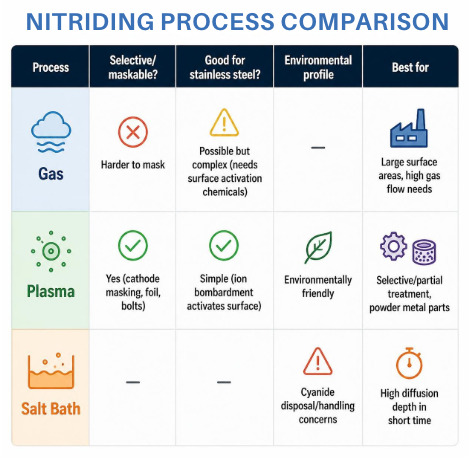
We can use it and reuse it many times. That’s important. Also very important is that there are different steels. There are stainless steels. How do we nitride stainless steels? Currently, which is 120 years after gas nitriding was invented, gas nitriding allows us to nitride stainless steels, but it’s very complex process. You have to add specific acids or chemicals to activate the surface, then you can nitride it. It’s an internal problem inside the vessel. Elements and measuring devices could be damaged by these chemicals.
In plasma nitriding, it’s simple because there is ion bombardment all the time and sputtering, so surface is activated very quickly. You add some nitrogen and hydrogen mixture and have a flow rate of, let’s say, 20 cubic feet per hour, that’s plenty for a large-size load. In gas nitriding, 20 cubic feet is small for a large size surface area of a load. All these components have to be considered also.
Modern Controls Still Require Nitriding Fundamentals (29:02)
Heather Falcone: So nitriding, like you said, has been around for decades, over 100 years, and when we’re talking about the controls, we have such a better ability to control with our modern technology. We can control the atmosphere, the nitriding potential, ammonia dissociation rate, etc. Since we’re dealing with a whole different world on how we can control the process, what has changed in how we should approach nitriding as far as the fundamentals are concerned? The very first things they should be considering. What are the basics that still hold true after all these years?
Dan Herring: Let me start by saying that more emphasis really needs to be placed on understanding the nitriding process and how it actually works. How to predict the outcome, both from a cycle standpoint and a metallurgical standpoint, and how to design process recipes to achieve that particular microstructure or those particular performance properties. So to me, it’s still a matter of educating people on understanding the nitriding process.
I’ll give you one simple example. Edward and I are going to be writing an article on how to interpret the Lehrer diagram, which is one of the basic toold that’s used to understanding, or for understanding nitriding potential or what is called the Kn values, as well as the microstructural outcome.
People have looked at the Lehrer diagram for many years and I’m not so sure after all these years that even Edward and I fully understand it. But it’s a fascinating way to understand the nitriding process. More education is needed to understand.
We have the controls in place. If we have a particular case depth we’re looking for or we have a particular microstructure we’re looking for, we can dial that in with the controls. But how to understand the case depth I need or what microstructural outcome I need, that’s a matter that requires, I think, a little more education.

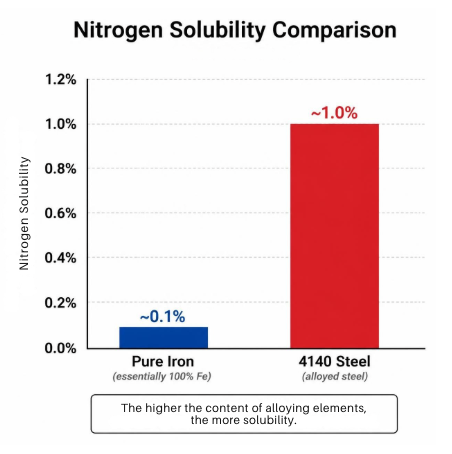
Edward Roliński: No education, no innovation. To add into the discussion about the Lehrer diagram, which is as important as iron-nitrogen phase diagram, we have to remember that Lehrer diagram in its original form and modifications by Malginski were developed for pure iron. We deal with steels, and solubility of nitrogen in pure iron is less than 0.1%. Solubility of nitrogen in different steels, for example 4140, is around 1%. Higher the content of alloying elements, more solubility, which means that white layer will not form at this higher nitriding potential for steels. This is much more complex, and we will address this in our article, which will be published in the next few months.
Heather Falcone: We’re really excited about the article that’s going to be coming out, so make sure that you get it through all of the methods that it’s available.
Getting the Basics Right: Cleaning and Surface Preparation (33:16)
Heather Falcone: If you could give the audience one piece of advice to improve their nitriding decisions before engaging a heat treater, whether it’s internal or external, what would it be?

Dan Herring: Being a consultant to the heat treating industry for many years now, I have solved a significant number of nitriding problems with good old-fashioned common sense. I can’t tell you how many lucrative certain consulting projects have been that boil down to proper cleaning and handling of parts. It’s just that simple.
Cleanliness is certainly next to godliness. Keep the parts clean, and when you’re handling them, remember to not handle them with dirty, oily gloves, putting more marks on the parts that will not nitride in areas. Cleaning would be the one area that I feel should really be a focus within most manufacturing plants.
Edward Roliński: That’s a very good point. Cleanliness and also surface condition of a part. Machining too quickly without cooling will overheat the surface, producing tensile stress that may eliminate formation of nitrided layer. Also, the knowledge that nitriding is a low temperature process and is in many situations just final operation.
You don’t have to do anything after. Occasionally you do polishing or cleaning with Scotch-Brite by hand, like bigger components. That’s important.
Heather Falcone: I think we have in the past had whole episodes on part cleaning because it just affects so many parts, so many portions of our processing and our outcomes. Many times, when we have to open an investigation, it’s at the very top of the quality person’s checklist. Were the parts cleaned? What was done to them prior to the processing? That surface condition prep is critical.
Dan Herring: It’s hard to visualize necessarily, but I often look at heat treating as a process of interlocking links on a chain. And we all know that a chain is only as strong as its weakest link, if you will.
For people to realize that performance of the material, the material, the design, the metallurgy, the heat treating, and the equipment are all intimately linked together. Performance, material, process, heat treating, and equipment, which includes maintenance, are all interlinked, and this is a key aspect of understanding that everything has to be done correctly.
If the customer is demanding a performance that’s not capable of being achieved, that’s a problem. If the design engineer selects the wrong process, that’s a problem. If the metallurgist doesn’t understand how to get the right case depth and microstructure, that’s a problem. If the heat treater doesn’t understand what he’s heat treating or how he’s heat treating, that’s a problem. And if the maintenance personnel or the equipment chosen isn’t properly maintained, we’re going to fail. So all of that is under the umbrella of quality, but that chain is only as strong as the weakest link.
About the Guests

(The Heat Treat Doctor®)
The HERRING GROUP, Inc.
Dan Herring, who is most well known as The Heat Treat Doctor®, has been in the industry for over 50 years. He spent the first 25 years in heat treating prior to launching his consulting business, The HERRING GROUP in 1995. His vast experience in the field includes materials science, engineering, metallurgy, equipment design, process and application specialist, and new product research. He is the author of six books and over 1000 technical articles.

Dr. Edward Rolinski, affectionately known as “Doctor Glow,” is a distinguished senior scientist having spearheaded research on plasma/ion nitriding since the 1970s. He holds advanced degrees in manufacturing technology and metallurgy, including a PhD and Doctor of Science. His focus has been on plasma nitriding processes, especially involving titanium alloys and powder metallurgy. Over his career, Dr. Rolinski authored numerous influential technical chapters and articles, including for ASTM International and the ASM Handbook, and is a prolific contributor to industry publications. After decades of leadership and innovation in surface engineering and heat treating, he is now a consultant in the heat treating industry.
For more information: Contact Dan at dherring@heat-treat-doctor.com.