



MANUFACTURING HEAT TREAT NEWS

Quality Counts: Gas Nitriding

BOTW-50w  Source:  Thermal Processing for Gear Solutions

In general, nitriding of parts involves a thermal process that provides a tough, corrosion-resistant, and wear-resistant surface with less distortion compared to other case hardening processes due to processing temperature and no need for quenching. There are different methods of nitriding, including gas nitriding, plasma/ion nitriding, and salt-bath nitriding. This article focuses on gas nitriding.

Read More:  Quality Counts:  Gas Nitriding by Jim Oakes

Quality Counts: Gas Nitriding Read More »
Heat Treating Involved in Production of Speakers

BOTW-50w  Source:  ETMM The Website

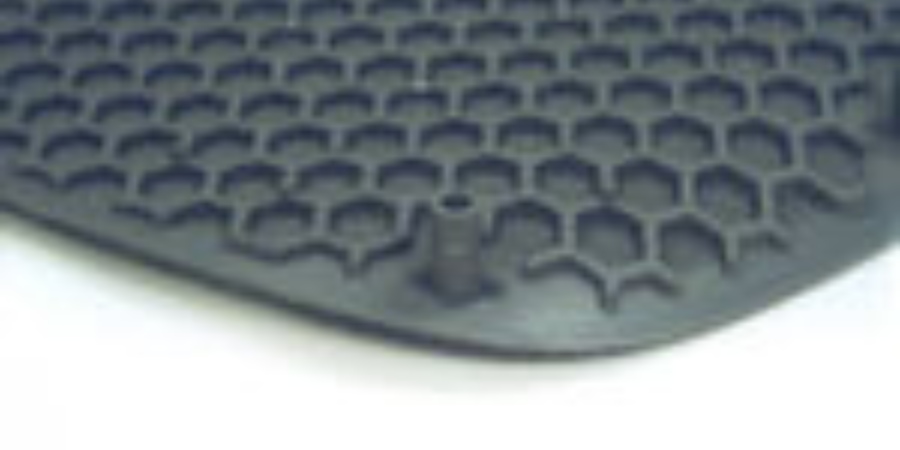
“One look at the back of the part told me it was filled with one sub-gate (see Figure 2). In the US at the time, we were trying to pack out this type of speaker grill with 12-drop systems, which resulted in poor fill and a lot of stress in the piece. In Japan, mouldmakers were using a mould material developed to enhance venting. This was a steel manufactured with interconnecting pores so the gas could pass through the seemingly solid piece of metal. To make this steel, powder metal was combined with metal fibers for added strength, cold-pressed into master blocks measuring 215 by 300 by 650 mm, sintered and heat-treated to 35 HRC. It was available with average pore diameter of either 7 or 20 microns; porosity averaged 25 percent of the mass of the block. Other materials available at the time ranged from porous ceramics to sintered porous vent buttons.”

Read More: The Potential of Enhanced Venting Materials by Tom Schade

Heat Treating Involved in Production of Speakers Read More »

Walking Beam Furnace Energy Savings: New Skid Pipe Insulation Concept

BOTW-50w  Source:  Heat Processing On-Line

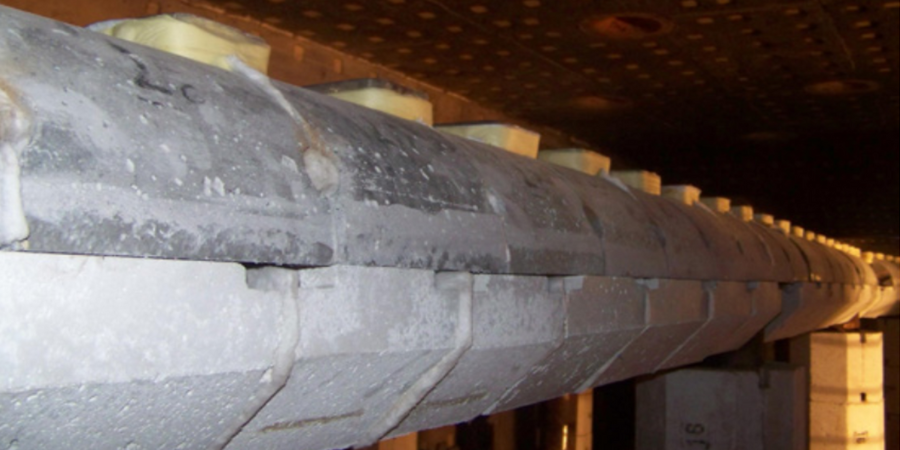
This paper discusses how energy consumption and energy loss can be reduced in reheating furnaces of hot rolling mills by using new lightweight refractory materials and a new lining concept for the skid pipe insulation.

Walking Beam Furnace Energy Savings: New Skid Pipe Insulation Concept Read More »

Heat Treatment Used in Building Conformal Cooling Inserts

BOTW-50w  Source:  MoldMaking Technology

“The process of building conformal cooling inserts can be generally broken up into four steps: 1) simulating the molding process, 2) insert design and optimization, 3) 3D direct metal laser melting, and 4) post processing. Simulation software in the first step allows tool designers to visualize flow capabilities and thermal properties that can cause mold deformation prior to actual production. Cavity block or core block inserts then can be designed with conformal water lines in place, based on simulation results. The layer-by-layer 3D-printing that comes next not only can be completed in a number of materials that match conventional tool steels, but the resulting built-in channels will exhibit outstanding geometric flexibility. Post-processing tasks include stress relief and heat treatment, using EDM to machine the part from its platform base, polishing the part surface, adding water lines, and inspection.”

Read More:  Reshaping Moldmaking by Lou Young

Heat Treatment Used in Building Conformal Cooling Inserts Read More »

PVD Coatings and Tool Steel Selection

BOTW-50w  Moldmaking Technology – July 2016

“When it comes to steel selection, the standard grades and heat-treat cycles might need to be changed depending on the selected PVD coating.  The moldmaker must ensure that the application temperature of the PVD process is lower than the heat-treatment cycle temperature that is used on the steel.

…..too often the customers allow the steel and heat treatment to determine the coating that can be considered. ”

Read More:  PVD Coatings and Tool Steel Selection by Mark Falkingham

PVD Coatings and Tool Steel Selection Read More »

Stainless Steel Can Be Heat -Treated to 50 – 53 HRC

International Mold Steel will introduce S-Star-A, a 420 stainless steel in the annealed condition that can be heat-treated to hardness of 50-53 HRC and will be stocked in plate form to 6″ thick. S-Star-PH is a prehardened (30/34 HRC) 420 stainless steel that can also be heated to 50-53 HRC and will be stocked in round bar ranging to 4″ in diameter.

The company also recently added new processing capabilities, including a large plate saw that can cut to 24″ thickness, side milling to 31.5” square and gun drilling to 1 3/4″ in diameter by 84″ long.

Stainless Steel Can Be Heat -Treated to 50 – 53 HRC Read More »

Integrated Heat Treating Used in Making Steinway Pianos

BOTW-50w  Source:  Modern Machine Shop

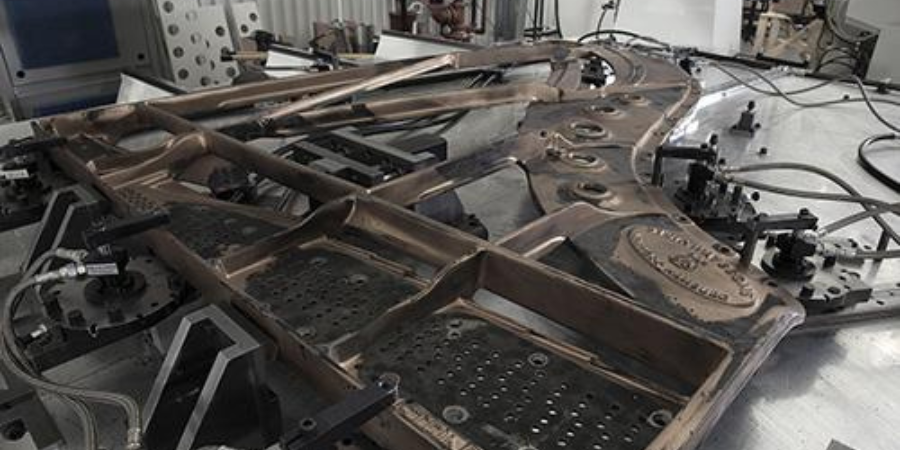
“The company wanted to develop a more streamlined machining method, including integrating a heat-treat process that was currently being performed on secondary equipment. If this could be achieved, it hoped to bring this machining process back to the United States to its foundry location in Springfield, Ohio. This will reduce shipping costs, streamline production, and speed delivery to customers throughout North America.”

Read More:  How Steinway Machines Its Pianos by Russ Willcutt

Integrated Heat Treating Used in Making Steinway Pianos Read More »

Proper Heat Treating Integral to Producing Quality Stainless Steel Parts

BOTW-50w  Source:  Modern Machine Shop

“DON’T forget that an attack can occur in a passivating bath if parts are improperly heat treated. High-carbon, high-chromium martensitic grades must be hardened to become corrosion-resistant.”

Read More: How to Passivate Stainless Steel Parts by Terry A. DeBold and James W. Martin


Proper Heat Treating Integral to Producing Quality Stainless Steel Parts Read More »

Direct-Chill Casting

BOTW-50w  Source:  Total Materia

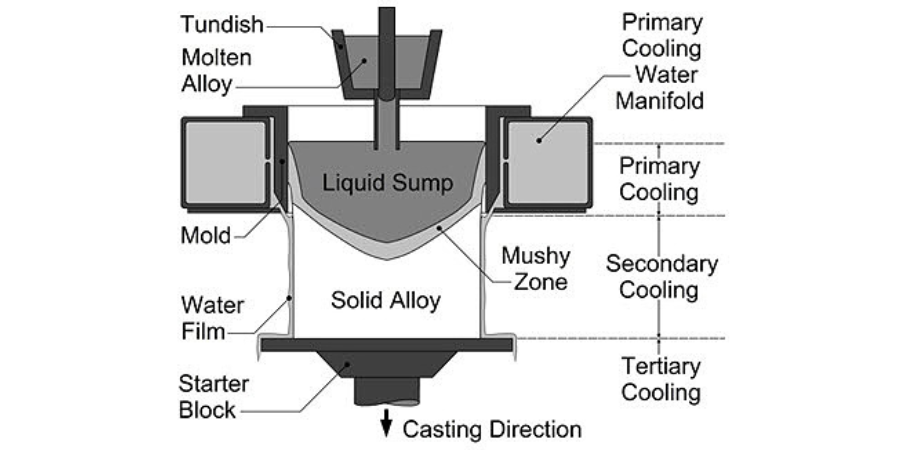
Direct-chill (DC) casting is currently the most common semi-continuous casting practice in non-ferrous metallurgy. The process is characterized by molten metal being fed through a bottomless water cooled mould where it is sufficiently solidified around the outer surface that it takes the shape of the mould and acquires sufficient mechanical strength to contain the molten core at the centre. As the ingot emerges from the mould, water impinges directly from the mould to the ingot surface (direct chill), falls over the cast surface and completes the solidification.

Read More:  Direct-Chill Casting

Direct-Chill Casting Read More »

Making Metal Wires – No Heating Required

BOTW-50w  Source:  Materials Today

“A team of engineers from North Carolina State University looked to eutectic gallium indium (EGaIn) – a metal with a melting point of ∼15.5 °C – to produce thin wires at room temperature. Conventional electrical wires are fabricated by using large forces to repeatedly pull and elongate a metal rod that had been produced at high temperatures. The approach taken by Prof. Michael Dickey and his team is rather different.”

Read More:  Making Metal Wires – No Heating Required

Making Metal Wires – No Heating Required Read More »

Skip to content