



Ask The Heat Treat Doctor® has returned to bring sage advice to Heat Treat Today readers and to answer your questions about heat treating, brazing, sintering, and other types of thermal treatments as well as questions on metallurgy, equipment, and process-related issues. In this installment, Dan Herring explores how to set realistic expectations for heat treatment outcomes, continuing his guidelines for design engineers and their clients. He explains how Jominy curves and H-band steels help predict and narrow hardness variation, why the lowest-hardenability steel that meets requirements best limits distortion, and how chemistry, including manganese sulfide in resulfurized steels and boron additions, affects hardenability and case consistency.
This informative piece was first released in Heat Treat Today’s October 2026 Ferrous & Nonferrous Heat Treatments/Mill Processing print edition.

If you have any comments or queries, on this article, let us know at editor@heattreattoday.com.
Para leer el artículo en español, haga clic aquí.
We continue our series of heat treatment articles offering guidelines focused on getting the job done right, the first time, and every time in the real world. Let’s learn more.
How We Achieve Our Goals (Continued)
As discussed in Part One (People of Heat Treat, September 2026), experienced heat treaters often point to the most common mistakes made by design engineers and/or their clients, that is, selecting materials, defining and understanding the limitations of the requested heat treatment processes, and specifying realistic outcomes from heat treating. These include the desired hardness, case depth, and dimensional tolerances. These issues generally result from a failure to recognize the differences in the material’s chemical composition and form (e.g., wrought or powder metallurgy, castings, forgings). The design engineer should also understand the mill processing methods used to produce the material. Often, the tolerances for the specified heat treatment properties are either too aggressive, ambiguous, or too restrictive from a real-world standpoint. Here are additional basic metallurgical guidelines that can, from a practical standpoint, help avoid these problems (Herring 2014, 2015; SAE International 1989).
Hardenability
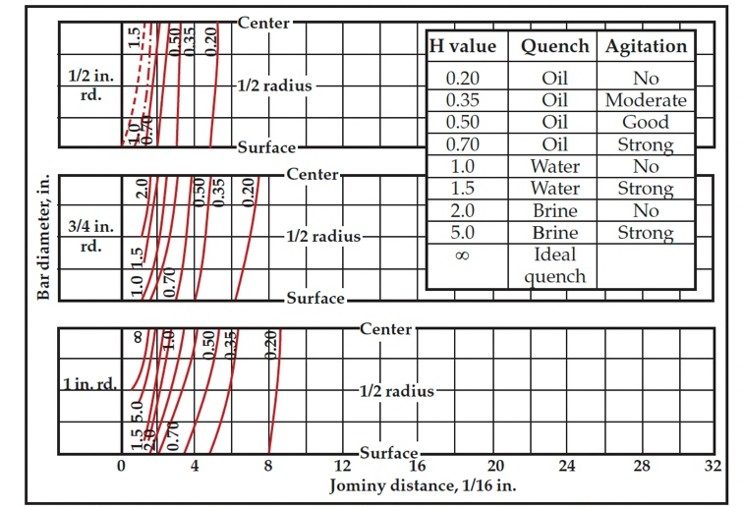
We often need to determine the expected core hardness range, and this can be accomplished by using the Jominy equivalent cooling rate (JEC) chart (Figure 1) and the hardenability band for the steel being used (Figure 2). These curves for 4140H show that using a strong oil quench results in a surface hardness for a 50.8 mm (2 inch) round would be at J4 and the core would at J8.5. The hardenability curves show that the corresponding surface hardness would be 51-59 HRC with a core hardness of 46-57 HRC. The actual hardness for a given heat of steel depends strictly on the specific hardenability (in Jominy or ideal diameter, DI values) for the specific heat from which the component parts were manufactured.
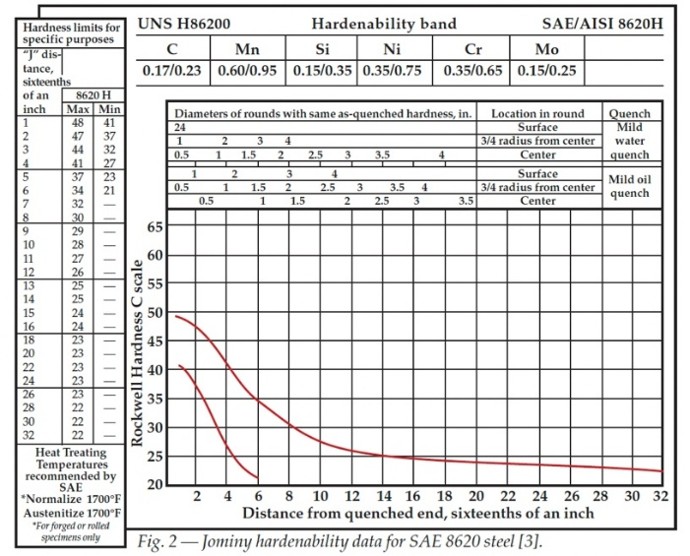
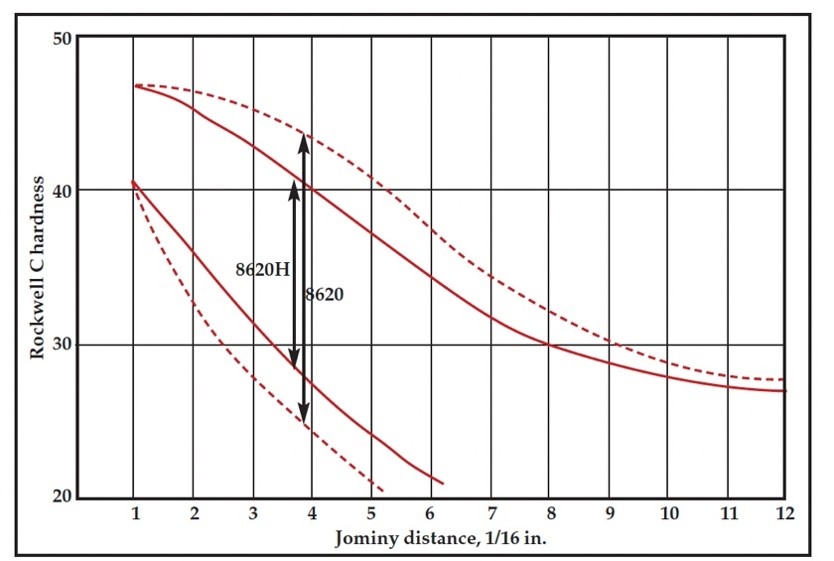
To reduce the variation in hardening response and thus narrow the surface and core hardness values that result after heat treatment, the hardenability of the steel chosen can be narrowed by using an “H-band” steel or using a restricted hardenability “RH-band” steel. For example, there is an effect on hardenability of an 8620 versus 8620H steel (Figure 3). The effect of changing to 8620H for carburized parts having a cross-section less than 25.4 mm (1 inch) is a reduction of up to 30% in the variation in core hardness after heat treatment along with greater dimensional stability.
Generally, the most economical steel that will achieve the desired properties when heat treated should be selected (e.g., surface and/or core hardness, tensile and/or yield strength). It is important to remember that a steel with the lowest hardenability that will still transform to the desired results should be selected to manage part distortion. First, check the maximum attainable hardness chart (Table 1 in Part One) using the carbon range that will give the required surface hardness, from the 95% or 99.9% martensite column, to select the proper steel. Following these guidelines will also result in greater dimensional stability and uniformity after heat treatment.
Influence of Chemistry on Hardenability
Resulfurized Steel-Hardenability Problems
An often-overlooked factor is the type of steel being specified. For example, specifying resulfurized steels for case hardening processes is highly dependent on the interrelationship and reaction of sulfur and manganese, and the design engineer must be aware that this can have a significant effect on both case and core hardenability and microstructure (Herring 2014, 2015; Dosset 2007).
All steels contain a certain percentage of sulfur, but certain high sulfur grades of steels have much larger amounts. Sulfur preferentially combines with some of the manganese to sulfide (MnS) often in the form of stringers. These manganese sulfides serve as a chip breaker and lubricity agent that cause these steel grades to be more machinable than other standard lower sulfur grades. However, the formation of MnS present in the form of inclusions has several negative effects including:
- Reduction of the fatigue limit compared with low sulfur steels and the tendency of “banding” in the steel in the as-rolled condition.
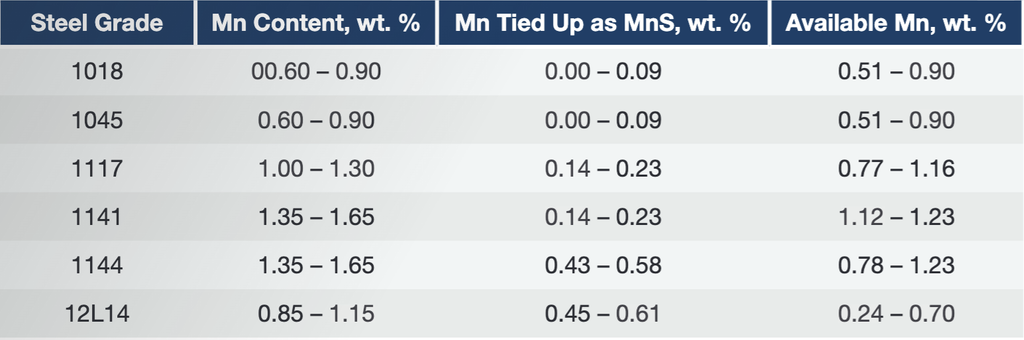
- Diminished hardness as a function of the amount of sulfur present since manganese sulfide lowers the hardenability of the steel. The interaction of manganese and sulfur in forming manganese sulfide is determined by the ratio of atomic weights of Mn (56) and S (32) in the ratio 56/32, that is, 0.0175 wt.% of the manganese combines with each 0.01 wt.% of sulfur present (Table A).
Manganese (and other alloying elements) and grain size influence case and core hardenability. For the steels shown, manganese is the principle alloying element.
In addition, during carburizing or carbonitriding, control of the furnace parameters (time, temperature, and carbon potential) establishes the surface carbon content and carbon profile for a given steel chemistry. However, the effective case depth (to 50 HRC) depends on case hardenability and core hardness, which are dependent on hardenability. Thus, for the same total case carbon profile, the higher the case hardenability, the higher the effective case. For this reason, effective case depth variations for resulfurized materials are significantly greater than those for nonresulfurized steels.
The final negative effect of case hardening resulfurized steels is the large variation in case microstructure (principally with regard to retained austenite) for the same heat treatment. The problem can be attributed to the variation in manganese levels due to varying amounts of sulfur present.
Boron Steels
Boron steels improve hardenability by adding a minute quantity of boron. It is generally accepted that a hardenability peak is reached when the amount of boron ranges between 3 and 15 parts per million (ppm). If an excessive amount of boron (>30 ppm) is present, the boron constituents become segregated in the austenite grain boundaries, which not only lowers hardenability but may also decrease toughness, cause embrittlement, and produce hot shortness. The effect of boron on hardenability also depends on the amount of carbon in the steel being inversely proportion to the percentage of carbon present (Herring 2007).
Boron must be in its atomic state to improve hardenability, which means that care must be taken during steel production for the boron to be effective. Boron may also become ineffective if its state is changed by incorrect heat treatment. For example, high austenitizing temperatures must be avoided, as well as temperature ranges where certain boron precipitates occur.
Hardenability is highly dependent on the behavior of oxygen, carbon, and nitrogen present in the steel. Boron reacts with oxygen to form boron oxide (B₂O₃); with carbon to form iron borocementite (Fe₃(CB)) and iron borocarbide (Fe₂₃(C,B)₆); and with nitrogen to form boron nitride (BN). Loss of boron due to combination with oxygen is prevented by making the boron addition to silicon- or aluminum-killed steels and by using good ladle and mold practices.
Strong nitride formers (titanium, aluminum, zirconium) protect the boron from reaction with nitrogen. For example, if nitrogen is fixed by using titanium, satisfactory hardenability is obtained in the temperature range up to 1830°F (1000°C) provided that the steel contains about 5-20 ppm of boron. When specifying boron steels, many companies report that a minimum 3:1 and even 4:1 ratio is desirable to avoid the problem of “ineffective” boron. The hardenability of boron steel is also closely related to austenitizing conditions and is generally said to decrease by heating above 1830°F (1000°C). Boron steel must also be tempered at a lower temperature than other alloy element steels of the same hardenability.
Next month, we will discuss total and effective case depth and set reasonable expectations for hardness values and achievable part tolerances.
References
Dossett, Jon. 2007. “Make Sure Your Specified Heat Treatment Is Achievable.” Heat Treating Progress (March/April).
Dossett, Jon. 2025. Private conversation.
Herring, Daniel H. 2007. “Boron in Steel.” Industrial Heating, May 2007.
Herring, Daniel H. 2014. Atmosphere Heat Treatment. Vol. 1. Troy, MI: BNP Media Group II.
Herring, Daniel H. 2015. Atmosphere Heat Treatment. Vol. 2. Troy, MI: BNP Media Group II.
SAE International. 1989. SAE Handbook. Vol. 1, Materials, 1.72.
TimkenSteel Corporation. 2014. Practical Data for Metallurgists. 17th ed., 64.
About the Author

“The Heat Treat Doctor®”
The HERRING GROUP, Inc.
Dan Herring has been in the industry for over 50 years and has gained vast experience in fields that include materials science, engineering, metallurgy, new product research, and many other areas. He is the author of six books and over 700 technical articles.
For more information: Contact Dan at dherring@heat-treat-doctor.com.
For more information about Dan’s books: see his page at the Heat Treat Store.