

Fabrication processes can introduce stresses that compromise the magnetic performance of electrical steel. In this Technical Tuesday installment, Tim Donofrio, VP of Sales at CAN-ENG Furnaces International Ltd., explores how precision thermal processing — from temperature and atmosphere control to furnace design and process repeatability — can help recover those properties and support efficient, reliable motors, generators, and transformers.
This informative piece was first released in Heat Treat Today’s October 2026 Ferrous & Nonferrous Heat Treatments / Mill Processing print edition.
Introduction
The rapid growth of electrification is driving demand for higher-performing electric motors, generators, transformers, and other electromagnetic equipment. Electric vehicles, industrial automation, renewable energy, data centers, and expanding electrical grid infrastructure are all pushing manufacturers toward greater efficiency, higher power density, and improved reliability.
At the heart of these systems is the magnetic core, manufactured from electrical steel specifically engineered to provide the magnetic properties required for efficient electromagnetic performance. Electrical steel, commonly referred to as silicon steel, is designed to minimize losses when subjected to alternating magnetic fields. The addition of silicon increases electrical resistivity, reducing eddy-current losses and improving magnetic efficiency.
Two primary grades are used in these applications. Non-oriented electrical steel (NGO) provides relatively uniform magnetic properties in all directions and is widely used for rotating equipment such as motors and generators. Grain-oriented electrical steel (GO) is processed to preferentially align its crystal grains, so that their preferred magnetic direction lies primarily along the rolling direction, making it particularly suited for stationary transformer cores.
While these properties are established during steel production, they can be affected as the material is converted into laminations and assembled into finished cores. Punching, shearing, laser cutting, stacking, interlocking, welding, and other fabrication processes can introduce localized deformation and residual stress, potentially resulting in:
- Increased core loss
- Reduced magnetic response and permeability
- Increased heat generation
- Reduced efficiency
- Variation in finished-core performance
Addressing the Stress
One of the primary functions of thermal processing is to reduce residual stress introduced during fabrication and assembly. Punching and shearing can produce localized plastic deformation, particularly near cut edges. Forming, stacking, clamping, and assembly can introduce additional stresses throughout the core. Although these stresses may have little structural significance, their effect on magnetic behavior can be substantial.
Mechanical stress can interfere with how electrical steel responds to a magnetic field. A properly developed annealing cycle promotes material recovery and stress relief, allowing the electrical steel to respond more closely to its intended magnetic characteristics. The degree of recovery depends on the steel grade, lamination thickness, fabrication method, degree of deformation, core geometry, and processing history. The heat treatment process restores magnetic properties in the material; it provides an opportunity to recover properties that have been compromised during fabrication.
Developing the Thermal Process
Achieving consistent magnetic property recovery requires more than heating the material to a specified temperature. The thermal cycle must be developed around the electrical steel grade, fabrication history, core configuration, and required final properties.
Key variables to be considered include:
- Steel grade, quality, and lamination thickness
- Cutting and fabrication methods
- Degree of deformation
- Core geometry and loading configuration
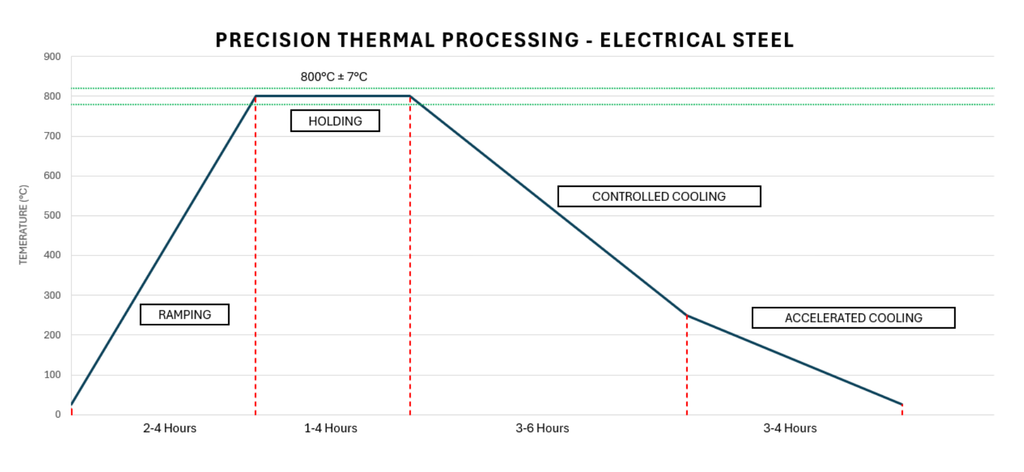
- Heating rate and soak time
- Controlled cooling rate
- Temperature uniformity and thermal gradients
- Furnace atmosphere and dew point
- Surface condition and oxidation requirements
- Desired magnetic properties
There is no universal heat treatment cycle for every electrical steel application. Temperature, time, atmosphere, heating and cooling rates, and load configuration must be established for the specific product and process. This is where furnace design and layout become an integral part of process development to ensure the system can deliver the required thermal and atmosphere conditions uniformly and repeatedly across densely packed heat treat loads.
Dimensional Stability and Load Uniformity
Electrical steel laminations are thin and dimensionally sensitive. Residual stresses can cause dimensional changes when the material is subsequently exposed to elevated temperatures. A controlled thermal cycle can relax these stresses while minimizing unwanted movement. Heating and cooling must also be carefully managed to limit thermal gradients and differential expansion. This is particularly important with large transformer cores, where substantial thermal mass can create significant temperature differences between the interior and exterior of the load.
Excessive gradients can introduce additional stress or distortion. For this reason, temperature uniformity throughout the product is often as important as the furnace temperature itself to achieve stress relief without uncontrolled dimensional change.
Process Consistency and Repeatability
The effectiveness of precision thermal processing ultimately depends on repeatability. Variations in the manufacturing process and assembly can result in different initial stress conditions. A properly engineered furnace must establish a consistent thermal history from load to load. Precision thermal processing of electrical steels ensures monitoring and control of the following parameters:
- Furnace and product temperature
- Heating and cooling rates
- Soak time
- Atmosphere composition
- Dew point and oxygen concentration
- Furnace pressure
- Gas flow
- Cycle time
This allows manufacturers to move beyond simply controlling furnace temperature and instead control the thermal history experienced by the product, ensuring consistent core performance. For high-volume motor production, this repeatability supports consistent quality across large production volumes. For large transformer cores, it provides greater confidence that the entire load has received the required thermal treatment.
The Importance of Product Temperature
One of the most important considerations in electrical steel heat treatment is the difference between furnace temperature and actual product temperature. A furnace controller may indicate that the chamber has reached setpoint while the center of a large core remains substantially cooler. The material responds to its actual thermal history, not the temperature displayed by the furnace controller.
Product temperature measurement and temperature mapping are therefore important tools for process development and validation. They can establish:
- Heating rate and thermal lag
- Minimum and maximum product temperatures
- Temperature uniformity throughout the load (± 7°C in some cases)
- Effective soak time
- Cooling response
Furnace design has a significant influence on these characteristics. Heat source location, position and orientation, along with preheating zones and load arrangement, can all be optimized to improve heat transfer and temperature uniformity. Forced recirculation, convective heating, atmosphere distribution, and atmosphere preheating methods can be used to optimize furnace performance.
Designing the Furnace Around the Product
Electrical steel applications vary considerably, and the thermal processing system must reflect those differences. Motor laminations and large transformer cores can have very different thermal characteristics. Product geometry, lamination thickness, thermal mass, and loading arrangement all influence furnace design. Other considerations include stamping oil burn-off requirements, product spacing, heating method, atmosphere, throughput, and cycle time.
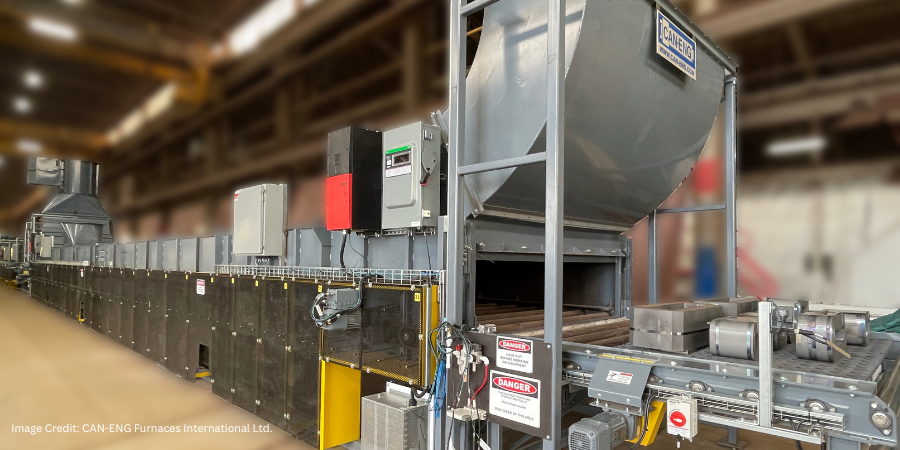
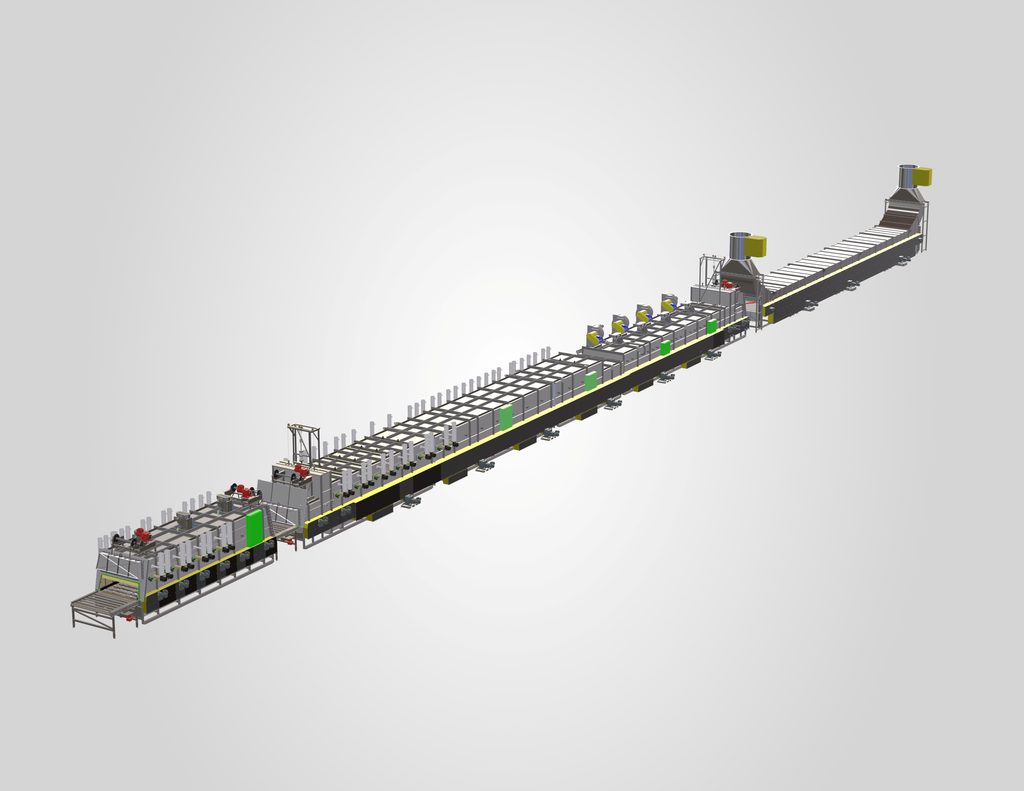
Batch furnaces can provide the flexibility required for large transformer cores, varying product sizes, and lower-volume production. Continuous systems can offer advantages for high-volume motor lamination production where throughput, repeatability, automated handling, and operating efficiency are priorities.
The appropriate furnace capacities can range from 5,000 lbs/hr to over 20,000 lbs/hr. The configuration, overall length, and floorspace requirements are ultimately determined by the product and thermal process requirements.
Atmosphere Control
Furnace atmosphere can also influence the surface condition and metallurgical response of electrical steel. Depending on the material and process, important variables may include incoming material contamination, gas composition, dew point, furnace pressure, gas flow, leakage, purging, and exhaust conditions. Stable atmosphere conditions help maintain a consistent environment throughout the cycle.
Energy Efficiency
Recovering magnetic performance and reducing core loss can improve the operating efficiency of motors and transformers. The furnace itself can also be designed to reduce energy consumption through effective insulation, efficient heating systems, auto-recuperative heating, optimized atmosphere flow and preheating, improved load utilization, reduced idle time, and appropriate cycle times.
The goal is not simply to minimize furnace energy consumption, but to achieve the required magnetic and metallurgical results with the least practical energy input.
An unnecessarily long cycle consumes energy without necessarily improving the product, while an inadequate cycle may fail to achieve the required recovery. The best process balances energy consumption with the required product performance.
From Furnace Temperature to Product Performance
Electrical steel heat treatment is moving beyond simply controlling furnace temperature. The more meaningful objective is controlling the thermal history experienced by the product. This means understanding how quickly the load heats, how long it remains at temperature, how uniform the temperature is throughout the load, and whether the product actually receives the intended cycle.
Enhanced real-time Level II Supervisory Control and Data Acquisition (SCADA) systems are critical to understanding and controlling a product’s thermal history. Product parameter monitoring and historical event tracking provide manufacturers with greater insight into process performance, allowing precision thermal processing cycles to be refined and optimized for different product configurations and required performance standards.
For the furnace designer, this changes the role of the equipment. The furnace is no longer simply a device for supplying heat. It is a precision thermal processing system designed to deliver a controlled and repeatable thermal environment to the product.
Conclusion: Enabling the Potential of Electrical Steel
The continued growth of electrification is placing greater demands on the performance of motors, generators, and transformers. Electrical steel provides the magnetic foundation for these systems, but its properties can be compromised during lamination and core manufacturing process. Properly developed thermal processing provides an opportunity to recover properties inherent in the original material.
Achieving this consistently requires more than a furnace capable of reaching a specified temperature or atmosphere condition. The thermal process must consider the steel grade, incoming cleanliness condition, fabrication history, product geometry, thermal mass, loading configuration, atmosphere, heating and cooling characteristics, and required final properties. The furnace must then be designed to deliver optimal conditions uniformly and repeatably throughout the load. As electrification continues to expand and efficiency requirements become more demanding, precision thermal processing will play an increasingly key role in extracting the full potential of electrical steel.
About The Author:

VP of Sales
CAN-ENG Furnace International Ltd.
Tim Donofrio has almost 40 years of experience working in the forging, heat treatment services, and equipment market sectors. He joined CAN-ENG Furnaces International, Ltd. in 1998 and has been the VP of Sales since 2016.
For more information: Contact Tim Donofrio at tdonofrio@CAN-ENG.com.