
Ask The Heat Treat Doctor® has returned to bring sage advice to Heat Treat Today readers and to answer your questions about heat treating, brazing, sintering, and other types of thermal treatments as well as questions on metallurgy, equipment, and process-related issues. In this installment, Dan Herring explores the optimal dew point for running an endothermic gas generator — comparing the low dew point practices of decades past with today’s modern operating range of +40°F to +45°F — and explains how dew point, temperature, and air/gas ratio affect catalyst life, generator maintenance, and the stability of the process gas.
This informative piece was first released in Heat Treat Today’s July 2026 Annual Super Brands Issue print edition.
A critical consideration in heat treatment is the type, consistency, and control of the furnace atmosphere. The purpose of a furnace atmosphere varies with the desired end result, so it begs the question if there is an optimal dew point to operate an endothermic gas generator to balance gas quality, performance, and maintenance life. Let’s learn more.
Purpose of an Endothermic Gas Atmosphere
In general, furnace atmospheres are used:
- To protect the components being processed from chemical reactions that could occur on their surfaces (e.g., oxidation or carburization), that is, to be passive (chemically inert) to the metal surface.
- To interact with the surface of the component (e.g., adding carbon, or nitrogen, or both), that is, to be reactive (chemically active) to the metal surface.
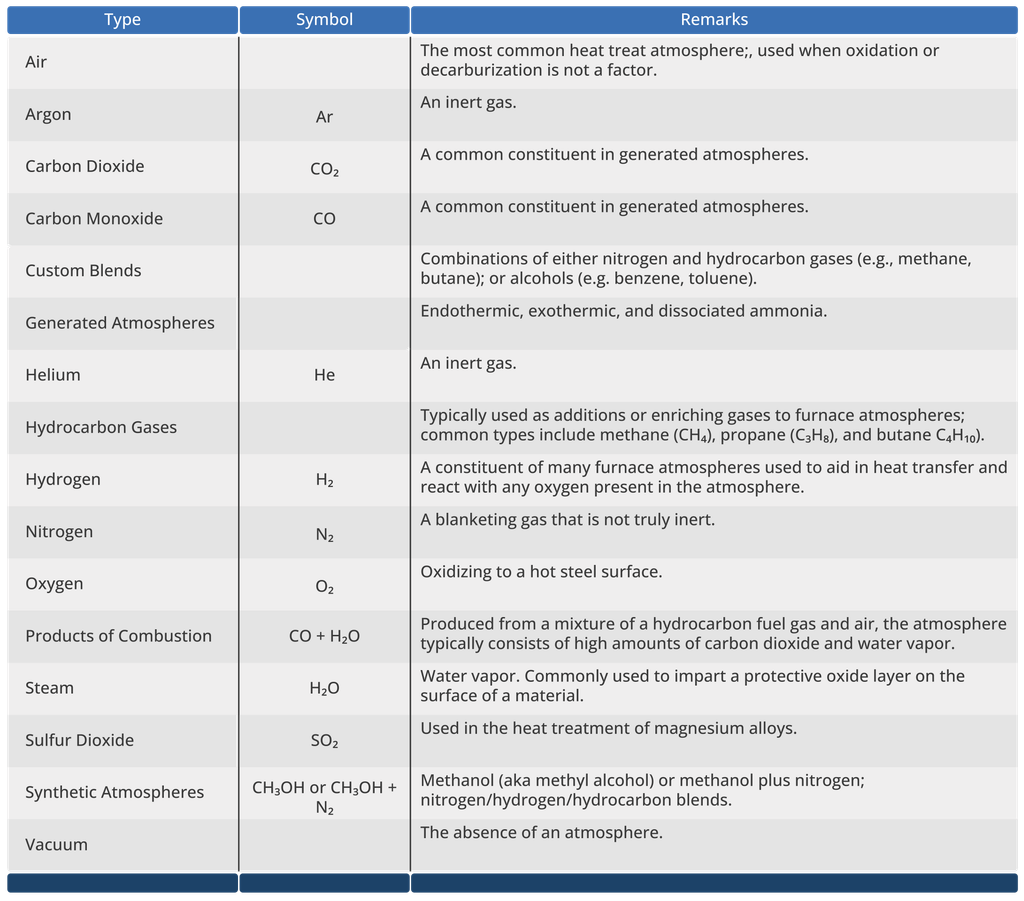
There are many types of furnace atmospheres available for use in heat treating (Table A). By far, one of the most common is endothermic gas.
Endothermic Gas Atmospheres
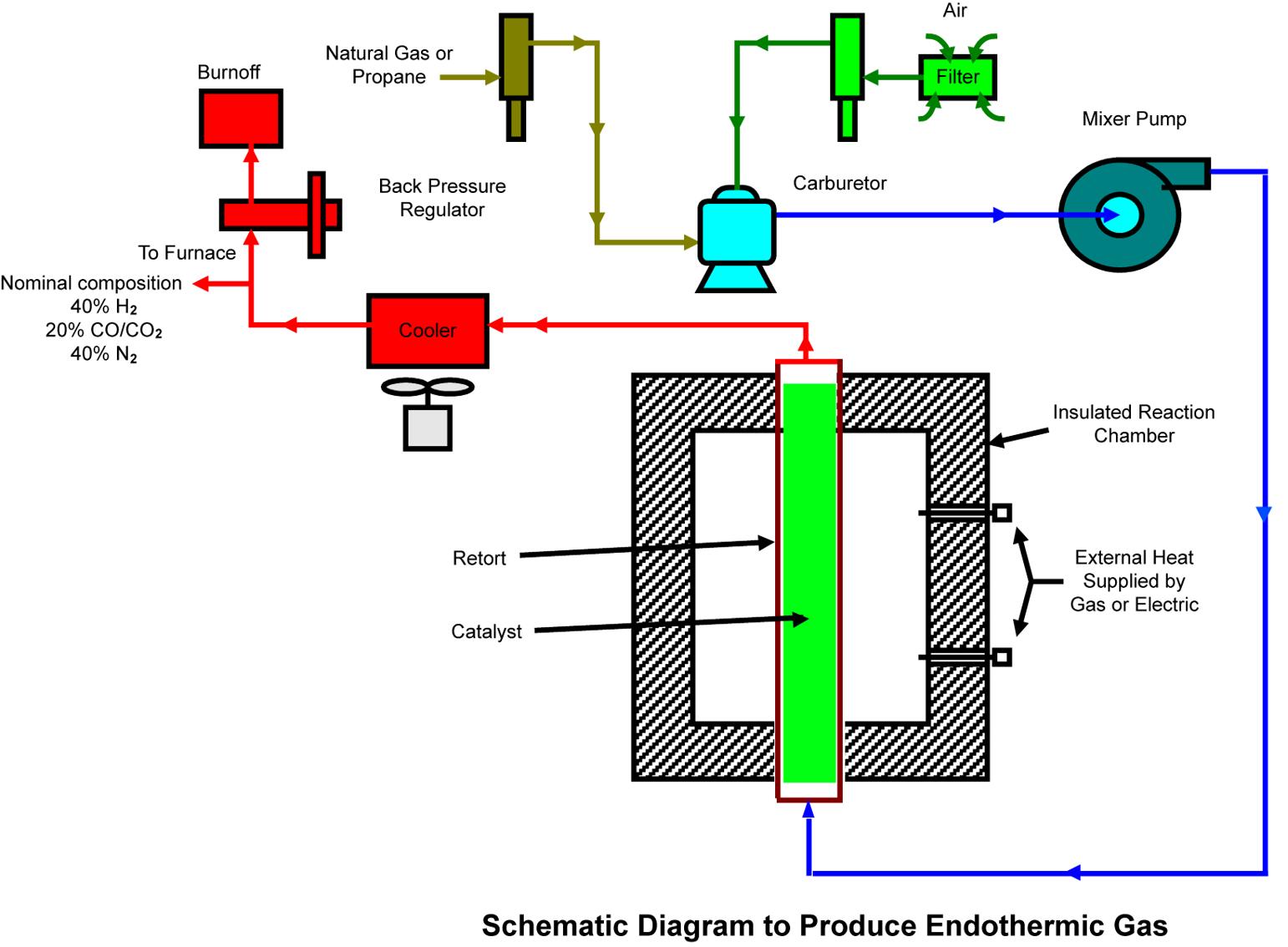
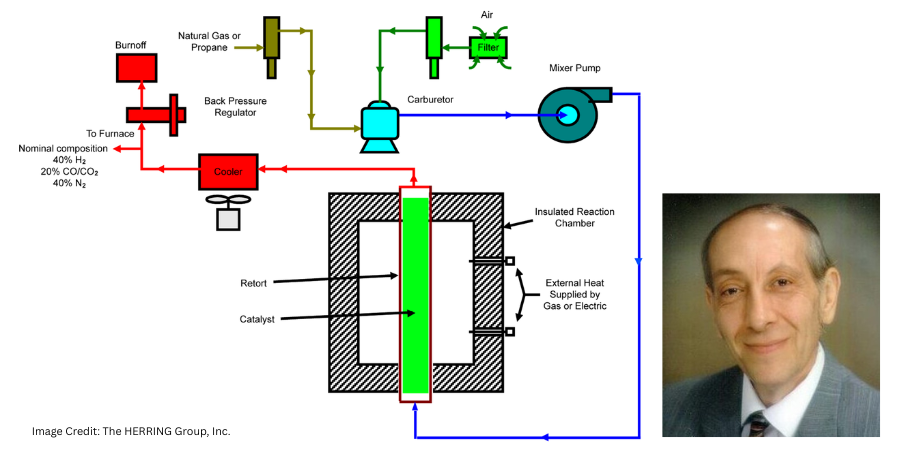
Endothermic gas generators are common equipment in the heat treat shop, with one of the most well-known generators being the RX®. The main components of an endothermic gas generator (Figure 1) are relatively simple, consisting of:
- Heated reaction retort with catalyst
- Air-gas proportioning control components
- Pump to pass the air-gas mixture through the retort
- Cooler to “freeze” the reaction and prevent soot formation
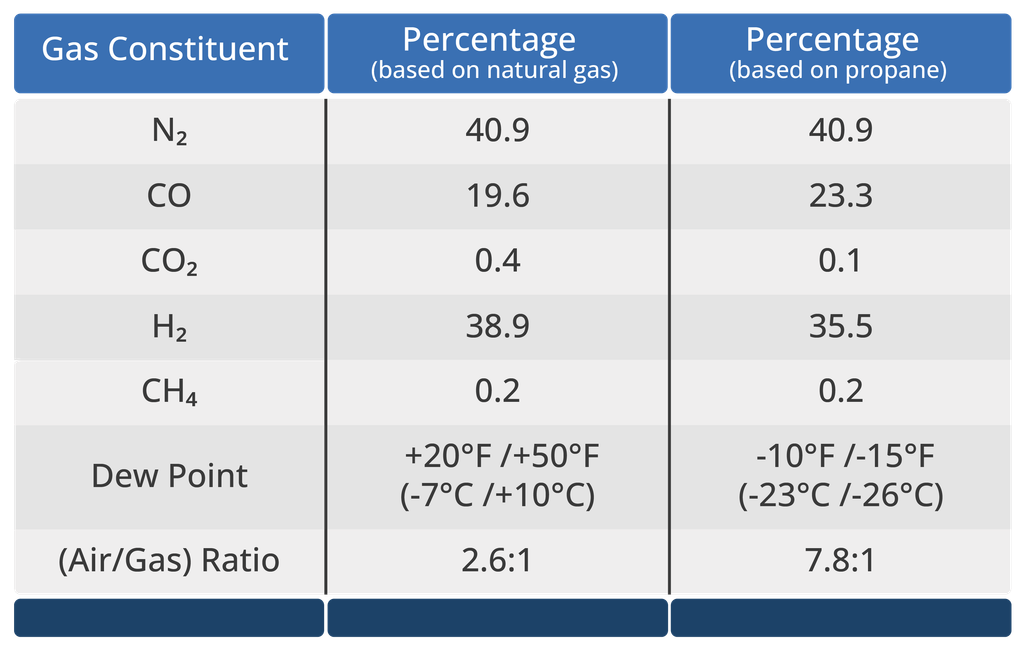
Endothermic gas (aka endo) is produced when a mixture of air and fuel is introduced into an externally heated retort at such a sufficiently low air-to-gas ratio that it will normally not burn. The retort contains an active catalyst, which aids in cracking the mixture. Leaving the retort, the gas is cooled rapidly to avoid carbon reformation (in the form of soot) before it is sent to the furnace. The endothermic gas composition (Table B), by volume, varies depending on the type of hydrocarbon gas feed stock.
Endothermic gas is typically used for applications such as neutral hardening gas carburizing and carbonitriding (as a carrier gas), and for certain types of brazing to name a few. It is generally produced so that its composition is chemically inert to the surface of the steel and can be made chemically active by the addition of enrichment (hydrocarbon) gas that is usually added at the furnace.
What is the Optimal Generator Dew Point?
A reader asked this important question: “I’m doing some searching on endothermic gas generation and the advantages/disadvantages of low/high dew point set points. We normally run a dew point of +50°F in our generator and have had success historically. We installed a new generator and were told to drop the dew point to +40°F as this would extend the life. Do you have any experience, or can you point me to any references listing some of the pros and cons of running lower and higher dew points?”
Past Thinking
The operating philosophy in yesterday’s heat treat shop was to run the generators at a low dew point, typically in the range of +30°F to +35°F, so that gas (or air) additions at the furnace could be minimized. The belief was that the furnace atmosphere was much more responsive at this range and controlling certain processes (e.g., carburizing) was easier.
The nickel content of the catalyst years ago varied by manufacturer but was typically in the 5–7.5% range. Given the operating parameters used, it was mandatory to run weekly air burnout cycles to minimize soot formation in the catalyst bed, which took place quickly at these low dew points. The catalyst also needed to be changed on average about every 12 months. This dew point range was considered a good compromise for heat treat shops that ran both carburizing and neutral hardening.
As a parenthetical note, the very first endothermic gas generators (which were charcoal fired) used 100% nickel balls as a catalyst.
Current Thinking
Today, and for roughly the last 20+ years, the “modern” thinking is to run endothermic gas generators at temperatures in the range of 1900°F–2000°F, depending on the manufacturer’s design and the materials and size (diameter and length) of the retort. Air/gas ratios (for natural gas) should be between 2.5:1 to 3.5:1 (Figure 2). Ratios as low as 2.0:1 can be run at higher generator operating temperatures. Gas and/or air additions are then done at the furnace for better process control.
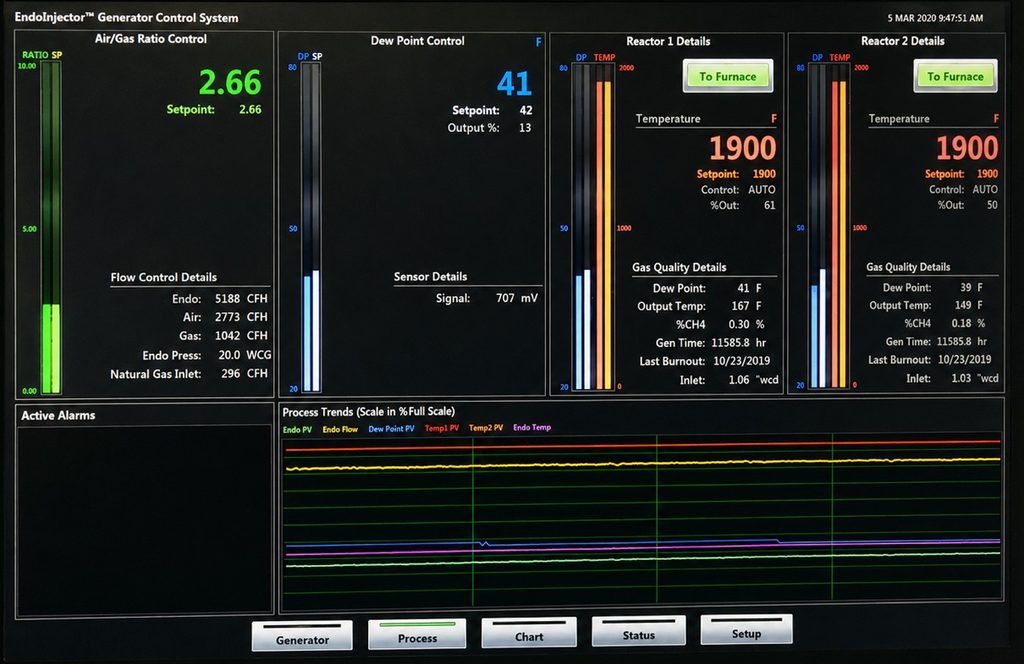
Experience has shown that a generator running at 1900°F with an air gas ratio between 3.0:1 and 3.5:1 and an output dewpoint of +42°F provides the best combination of a stable process gas and maximum generator life.
A generator dew point range held between +40°F and +45°F reduces maintenance on the generator and decreases the frequency of performing air burnouts of the catalyst bed, which at these dew points only needs to be done approximately once a month. It also extends the life of the catalyst (upwards of 2+ years) and makes it easier for the modern controls to regulate the system. Remember, however, that gas transmission from the generator to the furnace can often raise the incoming furnace dew point by +5°F to +10°F.
The advantage of performing air burnouts less often is that the nickel coated catalyst lasts longer. A major reason for this is that today’s catalyst averages around 3% nickel. The catalyst is insulating firebrick dipped in a nickel sulfate bath to allow nickel absorption on the outer surfaces of the cubes or spheres.
Miscellaneous Remarks
One must be very careful when running dew points at +50°F or above. In the writer’s experience, the gas is much more unstable, the water (moisture) content of the gas can rise quicker than one might anticipate, and you can literally start “raining water” inside the furnace or in the transmission lines. In literally minutes, the endo dew point can rise from +50°F to +70°F if one is not careful.
In Summary
The subject of endothermic gas generators never grows old. The key to their success is finding an operating dew point that provides both a stable process gas and little maintenance downtime. However, planned preventative maintenance is still required and should be performed on a schedule determined by the number and type of problems that arise.
A future column will discuss specifics of generator control, and we will broaden the subject by providing a guideline to the selection of furnace atmospheres in heat treating, brazing, and sintering. Look for it in next month’s publication.
References
Herring, Daniel H. 2015. Atmosphere Heat Treatment, Volume II, BNP Media Group.
Herring, Daniel H. 2009. “Furnace Atmosphere Considerations During Heat Treating”, Furnaces International, March/April.
Herring, Daniel H. “Understanding Furnace Atmospheres, Atmosphere Operation and Atmosphere Safety,” Heat Treating Hints, Vol. 1 No. 7. Manuscript forthcoming.
About the Author

“The Heat Treat Doctor®”
The HERRING GROUP, Inc.
Dan Herring has been in the industry for over 50 years and has gained vast experience in fields that include materials science, engineering, metallurgy, new product research, and many other areas. He is the author of six books and over 700 technical articles.
For more information: Contact Dan at dherring@heat-treat-doctor.com.
For more information about Dan’s books: see his page at the Heat Treat Store.