

Inductor design plays a critical role in heating efficiency, temperature uniformity, and process stability, but conventional manufacturing methods can limit what coil geometries are possible. In this Technical Tuesday installment, Max Wissing, technology manager at PROTIQ, explores how 3D-printed copper inductors expand design freedom, allowing heat treaters to more closely tailor electromagnetic fields, cooling, and overall coil performance to demanding applications.
This informative piece was first released in Heat Treat Today’s October 2026 Ferrous & Nonferrous Heat Treatments/Mill Processing print edition.
Why Inductor Design Matters More Than Ever
Induction heating remains one of the most established and widely used technologies in modern heat treating. It enables precise, contactless energy transfer and offers a high degree of repeatability, making it particularly suitable for demanding applications, such as surface hardening, partial hardening, and localized treatment of highly stressed components.
At the same time, requirements in industrial heat treatment continue to increase. Manufacturers are expected to improve energy efficiency, reduce cycle times, and maintain consistent process quality. These demands are further intensified by the growing complexity of component geometries, which require more precise control of electromagnetic fields and temperature distribution than ever before.
Within this context, the inductor itself becomes a decisive factor, as its design directly influences heating behavior, efficiency, and process stability. However, many conventional inductors are still constrained by the limitations of their manufacturing methods. These constraints often force compromises between manufacturability and functional performance, meaning that coil geometries are not always ideally adapted to the component or the specific heat treat application. In more complex cases, this can lead to reduced energy efficiency or non-uniform temperature distributions, ultimately affecting process consistency.
In response, recent developments have increasingly focused on application-driven coil design and improved engineering approaches. Industrial 3D printing introduces a fundamentally different paradigm by enabling inductors to be designed according to functional requirements rather than production constraints. This shift opens up new possibilities for optimizing electromagnetic field distribution, improving energy transfer, and enhancing overall process performance in induction heat treating.
Where Conventional Coil Design Reaches Its Limits
Traditional induction coils are typically manufactured by bending and assembling copper tubes or machined elements. These methods are well established and widely used, but they impose inherent restrictions that can limit further optimization.
Geometric flexibility, for example, is constrained by bending radii and available tube profiles. As a result, the coil design often represents a compromise between what is theoretically optimal and what can be manufactured. In more complex applications, this can lead to non-uniform heating or less efficient energy coupling.
In addition, conventional manufacturing involves a considerable degree of manual work, which can introduce variability. Small deviations in geometry may affect electromagnetic behavior and, consequently, process consistency. The presence of joints — created through soldering or welding — further introduces potential weak points that can impact durability under thermal and mechanical stress.
Taken together, these factors not only influence manufacturing efficiency but also define the performance limits of the entire induction heating process.
3D Printing as a Design Enabler
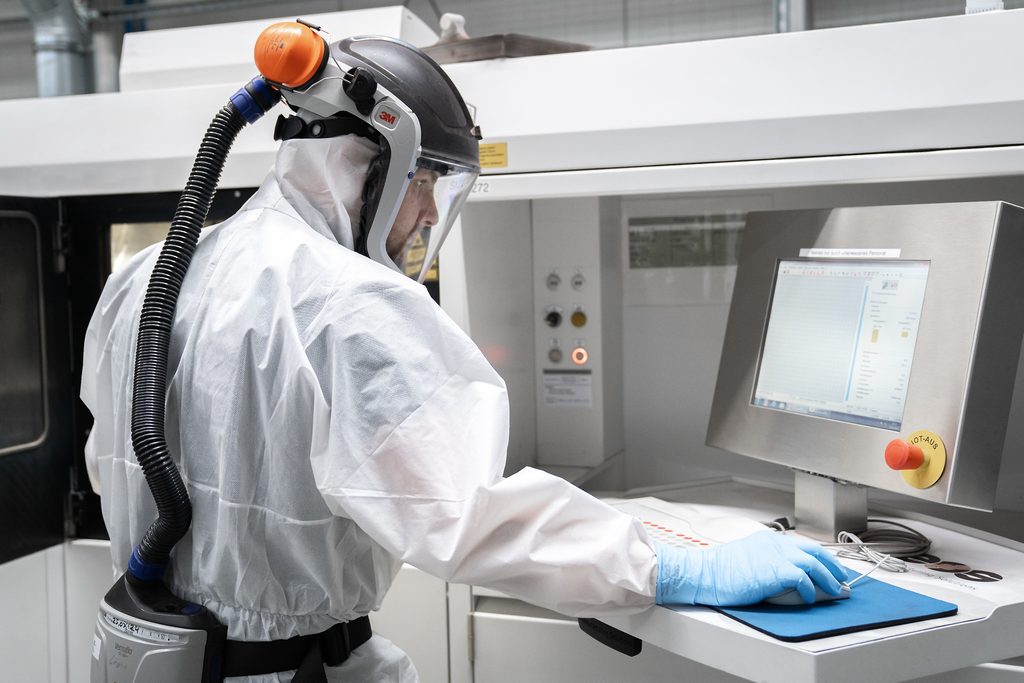
Additive manufacturing, often referred to as industrial 3D printing, is a production technology that creates metal components directly from digital design data. In processes like laser powder bed fusion (LPBF, often called SLM), a high-power laser selectively melts thin layers of metal powder. By repeating this process layer by layer, complex metal parts can be produced without the need for molds, tooling, or many of the manufacturing steps associated with conventional production methods.
This manufacturing approach offers a fundamentally different level of design freedom. Traditional manufacturing processes often require designers to adapt component geometries to machining, forming, or joining constraints. With additive manufacturing, many of these restrictions can be reduced or eliminated, allowing engineers to focus more directly on the functional requirements of the heat treatment application.
For induction heating, this means that the geometry of the inductor can be tailored more closely to the desired electromagnetic field distribution and heating characteristics. As a result, component design, process requirements, and performance objectives can be aligned more effectively.
Another important advantage is the ability to manufacture inductors as monolithic components. Instead of assembling multiple individual parts, the inductor can be produced in a single piece. This eliminates joints that may act as potential mechanical weak points while also enabling the integration of internal features, such as cooling channels. These channels can follow complex three-dimensional paths that would be difficult or impossible to realize with conventional manufacturing methods, enabling more targeted and efficient thermal management.
Impact on Induction Heating Performance
The increased design freedom enabled by additive manufacturing translates directly into improved process performance. When the geometry of the inductor is closely matched to the component, the electromagnetic field can be shaped more precisely. This allows for a more uniform temperature distribution, which is essential for achieving consistent material properties in heat treated parts.
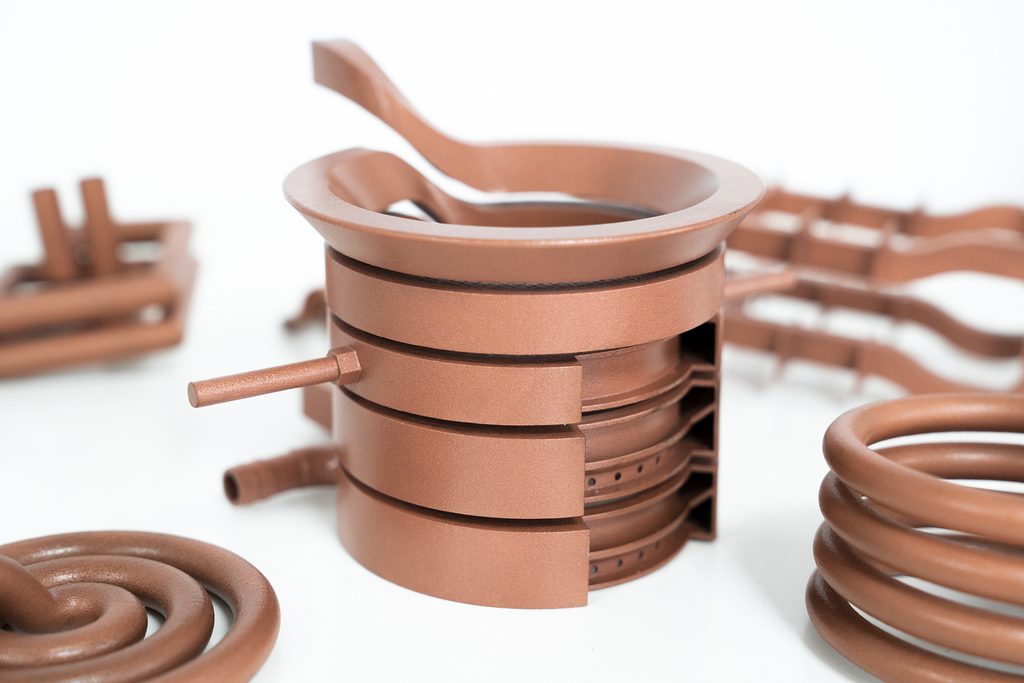
Optimized geometries also improve the coupling of energy into the workpiece. In practical terms, this means that the required heating energy can be delivered more efficiently, often resulting in shorter cycle times. At the same time, improved cooling concepts help stabilize the process by keeping the inductor within its operating limits, even under demanding conditions.
Because additive manufacturing allows components to be reproduced with high accuracy, it also supports consistent process results. Compared to manually fabricated coils, this reproducibility reduces variability and contributes to overall process stability. The absence of soldered or welded joints can further increase service life, as common failure mechanisms are eliminated by design.
Copper in Additive Manufacturing: From Challenge to Application
Copper is the preferred material for induction coils due to its high electrical conductivity. However, its processing in laser-based additive manufacturing systems has long been considered challenging. The high reflectivity of copper and its thermal conductivity make it difficult to achieve stable and efficient melting during the build process.
In recent years, these challenges have been addressed through advances in machine technology, laser systems, and material development. Today, it is possible to manufacture copper components with properties suitable for demanding industrial applications, including conductivity levels comparable to conventional materials.
Despite this progress, successful implementation still requires a detailed understanding of both material behavior and process conditions. The interaction between geometry, material properties, and manufacturing parameters must be carefully considered to ensure that the final component meets both functional and mechanical requirements.
Companies such as PROTIQ have developed extensive experience in processing pure copper by additive manufacturing. This knowledge helps ensure stable production processes and application-oriented solutions for demanding industrial components like inductors.
Bridging Design and Reality Through Simulation and Experience
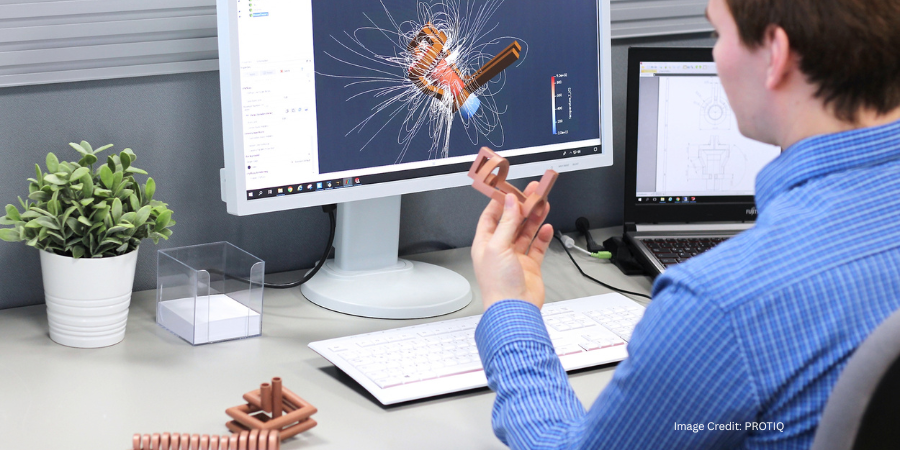
Simulation tools are an important element in the development of modern inductors. They provide insights into electromagnetic field distribution and thermal behavior, allowing engineers to evaluate and optimize designs before manufacturing.
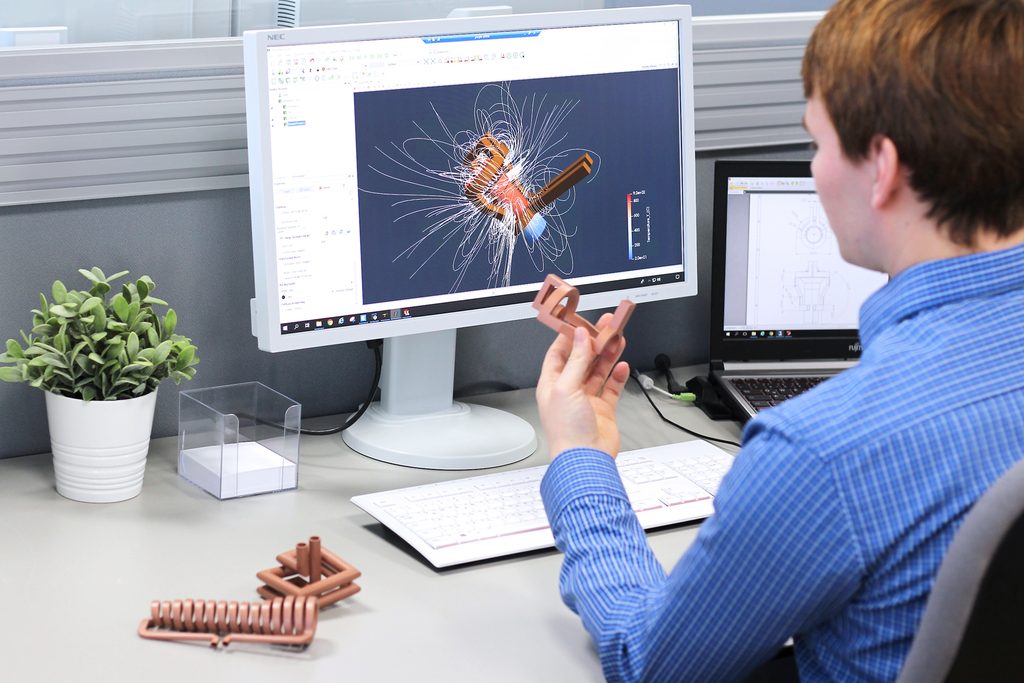
However, simulation alone cannot fully predict how a component will perform under real operating conditions. Factors, such as material characteristics, surface quality, and manufacturing tolerances, can influence actual results. For this reason, experience in both additive manufacturing and induction applications remains essential.
In practice, effective inductor development is based on a combination of simulation, engineering expertise, and manufacturing know-how. This integrated approach helps ensure that theoretical designs can be translated into reliable solutions for industrial use.
Typical Applications in Heat Treating
The advantages of additively manufactured inductors become particularly evident in applications where conventional designs reach their limits. This is often the case in the heat treatment of components with complex geometries or varying cross-sections, where uniform heating is difficult to achieve.
In surface hardening processes, for example, tailored coil geometries can improve the consistency of hardness profiles across critical areas. Similarly, localized hardening applications benefit from the ability to precisely confine the electromagnetic field to specific regions of the component.
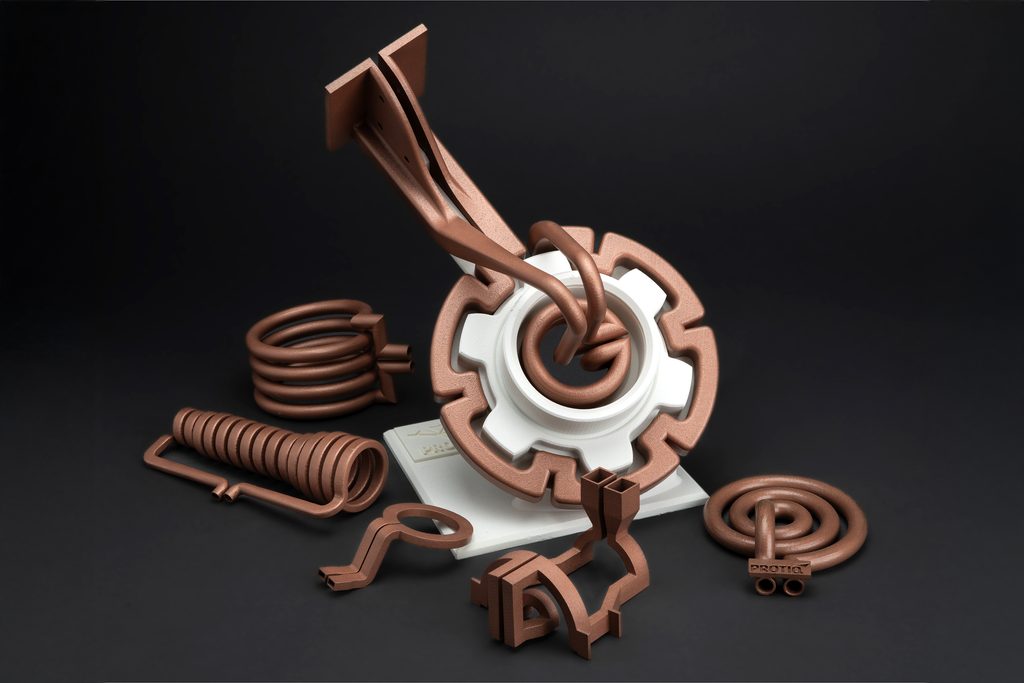
Another important field of application involves components with limited accessibility or intricate features. Here, additive manufacturing allows the realization of coil designs that can be adapted closely to the part geometry, enabling effective heating in areas that are difficult to reach with conventional inductors.
These application scenarios illustrate how additive manufacturing expands the solution space in induction heating, particularly for tasks that require a high degree of customization.
From Technology to Industrial Practice
While additive manufacturing offers significant opportunities, its successful use in induction heating depends on several factors. Material selection, manufacturability, and process stability must all be considered from the outset. Not every theoretically optimal design can be produced reliably, and design decisions must account for the specifics of the additive process.
Equally important is a deep understanding of the application itself. The requirements of the heat treat process, the properties of the component, and the desired outcomes must all be reflected in the inductor design.
In practice, additive manufacturing is not always the only or best solution. Depending on the application, a combination of conventionally manufactured and additively produced features can provide the most effective balance between performance, manufacturability, and cost.
This is where manufacturing expertise becomes critical. Companies like PROTIQ support clients in evaluating which parts of an inductor benefit from additive manufacturing and which may be better suited to conventional production methods. By combining process knowledge, material expertise, and industrial manufacturing capabilities, innovative designs can be translated into reliable and economically viable components.
Application-Driven Inductor Design
Additive manufacturing represents a shift in how induction coils are conceived and realized. By removing many of the constraints associated with conventional manufacturing, it enables a more direct alignment between design and function.
For heat treat operations, this opens up new possibilities for improving efficiency, quality, and reliability. Instead of adapting processes to the limitations of available coil geometries, inductors can be tailored to the specific requirements of the application.
As the technology continues to mature, additively manufactured inductors are likely to become an increasingly important element in advanced heat treat processes. Their successful application, however, depends not only on access to manufacturing technology but also on a comprehensive understanding of materials, processes, and application context.
About The Author:

Technology Manager
PROTIQ
Max Wissing is the technology manager for 3D printing at PROTIQ with nearly a decade of industry experience. He holds a degree in mechanical engineering, specializing in the optimization of 3D-printed induction coils.
For more information: Contact Max Wissing at mwissing@protiq.com.