


Accurate thermocouple readings depend on more than the sensing element itself. In this Technical Tuesday installment, Mark Betts, principal hardware design engineer at Watlow, examines how an innovative approach to cold junction compensation can reduce measurement uncertainty caused by airflow, thermal gradients, and changing ambient conditions, supporting greater accuracy, process stability, and repeatability in heat treat operations.
This informative piece was first released in Heat Treat Today’s October 2026 Ferrous & Nonferrous Heat Treatments/Mill Processing print edition.
Accurate temperature measurement has always been fundamental to industrial process control. Whether manufacturers are operating heat treatment furnaces, life sciences processes, power generation facilities, water and wastewater treatment plants, or food production systems, reliable temperature data is essential to safe, efficient, and repeatable operation. As manufacturing tolerances continue to tighten, achieving higher levels of measurement accuracy is becoming increasingly challenging. In regulated applications, measurement systems may need to satisfy demanding standards, such as AMS2750 and CQI-9, making every source of uncertainty within the measurement chain important.
The challenge is particularly important in heat treatment, where measurement systems must meet demanding accuracy
requirements. Client experience also highlighted the need for improvement, with reports that forced airflow within control cabinets could affect thermocouple readings. Addressing these effects required reconsidering how the cold junction temperature itself was determined.
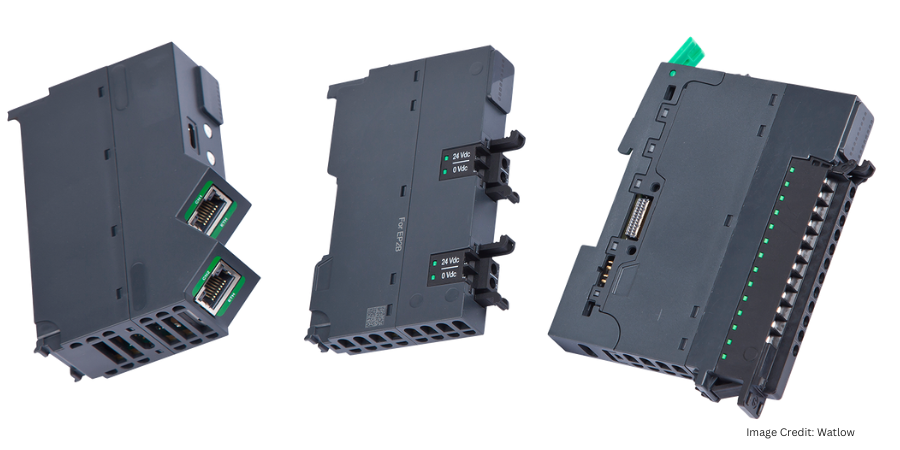
Recognizing this challenge, Watlow has developed an innovative approach to cold junction compensation (CJC) as part of its new Edge Process Management™ (EPM™) platform. Designed to bring together high-precision measurement, process control, data management, and automation within a scalable architecture, the EPM platform is being developed to provide an integrated approach to process management. The EPM data solution is designed to support the creation of trusted process records for regulated industries.
The Hidden Challenge of Accurate Thermocouple Measurement
Unlike resistance temperature detectors (RTDs), thermocouples do not measure absolute temperature directly. Instead, they generate a small voltage proportional to the temperature difference between two junctions formed by dissimilar metals. One junction is located at the point being measured, while the second exists where the thermocouple wires connect to the measurement instrument. To calculate the correct process temperature, the instrument must know the temperature at this reference point, making accurate CJC an essential part of every thermocouple measurement.
Although the principle is well understood, accurately determining the cold junction temperature is more difficult than it first appears. Most modern measurement systems estimate the terminal temperature using a sensor mounted on the printed circuit board (PCB). This has proven to be an effective and economical solution for many years, but it relies on the assumption that the PCB temperature accurately represents the temperature at the field terminals. In practice, these two locations rarely remain at exactly the same temperature, and even small differences can introduce measurable errors into the final process reading.
As industrial control systems have become smaller, more powerful, and more densely populated with electronics, maintaining thermal uniformity has become more difficult. Ambient temperature changes, forced airflow from cabinet cooling systems, heat generated by neighboring components, and thermal conduction through field wiring all contribute to temperature gradients between the PCB and the field terminals. As these gradients increase, the PCB sensor no longer accurately represents the true temperature at the thermocouple termination, meaning the compensation itself becomes a source of measurement uncertainty.
These limitations become even more significant in systems that use removable terminal blocks. Removable terminals simplify installation, commissioning, and maintenance, but they also introduce another thermal interface between the field wiring and the measurement electronics. During startup or changing operating conditions, different parts of the assembly warm and cool at different rates, meaning conventional compensation methods require time to stabilize before optimum accuracy can be achieved.
These effects are typical of conventional CJC measurements where the temperature is measured some distance from the actual thermocouple termination. The resulting thermal gradients can make the measurement more susceptible to internal
self-heating, position within the equipment, changing ambient temperature, and airflow. As expectations for measurement accuracy increase, reducing the influence of these external factors becomes more significant.
Rethinking Cold Junction Compensation
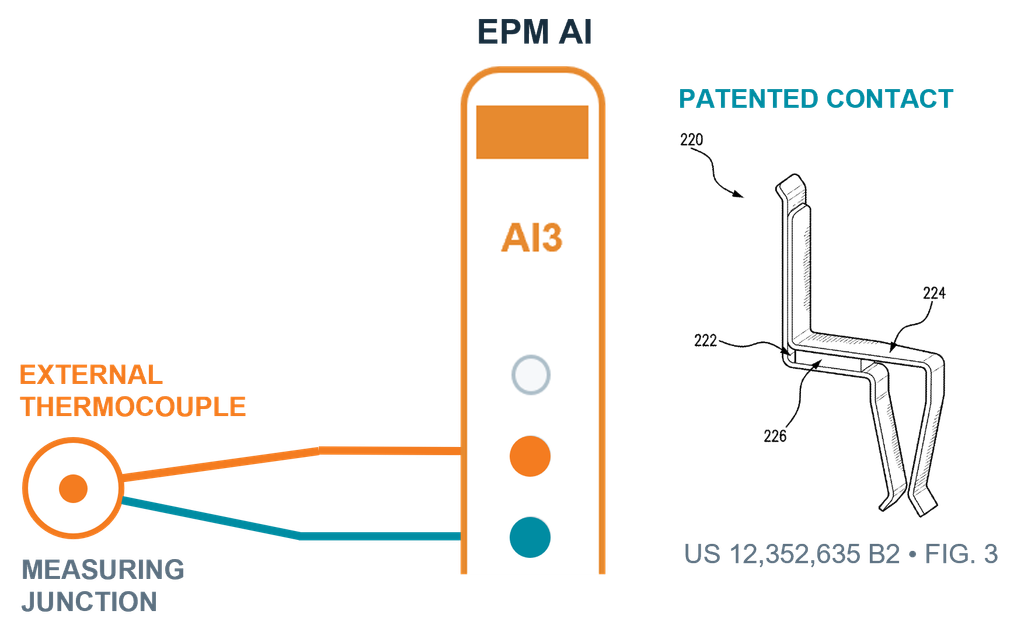
Rather than accepting these limitations, Watlow engineers investigated whether the temperature measurement could be moved closer to the point where CJC takes place. The result is an innovative design that integrates an additional thermocouple junction within the removable terminal assembly itself.
Instead of relying solely on a PCB-mounted temperature sensor, the design incorporates two dissimilar conductive materials within the terminal assembly to create an internal T-type thermal sensor. Rather than directly measuring the absolute temperature of the terminal, this internal sensor measures the temperature difference between the PCB and the field termination. Combined with the PCB temperature measurement, this enables the system to calculate a more representative cold junction temperature while significantly reducing errors caused by thermal gradients between the electronics and the field wiring.
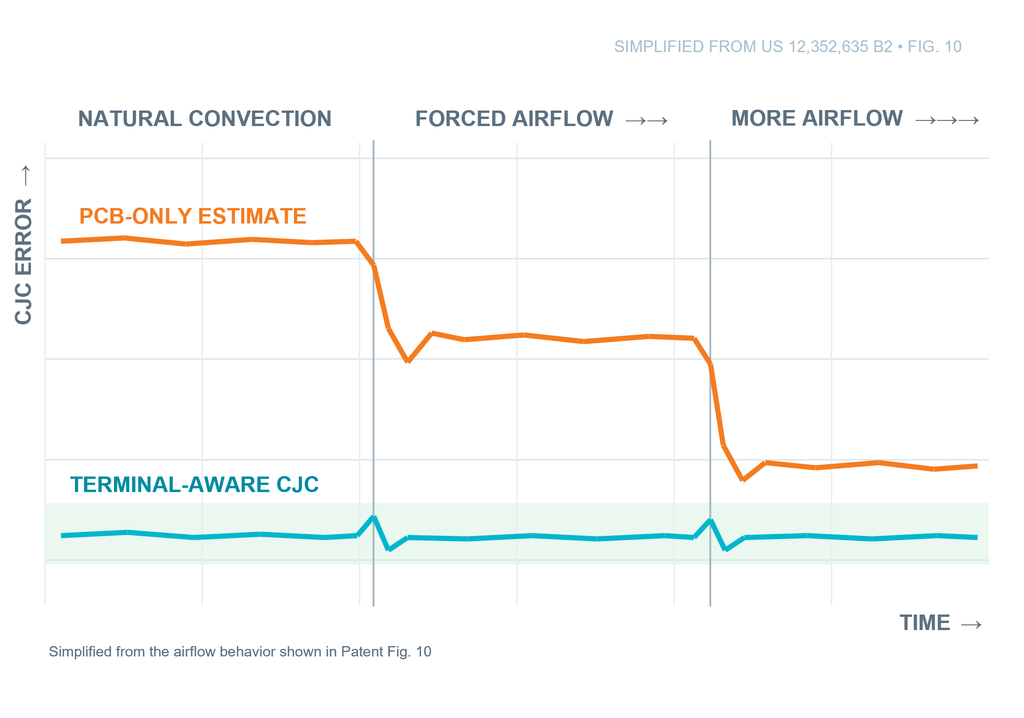
This seemingly simple change fundamentally alters how CJC is performed. Conventional systems infer the terminal temperature from a nearby location on the PCB. The new approach measures the thermal relationship between the PCB and the terminal directly, allowing the cold junction calculation to compensate more effectively for changing operating conditions.
The benefits extend beyond improved measurement accuracy. Positioning the sensing function within the removable terminal improves thermal coupling with the field wiring while reducing susceptibility to convective airflow, module self-heating, and thermal conduction effects. Because the design is integrated within a standard removable terminal block, it also avoids the need for specialist thermocouple connectors or external isothermal reference blocks in many applications, while retaining the convenience and serviceability engineers expect from removable field wiring.
The difference becomes particularly important when airflow changes. In conventional CJC arrangements, relatively large thermal gradients can exist between the point where the CJC temperature is measured and the thermocouple terminal. Forced airflow can change these gradients rapidly, causing the indicated thermocouple temperature to change even though the process temperature has not. With the new CJC approach, the measurement is in very close thermal contact with the terminated thermocouple junction, so these gradients are much smaller. Airflow can still have an effect, but its magnitude is significantly reduced.
Testing also examined performance as ambient temperature was varied between 0°C and 55°C. The results demonstrated that changes in ambient conditions had substantially less influence on the thermocouple reading with the new CJC approach. This has practical implications in an industrial control cabinet. Opening a cabinet door can allow accumulated warm air to escape rapidly, while heat generated by the process or surrounding equipment can progressively increase cabinet temperature. Reducing the influence of these changes helps maintain a more stable process measurement.
Achieving the required performance was only part of the engineering challenge. The solution also had to be robust, resistant to damage, and economical to manufacture, without placing electronics inside the removable terminal block. Watlow therefore developed an approach using a commonly available alloy for the additional measurement while working with terminal block manufacturers to identify suitable contact materials and manufacturing methods. All of this had to be accommodated within the dimensions of a standard terminal block.
Performance Under Real Operating Conditions
Industrial environments rarely remain thermally stable. Cabinets warm throughout the day, cooling systems cycle on and off, process loads fluctuate, and equipment experiences repeated thermal cycling during normal operation. Under these conditions, maintaining a stable and representative cold junction temperature becomes just as important as the accuracy of the thermocouple itself.
Where the thermocouple measurement is also used as the process control input, improved measurement stability has consequences beyond the indicated temperature. A measurement that is less influenced by changing ambient conditions provides the control system with a more stable process variable, supporting more repeatable control closer to the required set point.
Faster stabilization is another practical advantage. Conventional CJC arrangements can require significant warm-up time before the measurement fully stabilizes, whereas the new CJC approach provides an accurate thermocouple process reading with very little warm-up time. This can reduce the time required when checking system calibration and, in heat treatment applications, help reduce the risk of failing a system accuracy test because the measurement system itself has not reached thermal stability.
Supporting High-Integrity Process Measurements
The innovative CJC technology reflects a broader engineering philosophy in which improvements are achieved by strengthening every part of the measurement chain rather than focusing solely on the sensing element itself. More representative cold junction measurements support higher-quality process data, providing greater confidence in the information used for process control, quality assurance, and regulatory compliance. Heat treatment was a particular consideration during development, with the need to meet demanding accuracy requirements providing one of the drivers for efforts to improve CJC performance.
The approach demonstrates that meaningful innovation can still be achieved within mature measurement technologies. Thermocouples have been used successfully for decades, and the principles of CJC are well established. However, by challenging the assumption that the printed circuit board is always the best place to determine the cold junction temperature, Watlow has identified an opportunity to reduce one of the most significant sources of uncertainty within the thermocouple measurement chain.
Conclusion
The significance of improved CJC extends beyond a better accuracy specification. A thermocouple measurement that is less
susceptible to internal self-heating, airflow, and changing ambient conditions provides a more dependable representation of the actual process. Where that measurement is used for control, greater stability can support more repeatable operation closer to the required set point. In heat treatment applications, reduced CJC uncertainty and very little warm-up time can also simplify calibration checking and help reduce the risk associated with system accuracy testing.
By moving the CJC measurement into close thermal contact with the terminated thermocouple junction, Watlow has
developed an approach that reduces the influence of thermal gradients on thermocouple measurement. The result is an innovative solution that can support greater measurement accuracy, control stability and process repeatability within the EPM platform.
About The Author:

Principal Hardware Design Engineer
Watlow
Mark Betts is a hardware engineer with more than 30 years of product development experience at Watlow, where he has played a key role in developing Eurotherm-branded products. His experience spans the complete product development lifecycle, from initial concepts and design through testing, validation, and final release, with a focus on quality, reliability, and performance.
For more information: Contact Mark Betts at mark.betts@watlow.com.