

Victor Zacarias

¿Cómo elegir el termopar correcto en Tratamientos Térmicos?

OCLos termopares: elementos indispensables para lograr un acertado tratamiento térmico, pero ¿cómo elegir el más indicado para su necesidad particular? ¿Qué exigen las normas actuales? A continuación una explicación, por Víctor Zacarías, director general de Global Thermal Solutions México, que le ayudará a saber escoger el termopar adecuado.

Palabras clave: Termopar, Tratamiento térmico, Pirometría, Medición y Control de Temperatura, AMS2750, CQI-9

Read the Spanish translation of this article in the version below, or see both the Spanish and the English translation of the piece where it was originally published: Heat Treat Today's February's Air & Atmosphere Furnace Systems print edition.

Si quisieras aportar otros datos interesantes relacionados con los termopares, nuestros editores te invitan a compartirlos para ser publicados en línea en www.heattreattoday.com. Puedes hacerlos llegar a Bethany Leone al correo bethany@heattreattoday.com


Víctor Zacarías
Director General
Global Thermal Solutions México

La norma aeroespacial SAE AMS2750 y las evaluaciones automotrices de AIAG CQI-9, CQI-11, CQI-12, y CQI-29 son los estándares universalmente aceptados para el control de temperatura en operaciones de procesamiento térmico. Entre muchas cosas, describen los requisitos para el uso y control de los termopares empleados en hornos y estufas de proceso. En este artículo te comparto los requisitos de estas normativas para que puedas tomar una decisión correcta al elegir un termopar y de esta manera contar con una medición repetible que te asegure un proceso confiable.

1. Aplicación

Contact us with your reader feedback!

Para la selección apropiada de un termopar para la medición, control y/o registro de la temperatura debes considerar en primer lugar el tipo de proceso previsto. En la elección del termopar adecuado, toma en cuenta algunos factores que pudieran alterar su desempeño como:

  • El rango de temperatura en el que estará en uso
  • El tipo de atmósfera al que estará expuesto
  • Posible interferencia eléctrica
  • La precisión requerida por la especificación aplicable, etc.

En función de lo anterior, las normativas refieren una clasificación específica para los termopares en función de su fabricación y su aplicación final:

a) Termopares base y termopares nobles
b) Termopares desechables y no desechables

2. Tipos de termopar y su aislamiento

2.1 Termopar base o termopar noble

Un termopar base está fabricado de aleaciones básicas como hierro, cromo, níquel, cobre, etc., y constituyen los tipos más comunes en la industria por su versatilidad y costo: los termopares tipo K, E, J, N, y T. Un buen proveedor de sensores te recomendará un termopar de este tipo en función de la aplicación, el rango de temperatura y tu presupuesto (ver Tabla 1).

Tabla 1: Rango de temperatura y uso de los termopares más comunes
Source: GTS México

Por otro lado, un termopar noble está fabricado a partir de metales como platino y rodio: termopares tipo R, S y B. Éstos termopares son más estables a altas temperaturas y mantienen su precisión por mayor tiempo; sin embargo, tienen un costo elevado debido a que se fabrican a partir de metales preciosos. Debido a esta naturaleza, los termopares nobles son la elección preferida para aplicaciones de tratamiento térmico al vacío y procesos de alta temperatura.

2.2 Termopares desechables o no desechables

El segundo criterio de las normativas lo constituye el material con el que se protegen los elementos del termopar.

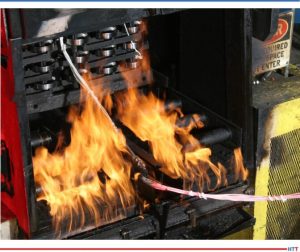
Los termopares desechables son aquellos cuyos elementos están revestidos por materiales como fibra de vidrio, tejido cerámico o recubrimiento polimérico y generalmente se suministran en forma de carrete o bobina. Esta presentación permite al usuario cortar el cable a la medida y fabricar el termopar al unir los dos alambres de un extremo por torsión o soldadura, lo que los hace ideales por ejemplo para aplicaciones de un solo uso como una prueba TUS o termopares de carga (ver Figura 1).

Figura 1: TUS usando termopar desechable tipo K aislado en fibra cerámica
Source: Trucal, Inc.

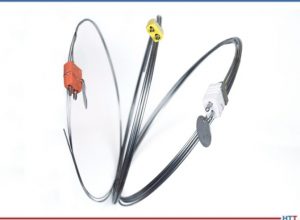
En contraste un termopar no desechable normalmente está protegido con aislamiento cerámico o mineral y revestido en su exterior por una carcasa metálica (los elementos no están expuestos en esta configuración), lo que le proporciona un mayor tiempo de vida útil y por eso se prefieren para emplearse como termopares de control o registro (ver Figura 2).

Figura 2: Termopares no desechables tipo N y K de aislamiento mineral
Source: GTS México

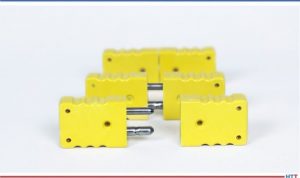
Cualquiera que sea la aplicación, cuando se requiere realizar interconexiones de cableado para la instalación del sensor, dichas conexiones se deben realizar usando conectores y terminales estándar como las que se muestran en la Figura 3, ya que tanto AMS2750 como CQI- 9 prohíben el empalme del cableado.

Figura 3: Conectores estándar tipo K
Source: GTS México

3. Calibración

De acuerdo con la normatividad, todos los termopares usados en operaciones de procesamiento térmico deben haber sido calibrados antes de usarse por primera vez. Para ello, el usuario del termopar debe asegurarse de contar con calibraciones trazables al laboratorio nacional como lo es el NIST en Estados Unidos o su equivalente en México (CENAM).

Las normas de pirometría defi nen los rangos aceptables de error para los termopares en función de su aplicación fi nal: 1) termopares patrón, 2) termopares de prueba (SAT y TUS), 3) termopares de control y registro y 4) termopares de carga. La Tabla 2 describe los máximos errores permitidos a elegir dependiendo del uso del sensor.

Tabla 2: Precisión requerida para sensores de temperatura según AMS2750 y CQI-9
Source: GTS México

Una vez instalado el termopar, el responsable de la operación de tratamiento térmico tiene que deberá documentar la fecha en la que éste entra en servicio, ya que la norma establece un tiempo de vida útil de un sensor en función de la aplicación del mismo.

Al recibir el reporte/certifi cado del termopar, el usuario debe revisar el contenido del documento, pues las normas también definen de manera específi ca la información mínima que debe aparecer en un informe de calibración, que incluye pero no se limita a:

1. Lecturas de prueba
2. Lecturas observadas
3. Factores de corrección
4. Fuente de los datos
5. Acreditación del laboratorio
6. Método de calibración empleado

El certifi cado de calibración puede amparar termopares individuales o un grupo de termopares fabricados a partir del mismo lote (carrete).

Es muy importante observar que tanto AMS2750 como CQI-9 requieren que todas las calibraciones sean realizadas por organismos acreditados en la norma ISO/IEC 17025, por lo que siempre recomiendo que revises el certifi cado de acreditación antes de seleccionar a tu proveedor.

4. En Resumen

Si alguna vez has comprado el termopar equivocado, se lo molesto que puede resultar. Por lo tanto aquí te comparto un resumen para seleccionar el sensor adecuado para su aplicación en 5 sencillos pasos:

1. Define el tipo de termopar: base ( K, T, J, E , N, y M) o noble (S, R, y B)
2. Define el tipo de aislamiento que requieres: fibra textil, polímero, cerámico, metálico, etc.
3. Especifi ca el rango exacto de temperatura en el que operará el sensor
4. Especifi ca el uso del sensor: termopar patrón (estándar), termopar para SAT/TUS, termopar de control / carga
5. Solicita el certifi cado de calibración conforme a la normativa aplicable (AMS2750 o CQI-9)


Referencias

ASTM International. ASTM E230, Standard Specification for Temperature-Electromotive Force (emf) Tables for Standardized Thermocouples, Rev. 2017.

Automotive Industry Action Group. CQI-9 Special Process: Heat Treat System Assessment, 4th Edition. June 2020

International Organization for Standardization. ISO/IEC 17025, General Requirements for the Competence of Testing and Calibration Laboratories, 3rd Edition. 2017.

Nadcap AC7102/8 Audit Criteria for Pyrometry, Rev. A, 2021

SAE Aerospace. Aerospace Material Specifi cation AMS2750: Pyrometry, Rev. G, 2022.


Sobre el autor: Víctor Zacarías es ingeniero metalúrgico egresado de la Universidad Autónoma de Querétaro con estudios en Gerencia Estratégica por parte del Tec de Monterrey. Con más de 15 años de experiencia en la gestión de tratamientos térmicos, actualmente es director general de Global Thermal Solutions México. Víctor ha realizado numerosos cursos, talleres y evaluaciones en México, Estados Unidos, Brasil, Argentina y Costa Rica y ha participado en el Grupo de Trabajo de Tratamiento Térmico de AIAG (CQI-9) y en el Comité de Ingeniería de Materiales Aeroespaciales de SAE.

Contact/Contacto Victor: victor@globalthermalsolutions.com


Find heat treating products and services when you search on Heat Treat Buyers Guide.com


¿Cómo elegir el termopar correcto en Tratamientos Térmicos? Read More »

How To Choose the Right Thermocouple in Heat Treatment

OC

Thermocouples: You can’t accurately heat treat without them. But how can you choose the best one for your needs? What do current regulations require? Read this helpful explanation, by Víctor Zacarías, managing director of Global Thermal Solutions Mexico, to find out how to choose the right thermocouple.

Keywords: Thermocouple, Heat Treatment, Pyrometry, Temperature Measurement and Control, AMS2750, CQI-9

Read the English version of the article below, or find the Spanish translation when you click the flag above right!

This Technical Tuesday article, first published in English and Spanish translations, is found in Heat Treat Today's February's Air & Atmosphere Furnace Systems print edition.

If you have any facts of your own about thermocouples, our editors would be interested in sharing them online at www.heattreattoday.com. Email Bethany Leone at bethany@heattreattoday.com with your own trivia!


Víctor Zacarías
Managing director 
Global Thermal Solutions México

The SAE AMS2750 aerospace standard and the AIAG CQI-9, CQI-11, CQI-12, and CQI-29 automotive assessments are the universally accepted standards for temperature control in thermal processing operations. Among many things, they describe the requirements for the use and control of thermocouples used in process ovens and furnaces. In this article you will find the requirements of these regulations so that you can make a correct decision when choosing a thermocouple, and thus have a repeatable measurement that ensures a reliable process.

1. Application

Contact us with your Reader Feedback!

For the appropriate selection of a thermocouple for the control and/or recording of temperature, you must first take into account the type of process. In choosing the right thermocouple, consider some factors that could alter its performance, such as:

  • The temperature range at which it will be in use
  • The type of atmosphere to which it will be exposed
  • Possible electrical interference
  • The accuracy required by the applicable specification, etc.

Based on the above, existing regulations refer to a specific classification for thermocouples based on their manufacture and final application. These classifications are:
a) Base thermocouples and noble thermocouples
b) Expendable and non-expendable thermocouples

2. Types of Thermocouples and Their Insulation

2.1 Base Thermocouple or Noble Thermocouple

A base thermocouple is made of basic alloys such as iron, chrome, nickel, copper, etc., and they are the most common types in the industry due to their versatility and cost. Base thermocouples are types K, E, J, N, and T. A good supplier of sensors will recommend a thermocouple based on the application, the temperature range, and your budget (see Table 1).


Table 1: Temperature range and application of most common thermocouples
Source: GTS México

On the other hand, a noble thermocouple is made from metals such as platinum and rhodium: types R, S, and B thermocouples. These thermocouples are more stable at high temperatures and maintain their accuracy for a longer time. However, they have the highest cost since they are made from precious metals. Due to this nature, noble thermocouples are the preferred choice for vacuum heat treatment applications and high temperature processes.

2.2 Expendable or Non-expendable Thermocouples

The second criteria from the regulations are the material which protects the elements of the thermocouple.

Expendable thermocouples are those whose elements are covered by materials such as fiberglass, ceramic fabric, or polymeric coating and are generally provided in the form of a spool. This form allows the user to cut the cable to size and manufacture the thermocouple by joining the two wires by twisting or welding, making them ideal for single use applications such as a TUS test or charging thermocouples, for example (see Figure 1).

Figure 1: TUS using type K expendable thermocouple insulated in ceramic fiber
Source: Trucal, Inc.

In contrast, a nonexpendable thermocouple is normally protected with ceramic or mineral insulation and covered on the outside by a metallic sheath (the elements are not exposed in this configuration), which gives it a longer useful life. Therefore, it is preferred for use as a control or recording thermocouple (see Figure 2).

Figure 2: Non-expendable type N and K mineral insulated thermocouples
Source: GTS México

Whatever the application, when wiring interconnections are required for sensor installation, these connections must be made using standard connectors and terminals such as those shown in Figure 3, as both AMS2750 and CQI-9 prohibit the wiring splice.

Figure 3: Standard type K connectors
Source: GTS México

3. Calibration

According to regulations, all thermocouples used in the heat treatment operation must have been calibrated before being used for the first time. The user of the thermocouple must ensure that they have calibrations traceable to a national laboratory such as the NIST in the United States or its equivalent in Mexico (CENAM).

Pyrometry standards defi ne the acceptable error ranges for thermocouples depending on their final application. These categories for final application include: standard thermocouples, test thermocouples (SAT and TUS), control and recording thermocouples, and load thermocouples (see Table 2). Table 2 describes the maximum errors allowed to be selected depending on the use of the sensor.

Table 2: Accuracy required for temperature sensors according to AMS2750 and CQI-9
Source: GTS México

Once the thermocouple is installed, the person responsible for the heat treatment operation must document the date on which it comes into service, since the regulations establish the life of a sensor based on its application.

When receiving the report/certificate of the thermocouple, the user must review the content of the document, since the standards specifically define the minimum information that shall appear in a calibration report, which includes but is not limited to:

1. Test readings
2. Actual readings
3. Correction factors
4. Data source
5. Laboratory accreditation
6. Calibration method used

The calibration certificate can cover individual thermocouples or a group of thermocouples manufactured from the same lot (spool).

It is very important to note that both AMS2750 and CQI-9 require all calibrations to be conducted by ISO/IEC 17025 accredited organizations, so ensure that you review the accreditation certificate before selecting your supplier.

4. In Summary

If you’ve ever bought the wrong thermocouple, you know how annoying it can be. Therefore, here is a quick guide to select the right sensor for your application in five easy steps:

1. Define the type of thermocouple: base (K, T, J, E, N, and M) or noble (S, R, and B)
2. Define the type of insulation you require: textile fiber, polymer, ceramic, metallic, etc.
3. Specify the exact temperature range in which the sensor will operate
4. Specify the use of the sensor: standard thermocouple, SAT/TUS thermocouple, control/load thermocouple
5. Request the calibration certificate in accordance with the applicable regulations (AMS2750 or CQI-9)


References

ASTM International. ASTM E230, Standard Specification for Temperature-Electromotive Force (emf) Tables for Standardized Thermocouples, Rev. 2017.

Automotive Industry Action Group. CQI-9 Special Process: Heat Treat System Assessment, 4th Edition. June 2020.

International Organization for Standardization. ISO/IEC 17025, General Requirements for the Competence of Testing and Calibration Laboratories, 3rd Edition. 2017.

Nadcap AC7102/8 Audit Criteria for Pyrometry, Rev. A, 2021

SAE Aerospace. Aerospace Material Specifi cation AMS2750: Pyrometry, Rev. G, 2022.


About the Author: Víctor Zacarías is a metallurgical engineer from the University of Queretaro with studies in Strategic Management from Tec de Monterrey. With over 15 years of experience in Heat Treatment Management, he is currently the managing director of Global Thermal Solutions México. He has conducted numerous courses, workshops, and assessments in México, the United States, Brazil, Argentina, and Costa Rica. He has been a member of the AIAG Heat Treat Work Group (CQI-9 committee) and the SAE Aerospace Materials Engineering Committee.

Contact Víctor at victor@globalthermalsolutions.com


Find heat treating products and services when you search on Heat Treat Buyers Guide.com


How To Choose the Right Thermocouple in Heat Treatment Read More »

Start Your Week with 4 Heat Treat Articles in Spanish

OC

At Heat Treat Today, we want to make sure everyone in the North American heat treat industry is well informed so they can be happier and make better decisions. With that in mind, we have been growing our library of Spanish heat treating content.

Below, click the blue headings to learn from Víctor Zacarías about pyrometry standards in the aerospace and automotive industries, from Carlos Carrasco about selecting heat treating equipment, from Bill Munn about leadership and motivation, and from Erika Zarazúa about CQI-9's probe method A. If you'd like to view this content in English, click the America flag icon. 


Pirometría: la normativa para un Procesamiento Térmico confiable en la Industria Automotriz y Aeroespacial

Víctor Zacarías
General Director
Global Thermal Solutions Mexico

"Las operaciones de tratamiento térmico son percibidas generalmente como cajas negras cuyos resultados son poco predecibles. Si bien, entendemos los mecanismos físicos involucrados para modificar las propiedades de un material, los hornos de tratamiento térmico son sistemas termodinámicamente imperfectos, y por ende los resultados finales en ocasiones también lo son."

Contact us with your Reader Feedback!

"Heat treatment operations are generally perceived as black boxes whose results are not very predictable. Although we understand the physical mechanisms involved in modifying the properties of a certain material, heat treatment furnaces are thermodynamically imperfect, and sometimes the final results are too."

This article first appeared Heat Treat Today's March 2022 Vacuum Furnace print edition.

Guía para la Selección de Equipos para Tratamiento Térmico

Carlos Carrasco
Founder
Carrasco Hornos Industriales

"Este artículo ayuda a los ingenieros a comprar equipos de tratamiento térmico. Hay muchas razones para seleccionar cuidadosamente los hornos industriales. Uno, es el costo del horno en sí y otro, es que el producto que se está tratando térmicamente afectará los resultados de su empresa."

"There are many reasons to select industrial furnaces carefully. One is the cost of the furnace. Another is realizing heat treating will affect the product and the bottom line. There is more specialized engineering in heat treating equipment than is apparent from the outside."

This article first appeared in Heat Treat Today's November 2021 Vacuum Furnace print edition.

Guía para el líder que quiere motivar

Bill Munn
Leadership Coach
Bill Munn
Source: Bill Munn Coaching

Por definición, de aquí se desprende que no se desempeña solo; es más, está posicionado no solo para trabajar en conjunto con otros seres humanos sino también para liderarlos; si su potencial se ha de realizar, puede que ya haya entendido bien que en esas personas reposa la verdadera clave del éxito que a futuro pudiera conseguir ¿Cómo, pues, lograr su compromiso?

By definition, this means that you are not functioning alone. Moreover, you are positioned not only to work with fellow human beings, but to lead them. And if your potential is to be realized, you may already know well that those people are the true key to your future success. So how will you engage them?

This article first appeared in Heat Treat Today's September 2022 print edition.

Guía para conducir pruebas System Accuracy Tests conforme a CQI-9 4ta. Edición

Erika Zarazúa
Regional Purchasing Manager 
Global Thermal Solutions México
Source: Global Thermal Solutions México

"Las pruebas SAT deben realizarse a todos los sistemas de control, monitoreo y registro de los equipos de procesamiento térmico. Esto no aplica para los sistemas de ‘alto-límite” cuya única función es la de proteger al horno de un sobre calentamiento."

"System Accuracy Tests (SATs) must be performed on all control, monitoring, and recording systems of thermal processing equipment. This does not apply to “high limit” systems, whose sole function is to protect the furnace from overheating."

This article first appeared in Heat Treat Today's August 2022 Automotive print edition.


Find heat treating products and services when you search on Heat Treat Buyers Guide.com


Start Your Week with 4 Heat Treat Articles in Spanish Read More »

Pyrometry: The Standard for Reliable Thermal Processing in Automotive and Aerospace Industries

OCThere is no way to validate the heat treating process without completely destroying the job. Here’s where pyrometry becomes crucial. The precision, accuracy, and uniformity standards of specifications like AMS2750 and CQI-9 provide peace of mind without destructive testing. Read how the requirements of these regulations are benefiting the industry through standardization and defect prevention.

"El tratamiento térmico como la mayoría de los procesos especiales, tiene la particularidad de ser una operación crítica que para su validación requiere de pruebas destructivas. . . "

Read the English translation of this article by Víctor Zacarías, general director at Global Thermal Solutions Mexico, in the version below, or the Spanish translation when you click the image to the right.

Both Spanish and English translations of the article were originally published in Heat Treat Today's March 2022 Vacuum Furnace print edition.


Víctor Zacarías
General Director
Global Thermal Solutions Mexico

Introduction

Heat treatment operations are generally perceived as black boxes whose results are not very predictable. Although we understand the physical mechanisms involved in modifying the properties of a certain material, heat treatment furnaces are thermodynamically imperfect, and sometimes the final results are too.

An extra variable must be added to this picture. As the properties of the final product can only be validated through destructive testing, we must have a high level of process control in place if we want to ensure repeatability in heat treat operations. This is where pyrometry specifications play an important role, particularly in defining the correct temperature controls for consistent heat treatment.

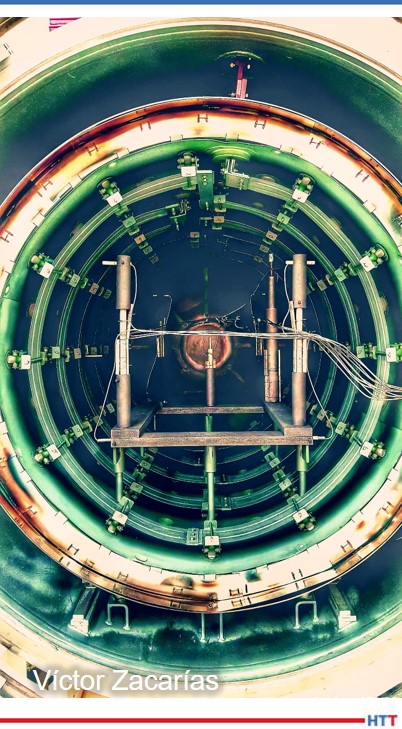
Picture 1. Temperature uniformity survey performed in a vacuum furnace

Pyrometry standards/specifications define the temperature control requirements for thermal processing equipment used in heat treatment operations (furnaces, ovens, muffles, etc.). These specifications are very comprehensive documents that allow us to solve the following problems:

  • How do you know that the temperature readings are accurate?
  • How do you know the temperature variation of your measurement system?
  • How do you know that the entire load was exposed to a consistent temperature during the cycle?
  • How do you know what you know? (Documented evidence)

The most widely accepted and proven pyrometry specifications in the industry are:

  1. AMS2750: issued by SAE International, it is the universally accepted standard for thermal processing certification purposes in the aerospace industry (Nadcap).
  2. AIAG CQI-9: this assessment provides the pyrometry requirements for the evaluation of heat treatment in the automotive industry.
  3. API 6A & 16A: annexes establish the pyrometric requirements for the components treated in the energy industry (oil and gas).

All of these specifications describe in their content at least the following four items:

  • Calibration of thermocouples (or any other temperature sensor), as well as the limit of use depending on its
    application
  •  Calibration of control and test instrumentation
  •  The procedure and acceptance criteria for conducting a System Accuracy Test (SAT)
  •  The method and acceptance criteria for a Temperature Uniformity Survey (TUS)

These specifications are subject to continuous revisions to ensure that the requirements are understood. However, it does not change the fact that they are very extensive documents, generally misinterpreted and which require experienced personnel for their implementation. As an example of these difficulties, in Nadcap accreditation audits, eight out of 10 findings are directly related to pyrometry. CQI-9 assessments in the automotive industry show similar figures.

Despite the above, the right implementation of the pyrometry requirements has proven for years that a consistent heat treatment process can be achieved, providing data that allows defect prevention in an effective way.

Thermocouple Requirements

A thermocouple is a very simple temperature sensor that consists of two conductors with different thermoelectric characteristics. The conductors are joined at one end (hot junction) which will be in contact with the element whose temperature is to be measured. When the conductors are exposed to a temperature gradient, a difference of electrical potential (mV) is generated due to the phenomenon known as Seebeck effect. At the other end (cold junction), a voltmeter is used to measure the potential generated by the temperature difference between the two ends (See Figure 1).

Figure 1. Schematic of a thermocouple

Pyrometry standards defi ne the calibration requirements for the thermocouples used in thermal processing equipment. In order to acquire thermocouples in accordance with these regulations, we must consider the final use of the sensor to define the maximum error allowed at the time of calibration (See Table 1).

Once we have a calibrated thermocouple, the date of the installation must be documented to track the sensor life. Thermocouples have a finite lifetime because of the natural degradation of the materials of which they are made, leading to a decrease in their accuracy. Therefore, the replacement of temperature sensors must be calendarized depending on the thermocouple type and the temperature to which they are exposed.

Instrumentation Requirements

Instruments receive electrical communication from thermocouples and convert potential (mV ) to a usable format.

Pyrometry specifications like AMS2750 and CQI-9 define the resolution and accuracy requirements for the instrumentation used in heat treating equipment, as well as the frequency at which these instruments must be calibrated. The level of accuracy of the instrumentation is based on the applicable specification and the purpose of the instrument, as shown in Table 1.

Table 1. Accuracy required for temperature sensors according to AMS2750 and CQI-9

It is important to consider the manufacturer’s instructions when installing and calibrating control and recording instruments. From a metrological standpoint, documentation must evidence that the calibrations are traceable to a national reference standard (NIST, CENAM, etc.) and, in most industries, carried out in accordance with ISO/IEC 17025.

The System Accuracy Test

A System Accuracy Test (SAT) or probe check is a very simple test to ensure that the entire measurement system (thermocouple and instrument together) provides an accurate representation of the temperature. It is an on-site comparison of the furnace’s measurement system against an independent calibrated measurement system (See Figure 2). The purpose of this test is to determine if the natural deviation of the temperature measurement system is still acceptable.

Figura 2. Diagrama de un Ensayo de Exactitud del Sistema (SAT)

The criteria to determine whether the results of an SAT test are acceptable or not will depend on the applicable regulations, AMS2750 or CQI-9. If the difference in the SAT exceeds the limits allowed by the standard, internal procedures must take into account the following considerations before reprocessing parts:

  • Document that the equipment has failed a test
  • Determine the root cause of the failure
  • Implement corrective actions

When an SAT test result fails, corrective actions can generally be reduced to two options: replace the thermocouple and/or recalibrate and adjust the instrument.

A SAT is performed to assure the accuracy of all the systems in the furnace which are used to make decisions about the product, both control and recording. It is important to note that SAT test results change over time, therefore historic SAT data is very useful to identify trends and proactively take action before a deviation shows.

Temperature Uniformity Surveys

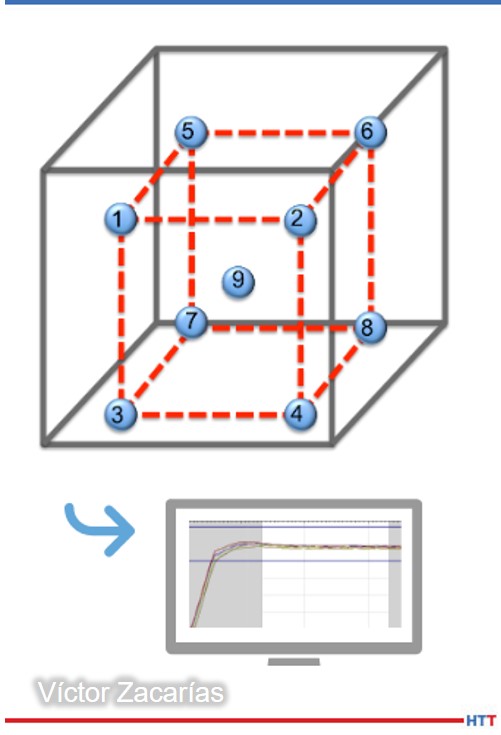
Figure 3. Schematic of a temperature uniformity survey (TUS)

A Temperature Uniformity Survey (TUS) is a test where a calibrated instrument (data logger) and several calibrated thermocouples measure the temperature variation inside the furnace. The result of a TUS test indicates where the hottest and/or coldest spots are in a furnace and provides elements to determine how to correct them.

For most commercially available furnace volumes, TUSs are conducted introducing nine thermocouples for batch type furnaces, and three tracking thermocouples for continuous furnaces.

A TUS is considered acceptable if the test thermocouple readings are within the limits set by the specification for the required time. TUS is highly recommended to be performed after the initial installation of the equipment or after a modification that could alter the heating characteristics of the furnace. Subsequently, they must be carried out periodically in accordance with the applicable regulation.

Importance of Pyrometry

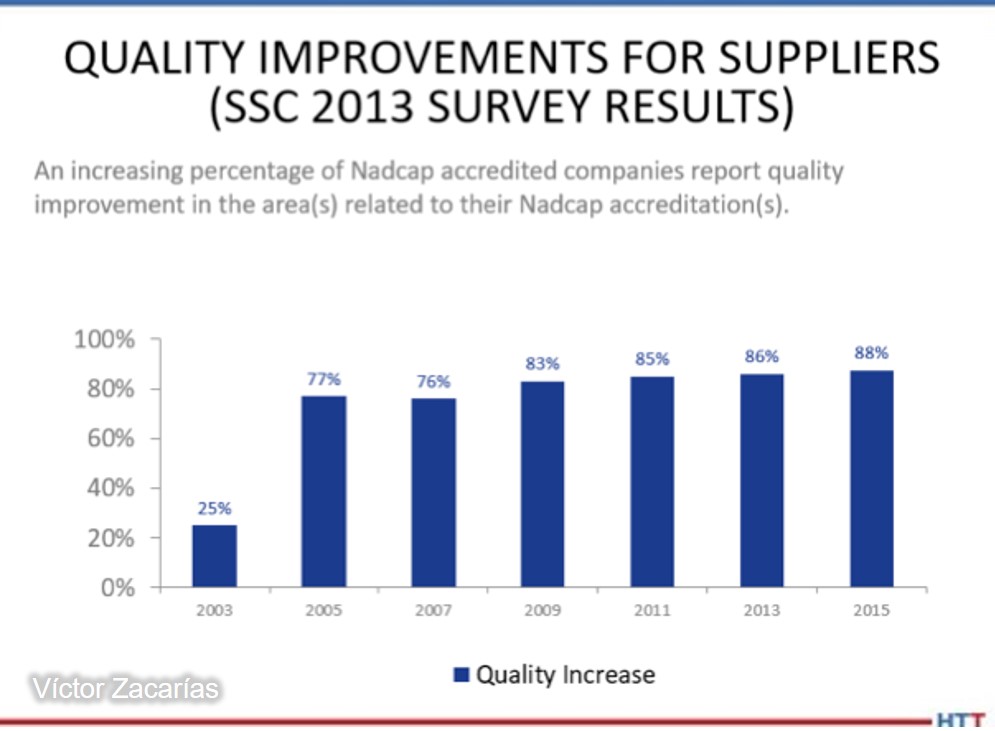
The labor of harmonizing special processes is not easy. However, there is strong evidence that proves the effectiveness of this eff ort. For example, Supplier Technical Assistance teams at Ford Motor Co. have followed the results achieved by the implementation of CQI-9 by their suppliers and have estimated cost savings of up to 20 million dollars in reduction of heat treatment defects. Similarly, the Performance Review Institute, which is the organization in charge of managing Nadcap, reports increasingly positive results each year by the implementation of the program, impacting directly on continuous improvement of aerospace organizations that accredit it (Figure 4).

Figure 4. Perception in quality improvement from Nadcap audits

Pyrometry testing provides valuable information that encourages preventive maintenance of furnaces and related equipment. At the same time, it provides understanding of the measurement systems that allow achieving repeatable metallurgical results. In both cases, the information generated in pyrometry allows heat treaters to reduce scrap and quality claims and most importantly, ensures business continuity by showing compliance with customers’ requirements.

About the author: Víctor Zacarías is a metallurgical engineer from the University of Querétaro with studies in Strategic Management from Tec de Monterrey. With over 15 years of experience in heat treatment management, he is currently the managing director of Global Thermal Solutions México. Victor has conducted numerous courses, workshops, and assessments in México, United States, Brazil, Argentina, and Costa Rica and has been a member of the AIAG Heat Treat Work Group (CQI-9 committee).

Contact Víctor: victor@globalthermalsolutions.com


Find heat treating products and services when you search on Heat Treat Buyers Guide.com



Pyrometry: The Standard for Reliable Thermal Processing in Automotive and Aerospace Industries Read More »

Pirometría: la normativa para un Procesamiento Térmico confiable en la Industria Automotriz y Aeroespacial

OCThere is no way to validate the heat treating process without completely destroying the job. Here’s where pyrometry becomes crucial. The precision, accuracy, and uniformity standards of specifications like AMS2750 and CQI-9 provide peace of mind without destructive testing.

Read the Spanish translation of this article by Víctor Zacarías, director general de Global Thermal Solutions México, in the version below, or read both the Spanish and the English translation of the article where it was originally published: Heat Treat Today's March 2022 Vacuum Furnace print edition.

El tratamiento térmico como la mayoría de los procesos especiales, tiene la particularidad de ser una operación crítica que para su validación requiere de pruebas destructivas. Al no poder medir el 100% del producto, las normas de pirometría juegan un papel fundamental en el control y documentación de los procesos de tratamiento térmico. La norma AMS2750 y la evaluación CQI-9 son los estándares mas aceptados en la industria aeroespacial y automotriz respectivamente, y describen los requisitos de precisión, exactitud y uniformidad para los sistemas de medición de temperatura y los equipos empleados en el procesamiento térmico. Este artículo sintetiza los requerimientos de estas normativas e ilustra los beneficios en la industria de contar con un enfoque homologado para la reducción de la variación y la prevención de defectos.


Víctor Zacarías
Director General
Global Thermal Solutions México

Introducción

Las operaciones de tratamiento térmico son percibidas generalmente como cajas negras cuyos resultados son poco predecibles. Si bien, entendemos los mecanismos físicos involucrados para modificar las propiedades de un material, los hornos de tratamiento térmico son sistemas termodinámicamente imperfectos, y por ende los resultados finales en ocasiones también lo son.

A esta situación hay que agregar una variable adicional. Al tratarse de operaciones en las cuales las características del  producto final solamente pueden ser validadas a través ensayos destructivos, debemos de contar con un nivel particular de control de proceso si queremos asegurar la repetibilidad en las operaciones de tratamiento térmico.

Fotografía 1. Ensayo de uniformidad de temperatura conducido en horno de vacío

Las normas y especificaciones de Pirometría definen los requerimientos de control de temperatura para los equipos de procesamiento térmico (hornos, muflas, estufas, etc) empleados en las operaciones de tratamientos térmicos. Se trata de estándares muy completos que nos permite resolver las incógnitas que los auditores de proceso ponemos sobre la mesa

  • ¿Cómo sabes que las lecturas de temperatura de tu horno son precisas?,
  • ¿Cómo sabes cuál es la variación de temperatura de tu sistema de medición?
  • ¿Cómo sabes que la totalidad de la carga fue expuesta a una temperatura consistente durante el ciclo completo de tratamiento térmico?,
  • ¿Cómo sabes que lo sabes?

Las especificaciones de pirometría mayormente aceptadas y probadas en la  industria son:

  1. AMS2750, emitida por SAE International, es la norma universalmente aceptada para fines de certificación de procesamiento térmico en la industria aeroespacial
  2. CQI-9 de la Automotive Industry Action Group (AIAG). Las secciones 3.1, 3.2, 3.3 y 3.4 definen los requerimientos de pirometría para la evaluación de tratamientos térmicos en la industria automotriz y
  3. API 6A y 16A, cuyos anexos establecen los requisitos pirométricos para los componentes tratados en la industria de energía (oil & gas)

Todas estas especificaciones contemplan en su contenido al menos los siguientes 4 aspectos:

  1. Calibración de los termopares (o cualquier otro sensor de temperatura), así como los requisitos y tiempo límite de uso en función de su aplicación.
  2. Calibración de la instrumentación de control y prueba
  3. El procedimiento y los criterios de aceptación para la realización de la prueba System accuracy Test (SAT).
  4. El método y los criterios de aceptación para la prueba de uniformidad de temperatura o Temperature Uniformity Survey (TUS).

Las normas de pirometría son sometidas procesos de revisión profunda de manera frecuente por las organizaciones que las emiten para asegurar que los requerimientos sean entendidos. Sin embargo, no cambia el hecho de que se trata de documentos complejos, generalmente malinterpretados y que requieren de personal experimentado para su implementación. Cómo ejemplo de estas dificultades, en auditorías de certificación Nadcap (industria aeroespacial) 8 de cada 10 hallazgos levantados están relacionados directamente con pirometría. Las evaluaciones de CQI-9 en la industria automotriz presentan cifras similares.

A pesar de lo anterior, la implementación correcta de los requerimientos de pirometría ha probado por años que se puede alcanzar un proceso de tratamiento térmico consistente y arrojar datos que permiten prevenir defectos de manera efectiva.

Termopares

Un termopar es un sensor de temperatura que consiste de dos conductores con características termoeléctricas distintas. Los conductores están unidos en un extremo (unión de medición o hot junction), el cual estará en contacto con el elemento cuya temperatura se quiere medir. Cuando los conductores se exponen a un gradiente de temperatura se genera una diferencial de potencial (mv) debido al fenómeno conocido como Efecto Seebeck. En el otro extremo (cold junction), se empleará un voltímetro para medir el potencial generado por la diferencia de temperatura entre los dos extremos (ver figura a continuación).

Figura 1. Diagrama de un termopar

La normas de pirometría definen los requisitos de calibración para los termopares usados en el equipo de procesamiento térmico. Para adquirir termopares acordes con la normatividad,  debemos considerar la aplicación final del sensor para definir el error máximo permitido al momento de la calibración (ver tabla a continuación).

Una vez que contamos con termopares calibrados, se debe documentar la fecha en la que se realiza la instalación para monitorear el tiempo de vida del sensor. Los termopares tienen un tiempo de vida finito debido a que la exposición a la temperatura provoca la degradación de los conductores y por ende la disminución de su precisión. El reemplazo por lo tanto de un sensor de temperatura estará determinado por el tipo de temopar (K, N, E, T, J, B, R, o S) y la temperatura a la que se expone.

Instrumentación

Los instrumentos reciben comunicación eléctrica de los termopares y convierten fuerza electromotriz (fem) a un formato usable.

La especificaciones de pirometría como AMS2750 y CQI-9 definen los requisitos de resolución y precisión para la instrumentación empleada en Tratamientos Térmicos, así como la frecuencia a la que se deben calibrar dichos instrumentos.  El nivel de precisión de la instrumentación está en función la norma aplicable y el propósito del instrumento como se muestra en la siguiente tabla.

Tabla 1. Precisión requerida sensores de temperatura de acuerdo a AMS2750 y CQI-9

Es importante considerar las instrucciones del fabricante al momento de instalar y calibrar los instrumentos de control del horno. Desde el punto de vista metrológico, la documentación debe demostrar que la calibración de los equipos es trazable a un patrón nacional (NIST, CENAM, etc) y, en la mayoría de los casos, realizada de conformidad a la norma ISO/IEC 17025:2017 correspondiente a los laboratorios de ensayo y calibración.

Prueba de Exactitud del Sistema (System Accuracy Test o Probe Check)

La prueba System Accuracy Test (SAT) o Probe Check es una comparación en sitio del sistema de medición del horno contra un sistema de medición calibrado. El objetivo de esta prueba es determinar si la desviación natural del sistema de medición de temperatura se encuentra dentro de límites aceptables.

Figura 2. Diagrama de un Ensayo de Exactitud del Sistema (SAT)

El criterio de aceptación para determinar si los resultados de una prueba SAT son aceptables o no, dependerá de la normativa aplicable. Si la diferencia del SAT excediera los límites permitidos por la norma, los procedimientos internos deben tomar en cuenta la siguientes consideraciones antes de volver a procesar piezas:

  1. Documentar que el equipo ha fallado la prueba,
  2. Determinar la causa raíz de la falla y
  3. Implementar acciones correctivas

Cuando el resultado de la prueba SAT excede los límites permitidos, las acciones correctivas generalmente se pueden reducir a dos alternativas: (1) Reemplazo del termopar o (2) Recalibración y ajuste del instrumento.

Una vez aplicadas las acciones correctivas y, antes de procesar cualquier material adicional, la prueba SAT debe repetirse conforme al procedimiento de la norma  para confirmar la efectividad de las acciones correspondientes.

Un SAT es una prueba muy simple para asegurar que el todo el sistema de medición (termopar mas instrumento en conjunto) provee una representación exacta de la temperatura. Es importante tomar en cuenta que los resultados de la prueba SAT cambian con el tiempo, por lo tanto se trata de un chequeo muy útil para identificar tendencias y tomar acciones de manera proactiva antes de una desviación.

Prueba de Uniformidad de Temperatura (Temperature Uniformity Survey)

Figura 3. Diagrama de un Ensayo de Uniformidad de
Temperatura (TUS)

Un Temperature Uniformity Survey (TUS) es una prueba en donde un instrumento y varios termopares calibrados miden la variación de temperatura dentro del volumen de trabajo del horno. La prueba TUS indica dónde se encuentran los puntos mas fríos y/o calientes de un horno y proporciona elementos para determinar el porqué de esos puntos y cómo corregirlos.

El primer aspecto a considerar es la cantidad de termopares a emplear durante la prueba, que está en función del volumen de trabajo del horno y la normativa aplicable.  Para la mayoría de los volúmenes de los hornos disponibles comercialmente, la cantidad de termopares requeridos es de 9 para hornos tipo batch (lote) y 3 para hornos continuos.

Un TUS se considera aceptable si las lecturas de los termopares se encuentran dentro de los límites establecidos por la especificación durante el tiempo requerido en todo momento. La prueba TUS se recomienda realizar después de la instalación inicial del equipo o después de una modificación que pudiera alterar las características de uniformidad del horno. Posteriormente se deben realizar de manera periódica de acuerdo a la normativa.

Importancia de la pirometría

La labor para armonizar los procesos especiales no es sencilla, sin embargo existen datos contundentes que prueban la efectividad de este esfuerzo. El equipo de STAs de Ford Motor Co. ha realizado estimaciones de los beneficios obtenidos al implementar CQI-9 en su cadena de proveduría y han cuantificado ahorros de hasta 20 millones de dolares por conceptos de reducción de defectos en Tratamientos Térmicos. De igual manera, el Performance Review Institute, quien es la organización encargada de administrar el programa Nadcap, reporta cada año el impacto en la mejora continua en las organizaciones aeroespaciales que acreditan este programa.

Figura 4. Percepción de la mejora en la calidad en relación con su acreditación Nadcap

Las pruebas de pirometría proporcionan información valiosa que fomenta el mantenimiento preventivo de los hornos y equipos relacionados. Al mismo tiempo, el entendimiento y control de los sistemas de medición ayudan de manera proactiva a obtener resultados metalúrgicos repetibles. En ambos casos la información generada en estas pruebas nos permite reducir la probabilidad de scrap o reclamos de calidad y asegurar la continuidad del negocio al mostrar conformidad con los mandatos del cliente.

Sobre el autor: Víctor Zacarías es ingeniero metalúrgico egresado de la Universidad Autónoma de Querétaro con estudios en Gerencia Estratégica por parte del Tec de Monterrey. Con más de 15 años de experiencia en la gestión de tratamientos térmicos, actualmente es director general de Global Thermal Solutions México. Víctor ha realizado numerosos cursos, talleres y evaluaciones en México, Estados Unidos, Brasil, Argentina y Costa Rica y ha participado en el Grupo de Trabajo de Tratamiento Térmico de AIAG (CQI-9) y en el Comité de Ingeniería de Materiales Aeroespaciales de SAE.

Contacto Víctor: victor@globalthermalsolutions.com

Pirometría: la normativa para un Procesamiento Térmico confiable en la Industria Automotriz y Aeroespacial Read More »

Tracking Results from the Systems Accuracy Test


Source: Global Thermal Solutions

The System Accuracy Test is performed on-site to ensure the accuracy of furnace controls and recorders across control zones, comparing the furnace temperature against a separate test instrument.

"It is very important to track the results from these tests since the information changes over time. When conducted properly, this simple test helps the heat treaters to take preventive actions and maintain a reliable temperature system." ~ Victor Zacarias

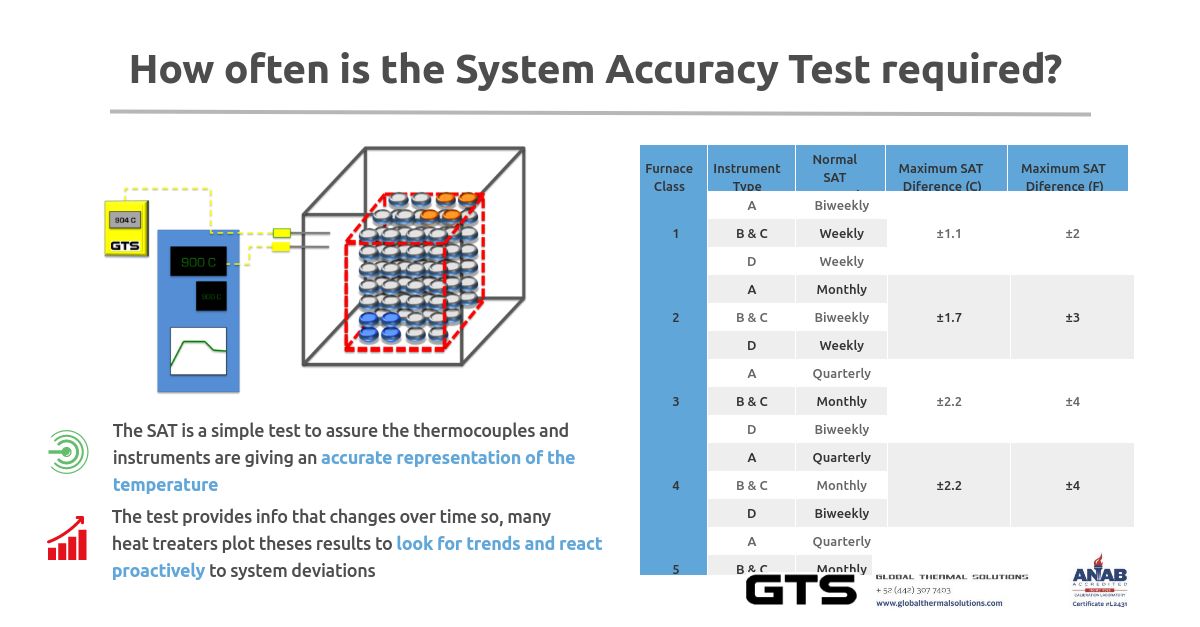
The above infographic (reproduced below) demonstrates how often to perform the SAT on furnace controls for processing parts for aerospace applications.


Read more: "How Often Is the System Accuracy Test Required?"

Tracking Results from the Systems Accuracy Test Read More »

Skip to content