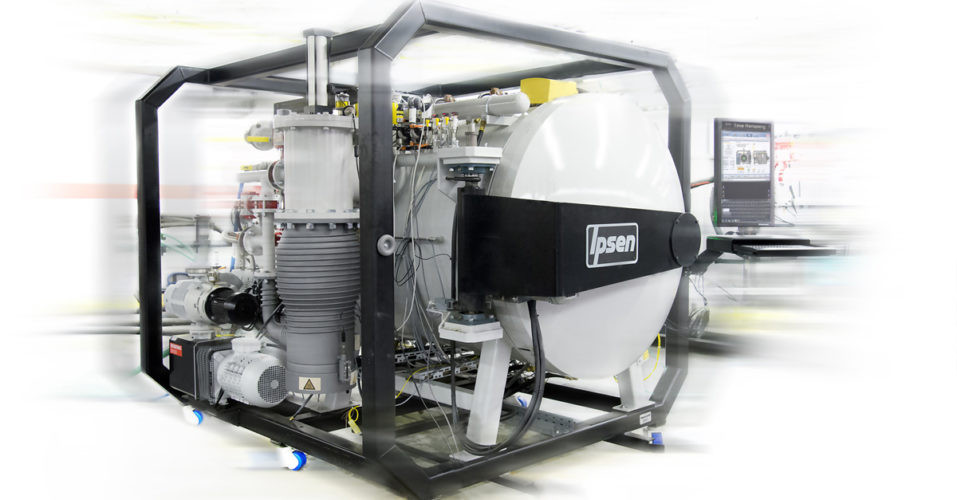
A manufacturing company based in Loves Park, Illinois, recently purchased a vacuum furnace with 2 bar gas quenching that will be used at its facility in Ho Chi Minh City, Vietnam.
The TITAN® H6 furnace
Zenith Cutter, which manufactures industrial knives, cutter blades and related accessories for multiple applications, is transitioning its shop from atmosphere heat treating to using vacuum equipment for production and commissioned a TITAN® H6 furnace from vacuum furnace maker Ipsen for its Metkraft location.
The TITAN® H6 furnace has a graphite work zone measuring a 36″ x 48″ x 36″ (915 mm x 1,220 mm x 915 mm) with a 3,000-pound (1,360 kg) load capacity and is capable of operating at temperatures of 1,000 °F to 2,400 °F (538 °C to 1,315 °C) with ±10 °F (±6 °C) temperature uniformity.
To join the United States in the celebration of Independence Day, Heat TreatToday brings you a story that highlights the role played by colonial-period metallurgists in the fight against the British, specifically the British Navy’s attempts to sail up the Hudson River during the American Revolution.
One of the first steel and iron manufacturers in the American colonies, the Sterling Iron Works, located in Warwick, New York, very near the New Jersey line, forged its place in history by forging the Hudson River Chain as a way to prevent the British from gaining access to West Point, the strongest and most important military post in America at that point in the war.
Interesting FAQs:
Peter Townsend, owner of Sterling Iron Works, probably violated the Iron Act of 1750 by building the steel furnace and kept it hidden from the British.
The chain was forged at Stirling ore mines and hauled to the shoreline of the Hudson where it was floated down the river. It was positioned on logs across the river with a heavy log boom in front of it.
The links of the chains weigh 140 lb (64kg) each; the total length weighed 186 tons.
The placement of the iron chain and boom at West Point
Benedict Arnold plotted to reveal a strategy to breach the chain to the British, but he was discovered by Sally Townsend, Peter Townsend’s cousin, when she intercepted his message and unmasked him as a traitor. He escaped to the British, and no attempt was made to break the chain.
The Great Chain of the Hudson River remained unbroken for the length of the war. Afterward, most of the links were melted down and made into cannons, but a few of the links have been preserved at the Military Academy at West Point.
With its unique ability to be used in the shaping of other materials, tool steel, which includes a variety of carbon and alloy steels, is a particularly valuable property for tool manufacturers as well as manufacturers of components and parts that require the same degree of distinctive hardness, resistance to abrasion and deformation, and ability to hold a cutting edge at elevated temperatures.
The three-phase process of heat treating tool steel — annealed, austenite, and martensite — ensures the tool retains these qualities, achieves intended functionality, and meets performance specifications. In addition,
“The phases that define the process of heat treating tool steel alter the microstructure of the steel itself. Observable under a microscope, heat treatment rearranges the atoms of the iron, carbon, and any other metal components, which serves to give the final material specifically desired properties.” — L&L Special Furnace
Multiple factors can influence the final product, including the appropriate hardening and tempering temperatures depending on the type of steel.
This table provides general recommendations for the appropriate hardening and tempering temperatures based on steel type, as well as the recommended type of quench process. — L&L Special Furnace
“Heat treating tool steel does more than adding significant value to the treated material—it makes the use of the tool steel possible. Without properly applied heat treating, tools simply wouldn’t work or couldn’t even be made. Modern metallurgical engineering is essential to the production and manufacturing of tool steel and all of its applications.” — L&L Special Furnace
Photo credit (main image): Youtube.com and caption: “Visual indication of tool steel phase change to austenite when heat treating. Small pools of iron are forced from the steel as the volumetric change takes place and small amounts of carbon are burned off.”
With the restart of the second of its two blast furnaces, a major U.S. steel producer expects to step up its supply of American-made steel to support customers demand.
U. S. Steel President and Chief Executive Officer David B. Burritt
United States Steel Corporation recently announced it will restart “A” blast furnace at its Granite City Works, an integrated steelmaking plant in Granite City, Illinois.
“We are excited to announce that after the restart of the “A” blast furnace on or around October 1, all of the steelmaking operations at Granite City will be back online, helping us meet an increased demand for American-made steel that has only grown since our March announcement,” said U. S. Steel President and Chief Executive Officer David B. Burritt. “After careful consideration of market conditions and customer demand, including the impact of Section 232, the restart of the two blast furnaces at Granite City Works will allow us to serve our customers’ growing demand for high-quality products melted and poured in the United States.”
Heat treaters strive to deliver parts that meet industry and manufacturers’ specifications with precision, but too often the information they get from customers is inadequate, unclear or incorrect. This article from Paulo’s Learning Center provides 7 points of data that will help a metallurgist treat parts to stand up to the manufacturer’s intended application, including:
An induction heating manufacturer has moved its operations to a facility twice the size of the previous location to accommodate increased demands for its products and industry solutions.
Ambrell Corporation, the thermal segment subsidiary of inTEST Corporation, which designs and manufactures thermal management products, recently broke ground on the new 80,000 sq ft facility in Rochester, New York. The $2.1 million project, which started in September 2017, included a complete company relocation from its previous manufacturing facility in Scottsville, New York.
“This is an exciting time for Ambrell and marks a huge milestone for the company, its employees, and customers who will all benefit from the opportunities this expansion presents,” said Tony Mazzullo, president of Ambrell, at the previous ribbon-cutting ceremony. “This new facility adds floor space to our Applications Laboratory to provide our customers with access to all of Ambrell’s products when they visit The Lab at Ambrell. The addition of floor space and equipment will also enable us to manufacture more products to meet the growing demands of our customers. In addition, our highly efficient manufacturing floor will enable us to maximize throughput while continuing to manufacture solutions that are innovative, of very high quality, and reliable.”
James Pelrin, inTEST president and CEO
“The new facility is designed to meet the demands of Ambrell’s growing business, increasing current capabilities for both product design and manufacturing,” commented James Pelrin, inTEST president and CEO. “To accommodate this rapid company growth, we are expanding from approximately 40,000 square feet at the previous facility to 80,000 square feet at the new location.”
inTEST designs and manufactures induction heating products for joining and forming metals for use in a variety of industrial markets, including automotive, aerospace &defense, machinery, wire & fasteners, medical, and semiconductor.
Photo caption and credit: Ribbon-cutting ceremony with Ambrell and inTEST representatives and local and state officials; Twitter
Dr. Valery Rudnev, who writes Heat TreatToday‘s column, “Dr Valery Rudnev On . . . “, was recognized during the opening ceremony of the American Society for Materials (ASM International) Thermal Processing in Motion 2018 (TPiM 2018) conference held this month in Spartanburg, South Carolina, and received two prestigious awards for his contributions in the field of induction heating and heat-treating.
Dr. Rudnev, Director of Science and Technology at Inductoheat Inc., an Inductotherm Group Company, was elected as a Fellow to the International Federation for Heat Treatment and Surface Engineering (IFHTSE) “[f]or his preeminence in induction heat treating and modeling of the induction heat treating process” (IFTSE, 2018). As a Fellow of ASM International with more than 30 years of experience, he is considered by many to be one of the leading global figures in the induction heating and is known among induction heating professionals as “Professor Induction.” His credits include a great deal of “know-how”, more than 50 patents and inventions (U.S. and International), and more than 250 engineering/scientific publications.
Dr. Richard D. Sisson Jr., George F. Fuller Professor, Director of Manufacturing and Materials Engineering and the Director of the Center for Heat Treating Excellence at Worcester Polytechnic Institute, and Professor Rafael Colás, Professor and Metallurgist Engineer, Universidad Autónoma de Nuevo León, were awarded fellowships with IFHTSE.
Dr. Rudnev was also presented with the ASM International “Best-Paper in Heat Treating” award for co-authoring an article entitled “Revolution – Not Evolution – Necessary to Advance Induction Heat Treating.” The article was published in the September 2017 issue of Advanced Materials & Processes Magazine (HTPro quarterly newsletter) and co-authored with Gary Doyon, Collin Russell, and John Maher. The ASM International Heat Treating Society, Research and Development Committee, established this award to recognize the best papers in the heat treat industry each year.
IFHTSE is a nonprofit group of scientific/technological societies and associations, groups and companies and individuals whose primary interest is heat treatment and surface engineering.
We at Heat TreatToday congratulate Dr. Valery Rudnev on these accomplishments!
Andrea Alborghetti, Technical Manager of TAV Vacuum Furnaces
Heat TreatToday previously posted Parts 1 and 2 of this series on vacuum sintering. Part 1 focused on the two processing steps of debinding and sintering. Part 2 addressed primarily the vacuum sintering furnace itself. This installment analyzes the process and variables involved with binder removal.
Andrea Alborghetti, technical manager of TAV Vacuum Furnaces and contributor to the company’s blog, provides an analysis of burning vs capturing binders, addressing advantages as well as problems that may arise and how to execute control in the process, as in this example:
“One thing that is worth clarifying is that the flames usually seen on the outlet of kilns that use combustible gases (hydrogen, for example) as the process gas, were not originally designed to burn the binder disassociation residues to reduce emissions to the legal limits. Rather, it is solely for disposing of the emitted hydrogen safely, thus avoiding hazardous, potentially explosive atmospheric concentrations being created outside of the kiln.”
An Indiana steelmaker recently acquired the flat roll operations of steel producer of hot roll coils, located in Terre Haute, Indiana, including the company’s continuous pickle line, a cold mill, and a galvanizing line.
Mark D. Millett, Steel Dynamics’ chief executive officer
Steel Dynamics, based in Fort Wayne, entered into a definitive agreement to purchase Companhia Siderurgica Nacional, LLC (“Heartland”) from CSN Steel, S.L.U., a whole owned subsidiary of Companhia Siderurgica Nacional (CSN), which expands Steel Dynamics’ annual flat roll steel shipping capacity to 8.4 million tons. Future plans are to utilize the full capacity of the facility, providing high-quality cold roll, pickle and oil, and galvanized products. The geographic proximity to Steel Dynamics’ other flat-roll operations and certain fabrication locations provide opportunities related to logistics and production efficiencies throughout the supply chain and customer network.
“In combination with our current operations, Heartland brings a tremendous amount of operating flexibility and optionality,” said Mark D. Millett, Steel Dynamics’ chief executive officer. “We look forward to welcoming the Heartland employees and customers into the Steel Dynamics family and working with them to drive future growth and success.”
Steel Dynamics produces steel products, including hot roll, cold roll, and coated sheet steel, structural steel beams and shapes, rail, engineered special-bar-quality steel, cold finished steel, merchant bar products, specialty steel sections and steel joists and deck. In addition, the company produces liquid pig iron and processes and sells ferrous and nonferrous scrap.
Heat treating more often than not includes the process of annealing in order to induce precise softness; to alter ductility, strength, or properties; or to produce a definite microstructure. Because of the wide variety of steels and metal alloys, it is important for heat treaters to match the correct annealing process with the steel grade and to the application of the parts being treated.
Machine Manufacturing has provided a summary of the annealing process and listed seven types of annealing, describing the process and the objectives for each. Included in the list are:
And to take the analysis into more specific types of annealing, over at Knergize.com, Dr. S.B. Sarkar discusses Spheroidized Annealing and its benefit to bearing manufacturers, describing the metallurgical science behind the process, noting the need to adhere to international standards and specifications, and addressing equipment management and quality control of the process.