A supplier for aluminum extrusions based in Fond-du-Lac, Wisconsin, recently broke ground on an expansion which will include the installation of a new press line at its extrusion and fabrication facility.
At the new plant, Mid-States Aluminum Corp. will provide services in aluminum extrusion, and include machining, fabrication, anodizing, tooling and assembly capabilities to medical manufacturing, construction, and transportation industries.
The leading supplier of steel sheet products to the diverse construction industry announced recently that it will restart the second of two blast furnaces (“A” blast furnace) at its Granite City Works, an integrated steelmaking plant in Granite City, Illinois.
U. S. Steel President and Chief Executive Officer David B. Burritt
The restart of the United States Steel Corporation’s “A” blast furnace will support increased demand for steel manufactured in the United States while allowing the company to continue to support customers during planned asset revitalization efforts.
“We are excited to announce that after the restart of the ‘A’ blast furnace on or around October 1, all of the steelmaking operations at Granite City will be back online, helping us meet an increased demand for American-made steel that has only grown since our March announcement,” said U. S. Steel President and Chief Executive Officer David B. Burritt. “After careful consideration of market conditions and customer demand, including the impact of Section 232, the restart of the two blast furnaces at Granite City Works will allow us to serve our customers’ growing demand for high-quality products melted and poured in the United States.”
U.S. Steel will hire around 300 new employees for the restart of blast furnace “A” that will support increased shipments beginning in the fourth quarter. In March, U. S. Steel announced the restart of Granite City Works’ blast furnace “B” and steelmaking operations that brought back 500 positions, filled by new and returning employees. The restart of blast furnace “B” is in progress.
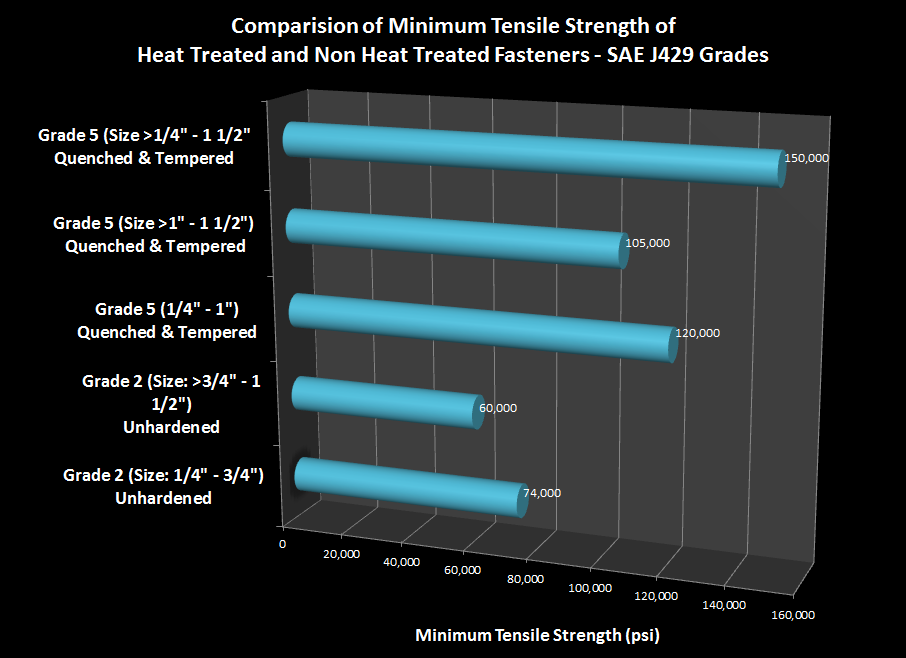
When tensile, shear or combination loads place a demand on bolted joints, heat treatment is a crucial step in the manufacturing of the high-strength fasteners often required to withstand the pressure.
“About 90 percent of fasteners are steel based and the required strength level is usually developed in steel fasteners using quenching and tempering processes.” ~ IEEE GlobalSpec
The authors of this week’s Technical Tuesday describe the standard industrial applications that call for heat-treated bolts or fasteners, environmental considerations that factor into determining heat treatment processes, the types of heat treatment according to the grade of steel, and more.
Comparison of minimum tensile strengths of heat treated and unhardened SAE J429 grade fasteners. Source: Bayou City Bolts
An advanced ship manufacturer recently announced today it has acquired a technology leader in developing and deploying non-destructive, portable probe devices that measure aluminum sensitization.
Craig Perciavalle, president of Austal USA
ElectraWatch, Inc., a privately-held company headquartered in Charlottesville, Virginia, was purchased by Mobile, Alabama-based Austal USA. The acquisition extends Austal USA’s ability to support the U.S. Navy fleet where nearly every ship includes aluminum structures.
“The combination of ElectraWatch patented technology along with Austal USA’s advanced ship manufacturing and sustainment expertise reinforces the company’s position as an industry leader to efficiently support the aggressive shipbuilding and sustainment requirements from our U.S. Navy customer,” said Craig Perciavalle, president of Austal USA. “As innovative technology reaches deeper into shipbuilding construction and sustainment, we remain laser focused at providing cost-effective solutions to our customers.”
Utilizing an electrochemical methodology, ElectraWatch engineers replicated laboratory testing measurements within a portable DoS Probe that yields a fast, accurate, measured result without removing test samples from a ship and sending to a laboratory. The company supports multiple shipbuilders, maintenance providers and the U.S. Navy across a broad range of military ships currently deployed in the U.S. fleet.
As both the designer and prime contractor, Austal USA manufactures the Independence-variant Littoral Combat Ship (LCS) and Expeditionary Fast Transport (EPF) for the U.S. Navy. The company delivers two LCS and two EPF per year with the capacity to increase its manufacturing rate at its 166-acre facility and headquarters in Mobile. Eight LCS (even numbered LCS 2 through 16) and nine EPFs (T-EPF 1-9) have been delivered to date. Austal USA was also one of five prime contractors awarded a concept design contract for the U.S. Navy’s future guided missile Frigate (FFG(X)) while its EPF is also being considered to support permanent medical ship operations.
Franz Rotter, head of the High Performance Metals Division
Since the official groundbreaking ceremony in April 2018, preparations for the construction of the world’s most advanced special steel plant in Kapfenberg, Austria, have been progressing rapidly. By awarding the contract for the electric arc furnace, the converter, and the secondary metallurgical systems—which represent the technological core of the plant—voestalpine has taken another important step in realizing the project.
The SMS group, based in Düsseldorf, Germany, will be responsible for the engineering, process technology, and start-up of the fully automated melting system, which will begin production in 2021.
“Awarding the contract for the supply of the main melting units, which represent around one-third of the total investment volume, lays the technological basis for the new special steel plant,” said Franz Rotter, member of the management board of voestalpine AG and head of the High Performance Metals Division. “The SMS group will contribute its comprehensive know-how to this project, both in the metallurgical systems and in the areas of digitalization and automation.”
In addition to the electric arc furnace, in which ultra-pure scrap and alloys are melted into liquid special steels at temperatures of up to 16232°F (9,000°C), the SMS group will also supply various after treatment systems that give the material its special properties. The units are operated with electricity from 100 percent renewable energy.”
The plant technology will set new standards worldwide in terms of digitalization. An ultra-modern sensor and electronic system enables the entire production process to be controlled from a central control station.
Vacuum furnace heat treaters know that one of the most critical parts of their system is the pump oil, but it may be a bit overwhelming trying to determine which is the right kind of oil is needed. Selecting the correct vacuum pump oil starts with knowing your pump.
“‘Oil’ is a bit of a misnomer because modern pump oil technology has evolved well beyond the original distilled petroleum products. There are now double- and triple-distilled oils available, as well as hydro-treated oils, low sulfur oils, silicone-based synthetic oils, and flushing oils used to clean the pump. Due to the wide variety of formulations available, these are often now referred to as pump ‘fluids’ rather than pump ‘oils’.” — VAC AERO International
“Different pump oil formulations are specifically designed for different pumps and different vacuum applications,” notes VAC AERO, and a key factor in learning how to select the correct pump oil is the understanding of vapor pressure, viscosity, and distillation methods, as well as solvent refining, hydrotreating, synthetic oil (Perfluoropolyether), flushing oil for vacuum pumps, and diffusion pump oils.
Heat TreatToday will soon be launching Heat Treat Consultants, a resource that offers the most comprehensive listing of heat treat industry consultants. An example of the type of exchange we anticipate will result from this resource is provided below. Click the link above for a sneak peek at our inaugural list of consultants and more information about contacting one of the experts listed.
[spacer color=”848484″ icon=”Select a Icon”]
Mike Dascoli, general manager of County Heat Treat in Millbury, Massachusetts, asked our publisher, Doug Glenn, about a product the company had used previously, “an alumina oxide powder to coat graphite fixturing plates . . . in our vacuum furnaces to stop off against braze alloy run off and eutectic melting.” Doug queried whether it was aluminum brazing or more conventional brazing of stainless or other metals and Mike specified, “No aluminum brazing . . . used to be gold/nickel, silver alloys. Here at County, I am just looking to introduce some options. I remember we would mix the powder with the acetone and paint it on the carbon plates. Acetone evaporated quick and the powder was left behind. For us now, it’s more about a layer against eutectics when heat treating.”
Dan Kay, Kay & Associates Brazing Consulting &Training Services
Doug brought in one of Heat Treat Today‘s consultants, Dan Kay of Kay & Associates Brazing Consulting & Training Services, to assist in hunting down the answer to Mike’s question.
Dan Kay:
Hi Mike —
Yes, there are a number of brazing filler metal (BFM) manufacturers who also produce and supply brazing stop-off materials that can be painted onto graphite surfaces such as you mention in your note to Doug Glenn. Here are just a few: Surface Flow Technologies (Div. of LSN Diffusion Int’l) in Michigan, Wall Colmonoy Corp in Michigan, Vitta Corp in Connecticut, and Wesgo Metals (Div. of Morgan Advanced Materials) in California are some of the primary ones.
Stop-off materials come in different colors, the coloring of them being merely to identify its manufacturer, since all stop-off materials use metallic oxide materials to create their “stop-off” capabilities, and all these oxide powders are essentially white, to begin with. Thus, to differentiate the various stop-offs they began to color them so that people would learn to associate green stop-off with company A, pink stop-off with company B, red stop-off with company C, etc.
White stop-off products are essentially the weakest of all the colored stop-offs out there and are primarily aluminum-oxide products in a paint-like consistency. The binders/gels used to make the stop-offs vary considerably from manufacturer to manufacturer are proprietary, and you’ll not get any of them to actually tell you about all the ingredients in them. People are often surprised to hear that a product such as Phillips Milk of Magnesia, available in lots of stores or pharmacies, is actually a decent stop off (magnesium oxide) for a number of applications.
But you are correct to say that you can make your own in many different ways by merely mixing some aluminum-oxide powder, or titanium-oxide powder, etc., in with a variety of quick-drying solvents, perhaps also with a thin acrylic type cement to give it adherence, paint it onto graphite surfaces, and after evaporation you would be left with an adherent layer of that protective oxide barrier, so that it prevents direct contact of a metal (especially any iron-containing metals) with the graphite, since an iron-carbon reaction is to be avoided.
I’d be happy to assist you further with this, if you have additional questions, since I’ve had much direct manufacturing experience over my 45+years in the brazing world, a lot of it involved in making BFMs, brazing stop-offs and cements, etc., and am pretty much aware of the companies today who make and supply such materials.
On my website at http://www.kaybrazing.com, you will see a tab on the homepage that shows “Brazing Suppliers”. By clicking on that tab you can see a listing of the different companies who produce these materials, and in that tabular section the name of each company (such as those I mentioned above) is a hotlink that will bring you directly to that company’s website so that you can search it for a specific type of product that you might desire. It part’s of the service that I want to provide to users of my website. I hope you will find it useful.
Let me know how I can help you further.
Best regards,
Dan
Daniel Kay
Kay & Associates
Brazing Consulting &Training Services
4 Lawton Drive
Simsbury, CT 06070
Phone: 860-651-5595
Heat Treat Consultants is a unique opportunity for personnel in the field to engage some of the industry’s knowledge powerhouses with questions about equipment, processes, management, troubleshooting — just about anything having to do with heat treating. We invite you to take a look at our inaugural crew of Heat Treat Consultants by clicking on the provided links, and we would be happy to help you make any connections. Just email Doug Glenn at doug@heattreattoday.com. You can also submit any questions or comments on Heat Treat Today articles to editor@heattreattoday.com.
A global leader in fully integrated freight car systems for the heavy haul rail market has added a new, complete furnace line to meet a growing need for additional heat treatment capacity.
Amsted Rail® purchased the UBH line from AFC-Holcroft, a manufacturer of turn-key heat treating systems for multiple applications based in Wixom, Michigan. The line includes a batch style carburizing furnace, two expansion modules to increase endothermic generator gas output, a rotary hearth reheat furnace for press quenching, and a continuous integrated parts washer and temper furnace.
“The batch furnace itself has an effective load size of 72 inches by 72 inches by 56 inches with a gross load capacity of 13,000 lbs, which is considered very large for this type of equipment, but is, in fact, one of AFC-Holcroft’s standard sizes,” stated Tracy Dougherty, sales manager at AFC-Holcroft. “The ability and experience to provide equipment for reliable processing of such large loads is just one of the benefits that AFC-Holcroft is able to offer, and one more thing that sets us apart from our competitors.”
Amsted Rail is headquartered in Chicago, Illinois, and has locations spanning the globe in every significant railroad market. The equipment is scheduled to ship to a joint venture facility located in Eastern Europe in the third quarter of 2018.
A special report from Heat Treat Today publisher, Doug Glenn.
Mr. Chad Spore, John Deere, speaking on “OEM Perspective on the ThermProcess Industry”
Chad Spore, materials engineering supervisor for John Deere, addressed the assembled guests of the International ThermProcess Summit, in Buckhead, Georgia, on the first day of the event, Tuesday, July 31, 2018. The presentation, which included encouragements to other manufacturers with in-house heat treating as well as industry suppliers to continue to innovate, was received with great interest by the nearly 100 attendees at this 2nd biennial event.
Omar Nashashibi, The Franklin Partnership, spoke on “Trump’s Washington: The New Normal?”
The attendees also enjoyed an excellent presentation from Omar Nashashibi. Mr. Nashashibi, as a-politically as possible, presented an excellent perspective on the first years of the Trump Administration. Whether you like Trump or not, Mr. Nashashibi made it clear that Trump was doing something that no other president has done in quite some time — he’s fulfilling all of his campaign promises to one degree or another. It was a balanced presentation with many positives and negatives.
Dr. Amber Selking, Selking Performance Group will be speaking on “Driving Consistent Performance Excellence”
The two-day event concludes today with keynote speaker and event emcee, Dr. Amber Selking of the Selking Performance Group, giving a presentation on “Driving Consistent Performance Excellence.”
A Special Report from Heat Treat Today Publisher, Doug Glenn
Nearly 100 top level heat treat and finishing professionals have gathered in Atlanta to discuss future trends in the heat treating industry. The event kicked off last night with an opening reception at the Intercontinental Hotel in Buckhead, Georgia (see photographs at the bottom of this post). Representatives from Mexico, Europe, and the United States are present to hear what an excellent panel of speakers has to say about the future of heat treat as well as share ideas with each other. (Listen to Heat Treat Radio’s interview with heat treat consultant Thomas Wingens as he discusses future MegaTrends in the heat treat industry. Click here.)
Of note in today’s sessions is an opening keynote address by Dr. Irene Petrick from Intel Corporation on “Factories of the Future: What Does the Future Workforce Look Like?” Based on anecdotes from the attendees, the recruitment of skilled help is becoming a significant issue.
Dr. Irene Petrick, Intel Corporation, speaking on Factories of the Future: What Does the Future Workforce Look Like?The “tape rule” test has eliminated more potential employees than a drug test!
And not only recruitment but retaining good workers. Since heat treating is not considered a cutting-edge industry, it is difficult to recruit and retain. Passing a drug test is one obstacle, but one high-ranking executive suggested that there is an even more significant hurdle for new employees to pass, what he referred to as the “tape rule” test — being able to read and accurately add measurements from a tape rule. Doesn’t seem like a monumental test to pass, but according to this source, it has eliminated more candidates from employment than the drug test. There’s something to be said for listening in 3rd- and 4th-grade math class when the concept of common denominators is taught.
Another industry consultant commented on the increased demand for experienced and knowledgeable individuals to advise when it comes to owning and operating heat treat equipment. The need for hands-on training as well process education is widespread as a vast amount of knowledge is leaving the industry through retirement. Fortunately, for this consultant, business is very good due to this fact. More companies are needing his services.
To help locate a qualified heat treat consultant, Heat Treat Today has launched a new Heat Treat Consultants resource. The “official” launch will be in a few weeks, but you can get a sneak peak by clicking here.
Todd Grimm, T.A. Grimm & Associates speaking on Trends in Additive Manufacturing
Additive manufacturing will also be one of the topics covered today by Todd Grimm of T.A. Grimm & Associates. As one of the more disruptive manufacturing technologies in the last decade, additive manufacturing is a topic often covered within the webpages of Heat Treat Today. For a glimpse at some of the articles published in the recent past, click here.
For a complete list of ITPS presentations, click here.