

Heat Treat Industry Supplier News

Heat Treat Radio #10: John Vanas on SX Oil Lifters

Welcome to another episode of Heat Treat Radio, a periodic podcast where Heat Treat Radio host, Doug Glenn, discusses cutting-edge topics with industry-leading personalities. Below, you can either listen to the podcast by clicking on the audio play button, or you can read an edited version of the transcript. To see a complete list of other Heat Treat Radio episodes, click here.


Audio: John Vanas on SX Oil Lifters

In this conversation, Heat Treat Radio host, Doug Glenn, tours Euclid Heat Treating Company with owner John Vanas and discusses a nano-technology parts washing solution.

Click the play button below to listen.


Transcript: John Vanas on SX Oil Lifters

The following transcript has been edited for your reading enjoyment.

If you’re a manufacturer and you use parts washers to remove oil residue from metal parts as part of your manufacturing process, or if you’re a commercial heat treater who washes parts, today’s Heat Treat Radio episode should be especially interesting to you. Why? If you thought there was nothing new in the parts washing arena, you’ll be shocked at what you’ll learn today. Let me whet your appetite. What if I told you there is a parts washing additive out there where you only had to add .3 ounces — that’s right, .3 ounces — to every gallon of wash water? And what if I told you that you could run that solution for 3 to 4 months without adding any chemicals? And what would you say if I told you that the oil skimmed off of your wash bath would have a lower water content than anything that you’re currently using? And what would you say if I told you your maintenance team would never have to check the concentrations of your wash water again? Not enough? Okay, let me give you one more. What if I told you that when you were done with the bath, you could just dump it down the drain?
Sounds too good to be true, right? Well, buckle up, because Heat Treat Today is going to take you where no heat treat washing system has ever gone before.

For today’s episode of Heat Treat Radio, your host, that’s me, Doug Glenn (I’m also the publisher of Heat Treat Today, which you can find on the web at www.heattreattoday.com), took a road trip to Euclid, Ohio, to visit with a current user of the wonder wash additive I just described to you. It was a rainy day, so any raindrop noises you hear are, in fact, raindrops.

John Vanas (JV): This is our rotary retort building.

Doug Glenn (DG): Ok, great.

JV: And this is Euclid Heat Treating Company. I am John Vanas. It was established in 1946 by my father. So we have been around for 72 years.

DG: 72?

JV: 72 years. I have been here 46 years.

DG: And it is a family business, right?

JV: Yes, a family business. I have got three kids working here and we are probably the most diverse commercial heat treater in this area. We do a lot of different things: induction, rotary retort, batch, pit, nitriding, ferritic nitrocarburizing, and intensive quenching. We have got quite a bit of different processes that we do.

John and I are on a walking tour of his six-building commercial heat treat complex just northeast of Cleveland, Ohio. As he mentioned, Euclid Heat Treat Company is no fly-by-night establishment. John’s dad started the business and has passed it down to John who is well on his way to passing it on to his kids. Before we jump into the specifics of the “wonder wash” additive, which by the way, is not the name of the product — it is called SX Oil Lifter — but before we jump into the specifics of that additive, here is a bit more about the family business.

DG: So you got it from your dad?

JV: Yes.

DG: Roughly, when?

JV: Actually he passed in 1991. I have been running it since 1974. We had a general manager who ran the plant and he passed away, so they threw it to me. I was here for two years and my dad said, “It’s your baby. I am going to Florida.” So, that’s alright.

DG: And you have three kids?

John Vanas’ children: Deidre, John, and Claudine

JV: Three kids.

DG: Which are Deidre, John ….

JV: ….. and Claudine. They work here. John runs production, Deidre is going to be the General Manager, pretty much, and Claudine does the finance work. And I just try to keep everybody in line.

The Plant Floor: Where the Magic Happens

John and I were standing at the entrance of his rotary retort building, as I mentioned, one of the six buildings, located just off of 222nd Street in Euclid. As we were working our way to washer end of one of his rotary retort furnace lines, John explained the markets he serves with these furnaces.

JV: Two rotaries we’ve got an AGF 139 and an 1814, so this is a large retort that quenches into polymer and this one quenches into oil and goes right through the wash and out the other end to the finished product. Not too many people do rotary work anymore. There are a few of us around, but the beauty of this is the parts tumble and they get even case all over where with a belt furnace they mask each other by laying on each other, so it’s a good technology. Kind of a niche market for us.

DG: So it’s primarily fasteners?

JV: Fasteners, little stampings, just a little bit of everything. You can see here these are actually plugs for automobile and truck oil pans. We do a ton of these things. There’s a little stamping here that we’re running. You name it, if you have to have even case hardness we can do it in these two furnaces.

We then moved our way to the discharge shoot at the back end of the first rotary retort furnace where parts fell into an oil quench and then on into a spray washer. John wanted me to see that the oil being pulled out of the washing solution was almost 100% pure oil; very little, if any water. Here’s how John tells it:

JV: So we load through the retort into the oil quench then into a wash. This is a spray washer. Then we’ve got one of these hula hoop type tooth skimmers that skim the oil off into this drum. If you can see that; that’s almost pure oil. This is the XS Oil Lifter in here. But that’s almost pure oil. There is no water in there.

A heat treat washer solution that minimizes waste and maximizes green

We spent a few more minutes discussing John’s rotary retort lines and the washers associated with it, including a disc skimmer and another bucket of, as John describes it, “pure oil — there’s no water in there.” The point being, there is a cost savings when you send this oil out to be processed since there is very little water in the oil.

We next walked by Euclid’s intensive quench system which is essentially an IQ furnace sitting on top of an 11,000-gallon quench tank. Euclid’s intensive quench capabilities is another unique offering for the company. 

From Skepticism to New Product Line

After leaving the intensive quench and rotary retort building, we got into the meat of our conversation as we walked in the rain between buildings. The wonder-wash additive which I mentioned, called SX Oil Lifter, I asked John to tell me a bit more about that product. 

DG: So John, one of the reasons I came over is we want to talk about this SX Oil Lifter.

JV: Yes, this is a new product that was introduced to me, and I tried it just on a whim because I didn’t think it was going to work in a small wash that we’re going to see over here in one of our other buildings. And it worked so well, I’ve got it now in six washers.

DG: Maybe before we go back into the noise of the building, it was introduced to you by whom?

JV: Actually by a friend of Bill Lohn, he’s my partner. So we decided to give it a try. I put it in a washer and it worked so well that we put it in other washers. It lasts 3 to 4 months and then you change it. You never have to add anything to it, which is the beauty of it. And it just does a great job. So after 3 to 4 months, usually you get oil in the washer and up on the walls of the washer. It just gets kind of scummy. We’ve had some people use it and not change it for 6 months. It just depends on what you’re washing and how often you’re washing.

DG: Now, Bill found out about from who?

JV: He found out about it from a friend of his that was using it for another type of washing and they had initially had developed through industrial but no one was using it for that, so we negotiated with the company to get the license to do it by industrial type of washing. So now we’re the partners and we’re really the company for the industrial side. We’re trying to introduce it to the heat treating industry because once you try it, you’re going to like it.

Nano-Invasive Technology

DG: So just to be clear on it, it’s not a washer, it’s a chemical, but it’s not a chemical-chemical. It’s very biodegradable….

JV: It’s biodegradable. You can probably drink it. When you’re done with it, you can just put it down the drain. If you have oil that you haven’t skimmed off, you can let it settle out and drain it off that way, but most people just dump it right down the drain. There is nothing biologically harmful about it. There is nothing to harm the sewer. Our people test our sewers once a month here and they have found nothing. So that’s how we dispose of it, we just dump it down the drain.

DG: You were also mentioning about the quantity that you have to put in.

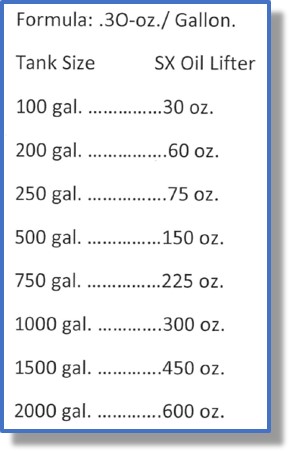
JV: Yes, it’s 3/10ths of a percent per gallon.

DG: So for a typical quench tank, what do you put in?
SX Oil Lifter Dosage Table

JV: Well this quench tank here has 750 gallons and I think we’re putting 80 ounces in there.

DG: And that 80 ounces will last you for 3 to 4 months, and maybe longer.

JV: Yes, then when you’re done, you dump it down the drain, clean it out and redo it.

DG: Ok, one other thing I wanted to ask. You said they call it “nano-invasive technology”?

JV: Yes, nano-invasive technology. What we found out is it does not actually dissolve in the water like your Tide or some other detergent or Simple Green. So, it’s in there and it’s lifting the oil, but it’s not dissolved in there, so when you’re dumping the fluid, you’re not dumping a dissolved chemical. And the fact that it is not dissolved, you don’t pull off that chemical you don’t have to add. You add water through your float valve, but you won’t add more product. The water evaporates, the product does not.

Seeing the Wonder Wash in Action

From there we went into the big batch building where three Super Allcases (a product of Surface Combustion) were located along with an older Lindberg IQ and a number of temper furnaces.

John showed me a batch wash that had just had the fluid changed the weekend prior, after 3 to 4 months of use. According to John, they probably could have gone longer, but that is the interval his maintenance team established to clean and change out the washing fluid. All the maintenance team did was wash down the inside of the washer and remove all the oil residue, skim off the oil from the top of the bath, and then dump the wash fluid down the drain. That’s it.

From the big batch building, we moved on to induction building.

JV: We have different stations and different power sources. We probably have about a dozen power sources and probably 40 different stations for doing different things. We’ve got a bolt machine there that he’s working on. We have a rotating machine there for different gears. We do a little bit of everything in here. We’ve got it crammed into the building pretty good. We just had this mezzanine put in and put the power sources up on top.

John’s father started the induction division. It was one of his special interests. John indicated that Euclid does a lot of work with local induction genius, as John describes him, Bill Stuehr of Induction Tooling out of North Royalton, Ohio, not far from Euclid.

The last building we entered was the vacuum and pit building.

JV: Here we have our vacuum equipment, our pit furnace, and our little batch furnace.

This building had about a dozen different vacuum and pit furnaces. After hitting this last building, we went back to talking a bit more about SX Oil Lifter and especially on the cost savings.

Pouring Savings into the Tank Instead of Down the Drain

DG: I assume there are cost savings here, right?

JV: Yes, it’s going to be about a third of what most people are using, from what we can determine. At least from what we used to use. We used to use a product from one of our oil suppliers and it would kinda make a funny-looking emulsion on the surface. And when we skimmed it off, we’d have to put it in the tank, let it settle out, drain it off until we got down to the oil and take the oil out. But we found out that we were getting a pretty good percentage of water in the oil when we sent it to the recycler. So he would charge us for getting the water out.

DG: So when you changed over the oil lifter, you didn’t have any problem with your current equipment that you used to separate the oil out I assume, right? There was no adverse effect?

JV: No, it was the same skimmer we always used, but it was just much more efficient.

DG: And you’re getting much better purity?

JV: Yes, we’re pretty much getting all oil in the tanks from the skimmers instead of an all water mixture.

When we walked back outside and headed back to John’s office, I asked him to repeat the cost savings information.

JV: It looks like from what we’ve seen from what our products we used to use, it’s going to be about a third.

DG: So you’re saving two-thirds?

JV: Yes. Plus, again, the beauty is, you don’t have to add all the time. You don’t have to have somebody coming in titrating. You can’t titrate this stuff. You can’t figure out what the percentage is because it’s such a small percentage, it doesn’t show up. We’ve tried several different methods to try to determine if we’ve got the right mix still in the tank, but we’ve come to the conclusion that you can’t. So, you put it in, you use it for 4 months or 3 months. When it starts to get to the point where perhaps it’s not cleaning the oil off well enough, you dump it and refill it.

DG: And you judge that not by taking any chemical composition of the solution, you just watch the parts, and if you’re seeing oil residue, it’s time to change.

JV: Exactly. And that kinda flies in the face of someone with technical knowledge, but that’s the way it works. You can tell if you’re washing off quench oil, if you start getting a smokey temper load, obviously you’ve got too much oil in there.

Once we got back to John’s office, I pressed him even more on the cost savings.

JV: We know the product we were using before was pretty expensive and I’ve talked to people who have tried and it and they said we’re putting a 55-gallon drum a month into our washer of the product we’re using now. And I said, well you won’t be doing that with SX Oil and I know that stuff is pretty expensive.

We further quantified the savings by talking about the money saved on oil processing because of less or no water in the oil being processed, plus the time savings of not having to test concentration levels of the wash. John had more to say about the time savings.

JV: Just talking to some other people who have tried the product, they said we’re going to save a lot of money because we have a guy who has to titrate it, has to add to it, and we don’t have to do that anymore.

DG: And they’re paying for that, I assume. They’re paying for that service or they’re paying one of their employees.

JV: Usually one of their employees. But it’s time-consuming and it’s a lab situation and titration. And with this, you don’t have to do anything.

I asked him if he had ever run into any problems with the product. He said that one customer called complaining the parts washed in the product were rusting faster than normal. After John and his fellow user discussed it for a while, they concluded that the product was doing such a good job of removing the oil from the surface, that it was more prone to rusting. What was the solution? John is working on adding a rust preventative to the product to help minimize the issue.

If it sounds too good to be true, it’s not. Here’s a brand new product. In fact, a brand new nanotechnology product, that

  • requires only .3 ounces per gallon of water,
  • lasts for 3-4 months minimum depending on your workload and oiliness of your products,
  • results in an almost pure oil skimming which minimizes oil reprocessing fees,
  • frees up your maintenance team to do other things besides worry about the washer,
  • and best of all, when you’re done, dump it down the drain.

If you’d like more information about SX Oil Lifter, please visit our website www.heattreattoday.com and search for SX Oil Lifter. We’ll have a full article about the product on the website along with a link to the product’s website. You can also email me directly if you’d like to get in touch with John Vanas at Euclid Heat Treat in Euclid, Ohio. My email address is doug@heattreattoday.com.

If you’d like more Heat Treat Radio, including our series on metallurgical poster children where we interview young, new metallurgical minds, please visit our website www.heattreattoday.com and click on Heat Treat Radio. Visit the website frequently. We post at least one heat treat news or technology item every weekday. Our content is targeted at manufacturers with in-house heat treat departments, especially in the aerospace, automotive, medical and energy sectors. Again, visit us at www.heattreattoday.com.

And finally, if you have a specific topic you’d like to see covered on Heat Treat Radio, please contact me directly at doug@heattreattoday.com.

Heat Treat Radio podcasts are the sole property of Heat Treat Today and cannot be reproduced without permission and appropriate attribution. This episode of Heat Treat Radio was produced and mixed by Jonathan Condon, Butler, Pennsylvania.

My name is Doug Glenn. Thanks for joining us.

To receive a copy of Euclid’s Safety Data Worksheet for SX Oil Lifter, contact Doug Glenn at doug@heattreattoday.com.

Doug Glenn, Publisher, Heat Treat Today
Doug Glenn, Heat Treat Today publisher and Heat Treat Radio host.

To find other Heat Treat Radio episodes, go to www.heattreattoday.com/radio and look in the list of Heat Treat Radio episodes listed.

Heat Treat Radio #10: John Vanas on SX Oil Lifters Read More »

Extrusion Equipment Supplier Expands Capacity, Increases Flow


Source: Light Metal Age


A company that supplies equipment for the aluminum extrusion industry recently announced a 50% expansion at its Belding, Michigan, manufacturing facility that will provide increased capacity.

According to Light Metal Age, Granco Clark’s marketing manager, Scott M. Biggs, sees the expansion as “the logical solution” to the challenge of limited flow and floor space.

“Recently, with the surge in demand of aluminum extrusions, and therefore extrusion equipment, we saw a need to make a change to improve our capabilities and capacity.” — Scott Biggs


Read more: “Granco Clark to Expand Its Manufacturing Capacity”

Extrusion Equipment Supplier Expands Capacity, Increases Flow Read More »

Heat Treat Equipment Manufacturer’s Expansion to UK a Return to Its Roots

A leading manufacturer of industrial heating equipment based in Hamilton, New Jersey, recently announced the opening of its United Kingdom facility in Birmingham, England, a move which hints of a return to the company’s roots.

Hotfoil-EHS expands into the UK.

The new Hotfoil-EHS facility in Birmingham will provide the UK with a local inventory of power consoles, recorders, ceramic heaters, and a full line of accessories used for heat treatment. Hotfoil-EHS UK will also supply hopper heaters, tank heaters, vessel heaters as well as control systems.

“The opening of our UK facility signals a homecoming of sorts, since our original company, Hotfoil, was founded in the mid-1960s in England,” said Hotfoil-EHS President, Matt Richards. “The Birmingham location makes perfect sense for Hotfoil-EHS. After several ownership changes, my father, Neville Richards, took ownership in 1993. Since then, we have grown through key acquisition and new product development. This move also is the first step in our aggressive strategy to expand into the international market.”

“The opportunity to introduce such a high-quality product line to the UK is wonderfully exciting,” said David Robbins, UK General Manager. “I am delighted to be working with such a well established US company and progressive management team.”

Hotfoil-EHS has two additional manufacturing operations in Laporte, Texas, and Chattanooga, Tennessee.


Heat Treat Equipment Manufacturer’s Expansion to UK a Return to Its Roots Read More »

End User Insights: Presentations & Panels

Actions and initiatives implemented by OEMs have a significant impact on supplier operations. ITPS/IFCS will feature OEM presentations and panel discussions in both the general session and breakouts to give participants a glimpse into the OEM perspective on manufacturing today and tomorrow.

General Session: OEM Manufacturing Perspective

Susanne Lauda, AGCO
Brian Westfall, Trane

Susanne Lauda, AGCO, and Brian Westfall, Trane

As one of the drivers behind AGCO’s global initiatives for Manufacturing 4.0, Susanne will discuss the agricultural equipment market and the organization’s “Design Anywhere Build Anywhere” strategy.

With more than three decades in product engineering and management, production operations, and leading four plant start-ups, Brian is well positioned to share insights relating to manufacturing and market trends in the commercial HVAC industry.

ThermProcess Breakout: OEM Perspective on the ThermProcess Industry

Chad Spore, John Deere

Chad Spore, John Deere

With over 20 years of experience, Chad has developed extensive knowledge of material and thermal processes used in agricultural and construction equipment applications. He has provided manufacturing and materials engineering support for various thermal processes, including heat treatment, sintering, coating, laser, and welding processes and will speak to thermprocess trends from John Deere’s perspective.

Finishing & Coatings Breakout: OEM Perspective on the Finishing Industry

Anteneh Kebbede, GE Global Research; Chris Misorski, Mercury Marine; Mark Prehar, AGCO

Experts from the aerospace, marine and agriculture industries will share insights on the finishing industry from their perspective including trends, quality/performance requirements, manufacturing technologies, purchasing processes, and more. A moderated discussion will conclude this informative session.

Hotel Discount Rate Deadline

ITPS/IFCS will be held at the InterContinental Hotel Buckhead. A discount rate of $189 is available for attendees. The deadline to take advantage of our group rate is July 11. Click here to book your room today. For complete Summit information, including hotel reservations and to register, visit www.itps-ifcs.com. Call 941-373-1830 with questions.

[button link=”www.itps-ifcs.com” size=”default” icon=”Select a Icon” side=”right” target=”blank” color=”b70900″ textcolor=”ffffff”]Register Now[/button] Save 25% with discount code ED25C.

Heat Treat Today is proud to be a co-sponsor of this event.

End User Insights: Presentations & Panels Read More »

Recognizing Young Heat Treat Talent — HTT’s 40 Under 40

Doug Glenn, Publisher, Heat Treat Today


Special Message from Heat Treat Today Publisher, Doug Glenn

Finding and retaining young talent is one of the most difficult challenges for nearly all manufacturers with in-house heat treat operations. It is also a major challenge for commercial heat treat shops and heat treat equipment and component suppliers. Beyond the initial difficulty of finding someone who can pass a drug test (!), there is the more persistent problem of finding and retaining good engineering and business minds.

When you do find that talent, it’s important to recognize it and reward it.

To help you recognize and reward the young talent in your organization — or, if you’re a supplier to the industry, in your customer’s organization — Heat Treat Today is officially opening nominations for 40 Under 40 the Class of 2018. This inaugural class will be comprised of 40 individuals UNDER THE AGE OF 40 who are significant contributors to the heat treat industry. We’ll give them widespread exposure through our website, our social media platforms, and through a special print edition later this year.

Nominations open today (7/9/18) and close on August 15th.

It is super quick and easy to nominate someone. Simply click on the “Nominate Now!” button to the right. Each nomination should take no more than 5 minutes to complete and it will be sincerely appreciated. If you’d like to read more about 40 Under 40, click on the 40 Under 40 logo above and you’ll be taken to a page with more details.

Don’t miss this great opportunity to recognize the young heat treat talent in your organization. Nominate someone today!

If you have any questions, please contact me directly by email (click here).


Recognizing Young Heat Treat Talent — HTT’s 40 Under 40 Read More »

15 Quick Heat Treat News Items to Keep You Current

15 Quick Heat Treat News Items to Keep You Current

Heat Treat Today offers News Chatter, a feature highlighting representative moves, transactions, and kudos from around the industry.

Personnel & Company Chatter

  • Professor Chris Sutcliffe, Director of Research and Development (R&D) at Renishaw‘s Additive Manufacturing Products Division (AMPD), was awarded a prestigious Silver Medal from the Royal Academy of Engineering (RAE), recognizing his role in driving the development of metal 3D printed implants for use in human and veterinary surgery and celebrating his successful commercialization of additive manufacturing products as part of his work with Renishaw, the University of Liverpool, Stryker Orthopaedics and Fusion Implants Ltd.
  • Michael Handscombe joins UK-based Phoenix Temperature Measurement as National and International Sales Manager to support PhoenixTM temperature monitoring solutions used in industrial heat treatment and furnace surveying and other industries.
  • One of five new vacuum furnaces, with an all-metal hotzone and 15 bar Argon quenching with an 8,000lb capacity, have been delivered to the Cleveland division of Paulo and will be ready for production late July. This represents the first step of a larger expansion that includes a new building.
  • Two large heat-treating furnaces were recently rebuilt and upgraded at Metlab, a heat treatment and surface enhancement company located in Wyndmoor, Pennsylvania. The furnaces, designated P-1 and P-2, are believed to be the largest atmosphere-controlled pit furnaces in North America and are used to neutral harden, carburize and harden, nitride, anneal, and stress relieve large components or multiple quantities of parts.
  • A 20-foot long car bottom air furnace capable of handling a workload up to 30,000 lbs will be installed at Solar Atmospheres of Western PA during July 2018 and surveyed in accordance with AMS2750. With a maximum operating temperature of 1400°F, this furnace will accommodate not only the tempering of large tool steel components but also age hardening of 15-5 PH, 17-4 PH, and nickel-based alloys. Although Solar is typically known as a “vacuum only” heat treater, the company notes the need for heat treating non-finished parts and materials in accordance with the same specifications (AMS, MIL, Boeing and Airbus) within different atmospheres where surface oxidation is permissible.
  • Robrecht Himpe retired from his position as CEO of ArcelorMittal North America and CEO of AM/NS Calvert on July 1, as well as his duties with ArcelorMittal’s executive management team. He has been with the group for 37 years and will be succeeded as ArcelorMittal North America CEO by Brad Davey, who has been serving as chief marketing officer of ArcelorMittal North America and head of global automotive.
  • Team, Inc., an industrial services company based in Houston, Texas, recently announced that Arthur F. Victorson, President of the Inspection and Heat Treating segment, will retire from the company on September 30, 2018. In connection with his retirement, Mr. Victorson will transition from his current role, effective July 15, 2018, and serve as a special advisor to Amerino Gatti, Team’s Chief Executive Officer, to ensure a seamless transition. Team anticipates naming a successor to Mr. Victorson in the near future.
  • A partnership has been formed between Plibrico, based in Northbrook, Illinois, and Upstate Refractory Services, headquartered in Newark, New York.
  • John Hynes has been promoted at Paulo to Director of Information Systems from his previous role as Manager of Information Technology.  John has been with Paulo for just over one year, strengthening the company’s IT position.

Equipment Chatter

  • A natural gas-fired, enhanced-duty, walk-in oven was recently shipped to the technology industry by Wisconsin Oven Corporation for use in post-curing refractory material. With a maximum operating temperature of 300°F, the oven was designed with the capacity to heat 8,000 pounds of steel and 4,000 pounds of refractory material from 70° to 150° F within 180 minutes.
  • A 1400°F electric, inert atmosphere tempering furnace from Grieve Corporation, No. 885, is currently being used for heat treating weldments at a customer’s facility.  
  • An India-based conglomerate recently commissioned an aluminum automotive casting heat treatment system from CAN-ENG Furnaces International Limited for its new greenfield North American expansion in South Carolina.

Kudos Chatter

  • The F-35 Joint Program Office of The Pentagon and Lockheed Martin delivered the 300th production F-35 aircraft, a US Air Force F-35A, to be delivered to Hill Air Force Base, Utah. “The F-35 weapons system is a key enabler of our National Defense Strategy and is providing our warfighters the combat-proven, advanced capabilities they need to meet mission requirements,” said Vice Admiral Mat Winter, program executive officer for the F-35 Joint Program Office. The first 300 F-35s include 197 F-35A conventional takeoff and landing (CTOL) variants, 75 F-35B short takeoff/vertical landing (STOVL) variants, and 28 F-35C carrier variants (CV) and have been delivered to U.S. and international customers. More than 620 pilots and 5,600 maintainers have been trained, and the F-35 fleet has surpassed more than 140,000 cumulative flight hours.
  • The first Future Aluminum Forum was held on 8th & 9th May 2018 in Milan, Italy, with more than 150 delegates from across the aluminum manufacturing and processing industries gathering to hear from technical experts and uncover the myths behind Industry 4.0 and what this means for the manufacturing value chain. An Advisory Board was established to develop a strategic approach towards integrating Industry 4.0 across the aluminum manufacturing and processing sectors.
  • A center for aerospace air management systems, Liebherr-Aerospace Toulouse SAS, in Toulouse, France, recently obtained accreditation from the National Aerospace and Defense Contractors Accreditation Program (NADCAP) for its materials testing laboratory. This accreditation follows an audit conducted in early March 2018 by the Performance Review Institute (PRI), which focused on both the overall quality system of the laboratory and the practice of static and dynamic mechanical tests.


Heat Treat Today celebrates with our heat treatment industry partners by highlighting their accomplishments and announcements here on our News Chatter page. Please send any information you feel may be of interest to manufacturers with in-house heat treat departments especially in the aerospace, automotive, medical, and energy sectors to the editor at editor@heattreattoday.com.

15 Quick Heat Treat News Items to Keep You Current Read More »

Cybersecurity and an Unpredictable Economy: Two Issues You Cannot Afford to Ignore

Is your company positioned to defend a cyber-attack? How about a sudden economic downturn? If the answer to either of these questions is no, ITPS/IFCS is a must-attend for you. Participants will hear directly from experts who will help business leaders successfully position their companies against these potential threats.

Cybersecurity: Keeping Your Business Secure

Shutterstock image

Chad Hunt, Supervisory Special Agent, FBI Atlanta Office

Supervisory Special Agent Hunt leads a team of agents and analysts who conduct investigations in support of the FBI’s Cyber Division mission to identify, pursue, and defeat cyber adversaries. As manufacturing becomes increasingly digitized, industrial internet hacking is of rising concern to businesses. Learn how the FBI is addressing this significant issue.

Managing in an Unpredictable Economy

Chris Kuehl

Chris Kuehl, Co-Founder & Managing Director, Armada Corporate Intelligence

As Armada’s economic analyst, Chris Kuehl has worked with a wide variety of private clients and professional associations. His presentation will focus on economic trends and their impact on manufacturers. He serves as CCAI’s and IHEA’s economist and delivers monthly updates on a variety of economic indices that impact manufacturing.


Why I’m Attending:

“The program topics are all relevant to my company, and the speakers appear to be top notch. This will also be a good opportunity for me to network with others in my industry.”

Sam Woehler, Vice President, Sales, George Koch Sons, LLC

 [spacer color=”EBF1F5″ icon=”Select a Icon”]

Hotel Discount Rate Deadline

ITPS/IFCS will be held at the InterContinental Hotel Buckhead. A discount rate of $189 is available for attendees. The deadline to take advantage of our group rate is July 11. Click here to book your room today. For complete Summit information, including hotel reservations and to register, visit
www.itps-ifcs.com. Call 941-373-1830 with questions.

[button link=”www.itps-ifcs.com” size=”default” icon=”Select a Icon” side=”right” target=”blank” color=”b70900″ textcolor=”ffffff”]Register Now[/button] Save 25% with discount code ED25C.

Heat Treat Today is proud to be a co-sponsor of this event.

Cybersecurity and an Unpredictable Economy: Two Issues You Cannot Afford to Ignore Read More »

Powder Metal Manufacturer Expands in PA

Jude Pfingstler, President of Atlas Pressed Metals

Construction is underway at a powder metal and sintered parts manufacturing plant in Dubois, Pennsylvania, which will more than double the facility’s square footage and is intended to adapt to growth with the installation of new equipment, such as larger tonnage presses.

Atlas Pressed Metals, which manufactures complex and simple structural iron, sinter-hardened steel, stainless, copper, brass, and bronze components utilizing the pressed metal (also known as sintered metal and powder metal) process, partners with heat treatment providers in supplying powder metal components for the automotive, transportation, industrial equipment, and electric motors markets.

“New equipment for the addition will enable Atlas to grow our capacity in multi-level and higher tonnage equipment,” said Jude Pfingstler, president of Atlas Pressed Metals.


Construction begins for Atlas Pressed Metals in Dubois, PA

Powder Metal Manufacturer Expands in PA Read More »

Refractories, Maritime Repair Partnership Extends Heat Treat Technology, Benefits Cruise Industry

An industry leader in monolithic refractories based in Illinois recently announced a partnership with a maritime repair specialist to deliver retrofit supplies and services to the world’s cruise ship operators, extending the reach of advanced heat treatment technology and improving the reliability of onboard boilers and incinerators.

Brad Taylor, president and CEO of Plibrico

Nordic Made Boiler Services Inc. (NMBS), headquartered in Denmark, will use Plibrico’s Plico™ brand high alumina- and alumino-silicate monolithic refractories in the retrofitting of cruise ship boilers and waste incinerators needed to ensure passenger safety and comfort.

“Partnering with Nordic Made Boiler Services enables Plibrico to help improve maritime operations the world over reducing cruise ship costs and their energy consumption,” said Brad Taylor, president and CEO of Plibrico. “Combining our refractories with NMBS’s retrofit solutions means that together we can extend the reach of our most advanced heat treatment technology.”

NMBS operates in a variety of industries in addition to the maritime market and will be the exclusive distributor for Plico materials in Norway, Sweden, Finland, Denmark, Poland, Spain, Holland, and Belgium. It will also be joining the Plibrico PliPartner™ network of certified installation and repair companies. The partnership will take full advantage of Plibrico’s high-quality aluminosilicate and high-alumina monolithic refractory materials. Demonstrating superior insulating properties, Plibrico refractories’ insulating properties facilitate the containment of heat generated by the marine boiler, minimizing heat loss and ensuring reliable hot water for ship passengers.

Photo credit: Plibrico

Refractories, Maritime Repair Partnership Extends Heat Treat Technology, Benefits Cruise Industry Read More »

Gas Density Sensor for Sintering Furnaces Introduced at POWDERMET

Dr. Liang He, Air Products

A U.K.-based industrial gases company that supplies liquefied natural gas process technology and equipment to heat treaters and companies with heat treating operations recently introduced its new gas density sensor at POWDERMET 2018, the International Conference on Powder Metallurgy & Particulate Materials, held June 17-20 in San Antonio, Texas.

Air Products announced that this novel sensor has been designed to measure hydrogen concentration in sintering furnaces that use a nitrogen-hydrogen blend as the hot zone atmosphere, aiding metals processors in improving quality control and comply with regulatory requirements. As part of the conference’s Sintering Atmosphere Control technical session, Air Products’ Dr. Liang He presented “Hot Zone Nitrogen-Hydrogen Atmosphere Monitoring with Gas Density Sensor”, which included beta test results of continuously measuring an industrial sintering furnace atmosphere composition for better production process control and consistent product quality.


Gas Density Sensor for Sintering Furnaces Introduced at POWDERMET Read More »

Skip to content