


Department of Energy

Reader Feedback: Don’t Dis the DOE

Readers are checking out Heat Treat Today’s magazine, and the April/May 2024 Sustainable Heat Treat Technologies print edition has a piece that sparked a comment from a reader. The letter from publisher Doug Glenn, entitled “The DOE IS Coming After YOUR Job“, debates the question of policy-driven market forces over economy-driven indicators.

Would you like to weigh in on the topic? Submit your question, comments, thoughts, or queries here or email Bethany Leone at editor@heattreattoday.com.


Here is an excerpt from the publisher’s page:

“On the fourth slide of a presentation entitled, ‘Cross Sector Technologies Meeting: Day 2, Nex-Generation Enabling Technologies,’ presented by Mr. Chan on May 30, 2023, we find the following: 

  • DOE Commitment to Industrial Decarbonization (slide title)
  • ‘Industrial Heat Shot — Developing technologies to reduce process heating GHG emissions by 85% by 2035′
  • ‘Industrial Decarbonization Roadmap — Net-zero CO2 emissions by 2050′

The same slide goes on to list four international organizations that the U.S. has joined to ‘decarbonize’ energy-intensive industries. Those four organizations are:

  • Net-Zero World Initiative
  • G7 Industrial Decarbonization Agenda
  • Mission Innovation’s Net-Zero Industries Mission
  • UNIDO’s coordinated Industrial Deep Decarbonization Initiative”

This publisher’s page prompted this feedback from loyal reader Jim Conybear:

“I enjoy keeping up with the industry through Heat Treat Today. I read your recent editorial, “The DOE is Coming After Your Job”. Although you make some interesting and provocative comments, I think you did a disservice to the work being done by the DOE. Without their efforts, we would be even further behind in our needed efforts to combat the wasteful use of energy. The headlines you extracted from the presentation by Isaac Chan, fourth slide . . . do not mean that there is an either/or decision on fossil fuels. They are, in fact ,very good goals to pursue if we are to continue to make progress. 

I have known Isaac Chan since his early days with the Gas Research Institute and the DOE. Never did he advocate the elimination of all combustion processes. On the other hand, he has led many industry and government programs that enabled our industry in particular to reduce costs and improve productivity by identifying and supporting more efficient, environmentally compatible processes. 

Isaac Chan is a friend to our industry, not the enemy. I would enjoy seeing an interview with him to present a more realistic assessment of the problems and potential solutions to our carbon excesses.” 

We welcome your inquiries to and feedback on Heat Treat Today articles. Submit your questions/comments to editor@heattreattoday.com.


Reader Feedback: Don’t Dis the DOE Read More »
US DOE Strategy Affects Heat Treaters

As heat treaters strive for a sustainable future, pressure mounts to make the right choices while running commercially viable operations. This guest column by Michael Mouilleseaux, general manager at Erie Steel, Ltd., explores how and why heat treat operations are now coming under the focus of the U.S. Department of Energy.

This informative piece was first released in Heat Treat Today’s March 2024 Aerospace print edition.


The iron and steel industry contributes approximately 2.1% of energy-related CO2 emissions from primary sectors in the U.S. These statistics may seem insignificant or far removed, but the federal government has now determined that heat treating is a significant contributor and has set in motion critical changes for U.S. heat treaters.

Background

Click to share your Reader Feedback!

On December 8, 2021, President Joe Biden issued an executive order that committed the federal government to “lead by example” in U.S. efforts towards carbon-free and net zero emissions solutions. Since then, the executive has delegated the Department of Energy (DOE) and the Environmental Protection Agency (EPA) to spearhead these initiatives aimed at reducing greenhouse gas emissions (GHGE) and promoting energy efficiency across various sectors of the U.S. economy. To support these efforts, $10,000,000,000 in incentives are being allocated for the DOE and EPA to investigate and promulgate regulations.

Specifically, the government sees the “industrial sector” as responsible for close to a quarter of all greenhouse gas emissions (GHGE); the five industries named within this sector are chemical processing, petroleum processing, iron & steel production, cement production, and food & beverage manufacturing. The DOE is leading the efforts of “supercharging industrial decarbonization innovation” and leveraging the potential of “clean hydrogen.”

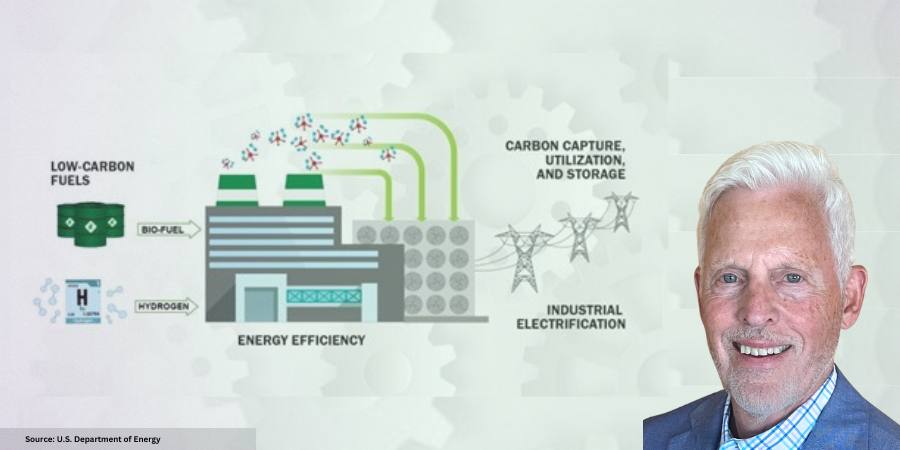
Following these directives, the DOE unveiled the “Industrial Decarbonization Roadmap” in September 2022. This strategic plan will guide decarbonization efforts of the five key industrial sectors to mitigate GHGE. The four pillars are:

  • Energy efficiency
  • Industrial electrification (using green electricity)
  • Adoption of low-carbon fuels, feedstocks, and energy sources (LCFFES)
  • Carbon capture, utilization, and storage at the generated source (CCUS)

The DOE determined that process heating — accounting for 63% of energy usage within the iron and steel industry — would be the best opportunity to apply these four pillars. However, until May 2023, heat treating had not been explicitly mentioned as a target for decarbonization efforts.

Why Should Heat Treaters Care?

In May 2023, the Industrial Efficiency & Decarbonization Office — an office within the DOE’s Office of Energy Efficiency & Renewable Energy — held a symposium to refine its commitment to the decarbonization of the industrial sector. It was then that heat treating was specifically defined as a process targeted for the reduction of GHGE in the steel, aluminum, and glass manufacturing industries.

The DOE’s refined commitment focuses on two things: reduce GHGE attributable to “process heating” by 85% by 2035 and achieve net-zero CO2 emissions by 2050. To reach these ambitious goals, the DOE emphasized the importance of adopting LCFFES, green electrification, and implementing strategies that promote industrial flexibility, advanced heat management, smart manufacturing, and alternative technologies.

The potential ramifications of the DOE’s efforts on the heat treating industry are momentous. With the development of regulations to support these efforts, businesses within this sector must prepare for significant changes. The focus on green hydrogen, biofuels, and electrification, coupled with advanced technological solutions like ultra-efficient heat exchangers, artificial intelligence, machine learning, and alternative no-heat technologies, are strategies being considered for potential regulation.

Conclusion

The heat treating industry stands at a crossroads, with the DOE’s decarbonization initiatives signaling a shift to adopt cleaner energy practices. As these regulations take shape, businesses will need to adapt, investing in new technologies and processes that align with the nation’s clean energy goals. In the next column, we’ll address potential ramifications of the DOE effort for industrial decarbonization in the heat treating industry to help you be better informed and prepared.

About the Author:

Michael Mouilleseaux
General Manager at Erie Steel, Ltd.

Michael Mouilleseaux is general manager at Erie Steel, Ltd. He has been at Erie Steel in Toledo, OH since 2006 with previous metallurgical experience at New Process Gear in Syracuse, NY, and as the director of Technology in Marketing at FPM Heat Treating LLC in Elk Grove, IL. Michael attended the stakeholder meetings at the May 2023 symposium hosted by the U.S. DOE’s Office of Energy Efficiency & Renewable Energy. He will be speaking on the MTI podcast about this subject on March 5, 2024, 2:30 EST, and will present on this topic at the April 3, 2024, MTI Mid-West chapter meeting.

For more information: Contact Michael at mmouilleseaux@erie.com.

Attend the SUMMIT to find out more about the DOE’s actions for the heat treat industry.

Find Heat Treating Products and Services When You Search on Heat Treat Buyers Guide.com

US DOE Strategy Affects Heat Treaters Read More »

Heat Treating, Metals Projects Included in DOE Program to Advance U.S. Manufacturing


The U.S. Department of Energy (DOE) recently announced the selection of 13 projects to stimulate the use of high-performance supercomputers to advance U.S. manufacturing. Heat treating research and development programs are among the finalists.

The Energy Department, in partnership with Lawrence Livermore National Laboratory, has set aside nearly $3 million in funding for the manufacturing-laboratory partnerships to assist the U.S. in bringing technologies to the market faster and gain a competitive advantage in the global economy.

Included in the list are heat treating or metals production companies with the following planned projects:

  • United Technologies Research Center – This project will develop a novel heat treatment scheme that eliminates deleterious phases from the microstructure additively manufactured aerospace components while reducing the annealing time.
  • SFP Works, LLC – This project will use computational effort to understand phase transformations that occur during the flash heat treating process in order to better control parameters to obtain the desired phase distribution and chemistry.
  • Arconic, Inc – This project will study the thermomechanics of micro-pores during the rolling process of aluminum slabs to improve yield.
  • Steel Manufacturing Simulation and Visualization Consortium – This project will create a shared database of heat exchange in 140 steel reheat furnaces whose inconsistencies lead to significant energy loss.

Selected projects will be awarded up to $300,000 in federal funding to cover the costs associated with using the supercomputers and technical expertise provided by the laboratory partners. Industry partners will provide a participant contribution of at least 20% of the DOE funding for the project.

DOE’s national laboratories have some of the most significant high performance computing (HPC) resources available, including some of the fastest supercomputers in the world. There is great potential for the U.S. manufacturing industry to use the power of HPC to solve key challenges, but many manufacturers lack access to supercomputing resources.

The High-Performance Computing for Manufacturing (HPC4Mfg) program, supported by DOE’s Advanced Manufacturing Office, unites DOE’s supercomputing capabilities and expertise with American manufacturers to optimize production processes and designs, enhance product quality, predict performance and failure, and speed up design and testing cycles while decreasing energy consumption. Manufacturer-laboratory partnerships leverage expertise in advanced modeling, simulation, and data analysis to accelerate innovation and shorten the time of adoption of new technologies in U.S. manufacturing.

The following projects were also selected for awards:

  • 3M – This project will optimize the design of emissive films on building windows for cooling via modeling of glass bead filled polymers.
  • 3M – This project will minimize energy consumption of the fiber spinning manufacturing process using computational fluid dynamics (CFD) and machine learning.
  • Alliance for Pulp & Paper Technology – This project will help create a fundamental understanding of alkali reactivity with wood components using molecular modeling.
  • GE Global Research Center – This project will extend GE Global Research Center’s TRUCHAS model to large-scale casting simulation of turbine blades.
  • KeraCel – This project will model a new plan to push energy density in Li batteries with lithium oxide garnet with the goal of lowering the required temperature to reduce porosity in sintering.
  • Seurat Technologies – This project will use the ALE3D software to optimize Seurat’s innovative laser energy flux distribution to reduce spatter during laser powder bed fusion.
  • The Dow Chemical Company – This project will model methods to reduce the thermal conductivity of Dow’s insulating foam polyurethane products while using less polymer in products.
  • Transient Plasma Systems – This project will build a comprehensive numerical model for use in understanding and optimizing key parameters in electrical pulse generation of plasmas for dilute burn combustion.
  • VAST Power Systems, Inc. – This project will optimize gas turbine combustors by developing and validating surrogate models using CFD.

Read more about the individual projects on Lawrence Livermore National Laboratory’s High-Performance Computing for Manufacturing website and at the Department of Energy’s website.

Heat Treating, Metals Projects Included in DOE Program to Advance U.S. Manufacturing Read More »

Skip to content