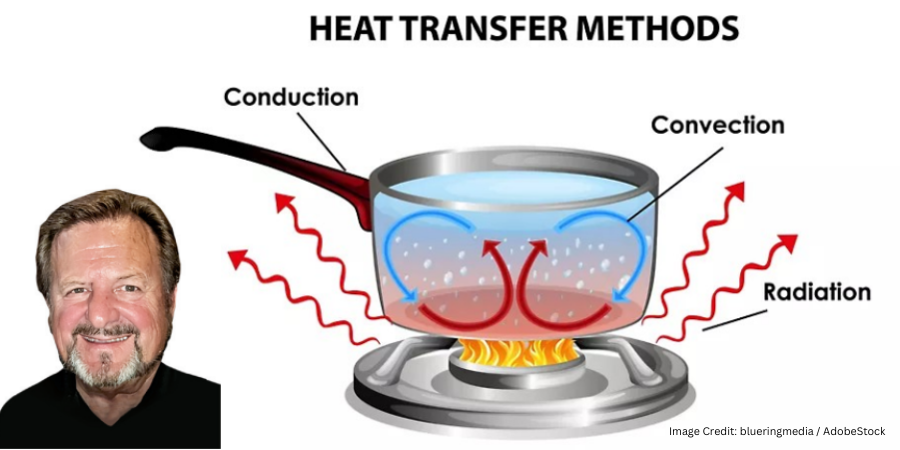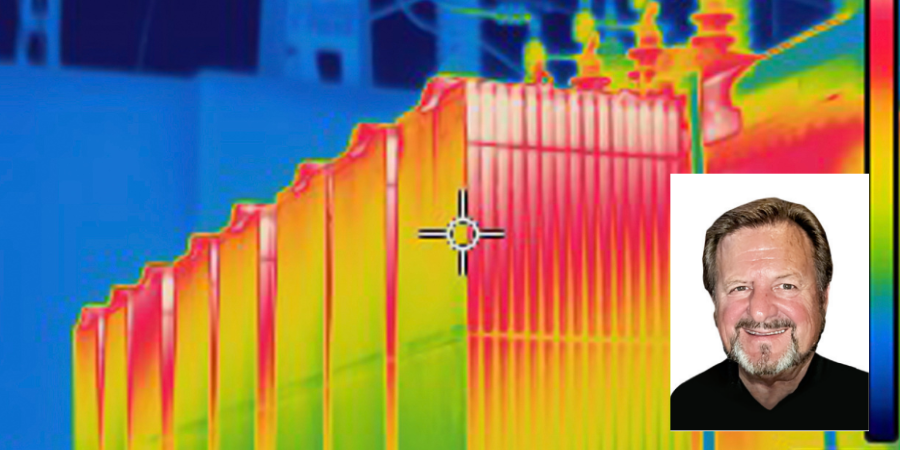
Jim Roberts of U.S. Ignition engages readers in a Combustion Corner column about the basics of heat transfer — breaking down the First Law of Thermodynamics into practical terms for heat treaters, then using a real-world example to show how ambient load temperature can meaningfully shift BTU energy requirements and furnace performance.
This column was first released in Heat Treat Today’s July 2026 Annual Super Brands Issue print edition.
A furnace guy walks into a heat treat plant and says to the group of operators, “I just transferred here.” One of the furnace operators says, “Perfect, it’s what we do best.” Huh…? Well, of course they transfer heat. That’s what heat treaters do better than anyone else — we transfer heat. And the science of this transfer is called thermodynamics.
In the world of physics, there are four laws of thermodynamics, which are centered on the movement and flow of heat between objects. We’ll start with the concept of heat transfer, based on the First Law of Thermodynamics.
The concept of thermal conservation states that energy cannot be created or destroyed; it can only be transferred or transformed. In other words, whatever we put into the furnace in the form of heat will be the same amount that comes out or is absorbed. Additionally, the part we want to heat treat has thermal mass and therefore has heat as well. We say that the load is “cold,” but really, it’s normally coming into the process at room temperature, which means there is energy there that gives us a head start in heating it up.
Then, we know that the heat we feel from the shell of the furnace was not absorbed by the load but is part of the energy that we put into the furnace, it just wasn’t absorbed by the load. So, the heat exits the furnace into the room to be absorbed by other items that are not in equilibrium. The energy is always there, continuing on. It’s a wild concept, isn’t it?
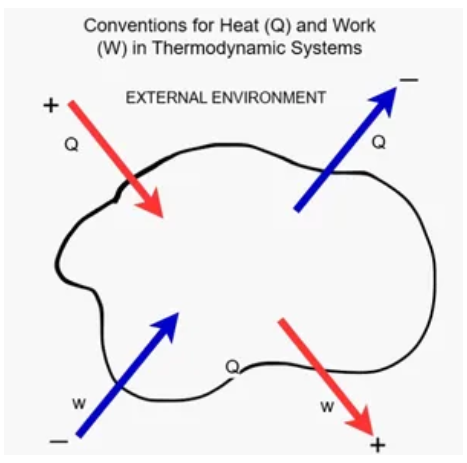
As shown in Figure 1, heat enters the furnace (designation “Q”). Heat then enters the work, which is designation “W” (e.g., load, furnace). Work absorbs most of the heat, but it also releases energy since it is starting to go towards a state of equilibrium, meaning heat in and heat released are equal. Then, the work releases energy into the area where it is not as hot and tries to heat it up and gain equilibrium. That’s the furnace guy standing there, the room, the building, etc. All of these things become the next stage of “work.”
So, when we get to the point of calculating the input (energy usage), we generally use BTU or KW ratings. We also must consider ambient temperature of the work because that Delta T, or temperature variance, is what we are having to account for. If that load is sitting at 70°F, it has value as a heat source, so we need to account for that. You will recall that the formula that is commonly used for calculating heat load is:
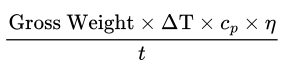
This will give you BTU requirements after you then apply an efficiency. Sometimes that’s an estimated efficiency. Let’s show the difference in that energy requirement that needs to be provided when the latent heat in the load is different.
Let’s suppose we are a heat treater in central Michigan. It’s December. We have been accustomed to staging our bulk parts for heat treating out on our open loading dock. The furnace is suddenly not performing like it did earlier in the year. It’s the same 1,000 lb load. Earlier in the year, our formula accounted for the 70°F load temperature coming in. Our equation would be:

In this example, if we bring the work in from the frozen loading dock at 20°F, the heat required jumps to 401,231 BTU energy required per hour. It’s not a lot, but the furnace will notice and not perform as well since the burners tend to run at a fixed setting.
Even slight variations can make a big difference in cost and performance. Simple and yet slightly confusing science is behind it all.
About The Author:

President
US Ignition
Jim Roberts president at U.S. Ignition, began his 45-year career in the burner and heat recovery industry focused on heat treating specifically in 1979. He worked for and helped start up WB Combustion in Hales Corners, Wisconsin. In 1985 he joined Eclipse Engineering in Rockford, IL, specializing in heat treating-related combustion equipment/burners. Inducted into the American Gas Association’s Hall of Flame for service in training gas company field managers, Jim is a former president of MTI and has contributed to countless seminars on fuel reduction and combustion-related practices.
For more information: Contact Jim Roberts at jim@usignition.com.